
- Home
- »
- Advanced Interior Materials
- »
-
Feed Mixer Market Size & Share Report, 2026-2033GVR Report cover

Feed Mixer Market (2026 - 2033)
Size, Share & Trends Analysis Report By Product Type (Vertical Feed Mixers, Horizontal Feed Mixers), By Portability (Portable, Stationary), By End Use (Farms/On-farm Feed Mixing, Feed Factories), By Region, And Segment Forecasts
Market Size, 2025
$973.3MMarket Estimate, 2026
$1,022.1MMarket Forecast, 2033
$1,469.1MCAGR, 2026–2033
5.3%Feed Mixer Market Summary
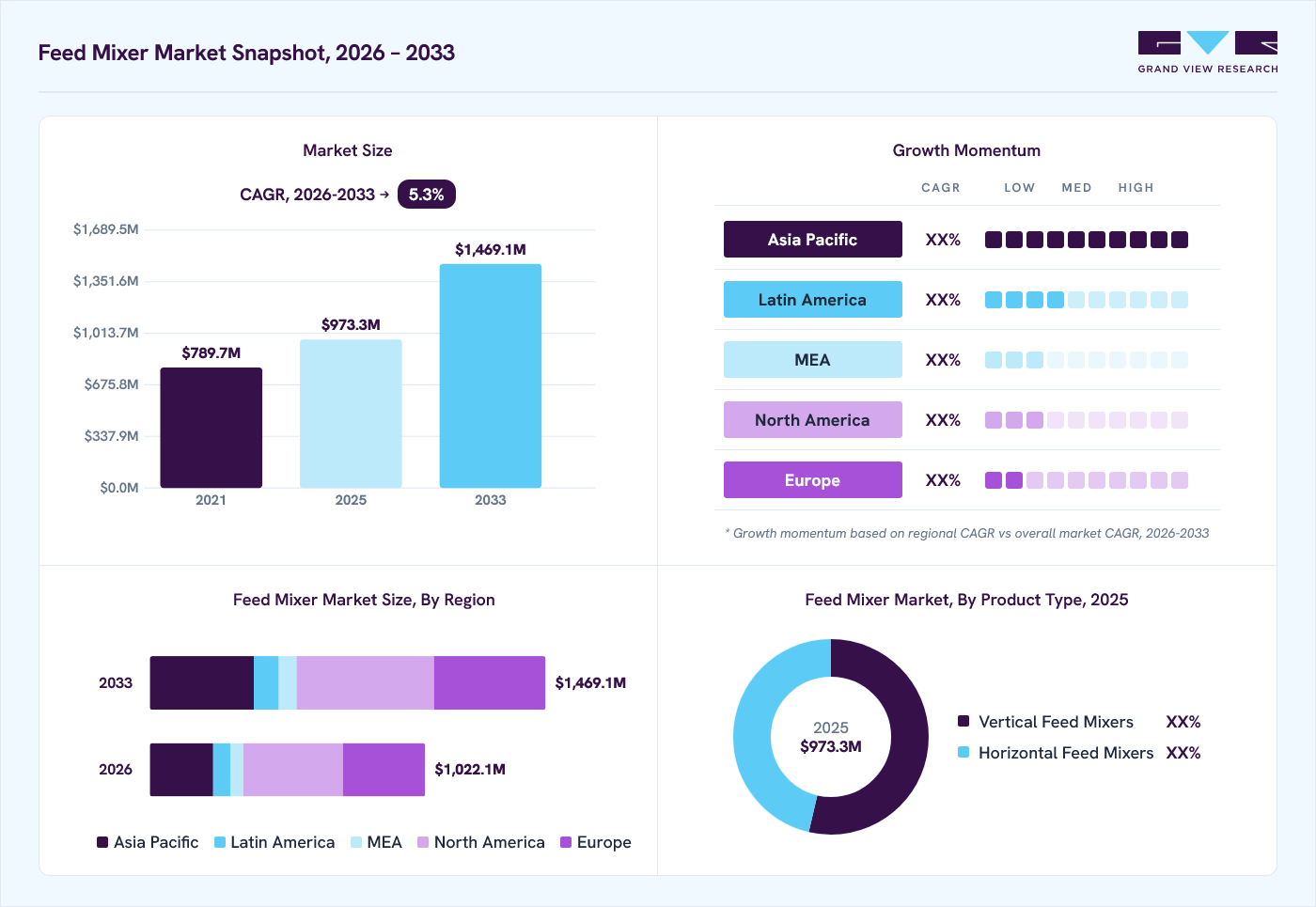
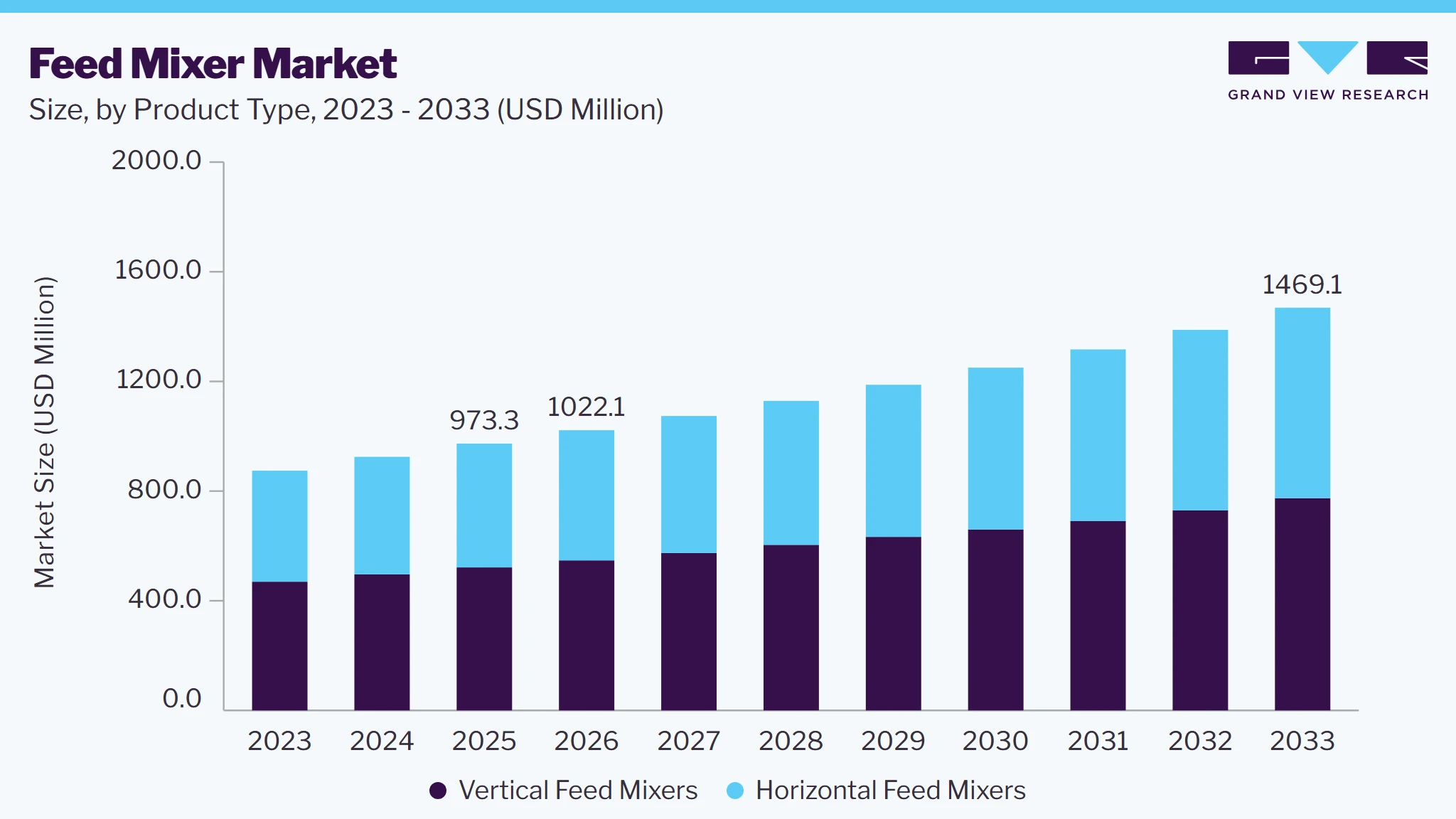
The global feed mixer market size was valued at USD 973.3 million in 2025 and is projected to grow from USD 1,022.1 million in 2026 to USD 1,469.1 million by 2033, at a CAGR of 5.3% from 2026 to 2033. North America dominated the market, accounting for the largest revenue share of 36.5% in 2025. The global feed mixer market is driven by the structural transition toward mechanized and ration-controlled livestock feeding practices across commercial dairy, beef cattle, and other intensive animal husbandry operations.
 Source: Grand View Research, IR Documents, Primary Interviews, Paid DatabasesTo learn more about this report,
 Download Free Sample Report
 Key Market Trends & Insights
- By product type: Vertical feed mixers dominated the market in 2025, accounting for 53.6% market share.
- By portability: Stationary segment is expected to record the fastest CAGR of 5.5% over the forecast period.
- By on end use: Feed factories segment is projected to grow at 4.9% CAGR during the forecast period.
Regional Highlights
- Largest regional market: North America (36.5% revenue share, 2025)
- By country: The U.S. held the largest market share in 2025.
Market Size & Forecast
- Market Size in 2025: USD 973.3 Million
- Estimated Market Size in 2026: USD 1,022.1 Million
- Projected Market Size by 2033: USD 1,469.1 Million
- CAGR (2026-2033): 5.3%
Three ways to get this report
Buy it, customize it, or ask a question.Ask an Analyst
Analyst response in 1 business day
- AccessReport author, directly
- Reply timeWithin 1 working day
- No sales callDirect answer only
- FormatEmail reply
- CostFree, no cost
Get the Full Report
What the study covers
- FormatsPDF · Excel · Dashboard
- Timeline2026–2033 annual, 2025 base
- Coverage20+ countries, 5 regions
- Companies10+ key players profiled
Customize the Report
20% free customization
- IncludeCountries, segments, points
- TailorTo your product definition
- ExtendDeeper competitor detail
- OrA fully bespoke study
- Turnaround5–10 working days
 To learn more about this report, Download Free Sample Report
 Additionally, technological refinement of feed mixer architecture is widening the addressable application base by improving dosing accuracy, mixing homogeneity, batch control, and discharge management. Contemporary systems increasingly incorporate integrated weighing mechanisms, programmable controls, load-cell technology, variable-speed drives, and automated discharge arrangements, enabling closer adherence to formulated feeding protocols and reducing inconsistencies arising from manual ingredient handling.
Market Dynamics
The global feed mixer market is shaped by the changing structure of livestock production, variations in farm economics, and the increasing scale of commercial animal husbandry. Demand is closely associated with herd concentration, labor availability, feed-cost management, and the transition toward larger production units. These structural changes are influencing equipment purchasing patterns, particularly in markets where livestock enterprises are moving from small-scale, labor-dependent operations toward commercially organized production systems.
The expansion of commercial dairy and cattle operations is increasing the requirement for equipment capable of preparing substantial feed volumes within defined feeding cycles. Growth in herd sizes raises the frequency and scale of feed preparation, making manual handling progressively less practical for larger production units. Commercial farms are consequently allocating greater capital toward dedicated mixing equipment that can accommodate recurring feed requirements without creating bottlenecks in daily feeding operations.
High equipment ownership costs remain a constraint in livestock markets characterized by small and fragmented farm structures. Producers with modest herd populations may experience insufficient equipment utilization to justify the purchase of dedicated mixing machinery, particularly when feed preparation can be performed through existing farm labor or basic equipment. Financing costs, servicing requirements, replacement components, and infrastructure requirements can further weaken the investment case.
The consolidation of livestock production is creating opportunities for manufacturers to address a customer base with higher equipment utilization and greater capital expenditure capacity. Large dairy units, feedlots, integrated livestock enterprises, and contract farming operations require equipment capable of supporting centralized and repetitive feed-preparation activities across substantial animal populations. This structural shift creates scope for higher-capacity mixers, specialized configurations, and equipment engineered for intensive operating cycles.<
Market Concentration & Characteristics
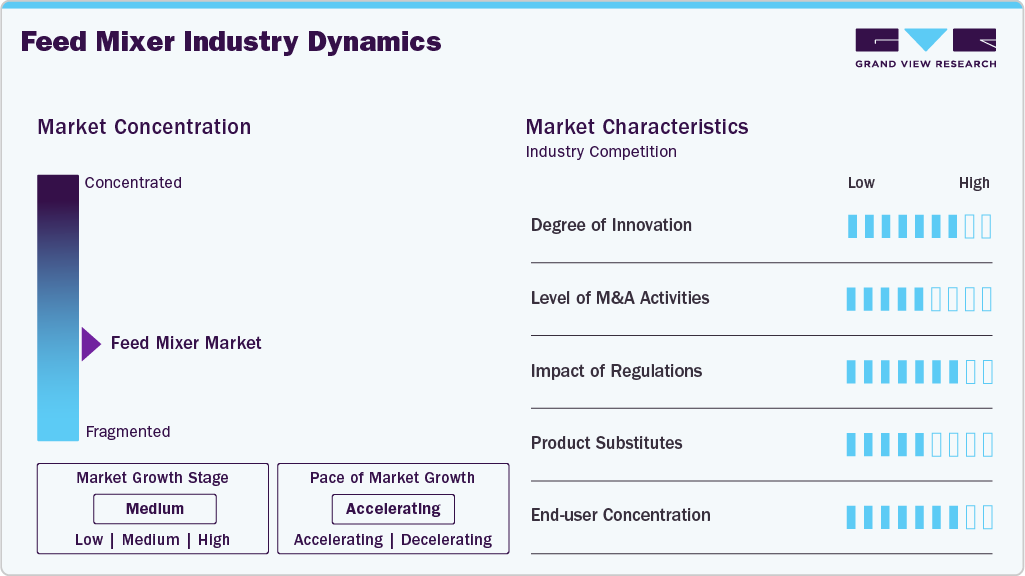
The global feed mixer market is moderately fragmented, with competition distributed among multinational agricultural machinery manufacturers, specialized feed-equipment producers, and regional manufacturers. Market concentration varies by geography and product configuration, as purchasing requirements differ according to herd size, feeding practices, farm mechanization, and investment capacity. Larger manufacturers compete through broad portfolios covering fixed, mobile, vertical, and horizontal mixer configurations, while regional suppliers emphasize application-specific designs, localized production, and cost competitiveness.
Product differentiation is primarily based on mixing uniformity, batch capacity, ingredient compatibility, mechanical configuration, and control precision. Feed mixers increasingly incorporate electronic weighing systems, load cells, programmable controls, variable-speed drives, and automated discharge systems to improve ration accuracy and batch consistency. Auger design, mixing chamber geometry, drive arrangement, and cutting mechanisms further determine suitability for different combinations of forage, silage, grains, concentrates, and additives. These technical parameters create distinct performance profiles across equipment categories and influence purchasing decisions among commercial livestock operators.
 To learn more about this report, Download Free Sample Report
 The competitive landscape is also shaped by distribution coverage, maintenance infrastructure, spare-parts availability, and equipment customization. Large-scale dairy and cattle operations generally prioritize throughput, durability, ration consistency, and integration with existing feeding workflows, whereas smaller producers place greater emphasis on acquisition cost, mechanical simplicity, and local service availability. Consequently, established manufacturers derive competitive strength from engineering capabilities and extensive dealer networks, while regional participants retain opportunities through flexible configurations, shorter supply chains, and customer-specific solutions.
Analyst Perspective
The feed mixer market is increasingly characterized by a shift from basic mechanical mixing toward purpose-engineered equipment aligned with the nutritional, physical, and logistical characteristics of livestock rations. Procurement decisions are becoming more specification-led, with auger geometry, cutting capability, mixing chamber design, discharge arrangement, loading compatibility, and machine maneuverability influencing equipment selection alongside nominal capacity. Market differentiation is consequently extending beyond mixer size, particularly as livestock producers seek machinery capable of accommodating heterogeneous feedstocks and varying batch requirements without extensive process modification. Regional market maturity remains uneven, creating a dual competitive environment in which technologically sophisticated manufacturers address highly mechanized operations while specialized producers compete through configuration flexibility and application-specific engineering.
Product Type Insights
The vertical feed mixers segment held the largest share of the global feed mixer market in 2025. Their widespread adoption is associated with their ability to accommodate high-fiber materials and varied feed textures while maintaining a relatively compact equipment footprint. Vertical configurations are also suitable for operations handling silage, hay, forage, grains, and concentrated ingredients, making them adaptable to diverse livestock feeding requirements. Availability in different chamber capacities further supports their deployment across varying farm scales.
Horizontal feed mixers are projected to register the fastest growth, advancing at a CAGR of 5.6% during the forecast period. Demand for these systems is supported by their suitability for relatively uniform processing of diverse feed components and their applicability in operations requiring larger batch volumes. Their configuration also provides flexibility for producers handling formulated rations with multiple dry and moist components, supporting broader utilization within commercially managed livestock facilities.
Portability Insights
The stationary feed mixers segment accounted for the largest share of the global market in 2025, representing 60.5% of total revenue. These systems are predominantly suited to facilities where feed preparation is concentrated at a designated location and the resulting ration is subsequently transported to feeding areas. Their installation within dedicated preparation zones makes them particularly relevant to established livestock facilities with predictable feed volumes and permanent site infrastructure.
The stationary segment is anticipated to register the fastest growth during the forecast period. Expansion of large-scale livestock establishments and greater investment in dedicated feed-handling infrastructure are creating favorable conditions for fixed equipment installations. Stationary systems can also be configured around existing storage areas, loading arrangements, and distribution routes, allowing producers to develop more structured feed-preparation layouts without relying on equipment mobility.
End Use Insights
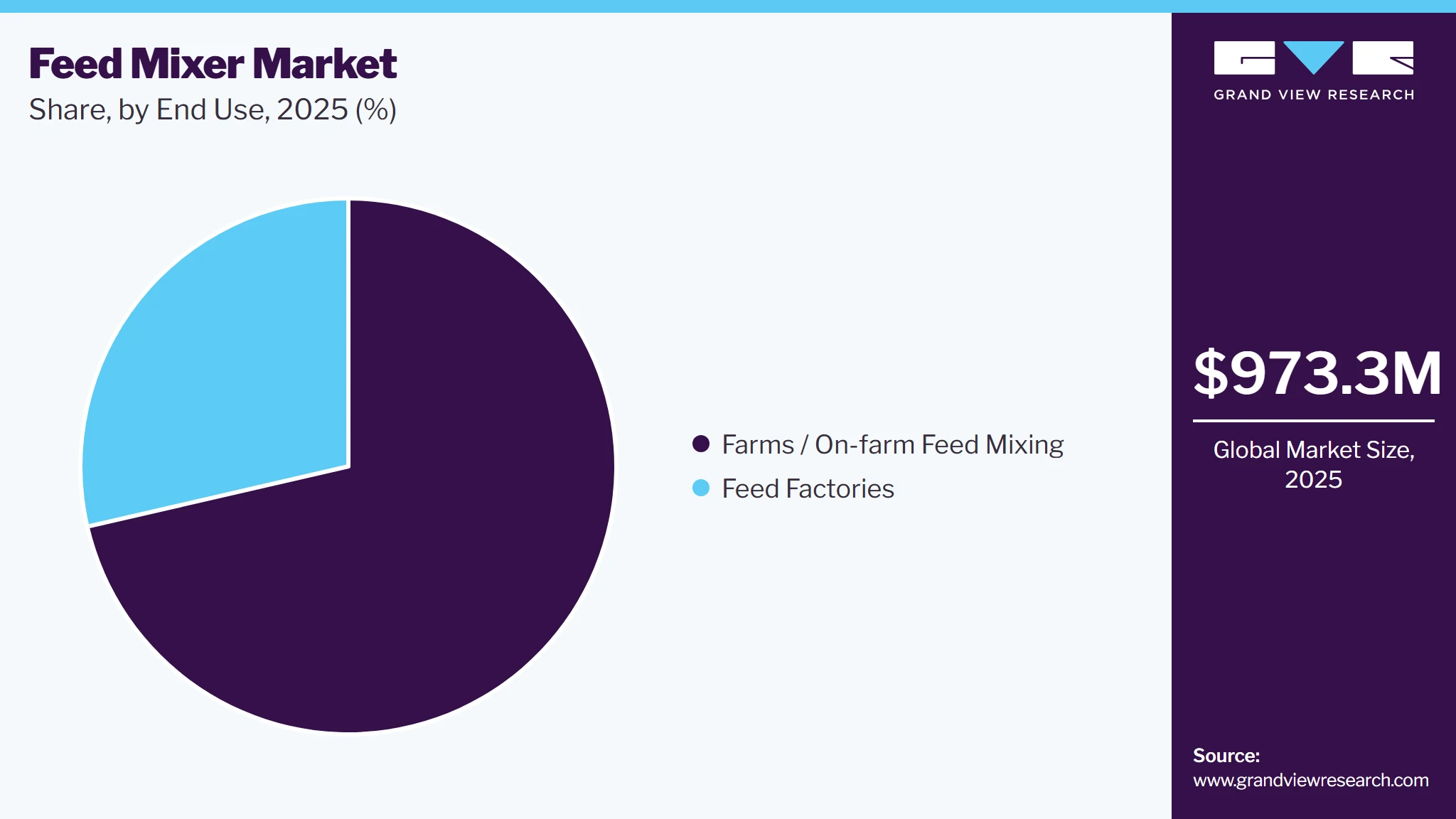
The farms/on-farm feed mixing segment accounted for the largest share of the global feed mixer market in 2025, representing 71.4% of total revenue. On-farm systems allow livestock producers to prepare rations using feed materials available at the production site, providing greater control over preparation schedules and formulation practices. The segment's substantial contribution is underpinned by the large installed base of dairy and cattle farms that undertake feed preparation as part of their routine livestock-management activities.
 To learn more about this report, Download Free Sample Report
 Feed factories are expected to maintain a growing role over the forecast period as commercial feed manufacturing becomes increasingly organized and production volumes expand. Industrial facilities require mixing machinery designed for continuous material handling, larger batch sizes, and consistent output across standardized formulations. The increasing shift toward commercially prepared livestock feed and centralized manufacturing is therefore widening the demand base for feed mixers within dedicated feed-production facilities.
Regional Insights
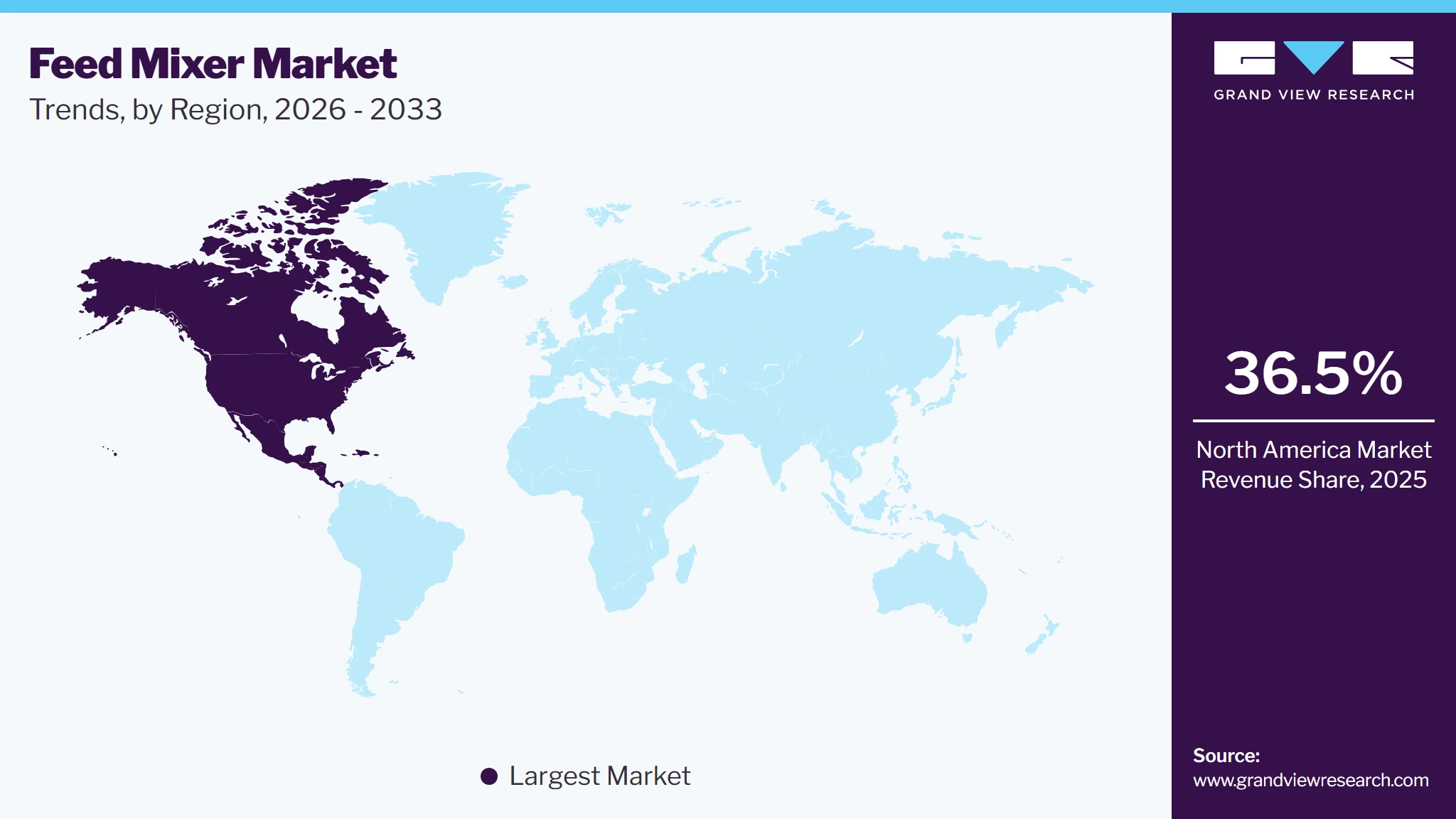
North America dominated the market, accounting for the largest revenue share of 36.5% in 2025. The region represents a mature feed mixer market with a comparatively extensive installed equipment base across dairy farms, beef operations, and feedlots. Market activity is influenced less by first-time mechanization and more by equipment lifecycle considerations, capacity upgrades, replacement demand, and aftermarket support. Well-established agricultural machinery dealerships also provide producers with access to servicing, spare parts, and equipment financing.
 To learn more about this report, Download Free Sample Report
 U.S. Feed Mixer Market Trends
U.S. represents the dominant market within North America, reflecting the scale of its commercial dairy sector, extensive beef cattle operations, and established feedlot infrastructure. Its diversified livestock production base sustains demand for feed mixers across varying capacities and configurations, with procurement shaped by herd size, feed preparation volumes, and farm-level mechanization. The prevalence of large-scale livestock enterprises and the continued modernization of feeding practices reinforce the country’s position as the region’s principal market for feed-mixing machinery.
The Mexico feed mixer market is projected to register the fastest growth in the North American region, with a CAGR of 6.0% during the forecast period. Market expansion is associated with the gradual modernization of livestock production, increasing adoption of mechanized feed preparation, and development of larger commercial dairy and cattle operations. Growing demand for consistent feed preparation among expanding livestock enterprises is creating additional scope for mobile and stationary mixer systems, particularly where producers are transitioning from labor-intensive preparation practices toward dedicated machinery.
Asia Pacific Feed Mixer Market Trends
Asia Pacific represents a heterogeneous feed mixer market, reflecting substantial differences in livestock-farm structure, animal husbandry practices, and machinery penetration across individual economies. China and India constitute the principal demand centers by livestock production scale, while Australia, Japan, and South Korea contribute through more structured and mechanized production environments. Regional demand is increasingly associated with the professionalization of dairy and cattle operations and the emergence of dedicated feed-preparation infrastructure.
The China feed mixer market represents a major regional market, underpinned by extensive dairy and livestock production and the concentration of animals within specialized production facilities. Larger operations require equipment capable of handling recurring feed volumes across established feeding cycles, creating demand across a broad capacity spectrum. The presence of domestic agricultural machinery manufacturers also provides producers with diverse equipment configurations suited to different farm structures.
The India feed mixer market is projected to register the fastest CAGR during the forecast period. Market expansion is associated with the country's substantial dairy and cattle population, increasing formalization of dairy enterprises, and development of organized livestock clusters. Growing adoption of dedicated feed-preparation machinery among expanding dairy units is widening the addressable equipment base beyond highly mechanized operations.
Europe Feed Mixer Market Trends
Europe represents a mature feed mixer market characterized by relatively high machinery penetration and an established livestock-equipment ecosystem. Demand patterns differ considerably across countries because of variations in farm consolidation, livestock density, agricultural policies, and production specialization. Machinery renewal remains an important source of demand as producers modernize existing farm infrastructure and replace aging equipment.
The Germany feed mixer market represents a prominent European market, supported by a well-developed dairy sector and sophisticated agricultural machinery manufacturing base. Specialized livestock farms create demand across multiple mixer capacities, while established distribution and servicing networks facilitate procurement and long-term equipment maintenance. The country's technically mature agricultural environment also favors equipment with differentiated configurations for specific feeding requirements.
The France feed mixer market represents an important market owing to its diversified dairy, beef, and mixed-livestock production structure. The coexistence of different farm scales creates demand across a relatively broad equipment capacity spectrum rather than a single dominant configuration. Cooperative purchasing structures and established agricultural machinery channels further facilitate access to feed-preparation equipment.
Middle East & Africa Feed Mixer Market Trends
The Middle East & Africa represents a developing feed mixer market in which adoption remains concentrated within organized dairy farms, intensive livestock projects, and commercially managed animal-production facilities. Regional demand varies considerably according to climatic conditions, feed-resource availability, infrastructure quality, and the level of livestock-sector formalization. Gulf countries provide comparatively stronger opportunities because of their concentration of intensive dairy and livestock enterprises.
The Saudi Arabia feed mixer market represents a key market within the region, supported by large-scale dairy production and intensive livestock-management systems. Arid climatic conditions and the dependence on formulated feed rations create requirements for dedicated feed-preparation infrastructure within major dairy establishments. Demand is therefore concentrated toward robust, higher-capacity machinery capable of operating reliably within intensive production environments.
Latin America Feed Mixer Market Trends
Latin America provides a substantial addressable market for feed mixers because of its extensive cattle and dairy production base and the increasing adoption of intensive feeding systems. Market development varies considerably between countries and production systems, reflecting differences in farm scale, capital availability, and machinery penetration. The expansion of feedlots and more structured cattle-feeding operations is creating additional requirements for dedicated mixing equipment.
The Brazil feed mixer market represents the principal demand center in the region, supported by its extensive cattle population and sizeable feedlot industry. The expansion of intensive and semi-intensive production systems is increasing the requirement for equipment capable of preparing larger feed batches for concentrated animal populations. Agricultural machinery distribution networks and the established presence of livestock-equipment suppliers further broaden access to mixer technologies.
Key Feed Mixer Company Insights
Some of the key players operating in the market include KUHN Group and Trioliet B.V., among others.
-
KUHN Group is a France-based agricultural machinery manufacturer with a long-established presence in the global agricultural equipment industry. The company develops machinery for crop production and livestock farming, with its livestock portfolio including trailed, stationary, and self-propelled feed mixers, silage equipment, straw blowers, and manure spreaders. Its feed mixer portfolio encompasses multiple vertical-auger configurations and capacity ranges designed for different livestock production requirements. The company maintains an international manufacturing and distribution network, serving agricultural customers across numerous mark
-
Trioliet B.V. is a Netherlands-based manufacturer specializing in livestock feeding machinery and automated feeding solutions. Founded in 1950, the company offers feed mixers, self-propelled mixer feeders, stationary mixing systems, silage cutters, weighing equipment, feed-management systems, and automated feeding solutions. Its mixer portfolio includes vertical-auger, self-loading, stationary, and self-propelled configurations across different capacity ranges. Trioliet maintains an international operating and distribution network, supplying livestock producers across European and overseas markets.
Key Feed Mixer Companies:
The following key companies have been profiled for this study on the feed mixer market.
-
KUHN Group
-
Trioliet B.V.
-
SILOKING Mayer Maschinenbau GmbH
-
Faresin Industries S.p.A.
-
Seko Industries S.r.l.
-
Supreme International Limited
-
Jaylor Fabricating Inc.
-
RMH Lachish Industries Ltd.
-
NDEco
-
BvL Maschinenfabrik GmbH & Co. KG
-
Storti S.p.A.
-
Sgariboldi S.r.l.
-
B. Strautmann & Söhne GmbH & Co. KG
-
Grupo Tatoma
-
Lucas G
Competitive Benchmarking
Category
Operating Strategies
Competitive Edge
Weakness
Established Players (e.g., KUHN Group; Trioliet B.V.; SILOKING Mayer Maschinenbau GmbH; Faresin Industries S.p.A.; Seko Industries S.r.l.; Supreme International Limited; Jaylor Fabricating Inc.)
- Diversify portfolios across vertical, horizontal, trailed, self-propelled, and stationary mixer architectures, with differentiated capacity ranges for varied livestock-production scales.
- Refine auger geometry, mixing chambers, loading mechanisms, and discharge systems while strengthening international distribution and aftermarket networks.
- Strong brand equity, broad manufacturing capabilities, and extensive configuration coverage provide access to diverse livestock applications.
- Established dealer networks, installed equipment bases, and service infrastructure reinforce customer retention and geographic reach.
- Higher acquisition costs associated with sophisticated mixer configurations can constrain penetration among smaller and price-sensitive producers.
- Organizational scale and complex equipment architectures can increase maintenance requirements and reduce responsiveness to highly localized procurement needs.
Emerging & Regional Players (e.g., RMH Lachish Industries Ltd.; NDEco; BvL Maschinenfabrik GmbH & Co. KG; Storti S.p.A.; B. Strautmann & Söhne GmbH & Co. KG; Sgariboldi S.r.l.; Grupo Tatoma; Lucas G))
- Concentrate on application-specific mixer architectures, targeted capacity bands, and mechanical configurations adapted to regional livestock-feeding practices.
- Pursue selective geographic expansion and customer-specific engineering while maintaining focused product portfolios rather than broad equipment proliferation.
- Greater engineering flexibility and regional market familiarity enable closer alignment with farm-level operating requirements.
- Leaner organizational structures can facilitate faster customization and more direct customer engagement in specialized applications.
- Smaller manufacturing footprints and narrower distribution networks restrict penetration across geographically dispersed markets.
- Limited scale can constrain investment in extensive R&D, production capacity, and global aftermarket infrastructure.
Recent Developments:
-
In August 2026, KUHN Group launched the ANTEA range of semi-autonomous, self-propelled mixer feeders for livestock operations. The range combines automated operating functions, weighing, connectivity, and feed-management capabilities with vertical twin-auger mixing technology. Available in capacities of 19, 22, 25, and 27 m³, the equipment is designed for high-volume feeding applications and incorporates wear-resistant K-NOX components for the mixing and cutting assemblies.
-
In September 2026, Trioliet B.V. introduced the Triotrac L Farmer Edition, a self-propelled feed mixer developed as a more cost-oriented variant of its Triotrac range. The model is available in 17 m³ and 20 m³ capacities and features a twin-auger mixing system, 200-hp engine, four-wheel steering, and an integrated silage cutting system. The launch broadens Trioliet’s self-propelled mixer portfolio toward livestock farms seeking high-capacity feed preparation with a comparatively simplified equipment specification.
Feed Mixer Market Report Scope
Report Attribute
Details
Market size in 2025
USD 973.3 million
Estimated market size in 2026
USD 1,022.1 million
Projected market size by 2033
USD 1,469.1 million
Growth rate
CAGR of 5.3% from 2026 to 2033
Base year for estimation
2025
Historical data
2021-2024
Forecast period
2026 - 2033
Quantitative units
Revenue in USD million and CAGR from 2026 to 2033
Report coverage
Revenue forecast, company market position analysis, competitive landscape, growth factors, and trends
Segments covered
Product type, portability, end use, region
Regional scope
North America; Europe; Asia Pacific; Latin America; Middle East & Africa
Country Scope
U.S.; Canada; Mexico; Germany; UK; Italy; Spain; France; China; Japan; India; Australia; South Korea; Brazil; Argentina; Saudi Arabia; UAE; South Africa
Key companies profiled
KUHN Group; Trioliet B.V.; SILOKING Mayer Maschinenbau GmbH; Faresin Industries S.p.A.; Seko Industries S.r.l.; Supreme International Limited; Jaylor Fabricating Inc.; RMH Lachish Industries Ltd.; NDEco; BvL Maschinenfabrik GmbH & Co. KG; Storti S.p.A., B. Strautmann & Söhne GmbH & Co. KG; Sgariboldi S.r.l.; Grupo Tatoma; Lucas G
Customization scope
Free report customization (equivalent up to 8 analysts working days) with purchase. Addition or alteration to country, regional & segment scope.
Pricing and purchase options
Avail customized purchase options to meet your exact research needs. Explore purchase options
Global Feed Mixer Market Report Segmentation
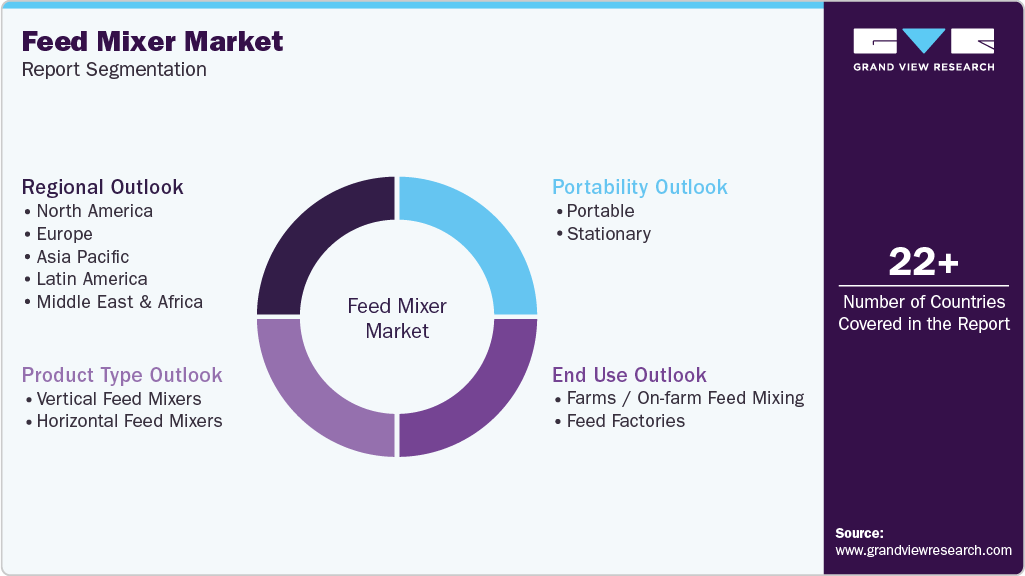
This report forecasts revenue growth at global, regional & country levels and provides an analysis on the industry trends in each of the sub-segments from 2021 to 2033. For the purpose of this study, Grand View Research has segmented the feed mixer market on the basis of product type, portability, end use, and region:
 To learn more about this report, Download Free Sample Report
 -
Product Type Outlook (Revenue, USD Million, 2021 - 2033)
-
Vertical Feed Mixers
-
Horizontal Feed Mixers
-
-
Portability Outlook (Revenue, USD Million, 2021 - 2033)
-
Portable
-
Stationary
-
-
End Use Outlook (Revenue, USD Million, 2021 - 2033)
-
Farms / On-farm Feed Mixing
-
Feed Factories
-
-
Regional Outlook (Revenue, USD Million, 2021 - 2033)
-
North America
-
U.S.
-
Canada
-
Mexico
-
-
Europe
-
Germany
-
France
-
UK
-
Spain
-
Italy
-
-
Asia Pacific
-
China
-
India
-
Japan
-
South Korea
-
Australia
-
-
Latin America
-
Brazil
-
Argentina
-
-
Middle East & Africa
-
Saudi Arabia
-
UAE
-
South Africa
-
-
Research Methodology
The feed mixer market figures in this report are based on a proven research process that combines executive interviews with secondary research from proprietary databases, company filings, and recognized regulatory and institutional sources. Market size is built through value-chain sizing—reconciling supply-side and demand-side estimates—and triangulated with bottom-up and top-down approaches. Every estimate passes multiple levels of expert validation before publication, with each feed mixer segment quantified using the revenue-capture definitions in the table below.
Segment Definition
Product Type
Revenue Capture Definition
Vertical Feed Mixers
Revenue generated from the sale of vertical feed mixer machinery, encompassing complete vertical mixing units, configured auger assemblies, mixing chambers, drive systems, and standard equipment supplied with the machine.
Horizontal Feed Mixers
Revenue generated from the sale of horizontal feed mixer machinery, encompassing complete horizontal mixing units, mixing assemblies, drive mechanisms, chambers, and standard equipment incorporated into the finished machine.
Portability
Revenue Capture Definition
Portable
Revenue generated from the sale of portable feed mixer machinery, including trailed, self-propelled, mobile, and other transportable mixer configurations sold as complete equipment units.
Stationary
Revenue generated from the sale of stationary feed mixer machinery, including fixed-position mixer units, associated mixing mechanisms, drive assemblies, and standard integrated components supplied as part of the equipment.
End Use
Revenue Capture Definition
Farms / On-farm Feed Mixing
Revenue generated from the sale of feed mixer machinery to individual farms, livestock producers, agricultural enterprises, and other farm-level purchasers.
Feed Factories
Revenue generated from the sale of feed mixer machinery to commercial feed manufacturers, industrial feed-processing companies, and dedicated feed-production facilities.
Estimation Model
Layer No.
Layer Name
Key Question
Description
01
Feed Mixing Demand Layer
What underpins the addressable demand for feed mixers?
Quantify the structural requirement for feed mixing equipment by assessing livestock populations, herd concentration, feed volumes, ration composition, mixing frequency, and prevailing feed-preparation practices across dairy, beef cattle, other livestock, and commercial feed-production operations.
02
Capital Procurement Layer
What determines feed mixer procurement?
Evaluate equipment purchases arising from new livestock facilities, herd expansion, farm consolidation, capacity augmentation, machinery replacement, and modernization of existing installations. Incorporate equipment age, utilization intensity, required batch capacity, investment propensity, and replacement intervals to distinguish incremental demand from replacement-driven purchases.
03
Configuration Adoption Layer
How is demand distributed across feed mixer configurations?
Determine the adoption structure across vertical and horizontal feed mixers and stationary and portable equipment. Assess mixer capacity, auger configuration, feed-material compatibility, mobility requirements, operating scale, and equipment specifications to establish configuration-level demand across end uses and regions.
04
Market Revenue Layer
How is feed mixer market value derived?
Translate estimated unit demand into market revenue using manufacturer selling prices, configuration-specific pricing, and regional price differentials. Include revenue attributable to the sale of new feed mixer machinery through manufacturers, authorized distributors, dealers, and direct sales channels, while excluding standalone feeding equipment, ancillary machinery, spare parts, and aftermarket services.
Customization Table
CLIENT REQUEST
CUSTOMIZATION DELIVERED
VALUE ADDS
Competitive Benchmarking
A comprehensive competitive benchmarking assessment was conducted for leading feed mixer manufacturers, covering product portfolios, vertical and horizontal mixer configurations, stationary and mobile systems, capacity ranges, auger and mixing mechanisms, loading and discharge arrangements, livestock applications, manufacturing capabilities, distribution reach, aftermarket infrastructure, and strategic developments.
Establishes a comparative view of manufacturer positioning, technical differentiation, portfolio breadth, application coverage, and route-to-market strength, enabling identification of competitive advantages and structural gaps within the global supplier landscape.
Regional Segmentation
Regional and country-level analysis was developed by assessing livestock production structures, herd concentration, feed-preparation practices, farm-scale distribution, equipment penetration, replacement requirements, and investment conditions across major geographic markets.
Delivers a differentiated view of regional demand maturity, equipment adoption potential, replacement-driven revenue pools, and geographic expansion prospects, supporting prioritization of high-potential markets.
Opportunity Assessment
Market opportunities were evaluated across farm expansion, livestock intensification, feed-preparation capacity requirements, machinery replacement, farm consolidation, and adoption of higher-capacity and specialized mixing systems across dairy, beef cattle, other livestock, and feed-production operations.
Identifies addressable revenue pools, attractive application segments, equipment configuration opportunities, and structural demand pockets that can inform product development, market-entry planning, and resource allocation.
About the Author(s)
Advanced Interior Materials Research Team
Advanced Materials · Advanced Interior MaterialsThis report was authored by the advanced interior materials research team at Grand View Research - comprising two research analysts, one senior research analyst, and one industry expert - with specialized expertise in the advanced interior materials segment of the advanced materials industry. All findings are based on proprietary advanced materials databases, executive interviews, and regulatory analysis, subject to internal peer review prior to publication.
Last Updated:
Speak to Analyst

Customize this report to your needs - add regions, segments, or data points, with 20% free customization.
Or view our licence options:


ISO 9001:2015 & 27001:2022 Certified
We are GDPR and CCPA compliant! Your transaction & personal information is safe and secure. For more details, please read our privacy policy.


