
- Home
- »
- Medical Devices
- »
-
Feminine Hygiene Products Market Size Report, 2025-2030GVR Report cover

Feminine Hygiene Products Market (2025 - 2030)
Size, Share & Trends Analysis Report By Product (Menstrual Care Products Cleaning & Deodorizing Products), By Distribution Channel, By Region, And Segment Forecasts
Market Size, 2024
$31.5MMarket Estimate, 2026
$36.3MMarket Forecast, 2030
$49.0MCAGR, 2025–2030
7.7%Feminine Hygiene Products Market Summary
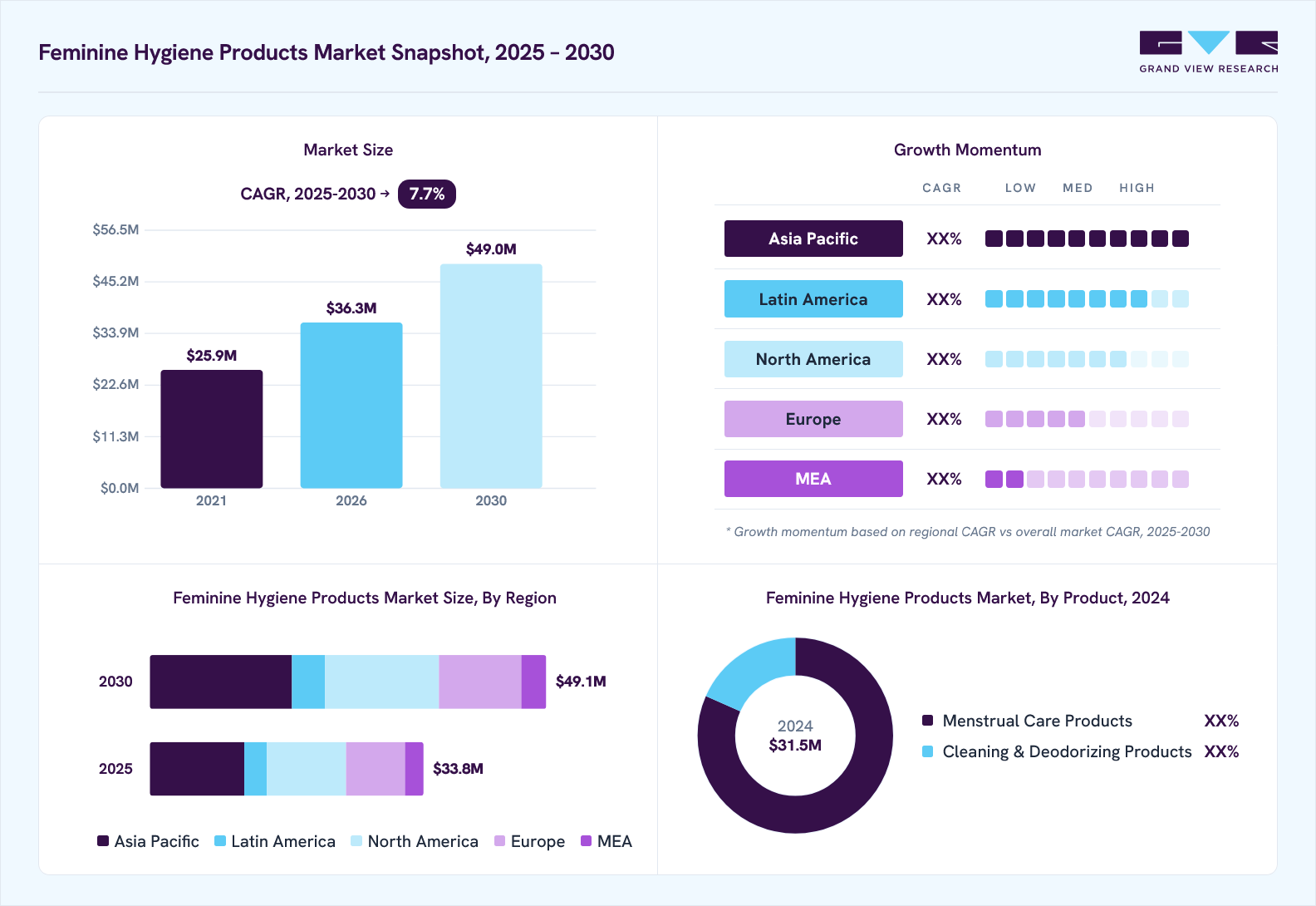
The global feminine hygiene products market size was valued at USD 31.5 million in 2024 and is projected to grow from USD 36.3 million in 2026 to USD 49.0 million by 2030, at a CAGR of 7.7% from 2025 to 2030. Asia Pacific dominated the market, accounting for a revenue share of 34.3% in 2024. The growth drivers for this particular market are initiatives taken by the government, such as an increase in awareness, product innovation, sustainability, and growth in e-commerce.
 Source: Grand View Research, IR Documents, Primary Interviews, Paid DatabasesTo learn more about this report,
 Download Free Sample Report
 Key Market Trends & Insights
- Based on product, the menstrual care products segment dominated the market with an 81.6% share in 2024.
- Based on distribution channel, the supermarkets and hypermarkets segment held the largest revenue share in 2024.
Market Size & Forecast
- 2024 Market Size: USD 31.5 Million
- 2030 Projected Market Size: USD 49.0 Million
- CAGR (2025-2030): 7.7%
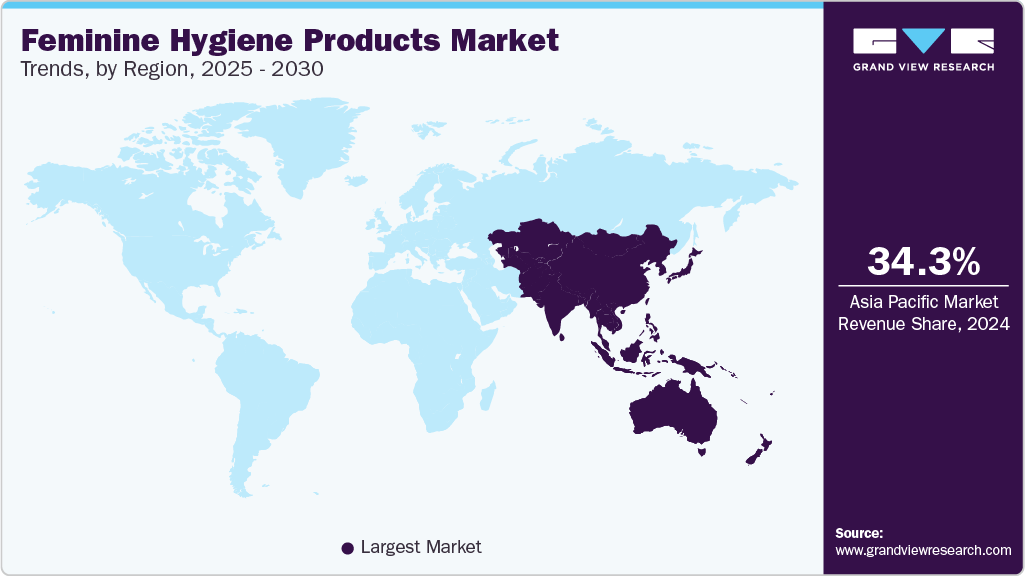
- Asia Pacific: Largest market in 2024
Three ways to get this report
Buy it, customize it, or ask a question.Ask an Analyst
Analyst response in 1 business day
- AccessReport author, directly
- Reply timeWithin 1 working day
- No sales callDirect answer only
- FormatEmail reply
- CostFree, no cost
Get the Full Report
What the study covers
- FormatsPDF · Excel · Dashboard
- Timeline2025–2030 annual, 2024 base
- Coverage20+ countries, 5 regions
- Companies10+ key players profiled
Customize the Report
20% free customization
- IncludeCountries, segments, points
- TailorTo your product definition
- ExtendDeeper competitor detail
- OrA fully bespoke study
- Turnaround5–10 working days
The increase in menstrual literacy is the most significant contributing factor driving the demand for feminine products. Schools, NGOs, and government initiatives are helping increase menstrual health literacy. Menstrual Hygiene Management (MHM) is fundamental in spreading awareness about feminine hygiene among women, girls, and other menstruators worldwide.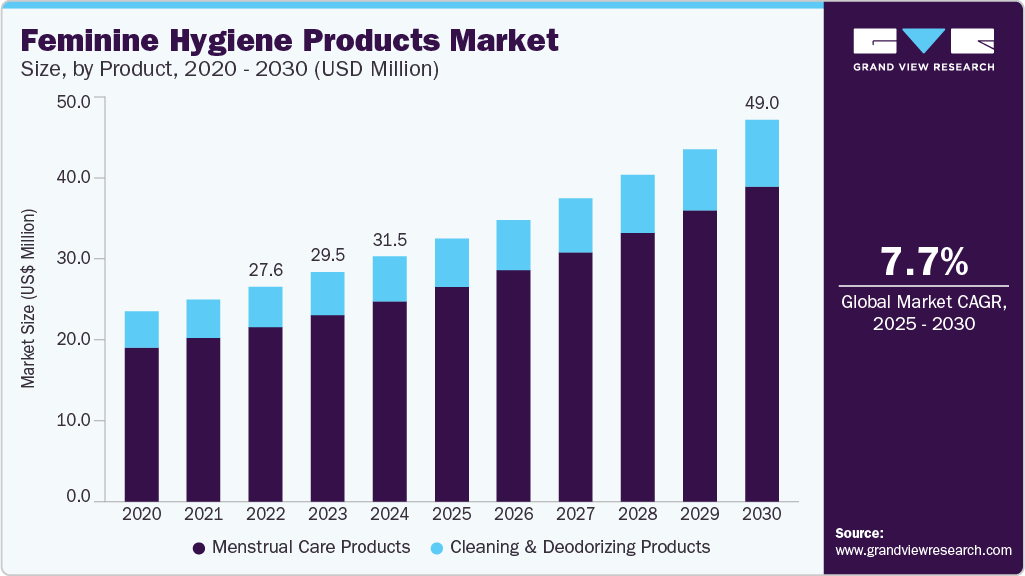 To learn more about this report, Download Free Sample Report
 Women and girls need access to Water, Sanitation, and Hygiene (WASH) facilities and suitable and affordable menstrual hygiene products to manage their menstruation effectively. Governments across the world are taking measures to ensure these resources are available and to promote good menstrual hygiene practices. According to the World Bank, globally, over 300 million women are of menstrual age, and it is projected that over 500 million females lack access to adequate facilities and menstrual products.
On average, women dispose of 150 kg of nonbiodegradable waste every year. In India, around 121 million girls and women use approximately eight non-compostable and disposable pads monthly, generating 12.3 billion pad waste annually. These numbers represent the potential market that can be tapped, and they play a crucial role in promoting the innovation and development of eco-friendly feminine hygiene products in the market.
Market Concentration & Characteristics
The industry growth stage is medium, and the pace of industry growth is accelerating. The global feminine hygiene product industry has witnessed significant innovation, marked by regulatory approvals, collaborations, mergers, and acquisitions. As per an article published in Vogue Business in July 2024, Unilever Ventures invested approximately USD 2.65 million in Luna Daily, a UK-based intimate body care brand focused on microbiome-balancing, natural, and vegan products. This investment is intended to expand Luna Daily's motherhood product line and marketing strategies.
Leading companies in the feminine hygiene products market are acquiring innovative product capabilities, expanding their market footprint, and enhancing product portfolios, with a moderate level of Merger & Acquisition (M&A) activity. The industry is subject to regulatory oversight pertaining to product safety, quality standards, and environmental compliance. Manufacturers are required to meet guidelines related to formulation, packaging, and sustainability practices.
 To learn more about this report, Download Free Sample Report
 The impact of regulation is moderate. Regulatory frameworks significantly influence the operations and strategic planning of companies in the feminine hygiene products industry. Adherence to these regulations has become a key factor in maintaining market credibility and access with growing consumer emphasis on eco-friendly and health-conscious products. Noncompliance can lead to substantial risks, including fines, product recalls, and reputational harm. As such, regulatory compliance is not just a legal obligation but also a strategic priority for market participants aiming to ensure business continuity and competitive advantage.
Regional market expansion is expected to be medium to high. It has become a strategic priority for companies in the feminine hygiene products market, supported by growing consumer awareness, rising disposable income, and favorable government initiatives in developing regions. Firms increasingly target high-potential markets in Asia Pacific, Latin America, and Africa through localized product strategies, strategic alliances, and enhancements in distribution infrastructure. Adapting offerings to align with regional preferences-such as cost sensitivity, sustainability, and cultural norms-has proven critical for successful market entry and long-term growth. This geographic diversification enables companies to tap into new revenue streams while reducing reliance on saturated markets.
Product Insights
Menstrual care products dominated the market with an 81.6% share in 2024. This leadership is primarily driven by the increasing worldwide female population, which stood at 3.99 billion, according to the World Bank Group in 2023. Statistics from UNICEF reveal that about 1.8 billion women menstruate every month, further driving the growth of this category and prompting innovation. Government backing also drives the segment, such as the Ministry of Health and Family Welfare in India, which launched the Scheme for Promotion of Menstrual Hygiene, specifically targeting adolescent girls aged 10 to 19 in rural areas.
The cleaning & deodorizing products segment is expected to witness the significant growth in the feminine hygiene products industry during the forecast period. This growth can be attributed to growing consumer awareness, increasing disposable incomes, and a rising focus on hygiene to avoid the spread of odor- and infection-causing bacteria. In addition, government initiatives for feminine hygiene and health literacy are also helping drive this expected growth.
Distribution Channel Insights
Supermarkets and hypermarkets held the largest revenue share in 2024. Feminine hygiene products are distributed through various channels, and these stores offer a variety of brands and provide bulk discounts, making them a popular choice among consumers. Offline retail, including pharmacies, convenience stores, and drugstores, also plays a significant role. While pharmacies may have a limited product range, these stores are trusted for their brand selection and easy access. Convenience stores are convenient options for quick purchases, specifically in urban areas. Specialty stores cater to specific needs, such as eco-friendly or reusable products.
 To learn more about this report, Download Free Sample Report
 The online retail stores segment is expected to grow at the fastest CAGR over the forecast period 2025 - 2030. Feminine hygiene remains taboo and prevents many consumers from shopping at retail outlets. Online retail stores provide anonymity to users, allowing them to experiment with innovative alternative products such as tampons and menstrual cups, eliminating hesitation. The online retailers contributing to the growth of the segment include Amazon, Flipkart, Blinkit, and Wellness Forever.
Regional Insights
North America feminine hygiene products market held the significant market revenue share of the global feminine hygiene products industry in 2024. This growth was driven by high awareness levels, the availability of a broad range of products, and supportive government policies. One such example is the inclusion of USD 25 million by the Canadian government in its 2022 budget to create a Menstrual Equity Fund to enhance the availability of hygiene products to low-income individuals. According to an article in The Canadian Press, in September 2023, the government provided funding of USD 17.9 million to Food Banks Canada to address affordability and decrease stigma related to accessing menstrual products. Such measures are expected to further drive market growth.
U.S. Feminine Hygiene Products Market Trends
The U.S. feminine hygiene products market accounted for a significant revenue share of the regional market in 2024. A higher rate of self-awareness, a wide range of product availability, and government initiatives are key growth drivers for the respective markets. The U.S. government has been undertaking various initiatives to provide feminine hygiene products, such as the Menstrual Equity for All Act, Period PROUD Act, First Step Act (2018), and CARES Act (2020). Provision for free menstrual products in schools, tax exemptions on menstrual products, and access to these products in correctional facilities and homeless shelters are some initiatives taken at the state level.
Europe Feminine Hygiene Products Market Trends
Europe feminine hygiene market is characterized by product innovation, marketing strategies, and private label growth. European companies are focusing on launching new and attractive products to meet consumer demands. Enhanced advertising and promotional campaigns are being employed to increase market share. There is a notable shift toward private-label products, with consumers seeking cost-effective alternatives without compromising quality.
Asia Pacific Feminine Hygiene Products Market Trends
The Asia Pacific feminine hygiene market held the largest market share of 34.3% in 2024 and is expected to grow at the fastest CAGR over the forecast period from 2025 to 2030. The growing young population in the region is a primary growth driver. The lack of developed countries in the region results in a higher taboo about feminine hygiene. Hence, regional governments are undertaking various initiatives to mitigate the situation.
 To learn more about this report, Download Free Sample Report
 India's feminine hygiene products industry is being driven by rising disposable income, growing awareness of feminine hygiene, and supportive government initiatives. In November 2024, the Union Ministry of Health and Family Welfare approved the Menstrual Hygiene Policy for School-Going Girls. Moreover, institutions such as the Pinkishe Foundation attempt to shatter the period taboo, promote safe practices, and distribute free period products among schools in remote areas to raise awareness. The Indian government is also actively promoting hygiene products through programs such as the Ministry of Health and Family Welfare's Pradhan Mantri Bharatiya Janaushadhi Pariyojana (PMBJP), which provides low-cost oxy-biodegradable pads. Companies and organizations, e.g., Anandi, Eco Femme, Saathi, and Avni Wellness, are working toward making positive contributions by supplying eco-friendly, reusable products.
Key Feminine Hygiene Products Company Insights
Some key companies in the feminine hygiene products industry include Procter & Gamble, KCWW, Prestige Consumer Healthcare Inc., GLENMARK PHARMACEUTICALS LTD, and Unicharm Corporation. Key companies are involved in strategic initiatives such as collaborations, innovations, new product launches, and partnerships.
-
Procter & Gamble serves customers globally through a variety of products in several areas such as feminine hygiene products, haircare, skincare, laundry, self-grooming and cleaning products, home care, and personal care products. It has various globally recognized brands for offering feminine hygiene products.
-
Unilever is a Fast-moving Consumer Goods (FMCG) company that manufactures and markets a variety of consumer goods in various segments such as skincare, personal care, food, home care, hair care, and laundry goods. It operates in over 190 countries worldwide. In the feminine hygiene market, Unilever serves consumers through brands such as VWash (under Hindustan Unilever Limited in India), Seventh Generation, and Luna Daily.
Key Feminine Hygiene Products Companies:
The following are the leading companies in the feminine hygiene products market. These companies collectively hold the largest market share and dictate industry trends.
- Procter & Gamble
- GLENMARK PHARMACEUTICALS LTD
- Unicharm Corporation
- Unilever
- Maxim Hygiene
- KCWW
- Edgewell Personal Care
- Premier FMCG (Pty) Ltd.
- Essity Aktiebolag
- Ontex BV
- Bodywise (UK) Limited
- Kao Corporation
- Prestige Consumer Healthcare Inc.
Recent Developments
-
In August 2024, Unilever Ventures invested over USD 2 million in Luna Daily, a UK-based intimate body care brand focusing on microbiome-balancing and natural and vegan products. This investment aims to expand Luna Daily's motherhood product line and marketing strategies.
-
In August 2024, Edgewell reported a 23% rise in adjusted Earnings Per Share (EPS) despite a slight drop in net sales. In the feminine care segment, the net sales of pads and tampons decreased by 7.9%, which was partially offset by an increase in liner sales.
-
In March 2023, Unicharm implemented menstrual education programs in Egypt and China, benefiting thousands of students. Moreover, the company hosted the “Mahila Udyami Samman” event under “Project Jagriti” in May 2023 in India to support and promote women's economic empowerment with menstrual hygiene awareness.
-
In December 2023, Ontex introduced two new feminine care products: SatinSense tampons with a silky coating for comfort and Confidaily daily liners offering high levels of protection and comfort.
Feminine Hygiene Products Market Report Scope
Report Attribute
Details
Market size in 2024
USD 31.5 million
Estimated market size in 2026
USD 36.3 million
Projected market size by 2030
USD 49.0 million
Growth rate
CAGR of 7.7% from 2025 to 2030
Base year for estimation
2024
Historical data
2018 - 2023
Forecast period
2025 - 2030
Quantitative units
Revenue in USD million/billion and CAGR from 2025 to 2030
Report coverage
Revenue forecast, company ranking, competitive landscape, growth factors, trends
Segments covered
Product, distribution channel, region
Regional scope
North America; Europe; Asia Pacific; Latin America; MEA
Country scope
U.S.; Canada; Mexico; Germany; UK; France; Italy; Spain; Denmark; Sweden; Norway; China; Japan; India; Australia;South Korea; Thailand; Brazil; Argentina; UAE; South Africa; Saudi Arabia; Kuwait
Key companies profiled
Procter & Gamble; GLENMARK PHARMACEUTICALS LTD; Unicharm Corporation; Unilever; Maxim Hygiene; KCWW; Edgewell Personal Care; Premier FMCG (Pty) Ltd.; Essity Aktiebolag; Ontex BV; Bodywise (UK) Limited; Kao Corporation; Prestige Consumer Healthcare Inc.
Customization scope
Free report customization (equivalent up to 8 analysts working days) with purchase. Addition or alteration to country, regional & segment scope.
Pricing and purchase options
Avail customized purchase options to meet your exact research needs. Explore purchase options
Global Feminine Hygiene Products Market Report Segmentation
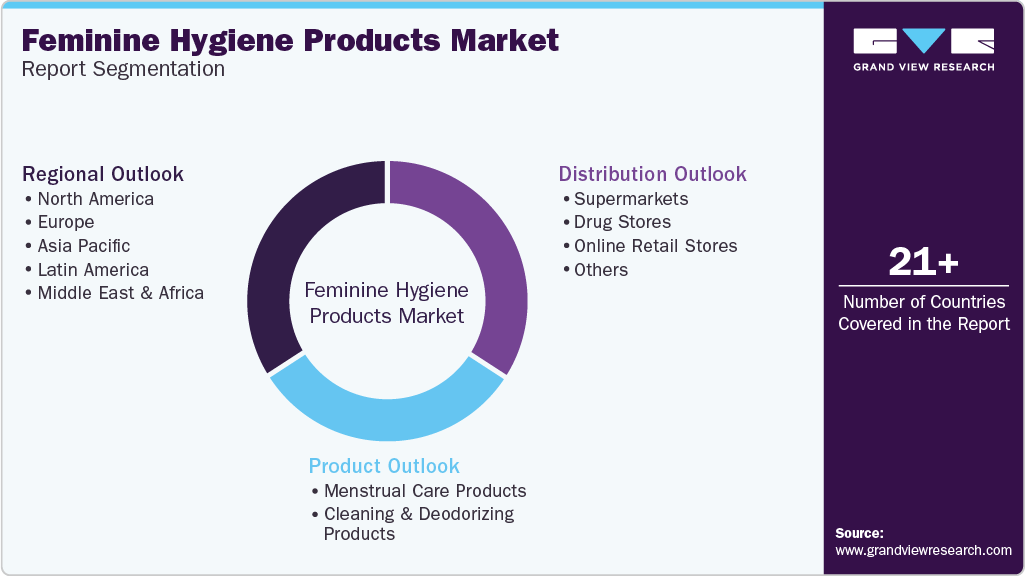
This report forecasts revenue growth at global, regional, and country levels as well as provides an analysis of the latest trends in each of the sub-segments from 2018 to 2030. For this study, Grand View Research has segmented the global feminine hygiene products report on the basis of product, distribution channel, and region:
 To learn more about this report, Download Free Sample Report
 -
Product Outlook (Revenue, USD Million, 2018 - 2030)
-
Menstrual Care Products
-
Sanitary Napkins
-
Tampons
-
Menstrual Cups
-
Others
-
-
Cleaning & Deodorizing Products
-
Feminine Powders, Soaps and Washes
-
Others
-
-
-
Distribution Outlook (Revenue, USD Million, 2018 - 2030)
-
Supermarkets
-
Drug Stores
-
Online Retail Stores
-
Others
-
-
Regional Outlook (Revenue, USD Million, 2018 - 2030)
-
North America
-
U.S.
-
Canada
-
Mexico
-
-
Europe
-
UK
-
Germany
-
France
-
Italy
-
Spain
-
Denmark
-
Sweden
-
Norway
-
-
Asia Pacific
-
Japan
-
China
-
India
-
Australia
-
South Korea
-
Thailand
-
-
Latin America
-
Brazil
-
Argentina
-
-
Middle East & Africa
-
South Africa
-
Saudi Arabia
-
UAE
-
Kuwait
-
-
Frequently Asked Questions About This Report
The global feminine hygiene products market size was valued at USD 31.5 million in 2024 and is estimated at USD 36.3 million for 2026.
The global feminine hygiene products market is expected to grow at a CAGR of 7.7% from 2025 to 2030, reaching USD 49.0 million by 2030.
Asia Pacific dominated the market with a share of around 30% in 2019. Large populations in countries like India and China with a high rate of women in their reproductive years is one of the prime reasons as to why this region is expected to account for a large market share.
Some key players operating in the feminine hygiene products market include Procter & Gamble; Edgewell Personal Care; Unicharm Corporation; Kimberly-Clark Corporation (KCWW); Lil-Lets UK Ltd.; Glenmark; Essity; Ontex; Natracare Bodywise; Kao Corporation; and Summer’s Eve
Key factors that are driving the market growth include rise in awareness, increasing disposable income in developing countries, novel product innovations, and initiatives undertaken by manufacturers and various governments
About the Author(s)
Medical Devices Research Team
Healthcare · Medical DevicesThis report was authored by the medical devices research team at Grand View Research - comprising two research analysts, one senior research analyst, and one industry expert - with specialized expertise in the medical devices segment of the healthcare industry. All findings are based on proprietary healthcare databases, executive interviews, and regulatory analysis, subject to internal peer review prior to publication.
Last Updated:
Speak to Analyst

Customize this report to your needs - add regions, segments, or data points, with 20% free customization.
Or view our licence options:


ISO 9001:2015 & 27001:2022 Certified
We are GDPR and CCPA compliant! Your transaction & personal information is safe and secure. For more details, please read our privacy policy.


