
- Home
- »
- Advanced Interior Materials
- »
-
Fire And Smoke Curtains Market Size & Share Report, 2033GVR Report cover

Fire And Smoke Curtains Market (2026 - 2033)
Size, Share & Trends Analysis Report By Product (Fire Curtains, Smoke Curtains), By End-use (Commercial Buildings, Industrial & Manufacturing, Warehouses & Distribution Centers), By Region, And Segment Forecasts
Market Size, 2025
$4.3BMarket Estimate, 2026
$4.5BMarket Forecast, 2033
$6.9BCAGR, 2026–2033
6.2%Fire And Smoke Curtains Market Summary
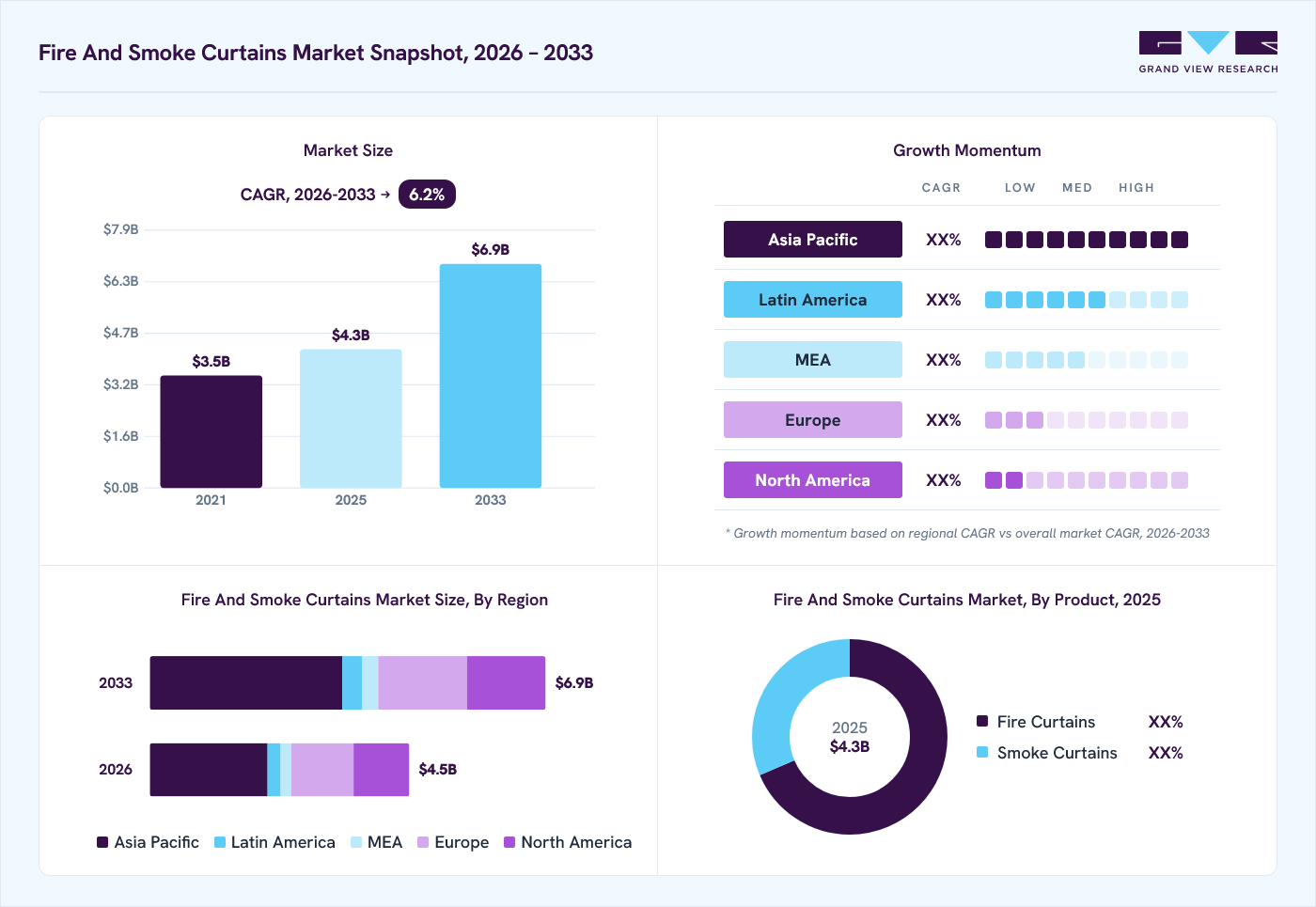
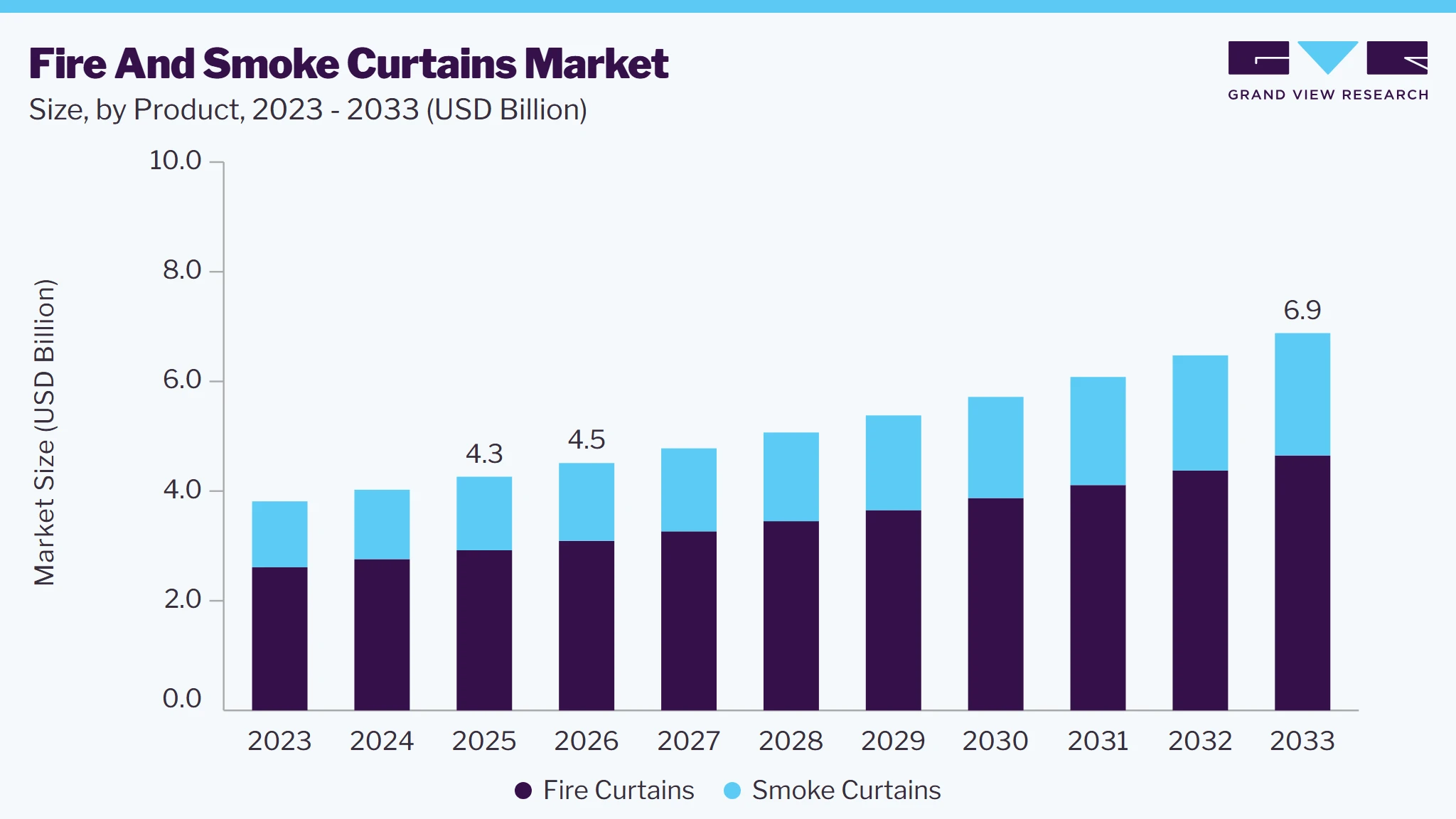
The global fire and smoke curtains market size was valued at USD 4.3 billion in 2025 and is projected to grow from USD 4.5 billion in 2026 to USD 6.9 billion by 2033, at a CAGR of 6.2% from 2026 to 2033. Asia Pacific dominated the market, accounting for the revenue share of 44.9% in 2025. The market is driven by tighter fire safety requirements and the growing integration of passive fire protection measures into building designs.
 Source: Grand View Research, IR Documents, Primary Interviews, Paid DatabasesTo learn more about this report,
 Download Free Sample Report
 Key Market Trends & Insights
- By product: Fire curtains segment accounted for the largest revenue share of 68.5% in 2025.
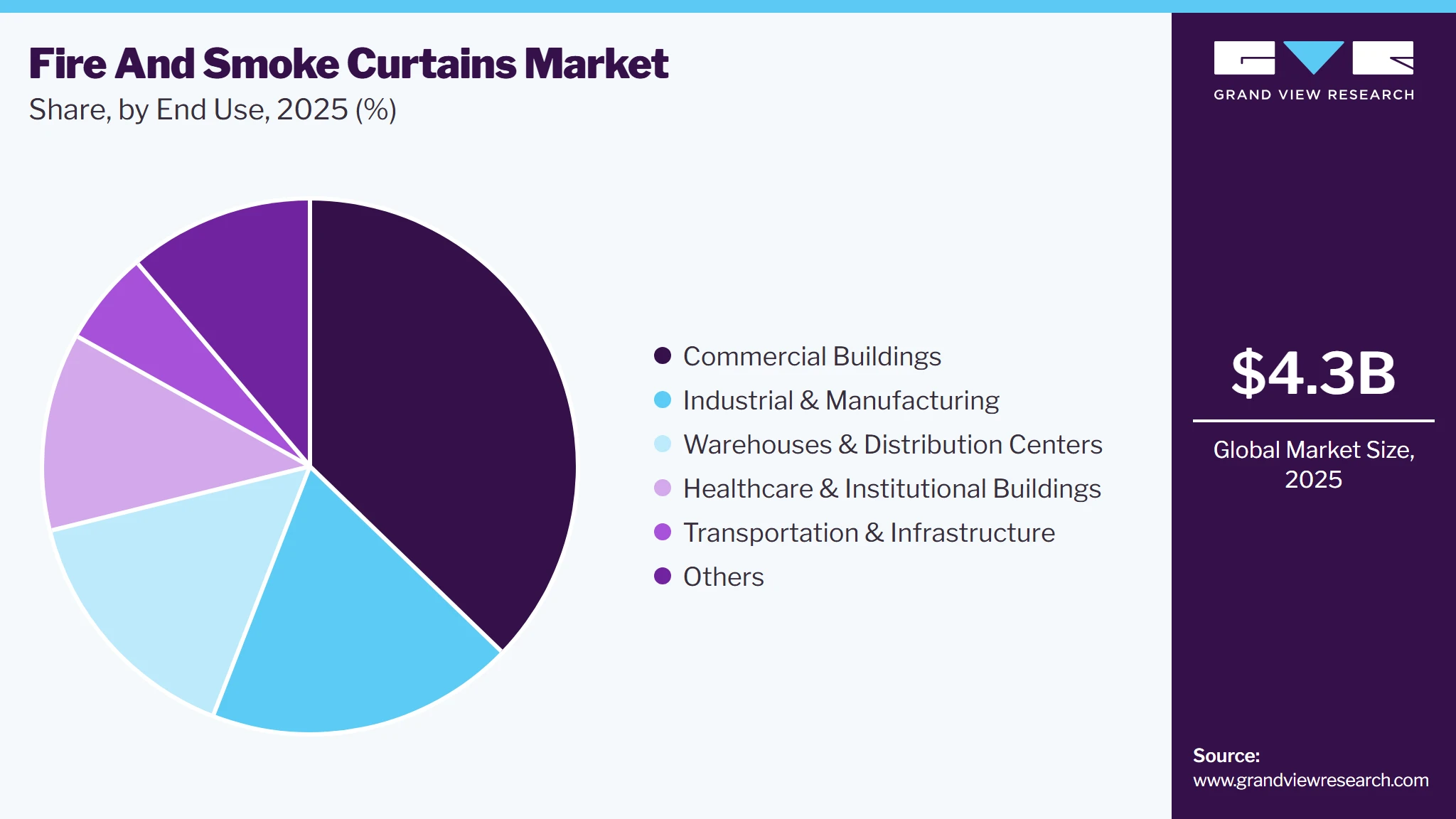
- By end-use: Commercial buildings segment accounted for the largest revenue share of 37.2% in 2025.
Regional Highlights
- Largest regional market: Asia Pacific (44.9% revenue share, 2025)
- By country: China held the largest market share in 2025.
Market Size & Forecast
- Market size in 2025: USD 4.3 Billion
- Estimated market size in 2026: USD 4.5 Billion
- Projected Market Size by 2033: USD 6.9 Billion
- CAGR (2026-2033): 6.2%
Three ways to get this report
Buy it, customize it, or ask a question.Ask an Analyst
A direct answer, usually in 1 working day
- AccessReport author, directly
- Reply timeWithin 1 working day
- No sales callDirect answer only
- FormatEmail reply
- CostFree, no cost
Get the Full Report
What the study covers
- FormatsPDF · Excel · Dashboard
- Timeline2026–2033 annual, 2025 base
- Coverage20+ countries, 5 regions
- Companies10+ key players profiled
Customize the Report
20% free customization
- IncludeCountries, segments, points
- TailorTo your product definition
- ExtendDeeper competitor detail
- OrA fully bespoke study
- Turnaround5–10 working days
 To learn more about this report, Download Free Sample Report
Fire and smoke curtains can provide separation across open areas, atriums, escalators, and other spaces where fixed barriers may be impractical, making them relevant to projects with complex architectural layouts.Additionally, the expansion of automated fire protection systems is creating demand for electronically controlled curtain solutions that can operate in coordination with fire detection and alarm systems. Retrofitting older commercial and public buildings is another area of opportunity, as building modifications and changes in occupancy can require upgrades to existing fire protection arrangements. Product developments focused on compact designs, improved fire resistance, and integration with building control systems are also widening the addressable application base.
Market Dynamics
The global fire and smoke curtains market is influenced by changes in building safety requirements, construction practices, refurbishment activity, and passive fire protection specifications. Market development depends on factors such as regulatory compliance, building configuration, installation conditions, certification requirements, and compatibility with existing fire protection infrastructure. Demand also varies across commercial, industrial, healthcare, transportation, and residential projects based on their compartmentation requirements and architectural layouts.
The global fire and smoke curtains market is driven by the growing incorporation of passive fire protection measures into building designs. Fire and smoke curtains enable compartmentation across open areas, atriums, escalators, corridors, and other locations where permanent fire-rated barriers may be difficult to incorporate. Increasing investment in high-rise buildings, commercial facilities, transportation infrastructure, healthcare properties, and large public buildings is creating a broader requirement for flexible fire containment solutions.
Installation complexity and compliance-related costs can limit the adoption of fire and smoke curtains, particularly in retrofit projects with structural or space constraints. Systems may require coordination with fire detection, alarm, electrical, and building control infrastructure, increasing engineering and commissioning requirements. Differences in national fire codes and testing standards can also raise certification costs and extend product qualification processes for manufacturers entering new markets.
The modernization of aging commercial, public, and institutional buildings presents opportunities for fire and smoke curtain suppliers. Retrofit installations can provide additional compartmentation where extensive structural alterations are impractical, particularly in buildings with open architectural layouts. Integration with fire detection, alarm, and building management systems also creates scope for automated deployment and monitoring. Advances in compact housings, control mechanisms, and installation configurations can further expand applications in space-constrained and architecturally complex projects.
Market Concentration & Characteristics
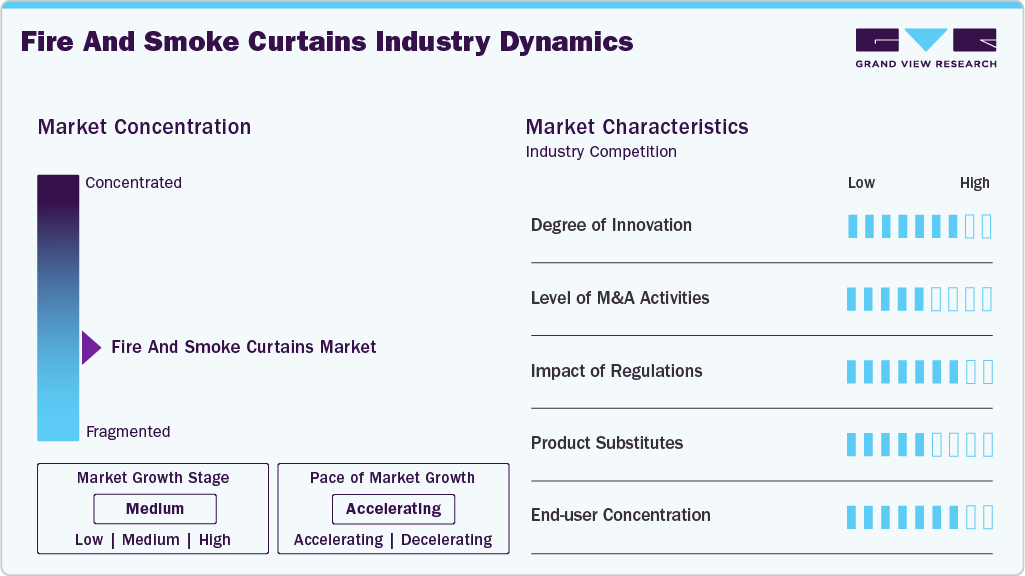
The global fire and smoke curtains market consists of dedicated fire protection manufacturers, architectural safety solution providers, and regional engineering companies. Market participation depends on the ability to meet prescribed fire performance standards, obtain relevant certifications, and deliver products compatible with specific building designs. Companies generally maintain portfolios covering different curtain sizes, deployment arrangements, control options, and installation configurations.
The industry is strongly specification-led, as fire and smoke curtains are frequently incorporated into building plans during the design or fire safety engineering stage. Their use across atriums, open stairways, escalators, service openings, and other exposed areas requires consideration of structural conditions, escape routes, ventilation arrangements, and fire compartmentation plans. Consequently, purchasing decisions can involve several stakeholders, including architects, consultants, contractors, fire safety specialists, and facility operators.
 To learn more about this report, Download Free Sample Report
 Manufacturing and installation capabilities are complemented by testing, commissioning, inspection, and maintenance services. Product reliability is particularly important because curtain systems may remain inactive for extended periods and are required to deploy correctly during a fire event. Manufacturers are therefore focusing on control electronics, sensing interfaces, compact assemblies, and monitoring functions. Retrofit projects represent another industry characteristic, particularly where existing buildings require modifications to meet updated fire protection requirements without extensive structural alterations.
Analyst Perspective
The global fire and smoke curtains market is influenced by the increasing use of deployable fire protection systems in buildings where fixed barriers may conflict with architectural layouts or space utilization. Product certification, fire and smoke performance, installation requirements, and compatibility with detection and control systems remain important considerations in project selection. Demand is also supported by refurbishment of existing buildings, particularly where fire safety upgrades need to be incorporated without extensive structural modifications. Competition centers on curtain performance, deployment reliability, product configurations, installation capabilities, and compliance with regional fire safety standards, while the continued development of compact systems and automated controls is expanding their applicability across commercial, institutional, industrial, and infrastructure projects.
Product Insights
The fire curtains segment accounted for the largest revenue share of 68.5% in 2025, supported by their established application in passive fire protection and compartmentation across commercial, industrial, institutional, and infrastructure facilities. Their suitability for protecting large openings, circulation areas, and interconnected spaces enables their incorporation into building designs where conventional fire-rated barriers may require substantial structural modifications. Continued construction and refurbishment of buildings subject to fire safety regulations further contribute to the demand for fire curtains.
Smoke curtains are projected to register the fastest CAGR during the forecast period, reflecting the growing emphasis on smoke control as a distinct component of building fire protection. Demand is increasing across atriums, shopping centers, transportation facilities, and other large-volume structures where unrestricted smoke movement can affect evacuation routes and protected areas. Integration with fire detection, alarm, and smoke management systems, along with greater use in retrofit applications, is expected to broaden the deployment of smoke curtains across building projects.
End-use Insights
The commercial buildings segment accounted for the largest revenue share in 2025, reflecting the widespread incorporation of fire and smoke curtains across offices, retail complexes, hotels, healthcare facilities, and other commercial properties. Their application is particularly relevant in structures with open-plan layouts, atriums, escalators, and interconnected spaces where conventional fire-rated barriers may restrict building functionality. Ongoing construction and refurbishment of commercial properties further contribute to demand for deployable fire protection solutions.
 To learn more about this report, Download Free Sample Report
 Warehouses & distribution centers are projected to register the fastest CAGR of 7.0% during the forecast period. Expansion of logistics networks, fulfillment centers, and large-scale storage facilities is increasing the need for fire and smoke compartmentation across extensive internal areas. High storage densities, large floor plates, and the movement of goods and equipment create specific fire protection requirements, encouraging the incorporation of curtain systems into warehouse safety designs. Growth in modern logistics infrastructure and upgrades to existing facilities are expected to provide further scope for adoption.
Regional Insights
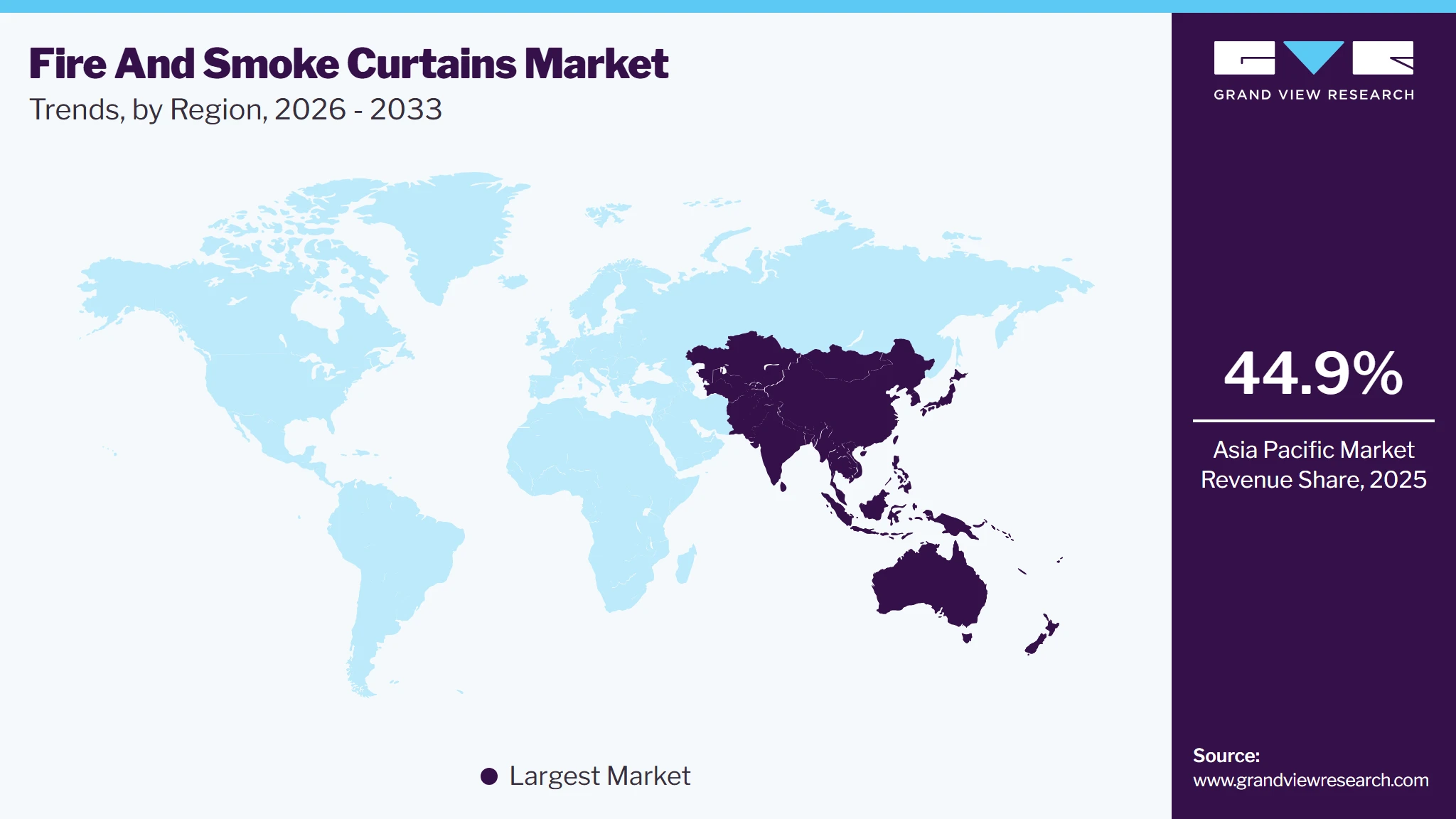
Asia Pacific led the fire & smoke curtains market, capturing 44.9% revenue share in 2025. The region presents a broad growth opportunity for fire and smoke curtains due to rapid urban development, expansion of commercial real estate, and construction of large infrastructure facilities. Applications are emerging across shopping centers, airports, hospitals, hotels, warehouses, and high-rise developments. The increasing scale and architectural complexity of new buildings are widening the range of locations where flexible fire protection systems can be specified.
 To learn more about this report, Download Free Sample Report
 China Fire And Smoke Curtains Market Trends
The China fire and smoke curtains market is influenced by extensive construction of commercial complexes, high-rise properties, logistics facilities, industrial buildings, and transportation infrastructure. Large building footprints and increasingly complex internal configurations are creating applications for curtain systems around atriums, escalators, service areas, and other openings. Fire safety upgrades in existing properties provide another avenue for market expansion.
The fire and smoke curtains market in India is developing with growth in commercial real estate, organized retail, hospitality, healthcare, warehousing, and transportation infrastructure. New shopping complexes, office developments, hospitals, and logistics facilities are creating applications for fire and smoke separation systems. Demand is also expanding as building owners incorporate additional fire protection measures into refurbishment and facility upgrade programs.
North America Fire And Smoke Curtains Market Trends
The fire and smoke curtains market in North America is an established sector, with demand influenced by mature fire safety practices, extensive building infrastructure, and refurbishment of commercial and institutional properties. The market benefits from applications in offices, healthcare facilities, hospitality, transportation hubs, and industrial buildings where flexible fire separation is required. Replacement of aging fire protection components and upgrades to existing safety systems also contribute to regional demand.
The fire and smoke curtains market in the U.S. is shaped by its extensive commercial building stock and broad implementation of fire safety systems. Applications span office buildings, healthcare facilities, retail properties, airports, hotels, and industrial sites. Demand is also linked to projects involving atriums, vertical circulation areas, and large openings, where curtain-based protection can be incorporated without permanently altering the building configuration.
The Mexico fire and smoke curtains market is developing alongside expansion in industrial parks, logistics facilities, commercial properties, and manufacturing infrastructure. Growth in warehouses and distribution facilities is creating additional applications for fire and smoke separation across large internal areas. Increasing construction of modern commercial and industrial buildings is also creating demand for fire protection systems that can be incorporated during the building design and installation stages.
Europe Fire And Smoke Curtains Market Trends
The fire and smoke curtains market in Europe is influenced by mature building safety practices, refurbishment activity, and the integration of passive fire protection into building projects. Demand extends across commercial, healthcare, hospitality, transportation, and public infrastructure. The region also presents opportunities in older buildings where fire safety upgrades must be accommodated within existing architectural and structural limitations.
The Germany fire and smoke curtains market is linked to its extensive commercial, industrial, transportation, and public infrastructure. Fire and smoke curtains find applications in facilities with atriums, large circulation areas, interconnected floors, and other locations requiring controlled fire or smoke separation. Refurbishment of existing properties and incorporation of fire protection measures into complex building projects continue to create demand for application-specific systems.
The fire and smoke curtains market in the UK is influenced by fire safety requirements across commercial, healthcare, education, hospitality, and public buildings. Retrofit projects represent an important application area, particularly where structural changes to existing properties are difficult to undertake. Demand also extends to buildings requiring smoke management around stairways, corridors, atriums, and other evacuation-related areas.
Middle East & Africa Fire And Smoke Curtains Market Trends
The fire and smoke curtains market in the Middle East and Africa is influenced by new commercial developments, hospitality projects, healthcare infrastructure, transportation facilities, and large mixed-use properties. Fire and smoke curtains are particularly relevant to developments incorporating extensive public areas and complex architectural features. Project-based procurement and specification by architects, consultants, and fire safety contractors play an important role in regional demand.
The Saudi Arabia fire and smoke curtains market growth is linked to the continued development of hospitality, retail, healthcare, transportation, and mixed-use infrastructure. Large-scale developments featuring expansive public spaces, atriums, and interconnected areas are creating applications for deployable fire and smoke barriers. New project construction provides a larger demand base than replacement activity, while fire protection specifications increasingly form part of building design and project planning.
Latin America Fire And Smoke Curtains Market Trends
The fire and smoke curtains market in Latin America is developing through commercial construction, logistics expansion, hospitality projects, healthcare facilities, and industrial infrastructure. Adoption is influenced by the incorporation of fire protection systems into new buildings and upgrades to existing properties. Demand varies considerably by building type and project specification, with larger commercial and institutional developments providing broader application potential.
The Brazil fire and smoke curtains market benefits from its extensive commercial, industrial, healthcare, hospitality, and logistics infrastructure. Fire and smoke curtains are applicable in shopping centers, office buildings, hospitals, hotels, warehouses, and other facilities requiring flexible separation of internal areas. Construction and refurbishment of large properties, together with the expansion of organized logistics infrastructure, are creating additional opportunities for curtain systems.
Key Fire And Smoke Curtains Company Insights
Some of the key players operating in the market include Coopers Fire (Lowe & Fletcher), STÖBICH Brandschutz, Weber Ultrasonics, Tecnitex Holding A/S, and AVAPS s.r.o., among others.
-
Coopers Fire (Lowe & Fletcher) is a UK-based fire protection manufacturer specializing in the design and manufacture of fire and smoke curtain systems. The company offers automatic fire curtains, smoke curtains, and associated control solutions for commercial, industrial, healthcare, hospitality, and infrastructure applications. Its systems are designed to provide deployable fire and smoke separation in buildings where conventional fixed barriers may be unsuitable or restrictive.
-
STÖBICH Brandschutz AG is a Germany-based manufacturer of passive fire protection systems, with a portfolio covering fire curtains, smoke curtains, and related containment solutions. Its products are designed for applications involving atriums, escalators, façades, shafts, and other building openings requiring controlled fire and smoke separation. The company focuses on certified systems that can be configured to meet varying architectural, installation, and fire protection requirements.
Key Fire And Smoke Curtains Companies:
The following key companies have been profiled for this study on the fire & smoke curtains market
-
Coopers Fire (Lowe & Fletcher)
-
STÖBICH Brandschutz
-
NAFFCO
-
Hörmann
-
Tecnitex
-
Colt International
-
McKEON
-
INTISI (Prefire Group)
-
SIMON PROtec
-
HAG
-
Envirograf
-
AVAPS s.r.o.
-
NGR Technologie
-
Dan-doors
-
A1S Group
Competitive Benchmarking
Category
Operating Strategies
Competitive Edge
Weakness
Established Players (e.g., Coopers Fire (Lowe & Fletcher); STÖBICH Brandschutz; NAFFCO; Hörmann; Tecnitex; Colt International; McKEON)
- Maintain broad portfolios of fire and smoke curtains across different sizes, configurations, and deployment arrangements.
- Target specification-driven projects through architects, fire consultants, contractors, and building developers, supported by installation and maintenance services.
- Established testing, certification, and fire protection expertise facilitates participation in complex building projects.
- Broad product portfolios and extensive project experience enable coverage across commercial, infrastructure, healthcare, hospitality, and industrial applications.
- Certification, testing, and project-specific engineering can increase product development and delivery costs.
- Differences in fire safety regulations and installation practices across countries can complicate international project execution.
Emerging & Regional Players (e.g., INTISI (Prefire Group); SIMON PROtec; HAG; Envirograf; AVAPS s.r.o.; NGR Technologie; Dan-doors; A1S Group)
- Focus on specialized fire and smoke curtain systems for defined building applications and regional project requirements.
- Expand through specialist contractors, distributors, consultants, and direct project relationships.
- Focused portfolios allow greater responsiveness to application-specific dimensions and installation conditions.
- Regional knowledge and closer customer engagement support tailored solutions for individual building projects..
- Limited geographic coverage can restrict participation in large international construction programs.
- Smaller certification, manufacturing, and service capabilities may constrain complex or multi-location projects.
Recent Developments
-
In April 2026, Vetrotech Saint-Gobain India launched CURTIVIA fire curtains in India, expanding its portfolio of fire protection solutions for buildings with open or complex layouts. The system is designed to deploy automatically during a fire event to establish a temporary fire separation barrier, while its concealed installation helps maintain the architectural appearance of the space. CURTIVIA is intended for applications across offices, hotels, hospitals, retail facilities, atriums, warehouses, and transportation buildings. The launch highlights continued product development toward flexible fire curtain systems that can be incorporated into modern building designs without requiring permanent structural barriers.
-
In February 2026, Bergman & Beving acquired all shares of A1 Shutters Limited (A1S), a UK supplier of certified fire curtains and fire shutters. A1S specializes in fire protection products and operates from Bolton, UK. The acquisition strengthens Bergman & Beving's presence in the certified fire curtain segment and expands its existing fire safety activities in the Nordic and UK markets. The transaction represents a direct consolidation move within the fire curtain industry and is relevant to the competitive landscape of the global fire and smoke curtains market.
Fire & Smoke Curtains Market Report Scope
Report Attribute
Details
Market size in 2025
USD 4.3 billion
Estimated market size in 2026
USD 4.5 billion
Projected market size by 2033
USD 6.9 billion
Growth rate
CAGR of 6.2% from 2026 to 2033
Historical data
2021 - 2024
Forecast period
2026 - 2033
Quantitative units
Revenue in USD billion and CAGR from 2026 to 2033
Report coverage
Revenue forecast, company ranking, competitive landscape, growth factors, and trends
Segments covered
Product, end-use, region
Regional scope
North America; Europe; Asia Pacific; Latin America; Middle East & Africa
Country scope
U.S.; Canada; Mexico; UK; Germany; France; Italy; Spain; China; Japan; India; Australia; South Korea; Brazil; Argentina; UAE; Saudi Arabia; South Africa
Key companies profiled
Coopers Fire (Lowe & Fletcher); STÖBICH Brandschutz; NAFFCO; Hörmann; Tecnitex; Colt International; McKEON; INTISI (Prefire Group); SIMON PROtec; HAG; Envirograf; AVAPS s.r.o.; NGR Technologie; Dan-doors; A1S Group
Customization scope
Free report customization (equivalent up to 8 analysts working days) with purchase. Addition or alteration to country, regional & segment scope.
Pricing and purchase options
Avail customized purchase options to meet your exact research needs. Explore purchase options
Global Fire And Smoke Curtains Market Report Segmentation
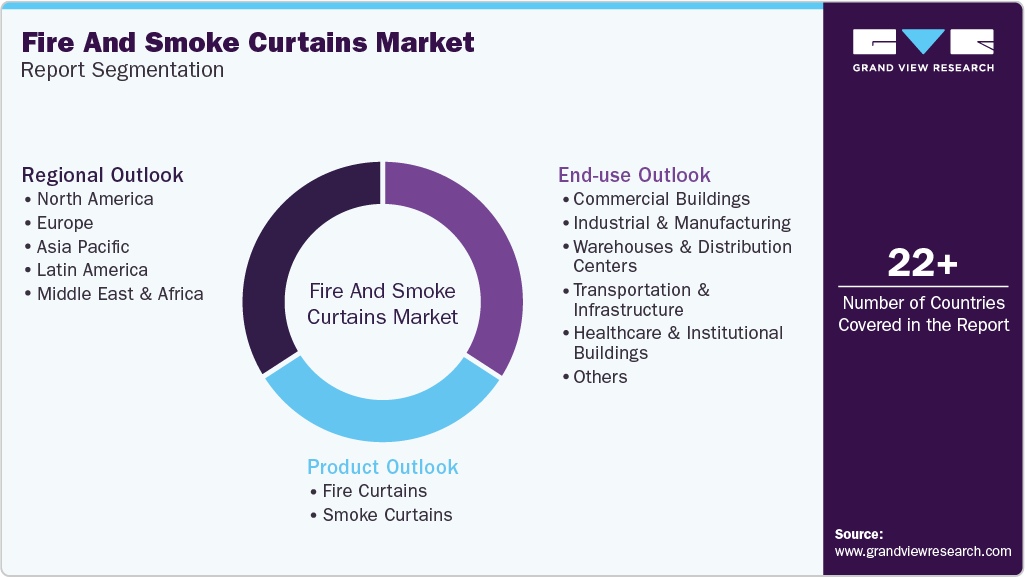
This report forecasts revenue growth at global, regional, and country levels and provides an analysis of the latest industry trends in each of the sub-segments from 2021 to 2033. For this study, Grand View Research has segmented the global fire & smoke curtains market report based on product, end-use, and region.
 To learn more about this report, Download Free Sample Report
 -
Product Outlook (Revenue, USD Billion, 2021 - 2033)
-
Fire Curtains
-
Vertical Fire Curtains
-
Horizontal Fire Curtains
-
Concertina Fire Curtains
-
-
Smoke Curtains
-
Static Smoke Curtains
-
Automatic Smoke / Draft Curtains
-
-
-
End-use Outlook (Revenue, USD Billion, 2021 - 2033)
-
Commercial Buildings
-
Industrial & Manufacturing
-
Warehouses & Distribution Centers
-
Transportation & Infrastructure
-
Healthcare & Institutional Buildings
-
Others
-
-
Regional Outlook (Revenue, USD Billion, 2021 - 2033)
-
North America
-
U.S.
-
Canada
-
Mexico
-
-
Europe
-
Germany
-
Spain
-
France
-
Italy
-
UK
-
-
Asia Pacific
-
China
-
India
-
Japan
-
Australia
-
South Korea
-
-
Latin America
-
Brazil
-
Argentina
-
-
Middle East and Africa
-
Saudi Arabia
-
UAE
-
South Africa
-
-
Research Methodology
The fire & smoke curtains market figures in this report are based on a proven research process that combines executive interviews with secondary research from proprietary databases, company filings, and recognized regulatory and institutional sources. Market size is built through value-chain sizing-reconciling supply-side and demand-side estimates-and triangulated with bottom-up and top-down approaches. Every estimate passes multiple levels of expert validation before publication, with eachfire & smoke curtainssegment quantified using the revenue-capture definitions in the table below.
Segment Definition
Segment - Product
Revenue Capture Definition
Fire Curtains
Revenue generated from the sale of fire-resistant curtain systems designed to compartmentalize building areas and restrict the spread of fire. Revenue includes vertical, horizontal, and concertina fire curtain systems supplied for new installations and replacement applications.
Smoke Curtains
Revenue generated from the sale of smoke control curtain systems designed to contain, channel, or restrict the movement of smoke within buildings during a fire. Revenue includes static smoke curtains and automatic smoke/draft curtains supplied for permanent building installations and replacement requirements.
Segment-End Use
Revenue Capture Definition
Commercial Buildings
Revenue generated from the sale of fire & smoke curtains installed in commercial properties, including offices, retail spaces, shopping centers, hotels, and other commercial facilities for fire compartmentation and smoke management.
Industrial & Manufacturing
Revenue generated from the sale of fire & smoke curtains for industrial and manufacturing facilities, including production plants, processing units, and industrial premises where fire separation and smoke control are required.
Warehouses & Distribution Centers
Revenue generated from the sale of fire & smoke curtains installed in warehouses, logistics facilities, storage buildings, and distribution centers to provide fire compartmentation and control smoke movement across storage and operational areas.
Transportation & Infrastructure
Revenue generated from the sale of fire & smoke curtains for transportation and infrastructure facilities, including airports, railway stations, transit facilities, tunnels, and related infrastructure requiring fire and smoke management systems.
Healthcare & Institutional Buildings
Revenue generated from the sale of fire & smoke curtains for hospitals, clinics, schools, universities, government facilities, and other institutional buildings where fire safety and smoke containment are required.
Others
Revenue generated from the sale of fire & smoke curtains across other building and facility types not classified under the specified end-use segments, including specialized facilities and miscellaneous commercial or institutional applications.
Estimation Model
Layer Name
Key Question
Description
End-Use Demand Layer
Which building segments generate demand for fire & smoke curtains?
Assess demand across commercial buildings, industrial & manufacturing, warehouses & distribution centers, transportation & infrastructure, healthcare & institutional buildings, and other facilities. The analysis considers building stock, construction activity, facility characteristics, and the prevalence of applications requiring fire and smoke compartmentation.
Fire Safety Application Layer
What building applications require fire & smoke curtains?
Evaluate requirements associated with fire compartmentation, smoke containment, protected openings, atriums, stairways, corridors, and other areas where curtain systems are incorporated into building fire protection strategies. Application requirements are assessed in relation to building configuration and fire safety provisions.
Product Adoption Layer
Which fire & smoke curtain configurations are selected?
Analyze adoption across Fire Curtains (Vertical Fire Curtains, Horizontal Fire Curtains, Concertina Fire Curtains) and Smoke Curtains (Static Smoke Curtains, Automatic Smoke / Draft Curtains). Product selection is evaluated based on curtain configuration, deployment method, opening characteristics, fire or smoke control function, and installation requirements.
Revenue Conversion Layer
How is market revenue derived?
Estimate market revenue from the sales of fire & smoke curtain systems across product, end-use, and geographic segments. Revenue capture includes systems supplied through manufacturers, distributors, fire protection contractors, and specialized suppliers for new projects, replacements, and upgrades.
Delivered Customizations
This report has been delivered with the following In-depth customizations
Client Request
Customization Delivered
Value Adds
Competitive Benchmarking
Benchmarking of key fire & smoke curtain companies based on product offerings, Fire Curtains and Smoke Curtains portfolios, vertical, horizontal, concertina, static, and automatic curtain systems, certifications, technical specifications, distribution networks, and recent product developments.
Enables comparison of company portfolios, product specialization, certification coverage, and competitive presence across the market.
Regional Segmentation
Regional market analysis covering North America, Europe, Asia Pacific, Latin America, and the Middle East & Africa, with country-level assessment of market size, product demand, regulatory requirements, construction activity, and presence of domestic and international suppliers.
Provides visibility into geographic differences in market development, product penetration, regulatory influence, and competitive structure.
Opportunity Assessment
Assessment of revenue opportunities across Fire Curtains and Smoke Curtains and their respective subsegments, together with Commercial Buildings, Industrial & Manufacturing, Warehouses & Distribution Centers, Transportation & Infrastructure, Healthcare & Institutional Buildings, and Others.
Supports evaluation of segment-level revenue potential, product demand patterns, and areas of market expansion across key product and end-use categories.
Frequently Asked Questions About This Report
Asia Pacific led the fire & smoke curtains market, capturing 44.9% revenue share in 2025.
The commercial buildings segment accounted for the largest revenue share in 2025, while warehouses & distribution centers is the fastest-growing end-use.
The global fire and smoke curtains market size was valued at USD 4.3 billion in 2025 and is estimated at USD 4.5 billion in 2026.
The market is driven by the increasing incorporation of passive fire protection measures into building designs, particularly where fixed fire-rated barriers are difficult to incorporate. Growth in high-rise buildings, commercial facilities, transportation infrastructure, healthcare properties, and large public buildings is creating demand for deployable fire containment solutions.
Key players include Coopers Fire (Lowe & Fletcher), STÖBICH Brandschutz, NAFFCO, Hörmann, Tecnitex, Colt International, McKEON, INTISI (Prefire Group), SIMON PROtec, HAG, Envirograf, AVAPS s.r.o., NGR Technologie, Dan-doors, and A1S Group.
The fire and smoke curtains market is expected to grow at a CAGR of 6.2% from 2026 to 2033, reaching USD 6.9 billion by 2033.
The fire curtains segment accounted for the largest revenue share of 68.5% in 2025, while smoke curtains is the fastest-growing product.
About the Author(s)
Advanced Interior Materials Research Team
Advanced Materials · Advanced Interior MaterialsThis report was authored by the advanced interior materials research team at Grand View Research - comprising two research analysts, one senior research analyst, and one industry expert - with specialized expertise in the advanced interior materials segment of the advanced materials industry. All findings are based on proprietary advanced materials databases, executive interviews, and regulatory analysis, subject to internal peer review prior to publication.
Last Updated:
Speak to Analyst

Customize this report to your needs - add regions, segments, or data points, with 20% free customization.
Or view our licence options:


ISO 9001:2015 & 27001:2022 Certified
We are GDPR and CCPA compliant! Your transaction & personal information is safe and secure. For more details, please read our privacy policy.


