
- Home
- »
- Advanced Interior Materials
- »
-
Flame Retardant Apparel Market Size Report, 2026-2035GVR Report cover

Flame Retardant Apparel Market (2026 - 2035)
Size, Share & Trends Analysis Report By Type (Durable, Disposable), By Fabric (Inherent, Treated), By Product (Shirt, Pant, FRC Coverall), By End Use (Defense & Law Enforcement, Firefighting), By Region, And Segment Forecasts
Market Size, 2025
$4.1BMarket Estimate, 2026
$4.3BMarket Forecast, 2035
$7.3BCAGR, 2026–2035
6.0%Flame Retardant Apparel Market Summary
The global flame retardant apparel market size was valued at USD 4.1 billion in 2025 and is projected to grow from USD 4.3 billion in 2026 to USD 7.3 billion by 2035, at a CAGR of 6.0% from 2026 to 2035. North America held the largest share of 33.2% of the global market in 2025. The global flame retardant apparel market is driven by stringent workplace safety regulations, rising industrialization, and increasing awareness of occupational hazards across high-risk industries such as oil & gas, petrochemicals, utilities, and firefighting services.
 Source: Grand View Research, IR Documents, Primary Interviews, Paid DatabasesTo learn more about this report,
 Download Free Sample Report
 Key Market Trends & Insights
- By fabric: Treated fabric segment held the largest market share of 56.4% in 2025.
- By product: FRC coverall segment held the largest market share of 43.7% in 2025.
- By type: Durable segment held the largest market share of 86.2% in 2025.
- By end use: Oil & gas segment held the largest market share of 26.0% in 2025.
Regional Highlights
- Largest regional market: North America (33.2% market share, 2025)
- By country: The U.S. held the largest market share in North America in 2025.
Market Size & Forecast
- Market size in 2025: USD 4.1 Billion
- Estimated market size in 2026: USD 4.3 Billion
- Projected market size by 2035: USD 7.3 Billion
- CAGR (2026-2035): 6.0%
Three ways to get this report
Buy it, customize it, or ask a question.Ask an Analyst
Analyst response in 1 business day
- AccessReport author, directly
- Reply timeWithin 1 working day
- No sales callDirect answer only
- FormatEmail reply
- CostFree, no cost
Get the Full Report
What the study covers
- FormatsPDF · Excel · Dashboard
- Timeline2026–2035 annual, 2025 base
- Coverage20+ countries, 5 regions
- Companies10+ key players profiled
Customize the Report
20% free customization
- IncludeCountries, segments, points
- TailorTo your product definition
- ExtendDeeper competitor detail
- OrA fully bespoke study
- Turnaround5–10 working days
Demand is supported by mandatory compliance with international safety standards and the growing adoption of protective clothing in emerging economies as industrial safety enforcement improves.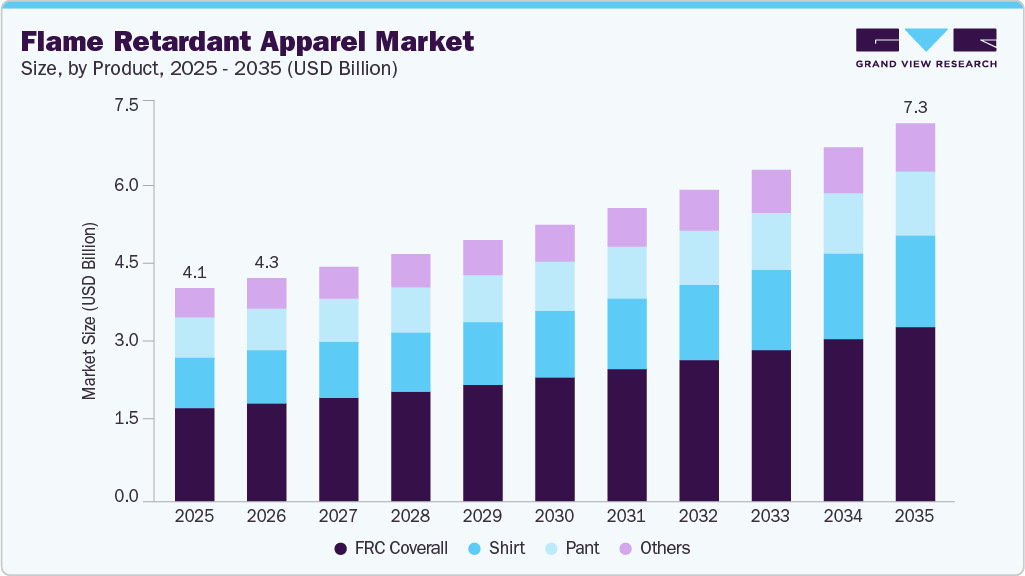 To learn more about this report, Download Free Sample Report
 The flame retardant apparel market is primarily driven by the growing enforcement of safety standards that require protective clothing to minimize fire hazards. Moreover, innovations in fabrics have resulted in lighter, more comfortable, and versatile flame-resistant materials, encouraging wider use.
 To learn more about this report, Download Free Sample Report
 Increasing focus on eco-friendly and sustainable flame retardant solutions is also boosting market growth. Furthermore, the adoption of smart textile technologies is opening new opportunities by enhancing safety features and real-time monitoring capabilities.
Market Concentration & Characteristics
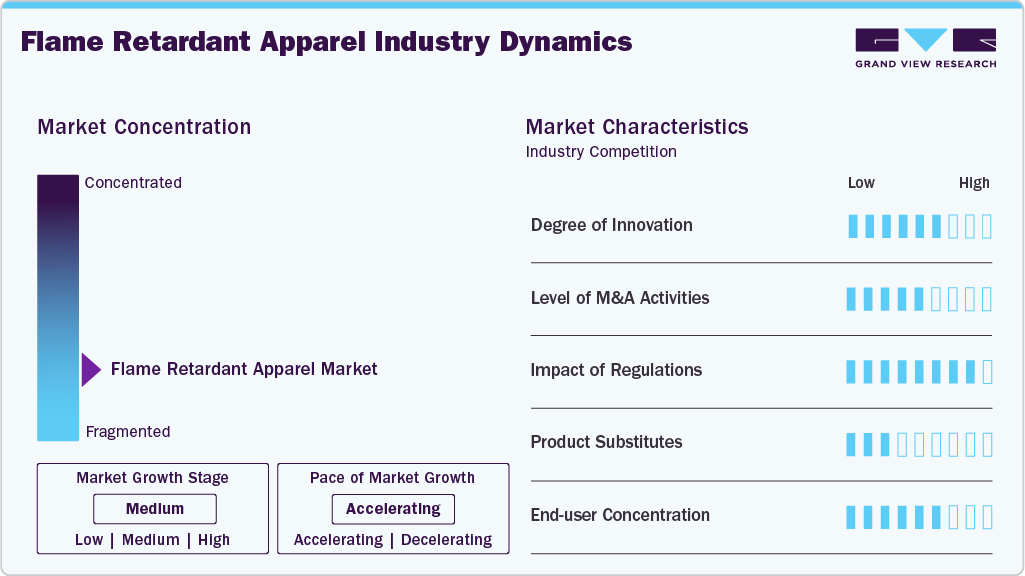
The global flame retardant apparel market is fragmented, with several established companies competing alongside a large number of smaller and regional players. This diverse competitive landscape drives innovation and a wide range of product offerings, preventing any single company from dominating the market. Although mergers and acquisitions occur, they have not significantly altered the overall market structure, allowing competition to remain balanced.
The global flame retardant apparel market is significantly influenced by stringent safety regulations aimed at protecting workers from fire hazards. Governments worldwide are enforcing policies that require the use of flame-resistant clothing, driving industries to adopt advanced protective apparel to comply with these standards. This regulatory framework not only boosts market demand but also encourages innovation, as companies develop more comfortable, durable, and sustainable flame retardant materials. The focus on enhancing both safety and wearability is fostering continuous advancements in fabrics and designs.
 To learn more about this report, Download Free Sample Report
 The flame retardant apparel market faces some substitution from fibers like polyester and aramid, and evolving non-halogenated flame retardant chemicals. However, strict safety standards and performance needs keep demand strong for specialized flame retardant fabrics. Continuous innovation in materials also helps maintain market competitiveness.
Advancements in products are key drivers in the development of the flame retardant apparel market. The creation of new flame-resistant fibers and innovative fabric treatments has greatly enhanced the comfort, durability, and protective qualities of these garments. This progress allows the apparel to meet a wide range of safety standards and adapt to different working conditions. Additionally, emerging smart textile technologies are beginning to offer features like real-time hazard detection and wearer monitoring, further improving safety and functionality.
Drivers, Opportunities & Restraints
The growth of the global flame retardant apparel market is primarily driven by increasingly stringent safety regulations and a growing corporate focus on workplace protection. Regulatory agencies worldwide are enforcing standards that require the use of flame-resistant clothing, prompting organizations to adopt compliant apparel to meet these mandates. Additionally, the demand for advanced, comfortable, and sustainable flame retardant materials is rising, supporting operational efficiency and worker safety. This regulatory and innovation-driven environment makes flame retardant apparel a strategic investment across various industrial sectors, fueling sustained market expansion.
Significant growth opportunities in the global flame retardant apparel market arise from the integration of advanced technologies such as automation, IoT, and AI-driven analytics. These innovations enable real-time monitoring of wearer safety, enhance garment performance, and support predictive maintenance of protective gear. Additionally, rapid industrialization in emerging regions such as Asia-Pacific, Africa, and Latin America, combined with tightening safety regulations, creates a favorable environment for market expansion. Strategic collaborations and government initiatives focused on workplace safety and sustainability further strengthen the market potential for both established brands and new entrants.
The adoption of flame retardant apparel faces challenges due to the high costs associated with advanced fabric production and ongoing research & development, which increase prices and limit accessibility for small and medium-sized enterprises. The technical complexity of meeting diverse, stringent safety regulations also slows product development and market entry. Additionally, fluctuating raw material and energy costs impact manufacturing expenses, making companies cautious about investing in premium flame retardant apparel. These factors, combined with occasional low compliance and preference for less expensive alternatives, particularly in price-sensitive regions, restrain the overall market growth despite its strong potential.
Product Insights
Shirt product segment is expected to grow at a considerable CAGR of 6.2% from 2026 to 2035 in terms of revenue. The FRC coverall product segment held a significant share of the market and accounted for a share of 43.7% in 2025. Flame retardant coveralls are leading the market due to their ability to provide extensive protection that aligns with strict safety regulations across industries such as oil & gas and defense & law enforcement. Improvements in materials have made these garments more comfortable, durable, and breathable, encouraging wider use.
The growing demand for shirts is largely due to the need for protective clothing that combines safety with comfort, especially in industries like manufacturing and firefighting. These shirts provide a lightweight and breathable option suitable for everyday use in hazardous conditions. Strengthening safety regulations and the development of inherently flame-resistant materials are further encouraging their use. Improvements in fabrics that enhance both durability and comfort are also contributing to the rising popularity of flame retardant shirts worldwide.
Fabric Insights
The inherent fabric segment is expected to grow at a considerable CAGR of 6.6% from 2026 to 2035 in terms of revenue. Treated fabric segment held a significant share of the market and accounted for a share of 56.4% in 2025. The treated fabric segment holds a major share due to its cost-effective flame resistance achieved through chemical treatments. These fabrics offer reliable protection while maintaining comfort, making them popular across multiple industries. Their versatility and compliance with safety standards drive widespread adoption. Further, growing emphasis on workplace safety further supports the demand for treated flame retardant fabrics.
The inherent fabric segment is expected to grow considerably over the forecast period as these fabrics have flame resistance built into their chemical structure, providing long-lasting and reliable protection that does not wash out or degrade. This durability and consistent performance make inherent fabrics highly preferred in industries with strict safety standards, such as aerospace, automotive, and construction.
Type Insights
The disposable type segment is expected to grow at a CAGR of 4.3% from 2026 to 2035 in terms of revenue.The durable type segment held a significant share of the market, accounting for 86.2% in 2025. The durable segment leads the flame retardant market because it provides long-term protection and holds up well in tough work environments. These products offer consistent flame resistance, reducing replacement costs and improving efficiency. Their strength, combined with meeting strict safety standards, drives wide use, especially in industries such as oil & gas, manufacturing, and construction, thereby driving market growth.
The disposable segment in the flame retardant apparel market is driven by demand from industries like oil & gas, chemicals, and emergency response, where short-term protection is essential. These single-use garments offer lightweight, cost-effective safety against sparks, heat, and limited chemical exposure. Their convenience and hygiene benefits make them ideal for high-turnover environments and temporary hazardous tasks.
End Use Insights
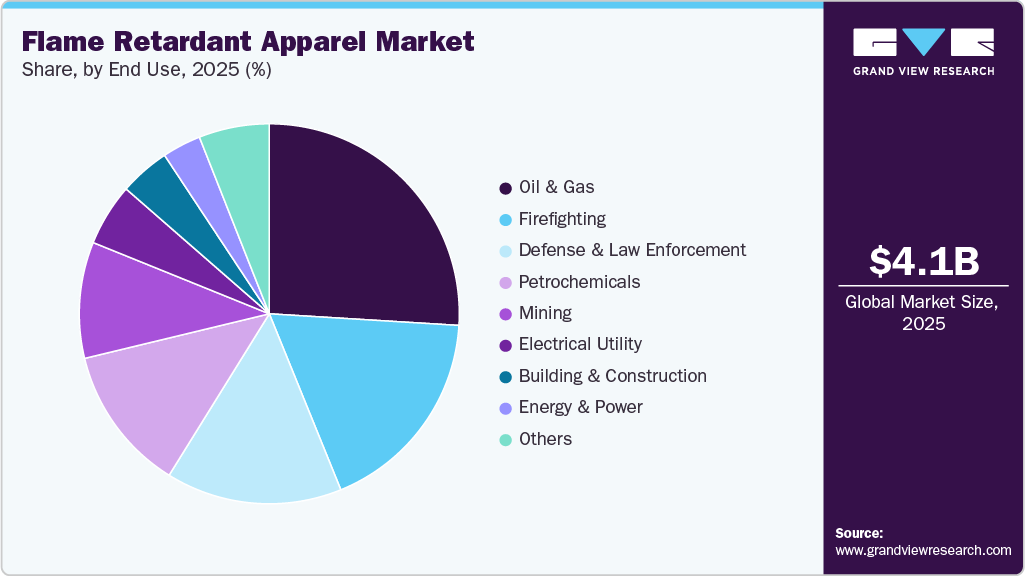
The petrochemical end-use segment is expected to grow at a considerable CAGR of 7.2% from 2026 to 2035 in terms of revenue. The oil & gas end use segment held a significant share of the market and accounted for a share of 26.0% in 2025. The oil & gas industry dominates the flame retardant apparel market due to the high-risk nature of its operations, which demand stringent safety standards and reliable protective clothing. Workers in this sector are regularly exposed to fire hazards, making flame retardant garments essential for compliance and safety. Additionally, strict regulatory requirements and growing emphasis on workplace safety drive consistent demand for advanced flame retardant apparel.
 To learn more about this report, Download Free Sample Report
 The petrochemical sector is seeing substantial growth owing to stricter fire safety regulations aimed at preventing accidents. These rules require flame retardants in many petrochemical products, like cables and insulation. Moreover, higher demand for polyolefins, which need flame retardants to improve fire safety, is boosting this growth. Furthermore, the ongoing expansion and modernization of petrochemical facilities worldwide are driving increased adoption of advanced flame retardant apparel.
Regional Insights
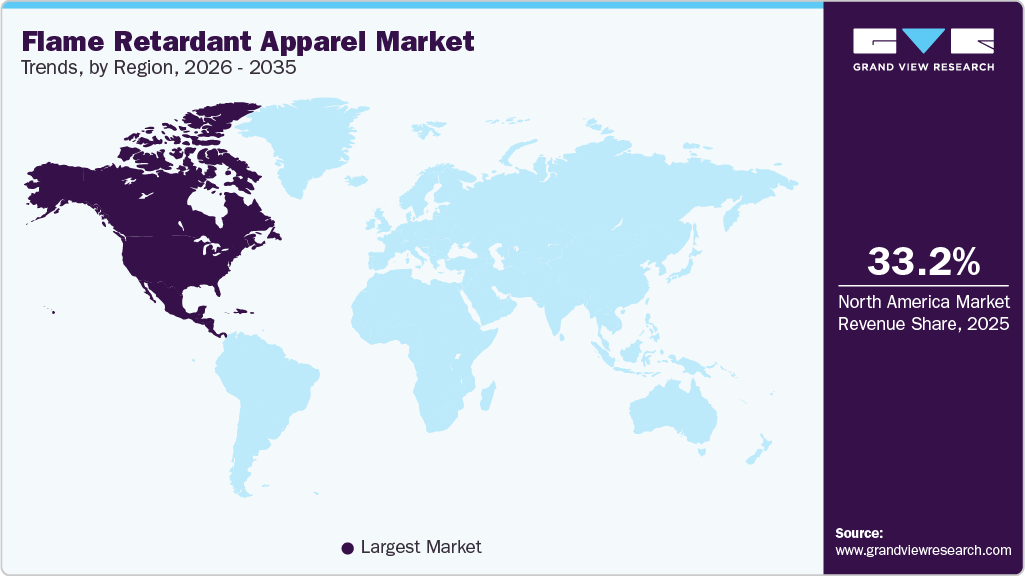
The North America region led the market and accounted for 33.2% of the global flame retardant apparel market in 2025. North America leads the global flame retardant market due to strict fire safety regulations across key industries such as oil & gas, defense & law enforcement, and building & construction.
 To learn more about this report, Download Free Sample Report
 Ongoing investments in infrastructure and industrial development continue to fuel demand for protective clothing with flame-resistant properties. Additionally, the growing emphasis on sustainable, non-toxic flame retardant solutions, coupled with advancements in material technologies, further supports market growth in the region.
U.S. Flame Retardant Apparel Market Trends
The flame retardant apparel market in the U.S. is expected to grow at a CAGR of 5.8% from 2026 to 2035. The U.S. holds the largest share of the North American flame retardant apparel market, largely driven by stringent OSHA regulations that require the use of flame-resistant clothing in hazardous work environments. Moreover, growth is supported by substantial investments in sectors such as firefighting, oil & gas, and manufacturing.
The flame retardant apparel market in Canada is expected to grow at a CAGR of 4.5% from 2026 to 2035. Canada’s flame retardant apparel market grows steadily, driven by industrial safety regulations and expansion in mining, oil & gas, and construction sectors. The government’s focus on worker safety and compliance with international standards supports market adoption.
Europe Flame Retardant Apparel Market Trends
Europe’s flame retardant market is fueled by stringent safety standards and increasing demand for protective materials. Strong environmental regulations encourage the use of sustainable and non-toxic flame retardants. Investments in research and innovation are driving the development of advanced flame retardant technologies. Additionally, government policies aimed at reducing fire-related hazards continue to support market expansion.
The Germany flame retardant apparel market held 21.4% share in the European market. Germany’s flame retardant apparel market benefits from its large industrial base, including automotive, manufacturing, and chemical sectors requiring high safety standards. Strict workplace safety laws drive demand for advanced flame retardant clothing. The country is also a hub for innovation in protective textiles, focusing on durability and comfort.
The UK flame retardant apparel market is driven by stringent national safety regulations, such as British Standards like BS EN ISO 11612 and EN ISO 14116, which set high requirements for flame resistance in protective clothing. These standards ensure widespread adoption of flame retardant apparel across industries with fire and heat hazards. Growing awareness of workplace safety and compliance with fire protection laws further boosts demand. Additionally, innovation by local manufacturers in durable and comfortable flame-resistant fabrics supports market growth.
Asia Pacific Flame Retardant Apparel Market Trends
The Asia Pacific flame retardant apparel market is expected to grow 7.2% CAGR during the forecast period and is driven by increasing industrialization and rising safety awareness. Strict regulations and growing demand for flame retardant apparel in sectors like manufacturing and firefighting support this expansion. Innovations in comfortable, durable, and eco-friendly flame retardant materials are boosting adoption. Additionally, rising disposable incomes and urbanization contribute to the region's strong market growth.
China's flame-retardant apparel market held a significant share in the Asia Pacific market due to its large industrial base and growing focus on worker safety. Strong manufacturing capabilities and government regulations drive demand for protective clothing. Rapid urbanization and infrastructure development further boost market growth. Additionally, increasing investments in high-risk sectors like oil & gas and building & construction contribute to China’s leading position.
The flame retardant apparel market in India is driven by rapid industrialization and increasing focus on workplace safety. Rising demand in sectors like oil & gas and construction, along with strict fire safety regulations, fuels market expansion. Technological advancements in comfortable and durable flame retardant fabrics also support growth. Additionally, growing infrastructure development and urbanization contribute to the rising need for protective apparel.
Middle East & Africa Flame Retardant Apparel Market Trends
The Middle East & Africa flame retardant apparel market is experiencing steady growth, driven by increasing safety regulations and rising awareness of worker protection in high-risk industries such as oil and gas, construction, and manufacturing. The region’s expanding industrial activities and infrastructure development are fueling demand for flame retardant clothing to ensure compliance with stringent workplace safety standards. Additionally, governments are emphasizing fire hazard reduction, which supports wider adoption of advanced flame retardant fabrics and protective wear.
The UAE flame retardant apparel market is growing steadily, supported by stringent safety standards in sectors such as oil & gas, construction, and firefighting. The country’s strong industrial base and emphasis on worker protection drive demand for high-performance, flame-resistant clothing. Aramid fibers remain popular due to their durability and heat resistance, while increasing awareness around safety continues to fuel adoption across both public and private sector projects.
Latin America Flame Retardant Apparel Market Trends
The Latin America flame retardant apparel market is driven by the need to protect workers in hazardous environments such as mining and oil extraction. Growing investments in infrastructure projects are driving demand for safety-compliant protective clothing. Heightened regulatory focus on fire prevention and worker safety is encouraging companies to adopt flame retardant solutions. Additionally, rising awareness of occupational hazards is pushing organizations to prioritize protective apparel for their workforce.
The Brazil flame retardant apparel market leads Latin America market, supported by its large oil & gas and mining sectors requiring protective clothing. Government safety regulations are strengthening, promoting market growth. Economic challenges pose some restraints, but infrastructure development and industrial expansion sustain demand.
Key Flame Retardant Apparel Company Insights
Some of the key players operating in the market include 3M Company, Ansell Limited, and PIP
-
3M is a multinational conglomerate known for its innovation in safety and protective products, including flame retardant apparel. Their flame retardant garments are widely used in industrial, defense, and firefighting sectors. 3M focuses heavily on research and development to enhance flame resistance, durability, and comfort in their apparel offerings, addressing critical safety needs in hazardous environments
-
Ansell Limited is a global player in personal protective equipment, specializing in chemical-resistant gloves and flame retardant protective apparel for industrial, healthcare, and chemical sectors. The company is known for its innovative safety solutions that enhance worker protection and comfort in hazardous environments. Ansell’s products are widely used in industries requiring high safety standards, including oil and gas, manufacturing, and firefighting. With a strong focus on quality and compliance, Ansell continues to drive advancements in protective clothing technology.
Key Flame Retardant Apparel Companies:
The following key companies have been profiled for this study on the flame retardant apparel market.
- 3M Company
- ANSELL LTD.
- PIP
- Benchmark FR
- Workwear Outfitters, LLC.
- Cintas Corporation
- Lakeland Inc.
- NSA - National Safety Apparel.
- MSA
- Scandia
Recent Developments
-
In December 2025, National Safety Apparel expanded its safety product offering with the acquisition of Nasco Industries. This move adds complementary protective apparel and safety gear to NSA’s portfolio, strengthening its position in industrial safety markets. The deal enhances NSA’s ability to serve customers with a broader range of FR and PPE solutions.
-
In April 2025, National Safety Apparel (NSA), backed by Blue Point Capital Partners, acquired Tri-Star Glove, a manufacturer specializing in inherent flame-resistant gloves. This acquisition expands NSA’s product portfolio and strengthens its position in the flame retardant protective gear segment, reflecting ongoing consolidation trends in the market aimed at broadening offerings and enhancing market reach.
-
In July 2024, Ansell Limited announced the successful acquisition of Kimberly-Clark’s Personal Protective Equipment (KCPPE) business. This strategic initiative is aimed at reinforcing Ansell’s leadership in the global PPE market by broadening its product portfolio, strengthening its presence across key industries, and enhancing its ability to deliver integrated safety solutions across diverse geographic markets.
Flame Retardant Apparel Market Report Scope
Report Attribute
Details
Market size in 2025
USD 4.1 billion
Estimated market size in 2026
USD 4.3 billion
Projected market size by 2035
USD 7.3 billion
Growth rate
CAGR of 6.0% from 2026 to 2035
Historical data
2021 - 2024
Forecast period
2026 - 2035
Quantitative units
Revenue in USD million and CAGR from 2026 to 2035
Report coverage
Revenue forecast, competitive landscape, growth factors, and trends
Segments covered
Type, product, fabric, end use, and region
Regional scope
North America; Europe; Asia Pacific; Latin America; Middle East & Africa
Country scope
U.S.; Canada; Mexico; UK; Germany; France; Spain; Italy; China; Japan; India; Australia; South Korea; Pakistan; Brazil; Argentina; Saudi Arabia; South Africa; UAE
Key companies profiled
3M Company; ANSELL LTD.; PIP; Benchmark FR; Workwear Outfitters, LLC.; Cintas Corporation; Lakeland Inc.; NSA - National Safety Apparel.; MSA; Scandia
Customization scope
Free report customization (equivalent up to 8 analysts working days) with purchase. Addition or alteration to country, regional & segment scope.
Pricing and purchase options
Avail customized purchase options to meet your exact research needs. Explore purchase options
Global Flame Retardant Apparel Market Report Segmentation
This report forecasts revenue growth at global, regional, and country levels and provides an analysis of the latest industry trends in each of the sub-segments from 2021 to 2035. For this study, Grand View Research has segmented the global flame retardant apparel market report based on type, product, fabric, end use, and region.
-
Product Outlook (Revenue, USD Million, 2021 - 2035)
-
Shirt
-
Pant
-
FRC Coverall
-
Others
-
-
Type Outlook (Revenue, USD Million, 2021 - 2035)
-
Durable
-
Disposable
-
-
Fabric Outlook (Revenue, USD Million, 2021 - 2035)
-
Inherent
-
Modacrylic-blend
-
Aramid-blend
-
Others
-
-
Treated
-
Treated Cotton
-
Cotton-synthetic Blend
-
-
-
End Use Outlook (Revenue, USD Million, 2021 - 2035)
-
Defense & Law Enforcement
-
Firefighting
-
Structural Firefighting
-
Wildland Firefighting
-
-
Oil & Gas
-
Petrochemicals
-
Mining
-
Energy & Power
-
Building & Construction
-
Electrical Utility
-
Others
-
-
Regional Outlook (Revenue, USD Million, 2021 - 2035)
-
North America
-
U.S.
-
Canada
-
Mexico
-
-
Europe
-
Germany
-
France
-
Italy
-
Spain
-
UK
-
-
Asia Pacific
-
China
-
India
-
Japan
-
South Korea
-
Australia
-
Pakistan
-
-
Latin America
-
Brazil
-
Argentina
-
-
Middle East and Africa
-
Saudi Arabia
-
UAE
-
South Africa
-
-
Frequently Asked Questions About This Report
North America dominated the global flame retardant apparel market with a revenue share of 33.2% in 2025, supported by stringent fire safety regulations and strong demand from industries such as oil & gas, defense, and construction.
The oil & gas segment held the largest market share of 26.0% in 2025 due to the high-risk nature of operations and strict workplace safety requirements.
The durable segment accounted for the largest market share of 86.2% in 2025, driven by its long-term protection, durability, and suitability for harsh industrial environments.
The treated fabric segment held the largest market share of 56.4% in 2025 due to its cost-effective flame resistance, versatility, and compliance with industrial safety standards.
The FRC coverall segment led the market with a revenue share of 43.7% in 2025, owing to its ability to provide extensive protection and comply with stringent workplace safety regulations.
The global flame retardant apparel market size was valued at USD 4.1 billion in 2025 and is estimated at USD 4.3 billion in 2026.
The global flame retardant apparel market is expected to grow at a CAGR of 6.0% from 2026 to 2035, reaching USD 7.3 billion by 2035.
Asia Pacific is the fastest-growing regional market and is projected to expand at a CAGR of 7.2% during the forecast period.
Some of the key players operating in the flame retardant apparel market include 3M Company, ANSELL LTD., PIP, Benchmark FR, Workwear Outfitters, LLC., Cintas Corporation, Lakeland Inc., NSA - National Safety Apparel., MSA, and Scandia.
Key factors driving the market include stringent workplace safety regulations, rising industrialization, growing awareness of occupational hazards, increasing demand for advanced and sustainable flame-resistant materials, technological advancements in protective textiles, and expanding adoption across high-risk industries such as oil & gas, petrochemicals, utilities, and firefighting services.
About the Author(s)
Advanced Interior Materials Research Team
Advanced Materials · Advanced Interior MaterialsThis report was authored by the advanced interior materials research team at Grand View Research - comprising two research analysts, one senior research analyst, and one industry expert - with specialized expertise in the advanced interior materials segment of the advanced materials industry. All findings are based on proprietary advanced materials databases, executive interviews, and regulatory analysis, subject to internal peer review prior to publication.
Last Updated:
Speak to Analyst

Customize this report to your needs - add regions, segments, or data points, with 20% free customization.
Or view our licence options:


ISO 9001:2015 & 27001:2022 Certified
We are GDPR and CCPA compliant! Your transaction & personal information is safe and secure. For more details, please read our privacy policy.


