
- Home
- »
- Advanced Interior Materials
- »
-
Flexible Waterproofing Membranes Market Size Report, 2033GVR Report cover

Flexible Waterproofing Membranes Market (2026 - 2033)
Size, Share & Trends Analysis Report By Product Type (Bituminous Membranes, PVC Membranes, TPO Membranes), By Application (Roofing, Walls & Facades, Water & Wastewater), By End-use, By Region, And Segment Forecasts
Market Size, 2025
$9.9BMarket Estimate, 2026
$10.6BMarket Forecast, 2033
$17.3BCAGR, 2026–2033
7.3%Flexible Waterproofing Membranes Market Summary
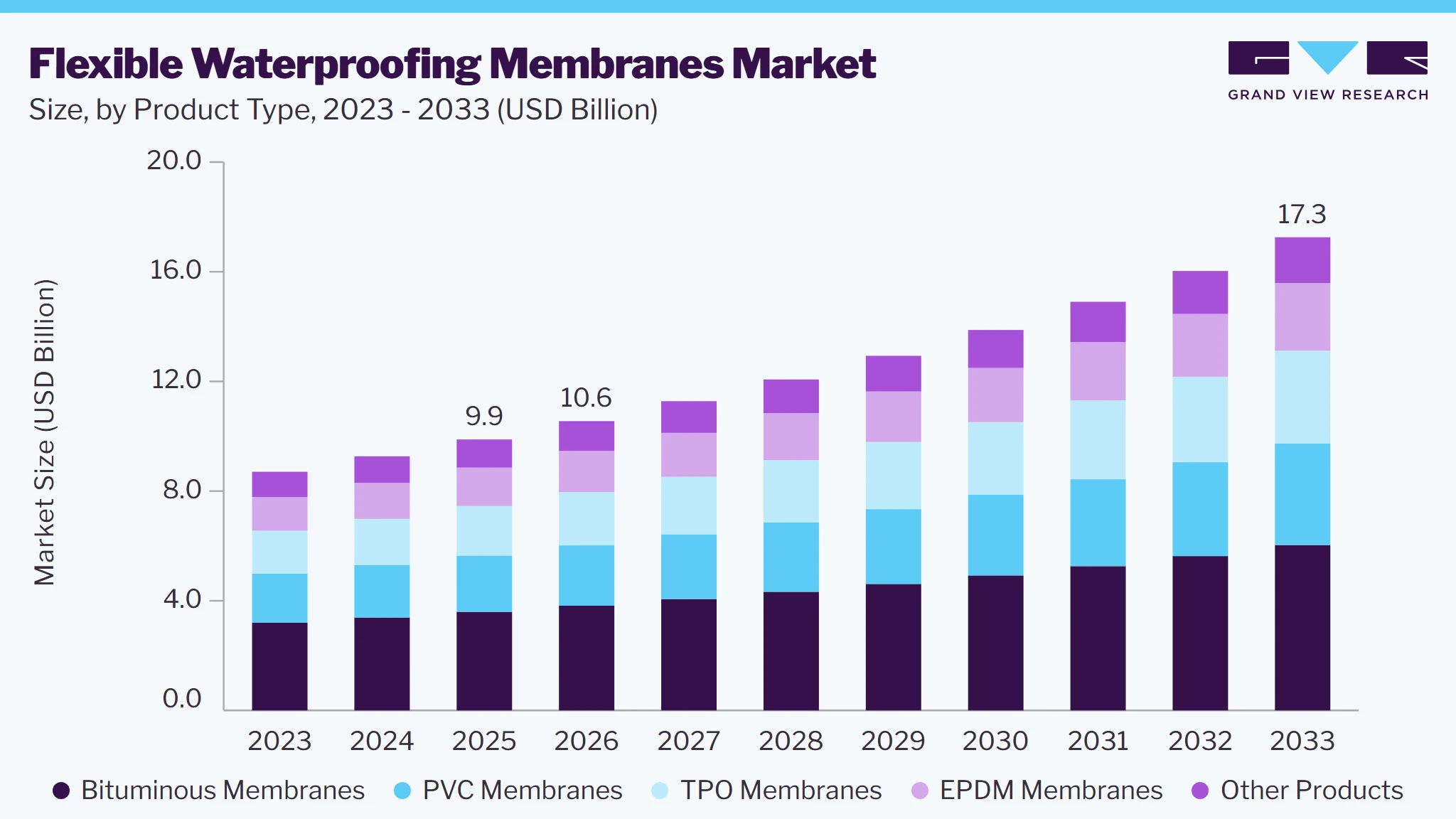
The global flexible waterproofing membranes market size was valued at USD 9.9 billion in 2025 and is projected to grow from USD 10.6 billion in 2026 to USD 17.3 billion by 2033, at a CAGR of 7.3% from 2026 to 2033. Asia Pacific dominated the market, accounting for a revenue share of 40.7% in 2025. The market growth is driven by increasing construction activity, infrastructure development, and the growing need to protect buildings and civil structures from water ingress, moisture, and weather-related deterioration.
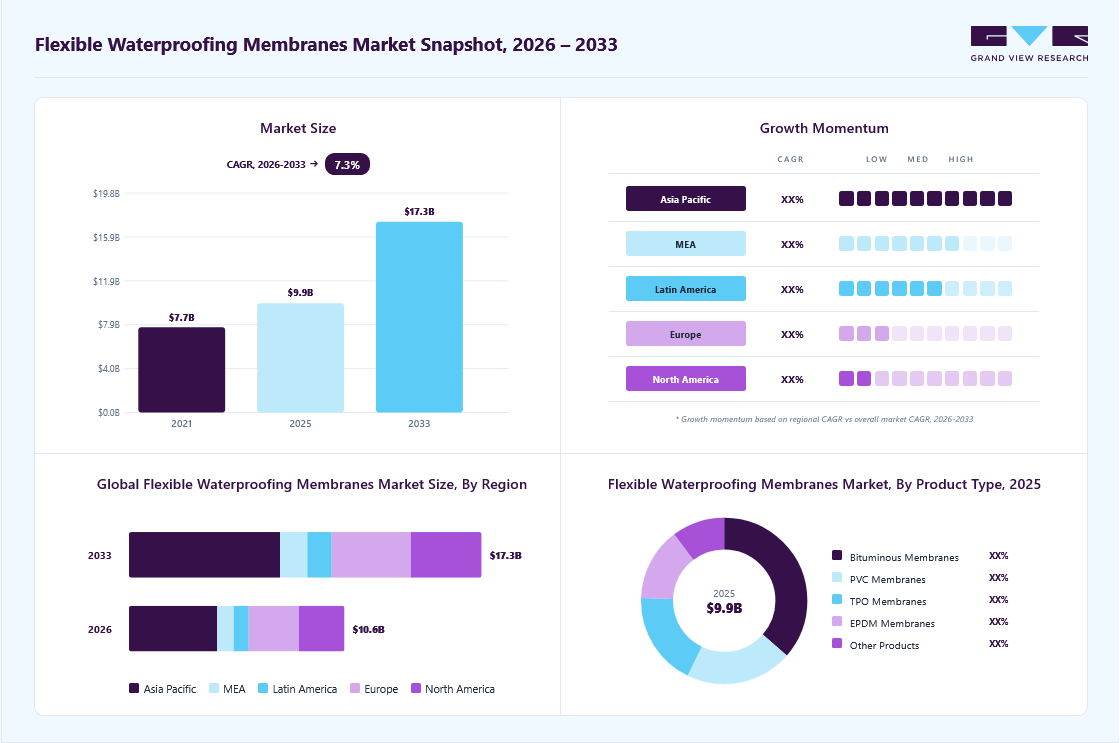 Source: Grand View Research, IR Documents, Primary Interviews, Paid DatabasesTo learn more about this report,
 Download Free Sample Report
Key Market Trends & Insights
- By end-use: The commercial buildings segment dominated the flexible waterproofing membranes market, accounting for a revenue share of 36.4% in 2025.
- By application: Roofing segment held the largest revenue share of 40.6% in 2025.
- By product type: Bituminous membranes segment held the largest revenue share of 36.4% in 2025.
Regional Highlights
- Largest regional market: Asia Pacific (40.7% revenue share, 2025)
- By country: China held the largest market share in 2025.
Market Size & Forecast
- Market size in 2025: USD 9.9 Billion
- Estimated market size in 2026: USD 10.6 Billion
- Projected market size by 2033: USD 17.3 Billion
- CAGR (2026-2033): 7.3%
GVR research-powered AIAsk Prism AI about the flexible waterproofing membranes marketGet cited answers from GVR research on market growth, segments, regulations and forecasts.Start with✓ Source-linked answers ✓ Market-specific context ✓ Traceable figuresExplore Prism AI ↗
Demand is increasing across residential, commercial, industrial, and infrastructure projects, where waterproofing is required for roofs, foundations, basements, walls, tunnels, bridges, and other exposed or below-grade structures.Rising urbanization and population growth are driving new construction, while the aging building stock in developed economies is creating additional demand for the renovation and replacement of existing waterproofing systems. Increasing awareness regarding structural durability and lifecycle maintenance is further supporting the adoption of reliable flexible membrane solutions.
 To learn more about this report, Download Free Sample Report
The market is witnessing increasing adoption of polymer-based and modified bituminous membranes that provide flexibility, durability, weather resistance, and improved resistance to mechanical stresses. TPO, PVC, and EPDM membranes are gaining importance in roofing and building-envelope applications because of their lightweight characteristics, resistance to UV exposure, and ability to accommodate building movement.
Modified bituminous membranes continue to see strong demand due to established installation practices, broad application suitability, and cost competitiveness. Manufacturers are also developing multilayer and reinforced membrane systems to improve puncture resistance, dimensional stability, service life, and overall waterproofing performance.
Sustainability, energy efficiency, and installation productivity are increasingly influencing product development across the flexible waterproofing membranes market. Manufacturers are focusing on membranes with improved recyclability, longer service lives, lower environmental impact, and compatibility with energy-efficient roofing systems. Self-adhesive, mechanically fastened, and heat-weldable membranes are also gaining attention for their ability to simplify installation and improve seam reliability. In addition, reflective and energy-efficient roofing membranes are being increasingly incorporated into building projects to reduce heat absorption and support broader energy-management objectives.
Market Dynamics
The flexible waterproofing membranes market is influenced by construction and infrastructure investment, renovation and refurbishment activity, increasing requirements for building durability, sustainability initiatives, and improvements in membrane technologies. Demand is also affected by climatic conditions, construction standards, project specifications, raw material prices, and the performance requirements associated with individual applications. The increasing emphasis on extending the service life of buildings and infrastructure is encouraging the use of durable waterproofing systems during both new construction and renovation projects.
Expanding residential, commercial, industrial, and infrastructure construction is generating sustained demand for flexible waterproofing membranes across roofs, foundations, basements, tunnels, bridges, parking structures, and other applications. Waterproofing is increasingly incorporated during the initial construction stage to prevent water penetration and minimize moisture-related deterioration. Rapid urbanization in developing economies is supporting new building construction, while investments in transportation, utilities, industrial facilities, and public infrastructure are creating additional applications for membrane systems. The increasing use of durable construction materials is also encouraging project developers and contractors to consider waterproofing as an important component of long-term asset protection.
Renovation and refurbishment activities are providing an additional source of demand, particularly in developed markets with large stocks of aging residential, commercial, and industrial buildings. Existing roofs, basements, and below-grade structures often require waterproofing replacement or rehabilitation to address leakage, material degradation, and evolving building performance requirements. Property owners are increasingly evaluating waterproofing upgrades alongside roof replacement, insulation improvements, and broader building-envelope renovations.
Advanced flexible waterproofing membrane systems can entail comparatively high material, surface preparation, installation, and skilled labor costs, particularly for complex roofing and below-grade applications. Proper substrate preparation, membrane placement, seam treatment, detailing around penetrations, and quality inspection are essential to achieving the expected service life of the system. Shortages of experienced installers can increase project timelines and installation costs in some markets. As a result, price-sensitive construction projects may favor lower-cost waterproofing coatings or conventional systems, particularly where long-term performance requirements are less stringent.
Growing emphasis on sustainable construction is creating opportunities for manufacturers to develop flexible waterproofing membranes with improved environmental profiles, durability, recyclability, and resource efficiency. Longer-lasting membrane systems can reduce the frequency of replacement and associated material consumption, while recyclable or recycled-content products can support circular construction objectives. Manufacturers are also developing products compatible with energy-efficient roofing systems, including reflective membranes and solutions designed for integration with insulation and renewable-energy installations.
Market Concentration & Characteristics
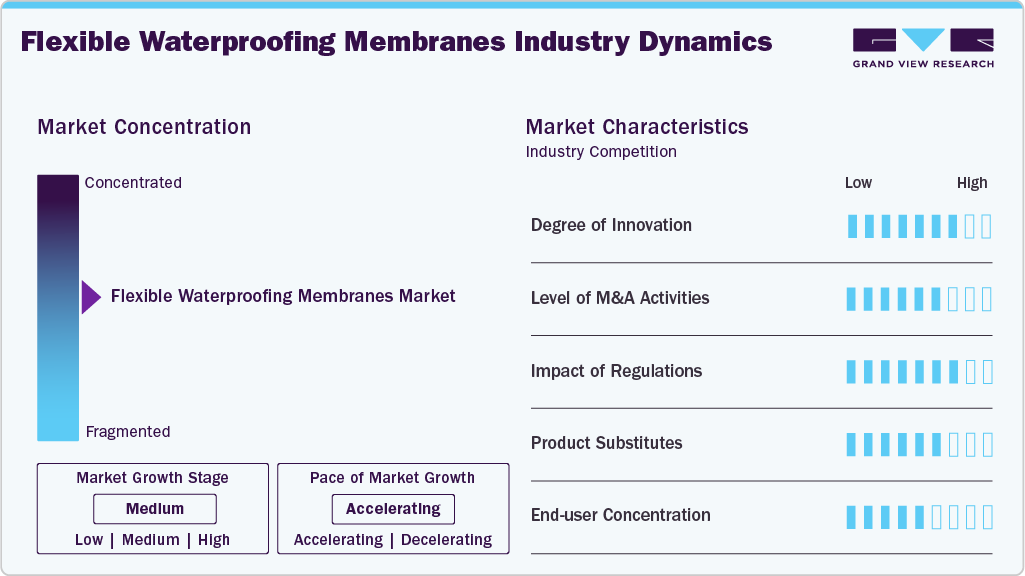
The flexible waterproofing membranes market is moderately consolidated, with major international construction material and specialty chemical companies competing alongside regional manufacturers and specialized waterproofing suppliers. Leading companies generally benefit from extensive product portfolios, established distribution networks, technical expertise, recognized brands, and relationships with contractors and construction companies. Regional manufacturers remain important because waterproofing requirements vary with climate, construction practices, regulations, and local pricing conditions. Competition is therefore influenced by product performance, application support, installation expertise, availability, warranties, and pricing.
 To learn more about this report, Download Free Sample Report
Flexible waterproofing membranes compete with liquid-applied waterproofing systems, cementitious waterproofing coatings, waterproofing admixtures, rigid barrier systems, and other surface-treatment technologies. Liquid-applied membranes can provide seamless coverage and are particularly suitable for irregular geometries, penetrations, and areas where conventional sheet installation can be difficult. Cementitious systems are commonly used for selected concrete and below-grade applications because of their compatibility with mineral substrates and relatively straightforward application. However, flexible membrane systems offer advantages for applications requiring continuous water barriers, movement accommodation, mechanical durability, and large-area coverage.
Analyst Perspective
The flexible waterproofing membranes market is expected to witness steady growth as construction and infrastructure projects increasingly prioritize long-term moisture protection, structural durability, and reduced maintenance requirements. Demand is shifting toward high-performance TPO, PVC, EPDM, FPO, and modified-bitumen membranes that offer flexibility, weather resistance, longer service life, and installation efficiency. Renovation of aging buildings, commercial reroofing, underground infrastructure, and sustainable construction are creating additional opportunities, while manufacturers are investing in production capacity, advanced membrane formulations, self-adhered systems, and environmentally responsible products.
Product Type Insights
The bituminous membranes segment held the largest revenue share of 36.4% in 2025, supported by their established use across roofing, foundations, basements, and other applications requiring durable protection against water penetration. Their proven performance, relatively straightforward installation, and compatibility with diverse building structures continue to support adoption across residential, commercial, and infrastructure projects.
The TPO membranes segment is expected to grow at a CAGR of 8.2% over the forecast period, as demand increases for lightweight, durable, and energy-efficient waterproofing solutions. TPO membranes are increasingly used in roofing systems for their resistance to weathering, UV exposure, and moisture, and for their heat-weldable seams, which provide reliable waterproofing performance. The growing preference for longer-lasting, lower-maintenance roofing materials is also supporting their adoption.
Application Insights
The roofing segment dominated the flexible waterproofing membranes industry, accounting for a revenue share of 40.6% in 2025, driven by the widespread need to protect buildings from rainfall, moisture, temperature fluctuations, and weather-related deterioration. Flexible membranes are widely used in commercial, industrial, and residential roofing systems because they provide continuous waterproofing and accommodate structural movement.
The water & wastewater segment is expected to grow at a CAGR of 8.4% over the forecast period, as waterproofing membranes are increasingly required to protect treatment facilities, reservoirs, tanks, pipelines, and containment structures from water leakage and chemical exposure. Infrastructure development and the expansion and modernization of water treatment facilities are supporting demand for flexible membrane systems that provide durable protection in continuously wet environments.
End-use Insights
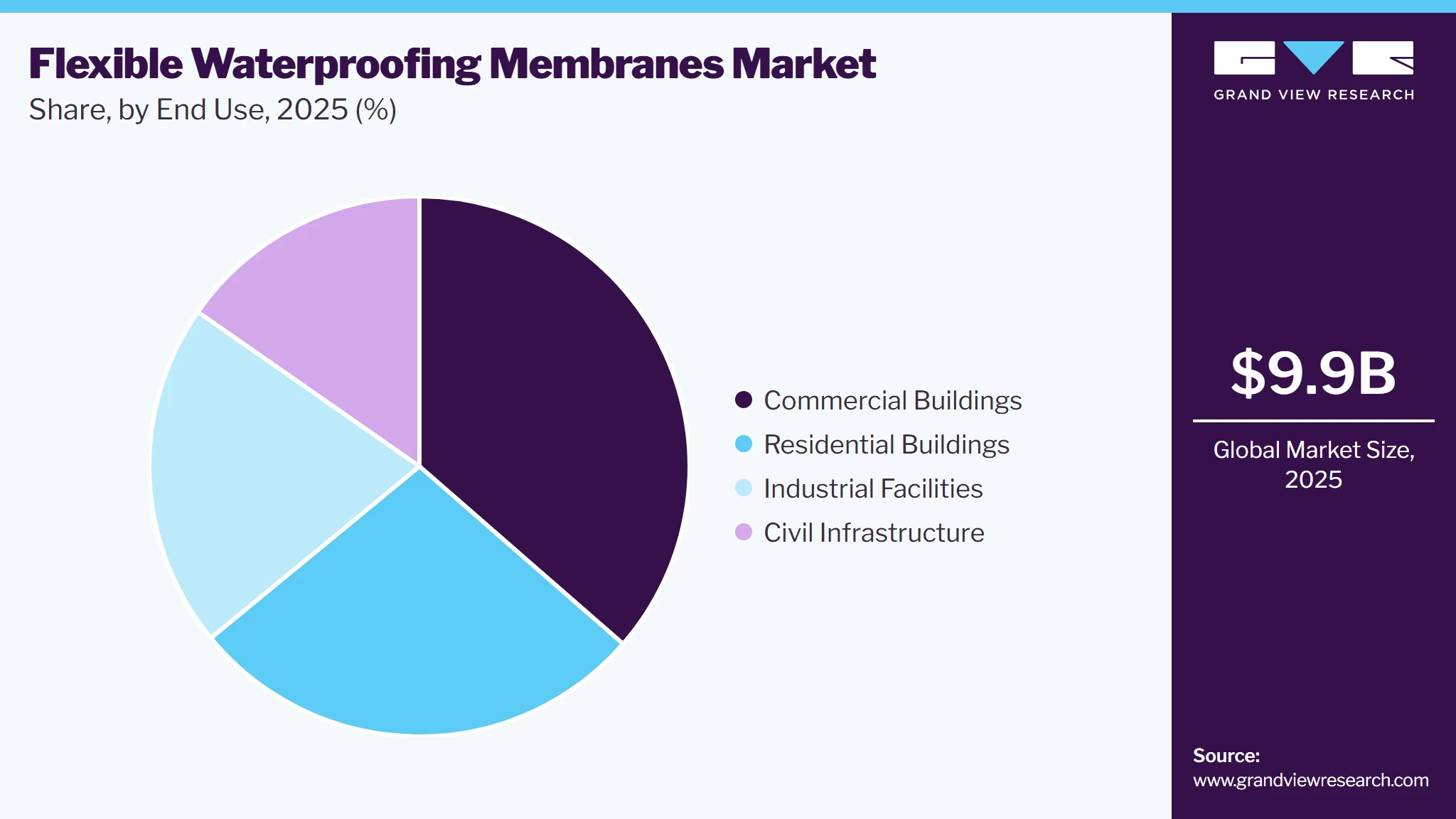
The commercial buildings segment dominated the flexible waterproofing membranes market, accounting for a revenue share of 36.4% in 2025, supported by extensive waterproofing requirements across roofs, foundations, basements, terraces, podiums, and other exposed building areas. Increasing construction and renovation of offices, retail facilities, hotels, and institutional buildings is sustaining demand for flexible membranes that provide long-term moisture protection while accommodating complex building designs.
 To learn more about this report, Download Free Sample Report
The industrial facilities segment is expected to grow at a CAGR of 8.0% over the forecast period, as manufacturing plants, warehouses, processing facilities, and other industrial structures require reliable waterproofing for roofs, floors, foundations, and water-retaining areas. Expansion of industrial infrastructure and the need to protect facilities and equipment from moisture-related deterioration are increasing the use of flexible waterproofing membrane systems.
Regional Insights
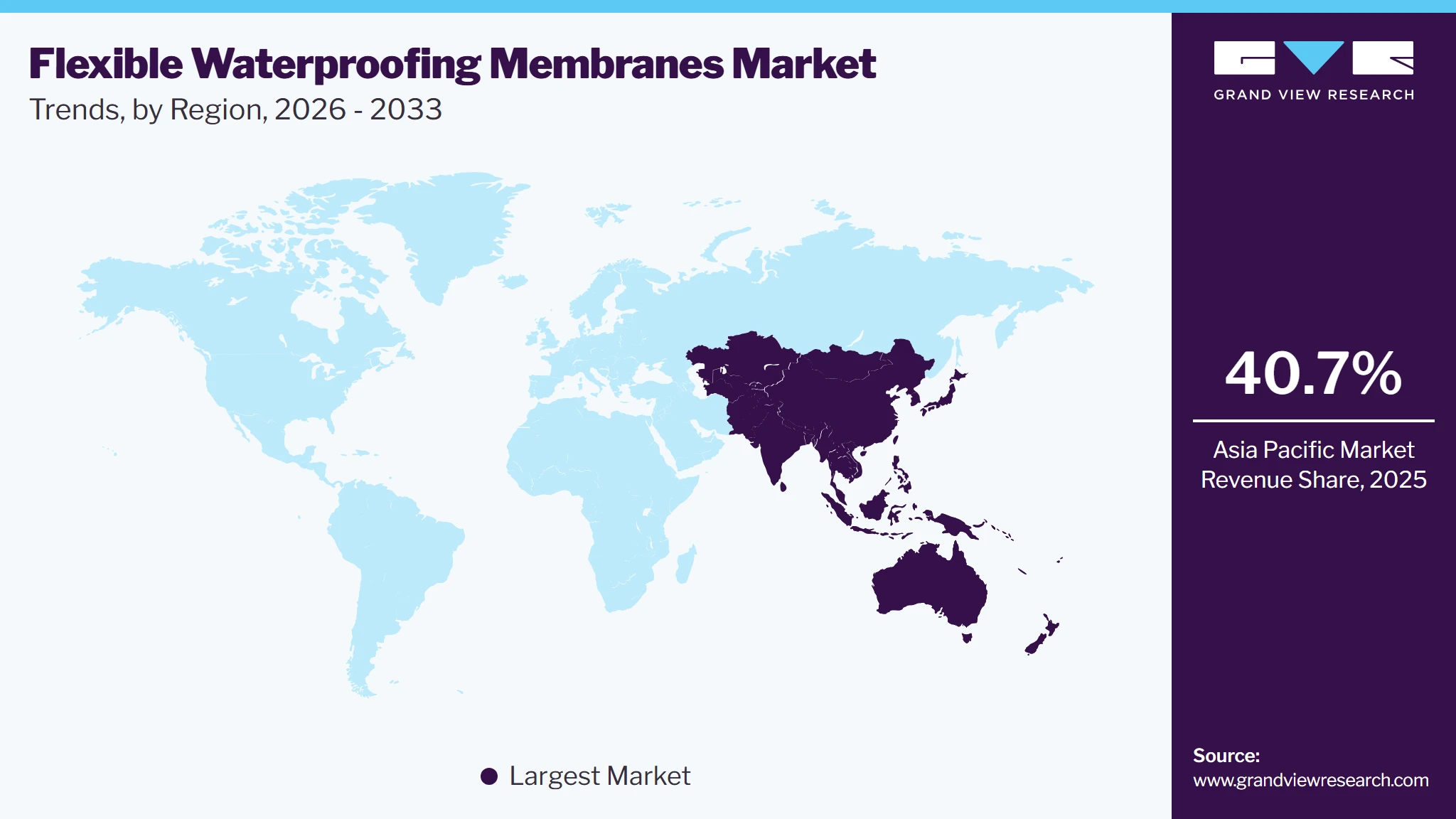
Asia Pacific dominated the global flexible waterproofing membranes market, accounting for the largest revenue share of 40.7% in 2025, driven by rapid urbanization, residential and commercial construction, infrastructure development, and industrial expansion. China and India are generating substantial construction activity, while Southeast Asian markets are also witnessing investments in commercial buildings, manufacturing facilities, transportation infrastructure, and urban development. The region's diverse climatic conditions, including heavy rainfall, humidity, and seasonal weather extremes, create significant requirements for effective waterproofing systems. Growing awareness of building durability and increasing adoption of modern construction materials are further supporting membrane demand.
 To learn more about this report, Download Free Sample Report
China Flexible Waterproofing Membranes Market Trends
China's flexible waterproofing membranes market is strongly influenced by its extensive urban infrastructure, transportation projects, industrial facilities, and large commercial and residential building stock. Waterproofing demand is particularly relevant in underground construction, tunnels, metro systems, foundations, and flat-roof applications, where water ingress can create significant structural and maintenance challenges. The country also has a large domestic manufacturing base for waterproofing materials, resulting in intense competition among local suppliers and international companies.
North America Flexible Waterproofing Membranes Market Trends
North America has a strong orientation toward commercial roofing and building-envelope applications, with single-ply membranes playing a particularly important role in low-slope roofing. TPO, PVC, and EPDM systems are widely used because they offer flexibility, weather resistance, and relatively efficient installation over large roof areas. Demand is also shaped by reroofing and replacement projects rather than being solely dependent on new construction, particularly across established commercial and industrial building stock.
The U.S. flexible waterproofing membranes market is particularly influenced by the large commercial and industrial roofing replacement cycle, with contractors and building owners placing significant emphasis on installation productivity, warranty requirements, energy performance, and total lifecycle cost. TPO has gained substantial use in commercial roofing, while PVC and EPDM remain important for applications requiring specific chemical, weathering, or durability characteristics. Severe weather events, including hurricanes, hail, heavy rainfall, and temperature extremes, also create demand for robust roofing assemblies and improved attachment systems.
Europe Flexible Waterproofing Membranes Market Trends
Europe has a strong renovation-driven waterproofing market, reflecting its extensive inventory of older residential, commercial, and industrial buildings. Energy-efficiency upgrades are frequently undertaken alongside roof refurbishment, creating opportunities to integrate waterproofing membranes with insulation and broader building-envelope improvements. Environmental considerations are also more prominent in product selection, with manufacturers focusing on recycled content, reduced material impacts, long service life, and end-of-life recyclability.
The Germany flexible waterproofing membranes market is distinguished by its strong renovation and technical construction standards, and an emphasis on long-term building performance. Waterproofing demand is closely linked to the refurbishment of commercial and residential roofs, basements, underground structures, and building envelopes, rather than being driven exclusively by new construction. Flat-roof systems are particularly important because of Germany's extensive use of flat and low-slope roof designs in commercial and industrial buildings. Sustainability and energy efficiency are increasingly incorporated into renovation decisions, encouraging the use of durable membranes alongside insulation upgrades and solar-ready roofing systems.
Central and South America Flexible Waterproofing Membranes Market Trends
Central & South America presents a highly climate-dependent waterproofing market, with heavy rainfall and humidity in tropical areas creating strong requirements for roof and building protection, while countries with more arid climates have different priorities related to UV exposure and thermal cycling. Brazil is an important market due to its large construction sector and extensive use of waterproofing in residential, commercial, and infrastructure projects.
Middle East & Africa Flexible Waterproofing Membranes Market Trends
The Middle East flexible waterproofing membranes industry is primarily shaped by large commercial developments, airports, hotels, industrial facilities, transportation infrastructure, and ambitious urban projects, creating demand for high-performance waterproofing systems. Extremely high temperatures, intense UV radiation, and thermal cycling require membranes with strong heat and weathering resistance, particularly for exposed roofing and infrastructure applications. In Africa, demand varies considerably across countries, with commercial construction, urban housing, industrial projects, and infrastructure investment as major application areas.
Key Flexible Waterproofing Membranes Company Insights
Some of the key players operating in the market include Sika AG and SOPREMA Group.
-
Sika AG is a Switzerland-based specialty chemicals company offering waterproofing solutions for roofing, basements, foundations, tunnels, and other construction applications. Its portfolio includes preformed membranes based on technologies such as PVC, TPO/FPO, EPDM, and modified bitumen.
-
SOPREMA Group is a global manufacturer of waterproofing and insulation solutions, with a broad portfolio of bituminous and synthetic membranes for roofing and building applications. The company serves residential, commercial, industrial, and infrastructure projects through its international manufacturing and distribution network.
Tremco and IKO Industries are some of the emerging market participants in the flexible waterproofing membranes market.
-
Tremco develops waterproofing, roofing, sealant, and building-envelope solutions for commercial and infrastructure applications. Its waterproofing portfolio includes sheet-applied and other membrane systems designed for foundations, below-grade structures, plazas, and other demanding construction environments.
-
IKO Industries is a manufacturer of roofing and waterproofing products serving residential, commercial, and industrial construction markets. Its portfolio includes modified-bitumen membranes and other waterproofing systems designed for low-slope roofing and building protection applications.
Key Flexible Waterproofing Membranes Companies:
The following key companies have been profiled for this study of the flexible waterproofing membranes market.
-
Sika AG
-
SOPREMA Group
-
Elevate
-
BMI Group
-
RENOLIT
-
Carlisle Construction Materials
-
IKO Industries
-
Tremco
-
Bauder
-
KÖSTER Bauchemie AG
Competitive Benchmarking
Category
Operating Strategies
Competitive Edge
Weakness
Established Players (Sika AG, SOPREMA Group, Elevate, BMI Group, RENOLIT, Carlisle Construction Materials)
- Invest in TPO, PVC, EPDM, FPO, and modified-bitumen membrane production to address growing demand across roofing, foundations, basements, tunnels, and infrastructure applications.
- Expand manufacturing and distribution capabilities through new production facilities, broader contractor networks, technical centers, and integrated waterproofing system portfolios.
- Focus on sustainable membranes, high-performance formulations, prefabricated systems, and installation technologies to serve commercial, industrial, residential, and infrastructure projects.
- Strong manufacturing scale and established positions across major construction and roofing markets.
- Broad portfolios covering synthetic, rubber, and bituminous waterproofing membranes for diverse applications and climatic conditions.
- Extensive technical expertise, contractor relationships, distribution networks, and project experience support large-scale and technically demanding waterproofing projects.
- High capital requirements for membrane manufacturing facilities, coating and extrusion equipment, quality-control systems, and product development.
- Exposure to fluctuations in bitumen, polymers, resins, plasticizers, and other raw material costs.
- Large multinational operating structures can create higher operating complexity and make companies more exposed to regional construction cycles and competitive pricing pressure.
Emerging Players (IKO Industries, Tremco, Bauder, KÖSTER Bauchemie AG)
- Expand flexible membrane portfolios across modified-bitumen, synthetic, TPO, PVC, and specialty waterproofing systems to capture growing demand in roofing and below-grade applications.
- Strengthen partnerships with architects, contractors, distributors, and building owners to increase specification and adoption of membrane-based waterproofing systems.
- Focus on application-specific membranes, sustainable product development, installation efficiency, and technical solutions for commercial, residential, industrial, and infrastructure projects.
- Strong specialization in roofing and construction waterproofing with products targeted toward specific application requirements.
- Established technical capabilities and regional distribution networks provide access to contractors and construction professionals.
- Flexible product development and application-focused solutions enable these companies to address regional construction requirements and specialized waterproofing projects.
- Smaller geographic footprint and manufacturing scale compared with the largest global waterproofing groups.
- Significant investment is required to expand production capacity, distribution infrastructure, and advanced membrane technologies.
- Dependence on regional construction activity, raw material availability, contractor adoption, and continued penetration of flexible membrane systems can constrain expansion in some markets.
Recent Developments
-
In February 2025, Sika launched the SikaShield brand and the new SikaShield HB79 hybrid modified-bitumen membrane in the U.S. The membrane combines APAO and SBS technologies into a single product.
-
In November 2025, Sika acquired Awazil Al Khaleej Industrial Facilities Co. (Gulf Seal), a Saudi Arabian manufacturer of bituminous waterproofing membranes.
Flexible Waterproofing Membranes Market Report Scope
Report Attribute
Details
Market size in 2025
USD 9.9 billion
Estimated market size in 2026
USD 10.6 billion
Projected market size by 2033
USD 17.3 billion
Growth rate
CAGR of 7.3% from 2026 to 2033
Base year for estimation
2025
Historical data
2021 - 2024
Forecast period
2026 - 2033
Quantitative units
Revenue in USD Million and CAGR from 2026 to 2033
Report coverage
Revenue forecast, company ranking, competitive landscape, growth factors, and trends
Segments covered
Product type, application, end-use, region
Regional scope
North America; Europe; Asia Pacific; Central & South America; Middle East & Africa
Country scope
U.S.; Canada; Mexico; UK; Germany; France; Italy; Spain; China; Japan; India; South Korea; Brazil; Saudi Arabia
Key companies profiled
Sika AG; SOPREMA Group; Elevate; BMI Group; RENOLIT, Carlisle Construction Materials, IKO Industries; Tremco; Bauder; KÖSTER Bauchemie AG
Customization scope
Free report customization (equivalent up to 8 analysts working days) with purchase. Addition or alteration to country, regional & segment scope.
Pricing and purchase options
Avail customized purchase options to meet your exact research needs. Explore purchase options
Global Flexible Waterproofing Membranes Market Report Segmentation
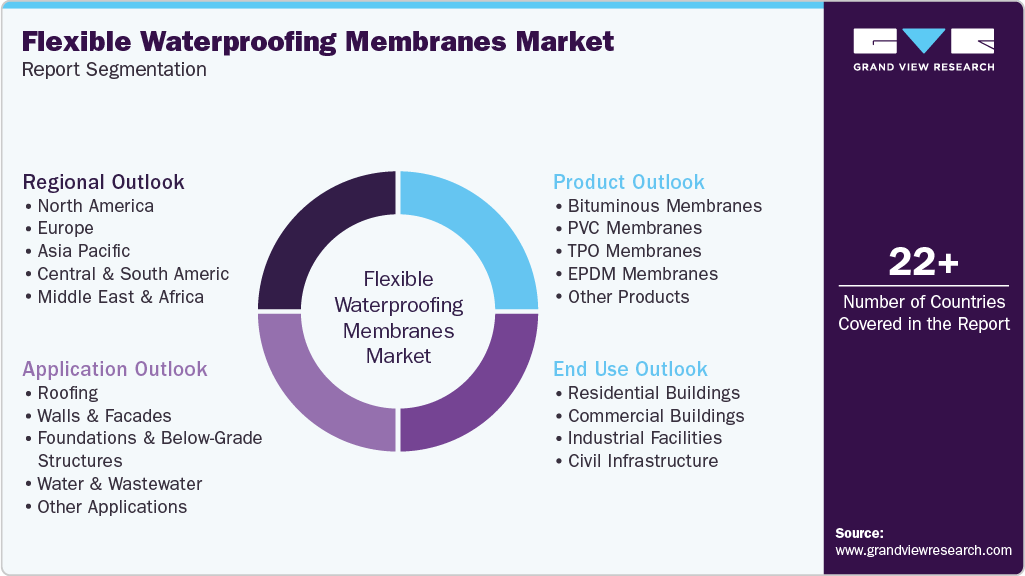
This report forecasts revenue growth at the global, regional & country levels and provides an analysis of the industry trends in each of the sub-segments from 2021 to 2033. For this study, Grand View Research has segmented the flexible waterproofing membranes market report based on product type, application, end-use, and region:
 To learn more about this report, Download Free Sample Report
-
Product Type Outlook (Revenue, USD Million, 2021 - 2033)
-
Bituminous Membranes
-
PVC Membranes
-
TPO Membranes
-
EPDM Membranes
-
Other Products
-
-
Application Outlook (Revenue, USD Million, 2021 - 2033)
-
Roofing
-
Walls & Facades
-
Foundations & Below-Grade Structures
-
Water & Wastewater
-
Other Applications
-
-
End-use Outlook (Revenue, USD Million, 2021 - 2033)
-
Residential Buildings
-
Commercial Buildings
-
Industrial Facilities
-
Civil Infrastructure
-
-
Regional Outlook (Revenue, USD Million, 2021 - 2033)
-
North America
-
U.S.
-
Canada
-
Mexico
-
-
Europe
-
UK
-
Germany
-
France
-
Italy
-
Spain
-
-
Asia Pacific
-
China
-
Japan
-
India
-
South Korea
-
-
Central and South America
-
Brazil
-
-
Middle East and Africa
-
Saudi Arabia
-
-
Research Methodology
The flexible waterproofing membranes market figures in this report are based on a proven research process that combines executive interviews with secondary research from proprietary databases, company filings, and recognized regulatory and institutional sources. Market size is built through value-chain sizing-reconciling supply-side and demand-side estimates-and triangulated with bottom-up and top-down approaches. Every estimate passes multiple levels of expert validation before publication, with each flexible waterproofing membranes segment quantified using the revenue-capture definitions in the table below.
Segment Definition
Segment - Product Type
Revenue Capture Definition
Bituminous Membranes
Revenue generated from the sale of flexible waterproofing membranes manufactured using bitumen as the primary waterproofing component, including polymer-modified bituminous sheets used for roofing, below-grade waterproofing, foundations, and related construction applications.
PVC Membranes
Revenue generated from the sale of flexible polyvinyl chloride (PVC) waterproofing membranes, including reinforced and non-reinforced products used for roofing, walls, foundations, tunnels, water-retaining structures, and other waterproofing applications.
TPO Membranes
Revenue generated from the sale of thermoplastic polyolefin (TPO) waterproofing membranes, primarily including flexible roofing and waterproofing sheets used in building envelopes, roofs, foundations, and other construction applications.
EPDM Membranes
Revenue generated from the sale of ethylene propylene diene monomer (EPDM) rubber waterproofing membranes used in roofing, foundations, below-grade structures, water-retaining systems, and other applications requiring flexible and weather-resistant waterproofing.
Other Products
Revenue generated from flexible waterproofing membrane products not classified under bituminous, PVC, TPO, or EPDM membranes, including other polymeric, elastomeric, and specialty membrane systems.
Segment - Application
Revenue Capture Definition
Roofing
Revenue generated from flexible waterproofing membranes supplied for waterproofing and moisture protection of roofs, including flat, low-slope, and other roof systems in new construction and renovation projects.
Walls & Facades
Revenue generated from flexible waterproofing membranes used to protect above-grade walls, exterior facades, building envelopes, and related vertical structures against water penetration and moisture ingress.
Foundations & Below-Grade Structures
Revenue generated from flexible waterproofing membranes used for foundations, basements, retaining structures, underground parking, tunnels, and other below-grade construction where protection against groundwater and moisture is required.
Water & Wastewater
Revenue generated from flexible waterproofing membranes used in water-retaining and water-management structures, including reservoirs, tanks, treatment facilities, canals, ponds, and wastewater containment systems.
Other Applications
Revenue generated from flexible waterproofing membranes used in applications not classified under roofing, walls & facades, foundations & below-grade structures, or water & wastewater, including specialty construction and other waterproofing projects.
Segment - End Use
Revenue Capture Definition
Residential Buildings
Revenue generated from flexible waterproofing membranes supplied for residential construction and renovation, including single-family homes, multifamily buildings, apartments, condominiums, and other residential structures.
Commercial Buildings
Revenue generated from flexible waterproofing membranes supplied for commercial buildings, including offices, retail properties, hotels, healthcare facilities, educational buildings, and other commercial structures.
Industrial Facilities
Revenue generated from flexible waterproofing membranes supplied for industrial facilities, including manufacturing plants, warehouses, logistics facilities, processing facilities, and other industrial structures.
Civil Infrastructure
Revenue generated from flexible waterproofing membranes supplied for infrastructure projects such as tunnels, bridges, transportation structures, water infrastructure, underground infrastructure, and other public or civil engineering projects.
Estimation Model
Layer Name
Key Question
Description
Parent Market Analysis
What is the overall size and growth outlook of the global waterproofing membranes market?
The analysis evaluates the broader waterproofing membranes market by considering construction activity, infrastructure development, renovation projects, building protection requirements, and adoption of advanced waterproofing systems to establish the addressable market for flexible waterproofing membranes.
Flexible Membrane Technology Penetration Analysis
What proportion of the waterproofing membranes market is represented by flexible membranes?
This layer assesses TPO, PVC, EPDM, FPO, modified bitumen, and other flexible membrane technologies based on adoption, performance, installation methods, manufacturing capacity, and suitability for roofing, foundations, basements, tunnels, and infrastructure applications.
Regional & Application Demand Assessment
Which regions and applications contribute the highest demand for flexible waterproofing membranes?
Demand is assessed across major regions and applications based on construction activity, renovation trends, climatic conditions, regulations, and infrastructure investment. Roofing, foundations, basements, tunnels, walls, and other applications are evaluated across residential, commercial, industrial, and infrastructure end uses.
Company Revenue Validation & Market Forecasting
How is the final market size validated and forecast?
Market estimates are validated using company revenues, product portfolios, manufacturing capacity, geographic presence, product launches, capacity expansions, acquisitions, partnerships, and secondary research. Bottom-up and top-down approaches are triangulated to develop market estimates and forecasts.
Delivered Customizations
We have successfully delivered the following deep-dive customizations:
Client Request
Customization Delivered
Value Adds
Product & Technology Benchmarking
Comprehensive comparison of TPO, PVC, EPDM, FPO, modified-bitumen, and other flexible waterproofing membranes based on flexibility, tensile strength, elongation, puncture resistance, weather and UV resistance, chemical resistance, service life, installation method, seam technology, and application suitability.
Enables stakeholders to benchmark membrane performance, identify technology gaps, optimize product portfolios, prioritize R&D investments, and select suitable membrane technologies across roofing, foundations, basements, tunnels, and infrastructure applications.
Regional Regulatory & Building Code Assessment
Detailed evaluation of regional waterproofing standards, roofing codes, fire-performance requirements, material certifications, installation standards, energy-efficiency requirements, environmental regulations, and sustainability criteria applicable to flexible membrane systems across major markets.
Supports regulatory compliance, reduces certification and project-approval risks, facilitates region-specific product adaptation and market entry, and identifies markets with favorable regulatory and construction conditions for flexible waterproofing membranes.
Sustainable Membrane & Circularity Assessment
Assessment of recycled-content availability, recyclable membrane technologies, low-emission formulations, material sourcing, manufacturing waste reduction, membrane service life, recovery and recycling practices, and end-of-life management across TPO, PVC, EPDM, FPO, and bituminous membrane systems.
Helps companies strengthen sustainable product strategies, evaluate circularity opportunities, respond to green-building requirements, reduce environmental impacts, and differentiate membrane products based on lifecycle sustainability and resource efficiency.
Frequently Asked Questions About This Report
Key factors driving the flexible waterproofing membranes market include increasing construction activity, rising infrastructure development, growing demand for durable moisture protection, and greater adoption of energy-efficient and long-lasting building materials.
Some key players in the flexible waterproofing membranes market include Sika AG, SOPREMA Group, Elevate, BMI Group, RENOLIT, Carlisle Construction Materials, IKO Industries, Tremco, KÖSTER Bauchemie AG, and Bauder.
The flexible waterproofing membranes market size was valued at USD 9.9 billion in 2025 and is estimated at USD 10.6 billion in 2026.
The flexible waterproofing membranes market is expected to grow at a CAGR of 7.3% from 2026 to 2033, reaching USD 17.3 billion by 2033.
The roofing segment dominated the market, accounting for a revenue share of 40.6% in 2025.
Asia Pacific held the highest revenue market share of 40.7% in 2025.
The bituminous membranes segment held the largest revenue share of 36.4% in 2025, while TPO membranes is the fastest-growing segment.
The Industrial facilities segment is the fastest growing end use in the flexible waterproofing membranes market.
The commercial buildings segment dominated the flexible waterproofing membranes market, accounting for a revenue share of 36.4% in 2025.
About the Author(s)
Advanced Interior Materials Research Team
Advanced Materials · Advanced Interior MaterialsThis report was authored by the advanced interior materials research team at Grand View Research - comprising two research analysts, one senior research analyst, and one industry expert - with specialized expertise in the advanced interior materials segment of the advanced materials industry. All findings are based on proprietary advanced materials databases, executive interviews, and regulatory analysis, subject to internal peer review prior to publication.
Last Updated:
Speak to Analyst

Customize this report to your needs - add regions, segments, or data points, with 20% free customization.
Or view our licence options:


ISO 9001:2015 & 27001:2022 Certified
We are GDPR and CCPA compliant! Your transaction & personal information is safe and secure. For more details, please read our privacy policy.


