
- Home
- »
- Communications Infrastructure
- »
-
Flexible Workspace Market Size & Share Report, 2026-2033GVR Report cover

Flexible Workspace Market (2026 - 2033)
Size, Share & Trends Analysis Report By Workspace Type (Coworking Spaces, Serviced Offices, Virtual Offices), By Business Model, By Industry (IT & Telecom, BFSI), By End-use (Startups, Remote & Hybrid Workers), By Region, And Segment Forecasts
Market Size, 2025
$44.5BMarket Estimate, 2026
$47.9BMarket Forecast, 2033
$134.1BCAGR, 2026–2033
15.8%Flexible Workspace Market Summary
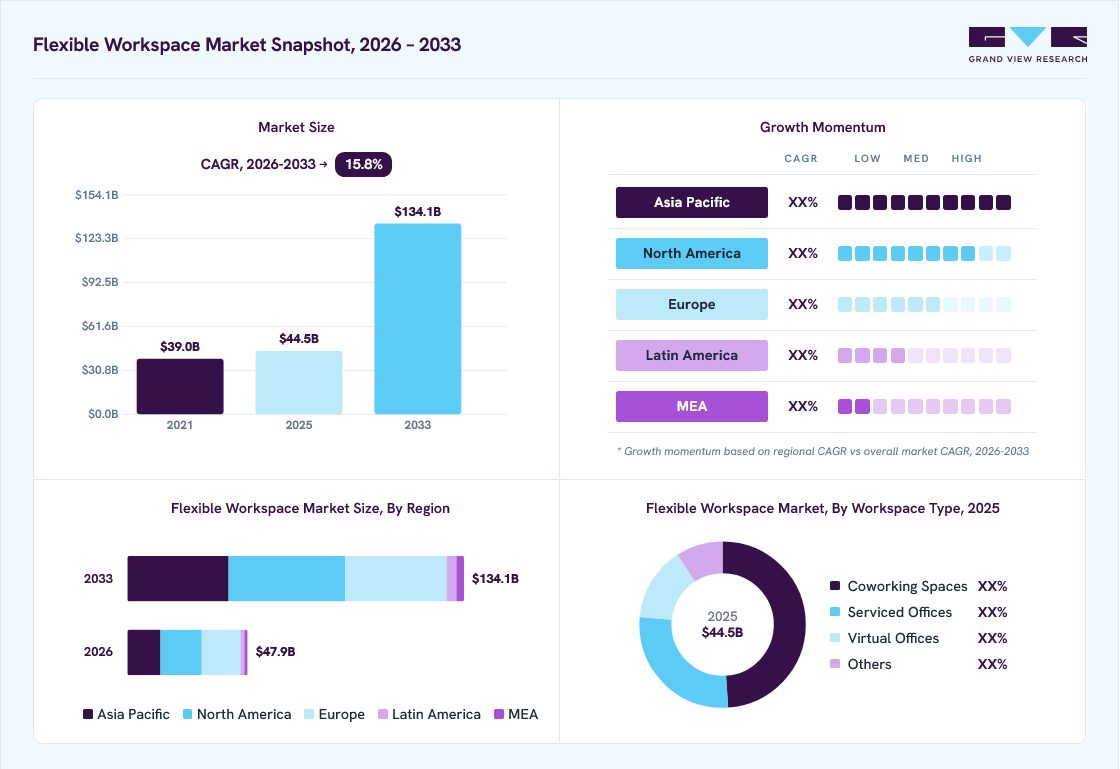
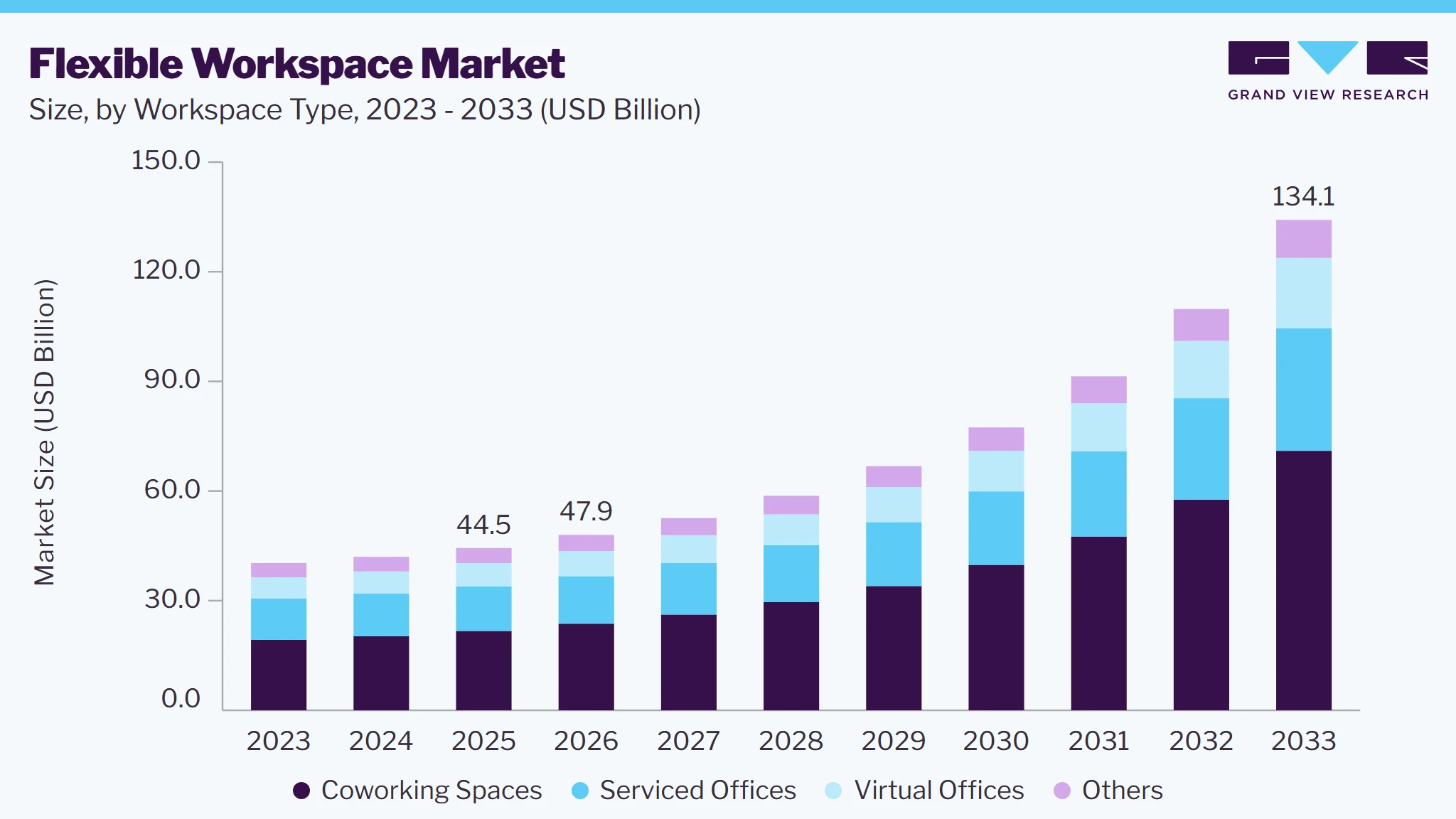
The global flexible workspace market size was valued at USD 44.5 billion in 2025 and is projected to grow from USD 47.9 billion in 2026 to USD 134.1 billion by 2033, at a CAGR of 15.8% from 2026 to 2033. North America dominated the market, accounting for a revenue share of 34.1% in 2025. The industry is growing as businesses increasingly adopt hybrid work models, flexible leasing, and distributed office strategies to reduce fixed real-estate costs and accommodate changing workforce requirements.
 Source: Grand View Research, IR Documents, Primary Interviews, Paid DatabasesTo learn more about this report,
 Download Free Sample Report
 Key Market Trends & Insights
- By workspace type: Coworking spaces segment dominated the market, with a revenue share of 48.8% in 2025.
- By business model: Recurring contract segment led the market and accounted for a share of 71.5% in 2025.
- By industry: IT & telecom segment dominated the market, with a revenue share of 25.6% in 2025.
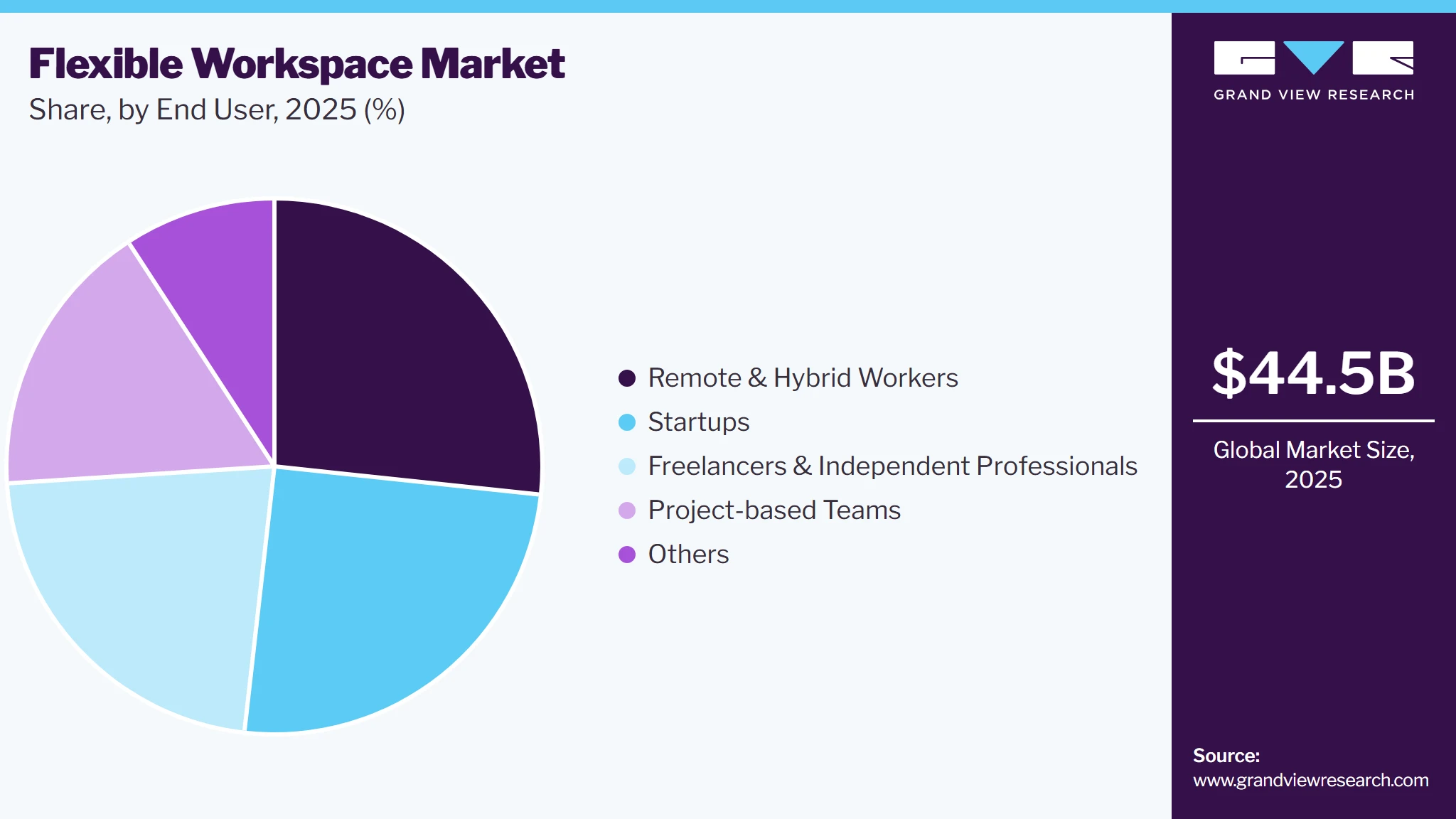
- By end-use: Remote & hybrid workers segment held the largest revenue share of 26.8% in 2025.
Regional Highlights
- Largest regional market: North America (34.1% revenue share, 2025)
- Fastest-growing regional market: Asia Pacific (highest CAGR, 2026-2033)
- By country: The U.S. held the largest market share in 2025.
Market Size & Forecast
- Market size in 2025: USD 44.5 Billion
- Estimated market size in 2026: USD 47.9 Billion
- Projected market size by 2033: USD 134.1 Billion
- CAGR (2026-2033): 15.8%
Three ways to get this report
Buy it, customize it, or ask a question.Ask an Analyst
A direct answer, usually in 1 working day
- AccessReport author, directly
- Reply timeWithin 1 working day
- No sales callDirect answer only
- FormatEmail reply
- CostFree, no cost
Get the Full Report
What the study covers
- FormatsPDF · Excel · Dashboard
- Timeline2026–2033 annual, 2025 base
- Coverage20+ countries, 5 regions
- Companies10+ key players profiled
Customize the Report
20% free customization
- IncludeCountries, segments, points
- TailorTo your product definition
- ExtendDeeper competitor detail
- OrA fully bespoke study
- Turnaround5–10 working days
Increasing adoption of hybrid and flexible work models is driving the growth of the flexible workspace market. Organizations across industries are moving away from fully centralized office models toward hybrid arrangements that combine remote work, office-based collaboration, and periodic in-person meetings. This shift has changed the way companies evaluate office requirements, as maintaining large amounts of permanently assigned workspace can result in underutilized real-estate capacity.
 To learn more about this report, Download Free Sample Report
 Flexible workspace solutions, including coworking spaces, serviced offices, private offices, meeting rooms, and flexible desks, enable organizations to provide workplace access in line with employee attendance patterns and business requirements. Companies can therefore accommodate fluctuating workforce sizes and changing attendance levels without committing to conventional long-term leases for large office premises. The flexible workspace market is being supported by the normalization of hybrid work and the increasing focus of enterprises on adaptable real-estate strategies. CBRE reported in 2026 that 89% of surveyed Americas employers required at least three office days per week, while actual attendance averaged 2.9 days, demonstrating continued variability in workplace utilization.
The growing emphasis on real estate cost optimization and operational flexibility is driving the expansion of flexible workspace adoption among enterprises. Conventional offices generally require significant expenditure on long-term leases, interior fit-outs, furniture, utilities, maintenance, security, and workplace administration, as well as the time required to establish and manage facilities. Flexible workspace providers bundle many of these requirements into workspace agreements, allowing organizations to access furnished, operational office environments with comparatively low upfront investment. This model is particularly relevant for companies facing uncertain workforce growth, restructuring their office footprint, or entering new geographic markets. Enterprises can increase or decrease the amount of workspace they occupy based on business conditions, reducing the need to maintain excess capacity.
Market Dynamics
The flexible workspace market is being shaped by the increasing need for enterprises to support business expansion, distributed operations, talent accessibility, and scalable workplace capacity across multiple locations. The evolution of corporate real-estate strategies is moving flexible workspaces beyond their traditional role as short-term coworking facilities toward an integrated component of enterprise office portfolios. Flexible workspace operators increasingly provide private offices, managed offices, meeting and collaboration facilities, satellite locations, and multi-location access, enabling organizations to respond to changes in headcount, geographic expansion, and workplace requirements.
The expansion of corporate operations across cities and business hubs is driving demand for flexible workspace, as enterprises require workplace capacity that can be rapidly deployed alongside business growth. Companies expanding their technology, consulting, engineering, financial, and shared-service operations may require additional offices before long-term workforce and location requirements are fully established. Flexible workspace providers can support this requirement through ready-to-occupy offices, managed workspaces, private suites, and multi-location networks, allowing enterprises to establish or expand teams without waiting for conventional office development and fit-out cycles.
Intensifying competition among flexible workspace providers can restrain market growth by making it more difficult for operators to maintain occupancy, pricing power, and customer retention. The market includes global coworking companies, domestic operators, serviced-office providers, managed-office specialists, landlords offering flexible products, and increasingly sophisticated enterprise-focused providers. As enterprises become more selective about workspace quality, location, technology infrastructure, amenities, security, and service standards, operators may need to invest substantially in premium facilities and customer experience to remain competitive.
The expansion of flexible workspace into Tier-II cities, peripheral business districts, and emerging employment hubs presents a significant opportunity for market participants. Enterprises increasingly require access to talent outside traditional central business districts, particularly as technology, GCC, professional-services, and distributed operating models expand into additional locations. Flexible workspace providers can establish smaller satellite facilities in these markets without requiring enterprises to set up independent offices, thereby creating a scalable model for geographic expansion.
Market Concentration & Characteristics
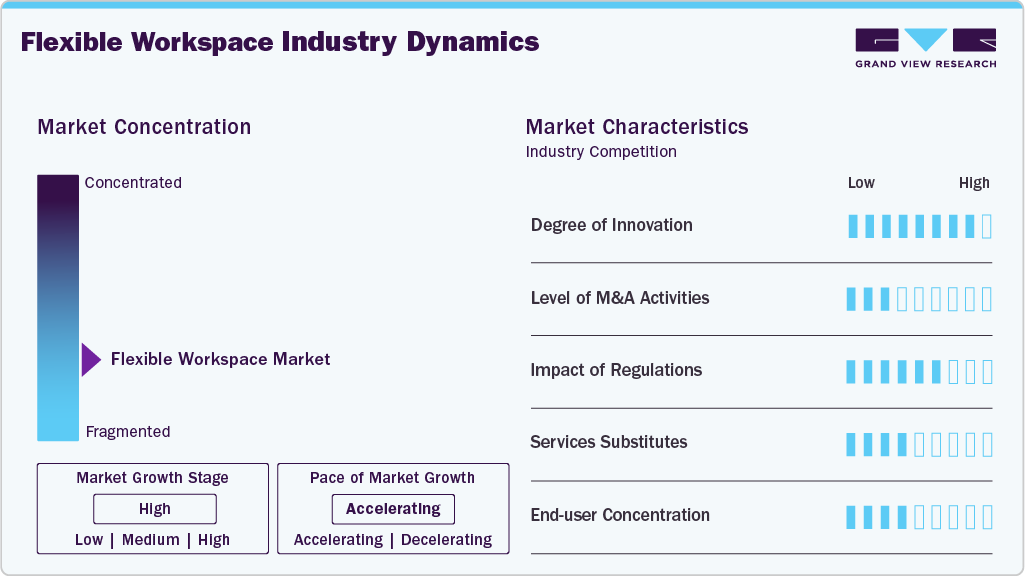
The flexible workspace market is highly fragmented, with competition among global coworking companies, serviced-office providers, managed workspace operators, commercial real-estate companies, and numerous regional and independent workspace specialists. Major participants include IWG, WeWork, Industrious, Mindspace, Smartworks, Awfis, Table Space, 91springboard, and other regional operators, as well as thousands of smaller providers serving individual cities and business districts. Entry barriers are moderate because operators require suitable commercial locations, workspace fit-out capabilities, technology infrastructure, facility-management expertise, and sufficient capital to establish and maintain facilities.
 To learn more about this report, Download Free Sample Report
 The market is in a rapid stage of expansion and institutionalization, supported by increasing corporate adoption of coworking spaces, managed offices, serviced offices, and other flexible workplace formats. Flexible workspace is moving beyond freelancers, entrepreneurs, and small businesses toward enterprise customers seeking private offices, managed facilities, satellite locations, project-based workspaces, and multi-city access. Competitive differentiation is increasingly shifting from basic desk availability toward location quality, enterprise-grade infrastructure, workplace technology, customization, employee experience, amenities, security, sustainability, and integrated facility services. Operators are also expanding beyond central business districts into peripheral commercial areas, emerging employment hubs, and Tier-II cities, supported by technology-enabled booking, access management, occupancy monitoring, and workplace analytics.
Analyst Perspective
The convergence of flexible workspace, hybrid work models, workplace technology, enterprise real-estate strategies, and data-driven space management is expected to increasingly shape the flexible workspace market. Organizations are moving from traditional long-term office leases toward flexible workplace models that adapt office capacity to changing workforce requirements, geographic expansion, project-based teams, and employee preferences. Technology is expected to increasingly transform flexible workspaces from conventional coworking and serviced-office facilities into digitally managed workplace environments, with integrated booking platforms, access control, occupancy monitoring, workplace analytics, and tenant-management systems enabling more efficient use of office space.
Workspace Type Insights
The coworking spaces segment dominated the market and accounted for the revenue share of 48.8% in 2025, driven by the growing need for collaborative environments that support networking, knowledge exchange, and community-oriented work. Unlike conventional offices, coworking facilities provide shared meeting areas, event spaces, breakout zones, and informal interaction spaces that enable professionals and businesses to collaborate with diverse organizations and individuals. This environment is particularly attractive to entrepreneurs, startups, independent professionals, and small businesses seeking access to professional workplace infrastructure without having to develop dedicated premises.
The virtual offices segment is anticipated to grow at a significant CAGR during the forecast period, driven by the increasing need for businesses to establish a professional commercial presence without maintaining a full-time physical office. Virtual office services can provide business addresses, mail handling, call management, meeting-room access, and other administrative facilities, enabling companies to establish a presence in recognized commercial locations while operating through distributed or home-based teams. This model is particularly relevant for startups, consultants, independent professionals, and companies entering new geographic markets that require a local business presence before committing to permanent physical infrastructure.
Business Model Insights
The recurring contract segment dominated the market and accounted for the revenue share of 71.5% in 2025 due to enterprises' need for predictable workplace access, continuity of services, and greater certainty in managing ongoing office requirements. Companies with established teams or recurring workspace needs can enter longer-duration agreements covering dedicated offices, managed workspaces, meeting facilities, and associated workplace services, allowing them to maintain consistent operating environments without repeatedly arranging space on an individual-use basis.
The on-demand segment is anticipated to grow at a significant CAGR during the forecast period, supported by the increasing need for short-duration and usage-based workplace access among professionals and businesses with variable space requirements. Companies may require meeting rooms, private offices, conference facilities, or temporary desks only during specific projects, business trips, client engagements, training sessions, or periods of increased activity. On-demand models allow users to obtain workspace when required rather than maintaining continuously occupied premises, making the format suitable for organizations with fluctuating workplace utilization.
Industry Insights
The IT & telecom segment dominated the market and accounted for the revenue share of 25.6% in 2025, driven by the geographically distributed nature of technology operations and the need for specialized workplace environments that can accommodate software development, technical teams, sales functions, customer support, and project operations across multiple locations. Technology companies frequently operate through distributed teams and may expand into new markets to access skilled talent, establish development centers, or support customers in different regions.
The professional services segment is expected to grow at a significant CAGR during the forecast period, driven by the need for client-oriented workplaces that can support consulting, legal, accounting, financial advisory, engineering, and other knowledge-intensive activities. These organizations often require professional meeting environments for client discussions, workshops, presentations, interviews, and collaborative assignments, while the amount of physical office space needed can vary with project schedules and workforce composition. Flexible workspaces provide access to meeting rooms, private offices, reception services, and business facilities that can support client-facing activities without requiring firms to maintain extensive permanent premises.
End-use Insights
The remote & hybrid workers segment dominated the market and accounted for the revenue share of 26.8% in 2025, supported by the need for alternatives to both traditional corporate offices and home-based work environments. Employees working remotely for part or most of the week may require access to professional environments when home conditions are unsuitable, when greater separation between work and personal activities is needed, or when in-person collaboration is required. Flexible workspaces provide these workers with access to reliable connectivity, ergonomic workstations, meeting facilities, and professional environments closer to their residences or other convenient locations.
 To learn more about this report, Download Free Sample Report
 The project-based teams segment is expected to grow at a significant CAGR over the forecast period, driven by the temporary and variable nature of project staffing, particularly across consulting, technology implementation, engineering, creative, construction-related, and other specialized assignments. Organizations may need to assemble teams with employees, contractors, consultants, and external specialists for defined project periods, creating workplace requirements that differ from those of permanent departments.
Regional Insights
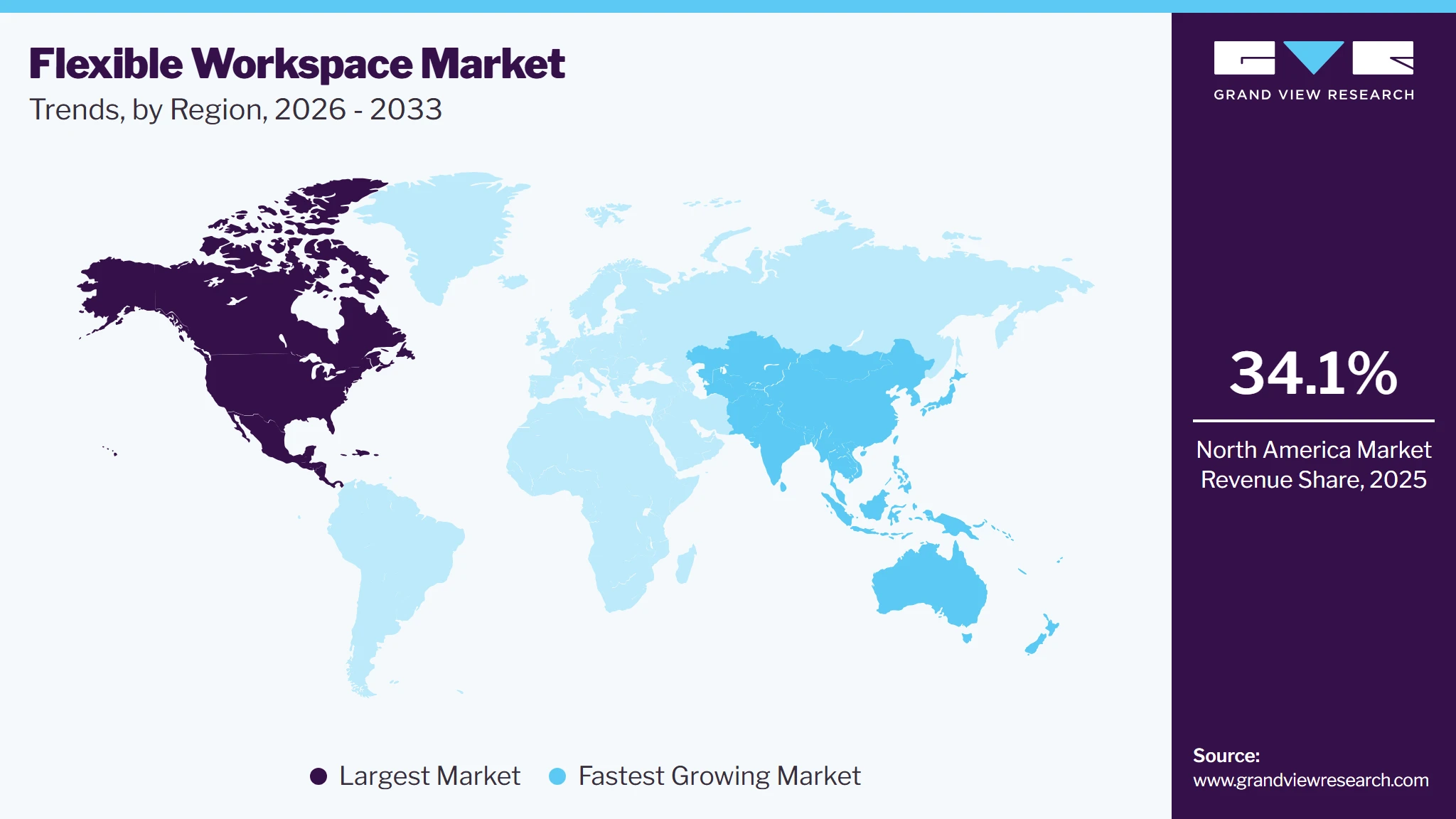
North America dominated the global flexible workspace market with the largest revenue share of 34.1% in 2025, driven by the increasing integration of flexible space into corporate real-estate portfolios as companies seek to balance office utilization, employee attendance requirements, and capital efficiency. Organizations are increasingly using flex space to accommodate uncertain workspace demand, provide meeting and collaboration areas, and supplement conventional leased offices without committing additional capital to permanent capacity.
 To learn more about this report, Download Free Sample Report
 U.S. Flexible Workspace Market Trends
The flexible workspace market in the U.S. is expected to grow significantly, at a CAGR of 16.3%, from 2026 to 2033, driven by the increasing need for flexible office portfolios as employers establish more structured office attendance policies while retaining hybrid work arrangements. The U.S. market is also comparatively mature, with flexible space already established across major technology and business centers.
Europe Flexible Workspace Market Trends
The flexible workspace market in Europe is anticipated to register considerable growth from 2026 to 2033, driven by the increasing emphasis on capital-light real estate strategies and workplace efficiency as companies reassess their office footprints amid hybrid working conditions. Companies are also increasing desk-sharing and workspace-efficiency measures, creating demand for flexible formats that allow office capacity to be adjusted without extensive fixed real-estate commitments.
The UK flexible workspace market is expected to grow rapidly in the coming years, owing to the flight to quality and accessibility in the office sector, as organizations seek flexible locations that combine professional workplace environments with strong transport connectivity and amenities.
The flexible workspace market in Germany held a substantial market share in 2025 due to the corporate demand for short-term, ready-to-use office environments amid workplace transformation and digitalization. The country's strong concentration of manufacturing and technology activity also creates requirements for project-specific offices near business clusters and customer locations.
Asia Pacific Flexible Workspace Market Trends
The flexible workspace market in the Asia Pacific is expected to exhibit the fastest CAGR over the forecast period, due to rapid urbanization, expanding service-sector employment, and the growth of multinational and technology businesses across major metropolitan areas. Businesses entering fast-growing markets can use flexible workspace to establish operations quickly while assessing local demand, talent availability, and commercial conditions before making longer-term real-estate commitments.
The Japan flexible workspace market is expected to grow rapidly in the coming years, driven by the need to make more efficient use of office infrastructure as companies adapt workplace arrangements to changing employee work patterns and evolving corporate office strategies. Flexible offices provide organizations with additional options for satellite work locations, meeting facilities, and distributed teams, particularly in major metropolitan areas where commuting distances and office costs can influence workplace decisions.
The flexible workspace market in China held a substantial market share in 2025, due to the continued development of technology, professional-services, and entrepreneurial ecosystems in major urban centers, where businesses require scalable office infrastructure as they establish and expand operations. Flexible workspace enables startups, domestic companies, and multinational organizations to obtain furnished offices and shared facilities without undertaking extensive upfront office development.
Key Flexible Workspace Company Insights
Key players operating in the flexible workspace industry are International Workplace Group plc (IWG), WeWork Companies LLC, Servcorp, Industrious, and Workspace Group. The companies are focusing on various strategic initiatives, including new product development, partnerships & collaborations, and agreements to gain a competitive advantage over their rivals.
Key Flexible Workspace Companies
The following key companies have been profiled for this study on the flexible workspace market.
-
BHIVE Workspace
-
CommonGrounds Workplace
-
Convene
-
Flex by JLL
-
Huckletree
-
Impact Hub
-
Industrious
-
International Workplace Group plc
-
Mindspace
-
Serendipity Labs
-
Servcorp
-
Smartworks
-
WeWork Companies LLC
-
Workbar
-
Workspace Group
Competitive Benchmarking
Category
Operating Strategies
Competitive Edge
Weakness
Established Players (International Workplace Group plc (IWG), WeWork Companies LLC, Servcorp, Industrious, and Workspace Group)
Invest in expanding coworking spaces, serviced offices, virtual offices, meeting rooms, and hybrid-work solutions across major business locations.
Expand geographic presence through new centers, management agreements, partnerships, acquisitions, and landlord collaborations. Increase technology-enabled workspace management, digital booking, member applications, and flexible access services.
Strong global or regional brands, extensive workspace networks, and established corporate customer relationships.
Broad portfolios covering coworking, serviced offices, virtual offices, meeting rooms, and hybrid workspace solutions.
Large geographic footprints enable multinational companies to provide employees with workspace access across multiple cities and countries.
High operating and occupancy costs associated with maintaining large physical workspace portfolios.
Exposure to commercial real estate costs, rental commitments, and fluctuations in occupancy levels.
Large networks can involve higher administrative and facility-management complexity.
Emerging Players (BHIVE Workspace, CommonGrounds Workplace, Flex by JLL, Serendipity Labs, Workbar)
Focus on specialized coworking, flexible offices, managed workspaces, meeting spaces, and hybrid-work solutions in selected cities and business districts.
Emphasize localized expansion, flexible membership models, partnerships with property owners, and technology-enabled workspace management.
Target startups, SMEs, independent professionals, project teams, and companies seeking flexible alternatives to conventional offices.
Greater flexibility in adapting workspace formats, pricing, and services to local market requirements.
Focused geographic operations can support localized customer relationships and faster adaptation to changing occupier needs.
Specialized offerings such as managed offices, private suites, coworking memberships, and meeting spaces allow these providers to serve specific customer segments without maintaining the scale of the largest global operators.
Smaller geographic footprints and lower brand recognition compared with major international workspace providers.
Limited financial and operational scale can constrain rapid expansion and investment in premium locations and technology.
Greater dependence on landlords, property partners, and local real estate conditions can increase operational risk.
Recent Developments
-
In June 2026, Industrious relaunched its member app with an updated experience designed to simplify workspace discovery, reservations, and access to location information. The upgraded app includes improved maps, search tools, and filters for finding meeting rooms and coworking spaces, while also providing location updates, events, reservation details, building access information, Wi-Fi instructions, and guest registration features in one platform.
-
In April 2026, WeWork Companies LLC expanded its global Coworking Partner Network in 2026 to approximately 2,000 locations, adding more than 900 coworking operators across 21 additional countries. The expansion enables members to access a broader network of flexible workspaces through participating third-party providers, supporting businesses and professionals that require workspace access across multiple markets.
Flexible Workspace Market Report Scope
Report Attribute
Details
Market size in 2025
USD 44.5 billion
Estimated market size in 2026
USD 47.9 billion
Projected market size by 2033
USD 134.1 billion
Growth rate
CAGR of 15.8% from 2026 to 2033
Actual data
2021 - 2025
Forecast period
2025 - 2033
Quantitative units
Revenue in USD billion and CAGR from 2026 to 2033
Report coverage
Revenue forecast, company share, competitive landscape, growth factors, and trends
Segments covered
Workspace type, business model, industry, end use, region
Regional scope
North America; Europe; Asia Pacific; Latin America; MEA
Country scope
U.S.; Canada; Mexico; UK; Germany; France; China; India; Japan; Australia; South Korea; Brazil; UAE; Kingdom of Saudi Arabia; South Africa
Key companies profiled
BHIVE Workspace; CommonGrounds Workplace; Convene; Flex by JLL; Huckletree; Impact Hub; Industrious; International Workplace Group plc; Mindspace; Serendipity Labs; Servcorp; Smartworks; WeWork Companies LLC; Workbar; Workspace Group
Customization scope
Free report customization (equivalent to 8 analysts working days) with purchase. Addition or alteration to country, regional & segment scope.
Pricing and purchase options
Avail customized purchase options to meet your exact research needs. Explore purchase options
Global Flexible Workspace Market Report Segmentation
This report forecasts revenue growth at the global, regional, and country levels and provides an analysis of the latest industry trends in each of the sub-segments from 2021 to 2033. For this study, Grand View Research has segmented the global flexible workspace market report based on workspace type, business model, industry, end use, and region.
-
Workspace Type Outlook (Revenue, USD Billion, 2021 - 2033)
-
Coworking Spaces
-
Serviced Offices
-
Virtual Offices
-
Others
-
-
Business Model Outlook (Revenue, USD Billion, 2021 - 2033)
-
Recurring Contract
-
On-demand
-
-
Industry Outlook (Revenue, USD Billion, 2021 - 2033)
-
IT & Telecom
-
BFSI
-
Professional Services
-
Media & Creative Industries
-
Healthcare
-
Education
-
Others
-
-
End-use Outlook (Revenue, USD Billion, 2021 - 2033)
-
Freelancers & Independent Professionals
-
Startups
-
Remote & Hybrid Workers
-
Project-based Teams
-
Others
-
-
Regional Outlook (Revenue, USD Billion, 2021 - 2033)
-
North America
-
U.S.
-
Canada
-
Mexico
-
-
Europe
-
UK
-
Germany
-
France
-
-
Asia Pacific
-
China
-
India
-
Japan
-
South Korea
-
Australia
-
-
Latin America
-
Brazil
-
-
Middle East & Africa
-
UAE
-
Saudi Arabia
-
South Africa
-
-
Research Methodology
The flexible workspace marketfigures in this report are based on a proven research process that combines executive interviews with secondary research from proprietary databases, company filings, and recognized regulatory and institutional sources. Market size is built through value-chain sizing-reconciling supply-side and demand-side estimates-and triangulated with bottom-up and top-down approaches. Every estimate passes multiple levels of expert validation before publication, with eachflexible workspace segment quantified using the revenue-capture definitions in the table below.
Segment Definition
Workspace Type
Revenue capture definition
Coworking Spaces
Market value is captured through fees paid for shared workspaces, including hot desks, dedicated desks, shared office areas, meeting rooms, and access to common facilities. Revenue includes memberships, workspace subscriptions, desk rentals, and related services attributable to coworking spaces.
Serviced Offices
Market value is captured through fees for ready-to-use private offices that include workspace, furniture, internet, utilities, reception, and facility services. Revenue includes office rentals, memberships, and additional charges for meeting rooms, administrative support, and other office services.
Virtual Offices
Market value is captured through fees for business-address and remote office services without requiring a permanent physical workspace. Revenue includes virtual office memberships, professional business addresses, mail handling, call answering, meeting-room access, and related services.
Others
Market value is captured through fees from other flexible workspace formats, including meeting rooms, business lounges, temporary workspaces, dedicated workspace arrangements, and other workspace solutions not classified as coworking, serviced offices, or virtual offices.
Business Model
Revenue capture definition
Recurring Contract
Market value is captured through recurring payments under memberships, subscriptions, leases, or workspace agreements that provide access to flexible workspaces for a defined period. Revenue includes monthly, quarterly, annual, and other recurring workspace contracts.
On-demand
Market value is captured through short-term or usage-based payments for workspace access without a recurring contractual commitment. Revenue includes day passes, hourly workspace bookings, meeting-room reservations, temporary office use, and other pay-per-use services.
Industry
Revenue capture definition
IT & Telecom
Market value is captured from workspace services purchased by software companies, IT service providers, telecommunications companies, cloud providers, cybersecurity firms, and other technology organizations.
BFSI
Market value is captured from workspace services purchased by banks, financial institutions, insurance companies, fintech firms, investment companies, and other financial services organizations.
Professional Services
Market value is captured from workspace services purchased by consulting, legal, accounting, advisory, engineering, recruitment, and other professional service organizations.
Media & Creative Industries
Market value is captured from workspace services purchased by advertising agencies, marketing firms, publishers, film and television companies, design firms, gaming companies, content creators, and other creative organizations.
Healthcare
Market value is captured from workspace services purchased by healthcare providers, health-tech companies, pharmaceutical companies, medical professionals, healthcare consultants, and related organizations.
Education
Market value is captured from workspace services purchased by schools, universities, training providers, education technology companies, tutors, educators, and other education-related organizations.
Others
Market value is captured from workspace services purchased by manufacturing, retail, hospitality, logistics, real estate, government, nonprofit organizations, and other sectors not included in the specified industry categories.
End Use
Revenue capture definition
Freelancers & Independent
Professionals
Market value is captured through workspace fees paid by self-employed individuals, freelancers, consultants, contractors, and independent professionals for desks, offices, meeting rooms, and other flexible workspace services.
Startups
Market value is captured through workspace fees paid by early-stage and newly established companies requiring flexible offices, coworking memberships, meeting facilities, and scalable workspace solutions.
Remote & Hybrid Workers
Market value is captured through fees paid by individuals or employers for workspace access used by employees working remotely or under hybrid work arrangements. Revenue includes memberships, day passes, desk bookings, and other flexible access services.
Project-based Teams
Market value is captured through workspace fees paid for temporary teams formed around specific projects, assignments, contracts, or business initiatives. Revenue includes short-term office arrangements, team rooms, meeting spaces, and dedicated project workspaces.
Others
Market value is captured through workspace fees generated by customers outside the defined end-user categories, including established enterprises, temporary visitors, corporate travelers, training groups, event participants, and other users requiring flexible workspace access.
Estimation Model
Layer
Question
Analysis
Workforce & Occupier Demand Layer
Who requires flexible workspace?
Identify the workforce and business groups generating demand, including freelancers, independent professionals, startups, SMEs, remote and hybrid workers, project-based teams, and large enterprises. Assess changes in workforce mobility, hybrid work adoption, business formation, temporary staffing, and demand for shorter workspace commitments.
Commercial Property Supply Layer
What property supply supports flexible workspaces?
Evaluate the availability of commercial office buildings, business centers, mixed-use properties, premium office developments, and underutilized office space that can be converted into flexible workspace. Assess property availability, location quality, floor area, building specifications, rental costs, and landlord participation.
Customer Acquisition & Membership Layer
How many users and organizations generate revenue?
Estimate the number of freelancers, startups, enterprises, project teams, and other customers using flexible workspace services. Analyze membership growth, customer retention, average contract duration, enterprise account penetration, and the proportion of individual versus corporate customers.
Technology & Access Layer
What technology supports flexible workspace delivery?
Assess digital booking platforms, mobile applications, smart access systems, occupancy monitoring, payment platforms, workspace management software, Wi-Fi infrastructure, visitor management, and workplace analytics. Evaluate how technology enables automated reservations, access control, space utilization, and customer management.
Delivered Customization
This report has been delivered with the following In-depth customizations
Client Request
Customization Delivered
Value Adds
Flexible Workspace Format & Hybrid Workplace Trends
- Analyzed flexible workspace formats including coworking spaces, serviced offices, virtual offices, private offices, dedicated desks, meeting rooms, and other flexible workspace solutions.
- Evaluated the impact of hybrid work, remote work, workforce mobility, and demand for shorter and more flexible office commitments.
- Helps identify high-demand workspace formats and changing occupier requirements.
- Provides insights into the shift from conventional long-term office leases toward flexible and scalable workspace arrangements.
Flexible Workspace Technology & Digital Workplace Trends
- Evaluated adoption of digital booking platforms, mobile workspace applications, smart access systems, occupancy management, workplace analytics, visitor management, and automated workspace services.
- Assessed the role of technology in improving workspace utilization, customer experience, access management, and operational efficiency.
- Highlights opportunities arising from technology-enabled flexible workspace management.
- Enables understanding of how digital tools support workspace booking, access, utilization monitoring, and customer engagement.
Geographic Flexible Workspace Expansion & Market Opportunity Analysis
- Evaluated flexible workspace demand across North America, Europe, Asia Pacific, Latin America, and the Middle East & Africa, including key country-level markets.
- Assessed commercial activity, business hubs, workforce trends, office demand, and provider expansion across major markets.
- Highlights geographic markets with opportunities for workspace expansion.
- Supports market-entry, location-selection, portfolio-expansion, and regional growth strategies for flexible workspace providers.
Frequently Asked Questions About This Report
Key factors include businesses increasingly adopting hybrid work models, flexible leasing, and distributed office strategies to reduce fixed real estate costs and accommodate changing workforce requirements.
Asia Pacific is the fastest-growing region over the forecast period.
The recurring contract segment led with a 71.5% revenue share in 2025, while the on-demand segment is the fastest-growing segment.
Key players operating in the flexible workspace market include BHIVE Workspace, CommonGrounds Workplace, Convene, Flex by JLL, Huckletree, Impact Hub, Industrious, International Workplace Group plc, Mindspace, Serendipity Labs, Servcorp, Smartworks, WeWork Companies LLC, Workbar, Workspace Group
The global flexible workspace market size was valued at USD 44.5 billion in 2025 and is estimated at USD 47.9 billion in 2026.
The global flexible workspace market is expected to grow at a CAGR of 15.8% from 2026 to 2033 to reach USD 134.1 billion by 2033.
North America dominated the market, accounting for a revenue share of 34.1% in 2025.
The coworking spaces segment led with a 48.8% revenue share in 2025, while virtual offices segment is the fastest-growing segment.
The IT & telecom segment held the largest share of 25.6% in 2025, while the professional services segment is the fastest-growing segment.
About the Author(s)
Communications Infrastructure Research Team
Technology · Communications InfrastructureThis report was authored by the communications infrastructure research team at Grand View Research - comprising two research analysts, one senior research analyst, and one industry expert - with specialized expertise in the communications infrastructure segment of the technology industry. All findings are based on proprietary technology databases, executive interviews, and regulatory analysis, subject to internal peer review prior to publication.
Last Updated:
Speak to Analyst

Customize this report to your needs - add regions, segments, or data points, with 20% free customization.
Or view our licence options:


ISO 9001:2015 & 27001:2022 Certified
We are GDPR and CCPA compliant! Your transaction & personal information is safe and secure. For more details, please read our privacy policy.


