
- Home
- »
- Food Additives & Nutricosmetics
- »
-
Flower Essence Market Size And Share Report, 2026-2033GVR Report cover

Flower Essence Market (2026 - 2033)
Size, Share & Trends Analysis Report By Product (Single Flower Essence, Flower Essence Blends), By Form (Liquid, Spray, Cream/Gel), By Application (Aromatherapy & Wellness, Personal Care & Cosmetics), By Region, Forecasts
Market Size, 2025
$92.8MMarket Estimate, 2026
$98.5MMarket Forecast, 2026
$150.1MCAGR, 2026–2026
6.2%Flower Essence Market Summary
The global flower essence market size was valued at USD 92.8 million in 2025 and is projected to grow from USD 98.5 million in 2026 to USD 150.1 million by 2033, at a CAGR of 6.2% from 2026 to 2033. North America dominated the market, accounting for the revenue share of 36.5% in 2025. The growth is supported by increasing consumer interest in holistic wellness, botanical remedies, personalized self-care, and convenient flower-essence formats across developed and emerging markets.
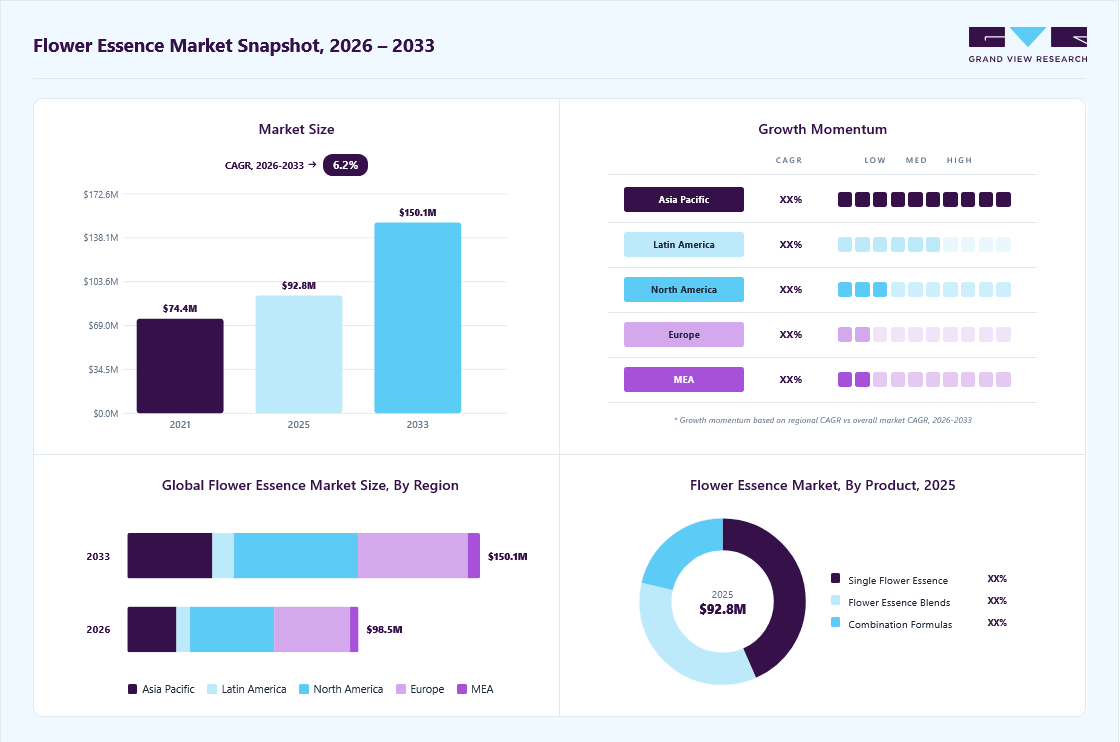 Source: Grand View Research, IR Documents, Primary Interviews, Paid DatabasesTo learn more about this report,
 Download Free Sample Report
Key Market Trends & Insights
- By product: Single flower essence segment held the largest revenue share of 43.3% in 2025.
- By form: Liquid segment dominated the market with the largest revenue share of 77.0% in 2025.
- By application: Aromatherapy & wellness segment led the market with the largest revenue share of 47.3% in 2025.
Regional Highlights
- Largest regional market: North America (36.5% revenue share, 2025)
- Fastest-growing regional market: Asia Pacific (highest CAGR, 2026-2033)
- By country: The U.S. dominated North America with the largest revenue share in 2025
Market Size & Forecast
- Market size in 2025: USD 92.8 Million
- Estimated market size in 2026: USD 98.5 Million
- Projected market size by 2033: USD 150.1 Million
- CAGR (2026-2033): 6.2%
GVR research-powered AIAsk Prism AI about the flower essence marketGet cited answers from GVR research on market growth, segments, regulations and forecasts.Start with✓ Source-linked answers ✓ Market-specific context ✓ Traceable figuresExplore Prism AI ↗
The growth is being supported by rising consumer interest in complementary approaches to emotional well-being. Greater awareness of stress management, mindfulness, relaxation, and personalized solutions is encouraging consumers to explore plant-based remedies alongside conventional healthcare practices.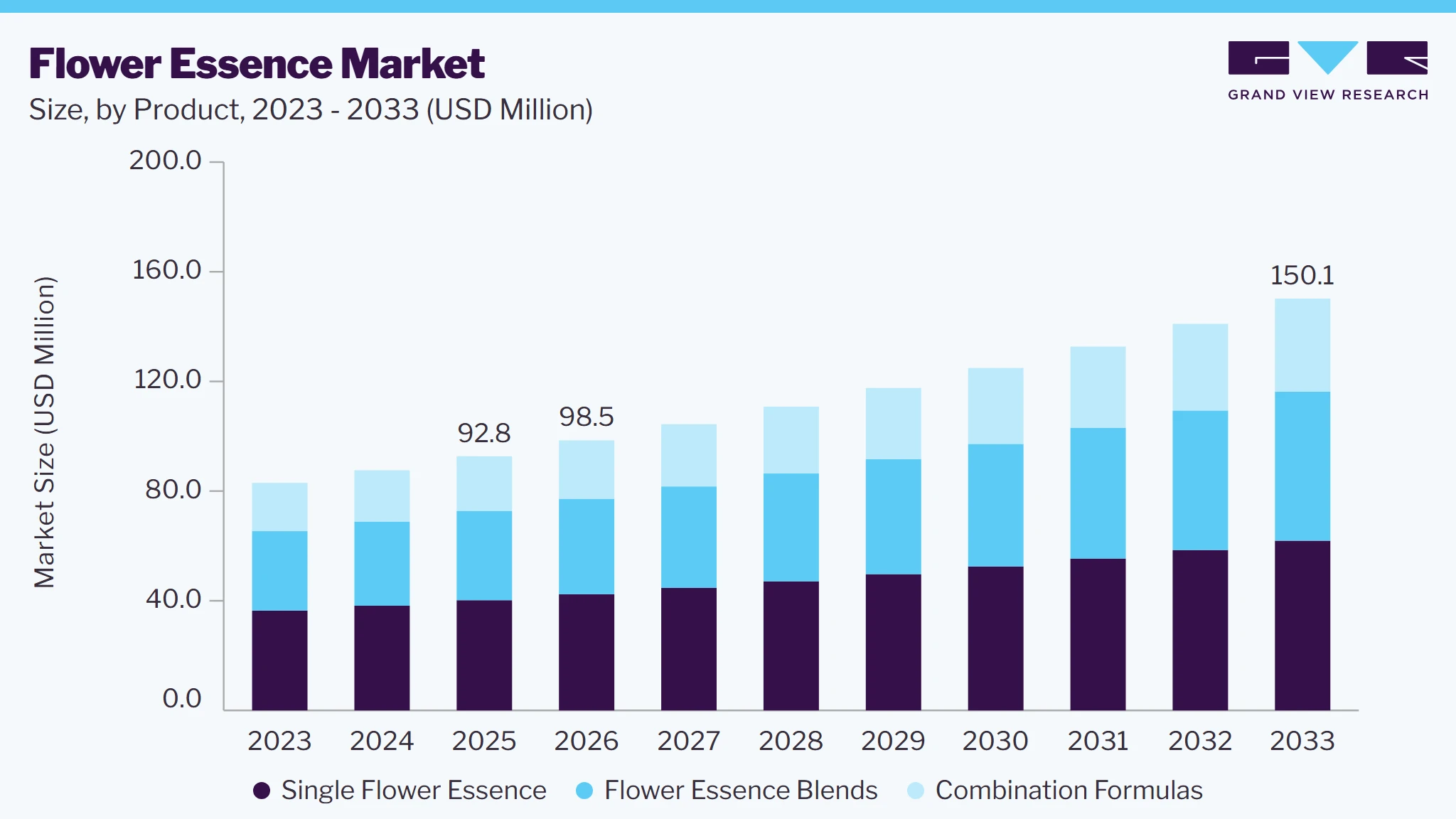 To learn more about this report, Download Free Sample Report
Manufacturers are responding by expanding their ranges beyond traditional individual-flower preparations to include combination formulas, sprays, creams, roll-ons, and other convenient formats. The increasing availability of these products through specialty stores, pharmacies, practitioner networks, and e-commerce platforms is also improving consumer access across developed and emerging markets. In addition, growing interest in clean-label and botanical products is encouraging brands to emphasize natural sourcing, traceability, sustainable preparation methods, and transparent product information.
Significant opportunities exist in product diversification, digital distribution, international expansion, and specialized consumer segments. Producers can develop targeted formulations for areas such as relaxation, emotional balance, sleep support, personal development, and lifestyle while maintaining clear differentiation between individual and blended preparations. E-commerce and direct-to-consumer channels offer smaller specialist manufacturers an opportunity to reach international buyers without extensive physical distribution networks. Further potential lies in products designed for children, pets, practitioners, and environmentally oriented consumers, provided claims remain aligned with applicable regulations. Partnerships with practitioners, complementary-health retailers, educational platforms, and botanical-product companies can further strengthen market access, while expansion into Asia-Pacific, Europe, and other regions with established interest in traditional and plant-based solutions presents additional avenues for revenue generation.
Market Dynamics
The industry is influenced by growing consumer preference for natural solutions, as well as increasing awareness of holistic self-care. Manufacturers are broadening portfolios from traditional individual preparations to blended formulas, sprays, creams, roll-ons, and other convenient formats, supporting product differentiation and wider consumer reach. E-commerce is further strengthening accessibility by enabling specialist producers to serve international customers without relying solely on physical retail networks. Demand is also being shaped by clean-label preferences, botanical sourcing, personalized, and practitioner-led recommendations. At the same time, limited clinical evidence, varying regulatory treatment across countries, and restrictions surrounding therapeutic claims can constrain broader acceptance. Competitive intensity remains influenced by established brands, specialist producers, and regional practitioners with strong customer loyalty.
The increasing integration of complementary practices into personalized self-care routines is creating a distinctive demand catalyst. Wellness practitioners, naturopaths, holistic therapists, counselors, and specialized retailers increasingly incorporate flower-based preparations into broader lifestyle programs focused on emotional balance and personal well-being. This practitioner-led exposure can strengthen product credibility among consumers who may otherwise have limited familiarity with these preparations. Unlike conventional mass-market promotion, recommendations from practitioners can encourage repeat purchases, experimentation with different formulations, and adoption of complementary products, thereby supporting sustained consumption.
This trend also benefits specialist manufacturers by creating opportunities to develop practitioner-oriented product ranges, educational materials, consultation resources, and professional distribution programs. Companies with established practitioner networks can obtain recurring demand while gaining direct insight into evolving consumer preferences. As services become increasingly personalized, producers that provide clearly differentiated formulations, transparent ingredient information, and professional education can strengthen relationships with intermediaries and improve customer retention.
A significant constraint is the inconsistent regulatory treatment of flower-essence preparations across countries, particularly regarding whether they are classified as self-care products, traditional remedies, homeopathic preparations, cosmetics, food supplements, or other consumer health categories. Regulatory requirements can therefore differ substantially with respect to formulation, labeling, manufacturing standards, registration, advertising, safety documentation, and permissible claims. This fragmentation increases compliance costs for manufacturers seeking international expansion and can delay product launches when companies must adapt packaging, documentation, or promotional materials to individual jurisdictions.
An emerging opportunity lies in expanding beyond conventional liquid drops into other application formats. Diversification can make these preparations more convenient for consumers who prefer topical or environmental applications rather than traditional oral products. It also enables manufacturers to address distinct usage occasions, including personal-care routines, travel, workplace wellbeing, relaxation rituals, and household environments. Such format innovation can increase the number of potential purchase occasions without requiring companies to substantially alter their underlying botanical-essence expertise.
Manufacturers can further capitalize on this opportunity by combining differentiated delivery formats with premium packaging, portable designs, curated combinations, and clearly defined lifestyle positioning. E-commerce provides an effective route for introducing these innovations because companies can educate consumers through detailed product descriptions, usage guidance, practitioner content, and digital demonstrations. Developing format-specific portfolios could therefore help established producers increase average basket value while allowing smaller specialists to differentiate themselves in an increasingly crowded natural-wellbeing landscape.
Market Concentration & Characteristics
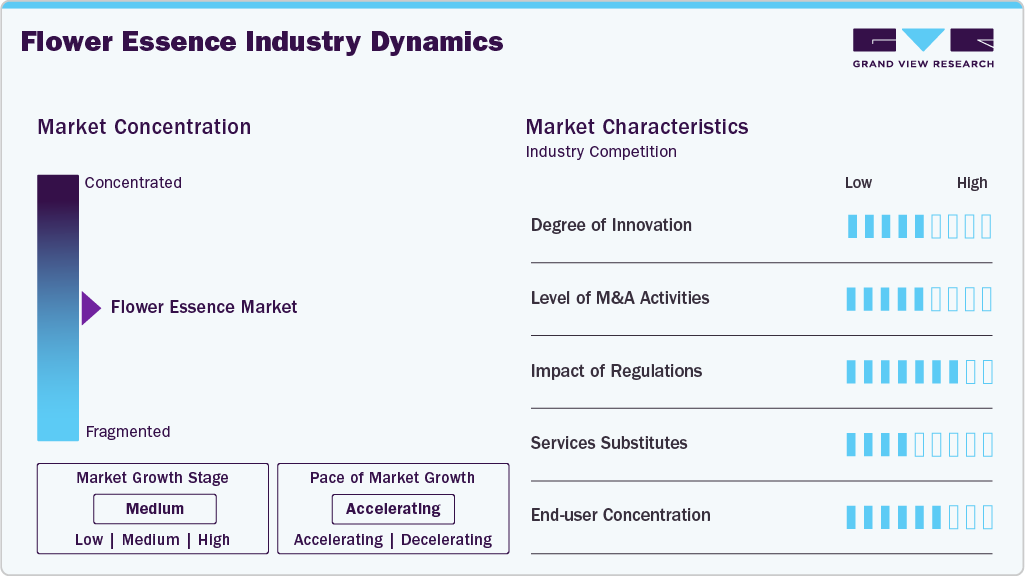
The competitive environment is characterized by a mix of established self-care brands, specialist flower-essence manufacturers, and regional producers with strong networks of practitioners and distributors. Leading participants differentiate themselves through proprietary botanical collections, established preparation methodologies, extensive product assortments, and longstanding consumer recognition. Companies such as Nelsons, Australian Bush Flower Essences, Flower Essence Services, Healing Herbs, Desert Alchemy, and Living Essences of Australia maintain distinctive portfolios spanning individual preparations, combination formulas, sprays, topical products, and specialized blends. Competitive positioning increasingly depends on product authenticity, botanical sourcing, formulation expertise, packaging innovation, and accessibility across online and offline channels.
The flower essence industry remains relatively fragmented, with specialist manufacturers competing alongside broader companies. Private ownership is common, particularly among niche producers, while larger participants benefit from stronger distribution capabilities and greater brand visibility. E-commerce has lowered entry barriers by allowing smaller businesses to reach international consumers without extensive physical infrastructure.
 To learn more about this report, Download Free Sample Report
Companies are consequently investing in direct-to-consumer platforms, practitioner partnerships, educational resources, and international distributor networks to strengthen market penetration. Portfolio expansion is another important strategy, with manufacturers introducing new botanical combinations and convenient delivery formats to address evolving lifestyle preferences. Geographic diversification, sustainable sourcing, and differentiated positioning around specific needs are expected to remain important avenues for strengthening competitive standing.
Analyst Perspective
The flower essence market is evolving beyond traditional products, with manufacturers expanding into combination formulas, sprays, topical applications, and specialized blends to meet changing self-care needs. Growing consumer interest in natural products is increasing the importance of product authenticity, responsible botanical sourcing, and transparent preparation. Digital commerce is enabling specialist producers to reach international customers and build direct relationships. Manufacturers focusing on distinctive formulations, convenient product formats, practitioner networks, regulatory compliance, and supply-chain transparency are expected to strengthen their competitive position.
Product Insights
The single flower essence segment dominated the market with a revenue share of 43.3% in 2025, reflecting strong demand for preparations derived from individual plant sources. Its leading position is supported by the extensive availability of single-source products across specialist manufacturers and wellness channels. These preparations offer straightforward positioning around specific emotional or lifestyle requirements. Established product ranges, practitioner familiarity, and broad retail availability further reinforce segment performance.
The combination formulas segment is expected to grow at the fastest CAGR of 6.8% during the forecast period. Their growth is supported by the convenience of addressing multiple wellness requirements through a single preparation. Manufacturers are increasingly developing targeted blends for relaxation, emotional balance, relationships, personal development, and lifestyle needs. Wider availability through online platforms, specialty retailers, and practitioner networks is expected to strengthen adoption throughout the forecast period.
Form Insights
The liquid segment dominated the market with the largest revenue share of 77.0% in 2025, primarily attributed to the longstanding popularity of drop-based preparations and their straightforward administration. Liquid products are offered extensively across individual and multi-ingredient ranges, providing manufacturers with a broad commercial base. Established production practices, flexible packaging sizes, and widespread availability through specialist distribution channels further support the segment's strong position.
The cream/gel segment is projected to grow at the fastest CAGR of 7.4% from 2026 to 2033. Expansion is being encouraged by increasing incorporation of these preparations into topical personal-care routines and specialized wellness products. This format offers an alternative to conventional oral administration and creates opportunities for premium positioning. Manufacturers are also broadening topical ranges with differentiated ingredients, packaging formats, and targeted applications, supporting greater market penetration.
Application Insights
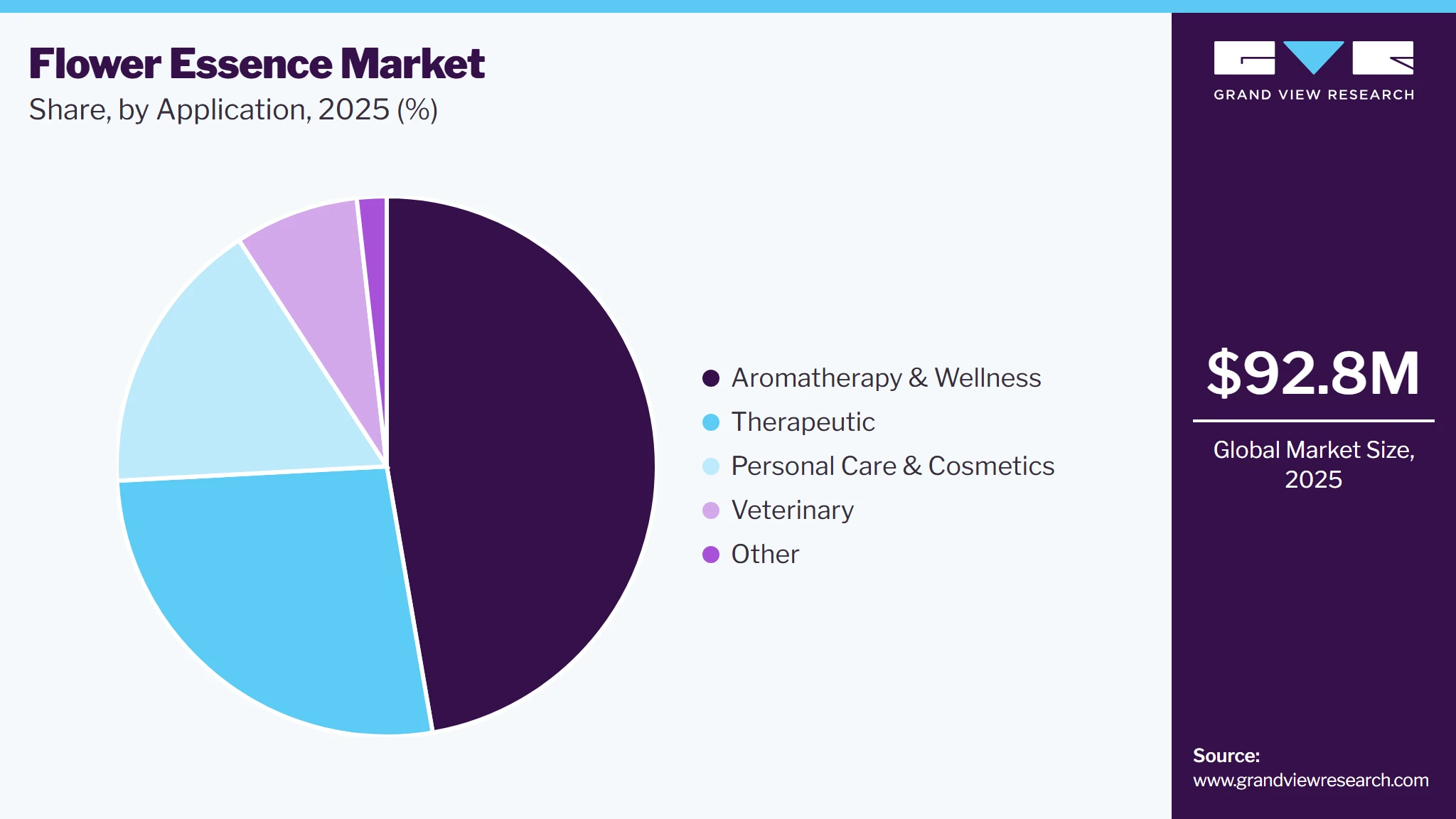
The aromatherapy & wellness segment led the market with the largest revenue share of 47.3% in 2025. The leading share reflects the established association of these preparations with relaxation, emotional balance, mindfulness, and holistic lifestyle practices. Increasing participation in complementary wellness activities is supporting demand across specialist practitioners, wellness centers, and digital channels. Product diversification and wider availability are also helping producers address a broader range of lifestyle-oriented requirements.
 To learn more about this report, Download Free Sample Report
The personal care & cosmetics segment is expected to grow at the fastest CAGR of 7.8% during the forecast period. Rising interest in plant-derived ingredients within topical preparations is encouraging manufacturers to introduce creams, gels, roll-ons, and related formats. The segment benefits from the convergence of wellness and beauty routines, particularly through premium and multifunctional products. Expansion across specialty retailers and online channels is expected to further strengthen its commercial prospects through 2033.
Regional Insights
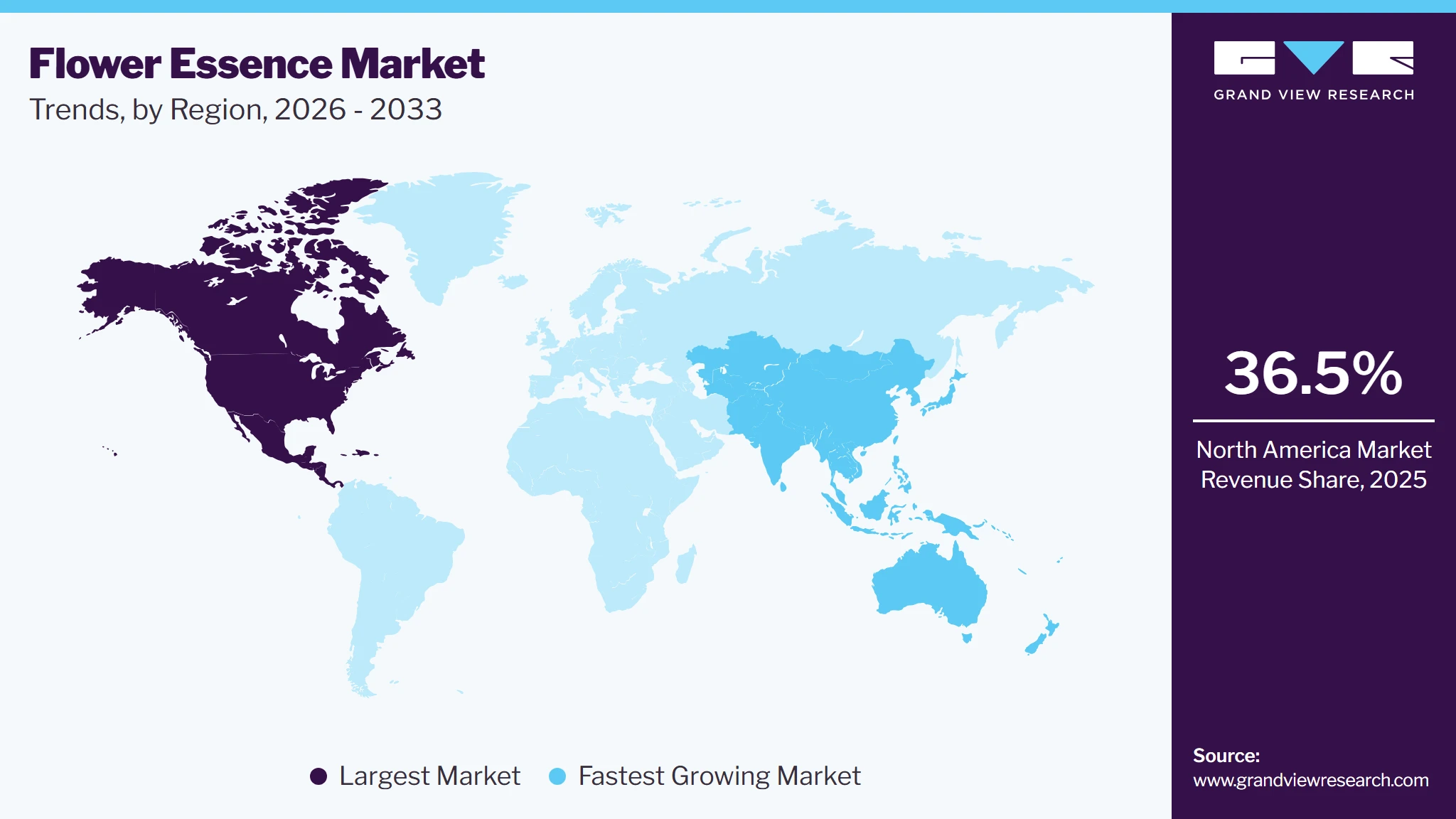
The North America flower essence market held the largest revenue share of 36.5% in 2025, due to high consumer awareness of complementary self-care, established specialty-retail networks, and strong direct-to-consumer infrastructure. The region hosts several specialist producers with proprietary botanical collections and long operating histories. Demand is supported by interest in mindfulness, holistic lifestyles, natural personal care, and individualized routines. Online channels provide manufacturers with efficient access to niche consumer groups while practitioner networks create additional routes for product discovery. Competitive differentiation increasingly depends on portfolio breadth, ingredient transparency, brand credibility, packaging convenience, and educational content. The mature retail environment also encourages companies to introduce specialized blends and alternative delivery formats.
 To learn more about this report, Download Free Sample Report
U.S. Flower Essence Market Trends
The flower essence market in the U.S. accounted for the largest market revenue share in North America in 2025, supported by a sizeable natural-products sector, sophisticated e-commerce ecosystem, and strong consumer participation in complementary activities. Specialist manufacturers such as Flower Essence Services and Desert Alchemy contribute to domestic production and provide differentiated botanical collections. Consumers can access these products through company websites, practitioners, specialty retailers, and online marketplaces. Direct-to-consumer distribution is particularly important for smaller producers because it allows them to reach targeted audiences without extensive physical infrastructure.
Asia Pacific Flower Essence Market Trends
The flower essence market in the Asia Pacific is expected to grow at the fastest CAGR of 7.4% during the forecast period. This growth is supported by longstanding familiarity with botanical and traditional plant-based practices and by expanding consumer interest in holistic self-care. Australia has particular importance because of its established ecosystem of native-flower essence producers, including manufacturers offering proprietary Australian botanical ranges. Japan also provides an established consumer base for complementary self-care products, while growing e-commerce penetration is improving access to specialist brands across India, China, Southeast Asia, and other developing markets. Producers can benefit from localized formulations, practitioner partnerships, and digital education as awareness expands. The region also offers opportunities for premium positioning based on indigenous botanical heritage and responsible sourcing.
The China flower essence market presents an emerging opportunity as consumers increasingly explore bio-based products alongside established traditional health practices. Rising disposable incomes, expanding online retail, and greater interest in preventive lifestyle management are supporting broader exposure to botanical and complementary products. Imported flower-essence brands can access consumers through specialized retailers and cross-border e-commerce platforms, although regulatory requirements and product classification remain important considerations. Local adaptation of packaging, product communication, and distribution strategies can improve commercial acceptance.
Europe Flower Essence Market Trends
The flower essence market in Europe is mature, with established complementary-health traditions, widespread availability of plant-derived products, and extensive specialty retail infrastructure. The UK is particularly significant because of its historical association with Bach flower remedies and the presence of established manufacturers such as Nelsons and Healing Herbs. Germany, France, Italy, and the Netherlands also provide attractive commercial opportunities through pharmacies, health stores, practitioner networks, and online channels.
The Germany flower essence market is an important European market due to its well-established natural-health and complementary-wellbeing ecosystem. Consumers demonstrate comparatively strong familiarity with botanical preparations, health-oriented retailing, pharmacies, and practitioner-led services. The country's sophisticated distribution infrastructure provides opportunities for both specialist international brands and domestic importers and retailers. Online commerce is further broadening access to niche formulations and enabling smaller producers to reach targeted customer groups.
Middle East & Africa Flower Essence Market Trends
The flower essence market in the Middle East & Africa remains a comparatively developing opportunity, with growth potential linked to increasing interest in natural personal care, self-care, personal health tourism, premium lifestyle products, and complementary health practices. Gulf countries, particularly the UAE and Saudi Arabia, offer attractive entry points due to higher purchasing power, sophisticated retail environments, and rapidly developing e-commerce infrastructure. International brands can leverage premium positioning and partnerships with holistic centers, specialty retailers, and distributors. Across Africa, opportunities are more concentrated in urban markets where modern retail and digital commerce are expanding. Market penetration can nevertheless be constrained by limited consumer awareness, uneven distribution infrastructure, and varying regulatory frameworks.
Latin America Flower Essence Market Trends
The flower essence market in Latin America offers growth potential through its strong cultural familiarity with medicinal plants and herbal preparations. Brazil represents the principal commercial opportunity because of its large consumer base, extensive botanical resources, developed beauty and related industries, and expanding online retail ecosystem. Argentina, Chile, and Colombia also provide opportunities for international and regional brands as specialty channels expand. Producers can benefit from positioning around botanical authenticity, natural sourcing, and holistic lifestyle applications. However, economic volatility, import costs, currency fluctuations, and country-specific regulatory requirements can influence pricing and market accessibility.
Key Flower Essence Company Insights
Companies are strengthening their market positions by broadening portfolios with combination formulas, sprays, topical applications, and specialized preparations to capture diverse consumer needs. They are also expanding through direct-to-consumer e-commerce, international distributor networks, practitioner partnerships, and educational initiatives, while emphasizing botanical provenance and product authenticity to reinforce brand differentiation.
-
Australian Bush Flower Essences is a specialist Australian producer focused on flower-based preparations derived primarily from Australian native flora. Its portfolio spans individual essences, combination remedies, creams, roll-ons, oral sprays, and environmental mists, enabling the company to address varied consumer preferences and usage occasions. The business has developed an international distribution network, supporting availability across multiple overseas markets. Its competitive positioning is reinforced by proprietary botanical collections, longstanding expertise in Australian flower essences, and continued portfolio development, including the introduction of new individual essences. The company also emphasizes education and practitioner engagement, helping strengthen brand recognition within specialist channels.
-
Yorkshire Flower Essences is a UK-based specialist manufacturer offering a portfolio centered on flower essences prepared from botanicals associated with the Yorkshire region and wider British flora. The company differentiates itself through a localized botanical identity, handcrafted positioning, and a focused range of individual and combination preparations. Its products are marketed through direct channels and specialist distributors, enabling access to consumers interested in complementary and plant-based approaches. The business benefits from the broader recognition of flower remedies within the UK and its established presence in the specialist essence segment. Its regional sourcing proposition and focused product development provide opportunities to differentiate itself from larger international brands with broader but less geographically specific portfolios.
Key Flower Essence Companies
The following key companies have been profiled for this study on the global flower essence market.
-
Nelsons / Bach Original Flower Remedies
-
Australian Bush Flower Essences
-
Flower Essence Services
-
Healing Herbs
-
Himalayan Flower Enhancers
-
Desert Alchemy
-
Power of Flowers
-
Living Essences of Australia
-
Yorkshire Flower Essences
-
Spirit-in-Nature Essences
Company Categorization
Operating Strategies
Competitive Edge
Weaknesses
Mature Players: Nelsons / Bach Original Flower Remedies, Australian Bush Flower Essences, Flower Essence Services, Healing Herbs, Living Essences of Australia, Himalayan Flower Enhancers.
- Maintain extensive portfolios spanning individual essences, combination formulas, topical preparations, sprays, and other specialized formats to serve diverse wellness preferences.
- Strengthen international reach through established distributor networks, specialist retailers, practitioner relationships, and direct-to-consumer digital channels.
- Preserve brand heritage and product authenticity by emphasizing established preparation methodologies, botanical provenance, and long-standing expertise.
- Expand consumer engagement through educational content, practitioner resources, product guidance, and digital platforms that encourage informed product selection.
- Strong brand recognition supported by long operating histories and established consumer trust.
- Broad geographic coverage provides access to multiple developed and emerging consumer markets.
- Proprietary botanical collections and differentiated formulations create barriers to direct imitation.
- Established manufacturing capabilities and distribution relationships enable consistent product availability across channels.
- Mature portfolios can make product innovation comparatively slower than that of smaller specialist producers.
- - Extensive international operations expose companies to differing regulatory requirements, labeling standards, and compliance costs.
- Established brands may carry higher operating and marketing costs because of broader distribution and organizational structures.
- Dependence on established product concepts can make repositioning more difficult as younger consumers seek novel formats and contemporary wellness experiences.
Emerging Players: Desert Alchemy, Power of Flowers, Yorkshire Flower Essences, Spirit-in-Nature Essences
- Concentrate on distinctive botanical collections and niche formulations to establish clear positioning within specialist wellness categories.
- Utilize direct-to-consumer websites, social media, and e-commerce marketplaces to reach targeted audiences without extensive physical distribution infrastructure.
- Introduce specialized blends, limited collections, and alternative formats to respond rapidly to emerging consumer preferences.
- Build visibility through practitioner relationships, educational initiatives, wellness communities, and specialist retailers rather than relying primarily on mass-market advertising.
- Greater operational flexibility enables faster experimentation with new formulations, formats, and positioning.
- Strong niche specialization allows these businesses to develop distinctive identities around particular botanical traditions or wellness philosophies.
- Leaner structures can support personalized customer engagement and closer relationships with practitioners and specialist retailers.
- Digital-first approaches provide relatively cost-efficient access to international consumers and geographically dispersed niche audiences.
- Lower brand recognition can make customer acquisition more difficult compared with established names.
- Smaller production capacity may restrict inventory availability and the ability to satisfy large-scale international demand.
- Limited financial resources can constrain regulatory expansion, clinical or scientific validation, marketing investment, and international distribution development.
- Greater dependence on founder expertise, specialist distributors, or niche consumer communities can create scalability and business-continuity challenges.
Recent Developments
-
In January 2026, Australian Bush Flower Essences introduced its 2026 Essence, an annual formulation developed around the Universal Year 1 theme and positioned around decisiveness, clarity, momentum, and purposeful action. The product is available in both 30 mL drops and an oral spray, providing consumers with two convenient formats. The launch extends the company’s annual essence program while adding a time-specific formulation to its existing portfolio.
-
In January 2026, Desert Alchemy launched Lavender Wand Penstemon as its 2026 Flower Essence of the Year. The preparation is derived from Penstemon dasyphyllus, a botanical native to parts of Arizona, New Mexico, and Texas, reinforcing the company’s focus on region-specific desert flora. The introduction expands its collection of proprietary botanical preparations while maintaining its established emphasis on plants from the Southwestern United States.
Flower Essence Market Report Scope
Report Attribute
Details
Market size in 2025
USD 92.8 million
Estimated market size in 2026
USD 98.5 million
Projected market size by 2033
USD 150.1 million
Growth rate
CAGR of 6.2% from 2026 to 2033
Base year for estimation
2025
Historical data
2021 – 2024
Forecast period
2026 – 2033
Quantitative units
Revenue in USD million, and CAGR from 2026 to 2033
Report coverage
Revenue forecast, volume forecast, company ranking, competitive landscape, growth factors, and trends
Segments covered
Product, form, application, region
Regional Scope
North America; Europe; Asia Pacific; Latin America; Middle East & Africa
Country scope
U.S.; Canada; Mexico; Germany; UK; France; Italy; Spain; China; India; Japan; South Korea; Brazil; Argentina; Saudi Arabia; South Africa.
Key companies profiled
Nelsons / Bach Original Flower Remedies; Australian Bush Flower Essences; Flower Essence Services; Healing Herbs; Himalayan Flower Enhancers; Desert Alchemy; Power of Flowers; Living Essences of Australia; Yorkshire Flower Essences; Spirit-in-Nature Essences.
Customization scope
Free report customization (equivalent up to 8 analysts’ working days) with purchase. Addition or alteration to country, regional & segment scope.
Pricing and purchase options
Avail customized purchase options to meet your exact research needs. Explore purchase options
Global Flower Essence Market Report Segmentation
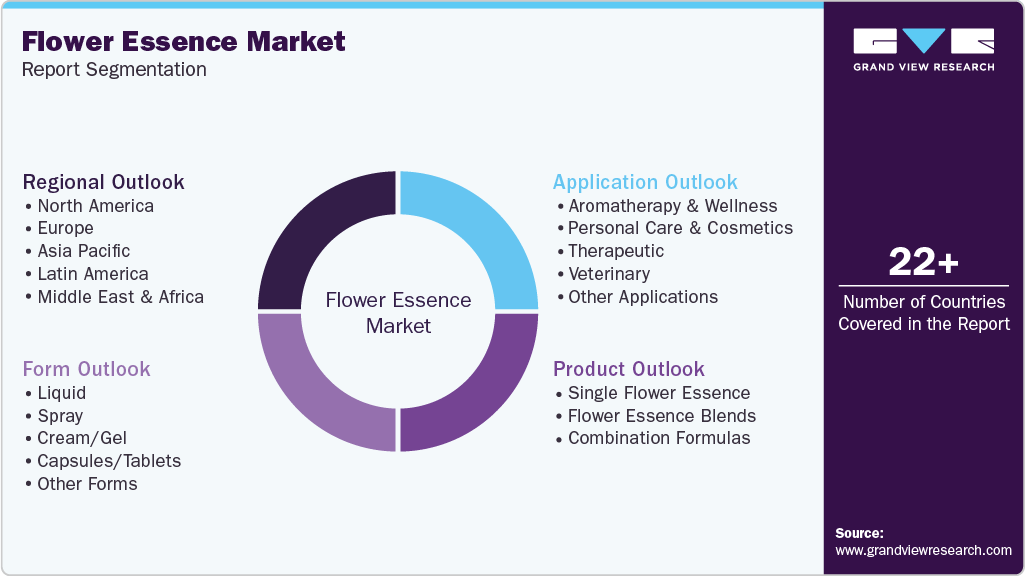
This report forecasts volume & revenue growth at regional, and country levels and provides an analysis of the latest industry trends in each of the sub-segments from 2021 to 2033. For this study, Grand View Research has segmented the global flower essence market report based on product, form, application, and region:
 To learn more about this report, Download Free Sample Report
-
Product Outlook (Revenue, USD Million, 2021 - 2033)
-
Single Flower Essence
-
Flower Essence Blends
-
Combination Formulas
-
-
Form Outlook (Revenue, USD Million, 2021 - 2033)
-
Liquid
-
Spray
-
Cream/Gel
-
Capsules/Tablets
-
Other Forms
-
-
Application Outlook (Revenue, USD Million, 2021 - 2033)
-
Aromatherapy & Wellness
-
Personal Care & Cosmetics
-
Therapeutic
-
Veterinary
-
Other Applications
-
-
Regional Outlook (Revenue, USD Million, 2021 - 2033)
-
North America
-
U.S.
-
Canada
-
Mexico
-
-
Europe
-
UK
-
Germany
-
France
-
Italy
-
Spain
-
-
Asia Pacific
-
China
-
Japan
-
India
-
South Korea
-
-
Latin America
-
Brazil
-
Argentina
-
-
Middle East and Africa (MEA)
-
South Africa
-
Saudi Arabia
-
-
Research Methodology
The flower essence marketfigures in this report are based on a proven research process that combines executive interviews with secondary research from proprietary databases, company filings, and recognized regulatory and institutional sources. Market size is built through value-chain sizing—reconciling supply-side and demand-side estimates—and triangulated with bottom-up and top-down approaches. Every estimate passes multiple levels of expert validation before publication, with eachflower essence segment quantified using the revenue-capture definitions in the table below.
Segment Definition
Segment – Product
Revenue capture definition
Single Flower Essence
Spending is associated with flower essences incorporated into relaxation routines, complementary wellness practices, meditation, emotional balance, and broader holistic self-care. Revenue potential is influenced by consumer awareness, practitioner recommendations, product variety, formulation positioning, and accessibility through wellness-oriented retail and digital channels.
Flower Essence Blends
Economic value arises from creams, roll-ons, mists, and other topical or personal-care preparations containing flower essences. Commercial demand is shaped by interest in botanical ingredients, clean-label positioning, convenient application, premium packaging, and integration with broader personal-care routines.
Combination Formulas
Revenue is associated with preparations positioned within complementary health and practitioner-led wellness practices. Adoption is influenced by practitioner acceptance, consumer perceptions, formulation specialization, product education, regulatory requirements, and restrictions governing health-related claims.
Segment – Form
Revenue capture definition
Liquid
Revenue is primarily derived from flower-essence drops and liquid preparations, including individual and blended formulations. Commercial performance depends on bottle capacity, formulation type, botanical sourcing, dosage convenience, repeat purchasing, and distribution through specialist retailers, practitioners, and online platforms.
Spray
Sales are generated through oral sprays and environmental mists designed to provide convenient application. Value is influenced by formulation composition, spray mechanism, packaging, portability, intended use, product differentiation, and consumer preference for convenient delivery systems.
Cream/Gel
Commercial returns stem from topical preparations that incorporate flower essences into creams, gels, and related personal-care products. Purchasing decisions are affected by formulation characteristics, skin-care positioning, botanical ingredients, packaging, application convenience, and premium product attributes.
Capsules/Tablets
Revenue may be captured through solid-dose products incorporating flower-essence preparations or related botanical formulations where offered by manufacturers. Market value is shaped by formulation design, dosage format, packaging, portability, shelf stability, and compatibility with consumer preferences for convenient wellness products.
Other Forms
Income encompasses roll-ons, balms, mists, kits, and other specialized delivery formats that do not fall within conventional liquid, spray, topical, or solid-dose categories. Commercial potential depends on format innovation, portability, intended application, packaging appeal, and differentiation from conventional preparations.
Segment – Application
Revenue capture definition
Aromatherapy & Wellness
Revenue is generated from flower essence products used in relaxation, meditation, emotional wellness, and holistic lifestyle routines. Sales are shaped by consumer awareness, professional recommendations, product differentiation, and availability through specialized wellness outlets and online platforms.
Personal Care & Cosmetics
Topical flower essence products generate income through the sale of formulations such as skincare creams, application sticks, and aromatic sprays. Their commercial performance depends on consumer interest in plant-derived ingredients, practical product formats, perceived quality, brand differentiation, and distribution across beauty retailers and e-commerce platforms.
Therapeutic
Revenue is associated with preparations positioned within complementary-health and practitioner-led wellness practices. Adoption is influenced by practitioner acceptance, consumer perceptions, formulation specialization, product education, regulatory requirements, and restrictions governing health-related claims.
Veterinary
Commercial activity stems from flower-essence preparations formulated or marketed for animal well-being and companion-animal care. Demand is influenced by product availability, practitioner or pet-care recommendations, owner awareness, formulation suitability, ease of administration, and the expansion of specialized animal-wellness offerings.
Other Applications
Revenue is generated through environmental mists, space preparations, and products intended for lifestyle or surrounding-environment applications. Commercial prospects depend on format convenience, differentiated positioning, consumer interest in holistic environments, product versatility, and availability through specialty and online channels.
Estimation Model
Layer No.
Layer Name
Key Question
Description
01
Raw Material & Production Layer
What forms the supply base?
Assess the flowers, plants, herbs, spring water, alcohol, glycerin, and other ingredients required to prepare these products. Examine botanical harvesting, cultivation or wild collection, flower selection, essence preparation methods, preservation, dilution, blending, filtration, bottling, labeling, quality assurance, storage, and sourcing practices. The assessment also considers seasonal availability, geographical provenance, supplier relationships, batch consistency, packaging materials, inventory management, and compliance with applicable wellness, cosmetic, food supplement, or complementary health regulations.
02
Application Adoption Layer
Where are flower essences utilized?
Evaluate utilization across emotional well-being, relaxation and stress management, personal development, complementary wellness, topical personal care, environmental applications, and animal-oriented products. Adoption varies according to consumer preferences, practitioner recommendations, cultural familiarity with botanical remedies, perceived naturalness, product accessibility, and the convenience of different delivery formats. Manufacturers also influence uptake through educational content, practitioner networks, specialty retailers, wellness centers, and direct-to-consumer platforms.
03
Consumption Intensity Layer
How extensively are flower essences consumed?
Analyze usage by individual versus combination preparations, product format, botanical source, bottle size, formulation concentration, application frequency, and end-user group. Consumption patterns differ between oral drops, sprays, creams, roll-ons, environmental mists, and other preparations because dosage, application frequency, product lifespan, and intended use vary. Demand is additionally affected by repeat-purchase behavior, practitioner recommendations, seasonal wellness trends, product bundling, household adoption, and expansion into specialized consumer segments.
04
Revenue Layer
How is market revenue generated?
Revenue is generated through the sale of individual essences, combination formulas, sprays, drops, creams, roll-ons, mists, kits, and other specialized preparations through manufacturers, distributors, specialty retailers, practitioners, pharmacies, wellness centers, and online channels. Commercial value is influenced by botanical sourcing, formulation complexity, bottle size, packaging, brand positioning, production scale, distribution margins, geographic reach, and product format. Premium opportunities arise from proprietary botanical collections, sustainably sourced ingredients, practitioner-oriented ranges, curated formulations, convenient delivery systems, and differentiated products supported by strong brand heritage and educational resources.
Delivered Customizations
This report has been delivered with the following In-depth customizations:
Client Request
Customization Delivered
Value Adds
Regional segmentation
The assessment provides country-level market sizing and forecasts by examining consumer wellness expenditure, complementary health practices, botanical product consumption, e-commerce penetration, practitioner networks, specialty retail infrastructure, regulatory frameworks, import activity, and domestic manufacturing capabilities. It evaluates regional supply chains, botanical availability, production clusters, distribution models, purchasing behavior, and adoption patterns across major countries.
Supports geographic prioritization, market-entry planning, channel development, distributor selection, inventory allocation, and investment decisions by highlighting territories with established complementary-wellness traditions, expanding natural-product consumption, strong digital commerce, and favorable access to specialist retail networks.
Opportunity Assessment
Comprehensive evaluation of emerging avenues across individual essences, combination formulations, oral drops, sprays, creams, roll-ons, environmental mists, practitioner-oriented products, and specialized wellness preparations. The assessment examines prospects arising from personalized wellness, botanical sourcing, convenient delivery formats, practitioner-led adoption, digital commerce, premium positioning, and expansion into underserved consumer groups and international territories.
Helps identify attractive product categories, consumer segments, distribution channels, and geographic opportunities by assessing purchasing behavior, portfolio gaps, wellness trends, regulatory developments, and manufacturer strategies. Findings support new-product development, R&D prioritization, format diversification, digital-channel expansion, practitioner engagement, partnerships, and market-entry initiatives.
Competitive Benchmarking
Comparative assessment of leading participants based on botanical portfolios, proprietary essence collections, preparation expertise, product-format diversity, manufacturing capabilities, geographic reach, distributor networks, digital presence, practitioner relationships, brand heritage, and product differentiation. The analysis also reviews recent launches, portfolio extensions, international expansion, educational initiatives, collaborations, channel development, and other strategic activities undertaken by prominent producers.
Enables companies to evaluate market positioning, portfolio strengths, capability gaps, differentiation potential, and strategic priorities. The resulting insights inform decisions on formulation development, product-format innovation, channel diversification, international expansion, practitioner partnerships, brand development, supply chain strengthening, and long-term competitive positioning.
Frequently Asked Questions About This Report
Aromatherapy & wellness had the highest revenue share of 47.3%, in 2025. The leading share reflects the established association of these preparations with relaxation, emotional balance, mindfulness, and holistic lifestyle practices.
Single flower essence segment dominated the market with a revenue share of 43.3% in 2025, reflecting strong demand for preparations derived from individual plant sources. Its leading position is supported by the extensive availability of single-source products across specialist manufacturers and wellness channels.
Personal care & cosmetics segment is expected to grow the fastest with a CAGR of 7.8% during the forecast period. Rising interest in plant-derived ingredients within topical preparations is encouraging manufacturers to introduce creams, gels, roll-ons, and related formats.
The flower essence market is expected to grow at a compound annual growth rate of 6.2% from 2026 to 2033 to reach USD 150.1 million by 2033.
Liquid segment dominated the market with a revenue share of 77.0% in 2025. This leadership is primarily attributed to the longstanding popularity of drop-based preparations and their straightforward administration.
North America is a crucial commercial center with the highest revenue share of 36.5% in 2025, due to high consumer awareness of complementary selfcare, established specialty-retail networks, and strong direct-to-consumer infrastructure.
Rising consumer interest in natural, botanical, and complementary approaches to emotional well-being is encouraging adoption across wellness-oriented households and practitioner channels. Manufacturers are introducing combination formulas, sprays, roll-ons, creams, and mists, improving convenience and creating additional consumption occasions.
Some of the key players operating in the flower essence market include Nelsons / Bach Original Flower Remedies; Australian Bush Flower Essences; Flower Essence Services; Healing Herbs; Himalayan Flower Enhancers; Desert Alchemy; Power of Flowers; Living Essences of Australia; Yorkshire Flower Essences; Spirit-in-Nature Essences
The flower essence market size was estimated at USD 92.8 million in 2025 and is expected to reach USD 98.5 million in 2026
About the Author(s)
Food Additives & Nutricosmetics Research Team
Specialty & Chemicals · Food Additives & NutricosmeticsThis report was authored by the food additives & nutricosmetics research team at Grand View Research - comprising two research analysts, one senior research analyst, and one industry expert - with specialized expertise in the food additives & nutricosmetics segment of the specialty & chemicals industry. All findings are based on proprietary specialty & chemicals databases, executive interviews, and regulatory analysis, subject to internal peer review prior to publication.
Last Updated:
Speak to Analyst

Customize this report to your needs - add regions, segments, or data points, with 20% free customization.
Or view our licence options:


ISO 9001:2015 & 27001:2022 Certified
We are GDPR and CCPA compliant! Your transaction & personal information is safe and secure. For more details, please read our privacy policy.


