
- Home
- »
- Catalysts & Enzymes
- »
-
Fluorspar Market Size, Share & Trends Report, 2026-2033GVR Report cover

Fluorspar Market (2026 - 2033)
Size, Share & Trends Analysis Report By End-use (Hydrofluoric Acid & Fluorochemicals, Aluminum, Steel & Metallurgical Flux, Cement, Ceramics & Glass), By Region, And Segment Forecasts
Market Size, 2025
$4.0BMarket Estimate, 2026
$4.3BMarket Forecast, 2033
$6.1BCAGR, 2026–2033
5.1%Fluorspar Market Summary
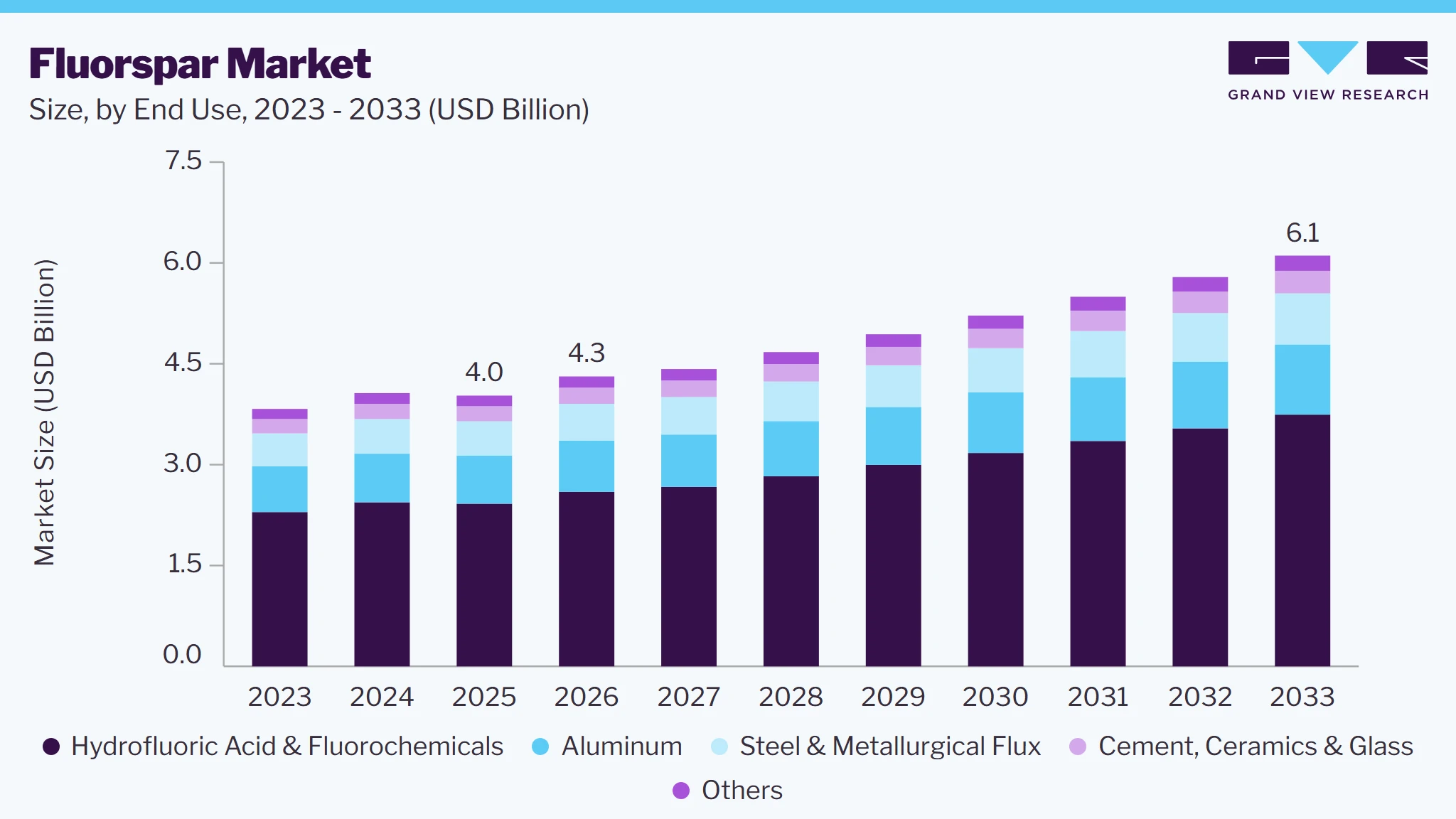
The global fluorspar market size was valued at USD 4.0 billion in 2025 and is projected to grow from USD 4.3 billion in 2026 to USD 6.1 billion by 2033, at a CAGR of 5.1% from 2026 to 2033. Asia Pacific dominated the market, accounting for a revenue share of 75.4% in 2025. The growth is primarily driven by increasing demand for hydrofluoric acid, which serves as a key raw material in the production of fluorochemicals, refrigerants, fluoropolymers, and specialty chemicals.
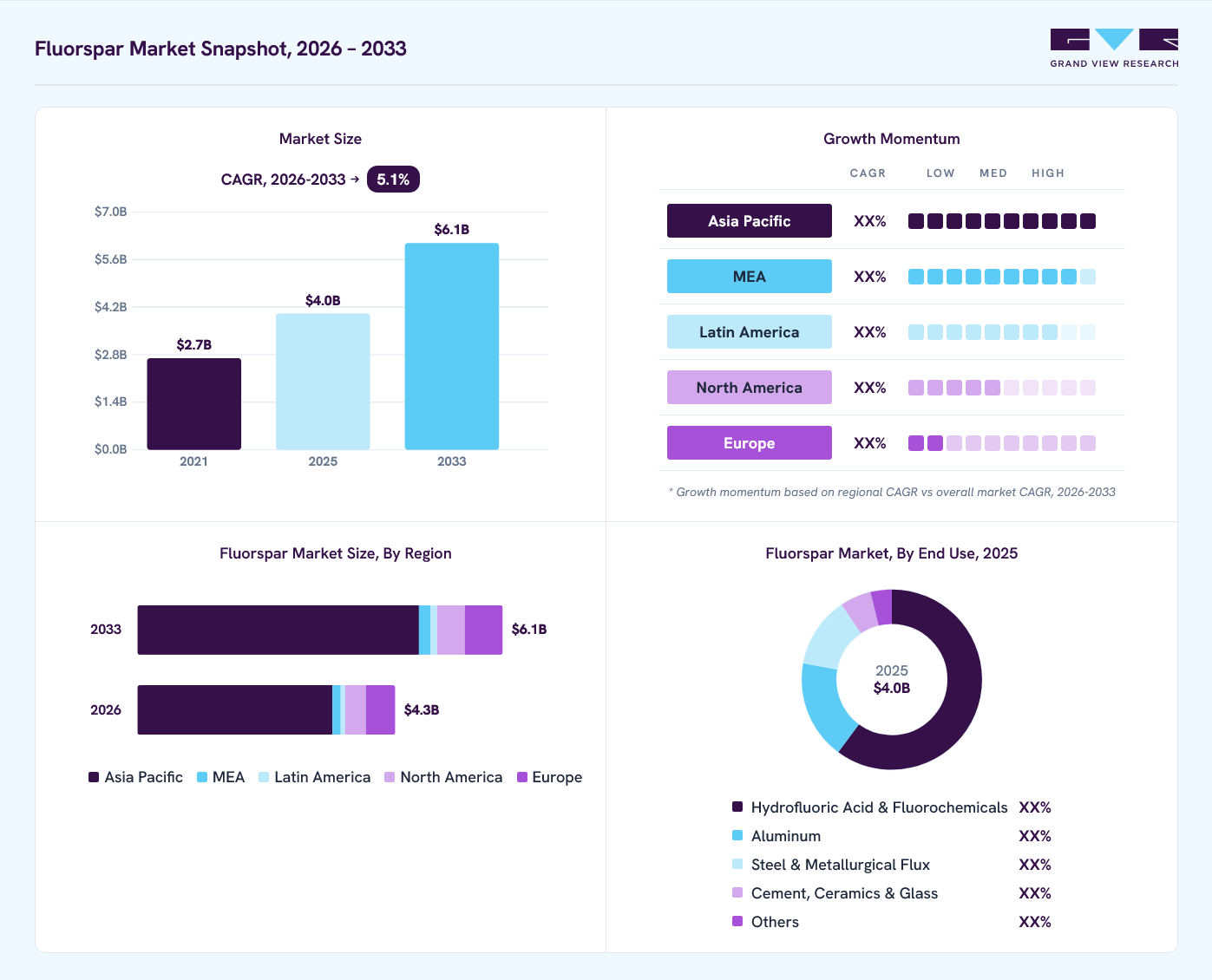 Source: Grand View Research, IR Documents, Primary Interviews, Paid DatabasesTo learn more about this report,
 Download Free Sample Report
Key Market Trends & Insights
- By end-use: Hydrofluoric acid & fluorochemicals segment accounted for the largest revenue share of 60.1% in 2025.
Regional Highlights
- Largest regional market: Asia Pacific (75.4% revenue share, 2025)
- By country: China held the largest share in 2025.
Market Size & Forecast
- Market size in 2025: USD 4.0 Billion
- Estimated market size in 2026: USD 4.3 Billion
- Projected market size by 2033: USD 6.1 Billion
- CAGR (2026-2033): 5.1%
GVR research-powered AIAsk Prism AI about the fluorspar marketGet cited answers from GVR research on market growth, segments, regulations and forecasts.Start with✓ Source-linked answers ✓ Market-specific context ✓ Traceable figuresExplore Prism AI ↗Expanding applications of hydrofluoric acid in the manufacturing of fluorinated compounds, including those used in refrigeration and air conditioning systems, are supporting market growth. The transition toward low global warming potential refrigerants is encouraging the development and adoption of alternative fluorochemical formulations, sustaining demand for fluorspar as an essential upstream mineral. In addition, growing demand for fluoropolymers in the automotive, electronics, chemical processing, and industrial equipment industries is strengthening consumption. The increasing use of high-performance materials in applications requiring chemical resistance, thermal stability, and durability is further contributing to the expansion of the market.
 To learn more about this report, Download Free Sample Report
Increasing investments in infrastructure development, transportation networks, renewable energy installations, and industrial manufacturing are supporting demand for steel and aluminum, thereby creating additional opportunities for fluorspar suppliers.
Market Dynamics
The increasing demand for hydrofluoric acid is a key driver of the market, as fluorspar serves as the primary raw material for its production. Hydrofluoric acid is widely used in manufacturing fluorochemicals, fluoropolymers, refrigerants, and specialty chemicals. Growing demand for fluorinated products across chemical processing, electronics, automotive, and industrial applications is supporting fluorspar consumption.
The expansion of steelmaking, aluminum production, and clean energy technologies is further contributing to market growth. Fluorspar is used as a flux in metallurgical processes to improve slag fluidity and support efficient metal production. Increasing demand for aluminum in transportation and renewable energy infrastructure, alongside the use of fluorine-based materials in batteries and semiconductor manufacturing, is strengthening demand for fluorspar across industrial value chains.
The market faces challenges due to the concentration of production in a limited number of countries, restrictions on mining activities, and stringent environmental requirements. Fluorspar extraction and beneficiation can involve land disturbance, waste generation, and energy-intensive processing, increasing compliance costs for producers. Supply disruptions, fluctuations in transportation expenses, and variations in ore quality can further affect availability and pricing for downstream consumers.
The growing adoption of advanced fluorochemicals in semiconductor manufacturing, lithium ion batteries, specialty polymers, and low global warming potential refrigerants is creating opportunities for fluorspar producers. These applications require reliable supplies of high quality acid grade fluorspar for hydrofluoric acid production. Investments in mining capacity, beneficiation technologies, and supply chain diversification can help producers meet evolving industrial requirements and strengthen their position in the global industry.
Analyst Perspective
The market is positioned for steady growth, supported by rising demand for hydrofluoric acid and fluorochemicals used in refrigerants, fluoropolymers, specialty chemicals, and semiconductor manufacturing. Increasing consumption in aluminum production, steelmaking, and metallurgical processing is further strengthening demand, while expanding applications in lithium-ion batteries and advanced industrial materials are creating additional opportunities.
End-use Insights
The hydrofluoric acid & fluorochemicals segment held the largest revenue share of 60.1% in 2025. The segment is expected to witness strong growth in the market due to the essential role of fluorspar as a primary raw material for producing hydrofluoric acid, which serves as a key intermediate in the manufacture of numerous fluorine-based chemicals. Hydrofluoric acid is widely used to produce fluorocarbons, fluoropolymers, refrigerants, and specialty fluorochemicals for applications across automotive, electronics, chemical processing, and refrigeration industries.
The cement, ceramics, and glass segment is driven by increasing demand for construction materials, architectural glass, ceramic tiles, and specialty glass products. Fluorspar is used in cement manufacturing as a mineralizer to facilitate clinker formation and improve production efficiency, while its derivatives support the production of hydrofluoric acid, which is used in glass etching, polishing, and ceramic surface treatment.
Regional Insights
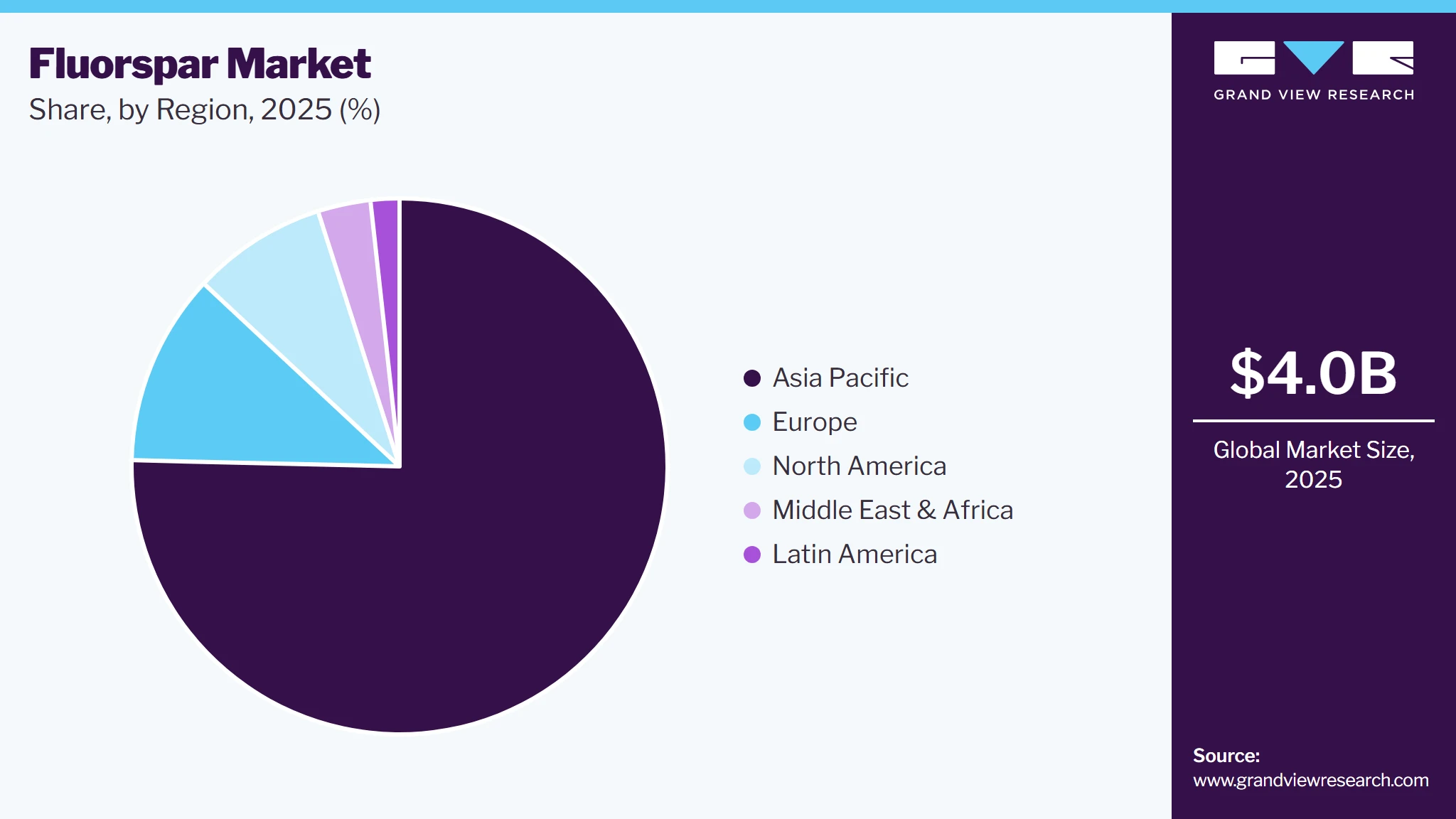
The Asia Pacific fluorspar market accounted for the largest revenue share of 75.4% in 2025 and is expected to grow at the fastest CAGR from 2026 to 2033. Asia Pacific is a leading region in the market, driven by strong demand from the chemicals, aluminum, steel, and specialty materials industries. China plays a dominant role in regional production and consumption, while India is witnessing increasing demand from aluminum production, steelmaking, and chemical manufacturing. Japan and South Korea contribute through their advanced electronics, semiconductor, and specialty chemical industries.
 To learn more about this report, Download Free Sample Report
China Fluorspar Market Trends
The fluorspar market in China represents a major market due to its substantial mining and processing capabilities and extensive downstream fluorochemical industry. China's aluminum and steel industries also consume fluorspar in metallurgical applications, where it acts as a flux to improve processing efficiency. Furthermore, expanding semiconductor manufacturing, electric vehicle battery production, and specialty chemical applications are increasing the importance of high purity fluorspar.
Europe Fluorspar Market Trends
The fluorspar market in Europe is supported by demand from fluorochemical manufacturing, aluminum production, steelmaking, and specialty chemical applications. Countries such as Germany, Italy, France, and Spain contribute through downstream industrial activities and chemical processing. The region's focus on developing secure supplies of critical raw materials and reducing dependence on imports is encouraging interest in domestic mining, recycling, and alternative sourcing.
North America Fluorspar Market Trends
The fluorspar market in North America is witnessing steady growth, driven by fluorochemical production, aluminum manufacturing, steelmaking, and specialty industrial applications. The U.S. is a major consumer and relies heavily on imported fluorspar to support its hydrofluoric acid and downstream fluorochemical industries. Mexico contributes to regional supply through its established fluorspar mining sector, providing an important source of metallurgical and acid-grade material.
The fluorspar market in the U.S. is primarily driven by demand from hydrofluoric acid production, fluorochemicals, aluminum processing, and specialty chemical manufacturing. Since the U.S. has limited active domestic fluorspar mining, it depends significantly on imports, particularly from countries such as Mexico and other international suppliers. Growing demand for advanced refrigerants, electric vehicle battery materials, and semiconductor manufacturing chemicals is increasing the importance of secure raw material sourcing.
Middle East & Africa Fluorspar Market Trends
The fluorspar market in the Middle East & Africa is developing through expanding chemical manufacturing, aluminum production, steelmaking, and mining activities. South Africa is an important regional producer, supported by its fluorspar deposits and established mining operations, while countries such as Morocco and other African mineral-producing economies offer opportunities for resource development. In the Middle East, investments in aluminum smelting and chemical processing, particularly in Saudi Arabia and the UAE, support demand for fluorspar and its derivatives.
Key Fluorspar Company Insights
Some of the key players operating in the market include China Kings Resources Group Co., Ltd., Fluorsid S.p.A., and others
-
China Kings Resources Group Co., Ltd. is a China-based mining and materials company established in 2001. The company specializes in the exploration, mining, processing, and development of fluorite resources, with operations spanning several Chinese provinces and an expanding presence in downstream fluorochemical processing. Its integrated business model combines fluorite resource development with the production of essential fluorochemical raw materials, supporting demand from metallurgy, chemicals, new energy, and advanced materials industries.
-
Fluorsid S.p.A. is an Italian chemical company established in 1969 in Sardinia, specializing in fluorine-based chemicals and mineral processing. The company operates across the fluorine value chain, from fluorspar extraction to the production of hydrogen fluoride, aluminum fluoride, and other fluorine derivatives. Through its international operations in Italy, the United Kingdom, Norway, and other markets, Fluorsid serves customers in the aluminum, fluoropolymer, specialty steel, and construction industries. Its integrated production capabilities support reliable raw material supply and the conversion of fluorspar into value-added industrial chemicals.
Key Fluorspar Companies:
The following key companies have been profiled for this study on the fluorspar market:
-
China Kings Resources Group
-
Fluorsid S.p.A.
-
Gujarat Fluorochemicals Ltd.
-
Inner Mongolia Baotou Steel Union
-
Masan High Tech Materials
-
Minersa Group
-
Mongolrostsvetmet SOE
-
Orbia Advance Corp. (Koura)
-
Sachtleben Minerals
-
SepFluor (Nokeng)
Competitive Benchmarking
Category
Operating Strategies
Competitive Edge
Weakness
Established Players (e.g. Orbia Advance Corp. (Koura), Mongolrostsvetmet SOE)
- Mature players in the global fluorspar market generally focus on securing long-term access to fluorspar deposits, optimizing mining and beneficiation operations, and supplying consistent grades of calcium fluoride (CaF₂) to downstream industries.
- The primary competitive advantage of mature players lies in their established mineral reserves, mining expertise, processing infrastructure, and long-standing relationships with downstream consumers.
- Mature fluorspar producers remain exposed to fluctuations in mineral prices, mining costs, energy expenses, and demand from downstream fluorochemical and metallurgical industries.
Emerging & Regional Players (e.g., Zhejiang Wuyi Shenlong Flotation)
- Emerging players in the fluorspar market generally focus on developing new deposits, reopening previously operated mines, and establishing specialized beneficiation facilities to serve regional or international customers.
- Emerging players can benefit from access to undeveloped deposits, flexible project structures, and the opportunity to establish operations using modern mining and processing technologies.
- New facilities can be designed around specific ore characteristics and customer requirements, potentially avoiding some inefficiencies associated with older production infrastructure.
- Emerging fluorspar companies typically face substantial financial, technical, and operational barriers during mine development and commercialization.
Recent Development
-
In October 2026, Ares Strategic Mining Inc. officially opened its Fluorspar Lumps Plant in Delta, Utah, marking a significant step toward strengthening domestic fluorspar processing capacity in the U.S. The facility processes raw fluorspar from the company’s fully permitted Lost Sheep Mine into metallurgical-grade fluorspar used in steelmaking and aluminum production. The development supports the company’s vertically integrated operating model by connecting mining with downstream processing and finished product supply.
Fluorspar Market Report Scope
Report Attribute
Details
Market Definition
Scope includes apparent consumption of fluorspar of all grades for various end uses.
Market size in 2025
USD 4.0 billion
Estimated market size in 2026
USD 4.3 billion
Projected market size by 2033
USD 6.1 billion
Growth rate
CAGR of 5.1% from 2026 to 2033
Base year for estimation
2025
Historical data
2021 - 2024
Forecast period
2026 - 2033
Quantitative units
Volume in kilotons, revenue in USD billion, and CAGR from 2026 to 2033
Report coverage
Volume & revenue forecast, competitive landscape, growth factors, and trends
Segments covered
End-use, region
Regional scope
North America; Europe; Asia Pacific; Latin America; Middle East & Africa
Country scope
U.S.; Canada; Mexico; Germany; UK; Spain; Russia; China; India; Japan; South Korea; Vietnam; Iran; South Africa; GCC
Key companies profiled
China Kings Resources Group; Fluorsid S.p.A.; Gujarat Fluorochemicals Ltd.; Inner Mongolia Baotou Steel Union; Masan High Tech Materials; Minersa Group; Mongolrostsvetmet SOE; Orbia Advance Corp. (Koura); Sachtleben Minerals; SepFluor (Nokeng)
Customization scope
Free report customization (equivalent up to 8 analysts working days) with purchase. Addition or alteration to country, regional & segment scope.
Pricing and purchase options
Avail customized purchase options to meet your exact research needs. Explore purchase options
Global Fluorspar Market Report Segmentation
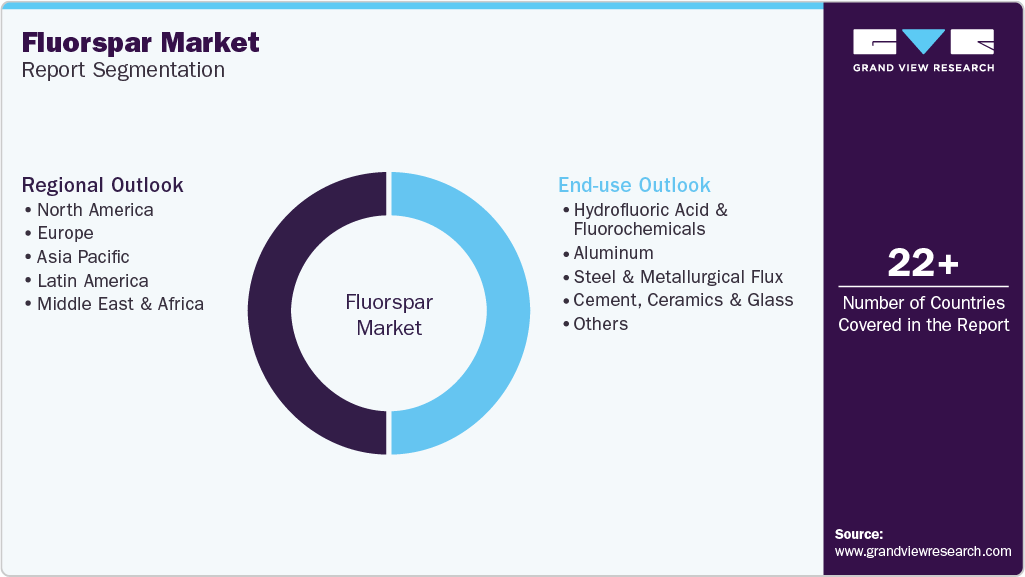
This report forecasts volume & revenue growth at global, regional, and country levels and provides an analysis of the latest industry trends in each of the sub-segments from 2021 to 2033. For this study, Grand View Research has segmented the global fluorspar market report based on end-use and region:
 To learn more about this report, Download Free Sample Report
-
End-use Outlook (Volume, Kilotons, Revenue, USD Billion, 2021 - 2033)
-
Hydrofluoric Acid & Fluorochemicals
-
Aluminum
-
Steel & Metallurgical Flux
-
Cement, Ceramics & Glass
-
Others
-
-
Regional Outlook (Volume, Kilotons, Revenue, USD Billion, 2021 - 2033)
-
North America
-
U.S.
-
Canada
-
Mexico
-
-
Europe
-
Germany
-
UK
-
Spain
-
Russia
-
-
Asia Pacific
-
China
-
India
-
Japan
-
South Korea
-
Vietnam
-
-
Latin America
-
Middle East & Africa
-
Iran
-
South Africa
-
GCC
-
-
Research Methodology
The fluorspar market figures in this report are based on a proven research process that combines executive interviews with secondary research from proprietary databases, company filings, and recognized regulatory and institutional sources. Market size is built through value-chain sizing-reconciling supply-side and demand-side estimates-and triangulated with bottom-up and top-down approaches. Every estimate passes multiple levels of expert validation before publication, with each fluorspar segment quantified using the revenue-capture definitions in the table below.
Segment Definition
End Use
Revenue Capture Definition
Hydrofluoric Acid & Fluorochemicals
The hydrofluoric acid and fluorochemicals segment captures revenue generated from fluorspar used as the primary feedstock for producing hydrofluoric acid, which serves as a key intermediate in manufacturing fluorochemicals.
Aluminum
The aluminum segment represents revenue generated from fluorspar used in the production of aluminum fluoride and other fluorine-based additives required for aluminum smelting.
Steel & Metallurgical Flux
The steel and metallurgical flux segment captures revenue generated from fluorspar used as a flux in steelmaking and other metallurgical processes. Fluorspar helps improve slag fluidity, facilitates the removal of impurities, and supports efficient refining under appropriate process conditions.
Cement, Ceramics & Glass
The cement, ceramics and glass segment represents revenue generated from fluorspar used as a mineral additive or processing aid in selected cement formulations, ceramic products, enamels, and glass manufacturing.
Others
The others segment captures revenue generated from fluorspar used in applications such as welding electrodes, optical materials, specialty chemicals, mineral processing, and other industrial processes.
Estimation Model
Layer Name
Key Question
Description
Fluorochemicals & Industrial Demand Base Layer
What forms the demand base?
Identify global demand from major fluorspar-consuming industries, including hydrofluoric acid and fluorochemicals, aluminum production, steel and metallurgical flux, cement, ceramics, and glass manufacturing. Assess fluorochemical production, aluminum output, steel production, and industrial manufacturing activity to establish the total addressable demand for fluorspar.
Fluorspar Application Penetration Layer
Where is fluorspar utilized?
Estimate the penetration of fluorspar across key applications, including hydrofluoric acid production, refrigerants, fluoropolymers, aluminum smelting, steelmaking, metallurgical flux, cement manufacturing, ceramics, and glass production. Analyze the adoption of acid-grade, metallurgical-grade, and other fluorspar grades according to downstream processing requirements, chemical purity, and end-use specifications.
Fluorspar Consumption Intensity Layer
How much fluorspar is consumed?
Analyze fluorspar consumption intensity based on hydrofluoric acid production, fluorochemical manufacturing, aluminum smelting, steel output, and other industrial processing volumes. Evaluate raw material requirements per unit of downstream production, accounting for fluorspar grade, calcium fluoride content, conversion yields, process efficiency, and material recovery. Consumption intensity varies according to manufacturing technology, product specifications, and the requirements of individual end-use applications.
Revenue Layer
How is market revenue generated?
Market revenue is quantified through the mining, beneficiation, processing, and sale of acid-grade, metallurgical-grade, and other fluorspar products. Revenue generation is driven by demand from fluorochemical manufacturers, aluminum producers, steelmakers, and cement, ceramics, and glass industries. Market value is influenced by ore quality, calcium fluoride concentration, product grade, mining and processing costs, transportation expenses, production volumes, and regional supply-demand dynamics.
Delivered Customizations
We have successfully delivered the following deep-dive customizations:
Client Request
Customization Delivered
Value Adds
Regional Segmentation
Regional assessment of North America, Europe, Asia Pacific, Central and South America, and the Middle East and Africa, covering major markets such as China, Mexico, Mongolia, South Africa, Spain, Italy, India, and the United States. The analysis evaluates fluorspar reserves, mining output, ore grades, beneficiation capacity, import dependence, and downstream processing infrastructure. It also examines regional demand from hydrofluoric acid and fluorochemicals, aluminum production, steelmaking, cement, ceramics, and glass manufacturing.
Identifies regional supply concentration, import dependency, emerging production hubs, and opportunities for local sourcing and downstream capacity expansion.
Cross Segmentation
Cross analysis of fluorspar grades, including acid grade, metallurgical grade, and ceramic grade, against key end uses such as hydrofluoric acid and fluorochemicals, aluminum, steel and metallurgical flux, cement, ceramics and glass, and other applications. The assessment evaluates how calcium fluoride content, impurities, processing requirements, and product specifications influence suitability across end uses.
Highlights high value grade and application combinations, demand pockets for higher purity material, and opportunities to optimize product portfolios according to end user requirements.
Opportunity Assessment
Identification of growth opportunities in acid grade fluorspar for hydrofluoric acid and fluorochemical production, metallurgical grade material for steelmaking and aluminum related applications, and ceramic grade material for glass and ceramic manufacturing. The analysis evaluates opportunities in mine development, beneficiation technology, recovery of usable fluorspar from lower grade resources, downstream integration, recycling and material efficiency, and supply arrangements with fluorochemical manufacturers.
Helps prioritize attractive application segments, assess investment opportunities across the value chain, and identify ways to improve resource utilization, product quality, supply security, and long term customer relationships.
Frequently Asked Questions About This Report
The global fluorspar market size was valued at USD 4.0 billion in 2025 and is estimated at USD 4.3 billion in 2026.
The global fluorspar market is expected to grow at a CAGR of 5.1% from 2026 to 2033, reaching USD 6.1 billion by 2033.
The hydrofluoric acid & fluorochemicals segment held the largest revenue share of 60.1% in 2025 and is the fastest-growing segment.
Asia Pacific is the fastest-growing region over the forecast period.
The key driver of growth in the global fluorspar market is the increasing demand for hydrofluoric acid, which serves as a critical raw material in the production of fluorochemicals, refrigerants, aluminum, and specialty chemicals across various industrial applications.
Key players include China Kings Resources Group; Fluorsid S.p.A.; Gujarat Fluorochemicals Ltd.; Inner Mongolia Baotou Steel Union; Masan High Tech Materials; Minersa Group; Mongolrostsvetmet SOE; Orbia Advance Corp. (Koura); Sachtleben Minerals; SepFluor (Nokeng)
Asia Pacific dominated the market, accounting for a revenue share of 75.4% in 2025.
About the Author(s)
Catalysts & Enzymes Research Team
Specialty & Chemicals · Catalysts & EnzymesThis report was authored by the catalysts & enzymes research team at Grand View Research - comprising two research analysts, one senior research analyst, and one industry expert - with specialized expertise in the catalysts & enzymes segment of the specialty & chemicals industry. All findings are based on proprietary specialty & chemicals databases, executive interviews, and regulatory analysis, subject to internal peer review prior to publication.
Last Updated:
Speak to Analyst

Customize this report to your needs - add regions, segments, or data points, with 20% free customization.
Or view our licence options:


ISO 9001:2015 & 27001:2022 Certified
We are GDPR and CCPA compliant! Your transaction & personal information is safe and secure. For more details, please read our privacy policy.


