
- Home
- »
- Advanced Interior Materials
- »
-
Fracking Fluid End Market Size & Share Report, 2026-2035GVR Report cover
![Fracking Fluid End Market (2026 - 2035)Report]()
Fracking Fluid End Market (2026 - 2035)
Size, Share & Trends Analysis Report By Material (Carbon Steel Fluid Ends, Stainless Steel Fluid Ends), By End User (OEM, Aftermarket), By Horsepower Of The Frac Pumps (2000–2500, Above 2500), By Region, And Segment Forecasts
Market Size, 2025
$647.0MMarket Estimate, 2026
$683.9MMarket Forecast, 2035
$1,126.3MCAGR, 2026–2035
5.7%Fracking Fluid End Market Summary
The global fracking fluid end market size was valued at USD 647.0 million in 2025 and is projected to grow from USD 683.9 million in 2026 to USD 1,126.3 million by 2035, at a CAGR of 5.7% from 2026 to 2035. North America dominated the market, accounting for the revenue share of 38.0% in 2025. The market is driven by increasing hydraulic fracturing activities, growing unconventional oil and gas production, and rising demand for durable, high-performance fluid ends. Advancements in fluid end materials and the replacement of aging fracturing equipment are also supporting market growth.
Key Market Trends & Insights
- By material: The carbon steel fluid ends segment held the largest market share of approximately 62.0% in 2025.
- By end user: The OEM (OE) segment held the largest market share of approximately 55.0% in 2025.
- By horsepower of the frac pumps: The 2000–2500 horsepower segment held the largest market share of around 57.0% in 2025.
Regional Highlights
- Largest regional market: North America (38.0% revenue share, 2025)
- Fastest-growing regional market: Asia Pacific (highest CAGR, 2026-2035)
Market Size & Forecast
- Market size in 2025: USD 647.0 Million
- Estimated market size in 2026: USD 683.9 Million
- Projected market size by 2035: USD 1,126.3 Million
- CAGR (2026-2035): 5.7%
The fracking fluid end market is driven by the increasing adoption of hydraulic fracturing for unconventional oil and gas production, particularly in shale reservoirs, to meet growing global energy demand. Rising investments in exploration and production (E&P) activities and the expansion of high-pressure hydraulic fracturing operations are fueling demand for durable, high-performance fluid ends. The industry's growing focus on improving pumping efficiency, extending equipment life, and reducing operational downtime has accelerated the adoption of advanced fluid end materials with superior wear, fatigue, and corrosion resistance. In addition, ongoing fleet modernization by oilfield service providers and technological advancements in fluid end design are further supporting market growth.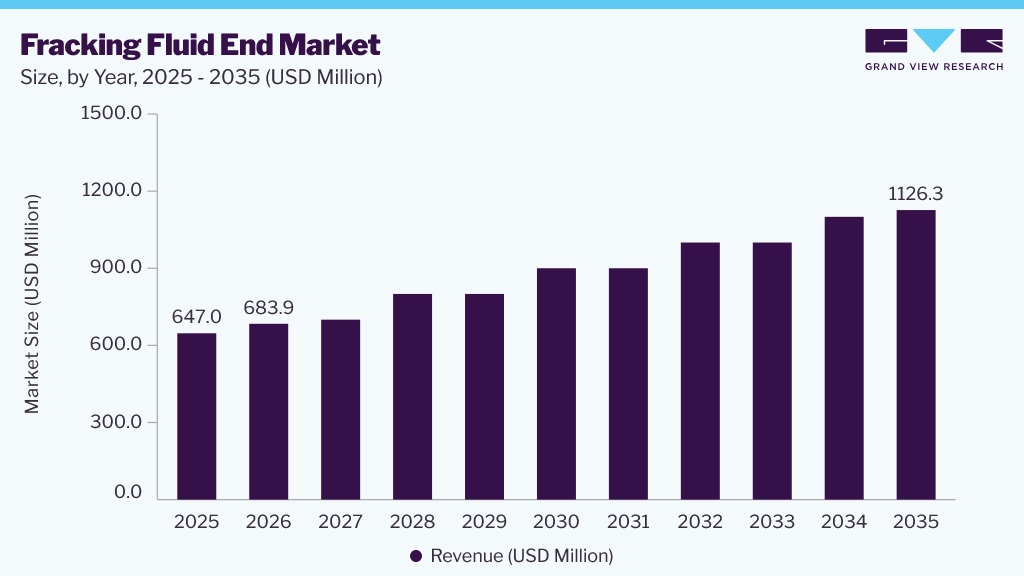
Despite favorable growth prospects, the market faces restraints due to volatile crude oil and natural gas prices, which directly influence drilling activity and capital expenditure across the oil and gas industry. Stringent environmental regulations related to hydraulic fracturing, increasing scrutiny overwater consumption and wastewater disposal, and the transition toward renewable energy sources may limit market expansion in certain regions. However, the market presents significant opportunities from growing demand for replacement of worn fluid ends, increasing adoption of advanced alloy components, and expansion of unconventional oil and gas exploration in emerging economies.
Manufacturers are also introducing next-generation hydraulic fracturing technologies to improve operational efficiency and equipment performance. For instance, in May 2025, Halliburton unveiled the ZEUS IQ intelligent fracturing platform, a closed-loop fracturing solution that combines real-time automation and intelligent decision-making, supporting the adoption of advanced hydraulic fracturing technologies across oilfield operations. The integration of predictive maintenance technologies, digital monitoring systems, and enhanced manufacturing processes is expected to improve equipment reliability and create growth opportunities for manufacturers during the forecast period.
Analyst Perspective
The fracking fluid end market is expected to witness steady growth, supported by rising hydraulic fracturing activity and continued investment in unconventional oil and gas production. Manufacturers are focusing on material innovations, precision engineering, and advanced manufacturing processes to improve equipment reliability and extend service life. Replacement demand from aging fracturing fleets is expected to remain a key revenue contributor, particularly in mature markets where operators seek to extend equipment life and reduce downtime. Meanwhile, increasing oil and gas exploration activities in emerging regions is creating opportunities for fluid end manufacturers and suppliers. The adoption of automation, digital monitoring, and intelligent fracturing technologies is also supporting improvements in operational efficiency and equipment utilization.
Material Insights
The carbon steel fluid ends segment accounted for the largest share of approximately 62.0% in 2025. The segment growth is attributed to the material's high mechanical strength, cost-effectiveness, and widespread adoption across hydraulic fracturing operations. Carbon steel fluid ends can withstand the high pressures and cyclic loading associated with hydraulic fracturing, making them a preferred choice for standard fracturing applications. Their availability, ease of manufacturing, and compatibility with existing high-pressure pumping equipment have further supported their extensive use across conventional and unconventional oil and gas fields. In addition, ongoing investments in drilling and well completion activities are contributing to demand for carbon steel fluid ends due to their established operational reliability and relatively lower acquisition costs.
The stainless steel fluid ends segment is expected to witness the fastest growth during the forecast period. The increasing complexity of hydraulic fracturing operations and exposure to abrasive and corrosive fracturing environments are driving demand for materials with enhanced durability and corrosion resistance. Stainless steel fluid ends can provide improved corrosion resistance and, depending on the specific alloy and application, enhanced fatigue performance and service life compared with conventional carbon steel alternatives. As oilfield service providers increasingly prioritize lifecycle cost optimization, operational efficiency, and equipment reliability, adoption of stainless steel fluid ends is expected to accelerate. Furthermore, advancements in metallurgy, precision machining, and heat-treatment technologies are improving the performance and reliability of stainless steel components, making them suitable for demanding high-pressure, high-cycle fracturing applications.
End User Insights
The OEM (original equipment manufacturer) segment accounted for the largest share of approximately 55.0% in 2025, supported by ongoing investment in new hydraulic fracturing fleets, increasing deployment of high-pressure pumping equipment, and demand for technologically advanced fluid ends capable of operating under extreme pressure and abrasive conditions. Oilfield service companies are increasingly procuring high-performance fluid ends that offer improved durability, longer service life, and enhanced reliability to maximize productivity and reduce operational downtime. In addition, modernization of fracturing equipment and the adoption of advanced pumping technologies are supporting demand for new equipment and associated fluid end components. For instance, in October 2025, GD Energy Products launched its High Flow (HF) Series of hydraulic fracturing pumps, comprising the 5,000-horsepower GD 5000HF and 3,600-horsepower GD 3600HF. The introduction of higher-horsepower fracturing pumps is expected to support demand for fluid ends integrated into newly manufactured pumping equipment, thereby contributing to OEM segment growth.
The aftermarket segment is expected to witness the fastest growth during the forecast period. Fluid ends operate under high-pressure and abrasive conditions, resulting in wear and fatigue that can create recurring requirements for maintenance, refurbishment, and replacement. This supports demand for aftermarket fluid ends and related components. As hydraulic fracturing fleets continue to operate for extended periods, operators are increasingly investing in replacement fluid ends and maintenance solutions to extend equipment life and minimize unplanned downtime. The growing focus on cost optimization, asset utilization, and equipment reliability is further supporting aftermarket demand. In addition, continued drilling activity, aging fracturing fleets, and adoption of replacement components designed for improved wear resistance are expected to accelerate aftermarket segment growth throughout the forecast period.
Horsepower Of The Frac Pumps Insights
The 2,000–2,500 horsepower segment accounted for the largest share of approximately 57.0% of the fracking fluid end market in 2025. Segment growth is supported by the widespread use of pumps within this horsepower range across hydraulic fracturing operations. High-horsepower fracturing pumps are designed to deliver substantial fluid volumes at elevated pressures, making them suitable for demanding well stimulation applications. The compatibility of these pumps with established fracturing fleets, their proven field performance, and their ability to support a range of pressure and flow requirements continue to support demand across major oil and gas producing regions.
The above-2,500-horsepower segment is expected to witness the fastest growth during the forecast period. The development of longer horizontal wells, higher pumping intensity, and increasingly demanding multi-stage hydraulic fracturing operations is driving demand for higher-capacity pumping equipment. Furthermore, the growing adoption of advanced pumping fleets and investments in high pressure hydraulic fracturing equipment are supporting the deployment of higher-horsepower pumps for complex shale development projects. As operators prioritize pumping efficiency, productivity, and equipment reliability, demand for fluid ends designed for higher-horsepower fracturing pumps is expected to increase during the forecast period.
Regional Insights
North America fracking fluid end market accounted for the largest share of approximately 38.0% in 2025, driven by extensive hydraulic fracturing activities across major shale basins in the U.S. and Canada. Strong investments in unconventional oil and gas production, continuous modernization of fracturing fleets, and the presence of leading oilfield service companies have sustained demand for high-performance fracking fluid ends. In addition, increasing replacement requirements for aging equipment, adoption of advanced fracturing technologies, and the high concentration of shale development activities continue to reinforce North America's leading position in the global market.

Asia Pacific Fracking Fluid End Market Trends
Asia Pacific is expected to witness the fastest growth during the forecast period. Rising energy demand, efforts to strengthen energy security, and increasing investments in unconventional oil and gas exploration are supporting the expansion of hydraulic fracturing activities across countries such as China, India, and Australia. The development of shale gas resources, coupled with government initiatives to increase domestic natural gas production, is creating new opportunities for manufacturers of fracking equipment and related components. Growing investments in unconventional gas exploration, particularly in China, are further expected to support regional demand for hydraulic fracturing equipment and fluid-end components. For instance, in May 2025, Sinopec announced a breakthrough in ultra-deep shale gas exploration in China's Sichuan Basin through its Tiebei 1HF well. The development highlights China's growing focus on expanding domestic shale gas production and is expected to create future opportunities for hydraulic fracturing equipment and service providers.
Key Fracking Fluid End Market Company Insights
The fracking fluid end market is characterized by established oilfield equipment manufacturers and service providers that focus on product innovation, material advancements, and technology integration to improve hydraulic fracturing efficiency. Companies are increasingly developing high-performance fluid ends with enhanced durability, corrosion resistance, and fatigue strength to withstand extreme pressure conditions during fracturing operations. Market participants are also investing in advanced manufacturing processes, intelligent fracturing solutions, and equipment upgrades to improve operational reliability and reduce maintenance requirements. Strategic collaborations between oilfield service providers and energy companies, along with the expansion of high-pressure pumping fleets, are further shaping the competitive landscape. Leading players are strengthening their market positions through technological advancements, portfolio expansion, and solutions that support efficient, cost-effective unconventional oil and gas production.
Key Fracking Fluid End Companies
The following key companies have been profiled for this study on the fracking fluid end market:
-
SLB
-
Halliburton Company
-
Baker Hughes Company
-
NOV Inc.
-
GD Energy Products
-
Weir Group PLC
-
Ingersoll Rand
-
Forum Energy Technologies
-
Jereh Group
-
SPM Oil & Gas
Recent Developments
-
In February 2026, SLB launched next-generation Cameron Frac Fluid Delivery System, a fully electric solution designed to improve efficiency, reliability, and safety in hydraulic fracturing operations. The system integrates electric actuation, maintenance-free frac valves, and ValveCommander fluid delivery control to enable more automated and digitally controlled fracturing workflows.
-
In June 2025, Chevron U.S.A. and Halliburton developed a closed-loop, feedback-driven completions process in Colorado, combining automated stage execution with real-time subsurface feedback to optimize fracturing fluid delivery without manual intervention. The technology highlights the industry's shift toward intelligent fracturing solutions focused on improving precision, efficiency, and operational performance.
-
In March 2025, Tenaris announced a USD 110 million investment to strengthen its hydraulic fracturing capabilities in Argentina's Vaca Muerta shale formation by adding a third frac set with 28 hydraulic fracturing pumps totaling 70,000 horsepower. The new equipment is expected to be operational in early 2026, expanding Tenaris's well-completion capacity in the basin.
Fracking Fluid End Market Report Scope
Report Attribute
Details
Market size in 2025
USD 647.0 million
Estimated market size in 2026
USD 683.9 million
Projected market size by 2035
USD 1,126.3 million
Growth rate
CAGR of 5.7% from 2026 to 2035
Base year for estimation
2025
Historical data
2021 – 2024
Forecast period
2026 – 2035
Quantitative units
Revenue in USD million, and CAGR from 2026 to 2035
Report coverage
Revenue forecast, company ranking, competitive landscape, growth factors, and trends
Segments covered
Material, end user, horsepower of the frac pumps, region
Regional Scope
North America; Europe; Asia Pacific; Latin America; Middle East & Africa
Country Scope
U.S.; Canada; Mexico; UK; Germany; France; Italy; Spain; China; Japan; India; Australia; South Korea; Brazil; Argentina; South Africa; Saudi Arabia; UAE.
Key companies profiled
SLB; Halliburton Company; Baker Hughes Company; NOV Inc.; GD Energy Products; Weir Group PLC; Ingersoll Rand; Forum Energy Technologies; Jereh Group; SPM Oil & Gas.
Customization scope
Free report customization (equivalent to 8 analyst working days) with purchase. Addition or alteration to country, regional & segment scope.
Pricing and purchase options
Avail of customized purchase options to meet your exact research needs. Explore purchase options
Global Fracking Fluid End Market Report Segmentation
This report forecasts revenue growth at the global, regional, and country levels and provides an analysis of the latest industry trends and opportunities across each sub-segment from 2021 to 2035. For this study, Grand View Research has segmented the global fracking fluid end market report based on material, end user, horsepower of the frac pumps, and region:
-
Material Outlook (Revenue, USD Million, 2021 - 2035)
-
Carbon Steel Fluid Ends
-
Stainless Steel Fluid Ends
-
Others
-
-
End User Outlook (Revenue, USD Million, 2021 - 2035)
-
OEM (OE)
-
Aftermarket
-
Others
-
-
Horsepower of the Frac Pumps Outlook (Revenue, USD Million, 2021 - 2035)
-
2000–2500 Horsepower
-
Above 2500 Horsepower
-
-
Regional Outlook (Revenue, USD Million, 2021 - 2035)
-
North America
-
U.S.
-
Canada
-
Mexico
-
-
Europe
-
UK
-
Germany
-
France
-
Italy
-
Spain
-
-
Asia Pacific
-
China
-
Japan
-
India
-
Australia
-
South Korea
-
-
Latin America
-
Brazil
-
Argentina
-
-
Middle East and Africa (MEA)
-
South Africa
-
Saudi Arabia
-
UAE
-
-
Frequently Asked Questions About This Report
The global fracking fluid end market size was valued at USD 647.0 million in 2025 and is estimated at USD 683.9 million for 2026.
The global fracking fluid end market is expected to grow at a CAGR of 5.7% from 2026 to 2035, reaching USD 1,126.3 million by 2033.
North America dominated with approximately 38.0% revenue share in 2025.
The carbon steel fluid ends segment accounted for the largest revenue share of approximately 62.0% in 2025.
Key players in the market include SLB, Halliburton Company, Baker Hughes Company, NOV Inc., GD Energy Products, Weir Group PLC, Ingersoll Rand, Forum Energy Technologies, Jereh Group, SPM Oil & Gas, and others.
About the Author(s)
Advanced Interior Materials Research Team
Advanced Materials · Advanced Interior MaterialsThis report was authored by the advanced interior materials research team at Grand View Research - comprising two research analysts, one senior research analyst, and one industry expert - with specialized expertise in the advanced interior materials segment of the advanced materials industry. All findings are based on proprietary advanced materials databases, executive interviews, and regulatory analysis, subject to internal peer review prior to publication.
Last Updated:
Speak to Analyst


Customize this report to your needs — add regions, segments, or data points, with 20% free customization.
Or view our licence options:


ISO 9001:2015 & 27001:2022 Certified
We are GDPR and CCPA compliant! Your transaction & personal information is safe and secure. For more details, please read our privacy policy.


