
- Home
- »
- Petrochemicals
- »
-
Friction Modifiers Market Size, Growth Report, 2026-2033GVR Report cover

Friction Modifiers Market 2026 - 2033
Size, Share & Trends Analysis Report By Type (Organic, Inorganic), By Application (Commercial Vehicles, Passenger Vehicles), By Region (North America, Europe, Asia Pacific), And Segment Forecasts
Market Size, 2025
$1.0BMarket Estimate, 2026
$1.1BMarket Forecast, 2033
$1.4BCAGR, 2026–2033
3.8%Friction Modifiers Market Summary
The global friction modifiers market was valued at USD 1.0 billion in 2025 and is projected to grow from USD 1.1 billion in 2026 to USD 1.4 billion in 2033, at a CAGR of 3.8% from 2026 to 2033. The Asia Pacific dominated the market, accounting for a revenue share of 35.5% in 2025. Friction modifiers, also known as boundary-lubrication additives, are oil-soluble chemicals used in lubricants for transmission and internal-combustion engine applications.
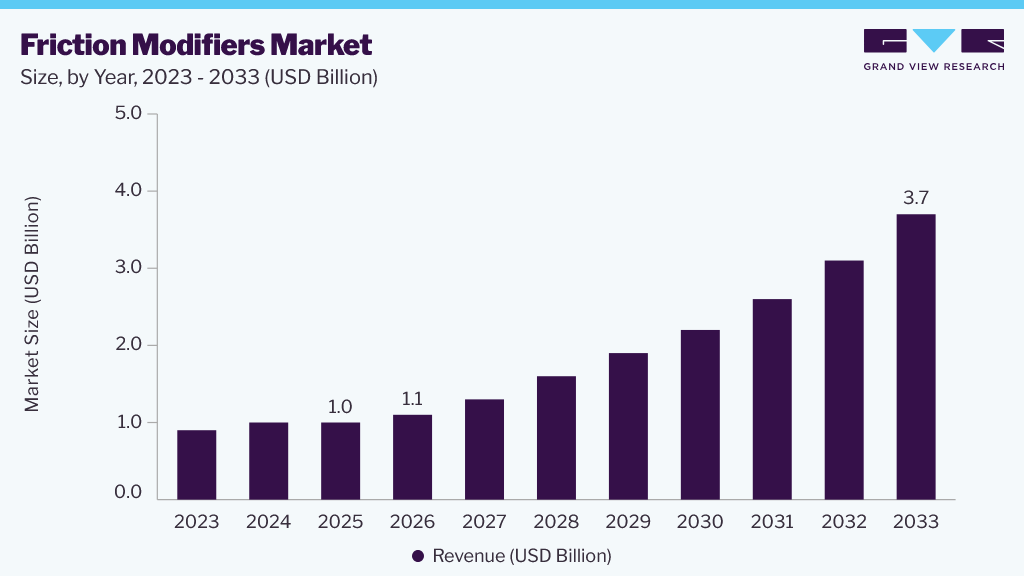 Source: Grand View Research, IR Documents, Primary Interviews, Paid DatabasesTo learn more about this report,
 Download Free Sample Report
 Key Market Trends & Insights
- By type: The organic segment dominated the market with a revenue share of approximately 57.0% in 2025.
- By application: The commercial vehicle applications dominated the market with a revenue share of approximately 64.0% in 2025.
Regional Highlights
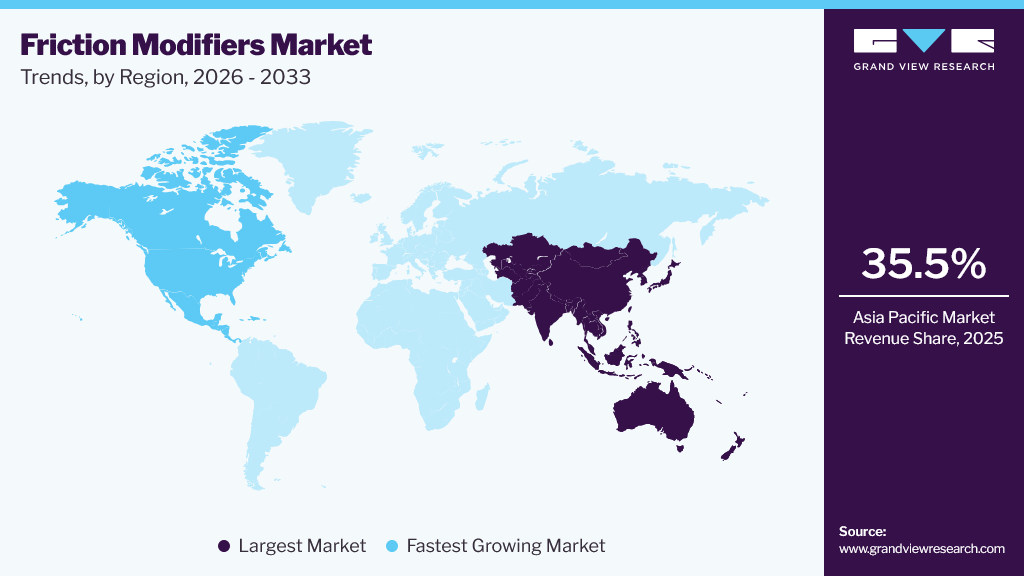
- Largest regional market: Asia Pacific (35.5% revenue share, 2025)
- Fastest-growing regional market: North America (highest CAGR, 2026-2033)
Market Size & Forecast
- Market size in 2025: USD 1.0 Billion
- Estimated market size in 2026: USD 1.1 Billion
- Projected market size by 2033: USD 1.4 Billion
- CAGR (2026-2033): 3.8%
Three ways to get this report
Buy it, customize it, or ask a question.Ask an Analyst
A direct answer, usually in 1 working day
- AccessReport author, directly
- Reply timeWithin 1 working day
- No sales callDirect answer only
- FormatEmail reply
- CostFree, no cost
Get the Full Report
What the study covers
- FormatsPDF · Excel · Dashboard
- Timeline2026–2033 annual, 2025 base
- Coverage20+ countries, 5 regions
- Companies10+ key players profiled
Customize the Report
20% free customization
- IncludeCountries, segments, points
- TailorTo your product definition
- ExtendDeeper competitor detail
- OrA fully bespoke study
- Turnaround5–10 working days
Friction modifiers are lubricant additives primarily used to reduce wear and friction in machine components by preventing solid surfaces from coming into direct contact. These additives play a crucial role in boundary lubrication regimes by forming protective layers that reduce friction and prevent metal-to-metal contact, thereby improving equipment efficiency and extending machinery lifespan.
Demand for friction modifiers is driven by the growing need to minimize energy losses from friction, improve fuel economy, and reduce wear in critical machine components. As the automotive industry continues to prioritize higher fuel efficiency and lower emissions in response to stringent environmental regulations, the importance of friction modifiers in lubrication solutions has increased significantly. These additives are essential for ensuring smoother operation, enhanced durability, and improved performance across applications ranging from passenger vehicles to heavy-duty industrial machinery.
For instance, in August 2025, Shell introduced an upgraded Shell Helix Ultra engine oil designed to improve fuel economy, enhance engine protection, and deliver better engine performance. This development highlights the growing industry focus on advanced lubricant technologies that reduce friction, improve efficiency, and support compliance with evolving emission standards.
Moreover, market growth is expected to be particularly strong in the Asia Pacific, driven by rising automotive production, increasing lubricant consumption, and rapid industrialization. Overall, the friction modifiers market is poised for substantial growth, supported by increasing demand from automotive and industrial sectors.
Analyst Perspective
The friction modifiers market is expected to witness steady growth as industries increasingly prioritize energy efficiency, equipment reliability, and compliance with stringent environmental regulations. Rising adoption of low-viscosity lubricants across automotive and industrial applications is driving demand for advanced friction modifier technologies that reduce wear, improve fuel economy, and extend equipment life. While the automotive sector remains a major demand generator, increasing adoption across industrial manufacturing, mining, marine, aerospace, and heavy machinery is further supporting market expansion.
Application Insights
Commercial vehicle applications dominated the friction modifiers market, accounting for approximately 64.0% of revenue in 2025. Rising sales of commercial vehicles are increasing lubricant consumption, thereby boosting demand for friction modifiers. Commercial vehicle lubricants remain a major application area for friction modifiers due to their critical role in improving engine efficiency, reducing wear, and extending equipment life. For instance, in March 2025, TotalEnergies highlighted the performance of its Rubia Optima heavy-duty engine oil range featuring Inno-Boost Technology, designed to reduce fuel consumption, lower emissions, minimize maintenance costs, and support extended oil drain intervals of up to 150,000 km. This development reflects the growing demand for high-performance commercial vehicle lubricants that utilize advanced additive technologies, including friction modifiers, to improve engine efficiency and durability.
The use of friction modifiers in passenger vehicles plays a critical role in improving fuel efficiency, reducing friction, and lowering vehicle emissions. These additives help improve engine efficiency, enhance lubricant performance, and reduce wear in critical vehicle components, making them essential for modern automotive lubrication systems. Rising passenger vehicle production, increasing adoption of hybrid vehicles, and growing demand for low-viscosity lubricants are key factors driving growth in the segment. Furthermore, stringent fuel economy and emission regulations are further supporting demand for friction modifiers in passenger vehicle applications.
Type Insights
Organic friction modifiers dominated the market, accounting for approximately 57.0% of revenue in 2025. Organic friction modifiers, derived from natural or synthetic organic compounds, have gained significant traction due to their strong lubricating performance and environmental compatibility. These additives form a protective boundary film on metal surfaces, reducing friction and wear. Organic friction modifiers such as fatty acids, esters, and amides offer excellent lubrication properties and are widely used in automotive and industrial applications. Their environmental compatibility and broad base-oil compatibility make them a preferred choice for lubricant formulations aimed at improving energy efficiency and equipment durability. For instance, in April 2025, Lubrizol unveiled SENSOMER Cassia 115 Polymer, a bio-based specialty polymer that highlights increasing industry investment in renewable and sustainable organic chemistries. Although developed for personal care applications, the launch reflects the broader shift toward bio-based materials influencing environmentally compatible lubricant additive technologies.
In contrast, inorganic friction modifiers are derived from mineral-based compounds and metallic salts and function by altering the surface properties of metal components to reduce friction and wear. Inorganic friction modifiers, including molybdenum disulfide and graphite, offer high-temperature stability and exceptional load-carrying capacity, making them highly suitable for heavy-duty applications such as industrial gear oils, metalworking fluids, and heavy machinery lubricants. Their ability to withstand extreme operating conditions and provide long-lasting lubrication solutions positions them as essential components in high-performance lubricant formulations across various industrial sectors. In addition, rising demand from heavy industries such as mining, construction, manufacturing, and power generation is further driving the adoption of inorganic friction modifiers due to the increasing need for superior wear protection and reliable performance under high-load and high-temperature operating conditions.
Regional Insights
Asia Pacific dominated the friction modifiers market, accounting for 35.5% of revenue in 2025, and is expected to maintain its leading position over the forecast period. The region’s growth is primarily driven by strong automotive production across China, Japan, India, and South Korea, as well as rising lubricant consumption and expanding industrial manufacturing activity. Increasing demand for fuel-efficient vehicles, growing commercial vehicle fleets, and rising adoption of high-performance lubricants are further supporting market growth in the region. For instance, in March 2026, BASF highlighted continued solid growth in China’s industrial and chemical demand, driven by sustained expansion in customer industries and the region’s strong manufacturing base, reinforcing Asia Pacific’s leading position in the global chemicals and materials market.
 To learn more about this report, Download Free Sample Report
 China Friction Modifiers Market Trends
The friction modifiers market in China is witnessing steady growth. This growth is primarily driven by China’s position as the world’s largest automobile producer, which has significantly increased lubricant consumption and supported demand for friction modifier additives. However, fluctuations in automotive production volumes in recent years have had a moderate impact on lubricant consumption and friction-modifier demand in certain end-use sectors.
North America Friction Modifiers Market Trends
North America has a strong presence of major end-use industries such as automotive, aerospace, and manufacturing, which are key consumers of friction modifiers. Technological advancements in the automotive sector, coupled with rising vehicle production, are further driving market growth in the region. For instance, in February 2026, Infineum International Limited launched its next-generation additive technology, P6188, enabling engine oils to meet the latest Volkswagen 50800/50900 specifications. This development reflects growing demand for advanced lubricant additive systems that improve fuel efficiency, reduce frictional losses, and enhance engine durability in modern vehicles.
Europe Friction Modifiers Market Trends
The growing automotive production and rising consumer demand for fuel-efficient vehicles are expected to drive market growth in Europe. In addition, the increasing electrification of passenger vehicles is expected to accelerate as European countries continue implementing stricter regulations to reduce carbon emissions and improve environmental sustainability. For instance, in April 2026, Infineum highlighted that the European automotive industry is undergoing a major transition driven by CO2 regulations, electrification, and evolving powertrain technologies. The company noted that OEMs are increasingly focusing on improving fuel economy, reducing emissions, and enhancing engine efficiency across ICE, hybrid, and alternative-fuel vehicles, thereby supporting demand for advanced lubricant additives, including friction modifiers.
Key Friction Modifiers Company Insights
Some of the key players operating in the market include Afton Chemical, Lubrizol, Chevron Oronite Company LLC., Infineum International Limited, BASF, Croda International Plc, Evonik Industries AG, and LANXESS.
- Afton Chemical is a prominent manufacturer of petroleum additives and specialty chemicals serving automotive, industrial, and lubricant markets. The company offers a broad portfolio of additive technologies, including friction modifiers, dispersants, detergents, and anti-wear additives designed to improve fuel efficiency, reduce wear, and enhance lubricant performance in engine oils and transmission fluids.
- Lubrizol is a global specialty chemical company known for its advanced lubricant additive technologies. The company provides friction modifier solutions, viscosity modifiers, dispersants, and performance additives for automotive and industrial lubricants. Its products are widely used to improve fuel economy, reduce friction losses, and meet evolving emission and efficiency standards across multiple end-use industries.
Key Friction Modifiers Companies
The following key companies have been profiled for this study on the friction modifiers market
-
Afton Chemical
-
Lubrizol
-
Chevron Oronite Company LLC.
-
Infineum International Limited.
-
BASF
-
Croda International Plc
-
Evonik Industries AG
-
R.T. Vanderbilt Holding Company, Inc.
-
LANXESS
-
ADEKA CORPORATION
Recent Developments
-
In April 2024, Chevron Oronite participated in major industry conferences, including ICIS Asia Base Oils and Lubricants and the UNITI Mineral Oil Technology Congress, advancements in lubricant additive technologies focused on improving fuel efficiency, enabling lower-viscosity engine oils, and supporting emissions compliance.
-
In January 2024, Shell UK Limited acquired MIDEL and MIVOLT from M&I Materials Ltd. The products of the latter two will be produced and distributed as part of Shell’s Lubricants portfolio. The acquisition will help Shell to strengthen its position in Transformer Oils, which finds use in offshore wind parks, utility companies, and power distribution.
Friction Modifiers Market Report Scope
Report Attribute
Details
Market size in 2025
USD 1.0 billion
Estimated market size in 2026
USD 1.1 billion
Projected market size by 2033
USD 1.4 billion
Growth rate
CAGR of 3.8% from 2026 to 2033
Base year for estimation
2025
Actual data
2021 – 2024
Forecast period
2026 – 2033
Quantitative units
Volume in kilotons, revenue in USD million/billion and CAGR from 2026 to 2033
Report coverage
Revenue forecast, company ranking, competitive landscape, growth factors, and trends
Segments covered
Type, application, region
Regional Scope
North America; Europe; Asia Pacific; Central & South America; Middle East & Africa
Country Scope
U.S.; Canada; Mexico; Germany; UK; Italy; France; Spain; China; India; Japan; South Korea; Brazil; Argentina; South Africa; Saudi Arabia
Key companies profiled
Afton Chemical; Lubrizol Corporation; Chevron Oronite Company LLC.; Infineum International Limited; BASF; Croda International Plc; Evonik Industries AG; R.T. Vanderbilt Holding Company, Inc.; LANXESS; ADEKA CORPORATION.
Customization scope
Free report customization (equivalent up to 8 analysts working days) with purchase. Addition or alteration to country, regional & segment scope.
Pricing and purchase options
Avail of customized purchase options to meet your exact research needs. Explore purchase options
Global Friction Modifiers Market Report Segmentation
This report forecasts revenue growth at global, regional, and country levels and provides an analysis of the latest industry trends and opportunities in each of the sub-segments from 2021 to 2033. For the purpose of this study, Grand View Research has segmented the global friction modifiers market report based on type, application, and region:
-
Type Outlook (Volume, Kilotons; Revenue, USD Million; 2021 - 2033)
-
Organic
-
Inorganic
-
-
Application Outlook (Volume, Kilotons; Revenue, USD Million; 2021 - 2033)
-
Commercial Vehicles
-
Passenger Vehicles
-
Others
-
-
Regional Outlook (Volume, Kilotons; Revenue, USD Million; 2021 - 2033)
-
North America
-
U.S.
-
Canada
-
Mexico
-
-
Europe
-
Germany
-
UK
-
France
-
Italy
-
Spain
-
-
Asia Pacific
-
China
-
India
-
Japan
-
South Korea
-
-
Central & South America
-
Brazil
-
Argentina
-
-
Middle East and Africa
-
Saudi Arabia
-
South Africa
-
-
Frequently Asked Questions About This Report
The global friction modifiers market size was valued at USD 1.0 billion in 2025 and is estimated at USD 1.1 billion for 2026.
The global friction modifiers market is expected to grow at a CAGR of 3.8% from 2026 to 2033, reaching USD 1.4 billion
Asia Pacific dominated with an approximately 35.5% revenue share in 2025.
The organic segment accounted for the largest revenue share of approximately 57.0% in 2025.
Key players in the market includes Afton Chemical; Lubrizol Corporation; Chevron Oronite Company LLC.; Infineum International Limited; BASF; Croda International Plc; Evonik Industries AG; R.T. Vanderbilt Holding Company, Inc.; LANXESS; ADEKA CORPORATION., and others.
About the Author(s)
Petrochemicals Research Team
Bulk Chemicals · PetrochemicalsThis report was authored by the petrochemicals research team at Grand View Research - comprising two research analysts, one senior research analyst, and one industry expert - with specialized expertise in the petrochemicals segment of the bulk chemicals industry. All findings are based on proprietary bulk chemicals databases, executive interviews, and regulatory analysis, subject to internal peer review prior to publication.
Last Updated:
Speak to Analyst

Customize this report to your needs - add regions, segments, or data points, with 20% free customization.
Or view our licence options:


ISO 9001:2015 & 27001:2022 Certified
We are GDPR and CCPA compliant! Your transaction & personal information is safe and secure. For more details, please read our privacy policy.


