
- Home
- »
- Consumer F&B
- »
-
Frozen Fish Market Size, Share & Trends Report, 2026-2033GVR Report cover

Frozen Fish Market (2026 - 2033)
Size, Share & Trends Analysis Report By Fish Type (Salmon, Tuna), By Distribution Channel (Supermarkets & Hypermarkets, Convenience Stores), By Region (North America, Europe, Asia-Pacific, Central & South America, MEA), And Segment Forecasts
Market Size, 2025
$110.5BMarket Estimate, 2026
$113.8BMarket Forecast, 2033
$142.8BCAGR, 2026–2033
3.3%Frozen Fish Market Summary
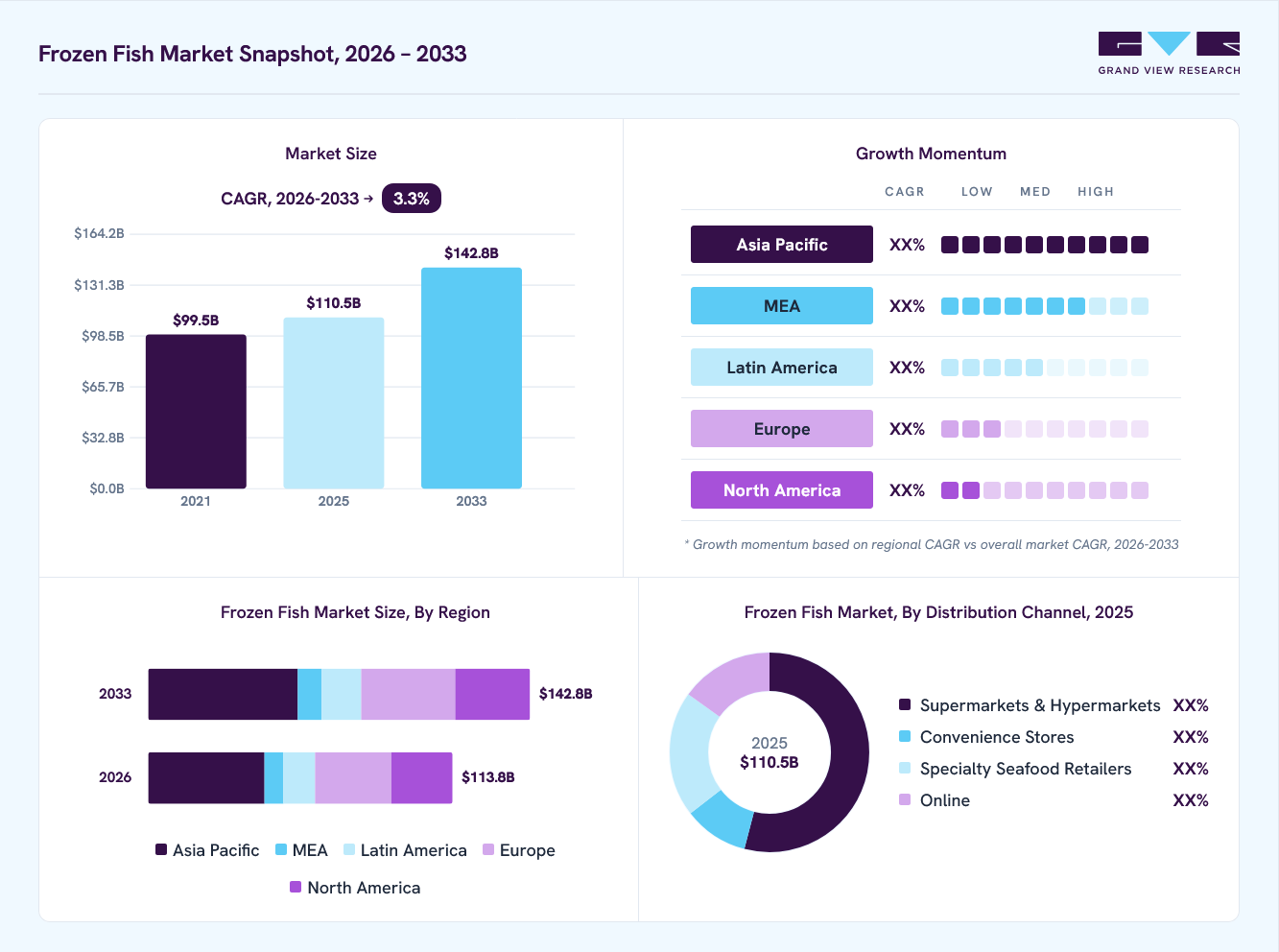
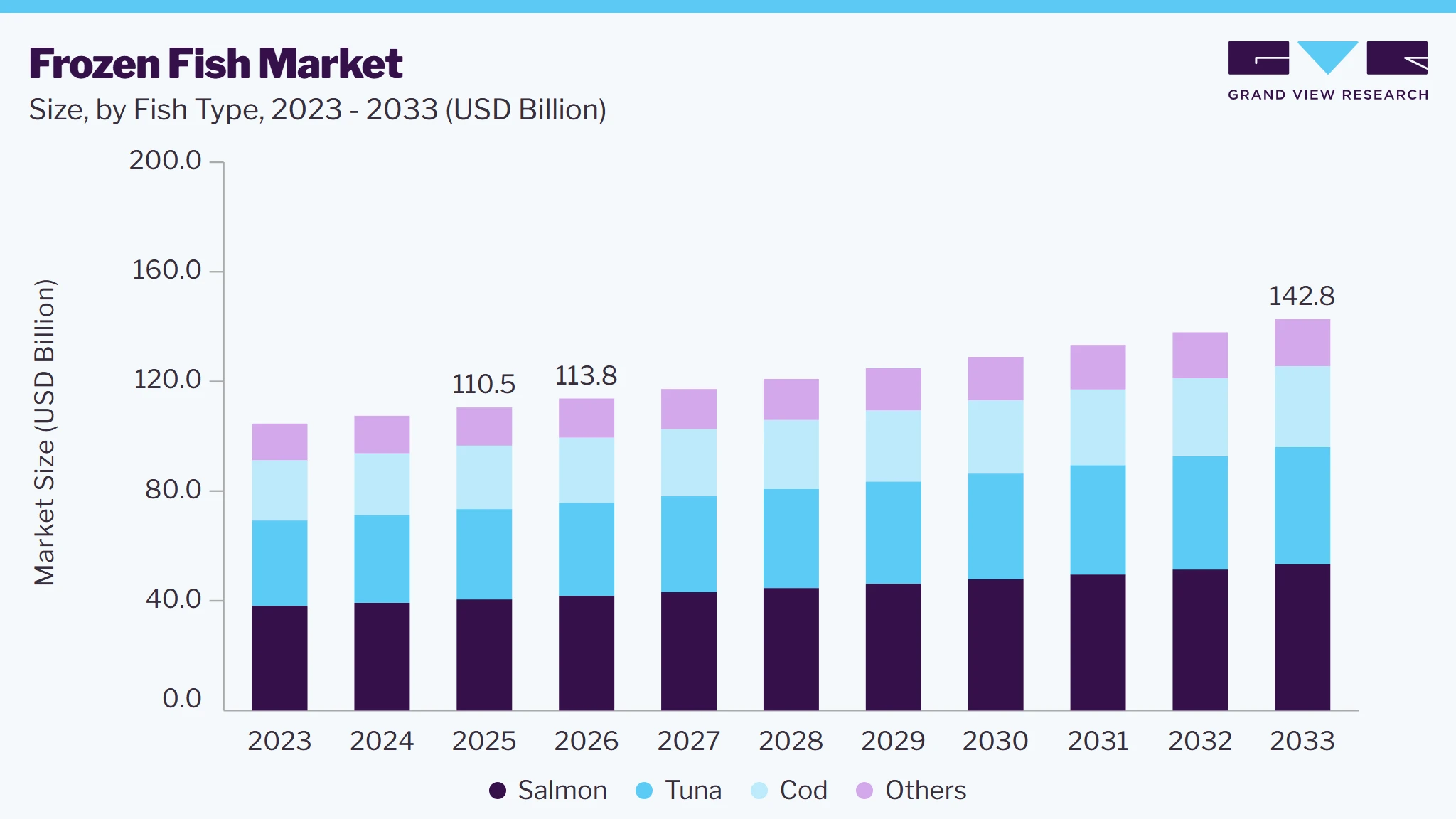
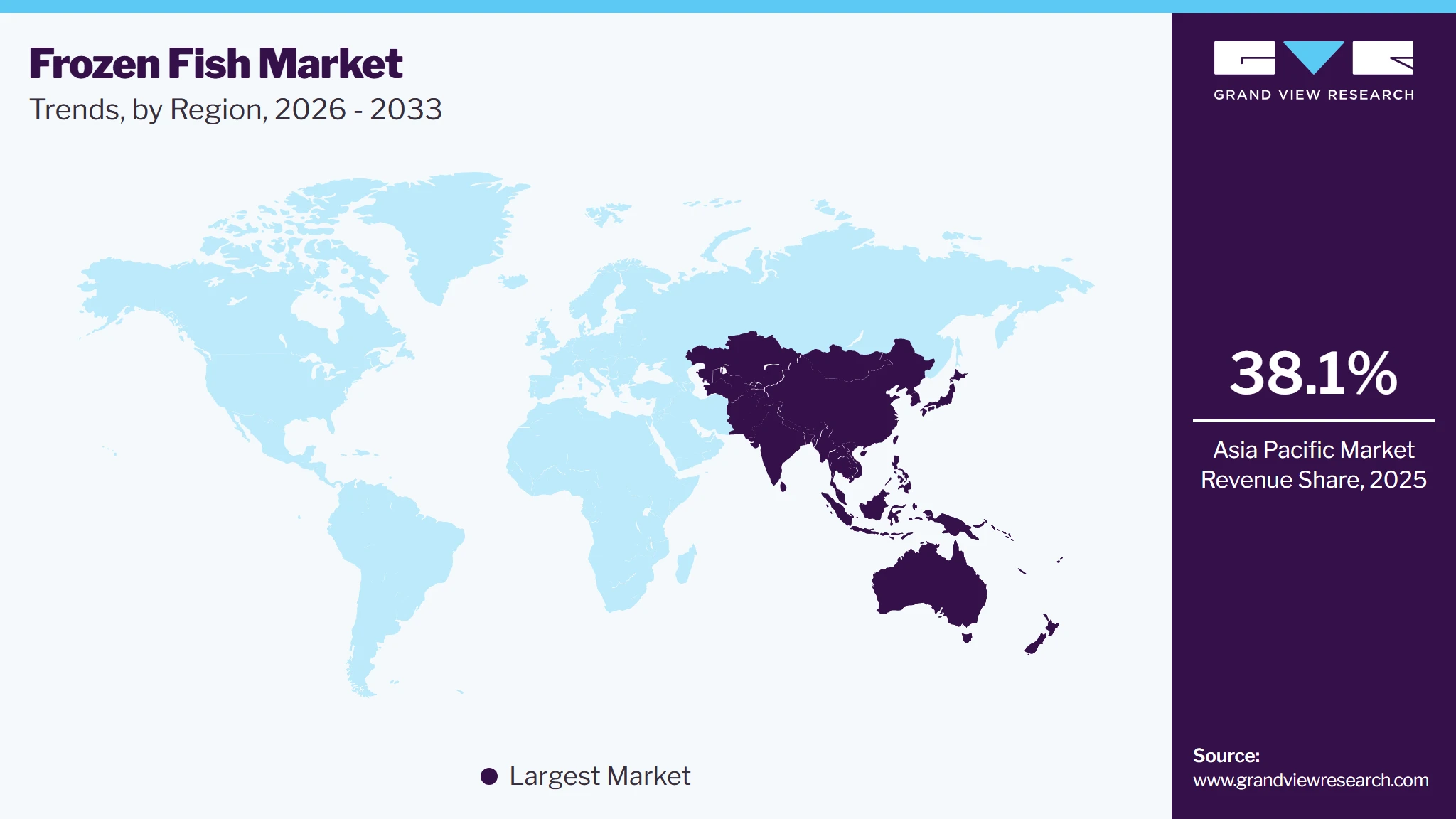
The global frozen fish market size was valued at USD 110.5 billion in 2025 and is projected to grow from USD 113.8 billion in 2026 to USD 142.8 billion by 2033 at a CAGR of 3.3% from 2026 to 2033. The frozen fish market is primarily driven by increasing consumer demand for convenient, ready-to-cook, and nutritious seafood products. Asia Pacific dominated the market with a revenue share of 38.1% in 2025.
 Source: Grand View Research, IR Documents, Primary Interviews, Paid DatabasesTo learn more about this report,
 Download Free Sample Report
Key Market Trends & Insights
- By fish type: Frozen salmon market held the largest share of 36.6% in 2025.
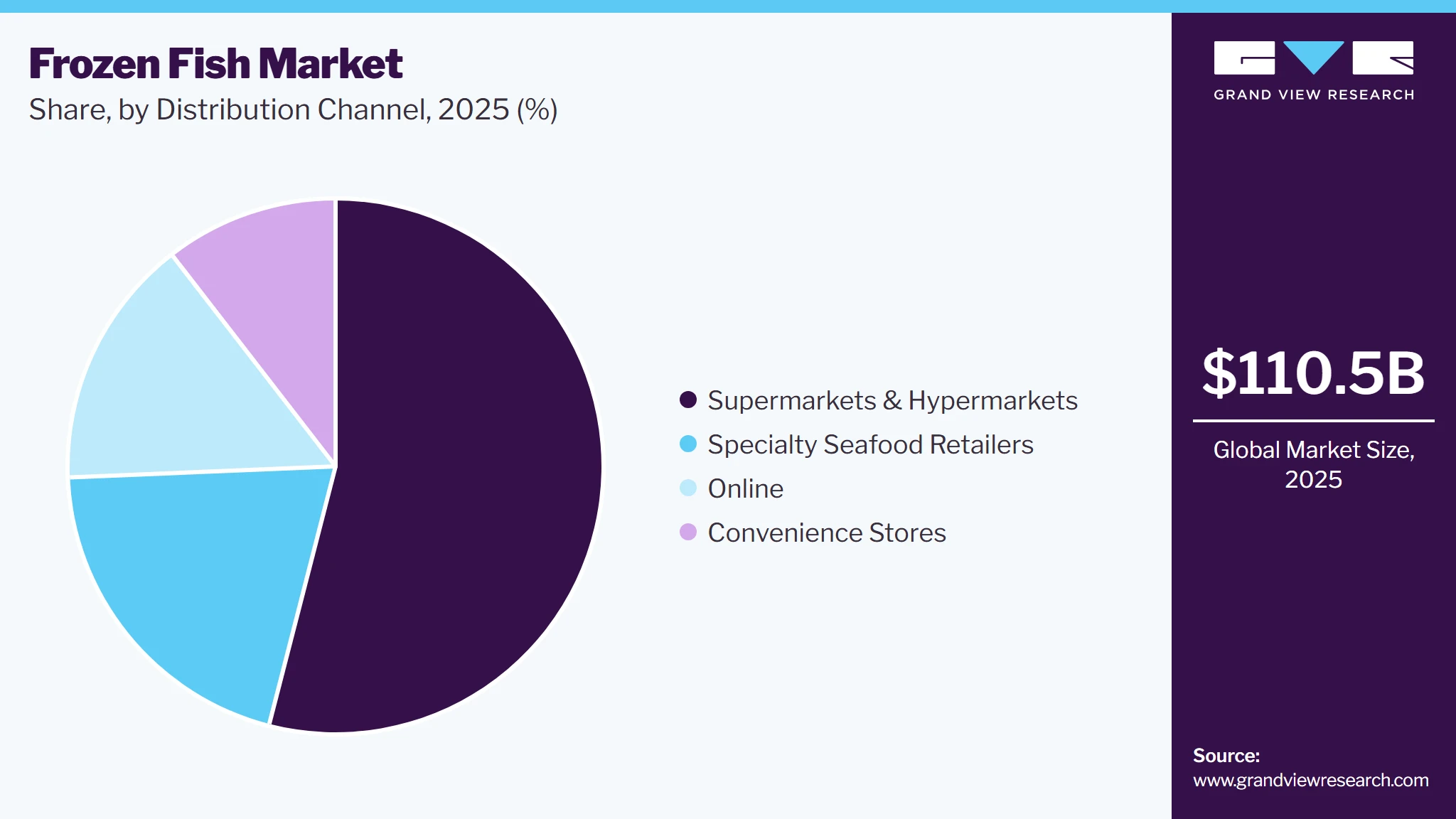
- By distribution channel: Supermarkets & hypermarkets channel held the largest share of 54.0% in 2025.
Regional Highlights
- Largest regional market: Asia Pacific (38.1% revenue share, 2025)
- By country: China held the largest market in 2025.
Key Market Trends & Insights
- Market size in 2025: USD 110.5 Billion
- Estimated market size in 2026: USD 113.8 Billion
- Projected market size by 2033: USD 142.8 Billion
- CAGR (2026-2033): 3.3%
Prism AI by Grand View Research Free to tryAsk a question about the frozen fish marketTry asking✓Every figure cited from GVR research Prefer the report? Download free sample →Growing urbanization, changing lifestyles, and the expansion of retail and food-service sectors are further supporting market growth. Additionally, improvements in cold-chain infrastructure, freezing technologies, storage facilities, and transportation systems are helping increase the availability and shelf life of frozen fish products. The market is also supported by the growing popularity of seafood as a source of high-quality protein and essential nutrients. Increasing demand for longer-lasting seafood products is encouraging consumers and businesses to opt for frozen alternatives. The development of organized seafood processing and distribution networks is further improving product accessibility across different markets.
 To learn more about this report, Download Free Sample Report
The expansion of international seafood trade is creating new opportunities for frozen fish producers and exporters. Increasing availability of diverse fish varieties and value-added frozen products is broadening consumer choices. Improvements in packaging solutions are also helping maintain product quality, reduce spoilage, and support efficient distribution. In April 2026, Klöckner Pentaplast (kp) launched recyclable mono-PET fish boards designed for vacuum skin packaging of processed fish. The solution incorporates recycled content and reduces the need for absorbent pads, supporting more recyclable fish packaging.
Market Dynamics
The demand for frozen fish is supported by consumers seeking seafood products that require minimal preparation. Frozen formats allow fish to be stored for longer periods without the need for immediate consumption. This makes them suitable for households with less frequent seafood purchases. Convenience is particularly relevant for consumers with busy schedules and limited time for food preparation. In March 2025, Birds Eye launched its Captain’s Discoveries range, introducing new globally inspired products to the frozen fish category. The range includes crumbed fish fillets and baked fish dishes, aiming to add variety and convenience to the frozen fish aisle. As preferences shift toward simpler meal solutions, demand for frozen fish can continue to expand.
Frozen fish businesses face significant operating expenses from maintaining low temperatures throughout storage and handling. Refrigeration systems require continuous electricity to preserve product quality and prevent temperature fluctuations. These costs can increase across warehouses, processing facilities, and distribution networks. Higher operating expenses may place pressure on profit margins, particularly for businesses with extensive frozen inventories. According to the Global Cold Chain Alliance’s Q4 2024 Cold Chain Index, refrigerated warehouse expenses increased 4.69% YoY, with rental costs rising 5.55%, labor costs 4.59%, and electricity costs 2.30%. These expenses may affect profitability and restrict market expansion in some regions. This need for uninterrupted refrigeration also increases dependence on reliable energy infrastructure.
Online seafood retail provides an additional channel for frozen fish brands to reach consumers directly. Digital platforms can offer a wider selection of fish varieties and pack sizes than some physical stores. Home-delivery services can also improve access to frozen seafood in areas with limited specialty retail options. Businesses can use online platforms to introduce subscription models, bundled products, and direct-to-consumer offerings. This channel creates scope for broader market reach without relying solely on traditional retail outlets. In September 2026, Larry’s Catch expanded its direct-to-consumer seafood delivery service across Canada, offering sustainably sourced seafood from Canadian fisheries. The company’s products are individually quick frozen (IQF), supporting growing consumer demand for convenient, traceable frozen seafood.
Analyst Perspective
The global frozen fish market is supported by steady demand for accessible and conveniently stored seafood products. Market development is shaped by the availability of key fish species, processing capacity, and the efficiency of refrigerated supply chains. Competition remains influenced by product quality, sourcing capabilities, distribution coverage, and the ability to serve different end-use requirements. Premium cuts, value-added formats, and improved packaging are creating additional avenues for product differentiation. Regional differences in seafood consumption, imports, production, and retail structures will continue to shape market performance.
Consumer Insights
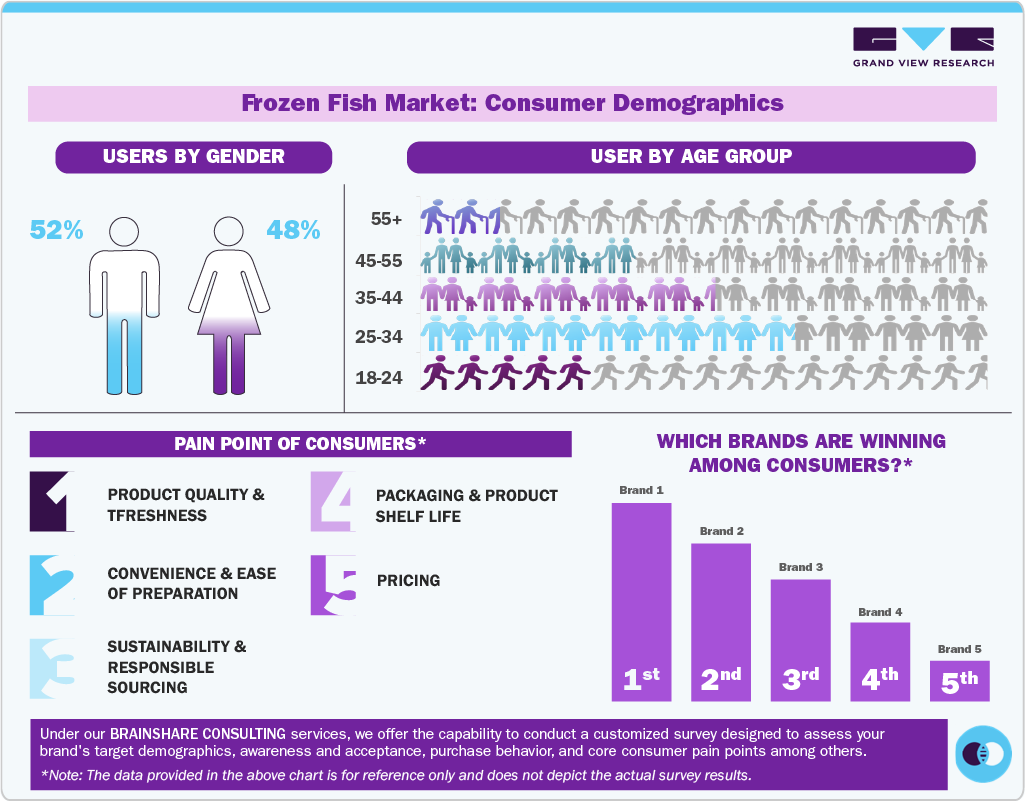
Consumer preferences in the frozen fish market are increasingly driven by convenience, affordability, and year-round availability. Consumers prefer products that are easy to prepare, such as fillets, portions, and ready-to-cook options. Quality, freshness, nutritional value, and food safety remain important purchase considerations. Demand is also growing for sustainably sourced and responsibly packaged frozen fish products. In addition, consumers are showing greater interest in value-added and premium frozen seafood offerings.
 To learn more about this report, Download Free Sample Report
Fish Type Insights
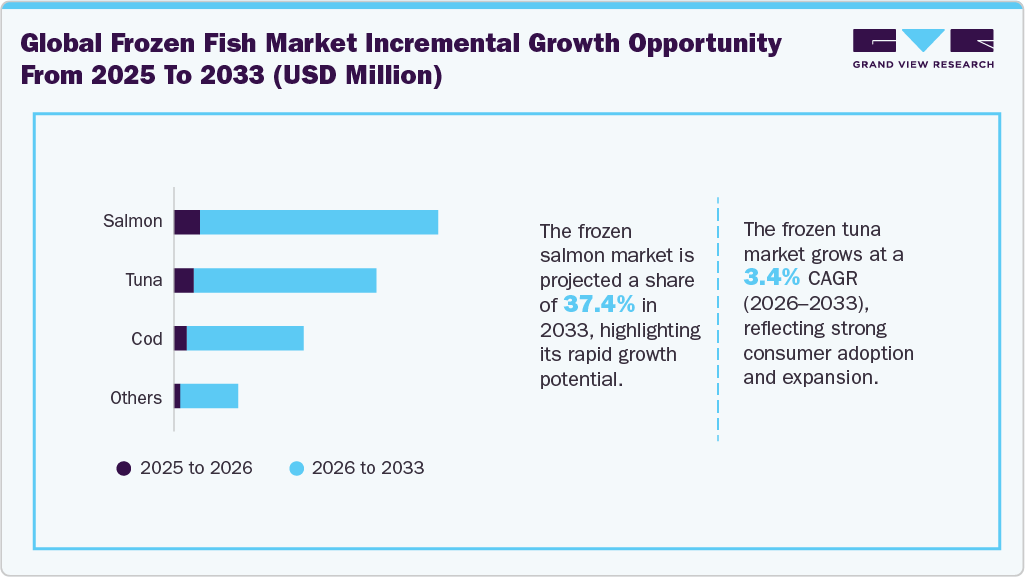
The frozen salmon market accounted for the largest share of 36.6% of the revenue in 2025. Salmon is widely used in the frozen fish industry due to its strong presence across retail and food-service applications. Its distinctive taste, texture, and versatility make it suitable for fillets, portions, steaks, and prepared seafood products. Frozen salmon also supports year-round availability, helping address variations in fresh supply. The availability of farmed salmon provides processors with a relatively consistent source of raw material. Demand for premium seafood products further supports the segment.
 To learn more about this report, Download Free Sample Report
The frozen tuna market is projected to grow significantly at a CAGR of 3.4% from 2026 to 2033. Tuna has a significant role in the frozen fish industry because of its broad use in processed and prepared seafood products. It is commonly supplied in forms such as loins, steaks, portions, and blocks for further processing. Its firm texture makes it suitable for multiple cooking methods and food-service applications. International seafood trade also enables tuna products to reach markets beyond major fishing regions. Growing demand from restaurants, processors, and institutional food buyers supports continued consumption of frozen tuna.
Distribution Channel Insights
The sales of frozen fish through supermarkets & hypermarkets account for the largest share of 54.0% of the global revenue in 2025. Supermarkets and hypermarkets provide frozen fish with dedicated chilled and frozen sections that allow consumers to compare different brands and product formats. Their large store networks make frozen seafood accessible across a broad geographic area. Promotional campaigns, discounts, and in-store merchandising can encourage purchases and increase product visibility. Private-label seafood offerings also provide retailers with opportunities to serve different consumer preferences. Established procurement and inventory systems help these outlets maintain a diverse range of frozen fish products.
 To learn more about this report, Download Free Sample Report
The sales of frozen fish through online channels are projected to grow significantly at a CAGR of 3.7% from 2026 to 2033. Online distribution is supported by the ability to browse and purchase frozen fish without visiting a physical store. Digital platforms can provide detailed information on product varieties, pack sizes, origin, and preparation methods. Customer reviews and product ratings can also assist shoppers when selecting unfamiliar seafood products. Specialized online seafood retailers can offer niche varieties that may have limited availability in conventional stores. Improved last-mile refrigerated delivery is helping online platforms handle temperature-sensitive seafood more effectively.
Regional Insights
The North America frozen fish market accounted for a significant market share of 20.2% in 2025. North American market benefits from established seafood processing and distribution networks that support the availability of frozen fish. The region has a developed cold-storage infrastructure serving both retail and food-service operators. Consumer familiarity with packaged seafood products also supports regular purchases. Imports from major fishing and aquaculture regions supplement the domestic supply. Product innovation in portions, fillets, and prepared formats is contributing to market development.
U.S. Frozen Fish Market Trends
The U.S. led the North American frozen fish market in 2025, holding the largest market share with 77.6% of the region’s total revenue. The Frozen Fish Market in the U.S. is supported by strong demand from restaurants, food-service providers, and retail seafood departments. Frozen fish provides food businesses with greater flexibility in inventory management and menu planning. A broad distribution network enables products to reach both metropolitan and regional markets. Imports play an important role in supplying species that are not consistently available from domestic fisheries. The presence of major seafood processors and distributors further strengthens market accessibility.
Europe Frozen Fish Market Trends
The European frozen fish market is projected to grow at a CAGR of 3.0% in 2025. Europe's frozen fish industry has a well-developed seafood industry supported by extensive processing, importing, and distribution activities. Frozen fish is widely incorporated into retail, food-service, and processed-food applications across the region. Established seafood consumption patterns create demand for multiple fish species and product formats. Sustainability requirements are also influencing sourcing, processing, and labeling practices. Cross-border trade within the region facilitates the movement of frozen seafood between markets.
The U.K. led the European frozen fish market in 2025, holding the largest market share with 24.5% of the region’s total revenue. The U.K. frozen fish market is supported by established seafood retail and food-service channels, including supermarkets, restaurants, and prepared-meal manufacturers. Fish and chips, ready meals, and other seafood-based foods create demand for processed and frozen fish products. The country's reliance on international seafood supply makes efficient import and distribution systems particularly important. Frozen formats allow businesses to maintain consistent supplies for food preparation and manufacturing. Changing product preferences are also encouraging suppliers to offer convenient portion-controlled formats. In August 2024, Brakes launched the Portico Seafood range, offering premium and everyday frozen fish and seafood products in the U.K. The range includes monkfish, seabass, cod, salmon, prawns, and scampi, with plans to expand to 150 products for year-round foodservice availability.
Asia Pacific Frozen Fish Market Trends
The Asia Pacific frozen fish market is accounted for the largest market share of 38.1% in 2025. The frozen fish market in the Asia Pacific represents a diverse frozen fish market due to its large population, extensive fishing activity, and expanding seafood-processing sector. The region includes major producers, exporters, importers, and consumers of fish products. Urban food distribution systems are supporting greater penetration of packaged and frozen seafood. Food-service expansion is creating additional demand from restaurants, hotels, and institutional buyers. Improvements in refrigerated logistics are also connecting seafood-producing areas with distant consumption centers.
 To learn more about this report, Download Free Sample Report
China led the Asia Pacific frozen fish market in 2025, holding the largest market share with 32.5% of the region’s total revenue. The frozen fish market China has a significant role in the frozen fish market through its large seafood-processing, aquaculture, and distribution industries. The country serves both domestic consumers and international seafood supply chains. Frozen fish is widely used by food processors, restaurants, catering businesses, and retail outlets. Expansion of modern grocery and food-delivery infrastructure is improving access to packaged seafood. The development of processing capabilities also enables a broad range of fish products to be supplied to domestic and export markets.
Central & South America Frozen Fish Market Trends
The Central & South America Frozen Fish Market is projected to grow at a CAGR of 3.2% from 2026 to 2033. The frozen fish market in Central & South America benefits from access to productive fishing grounds and established seafood production activities. Several countries in the region participate actively in fish harvesting, processing, and international seafood trade. Frozen processing enables producers to preserve catches for distribution beyond local markets. Growing food-service activity is creating additional demand for standardized seafood products. Export-oriented supply chains also provide opportunities for regional producers to serve overseas buyers.
Middle East & Africa Frozen Fish Market Trends
The Middle East & Africa Frozen Fish Market is expected to grow at a CAGR of 3.4% from 2026 to 2033. The Middle East & Africa market is influenced by expanding modern retail, hospitality, and food-service industries. Frozen fish provides distributors with a practical format for supplying seafood across areas where local production may be insufficient. The hospitality sector generates demand from hotels, restaurants, catering companies, and institutional kitchens. Imports remain important for maintaining product variety and availability in several markets. Investments in refrigerated storage and logistics are gradually strengthening regional seafood distribution capabilities.
Key Frozen Fish Company Insights
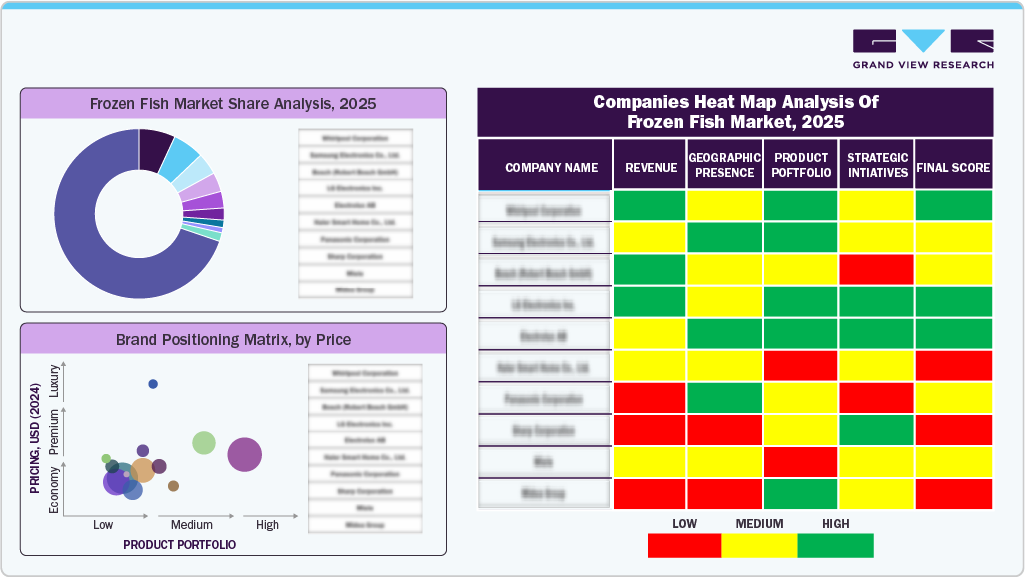
The frozen fish industry is characterized by the presence of established seafood processors, producers, distributors, and international suppliers operating across major regional markets. Key companies compete through product variety, sourcing capabilities, processing capacity, distribution reach, and supply-chain efficiency. Market share is influenced by the scale of operations, access to raw fish supply, brand presence, and relationships with retail and food-service customers.
Companies are also focusing on product quality, packaging, and value-added offerings to strengthen their market position. The competitive landscape remains diversified, with both large multinational companies and regional seafood players serving the market.
 To learn more about this report, Download Free Sample Report
Key Frozen Fish Companies
The following key companies have been profiled for this study on the frozen fish market.
-
Mowi
-
Nissui Corporation
-
Umios Corporation
-
Thai Union Group PCL
-
Nomad Foods
-
High Liner Foods Ingredients
-
Trident Seafoods Corporation.
-
Royal Greenland A/S
-
Austevoll Seafood ASA
-
Dongwon Industries Co., Ltd.
Competitive Benchmarking
Category
Operating Strategies
Competitive Edge
Weakness
Established Players (Umios Corporation)
High-volume sourcing, cold-chain networks, broad SKU coverage, and institutional supply.
Strong procurement, reliable supply, processing capacity, and market access.
High cold-chain costs, commodity exposure, and limited flexibility.
Emerging Players (High Liner Foods)
Premium species, ready-to-cook formats, regional sourcing, and online sales.
Product differentiation, niche targeting, and faster market adaptation.
Smaller sourcing base, limited brand awareness, and narrower distribution.
Recent Developments
-
In March 2026, Salmon Evolution and Korshags launched frozen land-based farmed salmon portions in Swedish supermarkets. The launch expands access to sustainably farmed salmon and increases Korshags’ presence in the frozen seafood retail market.
-
In August 2024, Brakes launched the Portico Seafood range, offering premium and everyday frozen fish and seafood products in the U.K. The range includes monkfish, seabass, cod, salmon, prawns and scampi, with plans to expand to 150 products for year-round foodservice availability.
Frozen Fish Market Report Scope
Report Attribute
Details
Market size in 2025
USD 110.5 billion
Estimated market size in 2026
USD 113.8 billion
Projected market size by 2033
USD 142.8 billion
Growth Rate (Revenue)
CAGR of 3.3% from 2026 to 2033
Actuals
2021 - 2025
Forecast period
2026 - 2033
Quantitative (Revenue) units
Revenue in USD Million, and CAGR from 2026 to 2033
Report coverage
Revenue forecast, company ranking, competitive landscape, growth factors, and trends
Segments covered
Fish type, distribution channel, and region
Regional Scope
North America, Europe, Asia-Pacific, Central & South America, Middle East & Africa
Country scope
U.S., Canada, Mexico, U.K., Germany, France, Italy, Spain, China, Japan, India, Australia & New Zealand, South Korea, Brazil, South Africa
Key companies profiled
Mowi, Nissui Corporation, Umios Corporation, Thai Union Group PCL, Nomad Foods, High Liner Foods, Trident Seafoods Corporation, Royal Greenland A/S, Austevoll Seafood ASA, Dongwon Industries Co., Ltd.
Customization scope
Free report customization (equivalent up to 8 analysts’ working days) with purchase. Addition or alteration to country, regional & segment scope.
Pricing and purchase options
Avail customized purchase options to meet your exact research needs. Explore purchase options
Global Frozen Fish Market Report Segmentation
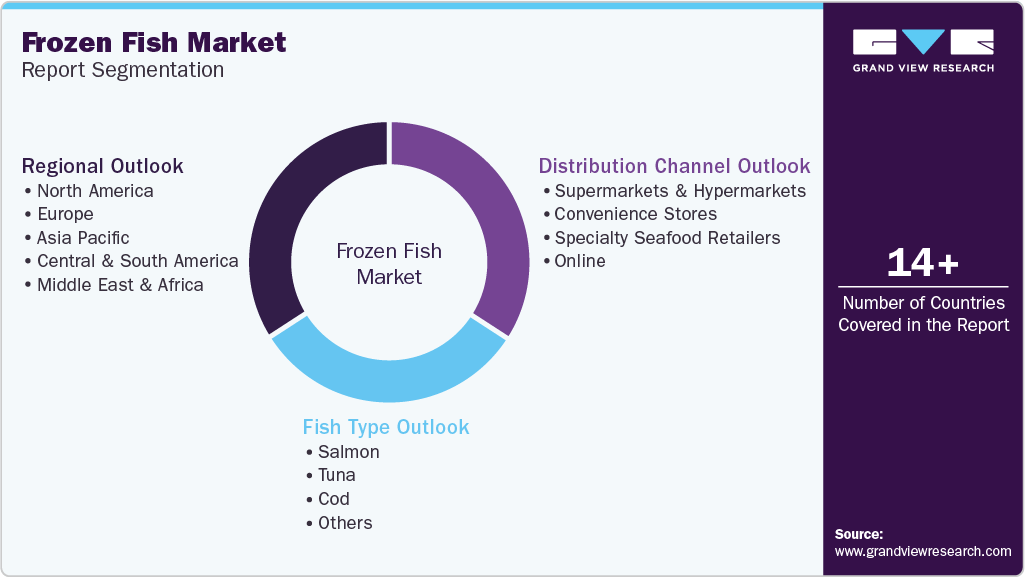
This report forecasts revenue growth at the regional and country levels and provides an analysis of the latest industry trends and opportunities in each of the sub-segments from 2021 to 2033. For the purpose of this study, Grand View Research has segmented the global frozen fish market report on the basis of fish type, distribution channel, and region.
 To learn more about this report, Download Free Sample Report
-
Fish Type Outlook (Revenue, USD Million, 2021 - 2033)
-
Salmon
-
Tuna
-
Cod
-
Others
-
-
Distribution Channel Outlook (Revenue, USD Million, 2021 - 2033)
-
Supermarkets & Hypermarkets
-
Convenience Stores
-
Specialty Seafood Retailers
-
Online
-
-
Regional Outlook (Revenue, USD Million, 2021 - 2033)
-
North America
-
U.S.
-
Canada
-
Mexico
-
-
Europe
-
U.K.
-
Germany
-
France
-
Italy
-
Spain
-
-
Asia Pacific
-
China
-
Japan
-
India
-
Australia & New Zealand
-
South Korea
-
-
Central & South America
-
Brazil
-
-
Middle East & Africa
-
South Africa
-
-
Research Methodology
The frozen fish market figures in this report are based on a proven research process that combines executive interviews with secondary research from proprietary databases, company filings, and recognized regulatory and institutional sources. Market size is built through value-chain sizing-reconciling supply-side and demand-side estimates-and triangulated with bottom-up and top-down approaches. Every estimate passes multiple levels of expert validation before publication, with each frozen fish segment quantified using the revenue-capture definitions in the table below.
Segment Definition
Segment - Fish Type
Revenue capture definition
Salmon
Frozen salmon generates revenue through fillets, steaks, portions, whole fish, and other frozen formats distributed across supermarkets, foodservice outlets, specialty seafood retailers, and online channels. Revenue is captured through retail packs, bulk formats, and portion-controlled products serving household and commercial buyers. Manufacturers can enhance value through premium-grade salmon, skin-on or skinless cuts, and ready-to-cook formats. Branded and private-label products provide opportunities to address different price points and consumer preferences.
Tuna
Frozen tuna generates revenue through loins, steaks, fillets, blocks, and other processed formats supplied to retail, foodservice, and seafood-processing customers. Sales are captured through consumer packs as well as larger formats intended for restaurants and further processing. Manufacturers can differentiate products through species selection, cut quality, portion size, and processing methods. Premium tuna cuts and high-quality products can support higher-value sales across selected applications.
Cod
Frozen cod generates revenue through fillets, portions, loins, steaks, and whole-fish formats sold through retail, foodservice, and institutional channels. Revenue is captured through household-sized packs, bulk commercial formats, and products designed for further preparation. Manufacturers can create value through boneless and skinless portions, standardized cuts, and convenient ready-to-cook formats. Product quality, portion consistency, and specialized packaging can support differentiation and value capture within the cod segment.
Others
Other frozen fish varieties generate revenue through a broad range of products including fillets, portions, whole fish, steaks, and processed seafood formats. Revenue is captured across supermarkets, specialty seafood stores, foodservice operators, processors, and online platforms. Manufacturers can diversify offerings by supplying species suited to different regional tastes, culinary applications, and price ranges. Value can be enhanced through convenient cuts, portion-controlled formats, processing options, and differentiated product positioning.
Estimation Model
Consumption Profile Layer
Market Reach Layer
Purchase & Retention Layer
Value Generation Layer
Who consumes frozen fish?
Where do consumers access it?
What drives repeat purchases?
How is revenue generated?
Urban households, working professionals, restaurants, and health-conscious consumers.
Supermarkets, modern trade, fish retailers, e-commerce, and foodservice channels.
Freshness, taste, price, convenience, product quality, packaging, and availability.
Premium cuts, fillets, value-added products, bulk packs, private labels, and recurring foodservice orders.
Delivered Customizations
This report has been delivered with the following In-depth customizations
CLIENT REQUEST
CUSTOMIZATION DELIVERED
VALUE ADDS
Global Frozen Fish Market Portfolio Assessment
Mapped frozen fish categories by species, cut, and preparation type, including fillets, portions, whole fish, breaded formats, and value-added seafood, with assessment of pack formats, quality tiers, and regional assortment.
Reveals portfolio gaps, premiumization opportunities, and areas for differentiated product development across frozen fish offerings.
Global Frozen Fish Market Route-to-Market & Commercial Assessment
Assessed retail, foodservice, wholesale, specialty seafood, and online channels, incorporating cold-chain requirements, distributor structures, purchasing models, pricing dynamics, and channel-specific product requirements.
Enables channel strategy development, commercial model refinement, distribution planning, and identification of expansion opportunities.
Global Frozen Fish Consumer & Demand Assessment
Examined seafood consumption occasions, species preferences, preparation habits, perceptions of frozen versus fresh fish, convenience expectations, health considerations, and purchase drivers across key consumer groups and markets.
Supports consumer-led portfolio design, positioning refinement, demand generation, and development of targeted innovation platforms.
About the Author(s)
Consumer F&B Research Team
Consumer Goods · Consumer F&BThis report was authored by the consumer f&b research team at Grand View Research - comprising two research analysts, one senior research analyst, and one industry expert - with specialized expertise in the consumer f&b segment of the consumer goods industry. All findings are based on proprietary consumer goods databases, executive interviews, and regulatory analysis, subject to internal peer review prior to publication.
Last Updated:
Speak to Analyst

Customize this report to your needs - add regions, segments, or data points, with 20% free customization.
Or view our licence options:


ISO 9001:2015 & 27001:2022 Certified
We are GDPR and CCPA compliant! Your transaction & personal information is safe and secure. For more details, please read our privacy policy.


