
- Home
- »
- Consumer F&B
- »
-
Frozen Pizza Market Size, Share & Trends Report 2026-2033GVR Report cover
![Frozen Pizza Market (2026 - 2033)Report]()
Frozen Pizza Market (2026 - 2033)
Size, Share & Trends Analysis Report By Size (Regular, Medium, Large), By Distribution Channel (HoReCa, Offline Sales, Online Sales), By Region (North America, Europe, Asia Pacific, Latin America, MEA), And Segment Forecasts
Market Size, 2025
$23.5BMarket Estimate, 2026
$24.3BMarket Forecast, 2033
$31.0BCAGR, 2026–2033
3.5%Frozen Pizza Market Summary
The global frozen pizza market size was valued at USD 23.5 billion in 2025 and is projected to grow from USD 24.3 billion in 2026 to USD 31.0 billion by 2033, at a CAGR of 3.5% from 2026 to 2033. North America dominated the global market with the largest revenue share of 36.8% in 2025. This expansion can be attributed to changing consumer lifestyles, changing food preferences among millennials and the working-class population, and the growing popularity of frozen pizza among various demographics.

Key Market Trends & Insights
- By size: Regular-size frozen pizza segment led the market with the largest revenue share of 44.1% in 2025.
- By distribution channel: HoReCa segment led the market with the largest revenue share of 58.5% in 2025.
Regional Highlights
- Largest regional market: North America (36.8% revenue share, 2025)
- Fastest-growing regional market: Asia Pacific (highest CAGR, 2026-2033)
- By country: The frozen pizza market in the U.S. held the largest share in the North America region in 2025.
Market Size & Forecast
- Market size in 2025: USD 23.5 Billion
- Estimated market size in 2026: USD 24.3 Billion
- Projected market size by 2033: USD 31.0 Billion
- CAGR (2026-2033): 3.5%
As people lead busier lives, the need for quick and easy meal solutions has become paramount, making frozen pizza an attractive option for many households. The shift of consumer preference toward ready-to-eat meals is further expected to drive the growth of the frozen pizza industry. With more individuals and families opting for suitability due to time constraints, frozen pizza is a practical solution requiring minimal preparation. For instance, the rise in dual-income households has led to a decline in traditional home cooking, prompting consumers to seek frozen options that can be quickly heated and served. This trend is particularly evident among millennials and working-class populations who prioritize both taste and ease of preparation.
Moreover, the expansion of retail channels has significantly contributed to the accessibility of frozen pizza products. Supermarkets, hypermarkets, and online platforms are increasingly stocking a diverse range of frozen pizzas, catering to various tastes and dietary preferences. The growing trend of e-commerce also allows consumers to easily order their favorite pizzas online, often at discounted prices.
Furthermore, health consciousness among consumers is shaping the future of the frozen pizza industry. As people become aware of their dietary choices, there is a noticeable shift toward healthier options, such as vegetable-topped pizzas or those made with whole-grain crusts. This shift reflects changing consumer attitudes and opens new opportunities for manufacturers to innovate and diversify their product offerings. The increasing demand for plant-based options illustrates this trend; many brands are now developing frozen pizzas that cater specifically to health-conscious consumers looking for nutritious yet convenient meal solutions.
Market Dynamics
The frozen pizza market is gaining momentum as consumers increasingly seek convenient, ready-to-eat meal solutions that fit busy lifestyles. Frozen pizzas offer a wide variety of options, including traditional, premium, organic, gluten-free, and plant-based varieties, catering to diverse consumer preferences. Advancements in freezing technology, improved product quality, and innovative flavor offerings have enhanced consumer acceptance and demand. The growing popularity of at-home dining, coupled with increasing demand for convenient food products and expanding retail distribution channels, is expected to continue driving growth in the frozen pizza market.
The rising demand for convenient and ready-to-eat meals is a major driver of the frozen pizza market. Modern consumers increasingly seek food options that require minimal preparation due to busy work schedules and fast-paced lifestyles. According to Instacart’s 2025 frozen pizza trends data, pepperoni pizzas accounted for 43% of frozen pizza sales, reflecting strong consumer demand for convenient frozen meal options. The report also highlighted that consumers increasingly choose frozen pizza for its affordability, ease of preparation, and suitability for at-home dining.
Frozen pizzas offer a quick and easy meal solution, as they can be stored for long periods and prepared within minutes. Their availability in a wide variety of flavors, sizes, and dietary options further enhances consumer appeal. As convenience becomes a key purchasing factor, demand for frozen pizza continues to grow across households and urban populations.
Competition from fresh pizza outlets and quick-service restaurants acts as a significant restraint on the frozen pizza market. Many consumers prefer freshly prepared pizzas because they are perceived to offer better taste, quality, and customization options. Quick-service restaurants also provide convenient delivery services and frequent promotional offers, making fresh pizzas more attractive. The growing presence of pizza chains and local pizzerias increases the availability of fresh alternatives. As a result, some consumers choose restaurant-made pizzas over frozen products, limiting market growth.
Opportunity - Development of premium, restaurant-style frozen pizzas with improved taste and quality
Developing premium, restaurant-style frozen pizzas is a strong opportunity because it combines convenience with improved taste and quality. Consumers increasingly want quick meals, but they often prefer the flavor and experience of fresh pizzas from quick-service restaurants. By enhancing ingredients, crust quality, and baking techniques, frozen pizza brands can closely replicate restaurant-style taste. In May 2025, DiGiorno launched a new Wood Fired Style Crust frozen pizza line in 2025, designed to replicate the smoky, charred taste and chewy texture of traditional wood-fired pizzeria pizzas using a home oven. The product range includes four varieties: Four Cheese, Italian Meat Trio, Premium Pepperoni, and Supreme Speciale, targeting consumers seeking restaurant-style pizza with frozen convenience. This reduces the advantage held by fresh pizza outlets and makes frozen options more competitive. As a result, it helps meet demand for convenience while addressing concerns about quality and competition.
Analyst Perspective
The frozen pizza market sits at the intersection of powerful structural shifts in global food consumption, where time scarcity, urbanization, and retail freezer infrastructure expansion are steadily redefining what “meal convenience” means for modern households. Unlike many packaged food categories, it benefits from a dual demand engine, household consumption driven by convenience and price sensitivity, and foodservice adoption where frozen formats are increasingly used as operational efficiency tools in HoReCa environments.
Size Insights
Based on size, the regular-size frozen pizza segment led the market with the largest revenue share of 44.1% in 2025 due to its widespread appeal and affordability. Regular frozen pizzas are often priced lower than their specialty counterparts, making them accessible to a broader consumer base, including students and busy professionals. Their classic taste and familiar flavor profile resonate well with consumers who seek ease without sacrificing quality. For instance, many families opt for regular frozen pizzas as a quick meal solution during hectic weeknights, allowing them to enjoy a satisfying dinner in under 20 minutes. In addition, the versatility of regular pizzas, which can accommodate a wide range of toppings and dietary preferences, further enhances their popularity in the industry. This combination of affordability, taste, and ease positions regular frozen pizzas as the preferred choice among consumers in an increasingly fast-paced world.

The medium segment is expected to grow at the fastest CAGR over the forecast period due to its appeal among busy consumers seeking convenient meal options. This segment strikes a balance between portion size and affordability, making it particularly attractive to working-class individuals and families who prefer ready-to-eat meals that require minimal preparation. For instance, many young professionals and college students choose medium-sized frozen pizzas for gatherings or quick dinners, as they provide enough servings for sharing without being large or expensive. In addition, the increasing trend of social events, such as house parties among millennials, is further expected to drive the demand for medium pizzas, as they are ideal for casual dining experiences. The combination of ease, affordability, and suitability for social occasions positions the medium segment as a key driver of market growth.
Distribution Channel Insights
Based on distribution channel, the HoReCa segment led the market with the largest revenue share of 58.5% in 2025, as restaurants and cafes increasingly rely on frozen pizzas to offer a quick and efficient service without compromising the quality or taste. Many establishments use frozen pizzas to meet customer demand during peak hours, allowing them to maintain service speed while offering a popular menu item. The versatility of frozen pizzas enables restaurants to customize toppings and flavors, catering to diverse consumer preferences. This trend is particularly prominent in casual dining settings, where frozen pizzas can be prepared rapidly, enhancing operational efficiency and customer satisfaction.
The online sales segment is expected to grow at the fastest CAGR over the forecast period. The online sales of frozen pizza are growing due to increasing consumer preference for convenience and easy meal solutions. E-commerce platforms offer various brands, flavors, and dietary options, making it easier for customers to find their preferred choices. Discounts, doorstep delivery, and improved cold-chain logistics have made online purchases more attractive. The rise of digital grocery shopping trends and busy lifestyles further contribute to this growth.
Regional Insights
North America dominated the frozen pizza market with the largest revenue share of 36.8% in 2025, primarily driven by the region's high consumption rates and established frozen food culture. The fast-paced lifestyles of consumers in the U.S. and Canada have led to an increased demand for appropriate meal solutions, making frozen pizzas an appealing option for busy households. For instance, many families turn to frozen pizzas as an easy dinner option after a long workday, allowing them to enjoy a satisfying meal with minimal preparation time. In addition, the strong retail infrastructure in North America facilitates the widespread availability of various frozen pizza brands and flavors, catering to diverse consumer preferences. Ongoing product innovations, including healthier options and unique flavor combinations, which attract health-conscious consumers, is further favoring the market growth in the region.

U.S. Frozen Pizza Market Trends
The frozen pizza market in the U.S. held the largest share in the North America region in 2025, owing to the wide range of flavors offered by the U.S. market players. From traditional options such as pepperoni and cheese to gourmet selections featuring unique toppings, the players cater to varied consumer preferences. Pizza is deeply ingrained in American culture, making it a popular choice for various occasions, from casual family dinners to parties and gatherings. In addition, the U.S. market benefits from ongoing product innovations, including healthier options and diverse flavors that cater to changing dietary preferences.
Europe Frozen Pizza Market Trends
The Europe frozen pizza industry is expected to grow significantly over the forecast period, driven by a shift toward busier lifestyles, which has led consumers to seek quick meal solutions, making frozen pizza an attractive and easy meal option. The variety of frozen pizza offerings reflects Europe’s rich culinary heritage, allowing consumers to enjoy authentic flavors from different regions, such as Italian and Mediterranean styles. Younger generations, changing consumer lifestyles, and increasing demand for favorable meal options are key factors driving the consumption of frozen pizzas. The market in Europe is expected to grow over the coming years with a surging preference for efficient, customizable meal options that fit fast-paced lifestyles.
Asia Pacific Frozen Pizza Market Trends
The Asia Pacific frozen pizza market is expected to grow at the highest CAGR during the forecast period due to increasing urbanization, rising disposable incomes, and growing preference for efficient meal options among consumers. As more people move to urban areas, busy lifestyles have led to increased demand for ready-to-eat foods, including frozen pizzas. For instance, in countries such as India, the expanding working population and Western dining habits have influenced the popularity of frozen pizzas as a quick meal solution. In addition, the proliferation of modern retail outlets and online grocery platforms has improved accessibility to frozen pizza products, increasing their appeal among consumers in the region.
China frozen pizza market held the largest revenue share in Asia Pacific region in 2025 due to its rapidly growing urban population, increasing disposable income, and rising demand for suitable food options. As urbanization accelerates, more consumers in China are adopting fast-paced lifestyles that prioritize quick meal solutions, making frozen pizzas an attractive choice. Furthermore, the influence of Western food culture has led to a greater acceptance and enthusiasm for pizza among Chinese consumers, further driving market growth. The expansion of modern retail channels and e-commerce platforms has also enhanced accessibility to frozen pizza products across the country.
Key Frozen Pizza Company Insights
Some key players in the frozen pizza market are Bellisio Foods, Inc., Nestlé S.A., McCain Foods Limited, One Planet Pizza, Dr. Oetker, Daiya Foods, California Pizza Kitchen, The Simply Good Foods Company, Freiberger Lebensmittel GmbH Co, and Jubilant FoodWorks. These companies in the frozen pizza industry employ various strategies to maintain a competitive edge, including the introduction of innovative flavors and healthy options that cater to evolving consumer preferences. They focus on enhancing product quality by using premium ingredients and developing unique crust types to attract health-conscious consumers.
-
McCain Foods Limited specializes in producing a wide range of frozen pizza products, leveraging its extensive experience in the frozen food industry to deliver high-quality offerings that cater to diverse consumer preferences. The company focuses on innovation by continually introducing new flavors and crust types, appealing to health-conscious consumers with options that include gluten-free and vegetarian pizzas.
-
Bellisio Foods, Inc. is known for its diverse product portfolio, which includes well-established brands such as Michelina's and Boston Market. The company emphasizes innovation by developing unique flavor combinations and premium ingredients, catering to evolving consumer tastes and dietary preferences. Bellisio also focuses on sustainability through eco-friendly packaging initiatives and responsible sourcing practices.
Key Frozen Pizza Companies:
The following key companies have been profiled for this study on the frozen pizza market.
-
Bellisio Foods, Inc.
-
Nestlé S.A.
-
McCain Foods Limited
-
One Planet Pizza
-
Dr. Oetker
-
Daiya Foods
-
California Pizza Kitchen
-
The Simply Good Foods Company
-
Freiberger Lebensmittel GmbH Co
-
Jubilant FoodWorks
Competitive Benchmarking
Category
Operating Strategies
Competitive Edge
Weakness
Established Players (Nestlé S.A., McCain Foods Limited, Dr. Oetker, Bellisio Foods, Inc.)
- Strong multi-channel distribution (retail, HoReCa, online) with focus on premium and branded frozen pizza expansion.
- High brand recognition, large-scale production, and strong retail shelf control.
- Slower innovation and high pricing pressure from private labels and QSR competition.
Emerging Players (One Planet Pizza, Daiya Foods, California Pizza Kitchen)
- Focus on niche offerings like plant-based, clean-label, and gourmet frozen pizzas with digital-first sales channels.
- High agility, faster innovation, and strong alignment with new dietary trends.
- Limited distribution reach and weaker brand trust compared to global players.
Recent Developments
-
In October 2024, Pizza Hut Middle East devised an innovative marketing stunt to promote the launch of its first-ever frozen pizza. The company introduced the product to consumers and involved regional influencers such as Rataj Khajah and Youssef Said, who shared their experiences on social media. However, the real twist came when these influencers opened the boxes to find them empty, creating a humorous prank that captivated the online community and generated buzz around the new frozen pizza offering.
-
In September 2024, Nestlé announced the launch of its new tavern-style pizza under the DiGiorno brand. This product aims to capture the essence of traditional tavern pizzas, characterized by a thin, crispy crust and generous toppings. The introduction of this pizza aligns with the growing consumer demand for useful and high-quality frozen meal options, reflecting Nestlé's commitment to innovation in the frozen food sector.
Frozen Pizza Market Report Scope
Report Attribute
Details
Market size in 2025
USD 23.5 billion
Estimated market size in 2026
USD 24.3 billion
projected market size by 2033
USD 31.0 billion
Growth rate
CAGR of 3.5% from 2026 to 2033
Base year for estimation
2025
Historical data
2021 - 2024
Forecast period
2026 - 2033
Quantitative units
Revenue in USD million/billion and CAGR from 2026 to 2033
Report coverage
Revenue forecast, company ranking, competitive landscape, growth factors, and trends
Segments covered
Size, distribution channel, region
Regional scope
North America; Europe; Asia Pacific; Latin America; MEA
Country scope
U.S.; Canada; Mexico; UK; Germany; France; Italy; Spain; China; Australia; Japan; India; Brazil; Argentina; UAE; South Africa
Key companies profiled
Bellisio Foods, Inc., Nestlé S.A., McCain Foods Limited, One Planet Pizza, Dr. Oetker, Daiya Foods, California Pizza Kitchen, The Simply Good Foods Company, Freiberger Lebensmittel GmbH Co, Jubilant FoodWorks
Customization scope
Free report customization (equivalent up to 8 analysts' working days) with purchase. Addition or alteration to country, regional & segment scope.
Pricing and purchase options
Avail customized purchase options to meet your exact research needs. Explore purchase options
Global Frozen Pizza Market Report Segmentation
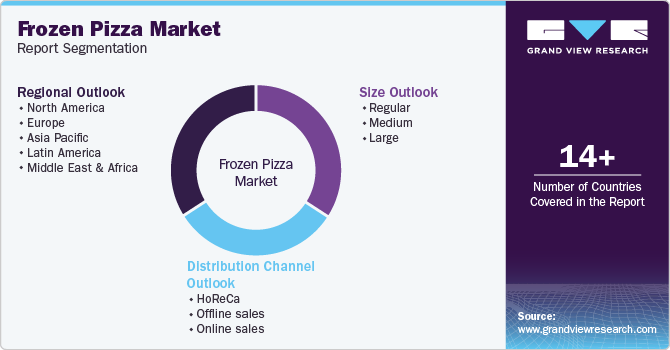
This report forecasts revenue growth at global, regional, and country levels and provides an analysis of the latest industry trends in each of the sub-segments from 2021 to 2033. For this study, Grand View Research has segmented the global frozen pizza market report based on size, distribution channel, and region:
-
Size Outlook (Revenue, USD Million, 2021 - 2033)
-
Regular
-
Medium
-
Large
-
-
Distribution Channel Outlook (Revenue, USD Million, 2021 - 2033)
-
HoReCa
-
Offline sales
-
Online sales
-
-
Regional Outlook (Revenue, USD Million, 2021 - 2033)
-
North America
-
U.S.
-
Canada
-
Mexico
-
-
Europe
-
Germany
-
UK
-
France
-
Italy
-
Spain
-
-
Asia Pacific
-
China
-
Japan
-
India
-
Australia
-
-
Latin America
-
Brazil
-
Argentina
-
-
Middle East and Africa (MEA)
-
South Africa
-
UAE
-
-
Research Methodology
Segment Definition
Segment - Distribution Channel
Revenue capture definition
HoReCa
Revenue is generated through bulk supply of frozen pizza to hotels, restaurants, cafes, and catering services, where it is used as a semi-prepared base or quick-serve menu item. This channel relies on B2B contracts, consistent repeat orders, and cost-efficient large-volume distribution.
Offline Sales
Revenue is earned through supermarkets, hypermarkets, grocery stores, and convenience stores, where frozen pizzas are sold directly to consumers. Growth is driven by strong freezer section presence, in-store promotions, discounts, and brand visibility at the point of purchase.
Online Sales
Revenue is generated via e-commerce grocery platforms and quick-commerce delivery apps that offer frozen pizzas with doorstep delivery. This channel benefits from rising digital adoption, convenience-focused buying behavior, and expanding cold-chain logistics networks.
Estimation Model
Layer Name
Core Question
Methodology / Description
Consumption Universe Layer
Who consumes frozen pizza globally?
Total population consuming frozen / ready-to-eat meals driven by urbanization, dual-income households, and time-poor lifestyles across developed and emerging economies.
Access & Availability Layer
Who can access frozen pizza via retail & delivery?
Portion of consumers with access via modern retail penetration, cold-chain infrastructure, and e-grocery/quick-commerce reach enabling frozen pizza visibility and purchase.
Purchase & Usage Layer
Who are active frozen pizza users?
Share of accessible consumers that actively purchase frozen pizza influenced by category penetration, substitution with fresh/QSR pizza, and frequency of at-home meal occasions.
Revenue Conversion Layer
How much revenue is generated?
Final revenue generated through per-capita frozen pizza spend, pack frequency, premium product mix, and incremental B2B foodservice adoption across HoReCa channels.
Delivered Customizations
This report has been delivered with the following In-depth customizations
Client Request
Customization Delivered
Value Adds
Frozen Pizza Market Growth Drivers, Challenges & Opportunities
Conducted a focused analysis of the frozen pizza market covering key growth drivers such as convenience demand, retail expansion, and product innovation; key restraints including health concerns, cold-chain logistics, and competition from fresh pizza/QSRs; and emerging opportunities like premiumization, plant-based offerings, and online grocery growth.
Helps stakeholders identify high-growth demand drivers, understand market barriers, and evaluate strategic opportunities for product innovation, expansion, and competitive positioning in the frozen food industry.
Frozen Pizza Distribution Channel Dynamics
Evaluated distribution performance across HoReCa, offline retail, and online grocery/quick-commerce platforms, including B2B foodservice adoption, supermarket penetration, and digital-first delivery trends shaping consumer access to frozen pizzas.
Provides insights into channel-wise revenue potential, retail penetration strategies, and evolving consumer purchasing behavior to optimize distribution mix and maximize market reach.
Frozen Pizza Product Innovation & Premiumization Trends
Assessed evolving product trends such as premium restaurant-style frozen pizzas, gourmet toppings, clean-label ingredients, plant-based variants, and healthier crust innovations targeting modern consumers.
Supports brands in identifying differentiation opportunities, improving product positioning, and aligning innovation pipelines with shifting consumer taste and health preferences.
Frequently Asked Questions About This Report
The global frozen pizza market size was valued at USD 23.5 billion in 2025 and is estimated at USD 24.3 billion for 2026.
The global frozen pizza market is expected to grow at a CAGR of 3.5% from 2026 to 2033, reaching USD 31.0 billion.
North America dominated with a 36.8% revenue share in 2025.
Asia Pacific is the fastest-growing region over the forecast period.
The regular size segment led with a 44.1% revenue share in 2025.
Key factors include rising demand for convenient, ready-to-eat meals as busy lifestyles increase, especially among working professionals and students. Additionally, growth in retail and e-commerce distribution, along with improved cold-chain logistics, has made frozen pizzas more widely accessible across urban and semi-urban areas.
HoReCa segment led the market with the largest revenue share of 58.5% in 2025.
Key players include Bellisio Foods, Inc., Nestlé S.A., McCain Foods Limited, One Planet Pizza, Dr. Oetker, Daiya Foods, California Pizza Kitchen, The Simply Good Foods Company, Freiberger Lebensmittel GmbH Co, and Jubilant FoodWorks.
About the Author(s)
Consumer F&B Research Team
Consumer Goods · Consumer F&BThis report was authored by the consumer f&b research team at Grand View Research - comprising two research analysts, one senior research analyst, and one industry expert - with specialized expertise in the consumer f&b segment of the consumer goods industry. All findings are based on proprietary consumer goods databases, executive interviews, and regulatory analysis, subject to internal peer review prior to publication.
Last Updated:
Speak to Analyst


Customize this report to your needs — add regions, segments, or data points, with 20% free customization.
Or view our licence options:


ISO 9001:2015 & 27001:2022 Certified
We are GDPR and CCPA compliant! Your transaction & personal information is safe and secure. For more details, please read our privacy policy.


