
- Home
- »
- Advanced Interior Materials
- »
-
Gas Compressor Market Size And Share Report, 2026-2033GVR Report cover

Gas Compressor Market (2026 - 2033)
Size, Share & Trends Analysis Report By Type (Positive Displacement, Dynamic), By Lubrication (Oil-Free, Oil-Lubricated), By End Use (Oil & Gas, Chemical & Petrochemical, Power Generation, Pharmaceuticals), By Region, And Segment Forecasts
Market Size, 2025
$5.3BMarket Estimate, 2026
$5.4BMarket Forecast, 2033
$6.8BCAGR, 2026–2033
3.5%Gas Compressor Market Summary
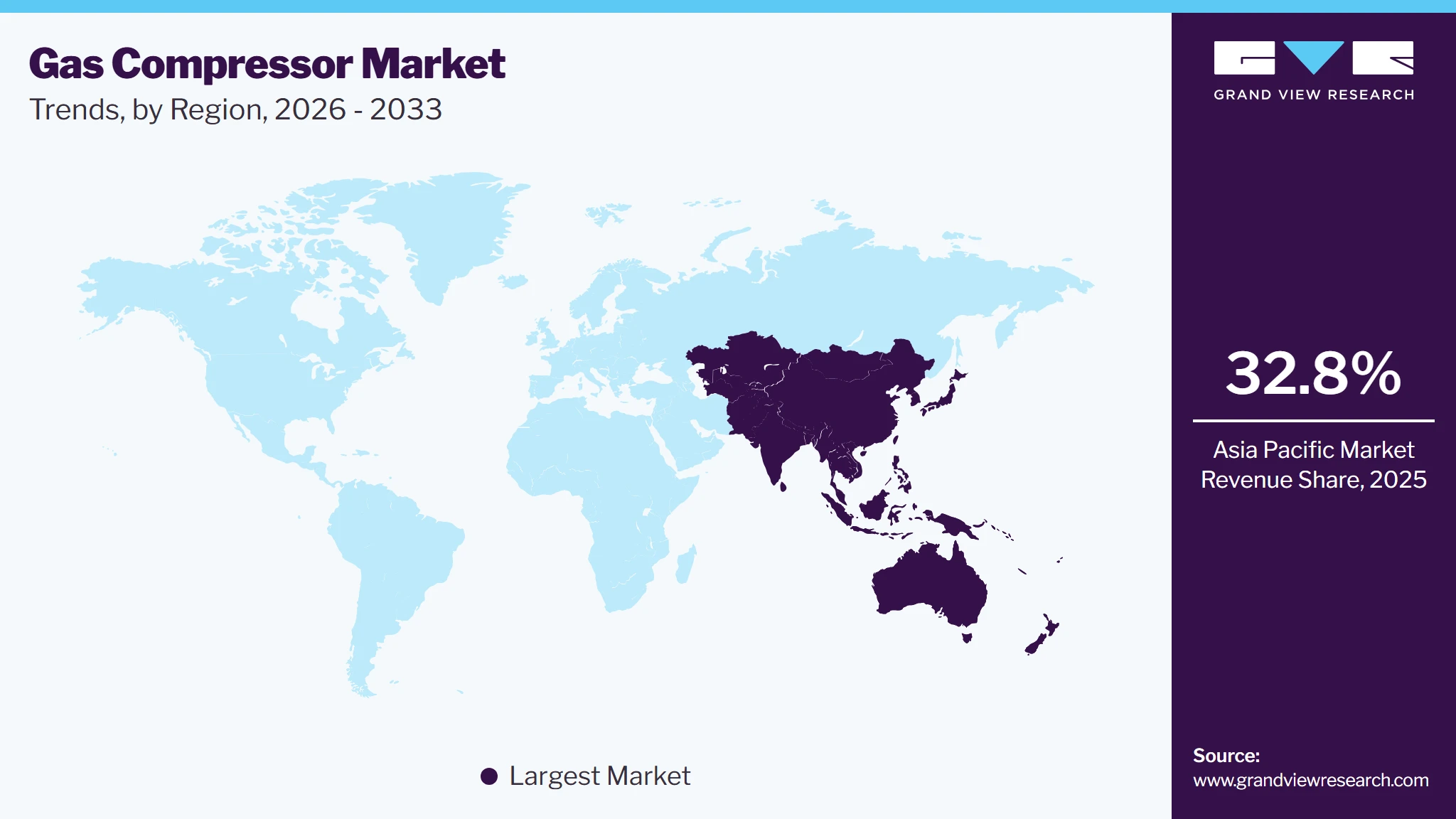
The global gas compressor market size was valued at USD 5.3 billion in 2025 and is projected to grow from USD 5.4 billion in 2026 to USD 6.8 billion by 2033, at a CAGR of 3.5% from 2026 to 2033. Asia Pacific dominated the market, accounting for a revenue share of 32.8% in 2025. The market is driven by the expansion of natural gas transmission and processing infrastructure, increasing LNG capacity, and continued demand for gas across power generation and industrial operations.
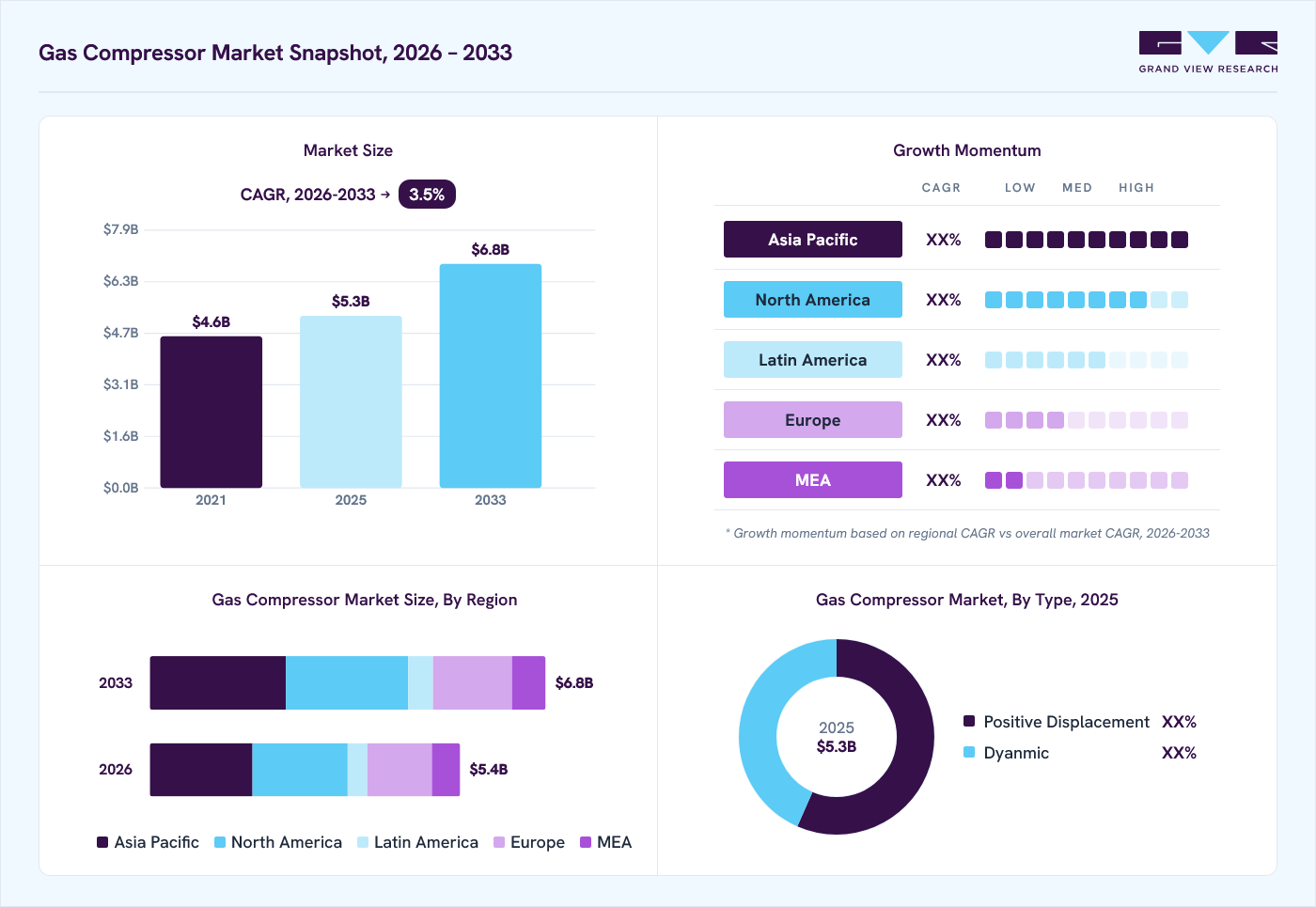 Source: Grand View Research, IR Documents, Primary Interviews, Paid DatabasesTo learn more about this report,
 Download Free Sample Report
Key Market Trends & Insights
- By type: Positive displacement compressors held the largest revenue share of 56.5% in 2025.
- By lubrication: Oil-lubricated segment dominated the market in 2025, accounting for 69.2% market share.
- By end use: Oil & gases segment held the largest market share of CAGR of 44.5% in 2025.
Regional Highlights
- Largest regional market: Asia Pacific (32.8% revenue share, 2025)
- By country: China held the largest share in the Asia Pacific region in 2025.
Market Size & Forecast
- Market Size in 2025: USD 5.3 Billion
- Estimated Market Size in 2026: USD 5.4 Billion
- Projected Market Size by 2033: USD 6.8 Billion
- CAGR (2026-2033): 3.5%
Prism AI by Grand View Research Free to tryAsk a question about the gas compressor market✓Every figure cited from GVR research Prefer the report? Download free sample →
Investments in pipeline networks, LNG terminals, storage facilities, and gas processing plants are generating requirements for reliable compression equipment, while replacement of aging compressor assets is creating demand for modern, energy-efficient systems. The development of hydrogen, carbon capture, and other low-carbon gas infrastructure is also broadening opportunities for specialized compression technologies.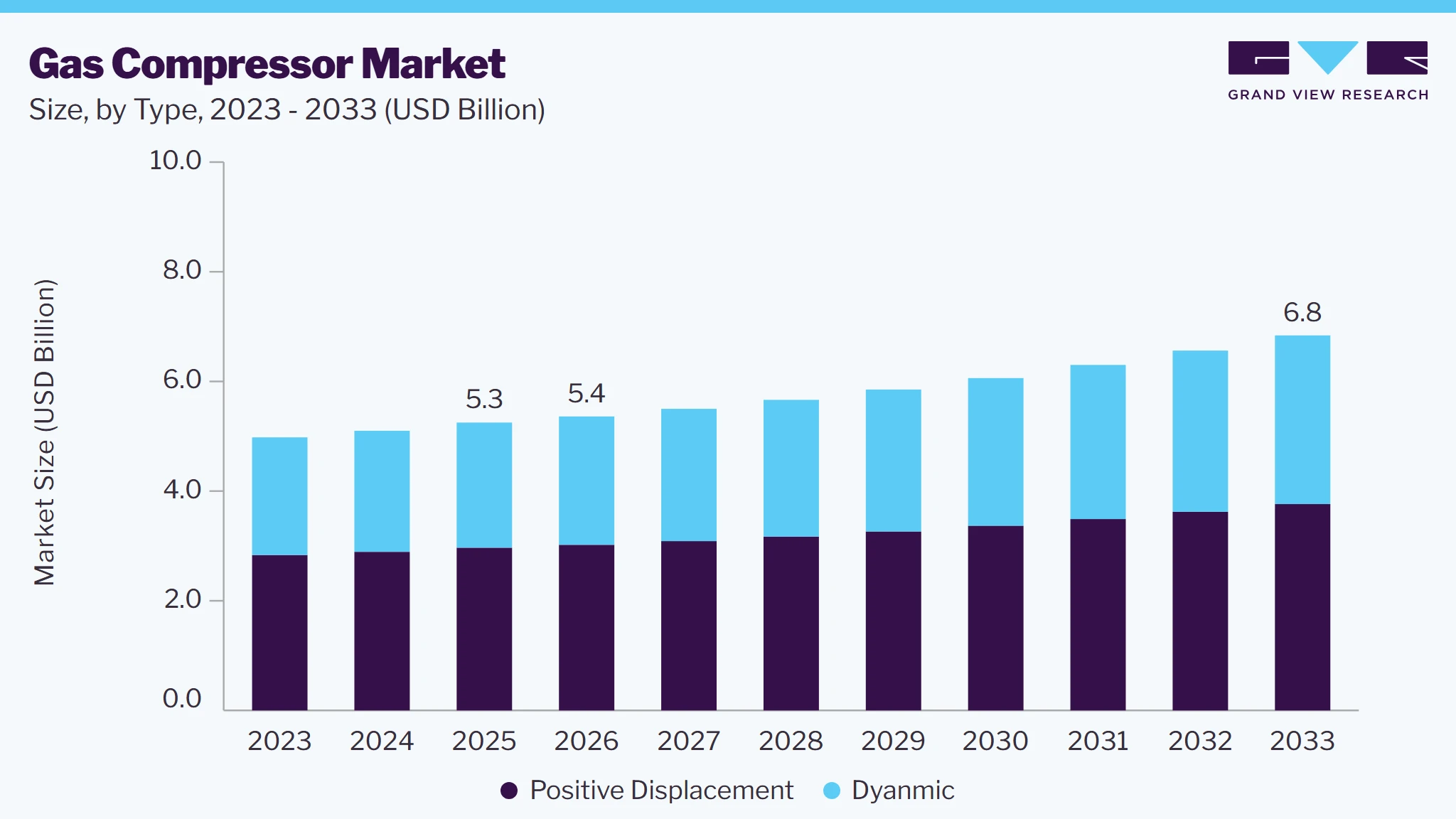 To learn more about this report, Download Free Sample Report
Technological advancements in compressor design are influencing market development, with manufacturers focusing on improving energy efficiency, operational reliability, pressure-handling capabilities, and equipment monitoring. Demand for advanced centrifugal and reciprocating systems is increasing as operators modernize existing compression infrastructure and seek to reduce operating and maintenance costs.
Market Dynamics
The global gas compressor market is shaped by continued investment in natural gas production, transmission, processing, LNG infrastructure, and industrial gas systems. Market development is influenced by the expansion of pipeline networks, new gas processing capacity, replacement of aging compression assets, and demand for higher equipment efficiency. Advances in compressor design, variable-speed drive systems, digital condition monitoring, sealing technologies, and control systems are improving operating performance while enabling more flexible and reliable compression.
Expansion of natural gas transmission networks, LNG terminals, processing facilities, and underground storage is generating sustained requirements for gas compression equipment. Pipeline and processing projects require compressors to maintain operating pressure across different stages of gas transportation and handling. Increasing gas production and cross-regional transportation are also encouraging investment in high-capacity centrifugal and reciprocating compressor systems. Infrastructure development across emerging gas markets is broadening equipment demand beyond established energy-producing regions.
Gas compressor systems involve substantial capital expenditure, particularly for large-capacity units used in transmission, processing, and LNG projects. Project costs extend beyond the compressor itself to include drivers, auxiliary equipment, controls, installation, commissioning, and supporting infrastructure. Energy consumption, scheduled overhauls, component replacement, and specialized maintenance can further increase lifecycle expenses. These cost considerations may influence equipment selection and project investment, particularly where operating margins are constrained.
The development of hydrogen production, transportation, storage, and refueling infrastructure is opening a new lubrication area for gas compressor manufacturers. Hydrogen compression requires equipment capable of operating under high-pressure conditions while addressing material compatibility, leakage control, sealing performance, and safety requirements. Investments in low-carbon gas infrastructure are encouraging the development of specialized compressor configurations and adaptable systems. Opportunities are also emerging for suppliers integrating digital monitoring, energy-efficient drives, and advanced control technologies into next-generation compression equipment.
Market Concentration & Characteristics
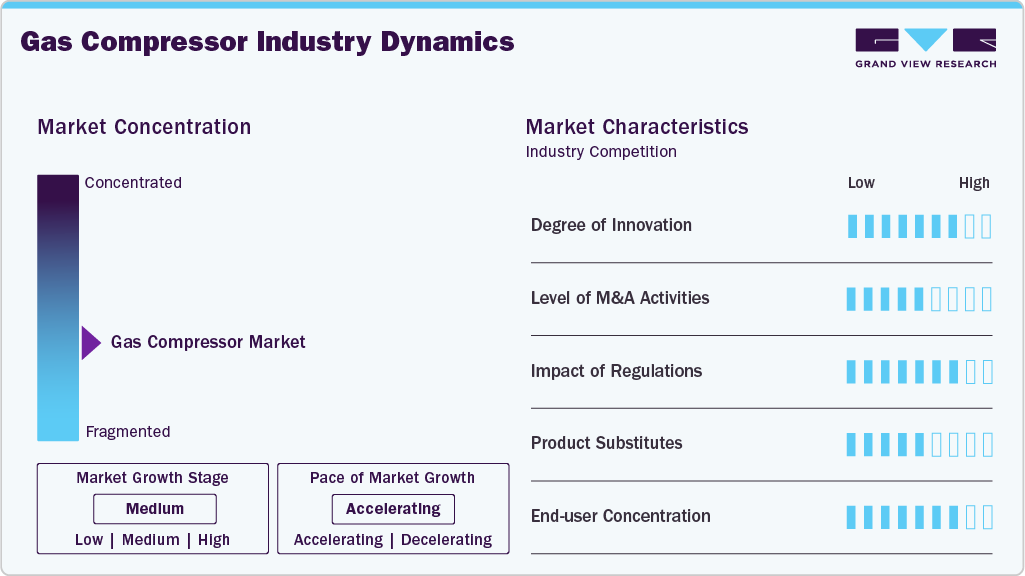
The global gas compressor market has a moderately fragmented competitive structure, with established manufacturers and specialized regional suppliers competing across centrifugal, reciprocating, rotary, and other compressor technologies. Competition is shaped by compression capacity, pressure range, energy efficiency, equipment reliability, customization capabilities, and lifecycle service support. High engineering requirements, substantial capital investment, technical certifications, and established customer relationships create significant entry barriers, particularly for large-scale compression projects.
Regulatory requirements influence product design, manufacturing, installation, and operation, with standards covering pressure safety, equipment reliability, emissions, energy efficiency, and environmental performance. Manufacturers are focusing on higher-efficiency compressor designs, advanced control systems, condition monitoring, and improved sealing technologies to meet evolving operating and compliance requirements. The development of hydrogen and other low-carbon gas infrastructure is also encouraging technology adaptation for different gas properties, pressure conditions, and operating environments.
 To learn more about this report, Download Free Sample Report
Mergers and acquisitions remain an important competitive strategy as manufacturers seek to strengthen technology portfolios, expand geographic coverage, enhance engineering capabilities, and broaden aftermarket service offerings. Industry consolidation is also supporting access to complementary compressor technologies and customer segments. At the same time, long equipment lifecycles, recurring maintenance requirements, replacement demand, and the growing importance of energy-efficient systems continue to influence supplier positioning and competitive intensity across the market.
Analyst Perspective
The global gas compressor market remains closely linked to investment cycles in gas transmission, LNG, processing, and industrial infrastructure. Equipment purchasing decisions are increasingly influenced by efficiency, reliability, maintenance requirements, operating flexibility, and total lifecycle cost rather than capacity alone. Replacement of older compressor fleets provides a steady equipment opportunity in mature markets, while new pipeline and gas infrastructure continues to expand demand in developing regions. Hydrogen and other low-carbon gas projects are gradually broadening the technology landscape, prompting manufacturers to develop compression systems that address higher pressure requirements, material compatibility, operational safety, and improved energy performance.
Type Insights
Based on type, positive displacement compressors held the largest revenue share of 56.5% in 2025. Their established position is attributed to their ability to deliver consistent compression across a wide range of pressure requirements and their suitability for applications requiring controlled gas flow and high-pressure operation. Reciprocating and rotary compressor configurations contribute significantly to this segment through their flexibility, reliability, and availability in multiple capacity ranges.
Dynamic compressors are projected to register the fastest CAGR during the forecast period. Demand is increasing for high-capacity compression systems that can provide continuous gas flow with efficient operation. Advancements in centrifugal compressor design, aerodynamic performance, digital controls, and variable-speed technologies are further improving efficiency and operational flexibility, strengthening adoption in large-scale gas infrastructure and processing projects.
Lubrication Insights
Based on lubrication, oil-lubricated gas compressors held the largest revenue share of 69.2% in 2025, supported by their established use across applications requiring reliable compression performance, effective component lubrication, and continuous operation. Their mature technology, broad availability, and suitability across different pressure and capacity requirements continue to support segment demand.
Oil-free gas compressors are projected to register the fastest CAGR of 4.8% during the forecast period. Growth is driven by increasing requirements for contamination-free gas compression, tighter purity specifications, and improved energy and environmental performance. Advances in oil-free compression technologies, sealing systems, and material design are further expanding their adoption across applications requiring high gas purity and operational reliability.
End Use Insights
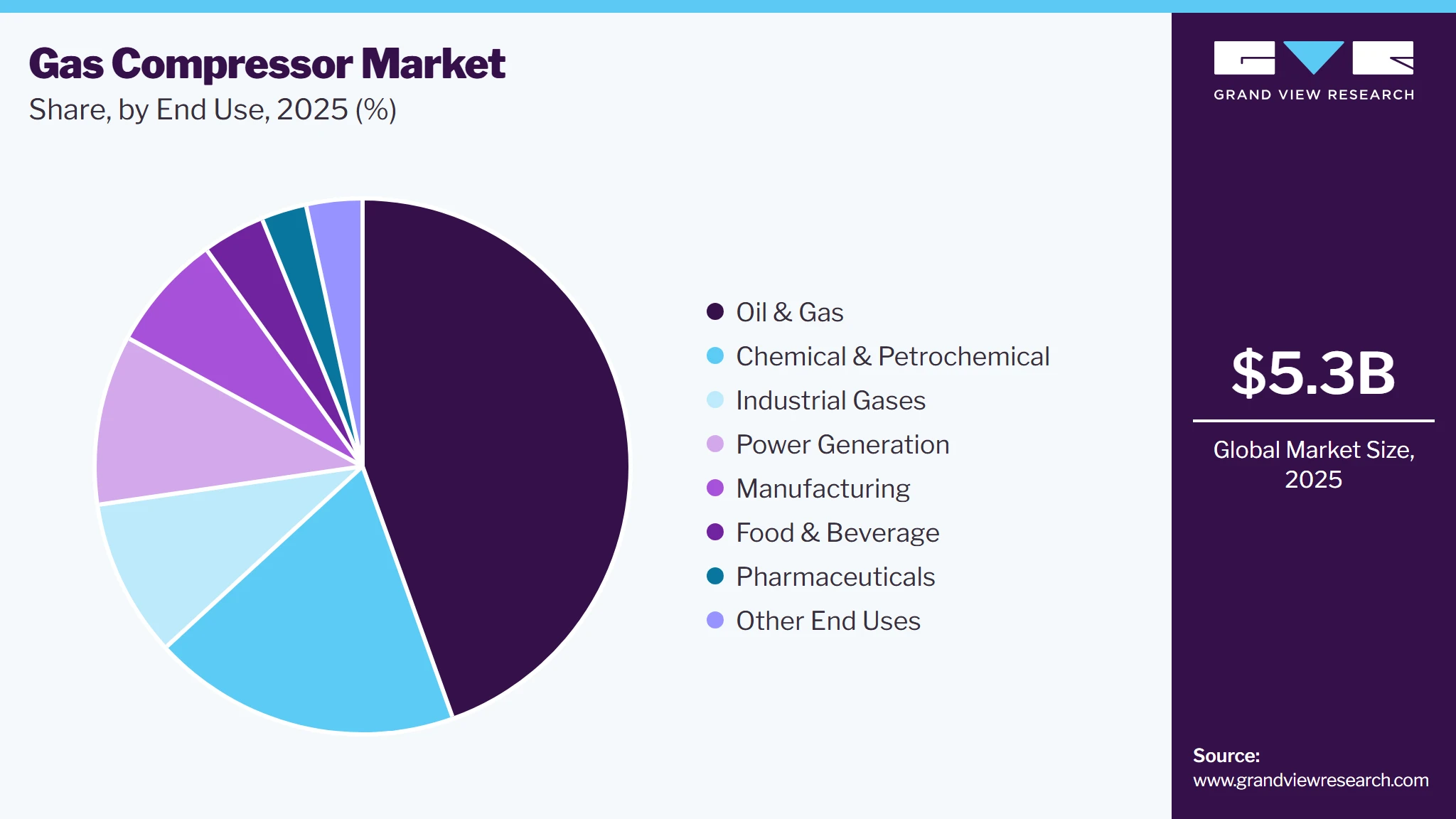
Based on end use, oil & gas held the largest revenue share of 44.5% in 2025, supported by sustained demand for gas compression equipment across natural gas production, processing, transmission, storage, and LNG infrastructure. Continued investment in pipeline networks, gas processing facilities, and compressor replacement is contributing to segment revenue.
 To learn more about this report, Download Free Sample Report
Industrial gases are projected to register the fastest CAGR during the forecast period, driven by expanding production capacity for gases such as hydrogen, oxygen, nitrogen, and other specialty gases. Increasing investments in gas production and distribution infrastructure, along with demand for high-pressure and high-purity compression systems, are creating growth opportunities for specialized gas compressor manufacturers.
Regional Insights
North America is supported by strong demand for gas compressors across manufacturing, oil & gas, chemical processing, healthcare, and electronics industries. Increasing deployment of specialty and high-purity gas delivery systems is driving demand for precision pressure regulation solutions. Stringent workplace safety standards and modernization of industrial gas distribution infrastructure continue to support product adoption. Expansion of hydrogen pressure regulation systems and semiconductor manufacturing is creating additional growth opportunities. Replacement of aging gas control equipment further strengthens market demand.
U.S. Gas Compressor Market Trends
The U.S. represents the largest market in North America, driven by widespread adoption of advanced gas regulation systems across industrial and healthcare sectors. Growing investments in semiconductor fabrication, hydrogen infrastructure, and high-purity gas delivery lubrications continue to support demand. Stringent regulatory standards are encouraging the adoption of high-performance pressure regulators. Industrial automation is increasing the need for precise and reliable gas flow control. Continuous product innovation focused on safety, accuracy, and durability supports market expansion.
Mexico is witnessing steady demand for gas compressors with the expansion of automotive, electronics, and metal processing industries. Increasing investments in industrial gas distribution systems and manufacturing facilities are supporting product adoption. Growing emphasis on operational safety and process reliability is encouraging replacement of conventional gas control equipment. Expansion of export-oriented manufacturing is creating additional demand for pressure regulation solutions. Industrial modernization continues to strengthen long-term market growth.
Europe Gas Compressor Market Trends
Europe has an established gas infrastructure base, with demand concentrated across transmission networks, underground storage, gas processing, LNG facilities, and industrial operations. Energy security investments and infrastructure modernization are supporting compressor upgrades and new installations. The development of hydrogen networks is creating demand for compressors capable of handling alternative gases. Efficiency improvements and emissions reduction requirements are influencing equipment replacement and technology selection.
Germany remains a prominent market, supported by extensive industrial infrastructure, gas transmission networks, storage facilities, and chemical manufacturing. The modernization of gas infrastructure is generating demand for efficient compressor systems. Hydrogen pipeline and storage projects are creating new requirements for specialized compression equipment. Industrial facilities are also upgrading compression systems to improve reliability and energy performance.
The UK is supported by gas transmission infrastructure, offshore production, LNG terminals, storage facilities, and industrial gas requirements. Compressor demand is influenced by the maintenance and modernization of existing infrastructure. Development of hydrogen and low-carbon gas networks is creating new opportunities for specialized compression technologies. Offshore and gas processing activities continue to require reliable compression systems.
Asia Pacific Gas Compressor Market Trends
Asia Pacific represents the largest and fastest-growing regional market, driven by expanding gas transmission infrastructure, LNG capacity, industrialization, and energy investments. New pipeline networks, LNG terminals, gas storage facilities, and processing plants are creating substantial demand for compression equipment. Industrial applications across chemicals, refining, and manufacturing are broadening the equipment base. Hydrogen infrastructure is emerging as another application area for specialized compressors.
 To learn more about this report, Download Free Sample Report
China dominates the regional market, supported by extensive pipeline infrastructure, LNG terminals, gas storage facilities, and domestic energy development. Expansion of natural gas transmission and processing capacity continues to generate compressor requirements. Growth in industrial gas consumption and petrochemical production is supporting equipment demand. Hydrogen production, storage, and transportation projects are creating opportunities for next-generation compression systems.
India is developing as a significant market with the expansion of natural gas transmission pipelines, LNG terminals, city gas infrastructure, refining, and petrochemical capacity. New pipeline projects are increasing requirements for compressor stations and associated equipment. Expansion of gas-based industrial infrastructure is supporting demand for reciprocating and centrifugal compressors. Hydrogen infrastructure and investments in cleaner energy systems are creating emerging opportunities.
Middle East & Africa Gas Compressor Market Trends
The Middle East & Africa have substantial demand for gas compressors across upstream production, gas processing, transmission, LNG, refining, and petrochemical infrastructure. Expansion of gas processing capacity and pipeline networks is generating requirements for high-capacity compression equipment. Offshore developments and gas monetization projects are supporting new installations. Hydrogen and low-carbon energy projects are creating additional opportunities for specialized compressors.
Saudi Arabia represents a prominent regional market, supported by large-scale investments in natural gas processing, transmission, petrochemicals, and energy infrastructure. Expansion of gas production and processing capacity is creating demand for industrial compression systems. New gas pipeline and processing projects are supporting high-capacity equipment requirements. Hydrogen and low-carbon energy investments are also opening opportunities for specialized compression technologies.
Latin America Gas Compressor Market Trends
Latin America is supported by oil & gas production, natural gas processing, pipeline development, LNG infrastructure, and refining investments. Offshore production and expansion of gas transportation networks are generating demand for compression equipment. The modernization of existing energy infrastructure is creating replacement opportunities. Development of new gas processing and transportation projects is supporting demand for both reciprocating and centrifugal compressor systems.
Brazil accounts for a significant share of the regional market, driven by offshore oil & gas production, natural gas processing, pipelines, refining, and petrochemical infrastructure. Expansion of offshore developments is generating demand for compression systems across production and processing facilities. Investments in gas transportation and processing infrastructure are creating additional equipment requirements. Replacement and modernization of existing compressor systems are supporting demand for efficient and reliable technologies.
Key Gas Compressor Company Insights
Some of the key players operating in the market include Baker Hughes, Siemens Energy, Swagelok Company
-
Baker Hughes is a global energy technology company headquartered in Houston, Texas, providing technologies, equipment, and services for energy and industrial applications. The company serves the upstream, midstream, and downstream segments of the energy value chain through its Oilfield Services & Equipment and Industrial & Energy Technology businesses. Its offerings span gas technology, LNG, turbomachinery, industrial equipment, and related lifecycle services, with operations across multiple international markets.
-
Siemens Energy is a global energy technology company headquartered in Munich, Germany, focused on technologies for power generation, transmission, and industrial energy systems. The company serves utilities, energy producers, industrial enterprises, and infrastructure operators through a broad portfolio covering gas and steam turbines, grid technologies, energy conversion, and compression systems. Its international operations encompass equipment manufacturing, engineering, project execution, digital solutions, and long-term service activities across established and emerging energy markets.
Key Gas Compressor Companies
The following key companies have been profiled for this study on the gas compressor market.
-
Ariel Corporation
-
Baker Hughes
-
Siemens Energy
-
Burckhardt Compression
-
MAN Energy Solutions
-
Howden
-
Kobelco Compressors Corporation
-
Elliott Group
-
Mitsubishi Heavy Industries
-
BORSIG GmbH
-
Neuman & Esser (NEA Group)
-
Hanwha Power Systems
-
Sundyne
-
Aerzen
-
HMS Group
Competitive Benchmarking
Category
Operating Strategies
Competitive Edge
Weakness
Established Players (e.g., Ariel Corporation; Baker Hughes; Siemens Energy; Burckhardt Compression; MAN Energy Solutions; Howden; Kobelco Compressors Corporation; Elliott Group; Mitsubishi Heavy Industries; BORSIG GmbH; Neuman & Esser (NEA Group))
- Expand gas compressor portfolios across reciprocating, centrifugal, screw, and specialized compression technologies.
- Invest in energy-efficient designs, digital monitoring, customized systems, global manufacturing, and lifecycle services.
- Strong engineering expertise, established manufacturing capabilities, broad compressor portfolios, and extensive installed bases.
- Global service networks and experience across natural gas, LNG, petrochemical, industrial gas, hydrogen, and process-gas applications.
- High R&D, manufacturing, and project execution costs.
- Long equipment qualification cycles and substantial investment requirements for global production and service infrastructure.
Emerging & Regional Players (e.g., Hanwha Power Systems; Sundyne; Aerzen; HMS Group)
- Focus on specialized gas compressor technologies, application-specific configurations, competitive pricing, and regional market requirements.
- Expand through local partnerships, distributors, project contracts, and aftermarket services.
- Specialized technology capabilities, flexible configurations, regional market knowledge, and responsiveness to specific customer requirements.
Ability to serve niche applications and selected gas-compression segments.
- Comparatively narrower global reach and product coverage.
Smaller service networks and limited participation in some large-scale international gas infrastructure projects.
Recent Developments
-
In July 2026, Baker Hughes announced the completion of its acquisition of Chart Industries, strengthening its portfolio of industrial and energy solutions. The deal integrates the latter as a new reporting segment focused on thermal management, lifecycle services, and air and gas handling, expanding Baker Hughes’ capabilities across gas infrastructure and other industrial markets. The combined business is targeting USD 325 million in annualized cost synergies by the third year after closing, alongside further commercial opportunities from the integration of their product, technology, manufacturing, and service capabilities.
-
In December 2025, Copeland launched its transcritical CO₂ scroll compressor with Dynamic Vapor Injection (DVI) technology in North America, expanding its CO₂ compression portfolio for distributed refrigeration systems. The compressor is available in fixed- and variable-speed configurations and uses DVI to improve efficiency while eliminating the need for parallel compression, simplifying system design and reducing component requirements. The technology is designed to lower installation and maintenance costs, improve reliability, and support the adoption of low-GWP natural refrigerant systems, particularly in small- to medium-sized food retail applications.
Gas Compressor Market Report Scope
Report Attribute
Details
Market size in 2026
USD 5.3 billion
Estimated market size in 2026
USD 5.4 billion
Projected market size by 2033
USD 6.8 billion
Growth rate
CAGR of 3.5% from 2026 to 2033
Historical data
2021 - 2024
Forecast period
2026 - 2033
Quantitative units
Revenue in USD billion and CAGR from 2026 to 2033
Report coverage
Revenue forecast, company ranking, competitive landscape, growth factors, and trends
Segments covered
Type, lubrication, end use, region
Regional scope
North America; Europe; Asia Pacific; Latin America; Middle East & Africa
Country scope
U.S.; Canada; Mexico; UK; Germany; France; Spain; Italy; China; Japan; India; Australia; South Korea; Brazil; Argentina; Saudi Arabia; South Africa; UAE
Key companies profiled
Ariel Corporation; Baker Hughes; Siemens Energy; Burckhardt Compression; MAN Energy Solutions; Howden; Kobelco Compressors Corporation; Elliott Group; Mitsubishi Heavy Industries; BORSIG GmbH; Neuman & Esser (NEA Group),Hanwha Power Systems; Sundyne; Aerzen; HMS Group
Customization scope
Free report customization (equivalent up to 8 analysts working days) with purchase. Addition or alteration to country, regional & segment scope.
Pricing and purchase options
Avail customized purchase options to meet your exact research needs. Explore purchase options
Global Gas Compressor Market Report Segmentation
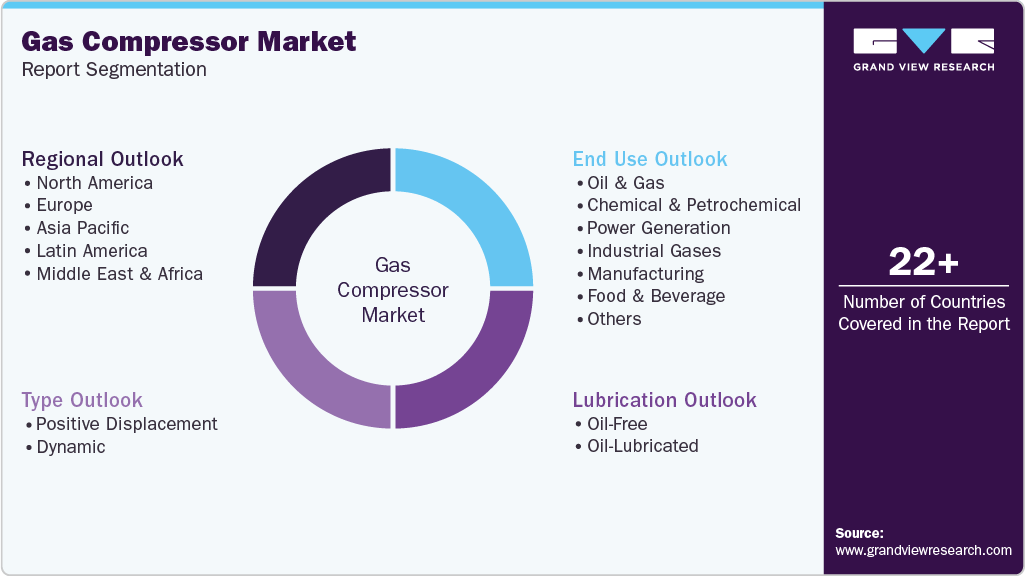
This report forecasts revenue growth at global, regional, and country levels and provides an analysis of the latest industry trends in each of the sub-segments from 2021 to 2033. For this study, Grand View Research has segmented the global gas compressor market report based on type, lubrication, end use, and region.
 To learn more about this report, Download Free Sample Report
-
Type Outlook (Revenue, USD Billion, 2021 - 2033)
-
Positive Displacement
-
Dynamic
-
-
Lubrication Outlook (Revenue, USD Billion, 2021 - 2033)
-
Oil-Free
-
Oil-Lubricated
-
-
End Use Outlook (Revenue, USD Billion, 2021 - 2033)
-
Oil & Gas
-
Chemical & Petrochemical
-
Power Generation
-
Industrial Gases
-
Manufacturing
-
Food & Beverage
-
Pharmaceuticals
-
Other End Uses
-
-
Regional Outlook (Revenue, USD Billion, 2021 - 2033)
-
North America
-
U.S.
-
Canada
-
Mexico
-
-
Europe
-
Germany
-
France
-
Italy
-
Spain
-
UK
-
-
Asia Pacific
-
China
-
India
-
Japan
-
South Korea
-
Australia
-
-
Latin America
-
Brazil
-
Argentina
-
-
Middle East and Africa
-
Saudi Arabia
-
UAE
-
South Africa
-
-
Research Methodology
The gas compressor market figures in this report are based on a proven research process that combines executive interviews with secondary research from proprietary databases, company filings, and recognized regulatory and institutional sources. Market size is built through value-chain sizing-reconciling supply-side and demand-side estimates-and triangulated with bottom-up and top-down approaches. Every estimate passes multiple levels of expert validation before publication, with each gas compressor segment quantified using the revenue-capture definitions in the table below.
Segment Definition
Type
Revenue Capture Definition
Positive Displacement
Revenue is generated from the sale of gas compressors that compress gas by mechanically reducing its volume, including reciprocating and rotary configurations. Sales value varies by capacity, pressure rating, stages, configuration, and technical specifications.
Dynamic
Revenue is generated from the sale of gas compressors that increase pressure through continuous gas acceleration using rotating components. Revenue varies by flow capacity, pressure ratio, efficiency, stages, and compressor configuration.
Lubrication
Revenue Capture Definition
Oil-Free
Revenue is generated from the sale of compressors designed to operate without oil entering the compression chamber or gas stream. Sales value is influenced by capacity, pressure, compression technology, sealing systems, and material specifications.
Oil-Lubricated
Revenue is generated from the sale of compressors incorporating oil-based lubrication for component protection, cooling, and sealing. Revenue varies according to capacity, pressure rating, lubrication system, stages, and equipment configuration.
End Use
Revenue Capture Definition
Oil & Gas
Revenue is generated from the sale of compressor units, packaged systems, and engineered compression equipment in oil & gas industry based on specified capacity, pressure, configuration, materials, and project requirements.
Chemical & Petrochemical
Revenue is generated from compressor sales in chemical and petrochemical facilities configured to meet specified gas composition, pressure, temperature, capacity, materials, and performance requirements.
Power Generation
Revenue is generated from the sale of compressor units and integrated packages based on capacity, pressure, efficiency, configuration, controls, and auxiliary equipment requirements in power generation sites and facilities.
Industrial Gases
Revenue is generated from the sale of compressors for industrial gases processing designed according to gas properties, purity requirements, pressure, flow capacity, materials, and compression specifications.
Manufacturing
Revenue is generated from the sale of standalone and packaged gas compressors in manufacturing industry based on capacity, pressure, technology, controls, configuration, and performance specifications.
Food & Beverage
Revenue is generated from the sale of gas compressors meeting specified purity, pressure, capacity, and contamination-control requirements, with pricing determined by configuration and technical specifications for food & beverage processing.
Pharmaceuticals
Revenue is generated from the sale of specialized compressors meeting specified purity, pressure, contamination-control, material, and reliability requirements in pharmaceutical industry.
Other End Uses
Revenue is generated from the sale of standard, customized, replacement, and engineered gas compressor systems in other end uses based on capacity, pressure, technology, materials, and customer specifications.
Estimation Model
Layer Name
Key Question
Description
Gas Compression Demand Layer
Where are gas compressors required?
Analyze demand across oil & gas, power generation, chemicals & petrochemicals, manufacturing, mining, LNG, and other industrial lubrications. Assess gas production, processing, transmission, storage, LNG infrastructure, and industrial gas handling requirements to establish the addressable demand for gas compressors. Gas compressors are used for gas transportation, processing, storage, and end-use lubrications across multiple industries.
Industrial Infrastructure Investment Layer
Where is new equipment demand being created?
Evaluate investments in gas pipelines, gas processing facilities, LNG terminals, refineries, petrochemical plants, power generation facilities, and industrial production capacity. Assess greenfield projects, capacity additions, pipeline expansions, and replacement of aging compression equipment. Expansion of gas infrastructure and LNG facilities remains an important source of compressor demand.
Product Adoption Layer
Which compressor technologies are being deployed?
Segment demand by compressor type, including centrifugal, reciprocating, rotary, and other configurations, along with pressure rating, lubrication, displacement, and end-use lubrication. Apply adoption rates based on gas flow rate, discharge pressure, compression ratio, operating conditions, energy efficiency, and lubrication requirements. Centrifugal compressors are commonly deployed for high-flow continuous lubrications, while reciprocating compressors serve higher-pressure, lower-flow lubrications.
Revenue Generation Layer
How much market revenue is generated?
Estimate annual shipments of new gas compressors by compressor type, lubrication, end use, and region. Convert equipment volumes into revenue using equipment-level pricing, project values, capacity requirements, and regional price variations. Validate estimates against manufacturer revenues, project awards, production capacity, and order activity.
Delivered Customizations
This report has been delivered with the following In-depth customizations
CLIENT REQUEST
CUSTOMIZATION DELIVERED
VALUE ADDS
Competitive Benchmarking
A competitive benchmarking analysis was conducted by evaluating gas compressor manufacturers based on compressor technology, capacity, pressure range, drive systems, gas compatibility, energy efficiency, control technologies, product portfolio, manufacturing capabilities, aftermarket services, and geographic presence.
The benchmarking enabled stakeholders to compare supplier capabilities, evaluate product differentiation, assess competitive positioning, and formulate market strategies.
Regional Segmentation
A comprehensive regional assessment was provided across North America, Europe, Asia Pacific, Latin America, and Middle East & Africa, examining gas compressor demand in relation to natural gas infrastructure, pipeline networks, LNG capacity, industrial investment, energy projects, and equipment replacement cycles.
The analysis helped stakeholders identify high-potential regions, evaluate demand conditions, prioritize expansion opportunities, and align product strategies with regional requirements.
Opportunity Assessment
A detailed opportunity assessment evaluated prospects associated with natural gas infrastructure expansion, LNG development, hydrogen compression, industrial gas demand, compressor modernization, energy-efficient equipment, and lower-emission compression technologies.
The assessment enabled stakeholders to prioritize growth opportunities, support investment planning, identify emerging lubrications, and align product development with requirements for efficiency, reliability, capacity, and emissions performance.
Frequently Asked Questions About This Report
The oil-lubricated segment dominated the market with a revenue share of 69.2% in 2025, reflecting its extensive use across applications requiring reliable and continuous compression performance.
Growth is driven by expanding natural gas infrastructure, increasing industrial gas consumption, investments in oil & gas processing facilities, and demand for reliable compression systems across industrial and energy applications.
Key players include Ariel Corporation, Baker Hughes, Siemens Energy, Burckhardt Compression, MAN Energy Solutions, Howden, Kobelco Compressors Corporation, Elliott Group, Mitsubishi Heavy Industries, BORSIG GmbH, Neuman & Esser, Hanwha Power Systems, Sundyne, AERZEN, and HMS Group.
Positive displacement compressors held the largest revenue share of 56.5% in 2025 while dynamic compressors segment is the fastest growing segment
Oil & gases segment held the largest market share of CAGR of 44.5% in 2025.
The global gas compressor market size was valued at USD 5.3 billion in 2025 and is projected to reach USD 5.4 billion by 2026.
The market is projected to grow at a CAGR of 3.5% from 2026 to 2033, reaching USD 6.8 billion by 2033.
Asia Pacific dominated the global gas compressor market with the largest revenue share of 32.8% in 2025.
About the Author(s)
Advanced Interior Materials Research Team
Advanced Materials · Advanced Interior MaterialsThis report was authored by the advanced interior materials research team at Grand View Research - comprising two research analysts, one senior research analyst, and one industry expert - with specialized expertise in the advanced interior materials segment of the advanced materials industry. All findings are based on proprietary advanced materials databases, executive interviews, and regulatory analysis, subject to internal peer review prior to publication.
Last Updated:
Speak to Analyst

Customize this report to your needs - add regions, segments, or data points, with 20% free customization.
Or view our licence options:


ISO 9001:2015 & 27001:2022 Certified
We are GDPR and CCPA compliant! Your transaction & personal information is safe and secure. For more details, please read our privacy policy.


