
- Home
- »
- Advanced Interior Materials
- »
-
Gas Masks Market Size, Share & Trends Report, 2026-2033GVR Report cover

Gas Masks Market (2026 - 2033)
Size, Share & Trends Analysis Report By Masks Type (Half-Face Gas Masks, Full-Face Gas Masks), By Product Type (Non-Powered Gas Masks, Powered Gas Masks, Manual), By End Use, By Region, And Segment Forecasts
Market Size, 2025
$4.1BMarket Estimate, 2026
$4.3BMarket Forecast, 2033
$6.7BCAGR, 2026–2033
6.6%Gas Masks Market Summary
The global gas masks market size was valued at USD 4.1 billion in 2025 and is projected to grow from USD 4.3 billion in 2026 to USD 6.7 billion by 2033, at a CAGR of 6.6% from 2026 to 2033. North America dominated the market, accounting for the largest revenue share of 32.3% in 2025. The growing focus on military preparedness and chemical, biological, radiological, and nuclear (CBRN) defense is a key factor driving the gas masks market.
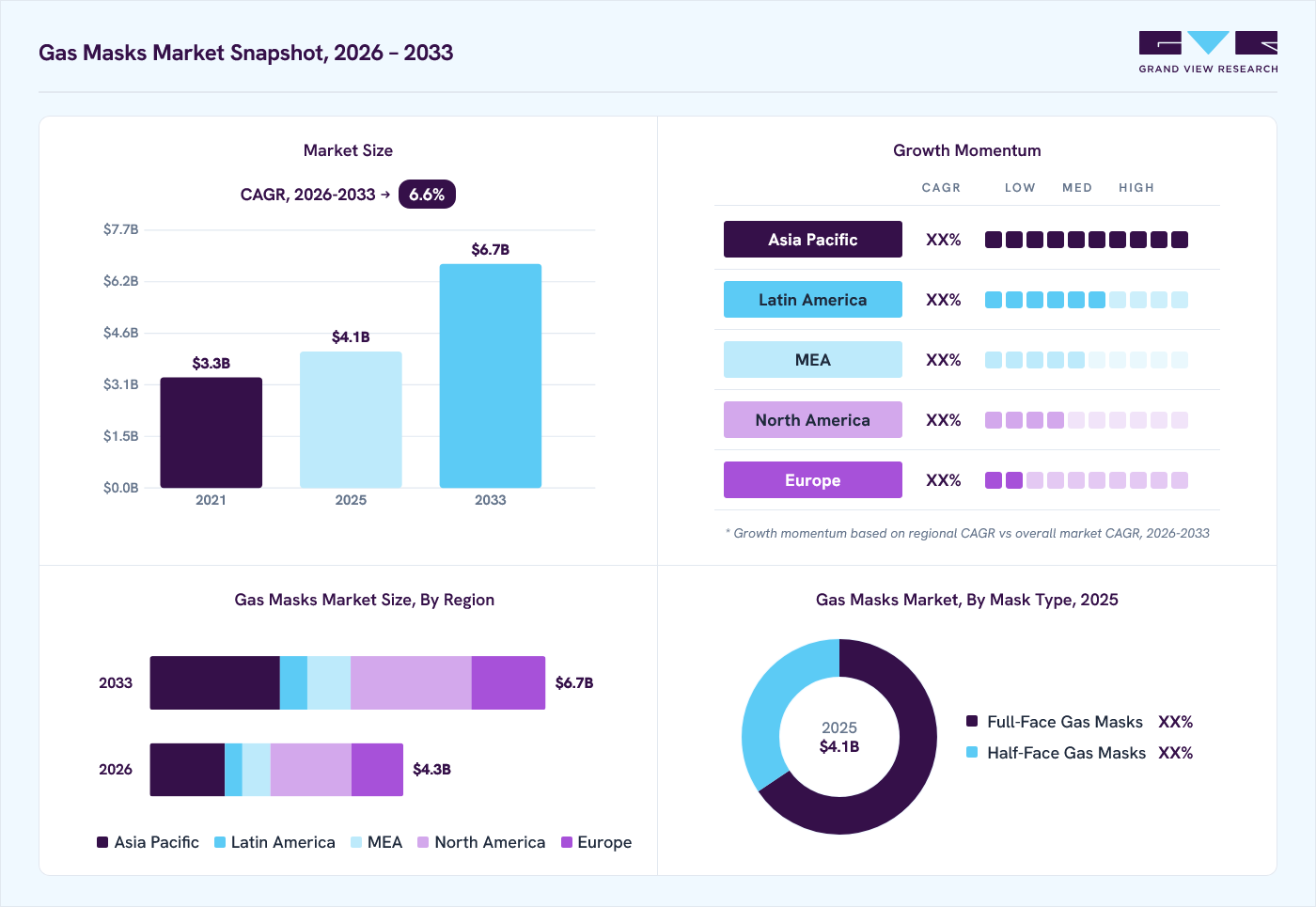 Source: Grand View Research, IR Documents, Primary Interviews, Paid DatabasesTo learn more about this report,
 Download Free Sample Report
Key Market Trends & Insights
- By masks type: Full-face gas masks segment led the market with the largest revenue share of 65.5% in 2025.
- By product type: Non-powered gas masks segment led the market with the largest revenue share of 73.5% in 2025.
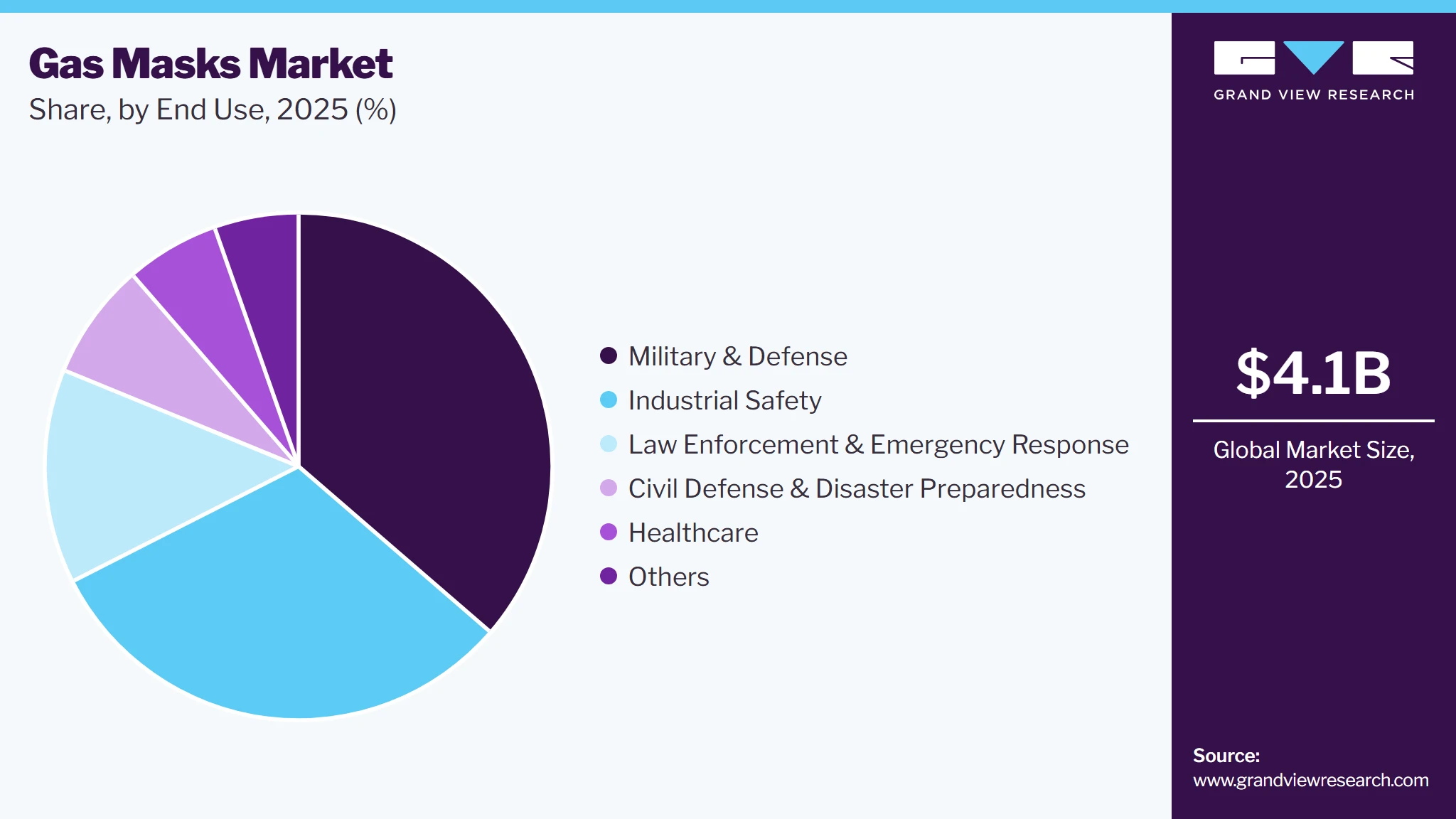
- By end use: Military & defense segment led the market with the largest revenue share of 36.3% in 2025.
Regional Highlights
- Largest Regional Market: North America held the largest share, 32.3% of gas masks market.
- By Country: The U.S. held the largest market share in 2025.
Market Size & Forecast
- Market size in 2025: USD 4.1 Billion
- Estimated market size in 2026: USD 4.3 Billion
- 2033 Projected Market Size: USD 6.7 Billion
- CAGR (2026-2033): 6.6%
Three ways to get this report
Buy it, customize it, or ask a question.Ask an Analyst
Analyst response in 1 business day
- AccessReport author, directly
- Reply timeWithin 1 working day
- No sales callDirect answer only
- FormatEmail reply
- CostFree, no cost
Get the Full Report
What the study covers
- FormatsPDF · Excel · Dashboard
- Timeline2026–2033 annual, 2025 base
- Coverage20+ countries, 5 regions
- Companies10+ key players profiled
Customize the Report
20% free customization
- IncludeCountries, segments, points
- TailorTo your product definition
- ExtendDeeper competitor detail
- OrA fully bespoke study
- Turnaround5–10 working days
Rising geopolitical tensions, increasing defense expenditure, and the need to protect military personnel from chemical warfare agents and toxic substances are encouraging governments to procure advanced respiratory protection equipment. Defense agencies are also strengthening emergency response capabilities and updating protective equipment to meet changing operational requirements.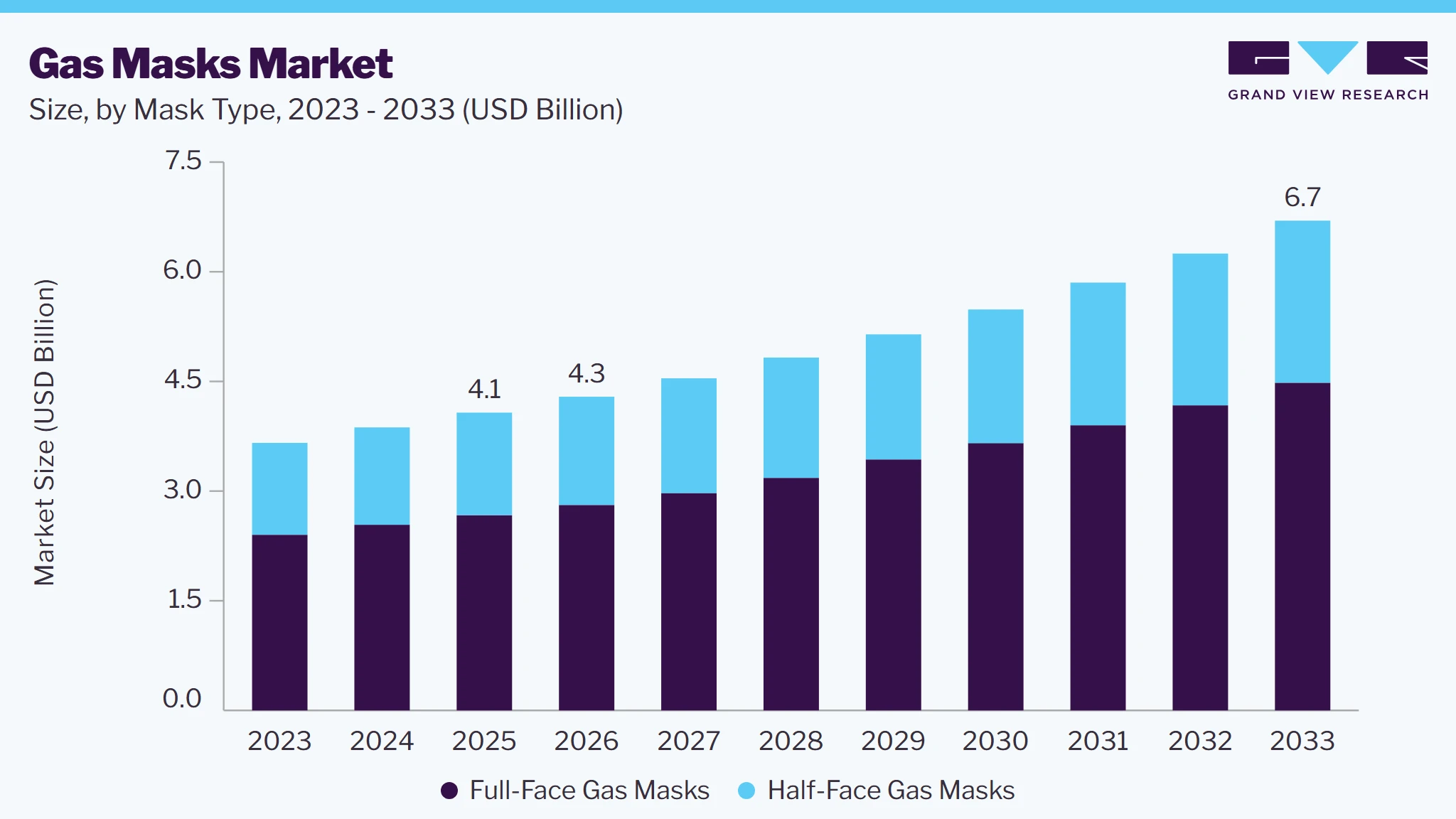 To learn more about this report, Download Free Sample Report
The increasing emphasis on workplace safety and hazardous environment protection is another major driver of market growth. Workers in chemical manufacturing, industrial production, mining, and other high-risk environments may be exposed to toxic gases, vapors, and airborne contaminants, creating demand for reliable respiratory protection. Stricter occupational safety requirements and greater awareness of workplace hazards are encouraging employers to invest in certified gas masks and compatible filtration equipment. In addition, growing preparedness for industrial accidents, hazardous material spills, natural disasters, and public safety emergencies is supporting the adoption of gas masks among law enforcement agencies, firefighters, and civil defense organizations.
Market Dynamics
The gas masks market is influenced by rising defense preparedness, increasing workplace safety requirements, and growing awareness of respiratory hazards. Demand is supported by military modernization programs, industrial safety regulations, and the need to protect emergency personnel during chemical incidents and hazardous material emergencies. Manufacturers are focusing on improved filtration technologies, lightweight designs, and enhanced user comfort to meet the requirements of different end users. However, high-quality product development costs, certification requirements, filter replacement needs, and price sensitivity among some buyers can limit market expansion. Growing investment in CBRN defense and industrial risk management is expected to create further opportunities for market participants.
Rising geopolitical tensions and evolving security threats are encouraging governments to strengthen military preparedness and invest in protective equipment. Gas masks are essential for protecting military personnel against chemical warfare agents, toxic gases, and other airborne threats in high-risk operational environments. Defense agencies are upgrading existing equipment and procuring advanced respiratory protection systems to improve personnel safety and operational readiness. This trend supports demand for full-face gas masks, specialized filters, and advanced CBRN protection solutions.
In addition, governments are placing greater emphasis on preparedness for chemical, biological, radiological, and nuclear incidents. Military forces, law enforcement agencies, and civil defense organizations require reliable respiratory equipment to respond to potential emergencies. Manufacturers offering durable masks, effective filtration systems, and products compatible with other protective equipment are well positioned to benefit from these procurement requirements. Continued investment in defense capabilities and emergency response infrastructure is expected to support market demand.
The high cost of advanced gas masks and their associated filtration systems can restrict adoption, particularly among small industrial businesses and budget-constrained public agencies. Specialized military-grade and CBRN protection equipment requires careful engineering, material selection, testing, and certification, which can increase manufacturing costs. Buyers must also consider the cost of compatible filters, replacement components, storage, and periodic inspection. These expenses may lead some organizations to delay procurement or choose lower-cost alternatives where appropriate.
Furthermore, gas masks must be selected according to the specific hazards present, as no single filter protects against every contaminant or atmospheric condition. Improper selection, poor fit, damaged seals, or expired filters can compromise protection. Organizations therefore need suitable training, fit testing where applicable, and procedures for inspection and replacement. These additional requirements can increase the overall cost of ownership and create challenges for users with limited safety budgets.
The development of advanced respiratory protection systems presents significant growth opportunities in the gas masks market. Increasing investments in CBRN defense, industrial safety, and emergency preparedness are creating demand for lightweight masks, improved filtration technologies, and powered respiratory protection systems. Manufacturers can also expand their presence in emerging markets, where industrialization and growing awareness of workplace hazards are encouraging the adoption of protective equipment. In addition, product innovation, regional distribution partnerships, and increasing procurement by civil defense and emergency response organizations can help companies reach new customer segments and strengthen their market position.
Market Concentration & Characteristics
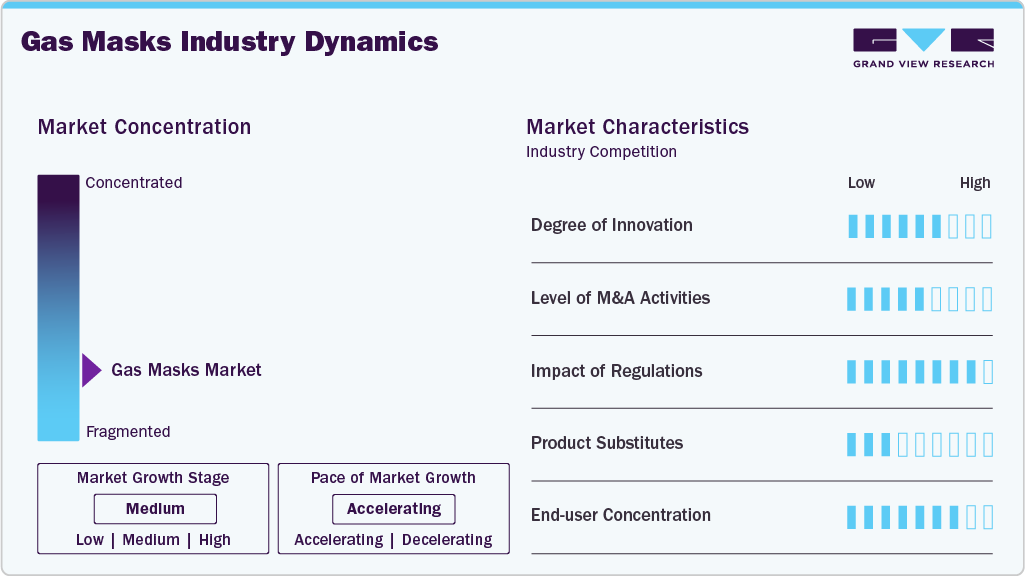
The gas masks market is fragmented, with numerous global and regional manufacturers competing across military and defense, industrial safety, law enforcement, and emergency response applications. Companies such as Avon Protection, Dräger, 3M, MSA Safety, and Supergum Industries offer different product ranges to meet specific user requirements. The presence of specialized manufacturers, regional suppliers, and varying safety standards across countries creates diverse competitive opportunities. Differences in product design, filtration technology, pricing, and end-use requirements further support competition, preventing any single company from dominating the overall market.
The gas masks market is experiencing steady innovation as manufacturers focus on improving filtration efficiency, comfort, durability, and ease of use. Companies are developing lightweight materials, advanced filter media, improved face-seal designs, and powered air-purifying systems to meet the needs of military personnel and industrial workers. Innovation also focuses on enhancing compatibility with communication equipment and protective gear, particularly for defense and emergency response applications. These developments help manufacturers address changing safety requirements and differentiate their products in a competitive market.
 To learn more about this report, Download Free Sample Report
Regulations have a significant impact on the gas masks market because respiratory protection products must meet strict performance, quality, and safety requirements. Standards such as NIOSH requirements in the U.S., EN 136 for full-face masks, and EN 14387 for gas and combined filters in Europe influence product design, testing, certification, and commercialization. Military and CBRN applications may require additional specialized testing and procurement approvals. Compliance with these requirements increases development costs and can create entry barriers for new manufacturers, while encouraging established companies to maintain product quality and reliability.
The gas masks market has a diverse end-user base comprising military and defense organizations, industrial facilities, law enforcement agencies, emergency response teams, healthcare institutions, and civil defense organizations. Although defense procurement and large industrial buyers can account for substantial orders, demand is distributed across multiple sectors with different protection requirements. Government contracts may lead to concentrated purchasing within the military segment, while industrial demand is spread across numerous workplaces and industries. This broad customer base reduces dependence on a single end-use sector and encourages manufacturers to offer products tailored to different applications.
Analyst Perspective
The gas masks market is expected to witness steady growth, supported by rising defense preparedness, increasing industrial safety requirements, and growing investments in CBRN protection and emergency response capabilities. Full-face gas masks are likely to maintain their leading position due to their comprehensive facial protection, while powered gas masks may gain traction as users prioritize breathing comfort and operational efficiency. Military and defense will remain a key demand segment, whereas industrial safety is expected to offer additional growth opportunities as businesses strengthen workplace protection practices. North America is positioned to maintain its market leadership, while Asia Pacific is expected to expand rapidly, driven by defense modernization and industrial development. Market participants can strengthen their competitive positions through product innovation, specialized filtration technologies, regulatory compliance, and expansion into emerging markets.
Masks Type Insights
Full-face gas masks dominated the gas masks market, driven by their ability to protect the eyes, nose, and mouth from hazardous gases, vapors, and other airborne threats. These masks are widely used in military and defense, law enforcement, emergency response, and industrial environments where comprehensive facial protection is required. Their compatibility with specialized filters and their suitability for CBRN protection further support demand among users operating in high-risk conditions.
Half-face gas masks are expected to grow at a CAGR of 5.9%, due to their lightweight design, affordability, and suitability for routine industrial safety applications. These masks cover the nose and mouth, offering respiratory protection against specific contaminants when fitted with compatible filters or cartridges. Growing awareness of workplace safety and increasing demand from manufacturing facilities, construction activities, and other industrial workplaces are supporting adoption. Their compact design and ease of use make them a practical choice for tasks that do not require full-face protection.
Product Type Insights
Non-powered gas masks dominated the gas masks market, owing to their simple design, lower cost, and ease of use across military, industrial safety, and emergency response applications. These masks rely on the user's breathing to draw air through compatible filters or cartridges, eliminating the need for batteries or powered airflow components. Their lower purchase and operating costs, along with relatively simple maintenance requirements, make them suitable for organizations seeking reliable respiratory protection across a wide range of hazardous environments.
Powered gas masks are expected to grow at the fastest CAGR of 6.9%, driven by increasing demand for improved breathing comfort and reduced respiratory effort during extended work periods. These systems use a battery-powered blower to move filtered air toward the user, helping reduce breathing resistance compared with conventional non-powered designs. Growing adoption in demanding industrial environments, specialized defense applications, and emergency response operations is supporting market growth. Continued improvements in battery performance, equipment weight, and filtration technology are expected to further strengthen demand for powered respiratory protection systems.
End Use Insights
The military & defense segment dominated the gas masks market, driven by rising defense preparedness, geopolitical tensions, and the need to protect armed forces against chemical warfare agents and other hazardous airborne threats. Military organizations require reliable respiratory protection for personnel operating in high-risk environments, supporting procurement of full-face gas masks and specialized CBRN protection equipment. Government investments in military modernization, equipment upgrades, and emergency preparedness continue to sustain demand across defense forces.
 To learn more about this report, Download Free Sample Report
The industrial safety segment is expected to grow at the CAGR of 6.8% over the forecast period, supported by increasing awareness of occupational hazards and stricter workplace safety requirements. Workers in chemical manufacturing, mining, metal processing, and other industrial environments may encounter toxic gases, vapors, and airborne contaminants, creating demand for suitable respiratory protection. Growing emphasis on employee safety, improved risk management practices, and the adoption of advanced filtration systems is encouraging businesses to invest in gas masks. Expansion of industrial activities and greater compliance with respiratory protection standards are expected to further support segment growth.
Regional Insights
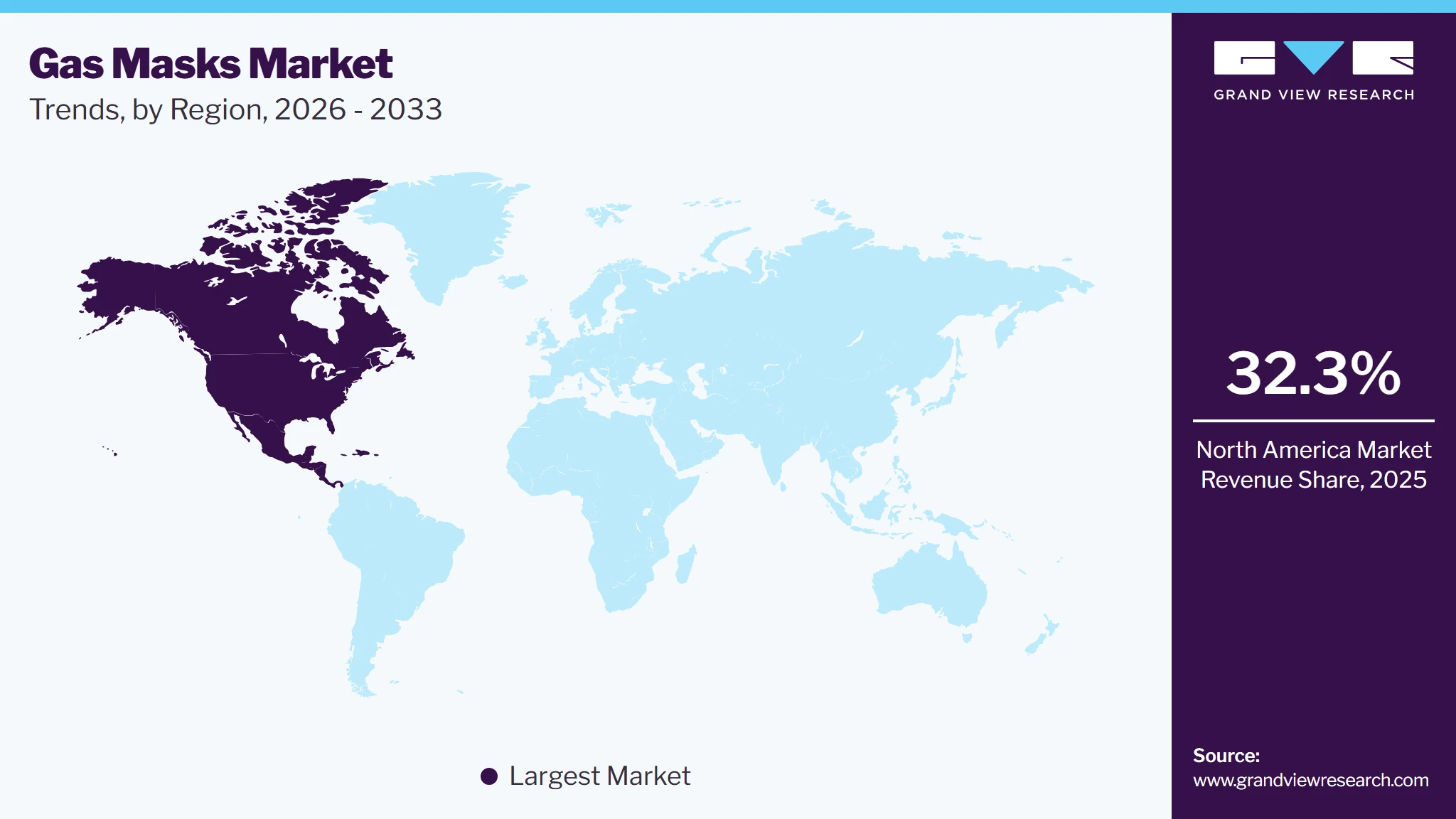
North America dominated the gas masks market, supported by substantial defense spending, established respiratory protection manufacturers, and stringent workplace safety requirements. The U.S. accounts for a significant portion of regional demand due to military modernization programs, CBRN preparedness initiatives, and the need for advanced protective equipment across defense and emergency response agencies. The presence of companies such as 3M, MSA Safety, and Avon Protection also strengthens the region's competitive landscape and supports the availability of specialized respiratory protection solutions.
 To learn more about this report, Download Free Sample Report
U.S. Gas Masks Market Trends
The U.S. dominated the North American gas masks market, driven by high defense spending, military modernization, and strict workplace safety requirements. The U.S. Department of Defense requested USD 849.8 billion for fiscal year 2025, reflecting the country's focus on national security and military readiness. In addition, workplace safety regulations require employers to provide suitable respiratory protection when employees face hazardous exposure. The National Institute for Occupational Safety and Health (NIOSH) also reported more than 9,000 active respirator approvals and 142 new approvals between January and June 2026. These factors support demand for gas masks across military and defense, industrial safety, and emergency response applications.
Europe Gas Masks Market Trends
Europe is expected to experience steady growth as governments and industrial operators emphasize personnel protection, regulatory compliance, and preparedness for chemical hazards. European workplace safety requirements support demand for certified respiratory equipment across manufacturing and other high-risk industries. Countries such as Germany, the UK, and France also benefit from established defense industries and ongoing investments in military readiness. The presence of manufacturers such as Dräger, Moldex, and Sundström Safety further supports product development and regional supply.
The Germany gas masks market dominated the European market, supported by its strong industrial base, established respiratory protection industry, and emphasis on workplace safety. The country's chemical, manufacturing, and automotive industries require suitable respiratory equipment to protect workers from hazardous gases, vapors, and airborne contaminants. Germany's focus on occupational safety compliance and emergency preparedness also supports demand from industrial operators and public safety organizations. In addition, the presence of established respiratory protection manufacturers and advanced product development capabilities strengthens Germany's position in the regional market.
The Italy gas masks market is expected to grow, driven by its manufacturing sector, industrial safety requirements, and continued attention to emergency preparedness. Chemical processing, metalworking, construction, and other industrial activities create demand for respiratory protection against workplace hazards. The country also benefits from domestic expertise in protective equipment manufacturing, including specialized full-face masks and filtration systems. Growing awareness of employee safety and the need to comply with European respiratory protection standards are expected to encourage the adoption of gas masks across industrial, defense, and emergency response applications.
Asia Pacific Gas Masks Market Trends
Asia Pacific is expected to grow at the fastest rate, driven by rising defense expenditure, expanding industrial activities, and increasing investment in emergency preparedness. Countries such as China, India, Japan, and South Korea are strengthening defense capabilities and improving protection against chemical and other hazardous airborne threats. In parallel, growth in manufacturing, mining, and chemical industries is increasing the need for workplace respiratory protection. Greater attention to occupational safety and the development of domestic protective equipment manufacturing are expected to create additional growth opportunities across the region.
The China gas masks market dominated the Asia Pacific gas masks market, supported by substantial defense investment, domestic protective equipment manufacturing, and demand from industrial safety applications. According to China's Ministry of Finance, the country's central government defense expenditure budget for 2025 reached approximately CNY 1.78 trillion (USD 247.8 billion) representing a 7.2% increase over 2024. This investment reflects continued efforts to modernize military capabilities and strengthen national security. The country's extensive manufacturing base and chemical and industrial activities also support demand for respiratory protection equipment across military, industrial, and emergency response applications.
The India gas masks market is expected to grow in the gas masks market, driven by rising defense investment, expanding industrial activity, and increasing attention to workplace safety. According to the Government of India, the Ministry of Defense received an allocation of approximately USD 81.7 billion for FY 2025-26, reflecting a 9.53% increase over the previous year's budget estimate. In addition, India's organized manufacturing sector recorded 6% employment growth in FY 2023-24, adding more than one million jobs, according to the Economic Survey 2025-26. These developments support potential demand for respiratory protection across military forces, manufacturing facilities, and hazardous industrial environments.
Middle East & Africa Gas Masks Market Trends
The Middle East & Africa region is expected to grow as governments and businesses invest in defense preparedness, industrial protection, and emergency response capabilities. Countries such as Saudi Arabia and the UAE have demand potential from defense procurement, energy-related operations, and industrial safety programs. In Africa, mining, manufacturing, and hazardous-material handling activities create opportunities for respiratory protection equipment. The need to prepare for chemical incidents and protect personnel in high-risk workplaces may further support adoption, while procurement budgets and access to certified equipment will influence market development across the region.
The South Africa gas masks market dominated the Middle East & Africa gas masks market, supported by its established mining industry, industrial activities, and demand for workplace respiratory protection. Mining, metal processing, and chemical-related operations expose workers to hazardous gases, dust, and airborne contaminants, encouraging the use of suitable protective equipment. The country's focus on occupational health and safety, along with demand from emergency response teams and security agencies, further supports gas mask adoption. In addition, ongoing industrial safety initiatives and the need to protect personnel in high-risk environments contribute to South Africa's leading position in the regional market.
Latin America Gas Masks Market Trends
Latin America is expected to record growth as industrial development and improving workplace safety practices encourage the use of gas masks. Brazil and Argentina represent important markets due to their manufacturing activities, chemical handling operations, mining industries, and energy-related infrastructure. Industrial employers are increasingly recognizing the importance of protecting workers from toxic gases and hazardous vapors. Demand from public safety agencies and emergency response organizations also provides opportunities, although budget limitations and differences in safety enforcement may affect adoption rates across individual countries.
The Brazil gas masks market plays a leading role in the Latin American gas masks market, supported by its large industrial base, mining activities, and growing focus on occupational safety. Workers in chemical production, metal processing, mining, and other industrial environments require respiratory protection against hazardous gases and airborne contaminants. Increasing awareness of workplace risks and the need to comply with occupational safety requirements are encouraging businesses to adopt suitable protective equipment. Demand from defense organizations, law enforcement agencies, and emergency response teams also supports market development, positioning Brazil as an important country for gas mask manufacturers in the region.
Key Gas Masks Company Insights
Some of the key players operating in the market include Avon Protection, Drägerwerk AG & Co. KGaA, and 3M.
-
Avon Protection is a UK based manufacturer specializing in respiratory protection and integrated CBRN defense systems for military personnel, law enforcement agencies, and emergency responders. Its product portfolio includes full-face gas masks, air-purifying respirators, powered air-purifying respirators, escape hoods, and protective equipment. Products such as the FM50, FM54, and C50 are designed to provide protection against specified airborne hazards in demanding operational environments. The company also develops modular solutions that support different mission requirements and integrate with other protective equipment.
-
Drägerwerk AG & Co. KGaA is a Germany based medical and safety technology company founded in 1889. Its respiratory protection portfolio includes full-face masks, half-face respirators, gas and vapor filters, powered air-purifying respirators, and breathing apparatus. Products such as the X-plore series and Panorama Nova full-face masks serve industrial workplaces, chemical handling operations, firefighting, and emergency response applications. The company focuses on reliable filtration, secure mask fit, wearer comfort, and compatibility with different respiratory protection systems, supporting its presence across industrial safety and specialized protection markets.
Key Gas Masks Companies:
The following key companies have been profiled for this study on the gas masks market.
-
Avon Protection
-
Drägerwerk AG & Co. KGaA
-
3M
-
MSA Safety
-
PIP
-
Supergum Industries
-
AirBoss Defense Group
-
Gentex Corporation
-
Sundström Safety AB
-
Moldex-Metric AG & Co. KG
-
Bullard
-
ILC Dover LP
-
GVS S.p.A.
-
Mestel Safety Srl
-
MIRA Safety
Competitive Benchmarking
Category
Operating Strategies
Competitive Edge
Weakness
Established Players (e.g., Avon Protection; Drägerwerk AG & Co. KGaA; 3M; MSA Safety; PIP; AirBoss Defense Group; Gentex Corporation; Sundström Safety AB)
- Invest in advanced filtration technologies and product innovation.
- Strengthen distribution networks across defense and industrial safety sectors.
- Expand certified respiratory protection portfolios.
- Strong brand recognition and established customer relationships.
- Broad product portfolios covering military, industrial, and emergency response applications.
- Proven expertise in meeting stringent safety and certification requirements.
- High product development, testing, and certification costs.
- Complex product portfolios can increase operational expenses.
- Defense-focused companies may be affected by changes in government procurement cycles.
Emerging & Regional Players (e.g., Supergum Industries; Moldex-Metric AG & Co. KG; Bullard; ILC Dover LP; GVS S.p.A.; Mestel Safety Srl; MIRA Safety)
- Focus on specialized gas masks and niche respiratory protection applications.
- Expand market reach through regional distributors and strategic partnerships.
- Offer products tailored to specific industrial and customer requirements.
- Flexibility in addressing specialized customer needs.
- Competitive pricing and differentiated product designs.
- Opportunities to serve underserved regional markets and niche applications.
- Lower brand recognition in some international markets.
- Limited resources for research, development, and certification compared with larger competitors.
- Smaller distribution networks may restrict access to large government and industrial contracts.
Recent Developments:
-
In January 2026, Avon introduced the MITR-M1 tactical half mask for military personnel, special operations teams, and first responders. In September, it launched the MITR-PG1 powered goggle, designed to work with the MITR-M1 and provide additional eye protection against particulate hazards and selected riot-control agents.
-
In March 2026, 3M completed its acquisition of Madison Fire & Rescue in a transaction valued at approximately USD 1.9 billion, in partnership with Bain Capital. The transaction also involved combining 3M's self-contained breathing apparatus business with Madison's operations. This is relevant to the broader respiratory and fire-safety equipment industry, although it is not a gas-mask-specific acquisition.
Gas Masks Market Report Scope
Report Attribute
Details
Market size in 2025
USD 4.1 billion
Estimated market size in 2026
USD 4.3 billion
Revenue forecast in 2033
USD 6.7 billion
Growth rate
CAGR of 6.6% from 2026 to 2033
Historical data
2021 - 2024
Forecast period
2026 - 2033
Quantitative units
Revenue in USD billion and CAGR from 2026 to 2033
Report coverage
Revenue forecast, company ranking, competitive landscape, growth factors, and trends
Segments covered
Masks Type, product type, end use, region
Regional scope
North America; Europe; Asia Pacific; Latin America; Middle East & Africa; Africa
Country scope
U.S.; Canada; Mexico; UK; Germany; France; Spain; Italy; China; Japan; India; Australia; South Korea; Brazil; Argentina; Saudi Arabia; UAE; South Africa
Key companies profiled
Avon Protection; Drägerwerk AG & Co. KGaA; 3M; MSA Safety; PIP; Supergum Industries; AirBoss Defense Group; Gentex Corporation; Sundström Safety AB; Moldex-Metric AG & Co. KG; Bullard; ILC Dover LP; GVS S.p.A.; Mestel Safety Srl; MIRA Safety.
Customization scope
Free report customization (equivalent up to 8 analysts working days) with purchase. Addition or alteration to country, regional & segment scope.
Pricing and purchase options
Avail customized purchase options to meet your exact research needs. Explore purchase options
Global Gas Masks Market Report Segmentation
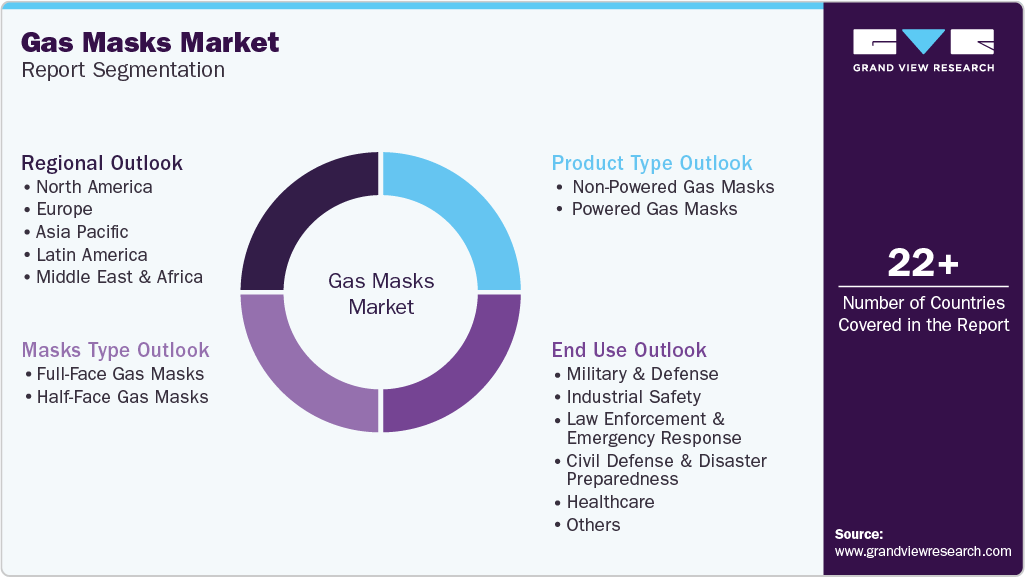
This report forecasts revenue growth at global, regional, and country levels and provides an analysis of the latest industry trends in each of the sub-segments from 2021 to 2033. For this study, Grand View Research has segmented the gas masks market report based on masks type, product type, end use, and region.
 To learn more about this report, Download Free Sample Report
-
Masks Type Outlook (Revenue, USD Billion, 2021 - 2033)
-
Full-Face Gas Masks
-
Half-Face Gas Masks
-
-
Product Type Outlook (Revenue, USD Billion, 2021 - 2033)
-
Non-Powered Gas Masks
-
Powered Gas Masks
-
-
End Use Outlook (Revenue, USD Billion, 2021 - 2033)
-
Military & Defense
-
Industrial Safety
-
Law Enforcement & Emergency Response
-
Civil Defense & Disaster Preparedness
-
Healthcare
-
Others
-
-
Regional Outlook (Revenue, USD Billion, 2021 - 2033)
-
North America
-
U.S.
-
Canada
-
Mexico
-
-
Europe
-
Germany
-
France
-
Italy
-
Spain
-
UK
-
-
Asia Pacific
-
China
-
India
-
Japan
-
South Korea
-
Australia
-
-
Latin America
-
Brazil
-
Argentina
-
-
Middle East & Africa
-
Saudi Arabia
-
UAE
-
South Africa
-
-
Research Methodology
The gas masks market figures in this report are based on a proven research process that combines executive interviews with secondary research from proprietary databases, company filings, and recognized regulatory and institutional sources. Market size is built through value-chain sizing—reconciling supply-side and demand-side estimates—and triangulated with bottom-up and top-down approaches. Every estimate passes multiple levels of expert validation before publication, with each gas masks segment quantified using the revenue-capture definitions in the table below.
Segment Definition
Masks Type
Revenue Capture Definition
Full-Face Gas Masks
Revenue generated from the sale of full-face gas masks that cover the eyes, nose, and mouth to provide respiratory and facial protection against specified airborne hazards.
Half-Face Gas Masks
Revenue generated from the sale of half-face gas masks that cover the nose and mouth and use compatible filters or cartridges to protect against specified respiratory hazards.
Product Type
Revenue Capture Definition
Non-Powered Gas Masks
Revenue generated from the sale of non-powered gas masks that rely on the user's breathing to draw air through filters or cartridges without an electrically powered airflow mechanism.
Powered Gas Masks
Revenue generated from the sale of powered gas masks that use a battery-operated blower to deliver filtered air to the wearer.
End Use
Revenue Capture Definition
Military & Defense
Revenue generated from the sale of gas masks and associated filtration systems to military forces and defense organizations for protection against chemical agents and other hazardous airborne threats.
Industrial Safety
Revenue generated from the sale of gas masks to industrial users for protecting workers against hazardous gases, vapors, and other airborne contaminants in occupational environments.
Law Enforcement & Emergency Response
Revenue generated from the sale of gas masks to police forces, firefighters, hazardous-material response teams, and other emergency services for use during hazardous incidents and public safety operations.
Civil Defense & Disaster Preparedness
Revenue generated from the sale of gas masks to civil defense agencies, disaster management organizations, and preparedness programs for protection during chemical incidents and other emergencies.
Healthcare
Revenue generated from the sale of gas masks and compatible respiratory protection systems for healthcare and laboratory applications involving specific hazardous airborne substances.
Others
Revenue generated from the sale of gas masks to other end users, including research laboratories, specialized facilities, and organizations requiring respiratory protection for specific hazardous environments.
Estimation Model
Layer No.
Layer Name
Key Question
Description
01
Market Segmentation
What are the key mask categories?
Segmentation of the market into full-face and half-face gas masks based on facial coverage and the level of protection provided against specified airborne hazards.
02
Product Classification
What product types are included?
Classification of gas masks into non-powered and powered systems based on airflow mechanisms, filtration methods, and respiratory protection design.
03
End-Use Analysis
Which end-use industries generate demand?
Assessment of demand across military and defense, industrial safety, law enforcement and emergency response, civil defense and disaster preparedness, healthcare, and other applications.
04
Market Revenue Estimation
What is the total market value?
Estimation of total revenue generated from gas mask sales across the defined product categories and end-use industries, considering the market scope and applicable revenue contributions.
Delivered Customizations
This report has been delivered with the following In-depth customizations
CLIENT REQUEST
CUSTOMIZATION DELIVERED
VALUE ADDS
Regional Segmentation
Delivered a comprehensive regional and country-level analysis covering North America, Europe, Asia Pacific, Latin America, and the Middle East & Africa, highlighting leading and high-growth countries and their key demand drivers.
Identifies regional growth opportunities, country-level demand patterns, and geographical differences in market development to support expansion planning.
Competitive Benchmarking
Delivered a competitive landscape covering established and emerging manufacturers, company profiles, product portfolios, recent developments, and competitive positioning based on their presence in the gas masks market.
Helps assess competitor strengths, product differentiation, innovation strategies, and competitive gaps across military, industrial safety, and emergency response applications.
Opportunity Assessment
Delivered an assessment of key market drivers, restraints, growth opportunities, product type trends, mask type preferences, and end-use demand, including opportunities in advanced respiratory protection and CBRN preparedness.
Supports strategic decision-making by identifying promising product categories, expanding end-use applications, and potential areas for investment and market entry.
About the Author(s)
Advanced Interior Materials Research Team
Advanced Materials · Advanced Interior MaterialsThis report was authored by the advanced interior materials research team at Grand View Research - comprising two research analysts, one senior research analyst, and one industry expert - with specialized expertise in the advanced interior materials segment of the advanced materials industry. All findings are based on proprietary advanced materials databases, executive interviews, and regulatory analysis, subject to internal peer review prior to publication.
Last Updated:
Speak to Analyst

Customize this report to your needs - add regions, segments, or data points, with 20% free customization.
Or view our licence options:


ISO 9001:2015 & 27001:2022 Certified
We are GDPR and CCPA compliant! Your transaction & personal information is safe and secure. For more details, please read our privacy policy.


