
- Home
- »
- Homecare & Decor
- »
-
Bathroom Vanities Market Size And Share Report, 2026-2033GVR Report cover
![Bathroom Vanities Market (2026 - 2033)Report]()
Bathroom Vanities Market (2026 - 2033)
Size, Share & Trends Analysis Report By Application (Residential, Non-residential), By Material (Stone, Glass, Metal), By Size (24 - 35 inch, 38 - 47 inch), By Region, And Segment Forecasts
Market Size, 2025
$46.1BMarket Estimate, 2026
$49.2BMarket Forecast, 2033
$83.6BCAGR, 2026–2033
7.9%Bathroom Vanities Market Summary
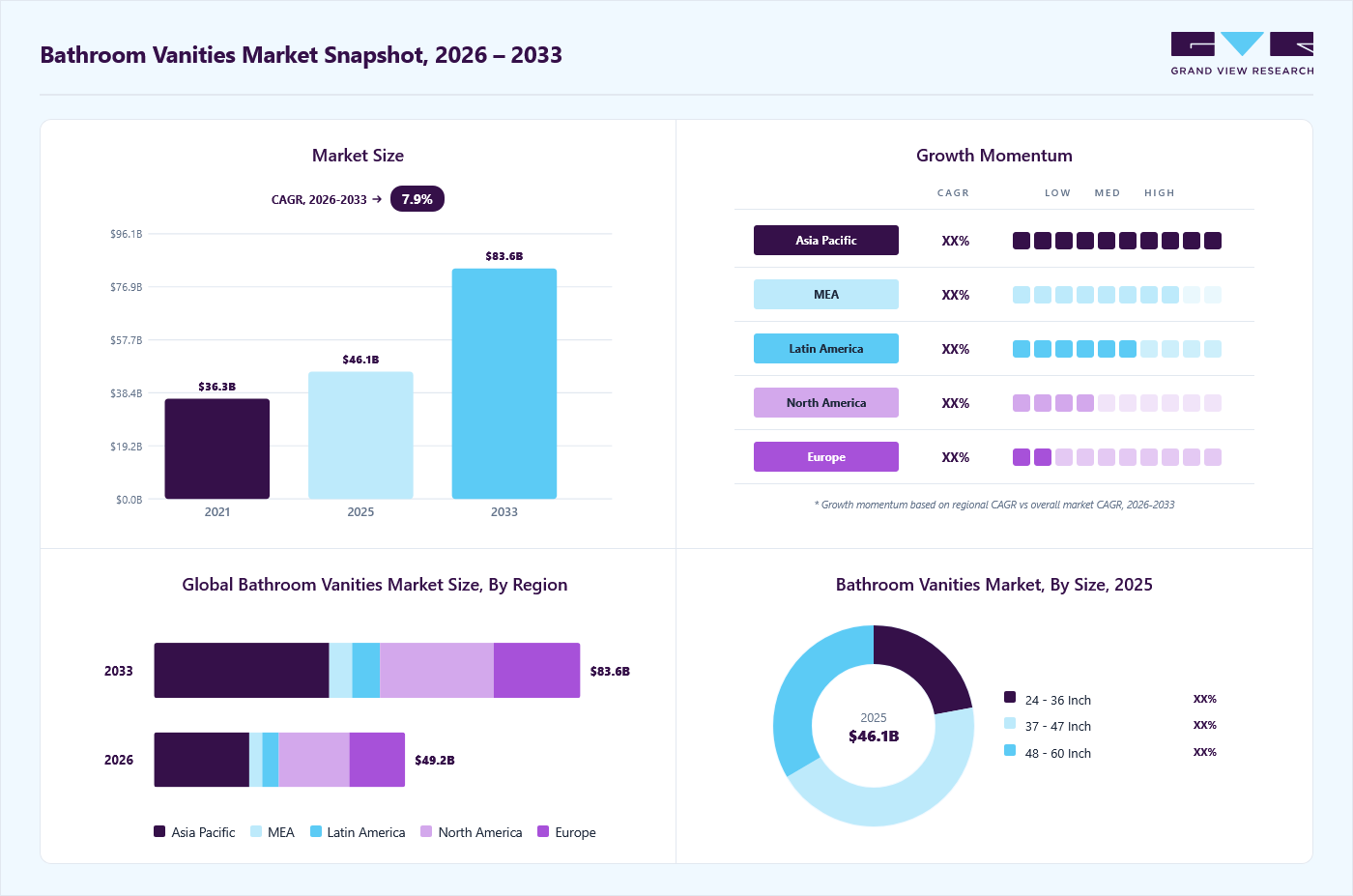
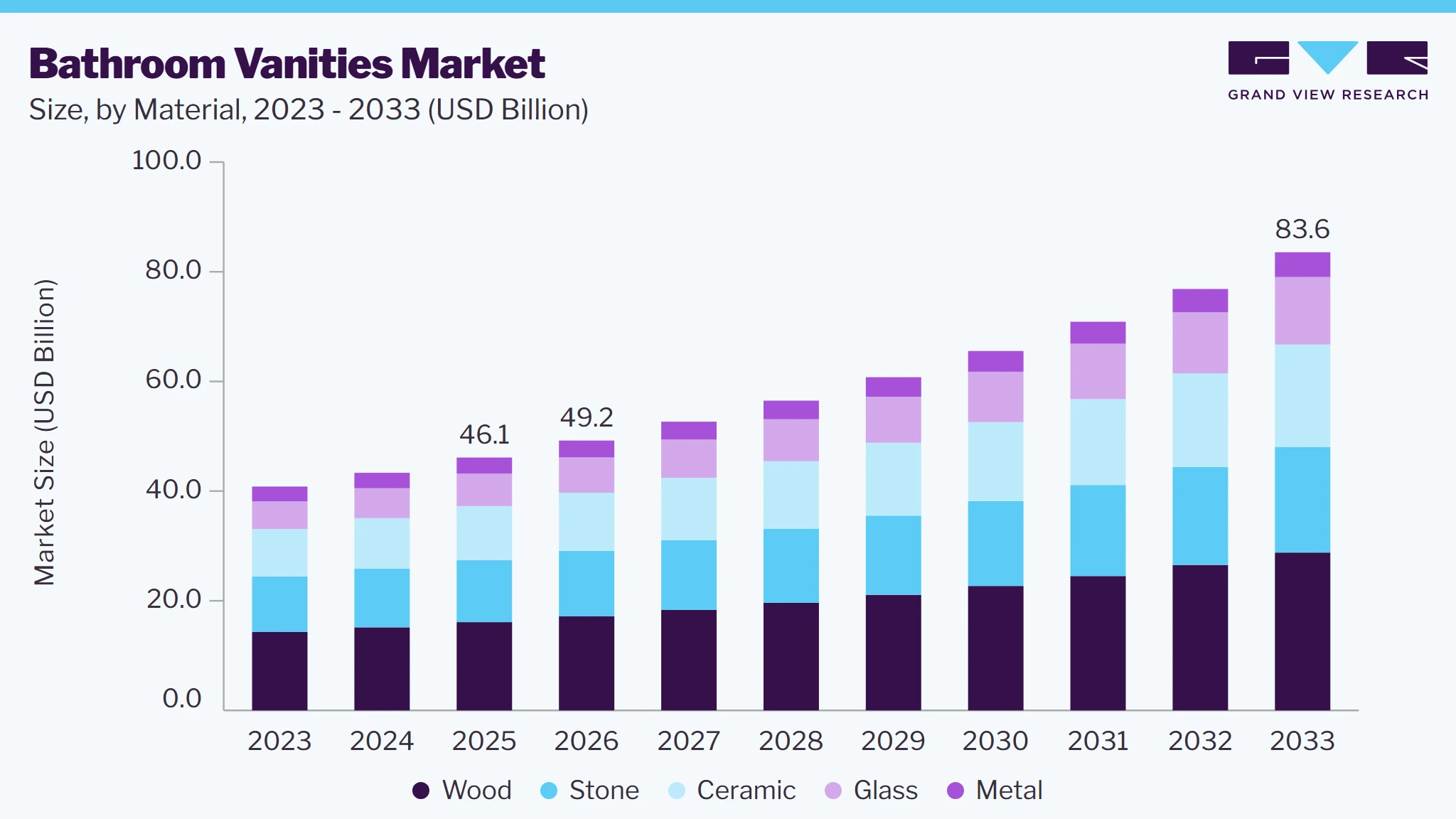
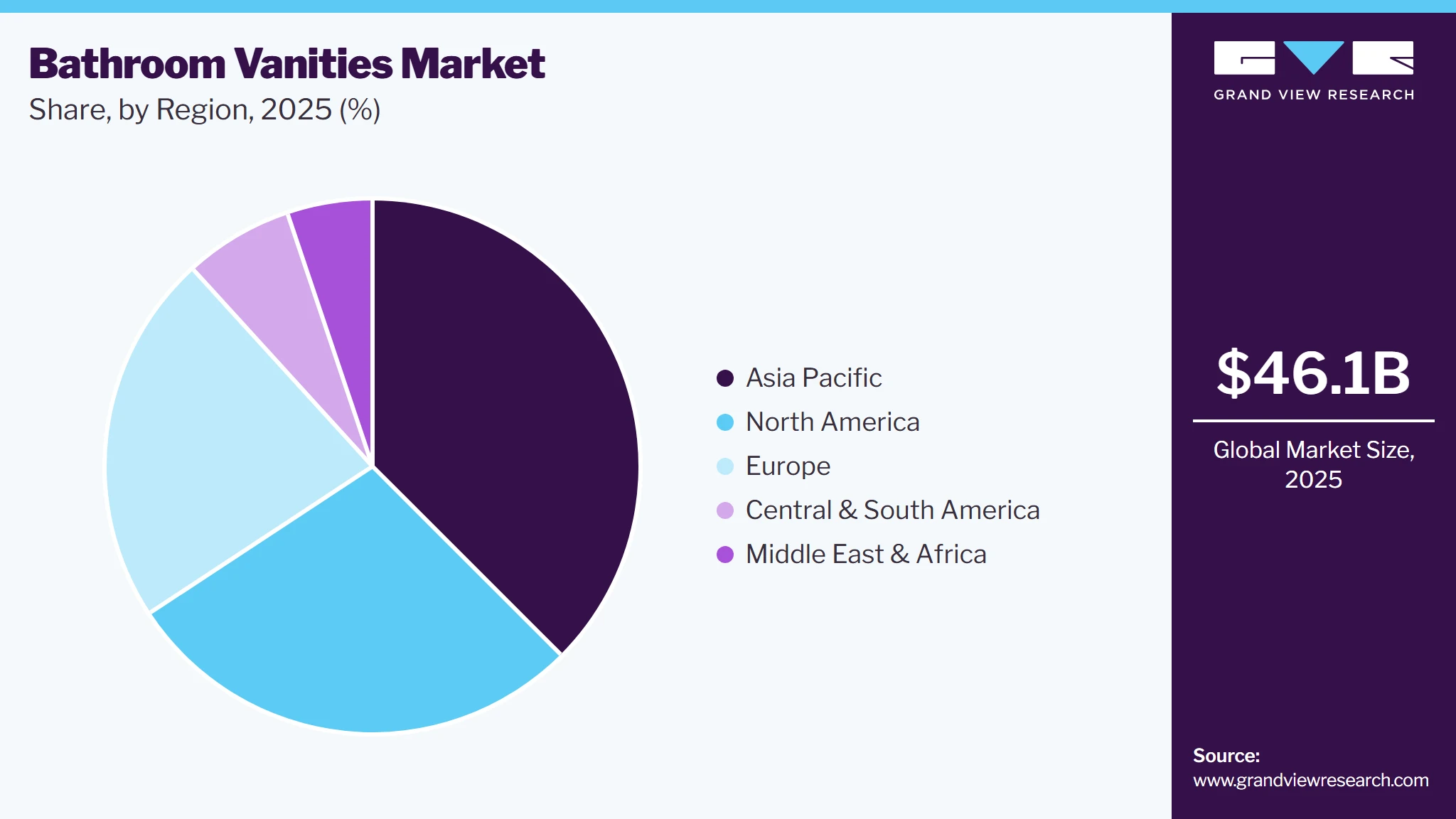
The global bathroom vanities market size was estimated at USD 46.1 billion in 2025 and is projected to grow from USD 49.2 billion in 2026 to USD 83.6 billion by 2033, growing at a CAGR of 7.9% from 2026 to 2033. The Asia Pacific market held the largest share of 37.5% of the global market in 2025. The increasing trend of bathroom remodeling and home restoration activities across major economies is expected to elevate the demand for bathroom furniture in the coming years.
Key Market Trends & Insights
- By material: The Wood segment led the market with the largest revenue share of 34.9% in 2025.
- By application: The residential segment led the market with the largest revenue share of 74.9% in 2025.
Regional Highlights
- Largest regional market: Asia Pacific (37.5% revenue share, 2025)
- By country: The China held the largest market share in 2025.
Market Size & Forecast
- Market size in 2025: USD 46.1 Billion
- Estimated market size in 2026: USD 49.2 Billion
- Projected market size by 2033: USD 83.6 Billion
- CAGR (2026-2033): 7.9%
As a fairly consolidated industry, major companies, including Masco, RSI Home Products, American Woodmark, and Kohler, hold sizeable shares in the market as of 2022. Moreover, branding and customized offerings are expected to be key to being competitive in this market. Eco-friendly and durable bathroom vanities are also expected to gain prominence in the market over the forecast period.There has been a growing demand for environment-friendly and sustainable home furniture, including bathroom vanities. For instance, according to a 2021 SFC survey, in the U.S., nearly 97% of respondents expressed an interest in purchasing environmentally friendly furniture for their homes, assuming favorable style and cost are about the same. According to the same survey, it was noted that most respondents (87%) were willing to pay at least 5% to 10% more for environmentally friendly furniture products, including bathroom furniture.
Moreover, key market players are investing in R&D and introducing new products regularly to stay competitive and grow their business over time. For instance, in July 2022, Wilsonart LLC announced its Wilsonart HPL Commercial Collection and the Wilsonart Traceless Laminate Collection. The designs feature new textures and surfaces that create realistic and authentic spaces. The Aligned Walnut Finish is a highlight of this new portfolio and can be paired with four new colors to create walnut designs.
In addition, bathroom vanities come in various sizes to accommodate bathrooms of different dimensions. These are typically purchased in colors and accents that complement the bathroom interiors. Customization of bathroom vanities is, therefore, a popular trend among consumers. According to a Houzz 2022 study, around 60% of consumers in the UK prefer customizing their bathroom furniture during bathroom remodeling. In response to this trend, major players have been offering personalized options according to the requirements of the consumers.
Furthermore, the popularity of bathroom furniture, including cabinets, shelves, and storage products, is due to rising urbanization and a significant increase in consumer adoption. Product manufacturers operating in this space are taking major initiatives such as advancements in raw materials, manufacturing technologies, and connected technology to cater to ever-growing consumer demand. This is expected to offer key players lucrative business expansion opportunities. The continued emphasis of manufacturers on new product development and improvements will also contribute to the market's future expansion.
With rising costs associated with home prices and mortgage rates, consumers are increasingly investing in home improvement or remodeling projects to revamp their traditional household structure. Growing home values have doubled homeowner equity in the past five years, thus indicating a trend of homeowners feeling richer and disposed toward spending money on home improvement.
The demand for built-in organizational features, such as electrical strips that allow curling irons or electric toothbrushes to be used off counters, is expected to boost profits. Integrated LED lighting in storage offerings with decorative feet and door options has raised customer interest in premium features and finishes.
With the increasing expansion of real estate and commercial constructions, the market is bound to grow in the bathroom fittings industry, thereby propelling the demand for bathroom vanities in commercial and residential settings. According to a Global Real Estate report published by Morgan Stanley Capital International (MSCI) in 2021, the professionally managed real estate market's size increased to USD 11.4 trillion from USD 10.5 trillion in 2020. A total of 40.2% of the estimated global market size came from the Americas region. This was an increase of 12.9% from 2020, coming in at USD 4.6 trillion.
Market Dynamics
The bathroom vanities market is witnessing steady expansion driven by rising residential construction, increasing home renovation activities, and growing consumer focus on aesthetic and functional bathroom interiors. Bathroom vanities are no longer viewed as basic storage units but as key design elements that enhance space utilization, luxury appeal, and overall bathroom experience. The growing influence of modern interior design trends, urban housing development, and premium real estate projects is further supporting demand for customized, modular, and space-efficient vanity solutions across both residential and commercial segments.
The increasing frequency of home renovation and remodeling activities is a major driver of the bathroom vanities market. Consumers are increasingly investing in upgrading bathrooms as part of broader home improvement projects, focusing on aesthetics, storage optimization, and improved functionality. The growing popularity of modular homes and compact urban apartments has further increased demand for space-saving vanity units that combine sinks, storage cabinets, and countertops in a single integrated design.
In addition, rising disposable incomes and changing lifestyle preferences are encouraging consumers to adopt premium bathroom fittings and designer furniture. The expansion of the real estate sector, particularly in urban and semi-urban regions, is also driving installations in new residential constructions. Hospitality and commercial infrastructure development, including hotels, resorts, and corporate buildings, is further boosting demand for durable and visually appealing bathroom vanities that enhance user experience and property value.
One of the key restraints in the bathroom vanities market is the relatively high cost associated with premium materials, customization, and installation. Products made from solid wood, natural stone, quartz, and high-end engineered materials significantly increase overall project costs, limiting adoption among price-sensitive consumers. Additionally, installation often requires skilled labor, plumbing adjustments, and precise fitting, further adding to expenses.
Fluctuations in raw material prices, such as wood, metal, and stone, also create cost instability for manufacturers and suppliers. Supply chain disruptions and import dependency for certain materials can further impact pricing and availability. These factors collectively restrict market penetration in cost-sensitive regions and among middle-income consumer groups, slowing down adoption in certain developing economies.
The increasing demand for smart homes and personalized interior design is creating strong opportunities in the bathroom vanities market. Consumers are increasingly looking for modular vanity systems that offer flexible storage, integrated lighting, anti-fog mirrors, and smart features such as sensor-based faucets and built-in charging points. The shift toward compact urban living spaces is also encouraging demand for multi-functional and space-efficient vanity designs.
Sustainability trends are further opening opportunities for eco-friendly bathroom vanities made from recycled materials, low-emission wood products, and water-resistant sustainable composites. The rapid growth of online home décor and furniture retail platforms is expanding market accessibility, allowing manufacturers to reach a wider customer base. Additionally, increasing investments in luxury real estate and hospitality infrastructure in emerging markets are expected to drive long-term demand for high-end, customized bathroom vanity solutions.
Analyst Perspective
The bathroom vanities market is increasingly shaped by the convergence of residential renovation cycles, urban housing expansion, and the premiumization of interior design, particularly in urban and high-income housing segments. Demand is shifting from purely functional cabinetry toward design-led, storage-optimized, and modular vanity solutions that align with modern bathroom aesthetics and smart home integration trends. The key competitive advantage will lie with manufacturers that can integrate durability, space efficiency, and customizable design within scalable production systems while maintaining cost competitiveness. Over time, brands that successfully align with the broader bathroom wellness and home personalization narrative will be best positioned to capture sustained replacement-driven and new construction demand.
Application Insights
Based on application, the residential segment led the market with the largest revenue share of 74.9% in 2025. The residential segment accounts for the largest share of the bathroom vanities market, driven by strong demand from new housing developments, home renovation activities, and bathroom upgrade projects. Consumers are increasingly investing in aesthetically appealing and functional bathroom furniture as bathrooms evolve from purely utilitarian spaces into key components of overall home design. Rising disposable incomes, growing urbanization, and increased spending on premium home interiors have further accelerated the adoption of modern bathroom vanities in residential settings. Additionally, the expansion of e-commerce platforms and direct-to-consumer home furnishing channels has improved product accessibility, enabling homeowners to choose from a broader range of vanity styles, sizes, and price points, thereby reinforcing the segment’s market leadership.
Material Insights
Based on material, the Wood segment led the market with the largest revenue share of 34.9% in 2025 and is expected to grow at the fastest CAGR over the forecast period, driven by its premium appearance, durability, design versatility, and strong consumer preference for natural aesthetics in residential interiors. Homeowners increasingly favor solid wood and engineered wood vanities as they complement a wide range of bathroom styles, from traditional and farmhouse designs to contemporary and luxury settings. The growing trend of bathroom remodeling, rising spending on home improvement projects, and increasing demand for customized storage solutions continue to support segment growth. Furthermore, advancements in moisture-resistant coatings and engineered wood technologies have enhanced product longevity, making wood vanities a practical and visually appealing choice for both new construction and renovation projects.
Size Insights
Bathroom vanities of 38 - 47 inch size accounted for a share of 43.88% in 2025. The category is primarily driven by spacious storage and its suitability for small bathrooms. Medium-sized vanities are characterized by their compact shape, which improves their visual appeal. There is a growing demand for the 38-47 inch range in residential and non-residential application categories.
The demand for 24 - 35-inch items is expected to grow at a CAGR of 8.2% from 2026 to 2033. Small bathroom products are preferred in urban areas due to limited space availability, thereby driving the demand for this category. For instance, according to a blog published by Flexible Finance Inc. in January 2023, the average size of flats is getting smaller as more micro-apartments are built. The typical new apartment is just 941 square feet in size, which is 5% less than it was a decade ago. This is expected to drive segment growth over the forecast period.
Regional Insights
The bathroom vanities market in North America accounted for a market share of 28.64% in 2025. The demand for bathroom vanities is majorly attributed to Americans' increasing spending on residential renovations and repairs. North America is a key region for this market owing to several high-priced hotels providing world-class facilities and a boost of expensive and exquisite bathroom fittings for a competitive edge. Another noteworthy trend in North America is the increase in investments in residential construction. Consumers in the region seek premium products as a one-time investment. This has driven the installations of distinctive and creative designs that fit in with every aspect of home décor setups. Regional companies are segmenting their markets to gain a competitive edge and meet regional demand.
U.S. Bathroom Vanities Market Trends
The bathroom vanities market in the U.S. accounted for a market share of around 71.19% in 2025 in the North American market. A high fascination for bathrooms among American households and commercial sectors such as hotels, restaurants, or any other public areas has resulted in a prominent demand for bathroom vanity installations. As per the housing layout patterns in America, almost all the bedrooms have an attached washroom. According to the U.S. Census Bureau, in 2021, out of 371,000 multi-family units, 160,000 had only one bedroom, and 35,000 had three or more bedrooms. The higher the number of bedrooms, the greater the number of bathrooms, leading to increased demand for bathroom vanities.
Europe Bathroom Vanities Market Trends
The bathroom vanities market in Europe accounted for a market share of 23.23% in 2025 in the global market. Numerous industries in the European markets are currently experiencing a good demand momentum, and this trend appears to last the rest of the forecasted year. A significant growing trend in hotel reservations across major tourist destinations in Europe is observed. These trends indicate the resurgence of travel in Europe, which is pushing hoteliers to renovate the rooms according to customer needs. The European hotel industry is undergoing a technological and luxury transformation to adapt to new and innovative products and services, majorly driven by the changing client needs. This renovation will likely focus on every area, including the hotel room bathrooms and walk-in cabinets, thereby driving the application of bathroom vanities.
Asia Pacific Bathroom Vanities Market Trends
Asia Pacific dominated the bathroom vanities market with the largest revenue share of 37.5% in 2025. Asia Pacific accounted for the largest share of the bathroom vanities market due to rapid urbanization, rising residential construction activity, and increasing consumer spending on home improvement projects. Growing demand for modern housing, particularly in emerging economies, has encouraged the adoption of aesthetically designed and space-efficient bathroom furniture. The region is also benefiting from expanding middle-class populations, rising disposable incomes, and increasing preference for premium bathroom interiors. Furthermore, large-scale residential developments and renovation activities across major economies continue to strengthen demand for bathroom vanities throughout the region.
China Bathroom Vanities Market Trends
The bathroom vanities market in China held the largest share of about 28.2% in the Asia Pacific region in 2025. China maintained its leading position within the Asia Pacific bathroom vanities market owing to its extensive residential construction sector, growing urban population, and strong manufacturing capabilities. Rising consumer interest in modern home décor and premium bathroom aesthetics has accelerated demand for contemporary vanity solutions featuring integrated storage and smart design elements. In addition, ongoing urban redevelopment projects, increasing renovation activity in existing housing stock, and the availability of competitively priced domestic products have supported market growth. The country’s robust e-commerce ecosystem has further enhanced consumer access to a wide range of bathroom vanity products.
Key Bathroom Vanities Company Insights
The market is fragmented and highly competitive, with a range of companies offering various products. Many big players are increasing their focus on new product launches, partnerships, and expansion into new markets to compete effectively.
Key Bathroom Vanities Companies:
The following key companies have been profiled for this study on the bathroom vanities market.
-
American Woodmark Corporation
-
Avanity Corporation
-
Bellaterra Home, LLC
-
Design Element Group, Inc.
-
Design House (DHI Corp.)
-
Empire Industries, Inc.
-
Foremost Groups
-
Wyndham Collection
-
Kohler Company
-
Water Creation, Inc.
-
Wilsonart LLC
-
Dupont Kitchen and Bath Fixtures
-
Caesarstone
Competitive Benchmarking
Category
Operating Strategies
Competitive Edge
Weakness
Established Players (Kohler Company; American Woodmark Corporation; Wilsonart LLC; Dupont Kitchen and Bath Fixtures; Caesarstone)
- Expand integrated kitchen and bath portfolios with a focus on premium bathroom vanity systems, engineered surfaces, and modular storage solutions.
- Strengthen omnichannel distribution through home improvement retailers, specialty bath showrooms, e-commerce platforms, and large-scale construction and renovation partnerships.
- Strong global brand recognition and deep presence in kitchen and bath furnishing ecosystems.
- Advanced manufacturing capabilities, diversified material expertise (wood, quartz, engineered stone), and strong relationships with builders, architects, and contractors.
- High dependency on housing and renovation cycles, making demand sensitive to macroeconomic fluctuations.
- Higher operational costs and slower innovation cycles due to large-scale manufacturing and complex distribution networks.
Emerging & Specialized Players (Avanity Corporation; Bellaterra Home, LLC; Design Element Group, Inc.; Design House (DHI Corp.); Empire Industries, Inc.; Foremost Groups; Wyndham Collection; Water Creation, Inc.)
- Focus on design-driven, ready-to-assemble, and mid-premium bathroom vanity solutions catering to residential renovation, online retail, and value-conscious consumers.
- Leverage e-commerce platforms, direct-to-consumer models, and trend-based product design emphasizing affordability, aesthetics, and space optimization.
- Greater agility in responding to interior design trends, faster product development cycles, and strong presence in online retail channels.
- Ability to offer cost-competitive and style-diverse product ranges tailored to evolving consumer preferences.
- Limited scale compared to global material and fixtures giants, restricting pricing power and supply chain efficiency.
- Lower brand equity in large commercial or luxury construction projects, with higher reliance on retail-driven demand cycles.
Recent Developments
-
In January 2023, Caesarstone launched its latest multi-material surfaces portfolio at the Kitchen & Bath Industry Show held at the Las Vegas Convention Center in the U.S. Porcelain and Natural Stone ranges were added to its Quartz and Outdoor Quartz portfolio.
-
In October 2022, Kohler Company unveiled its new line Anthem, which includes shower controls and valves. The products are created to provide users with an immersive showering experience tailored to their unique requirements. The line is available in both analog and digital control panels.
-
In October 2022, American Woodmark Corporation announced an investment of around USD 65 million to increase its kitchen and bath cabinet capacity in North Carolina, U.S., and Monterrey, Mexico. To improve the overall supply chain and capacity in both categories on the East Coast, it plans to build a fourth facility in Mexico and expand its Hamlet, North Carolina site.
Bathroom Vanities Market Report Scope
Report Attribute
Details
Market size in 2025
USD 46.1 billion
Estimated market size in 2026
USD 49.2 billion
Projected market size by 2033
USD 83.6 billion
Growth rate
CAGR of 7.9% from 2026 to 2033
Base year for estimation
2025
Historical data
2021 - 2024
Forecast period
2026 - 2033
Quantitative units
Revenue in USD billion and CAGR from 2026 to 2033
Report coverage
Revenue forecast, company ranking, competitive landscape, growth factors, and trends
Segments covered
Material, size, application, region
Regional scope
North America; Europe; Asia Pacific; Central & South America; MEA
Country scope
U.S.; Canada; Mexico; Germany; UK; France; Italy; Spain; Rest of Europe; China; Japan; India; South Korea; Australia & New Zealand; Rest of Asia Pacific; Brazil; Rest of CSA; South Africa; Rest of MEA
Key companies profiled
American Woodmark Corporation; Avanity Corporation; Bellaterra Home, LLC; Design Element Group, Inc.; Design House (DHI Corp.); Empire Industries, Inc.; Foremost Groups; Wyndham Collection; Kohler Company; Water Creation, Inc.; Wilsonart LLC; DuPont Kitchen and Bath Fixtures; Caesarstone
Customization scope
Free report customization (equivalent up to 8 analysts’ working days) with purchase. Addition or alteration to country, regional & segment scope.
Pricing and purchase options
Avail customized purchase options to meet your exact research needs. Explore purchase options
Global Bathroom Vanities Market Report Segmentation
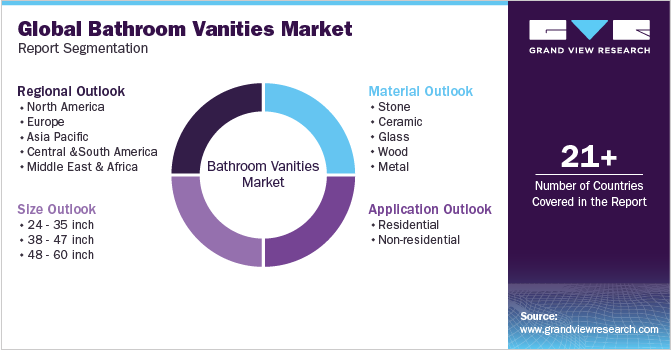
This report forecasts revenue growth at the regional and country levels and provides an analysis of the latest industry trends and opportunities in each of the sub-segments from 2021 to 2033. For this study, Grand View Research has segmented the global bathroom vanities market report based on application, material, size, and region:
-
Application Outlook (Revenue, USD Billion, 2021 - 2033)
-
Residential
-
Non-Residential
-
-
Material Outlook (Revenue, USD Billion, 2021 - 2033)
-
Stone
-
Ceramic
-
Glass
-
Wood
-
Metal
-
-
Size Outlook (Revenue, USD Billion, 2021 - 2033)
-
24 - 35 Inch
-
38 - 47 Inch
-
48 - 60 Inch
-
-
Regional Outlook (Revenue, USD Billion, 2021 - 2033)
-
North America
-
U.S.
-
Canada
-
Mexico
-
-
Europe
-
UK
-
Germany
-
France
-
Italy
-
Spain
-
-
Asia Pacific
-
China
-
Japan
-
India
-
-
Central & South America
-
Brazil
-
Argentina
-
-
Middle East & Africa
-
South Africa
-
Saudi Arabia
-
-
Research Methodology
The bathroom vanities market figures in this report are based on a proven research process that combines executive interviews with secondary research from proprietary databases, company filings, and recognized regulatory and institutional sources. Market size is built through value-chain sizing - reconciling supply-side and demand-side estimates - and triangulated with bottom-up and top-down approaches. Every estimate passes multiple levels of expert validation before publication, with each bathroom vanities segment quantified using the revenue-capture definitions in the table below.
Segment Definition
Segment - Type
Revenue capture definition
Stone
The scope includes bathroom vanities manufactured using natural and engineered stone materials such as marble, granite, quartz, and composite stone. It covers product configurations, surface finishes, design variations, countertop-integrated vanities, and modular units. The assessment includes usage across premium and mid-range bathroom interior installations in residential and commercial environments.
Ceramic
This sub-segment covers bathroom vanities constructed with ceramic-based materials, including ceramic tops, basins, and ceramic-coated structures. It includes molded designs, glazed finishes, color variants, and standard and customized vanity units. The scope extends to mass-market residential bathrooms, hospitality setups, and institutional washroom installations with standardized design preferences.
Glass
The scope includes bathroom vanities incorporating tempered, frosted, laminated, or decorative glass elements used in countertops, shelves, cabinets, or integrated washbasin designs. It covers aesthetic-focused vanity systems, frameless structures, and hybrid material combinations. Applications include modern residential interiors, boutique hotels, and premium commercial washroom environments, emphasizing design-centric installations.
Wood
This sub-segment covers bathroom vanities made from solid wood, engineered wood, plywood, MDF, and moisture-resistant laminated wood variants. It includes freestanding and wall-mounted units with carved, painted, and laminated finishes. The scope spans residential bathrooms, hotels, and commercial spaces, with emphasis on storage-integrated and customized vanity configurations.
Metal
The scope includes bathroom vanities constructed using stainless steel, aluminum, and coated metal frameworks. It covers industrial-grade, corrosion-resistant, and minimalist vanity designs with modular storage systems. The assessment includes usage in high-moisture environments such as public washrooms, healthcare facilities, commercial buildings, and contemporary residential interiors with industrial aesthetics.
Segment - Modality
Revenue capture definition
Residential
This application scope covers bathroom vanities installed in individual housing units including apartments, villas, and independent homes. It includes varied design preferences, size configurations, storage capacities, and material choices. The scope incorporates renovation and new construction demand, covering standard, premium, and luxury residential bathroom interior installations.
Non-residential
The scope includes bathroom vanities used in commercial and institutional spaces such as hotels, offices, hospitals, malls, airports, and educational facilities. It covers high-usage, durable, and standardized vanity systems designed for multiple-user environments, including centralized procurement, bulk installations, and compliance-driven design specifications across large infrastructure projects.
Estimation Model
Layer Name
Key Question
Description
Housing & Bathroom Infrastructure Layer
Who requires bathroom vanity installations?
Start with the global housing stock including residential apartments, independent homes, and commercial real estate such as hotels, offices, hospitals, and institutional buildings. Apply bathroom penetration rates and renovation cycles to estimate total spaces requiring bathroom vanities (new installations + replacements).
Renovation & Construction Accessibility Layer
Which bathrooms are accessible for vanity upgrades or installation?
Filter the total base using construction activity, real estate development rates, urbanization, income levels, and home renovation spending. This derives the addressable market where consumers and institutions actively invest in bathroom remodeling and interior upgrades.
Adoption & Purchase Layer
Who actively purchases bathroom vanities?
Apply purchase and replacement rates across residential homeowners, real estate developers, contractors, hospitality chains, and commercial facility managers. Demand is driven by bathroom remodeling trends, premium interior design adoption, and increasing preference for storage-integrated vanity systems.
Monetisation Layer
How much revenue is generated?
Multiply annual vanity installations by average selling prices across freestanding, wall-mounted, and custom vanities. Include revenue from premium materials (wood, stone, engineered wood), along with installation services and replacement cycles to estimate total market revenue.
Delivered Customizations
This report has been delivered with the following In-depth customizations
Client Request
Customization Delivered
Value Adds
Multi-dimensional Segmentation Deep-Dive across Product, Material, Size, Application & Regional Demand Patterns
Comprehensive cross-segment analysis of the global bathroom vanities market covering application (residential and non-residential), material composition (wood, stone, ceramic, glass, metal), size categories (24–35 inch, 38–47 inch, 48–60 inch), and regional breakdowns across North America, Europe, Asia Pacific, Latin America, and Middle East & Africa, including key country-level demand hubs such as the U.S., China, India, Germany, UK, Brazil, and Saudi Arabia.
Provides clarity on how demand varies between renovation-driven residential consumption and project-led commercial installations (hotels, hospitality, real estate developments). Highlights the dominance of mid-to-large vanity sizes in developed markets, while compact formats are increasingly relevant in high-density urban housing across Asia.
Competitive Landscape Mapping & Strategic Positioning of Key Manufacturers
Strategic benchmarking of leading global and regional players including Kohler, American Woodmark, Foremost Groups, Wyndham Collection, Avanity, Bellaterra Home, Design House (DHI Corp.), Empire Industries, Water Creation, Wilsonart, Dupont Kitchen & Bath Fixtures, and Caesarstone. Evaluation covered design capability, material innovation, pricing tiers, retail penetration, and contract/project supply strength.
Helps differentiate between OEM-heavy manufacturers focused on large-scale retail supply and design-led premium brands competing on customization, finishes, and modular bathroom solutions. Also identifies increasing competition from surface-material specialists (e.g., quartz and engineered stone suppliers) expanding into vanity ecosystems, signaling gradual vertical integration within the bathroom furniture value chain.
Channel Mix, Pricing Architecture & Purchase Behavior Analysis
Evaluation of how bathroom vanities are distributed across offline retail (home improvement stores, specialty bath retailers, furniture outlets) and online channels (e-commerce platforms and brand-owned websites), mapped against pricing tiers (economy, mid-range, premium, luxury). The study also incorporates buying triggers such as home renovation cycles, real estate turnover, hospitality expansion, and remodeling upgrades.
Reveals that while offline channels remain dominant for high-value and installation-driven purchases, online adoption is accelerating in mid-range segments due to catalog digitization and DIY remodeling trends. Also highlights that purchase decisions are increasingly influenced by design aesthetics, storage functionality, integrated lighting, and space optimization features, rather than price alone.
Frequently Asked Questions About This Report
Some of the key players operating in the bathroom vanities market include American Woodmark Corporation, Avanity Corporation, Bellaterra Home, LLC, Design Element Group, Inc., Design House (DHI Corp.), Empire Industries, Inc., and Foremost Groups. Wyndham Collection, Kohler Company, Water Creation, Inc., Wilsonart LLC, Dupont Kitchen and Bath Fixtures, Caesarstone.
Asia Pacific dominated with a 37.5% revenue share in 2025.
The global bathroom vanities market was estimated at USD 46.1 billion in 2025 and is expected to reach USD 49.2 billion in 2026.
The global bathroom vanities market is expected to grow at a CAGR of 7.9% from 2026 to 2033, reaching USD 83.6 billion by 2033.
Asia Pacific held the largest market share in 2025, accounting for approximately 37.5% of global revenue.
The residential segment dominated the market with approximately 74.9% revenue share in 2025.
Wood bathroom vanities led the market in 2025 with a 34.9% revenue share.
The glass segment is projected to register the fastest growth during the forecast period with the growth rate of 9.7%, driven by increasing demand for contemporary, minimalist, and luxury bathroom designs.
Key growth drivers include rising residential construction, increasing home renovation spending, growing consumer preference for premium bathroom interiors, demand for storage-integrated furniture, and the adoption of modern bathroom designs.
About the Author(s)
Homecare & Decor Research Team
Consumer Goods · Homecare & DecorThis report was authored by the homecare & decor research team at Grand View Research - comprising two research analysts, one senior research analyst, and one industry expert - with specialized expertise in the homecare & decor segment of the consumer goods industry. All findings are based on proprietary consumer goods databases, executive interviews, and regulatory analysis, subject to internal peer review prior to publication.
Last Updated:
Speak to Analyst


Customize this report to your needs — add regions, segments, or data points, with 20% free customization.
Or view our licence options:


ISO 9001:2015 & 27001:2022 Certified
We are GDPR and CCPA compliant! Your transaction & personal information is safe and secure. For more details, please read our privacy policy.


