
- Home
- »
- Green Building Materials
- »
-
Glue Laminated Timber Market Size Report, 2026-2033GVR Report cover

Glue Laminated Timber Market (2026 - 2033)
Size, Share & Trends Analysis Report By Application (Residential, Commercial), By Region (North America, Europe, Asia Pacific, Latin America), And Segment Forecasts
Market Size, 2025
$8.2BMarket Estimate, 2026
$8.6BMarket Forecast, 2033
$12.4BCAGR, 2026–2033
5.4%Glue Laminated Timber Market Summary
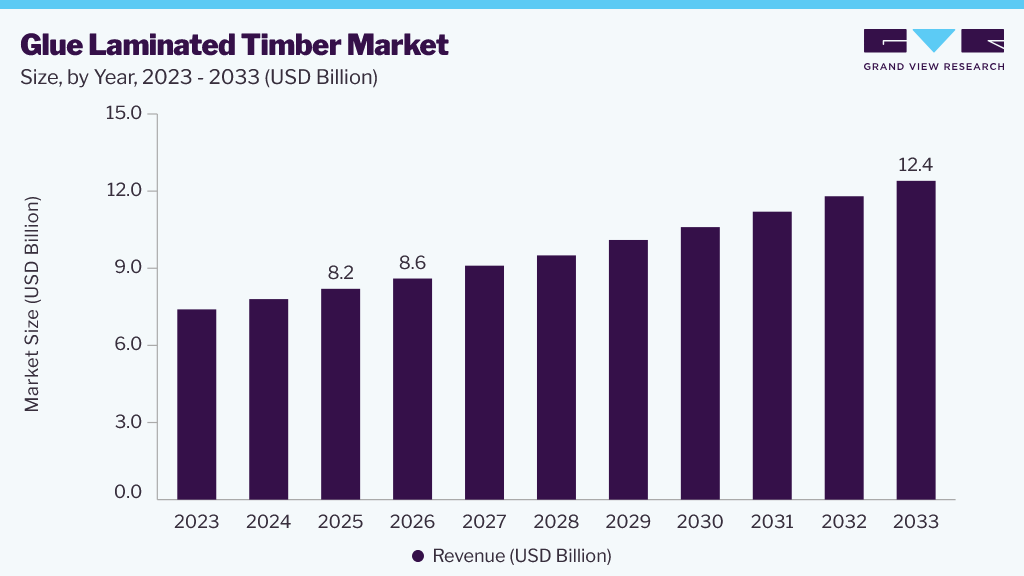
The global glue laminated timber market was valued at USD 8.2 billion in 2025 and is projected to grow from USD 8.6 billion in 2026 to USD 12.4 billion in 2033, at a CAGR of 5.4% from 2026 to 2033. Asia Pacific dominated the market, accounting for a revenue share of 40.0% in 2025. This growth is attributed to the increasing demand for sustainable building materials, particularly in residential and commercial construction. Factors such as superior strength, design flexibility, and aesthetic appeal enhance its attractiveness for architects and builders. The rise of mass timber construction and government initiatives promoting eco-friendly practices further support market growth.
 Source: Grand View Research, IR Documents, Primary Interviews, Paid DatabasesTo learn more about this report,
 Download Free Sample Report
Key Market Trends & Insights
- By application: The residential segment held the largest market share of over 45.0% in 2025.
Regional Highlights
- Largest regional market: Asia Pacific (40.0% revenue share, 2025)
Market Size & Forecast
- Market size in 2025: USD 8.2 Billion
- Estimated market size in 2026: USD 8.6 Billion
- Projected market size by 2033: USD 12.4 Billion
- CAGR (2026-2033): 5.4%
Prism AI by Grand View Research Free to tryAsk a question about the glue laminated timber marketTry asking✓Every figure cited from GVR research Prefer the report? Download free sample →
Glue laminated timber, also called glulam, is used in various applications, including framing, floor and roof beams, columns, door headers, and trusses. The demand for glulam is expected to rise as its use increases in residential, commercial, and industrial construction. The popularity of glue-laminated timber has grown over the past few years due to its use as a cost-effective and eco-friendly alternative to steel and concrete. In the upcoming years, glue-laminated timber will become more popular due to its higher strength, ease of production, and minimal maintenance needs. With all these advantages, glue-laminated lumber has become a preferred choice for architects and builders due to its strong, dimensionally stable, and design-flexible characteristics, leading to market expansion of glue-laminated timber in the upcoming period.Another factor contributing to the growth of the glue laminated timber market is the shift towards environmentally friendly and sustainable construction approaches across the world. In addition, there is a growing trend towards using environmentally friendly materials such as glulam in construction due to increased awareness of the environmental impacts of traditional materials and methods. Glulam has numerous benefits, such as strong load-bearing capacity, resistance to warping and cracking, and the ability to span large distances. It is commonly used for beams, columns, and arches in several building projects due to its strength and versatility, comprising residential, commercial, and industrial constructions.
Furthermore, the increasing adoption of architectural designs that blend natural elements has also increased the need for such designs. It can be shaped in various ways and has a natural wooden look. It is becoming increasingly popular in modern infrastructure projects due to its seamless integration with contemporary architectural designs. Moreover, with the increasing emphasis on green construction materials in environmental regulations and consumer preferences, glulam's eco-friendly qualities appeal to builders and architects. Key industry leaders are continually working to improve technology to produce high-quality products more efficiently, thanks to the minimal carbon footprint of glue-laminated timber, which, compared to traditional building materials such as steel or concrete, supports the worldwide push to reduce greenhouse gas emissions and address climate change. The increasing popularity of glue-laminated timber in construction projects, including residential housing and commercial and industrial structures, is fueled by a focus on eco-friendly practices.
Analyst Perspective
The glue-laminated timber market is expected to grow steadily, supported by increased use of sustainable construction materials and engineered wood in infrastructure projects. The residential sector is likely to remain the largest application, driven by demand for eco-friendly housing and structural timber. Increased investment in green buildings, supportive environmental regulations, and wider adoption of mass timber in commercial construction are also projected to create significant opportunities for market participants during the forecast period.
Application Insights
Residential applications led the market, accounting for the largest revenue share of over 45.0% in 2025. Customers are shifting to wood-based construction due to its wide-ranging benefits. Glulam is considered an eco-friendly construction material as it is created from renewable wood resources. The growing use in residential construction applications, such as flooring & roofing systems and straight or arched beams, is why. The appealing visual appearance of glulam makes it well-suited for residential construction, especially given the strong desire to create fashionable homes. The significance of sustainable building materials is growing due to escalating concerns about climate change and environmental impacts. Glue-laminated beams are versatile materials commonly used in commercial and residential construction projects.
Commercial applications are projected to grow significantly over the forecast period. Commercial projects frequently need longer spans and the ability to support larger loads, where the wood's strength and natural design are advantageous. Timber is known for being extremely long-lasting and moisture-resistant, allowing for the creation of large pieces and one-of-a-kind shapes. Because it can support weight, glue-laminated timber is used in eco-friendly construction, increasing its popularity. Glue laminated timber offers greater strength and stability than solid timber, enabling the construction of larger, sturdier structures and facilitating the design of spacious open areas. In addition, there is a strong presence of commercial construction projects happening worldwide, which is also impacting the glue-laminated timber market. Furthermore, the growing adoption of mass timber in large-scale commercial developments is reinforcing demand for glue laminated timber. For instance, in April 2025, Mercer Mass Timber completed its supply of cross-laminated timber (CLT) and glue-laminated timber (Glulam) for Walmart's new Home Office campus in Arkansas, the largest mass-timber corporate campus in the U.S., demonstrating the growing role of engineered timber in commercial construction.
Regional Insights
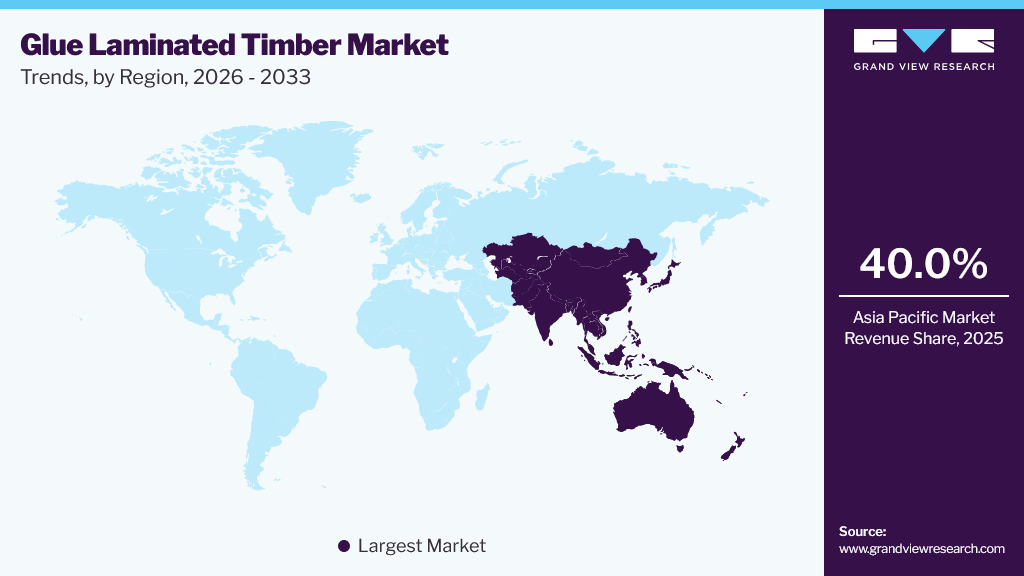
The Asia Pacific glue laminated timber market dominated the global market and accounted for the largest revenue share of approximately 40.0% in 2025. The construction industry is rapidly growing, and manufacturers are increasingly focused on providing higher-quality glue-laminated timber. The growing emphasis on sustainable, environmentally friendly construction methods in the area has increased the demand for glue-laminated timber. Glulam became popular as a sustainable option due to its renewable and eco-friendly qualities. In addition, the growing adoption of engineered wood in residential and commercial construction, along with regional sustainability initiatives and urban infrastructure development, is expected to drive growth in the glue-laminated timber market.
 To learn more about this report, Download Free Sample Report
Japan Glue Laminated Timber Market Trends
The glue laminated timber market in Japan dominated the Asia Pacific market and accounted for the largest revenue share in 2025. The use of glulam in Japan's residential sector has grown due to the increasing appeal of wooden houses for their beauty and design flexibility, as well as advancements in design. The enhanced convenience of building with glulam structures, especially in earthquake-, flood-, and disaster-prone regions, is expected to further boost their use. The rise in demand for environmentally friendly and recyclable materials and Japan's increasing focus on sustainability are expected to boost the demand for the glue-laminated timber market.
Europe Glue Laminated Timber Market Trends
Europe glue-laminated timber market is expected to grow substantially over the forecast period due to rising demand from both the residential and commercial sectors for glulam, which offers remarkable fire resistance, versatility, and adaptability. Europe's commitment to advanced engineering and design increases the use of glue-laminated timber by enabling innovative structural solutions that meet strict safety standards. In addition, the growing adoption of mass timber construction in public infrastructure and commercial buildings, supported by stringent decarbonization targets and sustainable building initiatives across Europe, is expected to further strengthen demand for glue-laminated timber over the forecast period.
The Germany glue laminated timber market is expected to experience significant growth over the forecast period, attributed to the increasing use of sustainable and eco-friendly products and the growing popularity of engineered wood in construction; the demand for glue laminated timber is expected to increase exponentially. Moreover, furniture and interior designers in the country are gradually embracing glue-laminated timber for its environmental friendliness and aesthetic appeal.
North America Glue Laminated Timber Market Trends
The North America glue-laminated timber market is expected to grow at a significant CAGR over the forecast period due to its increased use in residential and commercial construction projects. Rising renovation projects drive the growing requirement for glue-laminated timber for specific structural uses in the country. The market growth has been further propelled by continuous technical advancements, the use of glued laminated timber, and other engineered wood products.
The U.S. glue laminated timber market is significantly growing, owing to the increasing government investments in glue-laminated materials and the rise in construction projects due to expanding urban populations. Continual improvements in architecture and interior design, an emphasis on sustainable construction methods, architectural flexibility, increased energy efficiency and thermal performance, and the push for green building certifications are key factors driving the positive outlook for the glue-laminated timber industry.
Key Glue Laminated Timber Company Insights
Some of the key companies in the glue laminated timber market include Boise Cascade. Western Forest Products, PFEIFER GROUP, Setra Group AB, Schilliger Holz AG, and Mercer Mass Timber LLC are in the market, focused on providing higher-quality products and services to clients.
Key Glue Laminated Timber Companies
The following key companies have been profiled for this study on the glue laminated timber market:
-
Boise Cascade.
-
Western Forest Products.
-
PFEIFER GROUP
-
Setra Group AB
-
Schilliger Holz AG
-
Mercer Mass Timber LLC.
-
Mayr-Melnhof Holz Holding AG
-
Binderholz GmbH
-
HASSLACHER Holding GmbH
-
Stora Enso
Recent Developments
- In May 2024, Canadian Forest Products Ltd. Corporation announced its acquisition of the El Dorado lumber manufacturing facility in Union County, Arkansas, from Resolute El Dorado Inc., a Domtar Corporation affiliate. The deal, valued at USD 73 million, is expected to enhance Canfor's operations by creating collaborations and opportunities for vertical integration in the region. This strategic move aligns with Canfor's growth objectives in the Southern Pine market, reinforcing its commitment to expanding its manufacturing capabilities and strengthening its presence in the U.S. lumber industry.
Glue Laminated Timber Market Report Scope
Report Attribute
Details
Market size in 2025
USD 8.2 billion
Estimated market size in 2026
USD 8.6 billion
Projected market size by 2033
USD 12.4 billion
Growth rate
CAGR of 5.4% from 2026 to 2033
Base year for estimation
2025
Historical data
2021 - 2024
Forecast period
2026 - 2033
Quantitative units
Revenue in USD billion, and CAGR from 2026 to 2033
Report coverage
Revenue forecast, company ranking, competitive landscape, growth factors, and trends
Segments covered
Application, region
Regional Scope
North America; Europe; Asia Pacific; Latin America
Country Scope
U.S.; Canada; Mexico; Austria; Germany; France; Italy; China; Australia; Japan; Brazil
Key companies profiled
Boise Cascade; Western Forest Products.; PFEIFER GROUP; Setra Group AB; Schilliger Holz AG; Mercer Mass Timber LLC.; Mayr-Melnhof Holz Holding AG; Binderholz GmbH; HASSLACHER Holding GmbH; Stora Enso
Customization scope
Free report customization (equivalent up to 8 analysts working days) with purchase. Addition or alteration to country, regional & segment scope.
Pricing and purchase options
Avail of customized purchase options to meet your exact research needs. Explore purchase options
Global Glue Laminated Timber Market Report Segmentation
This report forecasts revenue growth at global, regional, and country levels and provides an analysis of the latest industry trends and opportunities in each of the sub-segments from 2021 to 2033. For the purpose of this study, Grand View Research has segmented the global glue laminated timber market report based on application and region:
- Application Outlook (Revenue, USD Billion, 2021 - 2033)
- Residential
- Commercial
- Others
- Regional Outlook (Revenue, USD Billion, 2021 - 2033)
- North America
- U.S.
- Canada
- Mexico
- Europe
- Germany
- Italy
- France
- Austria
- Asia Pacific
- China
- Japan
- Australia
- Latin America
- Brazil
- North America
Frequently Asked Questions About This Report
The global glue laminated timber market is expected to grow at a CAGR of 5.4% from 2026 to 2033, reaching USD 12.4 billion.
Key players in the market include Boise Cascade. Western Forest Products, PFEIFER GROUP, Setra Group AB, Schilliger Holz AG, Mercer Mass Timber LLC, Mayr-Melnhof Holz Holding AG, Binderholz GmbH, HASSLACHER Holding GmbH, Stora Enso, and others.
The residential segment accounted for the largest revenue share of approximately 45.0% in 2025.
The global glue laminated timber market size was valued at USD 8.2 billion in 2025 and is estimated at USD 8.6 billion for 2026.
Asia Pacific dominated with an approximately 40.0% revenue share in 2025.
About the Author(s)
Green Building Materials Research Team
Advanced Materials · Green Building MaterialsThis report was authored by the green building materials research team at Grand View Research - comprising two research analysts, one senior research analyst, and one industry expert - with specialized expertise in the green building materials segment of the advanced materials industry. All findings are based on proprietary advanced materials databases, executive interviews, and regulatory analysis, subject to internal peer review prior to publication.
Last Updated:
Speak to Analyst

Customize this report to your needs - add regions, segments, or data points, with 20% free customization.
Or view our licence options:


ISO 9001:2015 & 27001:2022 Certified
We are GDPR and CCPA compliant! Your transaction & personal information is safe and secure. For more details, please read our privacy policy.


