
- Home
- »
- Renewable Chemicals
- »
-
Glycerol Derivatives Market Size & Share Report, 2026-2033GVR Report cover

Glycerol Derivatives Market (2026 - 2033)
Size, Share & Trends Analysis By Grade (Bio-based, Petroleum-based), By Product (4-(hydroxymethyl)-1 3-dioxolan-2-one, Polyglycerol, Propane-1 2 3-triyl Triacetate, Propylene Glycol) By Region, And Segment Forecasts
Market Size, 2025
$7.5BMarket Estimate, 2026
$8.0BMarket Forecast, 2033
$11.3BCAGR, 2026–2033
6.0%Glycerol Derivatives Market Summary
The global glycerol derivatives market size was valued at USD 7.5 billion in 2025 and is projected to grow from USD 8.0 billion in 2026 to USD 11.3 billion by 2033, at a CAGR of 6.0% from 2026 to 2033. North America dominated the market, accounting for a revenue share of 52.1% in 2025. The demand for glycerol derivatives is driven by increasing demand from growing end-use industries such as construction, transportation, pharmaceutical, food & beverages, and cosmetics They are used as an emulsifier in the production of low-fat spreads such as frozen desserts and peanut butter.
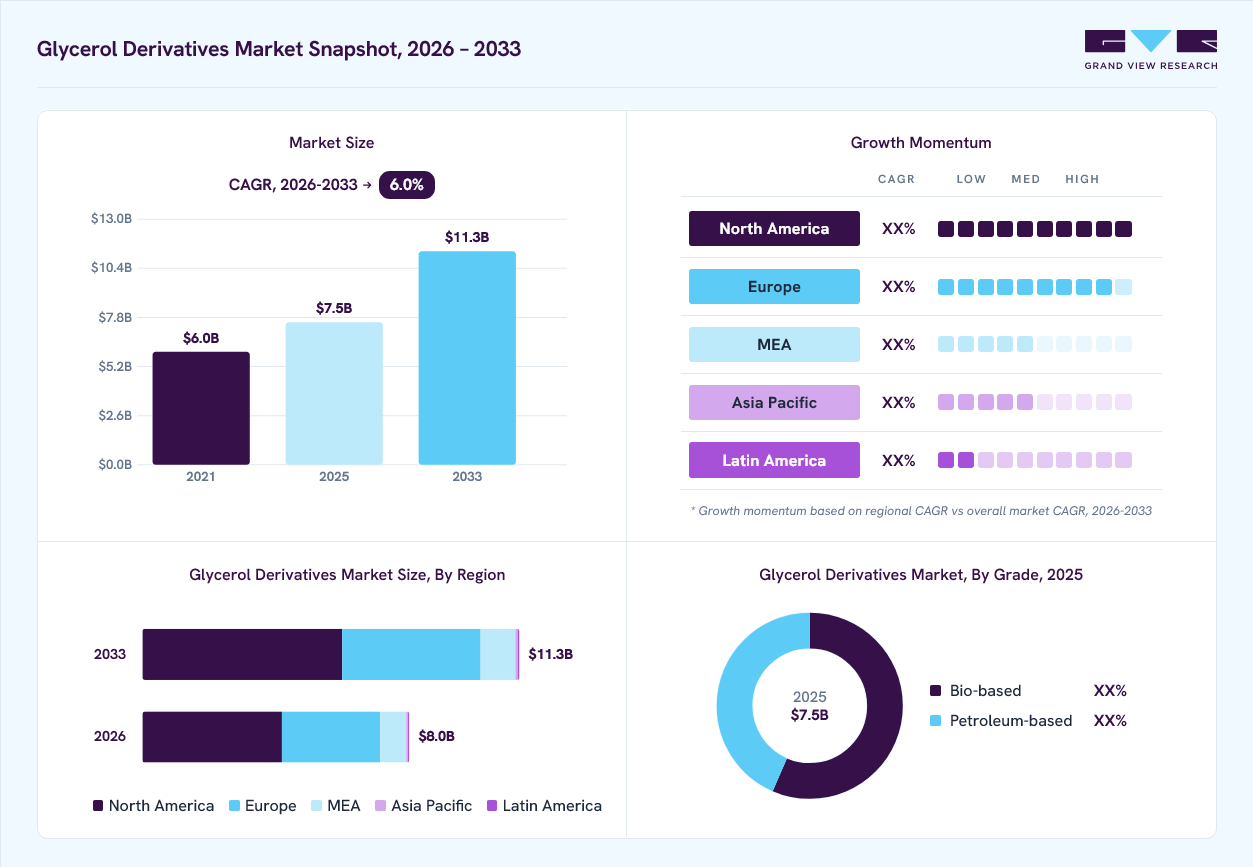 Source: Grand View Research, IR Documents, Primary Interviews, Paid DatabasesTo learn more about this report,
 Download Free Sample Report
Key Market Trends & Insights
- By grade: Bio-based segment dominated the market, with a revenue share of 56.5% in 2025.
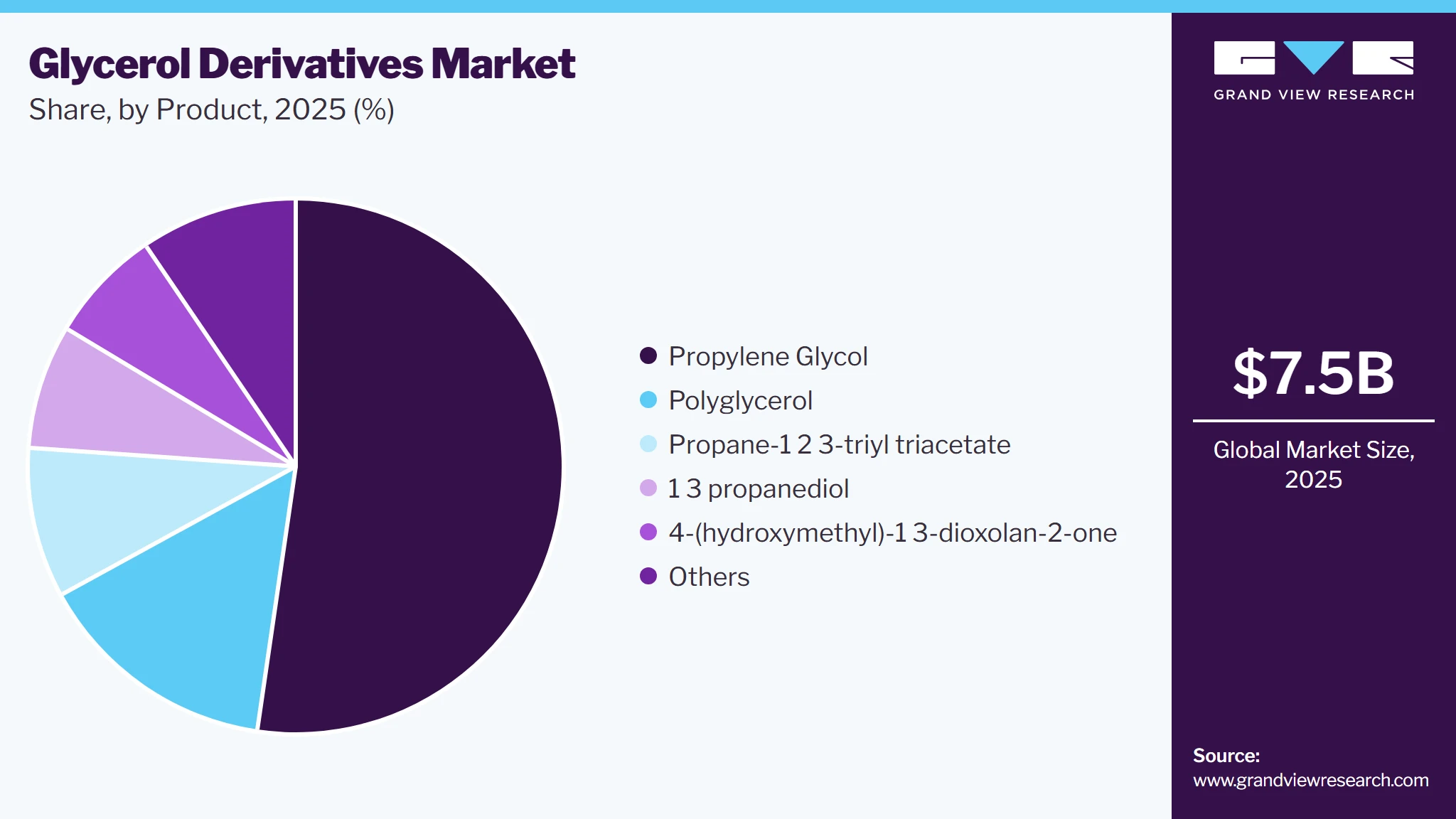
- By product: Propylene glycol segment held the largest market share of 52.3% in 2025.
Regional Highlights
- Largest regional market: North America (52.1% revenue share, 2025)
- By country: The U.S. held the largest market share in 2025.
Market Size & Forecast
- Market size in 2025: USD 7.5 Billion
- Estimated market size in 2026: USD 8.0 Billion
- Projected market size by 2033: USD 11.3 Billion
- CAGR (2026-2033): 6.0%
Prism AI by Grand View Research Free to tryAsk a question about the glycerol derivatives marketTry asking✓Every figure cited from GVR research Prefer the report? Download free sample →
Increasing consumption of emulsifiers in food & beverage application is anticipated to boost the demand for market. Glycerol derivatives are a class of chemicals derived from glycerol, a naturally occurring alcohol commonly found in fats and oils. These derivatives include a range of products, such as glycerol esters, glycerol ethers, polyglycerol esters, and propylene glycol, among others. The increasing use of propylene glycol in various industries, including construction and transportation, is expected to drive demand for these derivatives in the near future as glycerol-based plasticizers can be added to concrete to improve its workability and reduce water content. This can result in stronger, more durable concrete with reduced shrinkage and cracking.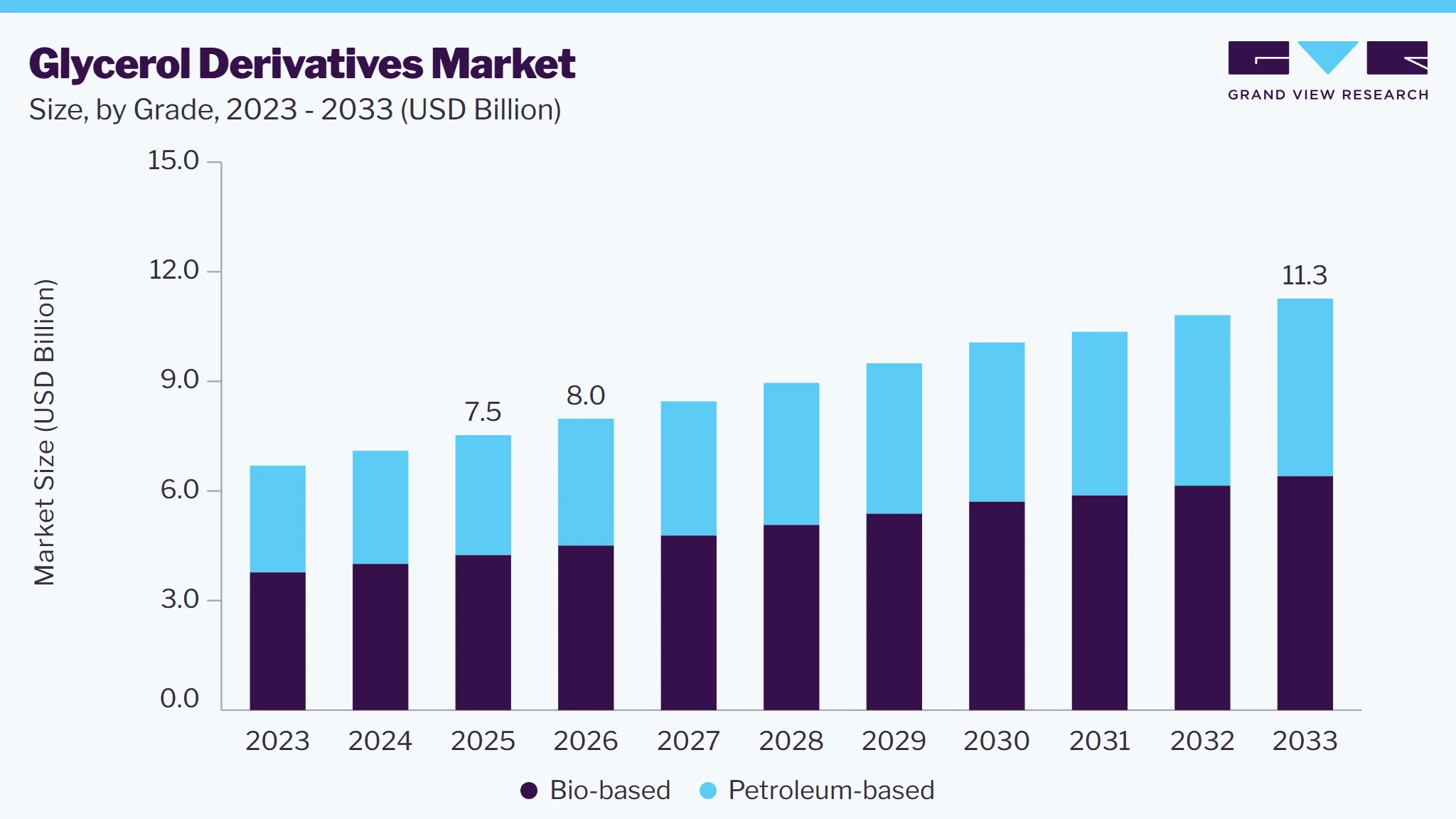 To learn more about this report, Download Free Sample Report
Polyglycerol is a derivative of glycerol and plays a significant role in the growth of the glycerol derivatives market. Its unique properties such as high viscosity, low toxicity, and excellent emulsifying and moisturizing abilities make it a popular choice for a variety of applications. In the food and beverage industry, it is used as a substitute for other emulsifiers due to its lower calorie content and improved stability, while in cosmetics and personal care products, it acts as a moisturizing ingredient.
Additionally, in the pharmaceutical industry, polyglycerol is utilized as a solubilizer and emulsifier in the production of drugs, and vaccines and also as a carrier. Its ability to improve the stability and efficacy of vaccines and drugs makes it a preferred choice in the pharmaceutical industry. The increasing demand for polyglycerol in these industries, along with the potential for new applications in the future, is contributing to the industry growth.
The COVID-19 pandemic had a mixed impact on the market growth. On one hand, the lockdowns and restrictions on transportation and trade disrupted the supply chain and led to temporary disruptions in production and distribution. This resulted in a shortage of raw materials and an increase in prices. On the other hand, the pandemic also led to a surge in demand for certain glycerol derivatives, particularly in the pharmaceutical and personal care industries.
The increased demand for hand sanitizers and other personal care products boosted the demand for glycerol derivatives as they are used as ingredients in these products. In the pharmaceutical industry, the demand for vaccines and drugs also increased as a result of the pandemic, further driving the demand for glycerol derivatives in the production of these products.
Market Dynamics
Glycerol derivatives are value-added chemicals produced from glycerol through various chemical and biochemical conversion processes. These derivatives are widely utilized across pharmaceuticals, personal care, food processing, polymers, coatings, lubricants, and industrial chemicals due to their excellent functionality, biodegradability, and compatibility with sustainable manufacturing practices. Growing availability of bio-based glycerol and increasing demand for renewable specialty chemicals continue to support market growth globally.
The increasing transition toward sustainable and renewable chemicals is a major factor driving the glycerol derivatives market. Rising biodiesel production has significantly improved glycerol availability, enabling manufacturers to convert surplus glycerol into high-value derivatives used across pharmaceutical, cosmetic, food, and industrial applications. Growing emphasis on reducing dependence on petrochemical feedstocks further supports market expansion.
In addition, favorable government initiatives promoting bio-based products and circular economy practices are encouraging investments in glycerol valorization technologies. Continuous innovation in green chemistry and biorefinery processes is expected to accelerate commercial adoption of glycerol-derived specialty chemicals over the forecast period.
The commercialization of several glycerol derivatives involves advanced processing technologies, purification requirements, and significant capital investment. These factors can increase production costs and create barriers for large-scale manufacturing, particularly for specialty derivatives. The fluctuations in crude glycerol quality and feedstock availability can affect production efficiency and product consistency. Competitive pricing from conventional petrochemical alternatives may also limit adoption across cost-sensitive industries.
Growing utilization of glycerol derivatives in pharmaceutical formulations, cosmetics, personal care products, and biodegradable polymers is creating significant growth opportunities for manufacturers. These derivatives offer excellent moisturizing, emulsifying, solvent, and functional properties while supporting clean-label and sustainable product development.
The increasing research into bio-based polymers, green solvents, and renewable chemical intermediates is expected to expand commercial applications. Rising consumer preference for environmentally friendly products will continue to create long-term market opportunities.
Analyst Perspective
The glycerol derivatives market is increasingly benefiting from the global transition toward renewable feedstocks and sustainable specialty chemicals. While personal care and cosmetics remain the largest application segment, emerging opportunities are developing across pharmaceuticals, food ingredients, industrial lubricants, agrochemicals, and biodegradable materials. Manufacturers are focusing on value-added derivative development, process optimization, and sustainable sourcing strategies to strengthen their competitive position. Furthermore, expanding biodiesel production and growing demand for bio-based chemical intermediates are expected to support long-term market growth.
Grade Insights
Based on grade, the bio-based segment led the market with the largest revenue share of 56.5% in 2025. This is attributable to the increasing demand for sustainable and eco-friendly products. Bio-based glycerol derivatives are produced from renewable resources, such as vegetable oils, and are considered to be more sustainable and environmentally friendly.
The use of bio-based glycerol derivatives is growing in various industries, such as cosmetics, personal care, food and beverage, pharmaceuticals, and others, due to their properties such as high viscosity, moisturizing effects, and emulsifying properties. Additionally, the increasing awareness of the harmful effects of petrochemicals and the growing trend towards natural and organic products are driving the growth of the bio-based glycerol derivatives market.
Petroleum based grade segment is growing significantly due to the growing concern over the environmental impact of petroleum-based products and the increasing demand for sustainable and eco-friendly products has led to a shift towards bio-based glycerol derivatives. Despite this, the market for petroleum-based glycerol derivatives is still expected to remain significant, driven by the demand from existing applications and the development of new applications in various industries.
Product Insights
The propylene glycol segment by product accounted for the dominating revenue share of 52.3% in 2025. This is attributable to growing use of the product as emulsifiers, solubilizing agents, and moisturizing agents. They are considered to be more sustainable and environmentally friendly compared to traditional petroleum-based emulsifiers and are considered to be a safer alternative to ingredients like propylene glycol.
 To learn more about this report, Download Free Sample Report
Moreover, the food and beverage industry is a major end-user of polyglycerols, and their use as emulsifiers and solubilizing agents is growing in the industry. They are used in products such as baked goods, dairy products, and sauces to improve texture and stability. Additionally, the increasing demand for natural and organic cosmetics and personal care products is driving the growth of the product market in the cosmetics and personal care industry.
1, 3-propanediol (PDO) product segment is growing significantly due to the growing personal care and cosmetics industry, where it is used as a moisturizing agent, solubilizer, and carrier in various skin care and hair care products. The food and beverage industry also uses PDO as a humectant and emulsifier to improve the texture and stability of various products. As the demand for (PDO) continues to grow, the demand for the product is expected to increase, thereby driving the growth of the market
Regional Insights
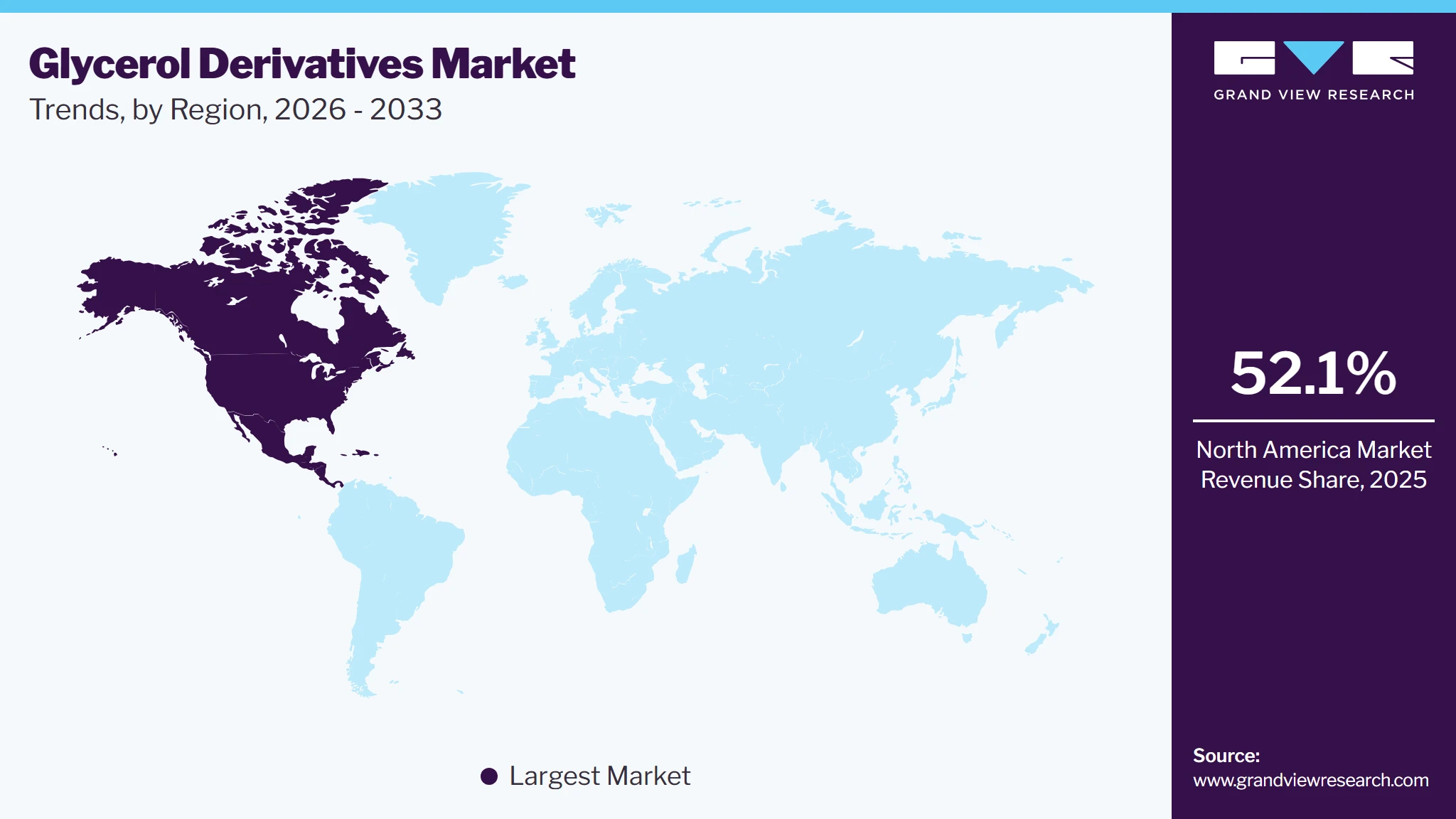
North America dominated the glycerol derivatives market with the highest revenue share of 52.1% in 2025. North America’s glycerol derivatives market is experiencing increasing demand for epichlorohydrin, glycerol carbonate, and glycerol-based propylene glycol across epoxy resins, coatings, pharmaceuticals, personal care, and specialty chemical applications. The region’s established biodiesel production base provides a consistent stream of glycerol feedstock, supporting downstream conversion into higher-value derivatives. Epichlorohydrin remains a key derivative due to its extensive use in epoxy resin production for protective coatings, adhesives, and composites. At the same time, growing interest in bio-based solvents and intermediates is supporting the development of glycerol carbonate and other renewable derivatives.
 To learn more about this report, Download Free Sample Report
U.S. Glycerol Derivatives Market Trends
The U.S. accounted for dominating revenue share in the North America glycerol derivatives market in 2025. The U.S. glycerol derivatives market is witnessing steady demand from pharmaceutical, personal care, and construction industries, supported by the expanding use of glycerol-derived ingredients and intermediates across these sectors. In pharmaceuticals, glycerol derivatives are used in drug formulations and excipients, while personal care manufacturers utilize them in moisturizers, emollients, and other functional formulations. Meanwhile, construction activity is driving demand for epichlorohydrin-based epoxy resins used in protective coatings, adhesives, and composite materials. This cross-industry demand is encouraging producers to expand downstream glycerol conversion and develop higher-value derivatives for specialized applications.
Asia Pacific Glycerol Derivatives Market Trends
Asia Pacific dominated the market with the highest revenue share of 39.3% in 2022. This is attributable to the growing demand for bio-based products, as well as the increasing demand for personal care and pharmaceutical products in countries such as China and India. Asia-Pacific is a major producer and consumer of glycerol, with countries such as China, India, and Indonesia among the largest producers of biodiesel and glycerol.
The food & beverage industry has also been a major driver for the market as the food processing industry is expected to expand at a lucrative rate in China. Market in China is expected to witness profitable growth in the food manufacturing sector, which has over 35,000 processing and manufacturing facilities in the country. The growing need for food production can be attributed to the changing consumer lifestyles, increasing purchasing power, and the expanding middle-class population of the country, which is expected to further contribute to food additives demand. This, in turn, is anticipated to drive the demand for the product in the country over the forecast period.
Europe Glycerol Derivatives Market Trends
Europe is a key producer of glycerol and biodiesel in the world and accounts for the second-largest share of the global market. Germany, Italy, France, and the Netherlands are the major producers of glycerol derivatives in Europe. Countries in Europe have a significant need for biofuels. Thus, biodiesel production is expected to rise over the forecast period which, in turn, will have a positive impact on the market. The supply of glycerol derivatives improved in the first quarter of 2022 owing to the availability of feedstock and large-scale biodiesel production.
Key Glycerol Derivatives Company Insights
The market is highly competitive, with a large number of companies operating in this market and competing for a share of the growing demand for bio-based products. Companies in this market are focusing on various initiatives to enhance their competitiveness and increase their market share.
One of the initiatives taken by manufacturers in the market is the development of new and innovative products. For example, AkzoNobel, a producer of the product, has developed a new range of bio-based surfactants using glycerol as a raw material. This new range of products has been well received by the market, as it provides a more sustainable and environmentally friendly alternative to traditional surfactants.
In addition, market players are also focusing on improving their supply chain management and distribution network. This includes establishing partnerships and collaborations with suppliers, distributors, and customers to enhance their competitiveness and increase their market share.
Key Glycerol Derivatives Companies
The following key companies have been profiled for this study on the glycerol derivatives market.
-
Zhangjiagang Glory Biomaterial Co., Ltd.
-
Shell Chemical Lp
-
Tokyo Chemical Industry Co., Ltd.
-
DuPont
-
Solvay
-
Croda International Plc
-
Cargill, Incorporated
-
Primient Covation LLC
-
Haihang Industry Co., Ltd
-
Sakamoto Yakuhin kogyo Co., Ltd.
-
Spiga Nord S.p.A.
-
Stepan Company
-
thyssenkrupp AG
-
Acuro Organics Limited
-
Repsol
Competitive Benchmarking
Category
Operating Strategies
Competitive Edge
Weakness
Established Players (Shell Chemical LP, DuPont, Solvay, Croda International Plc, Cargill, Incorporated, Primient Covation LLC, Stepan Company, thyssenkrupp AG, Repsol)
- Expanding bio-based specialty chemical portfolios through sustainable feedstock utilization and product innovation.
- Strengthening global manufacturing and supply chain capabilities to meet growing industrial demand.
- Extensive global production infrastructure supports reliable supply across diverse end-use industries.
- Strong technical expertise enables development of high-performance glycerol derivative formulations.
- Dependence on biodiesel and vegetable oil markets exposes operations to feedstock price volatility.
- High capital investment requirements may increase operational and expansion costs.
Emerging Players (Zhangjiagang Glory Biomaterial Co., Ltd., Tokyo Chemical Industry Co., Ltd., Haihang Industry Co., Ltd., Sakamoto Yakuhin Kogyo Co., Ltd., Spiga Nord S.p.A., Acuro Organics Limited.)
- Expanding regional production capabilities and developing application-specific glycerol derivative solutions.
- Strengthening distribution partnerships to improve market reach across specialty chemical industries.
- Flexible manufacturing operations support customized products for niche industrial applications.
- Strong regional presence enables responsive customer service and competitive pricing strategies.
- Limited international footprint may restrict participation in large global supply agreements.
- Smaller production capacities can reduce economies of scale compared to multinational competitors.
Glycerol Derivatives Market Report Scope
Report Attribute
Details
Market size in 2025
USD 7.5 billion
Estimated market size in 2026
USD 8.0 billion
Projected market size by 2033
USD 11.3 billion
Growth rate
CAGR of 6.0% from 2026 to 2033
Base year for estimation
2025
Historical data
2021 - 2024
Forecast period
2026 - 2033
Quantitative units
Revenue in USD million/billion, Volume in Kilotons and CAGR from 2026 to 2033
Report coverage
Revenue forecast, company ranking, competitive landscape, growth factors, and trends
Segments covered
Product, grade, region
Regional scope
North America; Europe; Asia Pacific; Latin America; MEA
Country scope
U.S.; Canada; Mexico; Germany; UK; France; Italy; Spain; China; Japan; India; South Korea; Brazil; Argentina; Colombia; South Africa; Saudi Arabia;
Key companies profiled
Zhangjiagang Glory Biomaterial Co., Ltd.; Shell Chemical LP; Tokyo Chemical Industry Co., Ltd.; DuPont; Solvay; Croda International Plc; Cargill, Incorporated; Primient Covation LLC; Haihang Industry Co., Ltd.; Sakamoto Yakuhin Kogyo Co., Ltd.; Spiga Nord S.p.A.; Stepan Company; thyssenkrupp AG; Acuro Organics Limited; Repsol
Customization scope
Free report customization (equivalent up to 8 analysts' working days) with purchase. Addition or alteration to country, regional & segment scope.
Pricing and purchase options
Avail customized purchase options to meet your exact research needs. Explore purchase options
Global Glycerol Derivatives Market Segmentation
This report forecasts revenue growth at global, regional, and country levels and provides an analysis on the latest industry trends in each of the sub-segments from 2021 to 2033. For this study, Grand View Research has segmented the global glycerol derivatives market report based on grade, application, and region:
 To learn more about this report, Download Free Sample Report
-
Grade Outlook (Volume, Kilotons, Revenue, USD Million; 2021 - 2033)
-
Bio-based
-
Petroleum-based
-
-
Product Outlook (Volume, Kilotons, Revenue, USD Million; 2021 - 2033)
-
4-(hydroxymethyl)-1 3-dioxolan-2-one
-
Pharmaceutical
-
Solvents
-
Polymers
-
Others
-
-
Polyglycerol
-
Food & Beverage
-
Pharmaceuticals
-
Personal care
-
Others
-
-
Propane-1 2 3-triyl triacetate
-
Personal Care & Cosmetics
-
Pharmaceutical
-
Dyes
-
Others
-
-
1 3 propanediol
-
Polytrimethylene Terephthalate (PTT)
-
Polyurethane (PU)
-
Personal Care & Detergents
-
Others
-
-
Propylene Glycol
-
Food & Beverage
-
Pharmaceutical
-
Cosmetics & Personal Care
-
Construction
-
Transportation
-
Others
-
-
Others
-
-
Regional Outlook (Volume, Kilotons, Revenue, USD Million; 2021 - 2033)
-
North America
-
U.S.
-
Canada
-
Mexico
-
-
Europe
-
Germany
-
U.K.
-
France
-
Italy
-
Spain
-
-
Asia Pacific
-
China
-
India
-
Japan
-
South Korea
-
-
Central & South America
-
Brazil
-
Argentina
-
Columbia
-
-
Middle East & Africa
-
Saudi Arabia
-
South Africa
-
-
Research Methodology
The Glycerol Derivatives market figures in this report are based on a proven research process that combines executive interviews with secondary research from proprietary databases, company filings, and recognized regulatory and institutional sources. Market size is built through value-chain sizing - reconciling supply-side and demand-side estimates - and triangulated with bottom-up and top-down approaches. Every estimate passes multiple levels of expert validation before publication, with each Glycerol Derivatives segment quantified using the revenue-capture definitions in the table below.
Segment Definition
Segment -Grade
Revenue capture definition
Bio-based
As the dominant grade segment, revenue is generated through glycerol derivatives produced from renewable glycerol obtained primarily from biodiesel production, supplying pharmaceutical, cosmetic, food, polymer, and industrial manufacturers seeking sustainable raw materials.
Petroleum-based
Revenue is captured through glycerol derivative production utilizing petrochemical feedstocks for applications requiring consistent quality, established supply chains, and large-scale industrial manufacturing.
Segment - Product
Revenue capture definition
4-(Hydroxymethyl)-1,3-dioxolan-2-one
Revenue is generated through specialty chemical applications utilizing this glycerol derivative as an intermediate in polymers, solvents, and advanced material formulations.
Polyglycerol
Revenue is supported by the use of polyglycerol in food emulsifiers, cosmetics, pharmaceuticals, surfactants, and specialty chemical formulations requiring multifunctional performance.
Propane-1,2,3-triyl Triacetate
Revenue is generated through applications in pharmaceutical formulations, food additives, plasticizers, and specialty solvent systems utilizing triacetin as a functional ingredient.
1,3-Propanediol
Revenue is captured through the commercialization of 1,3-propanediol for polymer production, cosmetics, personal care products, and industrial chemical manufacturing.
Propylene Glycol
As the dominant product segment, revenue is generated through large-scale utilization of propylene glycol across pharmaceuticals, food and beverages, cosmetics, unsaturated polyester resins, deicing fluids, and industrial applications.
Other Products
This segment captures revenue from additional glycerol derivatives utilized in specialty chemicals, lubricants, coatings, polymers, and emerging bio-based industrial applications.
Estimation Model
Layer Name
Key Question
Description
Industrial Demand Layer
What forms the addressable base?
Identify global glycerol production from biodiesel, oleochemical, and petrochemical industries available for derivative manufacturing.
Conversion Layer
Where are glycerol derivatives produced?
Estimate the proportion of glycerol converted into high-value derivatives such as propylene glycol, polyglycerol, triacetin, 1,3-propanediol, and other specialty chemicals.
Industrial Consumption Layer
How much is utilized?
Analyze derivative consumption across pharmaceuticals, food processing, personal care, polymers, coatings, lubricants, and industrial manufacturing based on formulation demand and production volumes.
Revenue Layer
How is market revenue generated?
Revenue is generated through the sale of bio-based and petroleum-based glycerol derivatives supplied to pharmaceutical companies, cosmetic manufacturers, food processors, polymer producers, and specialty chemical manufacturers worldwide.
Delivered Customizations
This report has been delivered with the following In-depth customizations
Client Request
Customization Delivered
Value Adds
Regional Segmentation
The study delivers additional country-level insights covering Indonesia, Malaysia, and Australia, evaluating glycerol derivatives demand across personal care, pharmaceuticals, food ingredients, industrial chemicals, and lubricant applications.
Enables stakeholders to identify emerging bio-based chemical markets, assess country-specific consumption trends, and formulate targeted expansion strategies across high-growth specialty chemical industries.
Cross-Segmentation Analysis
The study delivers detailed cross-segmentation analysis assessing glycerol derivatives demand across major applications by derivative type, highlighting consumption patterns, market attractiveness, and growth opportunities across key end-use industries.
Helps companies identify the most attractive derivative-application combinations, optimize product portfolios, and prioritize investments toward high-growth industrial and consumer markets.
Opportunity Assessment
The study delivers comprehensive assessment of emerging opportunities across renewable chemicals, biodegradable materials, pharmaceutical excipients, food ingredients, and sustainable personal care formulations driven by increasing demand for bio-based products.
Supports strategic planning by identifying future revenue opportunities, evaluating high-growth application areas, and aligning product innovation with evolving sustainability and circular economy trends.
Frequently Asked Questions About This Report
The global glycerol derivatives market size was valued at USD 7.5 billion in 2025 and is estimated at USD 8.0 billion in 2026.
The global glycerol derivatives market is expected to grow at a CAGR of 6.0% from 2026 to 2033, reaching USD 11.3 billion by 2033.
Key factors that are driving the market growth include increasing demand from growing end-use industries such as construction, transportation, pharmaceutical, food & beverages, and cosmetics along with rising demand from various end-use industries for environmentally friendly alternatives
North America dominated the glycerol derivatives market with a share of 52.1% in 2025.
Some key players operating in the glycerol derivatives market include Zhangjiagang Glory Biomaterial Co., Ltd.; Shell Chemical LP; Tokyo Chemical Industry Co., Ltd.; DuPont; Solvay; Croda International Plc; Cargill, Incorporated; Primient Covation LLC; Haihang Industry Co., Ltd.; Sakamoto Yakuhin Kogyo Co., Ltd.; Spiga Nord S.p.A.; Stepan Company; thyssenkrupp AG; Acuro Organics Limited; Repsol
The propylene glycol segment by product accounted for the dominating revenue share of 52.3% in 2025. This is attributable to growing use of the product as emulsifiers, solubilizing agents, and moisturizing agents.
Bio-based segment dominated the market, with a revenue share of 56.5% in 2025 while petroleum based grade segment is expected to be the fastest-growing market.
About the Author(s)
Renewable Chemicals Research Team
Specialty & Chemicals · Renewable ChemicalsThis report was authored by the renewable chemicals research team at Grand View Research - comprising two research analysts, one senior research analyst, and one industry expert - with specialized expertise in the renewable chemicals segment of the specialty & chemicals industry. All findings are based on proprietary specialty & chemicals databases, executive interviews, and regulatory analysis, subject to internal peer review prior to publication.
Last Updated:
Speak to Analyst

Customize this report to your needs - add regions, segments, or data points, with 20% free customization.
Or view our licence options:


ISO 9001:2015 & 27001:2022 Certified
We are GDPR and CCPA compliant! Your transaction & personal information is safe and secure. For more details, please read our privacy policy.


