
- Home
- »
- Advanced Interior Materials
- »
-
Gold Mining Market Size, Share & Trends Report, 2026-2033GVR Report cover

Gold Mining Market (2026 - 2033)
Size, Share & Trends Analysis Report By Mining Method (Placer Mining, Hard Rock Mining), By End Use (Jewelry, Investment), By Region (North America, Europe, Asia Pacific, Latin America, Middle East & Africa), And Segment Forecasts
Market Size, 2025
$406.2BMarket Estimate, 2026
$432.7BMarket Forecast, 2033
$616.4BCAGR, 2026–2033
5.3%Gold Mining Market Summary
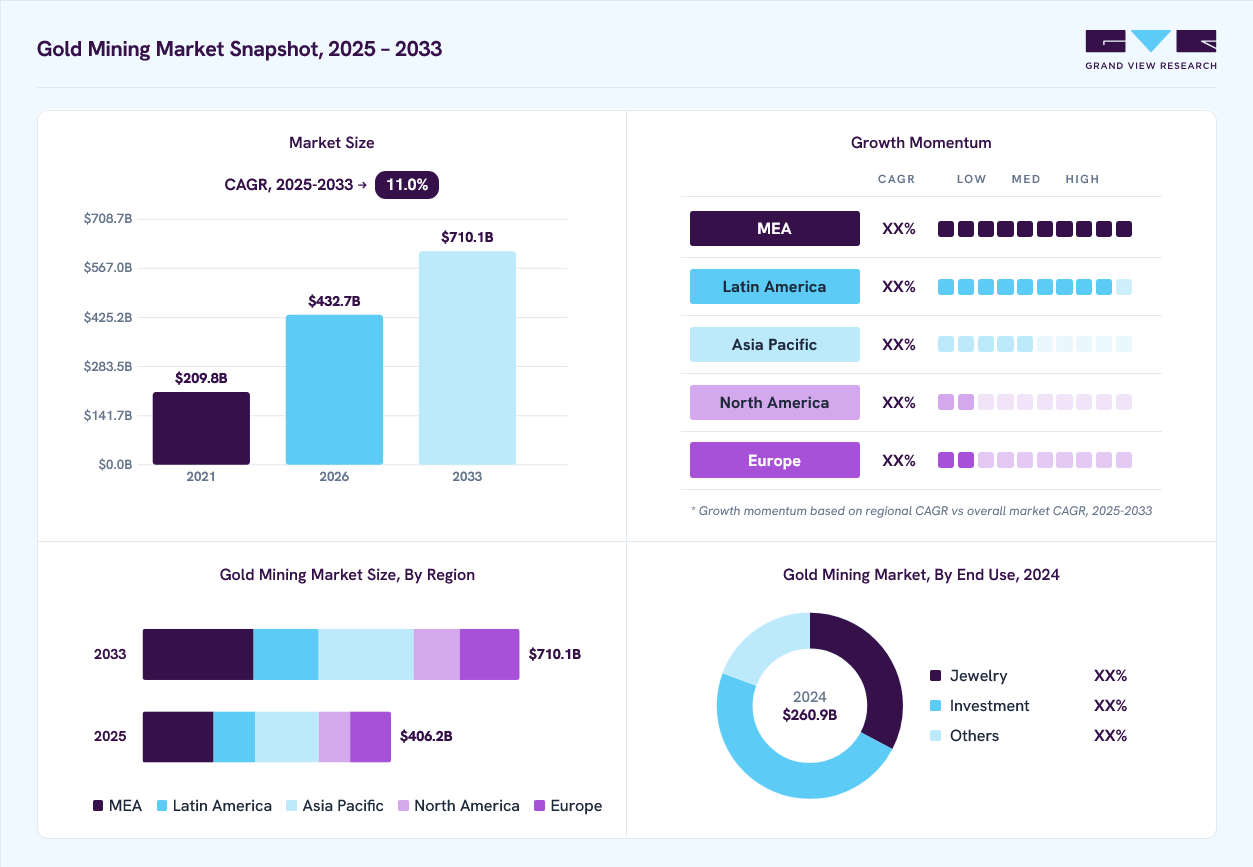
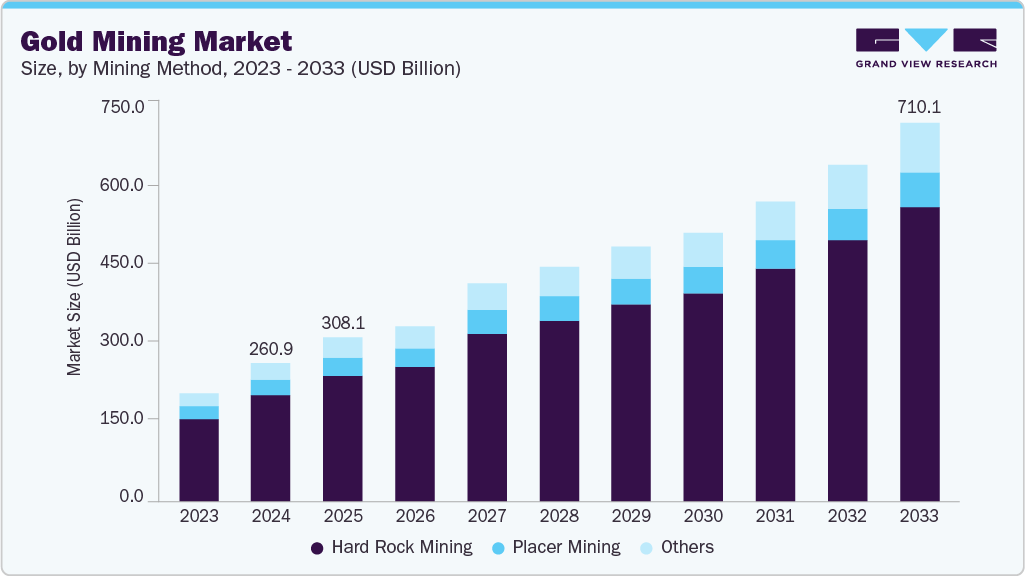
The gold mining market size was valued at USD 406.2 billion in 2025 and is projected to grow from USD 432.7 billion in 2026 to USD 616.4 billion by 2033, at a CAGR of 5.3% from 2026 to 2033. Middle East & Africa dominated the gold mining market with the largest revenue share of 28.6% in 2025. The market is sustained by a complex interplay of economic and financial drivers, with the price of gold itself standing as the primary catalyst.
 Source: Grand View Research, IR Documents, Primary Interviews, Paid DatabasesTo learn more about this report,
 Download Free Sample Report
Key Market Trends & Insights
- By method: Hard rock mining segment held the largest market share of 97.2% in 2025.
- By end use: Investment segment held the largest market share of 48.7% in 2025.
Regional Highlights
- Largest regional market: Middle East & Africa (28.6% revenue share, 2025)
- By country: Ghana held the largest market share in 2025.
Market Size & Forecast
- Market size in 2025: USD 406.2 Billion
- Estimated market size in 2026: USD 432.7 Billion
- Projected market size by 2033: USD 616.4 Billion
- CAGR (2026-2033): 5.3%
Three ways to get this report
Buy it, customize it, or ask a question.Ask an Analyst
Analyst response in 1 business day
- AccessReport author, directly
- Reply timeWithin 1 working day
- No sales callDirect answer only
- FormatEmail reply
- CostFree, no cost
Get the Full Report
What the study covers
- FormatsPDF · Excel · Dashboard
- Timeline2026–2033 annual, 2025 base
- Coverage20+ countries, 5 regions
- Companies10+ key players profiled
Customize the Report
20% free customization
- IncludeCountries, segments, points
- TailorTo your product definition
- ExtendDeeper competitor detail
- OrA fully bespoke study
- Turnaround5–10 working days
This price is heavily influenced by macroeconomic factors such as inflation, interest rates, and currency fluctuations, particularly the strength of the U.S. dollar. During periods of high inflation or economic uncertainty, investors flock to gold as a traditional store of value, driving up its price. A higher market price for gold directly increases the profitability of mining operations, making it economically viable to exploit lower-grade ore bodies and finance capital-intensive exploration and development projects in more remote or challenging locations. This price signal is the fundamental engine that powers investment and expansion within the sector. In 2025, global mine production stayed near the usual range of around 3,500 tons, and the distribution of this output shows how much the market depends on a few powerful producers. According to World Gold Council production updates, China mined about 380.2 tons of gold in 2025, while Russia followed with close to 330 tons. These two countries alone account for a major share of global supply, and their consistent production encourages mining companies across the world to keep expanding exploration and refining strategies to remain competitive.
 To learn more about this report, Download Free Sample Report
A major market growth driver is the scale of official gold reserves held by countries across the world. The U.S. sits at the top with more than 8,100 tonnes of gold, and this immense reserve level sends a strong signal about gold’s importance in long-term financial stability. When a country maintains such a large buffer, it guarantees lasting demand for newly mined gold, which strengthens the incentive for mining companies to keep expanding exploration and production.
Jewelry demand remains one of the most influential forces for gold consumption. Countries such as India and China observe festivals, weddings, and cultural events that rely heavily on gold ornaments, which keep the industry active throughout the year. The emotional and cultural connection people share with gold means that the appetite for finely crafted items does not fade even when economic conditions are mixed. Because of this steady pull from the jewelry sector, mining companies feel more confident in maintaining high output and initiating expansion projects across multiple regions.
 To learn more about this report, Download Free Sample Report
Technology is giving the gold mining sector a massive push by making exploration more precise and extraction more efficient. New geological mapping tools, improved drilling systems, and smarter mineral identification techniques help mining companies locate deeper or previously unexplored deposits. On top of that, the adoption of digital monitoring, automated haulage trucks, and energy-efficient processing methods reduces operational costs. This productivity improvement encourages companies to take up larger projects and explore challenging terrains that were previously considered too expensive or risky.
Market Dynamics
The growth of the gold mining market is significantly driven by rising global investment demand for gold as a haven asset during periods of economic uncertainty, inflation, and geopolitical tensions. Investors, financial institutions, and central banks continue to increase their gold holdings to diversify reserves and protect portfolios against currency fluctuations and market volatility. Sustained demand for gold bars, coins, exchange-traded funds, and official reserves has supported higher gold prices, encouraging mining companies to expand exploration, reopen previously uneconomic mines, and invest in new production projects. Strong gold prices improve project profitability and accelerate capital investments across the mining value chain.
The growing demand from the jewelry industry is a major factor driving the expansion of the gold mining market. Gold remains the preferred precious metal for jewelry due to its aesthetic appeal, durability, and long-term value. Strong consumer demand in major markets such as India, China, the Middle East, and Southeast Asia, where gold jewelry holds significant cultural and investment value, has led to consistent consumption levels. Rising disposable incomes, urbanization, and increasing spending on luxury and premium jewelry products are further supporting global demand for gold, encouraging mining companies to increase production to meet market requirements.
The increasing popularity of branded jewelry, evolving fashion trends, and rising demand for lightweight and customized gold ornaments are further contributing to higher gold consumption across both developed and emerging economies. Seasonal demand during weddings, festivals, and other cultural celebrations continues to boost jewelry sales, particularly in the Asia Pacific. In response to sustained demand, gold mining companies are expanding exploration activities, improving extraction efficiency, and investing in new mining projects to ensure a stable supply of gold for the global jewelry manufacturing industry.
Declining ore grades and the depletion of high quality gold reserves are significant restraints on the growth of the gold mining market. As easily accessible and high grade deposits become exhausted, mining companies must process larger quantities of ore to recover the same amount of gold, resulting in higher energy consumption, increased water usage, greater waste generation, and rising operating costs. Companies are also compelled to invest more in exploration and advanced extraction technologies to locate economically viable deposits, which increases capital expenditure and project development timelines. These challenges reduce overall operational efficiency and can limit the profitability of both existing and new mining projects, particularly in regions with complex geological conditions.
The expansion of gold recycling and circular economy initiatives presents a significant opportunity for the gold mining market by promoting sustainable resource management and strengthening long-term supply security. Increasing the recovery of gold from electronic waste, industrial scrap, and end-of-life jewelry is helping to meet growing demand while reducing pressure on primary mining operations. Many mining companies are investing in recycling technologies, refining capabilities, and partnerships across the value chain to complement conventional gold production and improve resource efficiency. As governments and industries continue to promote responsible sourcing and circular economy practices, companies that integrate recycled gold into their operations can enhance sustainability performance, reduce environmental impacts, and create new revenue opportunities.
Analyst Perspective
The gold mining market is expected to remain resilient over the long term, supported by sustained investment demand, strong jewelry consumption, and the continued role of gold as a safe haven asset during periods of economic uncertainty. Rising purchases by central banks, increasing geopolitical risks, and inflation concerns are encouraging steady investments in gold, supporting favorable market conditions for mining companies. At the same time, producers are investing in exploration, mine expansion, automation, and advanced extraction technologies to improve productivity and extend the life of existing operations.
Mining Method Insights
Based on method, hard rock mining segment led the market with the largest revenue share of 97.2% in 2025. Hard rock mining keeps gaining momentum because global gold prices have encouraged companies to tap deeper and more complex ore bodies. As surface deposits decline, miners are pushed toward underground veins that promise higher-grade ore and more consistent output. Modern drilling equipment, along with better geological mapping, makes it easier to locate these deposits with accuracy, so companies feel more confident investing in underground development. As long as gold prices remain healthy, producers have a strong motivation to push deeper into hard rock formations for a stable long-term yield.
Placer mining is benefiting from rising interest in cost-friendly extraction methods, especially in regions where surface-level gold deposits are still abundant. Since placer deposits form through natural erosion and concentration of gold in riverbeds and alluvial plains, companies can extract material with simpler equipment and lighter infrastructure. This lowers the entry barrier for small and mid-sized miners who want to capitalize on rising gold prices without committing huge upfront investment. In many developing regions, placer mining becomes appealing because it offers quicker project initiation and faster recovery of gold compared to more complex extraction methods.
End Use Insights
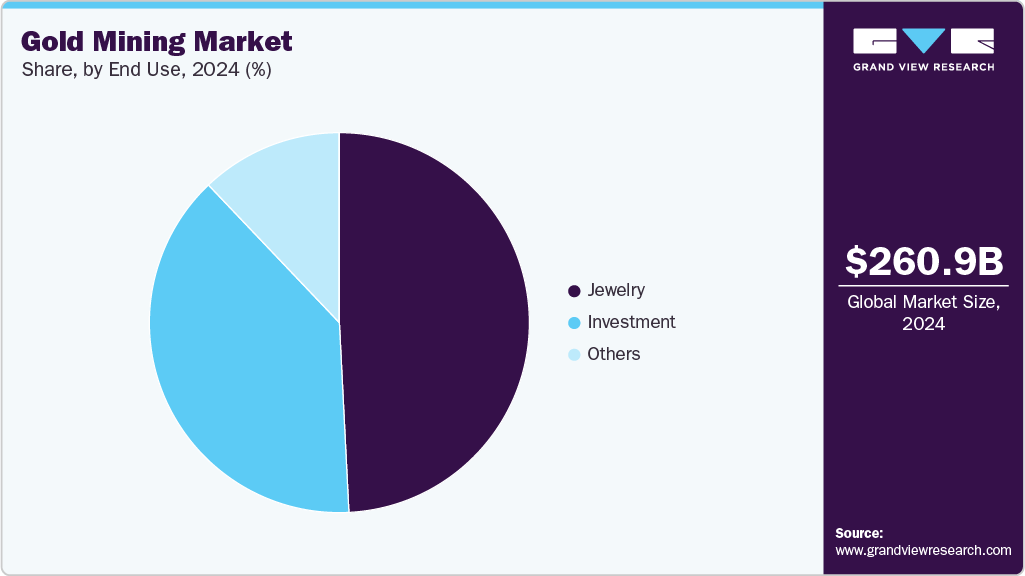
Based on end use, investment segment led the market with the largest revenue share of 48.7% in 2025. The jewelry segment continues to thrive because gold remains deeply rooted in cultural traditions, especially in countries where ornaments symbolize prosperity, purity, and long-term value. Markets such as India, China, the Middle East, and Southeast Asia see continuous demand driven by festivals, weddings, and gifting customs. Even during times of economic uncertainty, families tend to prioritize gold jewelry purchases since it serves both aesthetic and financial purposes. This cultural attachment keeps jewelry manufacturers sourcing large volumes of refined gold, which directly boosts mining activity and encourages companies to maintain stable supply levels.
 To learn more about this report, Download Free Sample Report
The investment segment is gaining strong momentum because gold continues to act as a reliable hedge during periods of financial volatility. Investors turn to bullion, coins, and gold-backed products whenever inflation rises or currency markets feel unstable, since gold holds value even when other assets fluctuate. Global uncertainties related to interest rate shifts, geopolitical tensions, and stock market swings have pushed both retail and institutional investors toward higher allocations in gold. This consistent appetite keeps investment-grade gold demand strong, which encourages mining companies to boost production and maintain large refining capacities.
Regional Insights
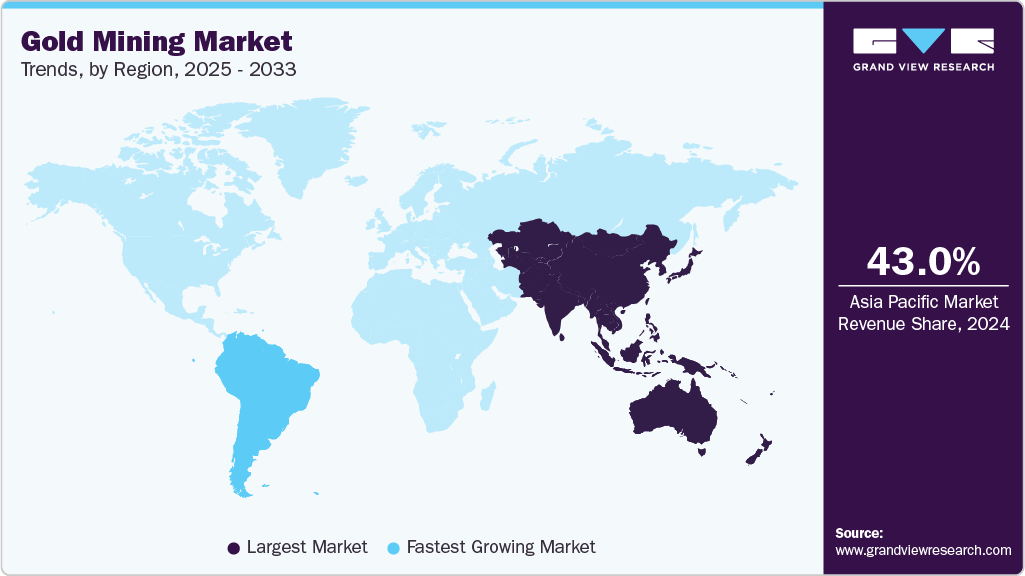
Asia Pacific is seeing strong growth in the gold mining market because the region holds some of the largest untapped reserves, and governments are actively supporting exploration activities. Countries like China, Indonesia, Australia, and the Philippines are investing in modern geological surveys and offering industry-friendly policies to encourage private mining companies. Rising gold prices have made deeper and technically challenging deposits more attractive, and large mining firms are expanding projects to secure long-term output. This steady rise in exploration spending keeps the regional supply chain busy and attracts global investors who are looking for resource-rich territories with strong future potential.
China Gold Mining Market Trends
The gold mining market in China is a global powerhouse, consistently ranking as the world's largest producer and consumer of gold. This dominance is strategically underpinned by the country's favorable geology and state-driven support for resource security. The recent discovery of the massive Dadonggou deposit in Liaoning province, with an estimated resource of 1,444 tonnes of gold, serves as a powerful testament to this dynamic. With an in-situ value of over USD 192 billion, this single find is transformative. This discovery reinforces China's strategic objective of reducing reliance on imported raw materials and securing its financial and industrial gold supply chains domestically.
North America Gold Mining Market Trends
The gold mining market in North America is experiencing steady growth because the region has advanced exploration capabilities and a strong base of established mining companies. The U.S. and Canada continue to invest heavily in new geological surveys, improved drilling systems, and digital mining technologies that enhance the efficiency of locating and extracting ore. Higher gold prices over the past few years have encouraged companies to reopen dormant mines and initiate expansion plans in existing projects. The presence of world-class mining infrastructure, along with access to skilled labor and sophisticated machinery, gives North America a competitive edge in scaling production.
The U.S. gold mining market is supported by strong investor interest and gold demand as a financial hedge. U.S. gold demand surged 58% year-over-year in Q3 2025, driven mainly by robust inflows into gold-backed ETFs and increased physical investment. Leading U.S. miners, including Newmont and Agnico Eagle Mines, are expanding production capabilities and focusing on sustainable practices to meet environmental regulations.
Europe Gold Mining Market Trends
The gold mining market in Europe is seeing renewed growth in gold mining as several countries are investing in modern exploration techniques and reactivating older mining zones. Nations like Finland, Sweden, Spain, and Ireland have become attractive hotspots due to favorable geology and improved resource mapping. The rise in gold prices has encouraged companies to revisit historic mines and explore deeper extensions that were previously too expensive to develop. Strong infrastructure, reliable energy access, and skilled technical expertise across the region help mining firms operate efficiently and scale their projects with confidence.
Latin America Gold Mining Market Trends
The gold mining market in Latin America is experiencing strong momentum because the region holds some of the richest undeveloped reserves in the world. Countries like Peru, Chile, Brazil, and Colombia are attracting sustained exploration investments due to favorable geology and supportive policy frameworks for mining. Advancements in exploration technology allow companies to assess deeper deposits across the Andes and Amazon basin with higher accuracy, which encourages new project launches.
Middle East & Africa Gold Mining Market Trends
Middle East & Africa dominated the gold mining market with the largest revenue share of 28.6% in 2025. The gold mining market in the Middle East & Africa is supported by increased exploration activity, new mine development, and investments to expand existing production capacity. In Africa, countries such as Ghana, Sudan, Burkina Faso, and Côte d’Ivoire continue to attract mining investments due to their established gold resources and exploration potential. In the Middle East, Saudi Arabia’s focus on mineral resource development and the expansion of exploration activities is creating additional opportunities for gold mining. Rising gold prices are further improving the economic attractiveness of new mining projects, encouraging companies to invest in exploration, mine development, and processing infrastructure across the region. The gold mining market in the Ghana held the largest share in the Middle East & Africa region in 2025.
 To learn more about this report, Download Free Sample Report
Key Gold Mining Company Insights
Some of the key players operating in the market include Agnico Eagle Mines Limited, AngloGold Ashanti Limited, and others.
-
Agnico Eagle Mines Limited is a large gold mining company headquartered in Canada with operations spread across Canada, Mexico, Finland, and exploration activities in several other regions. The company is known for its focus on high-quality deposits, strong operational efficiency, and a long history of consistent production. It has built a reputation for maintaining stable output even during volatile market conditions through disciplined financial management and well-structured expansion plans.
-
AngloGold Ashanti Limited is a major global gold producer headquartered in South Africa with mining operations across Africa, Australia, and the Americas. The company manages a diverse portfolio of underground and open-pit mines and maintains a strong pipeline of exploration and development projects. It has earned recognition for its technical expertise, strong ore body knowledge, and operational improvements that enhance efficiency and production consistency. AngloGold also emphasizes community development, environmental responsibility, and long-term sustainability across its operating regions.
Key Gold Mining Companies
The following key companies have been profiled for this study on the gold mining market.
-
Agnico Eagle Mines Limited
-
AngloGold Ashanti Limited
-
Barrick Gold Corporation
-
Franco Nevada Corporation
-
Gold Fields Limited
-
Kinross Gold Corporation
-
Newmont Corporation
-
Polyus Gold International
-
Shandong Gold Mining Co
-
Zhaojin Mining Industry Company Limited
Competitive Benchmarking
Category
Operating Strategies
Competitive Edge
Weakness
Established Players (e.g. Newmont Corporation, Barrick Gold Corporation)
- Mature participants in the gold mining market primarily focus on expanding proven reserves, optimizing mine productivity, and maintaining diversified mining portfolios across multiple geographic regions.
- These companies employ integrated exploration, mining, processing, and refining operations while emphasizing long mine life assets and operational efficiency.
- Established players possess significant competitive advantages through ownership of extensive gold reserves, diversified mining operations, and advanced extraction and processing capabilities.
- Their large scale production enables lower unit operating costs, greater resilience during commodity price fluctuations, and stronger negotiating power with suppliers and service providers.
- Despite their strong market positions, mature players face challenges related to declining ore grades, increasing extraction depths, and rising operating costs.
- Developing and operating large scale gold mines requires substantial investments in exploration, mine construction, processing facilities, environmental management, and supporting infrastructure.
Emerging & Regional Players (e.g., Zhaojin Mining Industry Company Limited)
- Emerging participants in the gold mining market generally focus on resource exploration, development of new deposits, and efficient project commercialization.
- Rather than competing directly with established mining companies on production scale, these firms prioritize high potential exploration projects, brownfield resource expansion, and selective acquisitions of underdeveloped mining assets.
- Emerging companies benefit from operational flexibility and the ability to focus on high potential exploration opportunities without the burden of managing extensive legacy operations.
- Their smaller organizational structures support faster decision making, quicker project evaluation, and more efficient allocation of exploration capital.
- Emerging participants face significant challenges related to limited financial resources, exploration uncertainty, and lengthy mine development timelines.
- Advancing a gold project from exploration to commercial production requires substantial investment in drilling, feasibility studies, permitting, infrastructure development, and mine construction.
Recent Development
-
In November 2025, Barrick Mining and the government of Mali agreed in principle to resolve their prolonged dispute over the Loulo-Gounkoto gold mining complex. This verbal agreement, though unsigned, marks a significant step toward reopening the mine, which had been suspended since January 2025 due to disagreements over Mali's 2023 revised mining code that raised taxes and expanded state participation in gold operations.
Gold Mining Market Report Scope
Report Attribute
Details
Market definition
The gold mining market size represents the total value of gold produced through mining operations globally within a given year.
Market size in 2025
USD 406.2 billion
Estimated market size in 2026
USD 432.7 billion
Projected market size by 2033
USD 616.4 billion
Growth rate
CAGR of 5.3% from 2026 to 2033
Base year for estimation
2025
Historical data
2021 - 2024
Forecast period
2026 - 2033
Quantitative units
Revenue in USD million, volume in kilotons, and CAGR from 2026 to 2033
Report coverage
Revenue forecast, volume forecast, company ranking, competitive landscape, growth factors, and trends
Segments covered
Grade, application, and region.
Regional scope
North America; Europe; Asia Pacific; Latin America; Middle East & Africa
Country scope
U.S., Canada, Mexico, Russia, Finland, Sweden, Turkey, India, China, Australia, Papa New Guinea, Peru, Brazil, Colombia, Bolivia, Ghana, South Africa, Burkina Faso, Mali
Key companies profiled
Newmont Corporation; Barrick Gold Corporation; Agnico Eagle Mines Limited; Polyus Gold International; AngloGold Ashanti Limited; Gold Fields Limited; Kinross Gold Corporation; Franco Nevada Corporation; Shandong Gold Mining Co; Zhaojin Mining Industry Company Limited
Customization scope
Free report customization (equivalent up to 8 analysts' working days) with purchase. Addition or alteration to country, regional & segment scope.
Pricing and purchase options
Avail customized purchase options to meet your exact research needs. Explore purchase options
Global Gold Mining Market Report Segmentation
This report forecasts revenue and volume growth at global, regional, and country levels and provides an analysis of the latest industry trends in each of the sub-segments from 2021 to 2033. For this study, Grand View Research has segmented the global gold mining market report based on mining method, end use, and region:
 To learn more about this report, Download Free Sample Report
-
Mining Method Outlook (Volume, Tons; Revenue, USD Billion, 2021 - 2033)
-
Placer Mining
-
Hard Rock Mining
-
Others
-
-
End Use Outlook (Volume, Tons; Revenue, USD Billion, 2021 - 2033)
-
Jewelry
-
Investment
-
Others
-
-
Regional Outlook (Volume, Tons; Revenue, USD Billion, 2021 - 2033)
-
North America
-
U.S.
-
Canada
-
Mexico
-
-
Europe
-
Russia
-
Finland
-
Sweden
-
-
Asia Pacific
-
China
-
Australia
-
Indonesia
-
-
Latin America
-
Brazil
-
-
Middle East & Africa
-
South Africa
-
Saudi Arabia
-
-
Research Methodology
The gold mining market figures in this report are based on a proven research process that combines executive interviews with secondary research from proprietary databases, company filings, and recognized regulatory and institutional sources. Market size is built through value-chain sizing - reconciling supply-side and demand-side estimates - and triangulated with bottom-up and top-down approaches. Every estimate passes multiple levels of expert validation before publication, with each gold mining segment quantified using the revenue-capture definitions in the table below.
Segment Definition
Method
Revenue Capture Definition
Hard Rock Mining
Riverbed panning, sluicing, and large-scale industrial dredging. It tracks the extraction of secondary gold deposits found loose in sands, gravels, and silt beds.
Placer Mining
Both underground and open-pit mining operations. It tracks the extraction of primary gold deposits locked inside solid quartz, ore veins, or sulfide rock units.
End Use
Revenue Capture Definition
Jewelry
Gold utilized in the manufacturing of jewelry, ornaments, coins, and decorative products.
Investment
Gold used for investment purposes, including bullion bars, coins, ETFs, and reserves.
Others
Gold consumed in electronics, dentistry, medical devices, industrial applications, and other uses.
Estimation Model
Layer Name
Key Question
Description
Gold Demand Base Layer
What forms the demand base?
Identify global demand for gold across major end use sectors including jewelry, investment, central bank reserves, technology, and industrial applications. Assess jewelry consumption, gold bar and coin demand, exchange traded fund (ETF) investments, and central bank purchases to establish the total addressable demand for mined gold.
Gold Mining & Supply Penetration Layer
Where is mined gold supplied?
Estimate the contribution of mined gold across major producing countries and evaluate its distribution through domestic consumption, exports, refining, and bullion markets. Analyze production from open pit and underground mines, along with the role of primary mining and byproduct gold recovery in meeting global demand.
Gold Production Intensity Layer
How much gold is produced?
Analyze gold production intensity based on ore grades, mine capacity, recovery rates, extraction technologies, and exploration success. Evaluate production across large scale, mid tier, and artisanal mining operations. Production intensity varies according to geological characteristics, mining methods, operational efficiency, and regulatory requirements.
Revenue Layer
How is market revenue generated?
Market revenue is quantified through the extraction, processing, refining, and sale of gold bullion, doré bars, and refined gold products. Revenue generation is driven by demand from jewelry manufacturers, investors, central banks, technology companies, and industrial users. Market value is influenced by global gold prices, production volumes, ore grades, operating costs, refining capacity, and regional supply demand dynamics.
Delivered Customizations
This report has been delivered with the following In-depth customizations
Client Request
Customization Delivered
Value Adds
Regional Segmentation
Detailed regional analysis of the gold mining market across North America, Europe, Asia Pacific, Latin America, and Middle East & Africa. Included evaluation of gold reserves, mining production, exploration activities, mine development projects, government mining policies, investment trends, and regional demand from jewelry, investment, central banks, and industrial sectors.
Identified key gold producing regions, emerging exploration hotspots, and high growth investment markets. Enabled strategic expansion planning based on resource availability, mining regulations, and regional production outlook. Supported demand forecasting and long term investment strategies.
Trade Assessment
Evaluation of global gold trade flows, export import trends, country level trade balances, refining hubs, bullion trade routes, logistics networks, trade regulations, and international supply chain dynamics. Included assessment of mined gold, refined bullion, doré exports, and central bank gold movements influencing global trade patterns.
Highlighted export opportunities, geopolitical risks, supply chain challenges, and sourcing diversification options. Supported strategic trade planning, logistics optimization, and international market expansion initiatives.
Opportunity Assessment
Identification of high growth opportunities across gold exploration, brownfield mine expansion, digital mining technologies, automation, responsible mining practices, gold recycling integration, low grade ore processing technologies, and sustainable mining operations.
Enabled prioritization of high return investment opportunities and emerging mining regions. Supported long term exploration planning, capacity expansion, technology adoption, and strategic business development initiatives aligned with evolving global gold demand and sustainability objectives.
Frequently Asked Questions About This Report
The gold mining market size was estimated at USD 406.2 billion in 2025 and is expected to reach USD 432.7 billion in 2026.
Latin America is anticipated to register the fastest CAGR over the forecast period.
Based on method, hard rock mining accounted for largest revenue share of 97.2% in 2025.
Based on end use, investment accounted for largest revenue share of 48.7% in 2025.
Some of the key vendors in the global gold mining market are Newmont Corporation; Barrick Gold Corporation; Agnico Eagle Mines Limited; Polyus Gold International; AngloGold Ashanti Limited; Gold Fields Limited; Kinross Gold Corporation; Franco Nevada Corporation; Shandong Gold Mining Co; Zhaojin Mining Industry Company Limited.
The gold mining market is expected to grow at a compound annual growth rate of 5.3% from 2026 to 2033 to reach USD 616.4 billion by 2033.
The key factor driving the growth of the global gold mining market is the rising investment demand for gold as a secure asset during periods of economic uncertainty.
Middle East & Africa dominated the market with revenue share of 28.6% in 2025.
Ghana dominated the Middle East & Africa market with revenue share of 17.3% in 2025.
About the Author(s)
Advanced Interior Materials Research Team
Advanced Materials · Advanced Interior MaterialsThis report was authored by the advanced interior materials research team at Grand View Research - comprising two research analysts, one senior research analyst, and one industry expert - with specialized expertise in the advanced interior materials segment of the advanced materials industry. All findings are based on proprietary advanced materials databases, executive interviews, and regulatory analysis, subject to internal peer review prior to publication.
Last Updated:
Speak to Analyst

Customize this report to your needs - add regions, segments, or data points, with 20% free customization.
Or view our licence options:


ISO 9001:2015 & 27001:2022 Certified
We are GDPR and CCPA compliant! Your transaction & personal information is safe and secure. For more details, please read our privacy policy.


