
- Home
- »
- Electronic & Electrical
- »
-
Golf Rangefinder Market Size & Share Report, 2027-2035GVR Report cover

Golf Rangefinder Market (2027 - 2035)
Size, Share & Trends Analysis Report By Product (Laser, GPS), By Distribution Channel (Offline, Online), By Region (North America, Europe, Asia Pacific, Central & South America, Middle East & Africa), And Segment Forecasts
Market Size, 2026
$435.5MMarket Estimate, 2027
$476.3MMarket Forecast, 2035
$1,148.1MCAGR, 2027–2035
11.6%Golf Rangefinder Market Summary
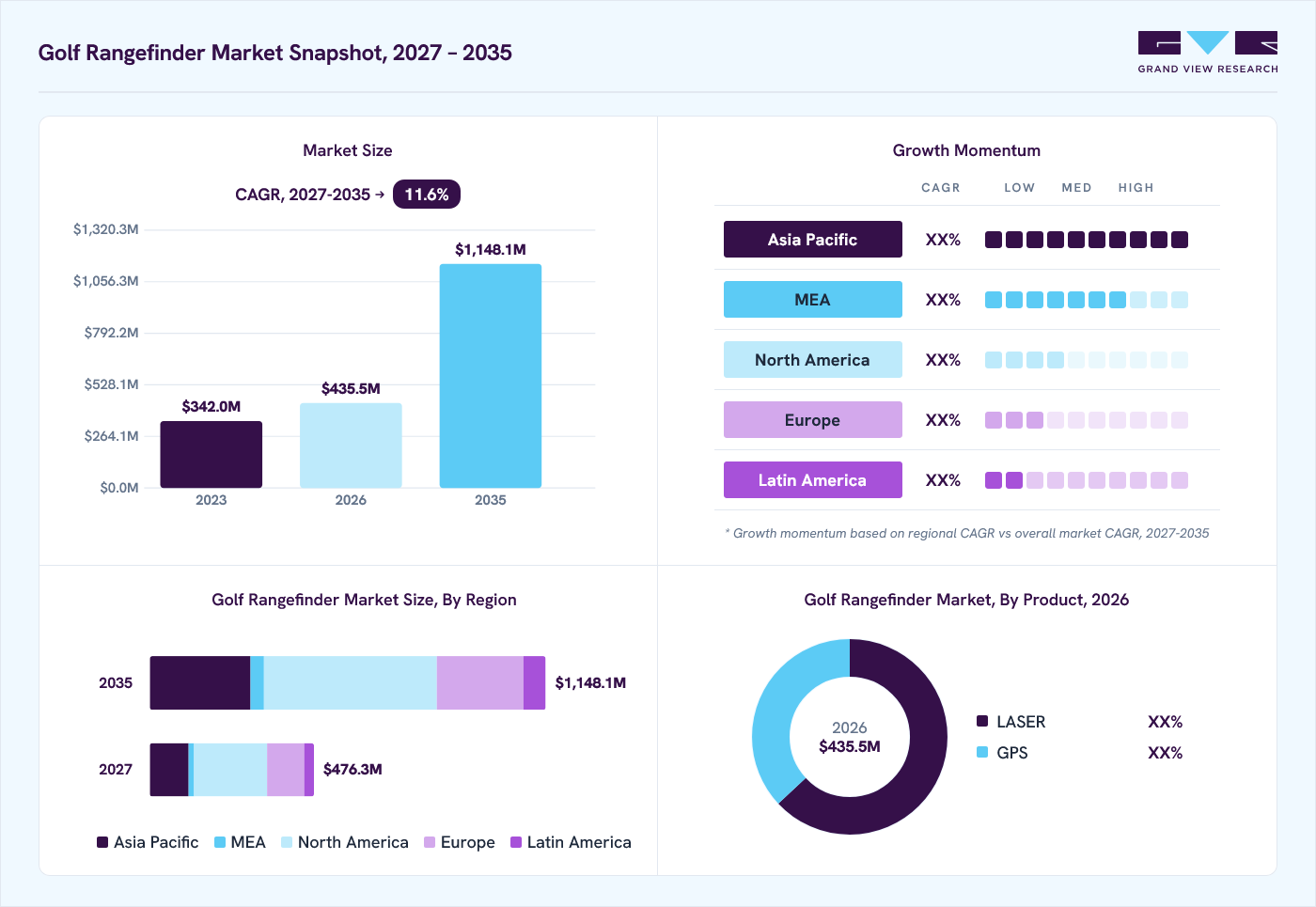
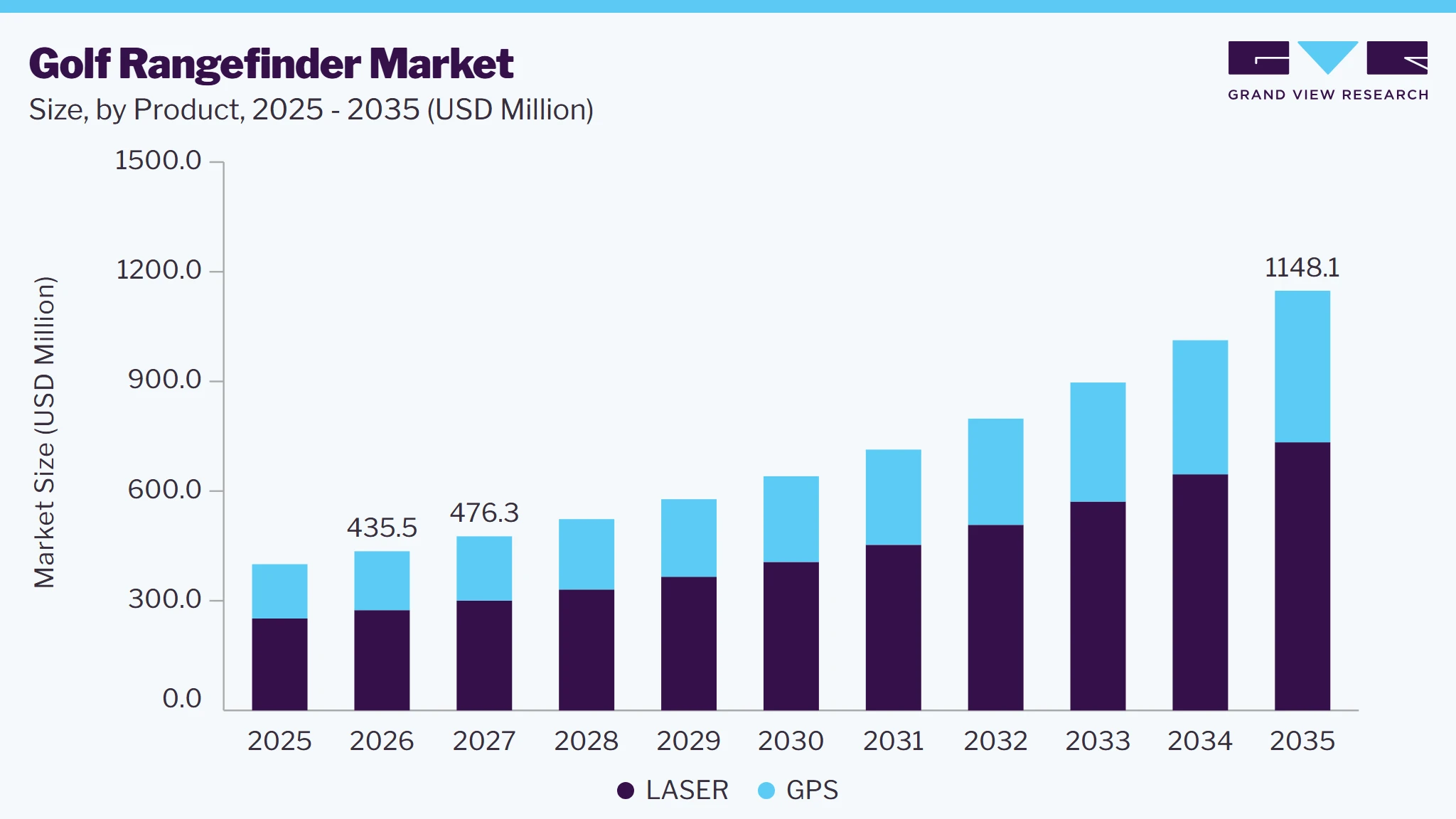
The global golf rangefinder market was valued at USD 435.5 million in 2026 and is projected to grow from USD 476.3 million in 2027 to 1,148.1 million in 2035 at a CAGR of 11.6% from 2027 to 2035. North America dominated the market, accounting for a revenue share of 44.6% in 2026. The market driven by increasing global golf participation among business professionals, amateurs, youth, and female golfers.
 Source: Grand View Research, IR Documents, Primary Interviews, Paid DatabasesTo learn more about this report,
 Download Free Sample Report
Key Market Trends & Insights
- By product, the laser segment dominated the market with a 63.0% share in 2026.
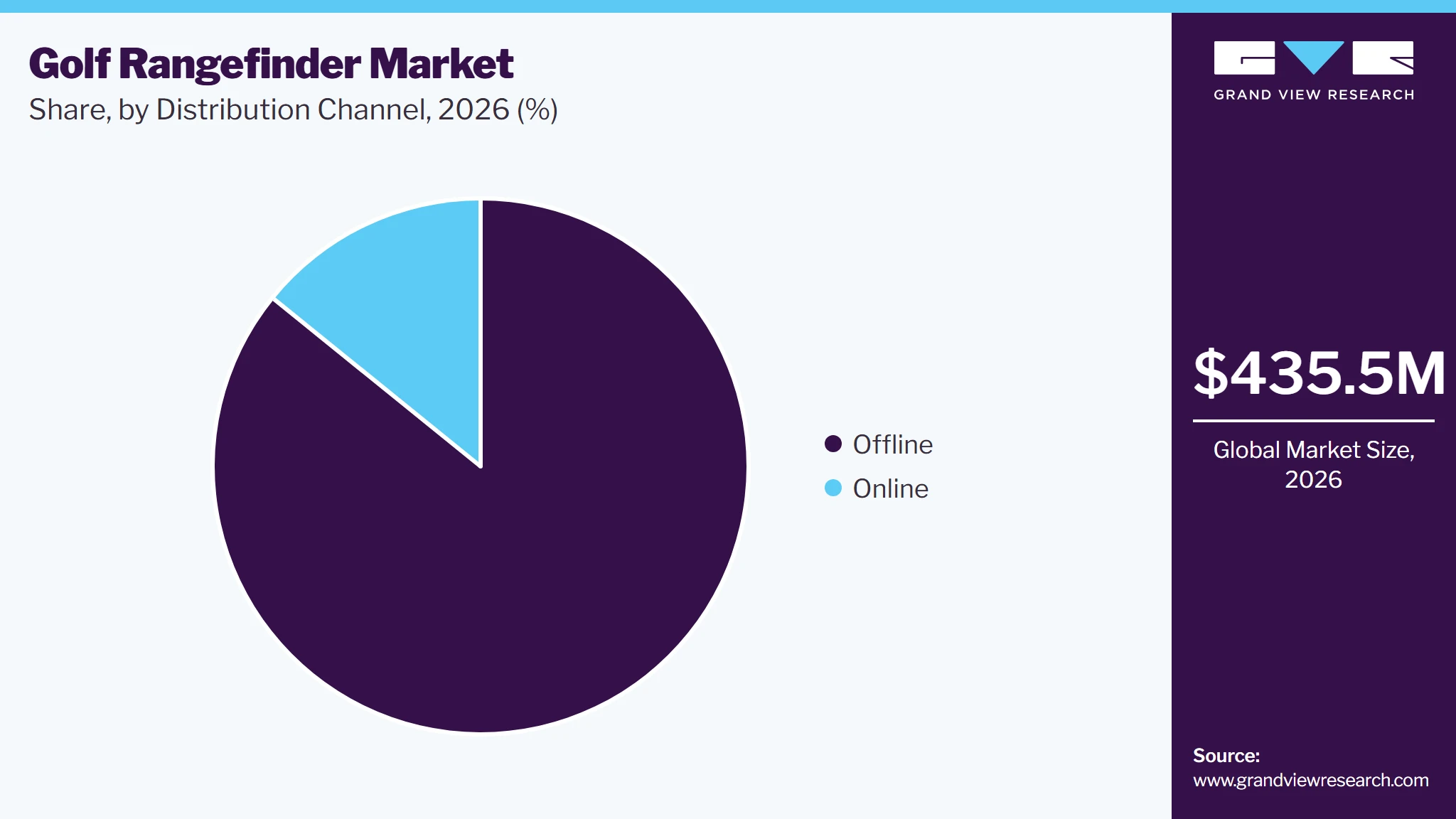
- By distribution channel, the offline segment dominated the market and accounted for 85.8% in 2026.
Regional Highlights
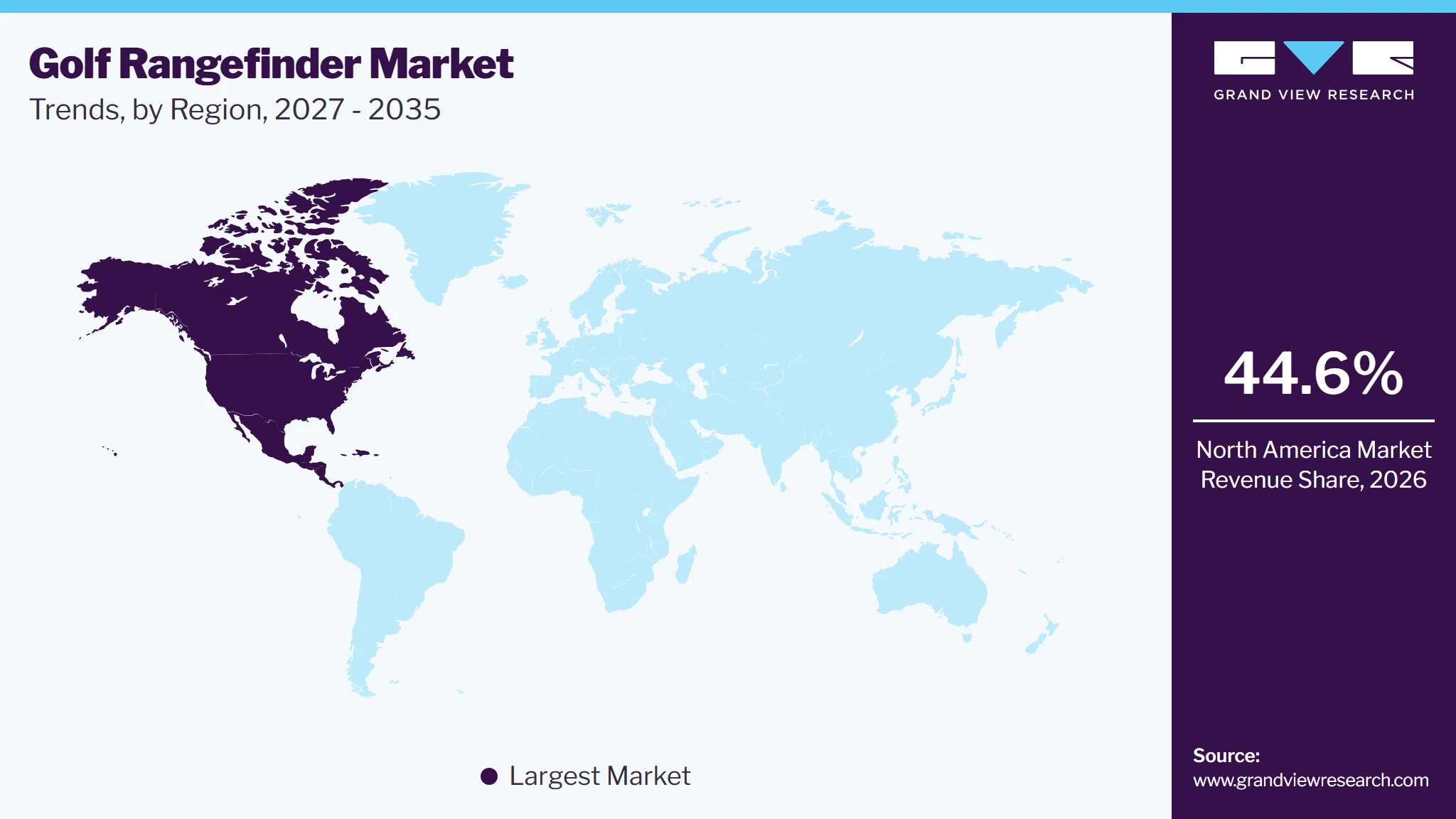
- Largest regional market: North America (44.6% revenue share, 2026)
- By country: The U.S. held the largest market share in 2026.
Market Size & Forecast
- Market size in 2026: USD 435.5 Million
- Estimated market size in 2027: USD 476.3 Million
- Projected market size by 2035: USD 1148.1 Million
- CAGR (2027-2035): 11.6%
Prism AI by Grand View Research Free to tryAsk a question about the golf rangefinder marketTry asking✓Every figure cited from GVR research Prefer the report? Download free sample →According to The R&A's Global Golf Participation Report 2025, total golf participation across its affiliated markets reached 112.2 million adults and juniors in 2025, up 3% from 108 million in 2024. More importantly for rangefinder demand, the number of golfers playing traditional 9- and 18-hole golf increased from 43.3 million in 2024 to 43.9 million in 2025. The report also recorded 18,500 golf courses across R&A-affiliated countries. This expanding base of course-playing golfers creates opportunities for laser rangefinders, as players increasingly seek reliable yardage information for approach shots, club selection and hazard avoidance.
 To learn more about this report, Download Free Sample Report
The increasing acceptance of electronic distance-measuring devices under established golf rules is supporting their integration into regular golfing practices. The USGA's Rule 4.3, effective January 2019, permits distance-measuring devices by default, unless a competition committee or golf course adopts a Local Rule prohibiting their use. The rule specifically recognizes standalone laser rangefinders, handheld GPS devices and GPS watches as distance-measuring equipment. This regulatory change has reduced restrictions on using such technology during amateur and club-level play, expanding the potential applications of rangefinders beyond casual practice.
Furthermore, continuous product innovation by leading manufacturers is strengthening the adoption of technologically advanced golf rangefinders and encouraging replacement purchases. In January 2025, Bushnell Golf launched its A1-Slope laser rangefinder, featuring a rechargeable USB-C battery, ultra-compact design, magnetic cart attachment and slope-compensated distance measurements.
Market Dynamics
Growing familiarity with digital golf tools is encouraging golfers to incorporate electronic distance-measurement solutions into their regular playing routines. According to the National Golf Foundation (NGF), usage of golf applications for stat tracking and scorekeeping increased by 13% compared with 2020, while the use of GPS distances and course guides increased by 7%. This growing acceptance of digital tools creates a favorable environment for dedicated golf rangefinders, particularly GPS-enabled and connected devices that complement mobile golf applications and provide golfers with convenient access to course information.
The availability of golf applications offering GPS-based yardages, digital scorecards, hazard mapping and course information can reduce the need for some recreational golfers to purchase a dedicated rangefinder. Smartphone applications also offer a relatively accessible entry point for beginners who may be unwilling to invest in specialized equipment, while GPS-enabled smartwatches provide distance information without requiring golfers to carry an additional handheld device. This growing availability of alternative distance-measurement solutions can constrain dedicated rangefinder sales, particularly in the entry-level segment.
Increasing acceptance of distance-measuring equipment beyond experienced golfers creates opportunities for manufacturers to expand their customer base through affordable, lightweight and easy-to-operate products. According to a June 2025 survey by Japan's Golf Digest Online (GDO), which received responses from 4,780 golfers, 78.7% reported owning a distance-measuring device. Notably, ownership had also expanded among average and beginner golfers, with nearly 70% of golfers scoring above 100 reporting ownership. This indicates potential for manufacturers to target less experienced players through entry-level laser rangefinders, simplified interfaces and competitively priced GPS-enabled products.
Analyst Perspective
The global golf rangefinder market is evolving from a niche golf accessory category into a technology-enabled equipment segment, supported by growing golf participation and increasing adoption of precision distance-measurement tools. Laser rangefinders continue to attract golfers seeking accurate point-to-point measurements, while GPS rangefinders are gaining relevance through course mapping, hazard information, hands-free distance measurement, and connectivity with golf applications and smartwatches. Manufacturers are strengthening their portfolios through faster measurement response, optical stabilization, slope compensation, improved displays, rechargeable batteries, and connected features. At the same time, expanding online distribution and growing demand among recreational and beginner golfers are creating opportunities beyond the traditional premium and professional user base.
Consumer Insights
 To learn more about this report, Download Free Sample Report
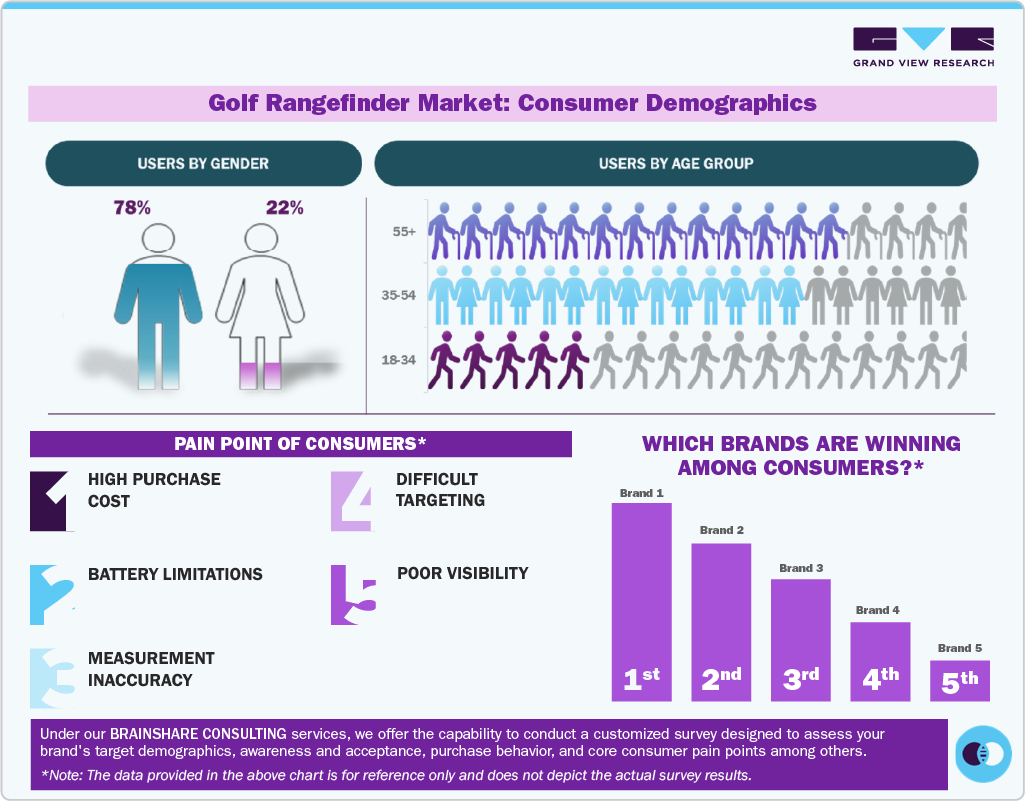
The global golf rangefinder market exhibits a predominantly male consumer base, with male golfers estimated to account for approximately 78% of total users, compared with 22% for female golfers.
-
This distribution reflects the historically higher participation of men in organized and recreational golf, alongside greater adoption of specialized golf equipment among male players.
-
However, increasing female participation in golf and the availability of compact, lightweight and easy-to-operate rangefinders are gradually expanding the female consumer base.
In terms of age distribution, golfers aged 55 years and above represent the largest estimated user group at 40%, followed by the 35-54 age group at 38% and golfers aged 18-34 at 22%.
-
The relatively higher representation of older golfers reflects their established involvement in the sport, purchasing capacity and preference for equipment that supports accurate distance measurement and consistent on-course performance.
-
Meanwhile, younger golfers represent an emerging consumer segment, with growing interest in technologically advanced rangefinders offering GPS connectivity, smartphone integration and simplified performance tracking.
Consumers primarily face challenges related to high purchase costs, battery limitations, measurement accuracy and ease of use. Premium models with advanced optics and slope technology can be expensive for beginners, while frequent battery replacement or charging affects convenience during extended rounds. Additionally, difficulty locking onto distant flags, inaccurate readings under obstructed or challenging conditions, and poor display visibility in bright sunlight can compromise the user experience and influence purchasing decisions.
Product Insights
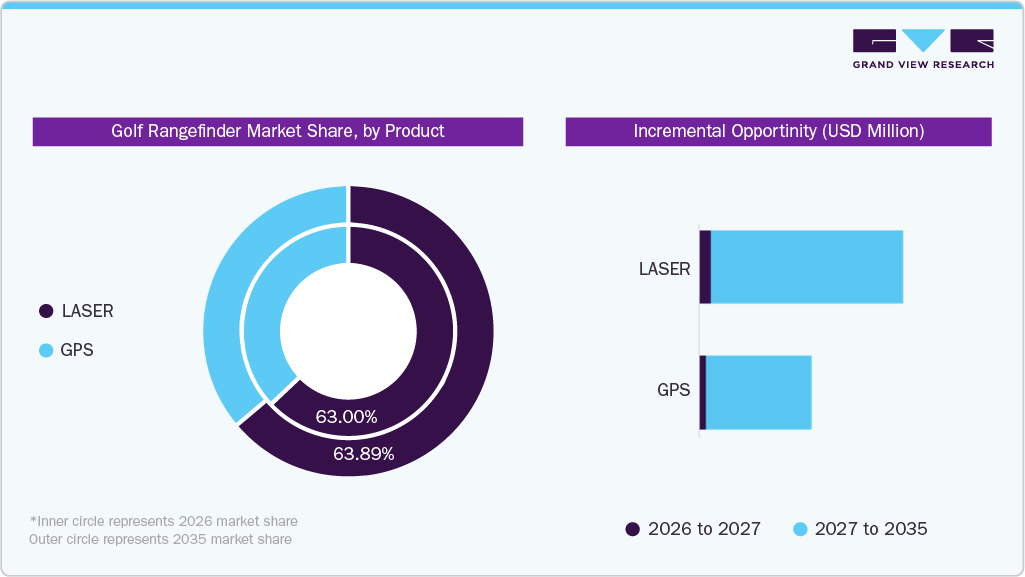
Laser golf rangefinders account for the largest revenue share of 63.0% in 2026, driven by their ability to provide direct distance measurements to flags, bunkers and other course targets with high accuracy. Unlike GPS-based devices, laser rangefinders allow golfers to measure distances to specific targets rather than relying primarily on pre-mapped course locations, making them particularly useful for approach shots and club selection. Technological improvements in target acquisition, optical stabilization and slope-adjusted measurements further strengthen their appeal.
For instance, in January 2025, Nikon launched its COOLSHOT PROIII STABILIZED laser rangefinder, featuring a measurement response time of just 0.1 seconds, compared with 0.3 seconds in its predecessor, alongside optical image stabilization. These advancements reinforce demand for laser-based devices among golfers prioritizing measurement precision and reliable on-course performance.
 To learn more about this report, Download Free Sample Report
GPS rangefinders are anticipated to witness the fastest CAGR of 11.3%, driven by growing demand for hands-free distance measurement, preloaded course maps, hazard identification and integration with golf applications and smartwatches. Unlike laser devices, GPS-based rangefinders allow golfers to quickly access distances to the front, middle and back of greens without manually targeting the flag, making them particularly attractive to recreational and less-experienced players. For instance, in June 2024, Garmin launched its Approach Z30, introducing its Range Relay feature, which transfers laser-measured distances to compatible Garmin smartwatches and the Garmin Golf smartphone application, demonstrating the growing convergence of GPS-based course information and connected distance-measurement technology.
Distribution Channel Insights
The sale of golf rangefinders through the offline distribution channel accounted for the largest share of 85.8% in 2026, supported by golfers' preference to physically evaluate rangefinders before purchasing, particularly given differences in optical clarity, magnification, display visibility, and target-locking performance across models. Specialty golf retailers, sporting goods stores and golf course pro shops also provide product demonstrations and personalized recommendations, helping buyers understand features such as slope compensation, GPS functionality and tournament modes. According to a Golf Datatech 2025 study covering 2,000 serious golfers, purchasing behavior is evaluated across multiple channels, including green-grass pro shops, off-course specialty retailers, custom-fit specialists and sporting goods stores, highlighting the importance of established physical retail networks in golf equipment purchasing.
 To learn more about this report, Download Free Sample Report
The sale of golf rangefinders through the online distribution channel is projected to grow at the fastest CAGR of 11.3% from 2027 to 2035. riven by increasing golfer preference for convenient purchasing, wider product selection and easier price comparisons across brands. Online retailers and marketplaces enable consumers to compare technical specifications, customer reviews, magnification capabilities, slope functionality and GPS features before making purchasing decisions.
According to the National Golf Foundation (NGF), 54% of golfers reported purchasing golf-related merchandise online in the preceding 12 months, compared with 38% in 2019, highlighting the growing acceptance of e-commerce within the golf industry. Additionally, Golf Datatech's 2021 online purchasing study found that 30% of distance-measuring devices purchased online were bought directly from manufacturers, demonstrating the importance of direct-to-consumer digital channels
Regional Insights
North America Golf Rangefinder Market
North America accounts for the largest revenue share of the global golf rangefinder market at 44.6% in 2026, supported by an established golfing ecosystem, high equipment expenditure and widespread adoption of performance-enhancing golf accessories. According to the National Golf Foundation (NGF), 29.1 million Americans played golf on a golf course in 2025, while the country recorded more than 500 million rounds played for the sixth consecutive year. The substantial base of regular golfers, combined with demand for advanced laser measurement, GPS connectivity and premium golfing equipment, supports regional rangefinder sales.
 To learn more about this report, Download Free Sample Report
U.S. Golf Rangefinder Market
The U.S. accounted for approximately 81.3% of North America's golf rangefinder market revenue in 2026, reflecting its extensive golf course network, established specialty retail infrastructure and large population of active golfers. According to the NGF, the U.S. had approximately 16,000 golf courses across 14,000 facilities at the end of 2025, providing a substantial playing environment for distance-measuring equipment. Continued investment in golf equipment and the availability of premium products through specialist retailers and online channels further support the country's dominant market position.
Canada Golf Rangefinder Market
Canada's golf rangefinder market is projected to grow at a CAGR of 12.0% from 2027 to 2035, supported by increasing golf participation and growing demand for specialized golfing equipment. According to The R&A's 2025 Global Golf Participation Report, Canada recorded approximately 593,000 registered golfers in 2025, an 8% increase over 2024, while the number of golfers playing traditional 9- and 18-hole formats reached 5.8 million. Rising participation and increasing rounds played create opportunities for rangefinder manufacturers, particularly for products suited to outdoor playing conditions and seasonal golfing activity.
Europe Golf Rangefinder Market
Europe's golf rangefinder market is projected to register a CAGR of 11.2% from 2027 to 2035, driven by its established golfing culture, extensive golf course infrastructure and growing adoption of technology-assisted playing equipment. According to the European Golf Association (EGA) and The R&A's 2026 European Golf Participation Report, the region recorded more than 4.9 million registered golfers in 2025, representing a 13% increase since 2020. Furthermore, approximately 14 million people participated in traditional 9- and 18-hole golf formats in 2025. The established presence of golf clubs, professional tournaments and specialist equipment retailers supports demand for laser and GPS rangefinders across the region.
Germany Golf Rangefinder Market
Germany accounted for approximately 22.8% of Europe's golf rangefinder market revenue in 2026, supported by its large registered golfing population and well-developed golf course infrastructure. According to The R&A's 2025 Global Golf Participation Report, Germany had approximately 695,617 registered golfers and 721 golf courses in 2025, while 2.34 million people participated in traditional 9- and 18-hole golf formats. The country's established club-based golfing ecosystem and demand for precision-oriented equipment support the adoption of advanced rangefinders, particularly products offering slope compensation, optical clarity and accurate target acquisition.
UK Golf Rangefinder Market
The U.K. golf rangefinder market is projected to grow at a CAGR of 11.1% from 2027 to 2035, supported by established golf participation, a strong club network and continued demand for performance-oriented equipment. According to The R&A's 2025 Global Golf Participation Report, Great Britain and Ireland recorded approximately 6.1 million traditional 9- and 18-hole golfers in 2025, up 5% from 2024. The country's strong golfing heritage, extensive availability of golf courses and active amateur golfing community create a favorable environment for laser rangefinders and GPS-enabled devices used for distance measurement and course navigation.
France Golf Rangefinder Market
France golf rangefinder market is projected to expand at a CAGR of 11.7% from 2027 to 2035, driven by an established recreational golfing base and increasing interest in golf equipment that improves playing accuracy. According to The R&A's 2025 Global Golf Participation Report, France recorded approximately 446,547 registered golfers and 885 golf courses in 2025, while traditional 9- and 18-hole participation reached approximately 1.57 million golfers. This established infrastructure, alongside demand from club members and recreational players, supports opportunities for manufacturers offering compact laser rangefinders, GPS devices and technologically advanced distance-measuring solutions.
Asia Pacific Golf Rangefinder Market
Asia Pacific represents a significant growth opportunity for golf rangefinder manufacturers, supported by established golfing markets such as Japan and South Korea alongside expanding participation in India, China and Southeast Asia. According to The R&A's 2025 Global Golf Participation Report, the region recorded approximately 26.2 million adults participating in golf across R&A-affiliated markets, making it the largest regional adult golfing population within those markets. Japan's established golf infrastructure, China's expanding golfing ecosystem and increasing interest in golf as a recreational and business activity across emerging Asian markets create opportunities for both premium laser and GPS-enabled rangefinders.
China Golf Rangefinder Market
China accounted for approximately 27.3% of Asia Pacific's golf rangefinder market revenue in 2026, supported by its sizeable golfing population, established premium golf facilities and growing interest in golf-related leisure activities. According to The R&A's 2025 Global Golf Participation Report, China had approximately 1 million traditional 9- and 18-hole golfers and 335 golf courses in 2025. The presence of premium golf clubs, golf tourism facilities and affluent recreational players supports demand for technologically advanced equipment, including laser rangefinders offering slope compensation, high magnification and reliable flag-locking capabilities.
India Golf Rangefinder Market:
India golf rangefinder market is projected to register a CAGR of 13.3% from 2027 to 2035, driven by growing interest in golf among affluent consumers, corporate professionals and younger recreational players. According to The R&A's 2025 Global Golf Participation Report, India recorded approximately 368,000 traditional 9- and 18-hole golfers and 289 golf courses in 2025. The report also recorded a substantial increase in registered golfers compared with 2024. The development of premium golf courses, golf communities and destination-based golfing facilities is creating opportunities for rangefinder adoption, particularly among regular golfers seeking accurate distance measurement and improved playing performance.
Japan Golf Rangefinder Market
Japan's golf rangefinder market is projected to grow at a CAGR of 12.5% from 2027 to 2035, supported by its established golfing culture, extensive golf course network and strong consumer interest in technologically advanced sporting equipment. According to The R&A's 2025 Global Golf Participation Report, Japan recorded approximately 10.93 million traditional 9- and 18-hole golfers and 2,163 golf courses in 2025. The large base of established golfers and widespread availability of golf facilities create a substantial addressable market for distance-measuring devices. Demand is further supported by product innovations in optical stabilization, rapid measurement response and compact device designs from domestic manufacturers.
Central and South America Golf Rangefinder Market
The Central and South American golf rangefinder market is projected to register a CAGR of 10.9% from 2027 to 2035, supported by gradually expanding golf participation, increasing golf tourism and the presence of established golfing markets such as Brazil, Argentina and Mexico. According to The R&A's 2025 Global Golf Participation Report, registered golfers across Central and South America increased from approximately 122,000 in 2024 to 146,000 in 2025, representing 20% growth. This expansion of the registered golfing population, alongside increasing participation in traditional golf formats, creates opportunities for rangefinder manufacturers to target club members, recreational golfers and premium golf course users.
Middle East and Africa Golf Rangefinder Market
The Middle East and Africa golf rangefinder market is projected to grow at a CAGR of 12.0% from 2027 to 2035, driven by investments in premium golf infrastructure, destination golf tourism and government-backed sports development initiatives. According to The R&A's 2025 Global Golf Participation Report, Africa recorded approximately 329,000 registered golfers in 2025, representing a 6% increase over 2024, while traditional 9- and 18-hole participation reached approximately 740,000 golfers. Additionally, Saudi Arabia's Public Investment Fund and Golf Saudi announced plans for three flagship golf courses across the Red Sea and NEOM developments in August 2025, with the country's total golf course count expected to more than triple by 2030. These developments are expected to create additional demand for premium golf equipment, including laser and GPS rangefinders, among local players and international golf tourists.
Key Companies & Market Share Insights
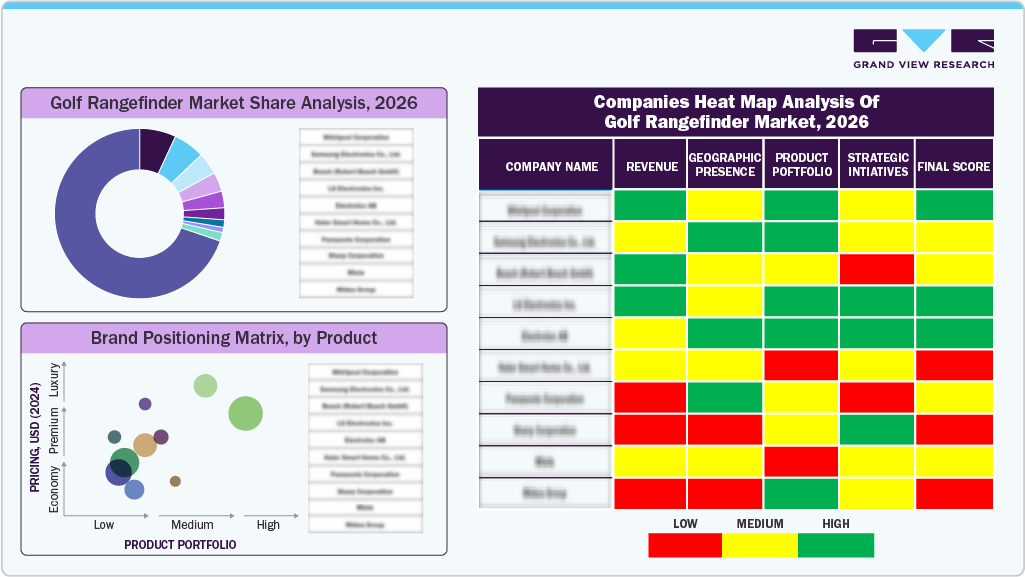
The global golf rangefinder market is characterized by competition among established golf distance-measurement brands, optical and sports-electronics manufacturers, and specialized golf technology companies. Competitive positioning varies by product type, technological capabilities, pricing, brand reputation, and distribution reach.
Established companies benefit from strong brand recognition, product reliability, professional-golfer endorsements, and established retail networks, while specialist and emerging brands compete through feature-rich products, competitive pricing, distinctive designs, and connected golf technology. Competition is increasingly shaped by improvements in laser measurement accuracy, slope compensation, optical stabilization, GPS course mapping, and integration with golf watches and mobile applications.
 To learn more about this report, Download Free Sample Report
Key Golf Rangefinder Companies
The following key companies have been profiled for this study on the golf rangefinder market.
-
Bushnell Golf
-
Garmin Ltd.
-
Nikon Corporation
-
Leupold & Stevens, Inc.
-
Callaway Golf
-
Precision Pro Golf
-
SkyHawke Technologies (SkyCaddie)
-
GolfBuddy
-
Voice Caddie
-
Shot Scope Technologies
-
Blue Tees Golf
-
TecTecTec
-
CaddyTalk
-
MiLESEEY
Competitive Benchmarking
Category
Operating Strategies
Competitive Edge
Key Challenges
Established Players
( Bushnell Golf; Garmin Ltd.; Nikon Corporation; Leupold & Stevens, Inc.; Callaway Golf; SkyHawke Technologies (SkyCaddie); GolfBuddy)
Develop and expand laser and GPS rangefinder portfolios through improvements in measurement accuracy, optical performance, slope compensation, course mapping, and connectivity. Invest in product innovation, brand visibility, professional endorsements, and omnichannel distribution to serve recreational and experienced golfers.
Strong brand recognition, established distribution networks, optical and electronics expertise, product reliability, broad golf technology portfolios, and established relationships with golfers and golf retailers.
Intense competition from established and specialist brands, pressure to maintain technological differentiation, product replacement cycles, pricing competition, and the need to continuously update GPS course databases and connected features.
Specialist & Emerging Players
( Precision Pro Golf; Blue Tees Golf; TecTecTec; CaddyTalk; MiLESEEY; Shot Scope Technologies; Voice Caddie)Focus on specialized rangefinder features, competitive pricing, compact and ergonomic designs, GPS integration, connected applications, and targeted product positioning. Use online retail, direct-to-consumer channels, specialist golf retailers, and digital marketing to build brand awareness and reach specific golfer segments.
Product-development flexibility, focused golf technology expertise, competitive price-to-feature positioning, distinctive designs, and the ability to respond to demand for connected and user-friendly distance-measurement devices.
Lower brand recognition relative to leading manufacturers, limited professional endorsement networks, competition for retail visibility, customer acquisition costs, and the need to establish product reliability and after-sales support across international markets.
Recent Developments
-
In October 2026, Nikon Corporation introduced the COOLSHOT PROIII STABILIZED BLACK, a limited-edition golf laser rangefinder featuring a black finish while retaining the flagship model's optical stabilization and measurement capabilities. The device incorporates HYPER READ technology, delivering measurement results in 0.1 seconds, and Dual LOCKED ON QUAKE technology, which confirms flagstick measurement through visual and vibration alerts. The launch reflects Nikon's focus on combining precision measurement, optical performance, and differentiated product design.
-
In July 2026, Garmin Ltd. unveiled the Approach Z10, a compact laser rangefinder capable of measuring distances to targets up to 350 yards with six-times magnification. The device features Garmin's Range Relay technology, enabling measured distances to be transferred to compatible smartwatches, handheld devices, and the Garmin Golf application. This integration allows golfers to view laser-measured distances alongside green and course information, highlighting the growing convergence of traditional rangefinders with connected golf technology.
Global Golf Rangefinder Market Report Scope
Report Attribute
Details
Market size in 2026
USD 435.5 million
Estimated market size in 2027
USD 476.3 million
Projected market size by 2035
USD 1,148.1 million
Growth rate
CAGR of 11.6% from 2027 to 2035
Actuals
2021 - 2025
Forecast period
2027 - 2035
Quantitative (Revenue) units
Revenue in USD Million, Volume in Thousand Units and CAGR from 2025 to 2033
Report coverage
Revenue forecast, company ranking, competitive landscape, growth factors, and trends
Segments covered
Product, Distribution Channel, Region
Regional Scope
North America, Europe, Asia-Pacific, Central & South America, Middle East & Africa
Country scope
U.S., Canada, Mexico, Germany, U.K., France, Italy, Spain, China, India, Japan, Australia & New Zealand, South Korea, Brazil, South Africa
Key companies profiled
Bushnell Outdoor Products; Nikon Corporation; Laser Link Golf SA; Topgolf Callaway Brands; Leupold & Stevens, Inc.; SkyHawke Technologies LLC; Carl Zeiss AG
Customization scope
Free report customization (equivalent up to 8 analysts’ working days) with purchase. Addition or alteration to country, regional & segment scope.
Pricing and purchase options
Avail customized purchase options to meet your exact research needs. Explore purchase options
Global Golf Rangefinder Market Report Segmentation
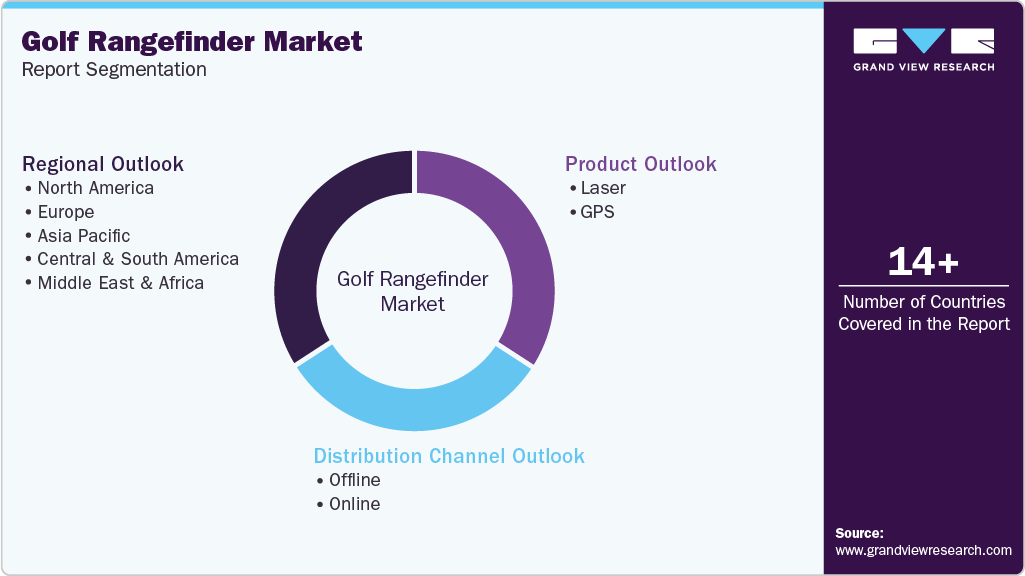
This report forecasts revenue growth at the global, regional and country levels and provides an analysis of the latest industry trends and opportunities in each of the sub-segments from 2021 to 2035. For the purpose of this study, Grand View Research has segmented the global golf rangefinder market report on the basis of product, distribution channel, and region.
 To learn more about this report, Download Free Sample Report
-
Product Outlook (Revenue, USD Million, 2021 - 2035)
-
Laser
-
GPS
-
-
Distribution Channel Outlook (Revenue, USD Million, 2021 - 2035)
-
Offline
-
Sports Shops/Specialized Shops
-
Golf Course Shops
-
Supermarket/Hypermarket
-
-
Online
-
Amazon
-
Others
-
-
-
Regional Outlook (Revenue, USD Million, 2021 - 2035)
-
North America
-
U.S.
-
Canada
-
Mexico
-
-
Europe
-
Germany
-
U.K.
-
France
-
Italy
-
Spain
-
-
Asia Pacific
-
China
-
India
-
Japan
-
South Korea
-
Australia
-
New Zealand
-
-
Central & South America
-
Brazil
-
-
Middle East & Africa
-
Saudi Arabia
-
-
Segment Definition
Product
Revenue capture definition
Laser Rangefinders
Includes handheld optical devices that use laser beams to measure the direct distance between the golfer and a selected target, such as the flagstick, green, bunkers, or other course features. These devices calculate distance based on the time taken for the emitted laser to reflect from the target. Includes standard and slope-adjusted laser rangefinders, models with flag-lock and vibration confirmation, optical magnification, image stabilization, and magnetic cart-mounting features.
GPS Rangefinders
Includes electronic distance-measuring devices that use Global Positioning System (GPS) technology and preloaded or downloadable golf course maps to provide distances to course points, including the front, middle, and back of greens, hazards, bunkers, and other relevant features. Includes handheld GPS devices and dedicated GPS rangefinders featuring touchscreen displays, automatic course recognition, shot tracking, green mapping, and connectivity with golf applications or compatible devices.
Estimation Model
Layer
Golfing Population & Consumer Base Layer
Golf Rangefinder Demand Layer
Product & Distribution Channel Layer
Monetization Layer
Key Question
Who forms the addressable consumer base?
Which golfers purchase golf rangefinders?
What type of golf rangefinder do they purchase, and where do they purchase it?
How much revenue is generated?
Description
Individuals participating in golf, including recreational, amateur, club-affiliated, and professional golfers across the defined markets. The assessment considers the golfing population, frequency of play, golf course availability, participation trends, and consumers with the purchasing power to acquire golf equipment and accessories.
Golfers who use or are likely to adopt distance-measuring devices to improve distance assessment, club selection, and on-course performance. The addressable population is narrowed using rangefinder adoption and ownership rates, playing frequency, golfer experience, purchasing power, and preference for dedicated measuring devices over smartphone-based GPS applications or other alternatives.
Consumers purchasing golf rangefinders are segmented by product type-Laser and GPS-and distribution channel-Offline and Online. The assessment evaluates the revenue and volume contribution of each product segment and sales channel to determine the market's product and distribution mix.
The estimated number of golf rangefinder purchasing consumers is converted into market revenue by applying annual purchase volumes, replacement frequency, average selling prices, and product-specific revenue assumptions. Revenue is further allocated across laser and GPS products, price tiers, distribution channels, and individual country markets to derive the total retail market value.
Delivered Customizations
This report has been delivered with the following In-depth customizations
Client Request
Customization Delivered
Value Adds
Product Type & Technology Assessment
Developed a product-level assessment of laser and GPS golf rangefinders, evaluating measurement accuracy, optical performance, slope compensation, target-lock functionality, course mapping, connectivity, and integration with golf watches and mobile applications.
Helps identify high-potential product technologies and feature combinations, supporting product development, innovation prioritization, and competitive positioning across laser and GPS rangefinder categories.
Distribution Channel & Market Access Assessment
Evaluated offline and online distribution channels, including specialty golf stores, sporting goods retailers, pro shops, brand-owned websites, and e-commerce platforms. Assessed the role of product demonstrations, technical specifications, customer reviews, and price comparisons in purchase decisions.
Helps companies prioritize distribution investments, strengthen retail partnerships, improve online visibility, and identify opportunities to expand direct-to-consumer sales.
Product Positioning & Pricing Strategy
Compared entry-level, mid-range, and premium golf rangefinders across laser and GPS categories, considering product features, measurement capabilities, optical quality, connectivity, brand positioning, and retail pricing.
Helps identify pricing gaps, premiumization opportunities, and competitive feature combinations, supporting product portfolio optimization, pricing decisions, and revenue diversification.
Frequently Asked Questions About This Report
The golf rangefinder market size was valued at 435.5 million in 2026 and is estimated at USD 476.3 million for 2027.
GPS rangefinders are anticipated to witness the fastest CAGR of 11.3% from 2027 to 2035.
The sale of golf rangefinder through offline channel led the market with the largest revenue share of 85.8% in 2026.
The sale of golf rangefinders through the online distribution channel is projected to grow at the fastest CAGR of 11.3% from 2027 to 2035.
Asia Pacific golf rangefinders is projected to grow at the fastest CAGR from 2027 to 2035.
The global golf rangefinder market is expected to grow at a CAGR of 11.6% from 2027 to 2035, reaching USD 1,148.1 million.
Laser golf rangefinder segment led the market with the largest revenue share of 63.0% in 2026.
Key players include Bushnell Outdoor Products; Nikon Corporation; Laser Link Golf SA; Topgolf Callaway Brands; Leupold & Stevens, Inc.; SkyHawke Technologies LLC; Carl Zeiss AG
Key factors driving the golf rangefinder market growth is the increasing global golf participation among business professionals, amateurs, youth, and female golfers.
About the Author(s)
Electronic & Electrical Research Team
Consumer Goods · Electronic & ElectricalThis report was authored by the electronic & electrical research team at Grand View Research - comprising two research analysts, one senior research analyst, and one industry expert - with specialized expertise in the electronic & electrical segment of the consumer goods industry. All findings are based on proprietary consumer goods databases, executive interviews, and regulatory analysis, subject to internal peer review prior to publication.
Last Updated:
Speak to Analyst

Customize this report to your needs - add regions, segments, or data points, with 20% free customization.
Or view our licence options:


ISO 9001:2015 & 27001:2022 Certified
We are GDPR and CCPA compliant! Your transaction & personal information is safe and secure. For more details, please read our privacy policy.


