
- Home
- »
- Advanced Interior Materials
- »
-
Grain Dryers Market Size & Share Report, 2026-2033GVR Report cover

Grain Dryers Market (2026 - 2033)
Size, Share & Trends Analysis Report By Operation (Continuous, Batch), By Mobility (Stationary, Mobile), By End Use (Farms, Grain Storage Facilities), By Region, And Segment Forecasts
Market Size, 2025
$3.2BMarket Estimate, 2026
$3.4BMarket Forecast, 2033
$4.9BCAGR, 2026–2033
5.6%Grain Dryers Market Summary
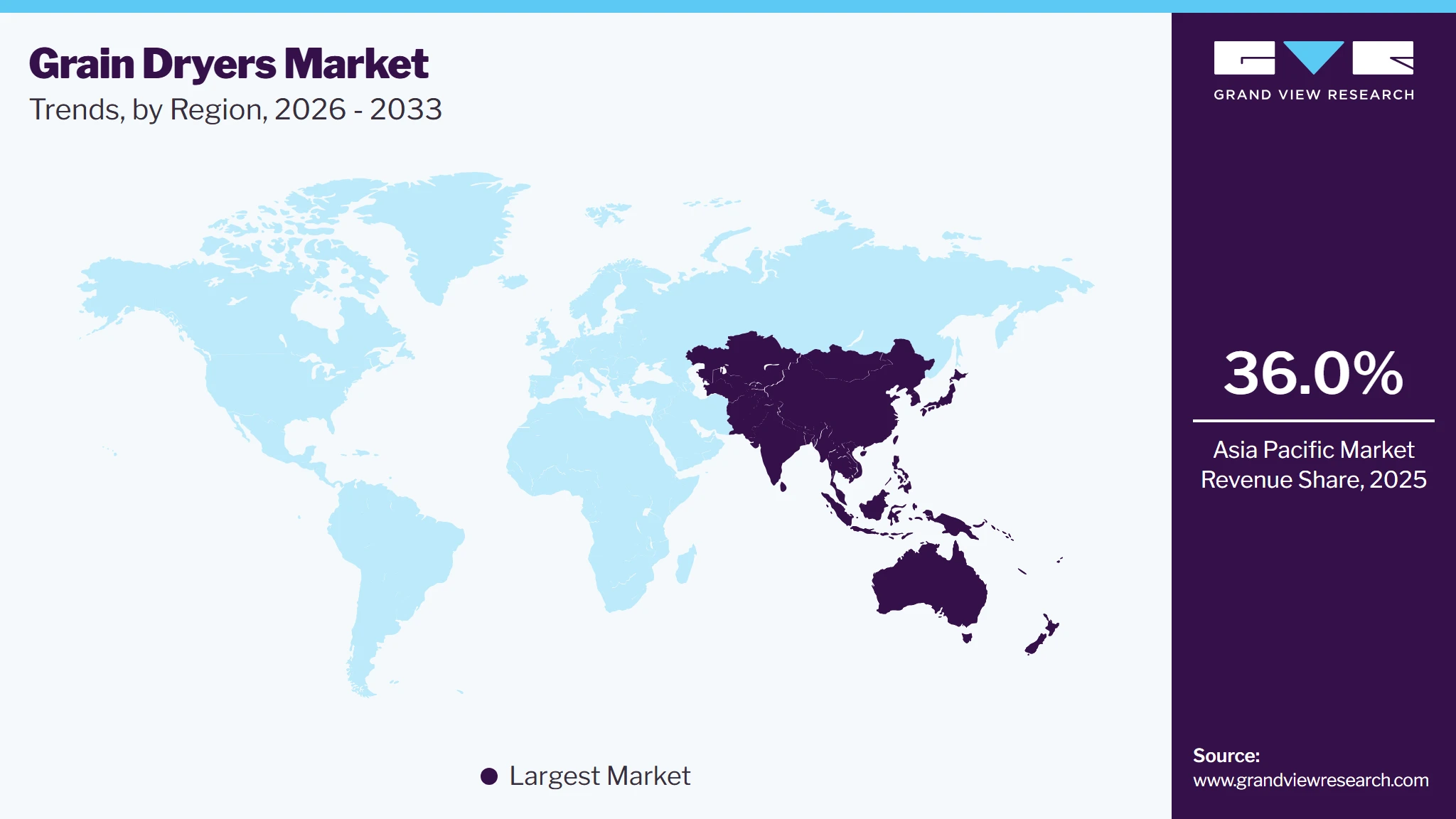
The global grain dryers market size was valued at USD 3.2 billion in 2025 and is projected to grow from USD 3.4 billion in 2026 to USD 4.9 billion by 2033, at a CAGR of 5.6% from 2026 to 2033. Asia Pacific dominated the market, accounting for the largest revenue share of 36.0% in 2025. The grain dryers market is driven by the growing requirement for effective post-harvest grain handling and moisture control.
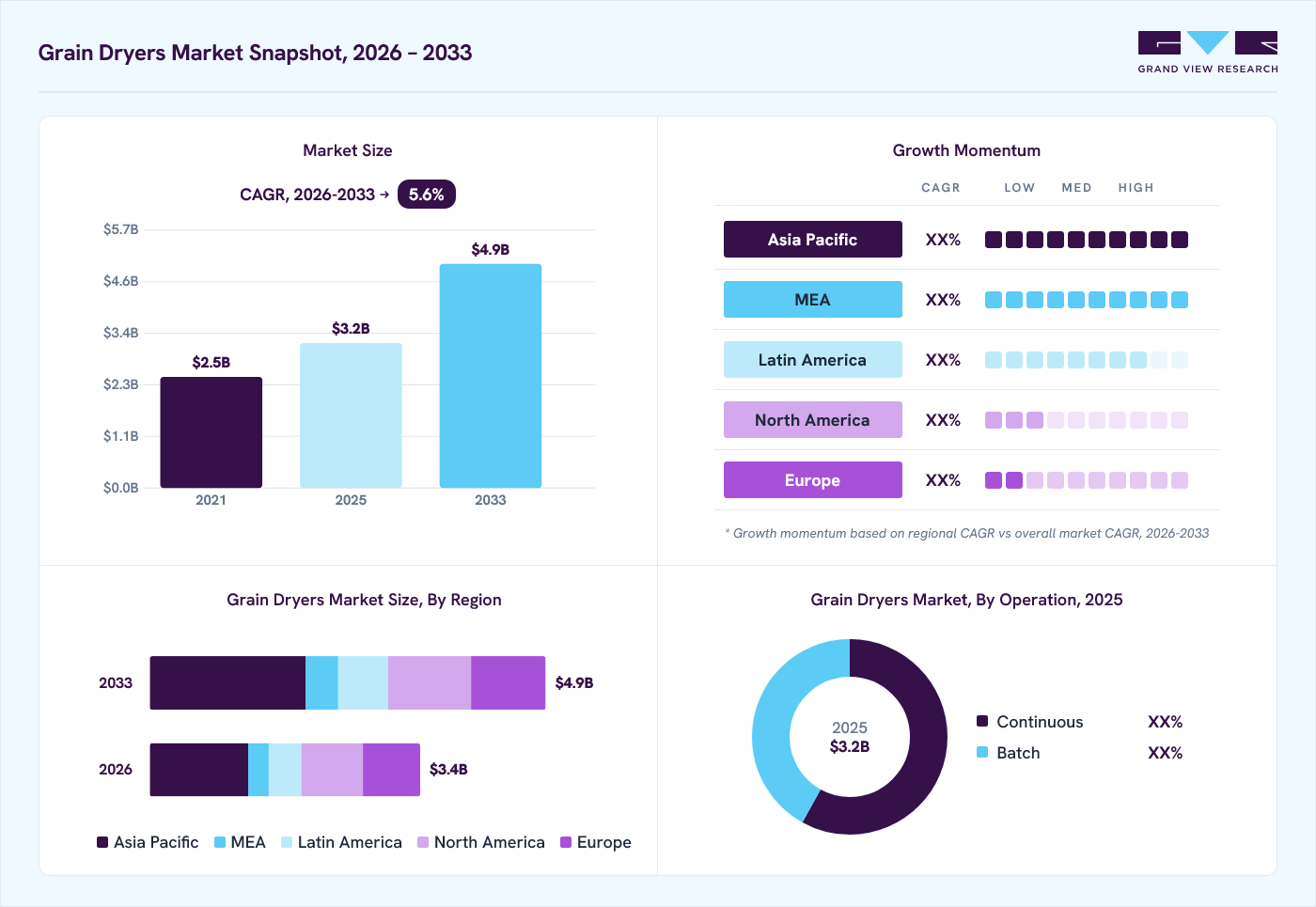 Source: Grand View Research, IR Documents, Primary Interviews, Paid DatabasesTo learn more about this report,
 Download Free Sample Report
Key Market Trends & Insights
- By operation: Batch segment is projected to grow at a CAGR of 4.8% during forecast period.
- By mobility: Stationary segment dominated the market in 2025 accounting for 60.0% market share.
- By end use: Grain processors & mills segment is expected to grow at the fastest CAGR of 6.1% from 2026 to 2033.
Regional Highlights
- Largest regional market: Asia Pacific (36.0% revenue share, 2025)
- By country: China held the largest market share in 2025.
Market Size & Forecast
- Market Size in 2025: USD 3.2 Billion
- Estimated Market Size in 2026: USD 3.4 Billion
- Projected Market Size by 2033: USD 4.9 Billion
- CAGR (2026-2033): 5.6%
GVR research-powered AIAsk Prism AI about the grain dryers marketGet cited answers from GVR research on market growth, segments, regulations and forecasts.Start with✓ Source-linked answers ✓ Market-specific context ✓ Traceable figuresExplore Prism AI ↗
Additionally, changing weather conditions during harvest are increasing the need for dependable drying solutions that can accommodate variations in crop moisture. Manufacturers are incorporating automated temperature control, improved airflow systems, and energy-efficient heating technologies to meet the operational requirements of farms, grain elevators, and processing facilities. Growing investments in post-harvest infrastructure and stricter quality requirements across food, feed, and grain-processing applications are also creating opportunities for advanced drying systems.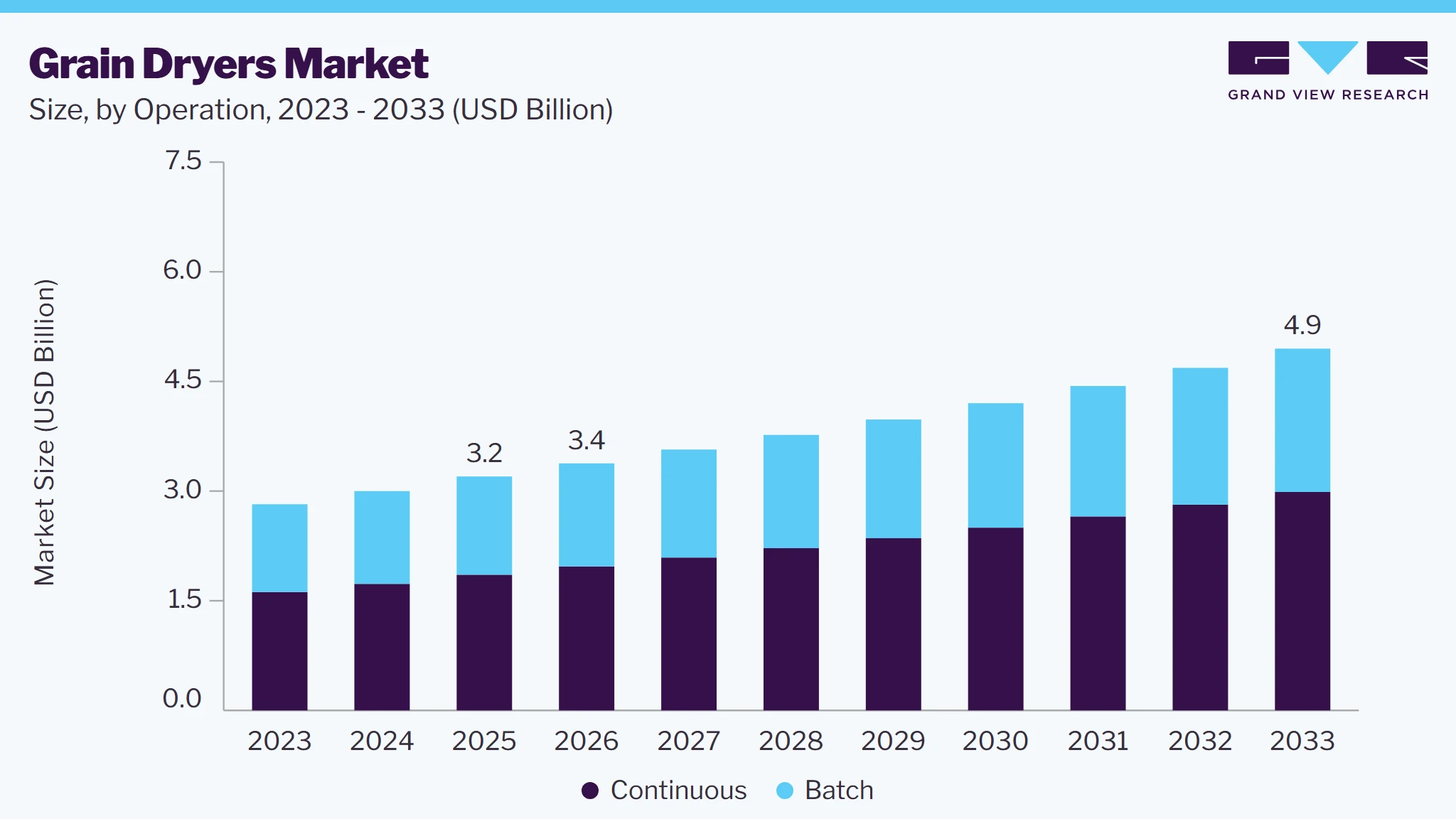 To learn more about this report, Download Free Sample Report
Market Dynamics
The global grain dryers market is shaped by the increasing commercialization of grain handling and the need for equipment that can accommodate varying harvest volumes, crop characteristics, and drying requirements. Market development is influenced by the shift toward larger-scale grain collection and storage operations, seasonal harvesting patterns, equipment replacement cycles, and the modernization of post-harvest infrastructure. Manufacturers compete through dryer configuration, throughput, fuel flexibility, operating reliability, and suitability for different grain-handling environments.
The growth of commercial grain elevators, cooperatives, large-scale farms, and centralized grain collection facilities is creating demand for higher-capacity drying equipment. These operations handle substantial volumes during concentrated harvesting periods, underscoring the importance of rapid, reliable drying before grain enters subsequent handling or storage stages. The expansion of centralized grain handling is therefore supporting demand for continuous-flow and other high-throughput dryer configurations that can accommodate intensive seasonal use.
The purchase of a grain dryer involves significant expenditure beyond the core drying unit, particularly when installation requires burners, conveying equipment, electrical systems, controls, and supporting infrastructure. Ownership costs can also increase through maintenance, replacement of wear components, and periodic servicing. Such financial requirements can extend purchasing cycles and encourage smaller operators to rely on shared, contracted, or existing drying capacity rather than investing in dedicated equipment.
Integration of dryers with grain cleaning, conveying, cooling, weighing, storage, and monitoring equipment offers suppliers an opportunity to move beyond standalone equipment sales. Complete handling lines can simplify material movement between processing stages and enable coordinated operation across a facility. This creates scope for manufacturers to supply customized systems based on facility layout, throughput, crop mix, and processing requirements, particularly in newly developed or upgraded commercial grain-handling installations.
Market Concentration & Characteristics
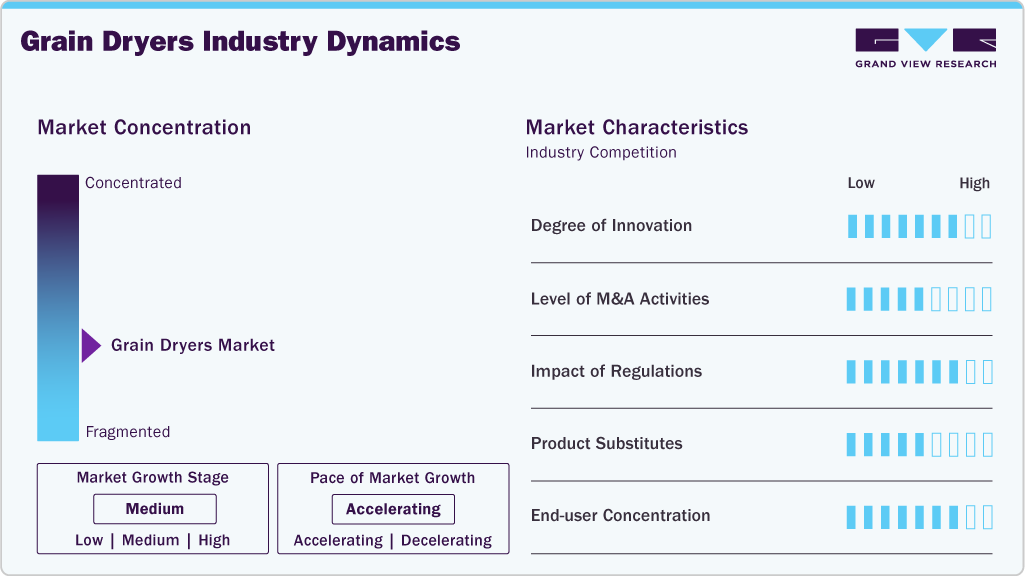
The grain dryers market exhibits a fragmented competitive structure, comprising global agricultural machinery manufacturers, specialized grain-drying equipment suppliers, and regional manufacturers. Competitive intensity varies across geographic markets according to grain production patterns, farm structures, climatic conditions, and the maturity of post-harvest infrastructure. Established participants generally compete through product breadth, drying performance, technical expertise, distribution reach, and after-sales service, while regional manufacturers strengthen their position through localized designs, cost competitiveness, shorter delivery cycles, and application-specific solutions.
Product and technology differentiation form central characteristics of the market. Manufacturers offer batch, continuous-flow, mixed-flow, tower, and other configurations designed for varying throughput requirements and grain-handling conditions. Key areas of differentiation include consistency in moisture removal, drying capacity, thermal performance, fuel consumption, temperature control, and grain quality preservation. The increasing adoption of automated moisture sensors, temperature controls, airflow regulation, and digital monitoring is shifting product competition beyond basic drying capacity toward greater process control.
 To learn more about this report, Download Free Sample Report
The market is further characterized by diverse purchasing requirements across farm sizes, grain elevators, cooperatives, and processing facilities. Large commercial operators typically require high-capacity systems with automated controls and integration capabilities, whereas smaller agricultural operations may prioritize compact designs, operational flexibility, ease of installation, and lower capital requirements. Dealer networks, installation expertise, maintenance support, spare-parts availability, and customization capabilities therefore influence supplier selection alongside equipment specifications.
Analyst Perspective
The grain dryers market remains a diverse equipment segment in which purchasing decisions vary with crop characteristics, facility scale, operating environment, and the degree of post-harvest integration. Competitive positioning is increasingly shaped by the ability to provide application-specific configurations rather than a uniform dryer platform, with suppliers differentiating through capacity ranges, drying methods, control architecture, energy options, and system customization. The market also has a substantial service component, as installation, commissioning, maintenance, spare parts availability, and technical support influence the long-term value of equipment. This creates room for both broad agricultural machinery manufacturers and specialized dryer suppliers, while established regional distribution and service networks can provide an important route to customer retention.
Mobility Insights
By mobility, stationary grain dryers held the largest revenue share in 2025. Their permanent installation supports high-volume drying at grain elevators, commercial farms, mills, cooperatives, and storage facilities. Integration with fixed conveying and handling infrastructure makes stationary systems suitable for continuous or recurring grain-processing requirements.
Mobile grain dryers are projected to register the fastest CAGR of 6.5% during the forecast period. Their ability to be relocated between farms, fields, and collection points provides flexibility where drying demand varies by harvest location and season. Mobile configurations are particularly suitable for decentralized operations that require additional drying capacity without establishing multiple permanent installations.
Operation Insights
By operation, the continuous segment dominated the grain dryers market in 2025, accounting for 58.0% of revenue. Continuous dryers are designed for uninterrupted grain movement through the drying chamber, making them well-suited to high-throughput operations such as commercial farms, grain elevators, cooperatives, and processing facilities. Their ability to handle substantial volumes with consistent drying conditions supports their extensive adoption in large-scale grain-handling applications.
Batch dryers serve operations where grain is processed in discrete quantities and drying requirements vary by crop, volume, or facility. Their operating flexibility makes them suitable for smaller agricultural enterprises, specialized grain handlers, and facilities that do not require continuous processing. Batch configurations also allow operators to adjust drying cycles according to the characteristics of individual grain lots, supporting their use across diverse post-harvest applications.
End Use Insights
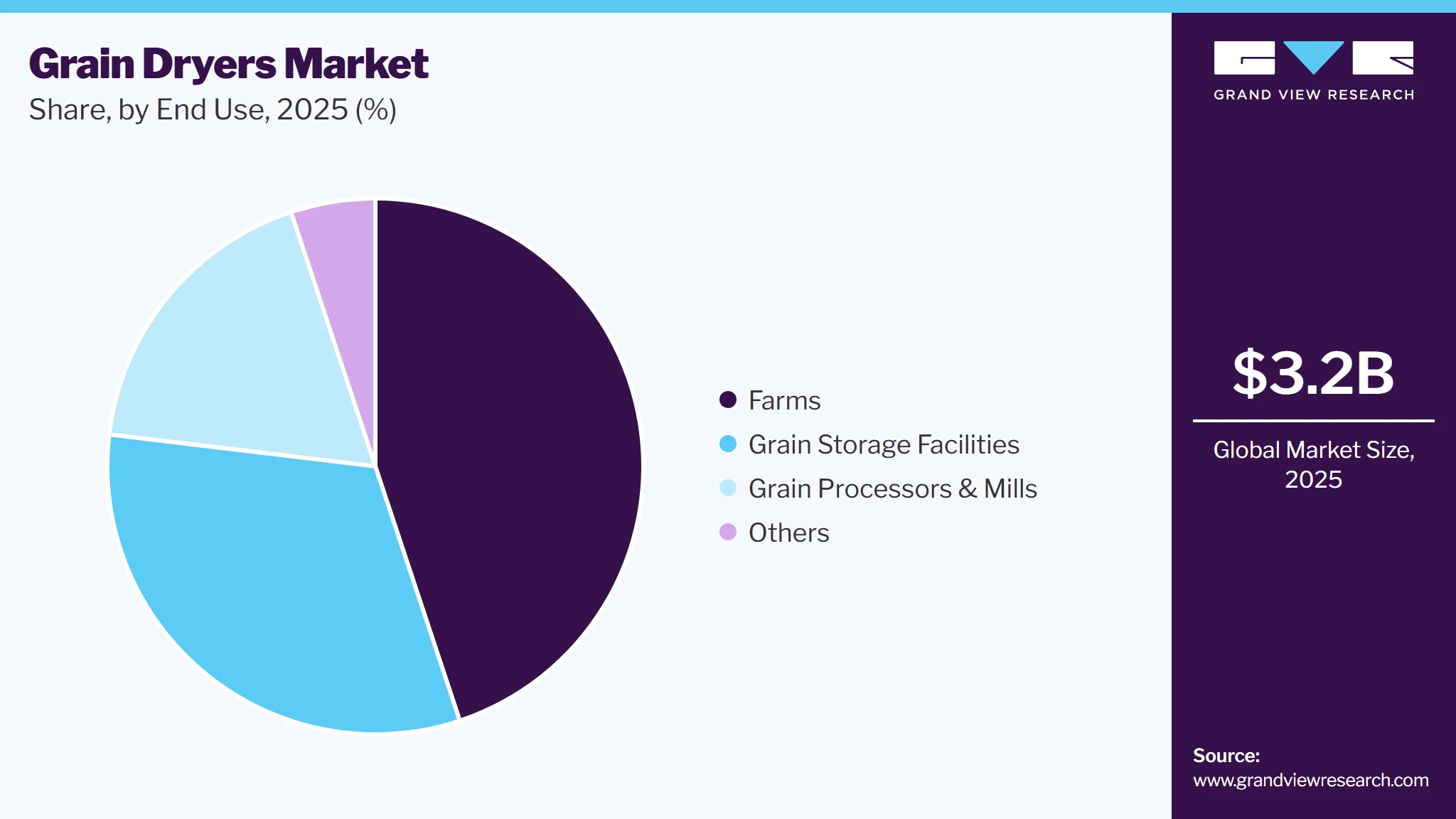
Farms accounted for the largest revenue share, at 44.9%, in 2025. Farm-level adoption remains closely associated with the need to manage harvested grain within limited post-harvest timeframes, particularly across operations with dedicated storage capacity. On-site drying enables producers to condition grain before storage and subsequent sale or processing, making farm-based systems an established component of integrated grain-handling operations. Demand also varies according to farm scale, crop mix, storage arrangements, and the extent of mechanization.
 To learn more about this report, Download Free Sample Report
Grain processors and mills are projected to register the fastest CAGR during the forecast period. Expansion of commercial grain processing capacity is increasing the requirement for drying systems that can accommodate continuous grain intake and maintain specified moisture levels before milling, feed production, or other downstream processing. Equipment selection in this segment is increasingly linked to throughput requirements, dryer configuration, process control, and compatibility with existing material-handling infrastructure, creating demand for systems designed for higher-volume and more controlled processing environments.
Regional Insights
The Asia Pacific grain dryers market encompasses highly diverse agricultural systems, ranging from smallholder-based production to large commercial farming and industrial grain processing. Equipment adoption varies according to the degree of mechanization, organization of grain collection, availability of post-harvest facilities, and prevailing climatic conditions. The region therefore includes both emerging markets where mechanical drying is replacing traditional practices and mature processing centers where demand is increasingly linked to capacity expansion, automation, and equipment modernization.
 To learn more about this report, Download Free Sample Report
China Grain Dryers Market Trends
China's grain dryers market is shaped by the scale and organization of its grain processing industry. Large agricultural enterprises, rice mills, feed manufacturers, grain depots, and centralized collection facilities create demand for equipment capable of handling substantial volumes. Automation is becoming more relevant within these operations, with moisture detection, temperature regulation, and centralized controls allowing drying processes to be managed alongside other grain-handling stages.
India's grain dryers market is projected to register the fastest CAGR of 7.9% during the forecast period. Growth is supported by increasing mechanization across agricultural and food-processing activities, alongside rising investment in modern drying infrastructure. Demand spans farms, rice mills, cooperatives, and commercial processing facilities, with equipment selection influenced by crop type, operating scale, moisture requirements, and local production conditions. The expansion of organized processing capacity is also encouraging adoption of higher-capacity and more automated drying systems.
North America Grain Dryers Market Trends
The North American grain dryers market is characterized by a mature equipment ecosystem in which drying systems are generally integrated into established agricultural operations. Farm storage, grain elevators, cooperatives, conveying systems, and processing facilities already provide extensive infrastructure for post-harvest handling. Consequently, market activity is influenced not only by new installations but also by replacement cycles, capacity additions, system upgrades, and technological improvements to existing equipment.
U.S. Grain Dryers Market Trends
The U.S. grain dryers market benefits from a large installed base across commercial farms and grain-handling facilities. Corn-producing operations represent an important application area, while grain elevators and cooperatives add demand outside the farm level. Because drying equipment is already embedded in many established operations, purchasing decisions increasingly involve replacing aging units, increasing throughput, or upgrading controls rather than establishing basic drying capability for the first time.
Canada's grain dryers market is distinguished by the operating conditions faced by grain producers across large agricultural territories. The combination of short production cycles and variable weather can compress the period available for harvesting and post-harvest handling. This places particular importance on dependable equipment availability during peak periods, making dryer capacity planning and operational reliability important considerations for farms and grain-handling facilities
Europe Grain Dryers Market Trends
The Europe grain dryers market operates within a relatively developed agricultural and equipment environment, with purchasing decisions increasingly influenced by operating economics and integration with existing facilities. Rather than being defined primarily by the introduction of mechanical drying, the market is characterized by modernization of established installations, energy-conscious equipment selection, process automation, and adaptation of systems to individual facility requirements.
Germany's grain dryers market is particularly associated with modernization within an established agricultural infrastructure. Cooperatives, commercial grain handlers, and agricultural enterprises already operate organized collection and storage networks, creating opportunities for equipment replacement and system upgrades. Demand therefore extends beyond basic drying capacity toward improved process control, energy performance, and compatibility with existing handling installations.
France's grain dryers market is strongly connected with its cooperative-based grain collection structure. Cooperatives aggregate crops from numerous producers before directing them toward storage, trading, milling, feed production, or other downstream uses. This creates demand for drying systems capable of accommodating fluctuations in grain intake at centralized facilities, with equipment configuration influenced by collection volumes and the diversity of crops handled.
Middle East & Africa Grain Dryers Market Trends
The Middle East & Africa grain dryers market has a comparatively uneven equipment landscape, reflecting differences in domestic agricultural activity, grain import dependence, processing capacity, and infrastructure development. Demand is concentrated in selected commercial facilities rather than distributed uniformly across agricultural producers. Grain mills, storage complexes, feed operations, and food-processing facilities therefore provide important channels for equipment adoption as post-harvest infrastructure develops.
Saudi Arabia's grain dryers market is primarily associated with strategic grain handling and food-processing infrastructure. The country's demand profile is less dependent on widespread domestic cereal cultivation and more connected with centralized facilities responsible for receiving, conditioning, storing, and processing grain. This creates opportunities for commercial-scale drying equipment integrated into broader grain-handling systems, particularly as storage and food-security infrastructure is modernized.
Latin America Grain Dryers Market Trends
The Latin American grain dryers market is closely linked to the region's role as a major supplier of agricultural commodities. Large production areas, export-oriented supply chains, and expanding transportation and storage networks influence the location and scale of drying capacity. Equipment demand is consequently connected with the broader movement of grain from producing regions toward domestic processors, storage facilities, ports, and export channels.
Brazil's grain dryers market is shaped by the rapid expansion of large-scale agricultural production and the need to strengthen supporting infrastructure across major producing regions. The development of new storage facilities and improvements in grain logistics can require additional drying capacity alongside existing handling equipment. This creates opportunities for systems designed around high-volume operations, particularly at farms, cooperatives, commercial storage facilities, and grain terminals.
Key Grain Dryers Company Insights
Some of the key players operating in the market include AGCO Corporation, Bühler Holding AG, among others.
-
AGCO Corporation manufactures grain drying systems through its grain handling equipment portfolio, including solutions designed for on-farm and commercial grain handling operations. Its dryer offerings are designed to remove moisture from harvested crops while maintaining grain quality and supporting controlled drying across different throughput requirements. The company serves grain producers and storage operations with equipment integrated into broader grain handling and storage systems.
-
Bühler Holding AG provides grain drying equipment as part of its post-harvest processing portfolio, serving agricultural and commercial grain handling facilities. Its drying solutions are designed to control moisture levels after harvest, helping prepare grains for safe storage and subsequent processing. The company combines drying equipment with grain cleaning, conveying, storage, and handling technologies to support integrated post-harvest operations.
Key Grain Dryers Companies
The following key companies have been profiled for this study on the grain dryers market.
-
AGCO Corporation
-
Bühler Holding AG
-
Sukup Manufacturing Co.
-
Alvan Blanch Development Company Limited
-
Cimbria A/S
-
Mathews Company
-
Chief Industries Inc.
-
Mysilo Grain Storage Systems (Özyürek A.Ş.)
-
Shivvers Manufacturing Inc.
-
Brock Grain Systems (CTB Inc.)
-
Perry Engineering Services Ltd.
-
Agridry Dryers Pty Ltd.
-
Grain Handler USA Inc.
-
Fratelli Pedrotti S.r.l.
-
Mecmar S.p.A.
Competitive Benchmarking
Category
Operating Strategies
Competitive Edge
Weakness
Established Players (e.g., AGCO Corporation; Bühler Holding AG; Sukup Manufacturing Co.; Alvan Blanch Development Company Limited; Cimbria A/S; Mathews Company; Chief Industries Inc.; Mysilo Grain Storage Systems (Özyürek A.Ş.))
- Expand portfolios across continuous-flow, mixed-flow, batch, and commercial grain-drying systems to address different throughput and grain-handling requirements.
- Integrate automated moisture and temperature monitoring, airflow control, energy-management features, and drying controls with broader grain-handling and storage systems.
- Integrated product portfolios allow suppliers to serve farm-level, commercial, and large-scale grain-processing operations.
- Established distribution, engineering, installation, and aftermarket networks support equipment deployment across multiple agricultural markets.
- High-capacity and integrated systems can require substantial upfront investment, particularly for large commercial installations.
- Broader product and service structures may be less economical for smaller farms requiring limited-capacity or highly customized drying solutions.
Emerging & Regional Players (e.g., Shivvers Manufacturing Inc.; Brock Grain Systems (CTB Inc.); Perry Engineering Services Ltd.; Agridry Dryers Pty Ltd.; Grain Handler USA Inc.; Fratelli Pedrotti S.r.l.; Mecmar S.p.A.)
- Concentrate on specialized batch, mobile, in-bin, continuous-flow, and other application-specific dryer configurations suited to defined customer segments.
- Strengthen regional distribution, installation, and service capabilities while adapting equipment configurations to local grain types, farm structures, and operating conditions.
- Focused product expertise enables flexible configurations for farm-level and commercial drying applications.
- Regional market knowledge and localized technical support can facilitate equipment selection, installation, and servicing.
- More focused product portfolios can limit the ability to supply highly integrated, multi-equipment grain-processing projects.
- Regional sales and service footprints can restrict participation in large international procurement programs.
Recent Developments
-
In February 2025, GSI introduced its Grain Dryer Guide, an online tool designed to help producers identify suitable drying systems based on their operation size, grain type, and specific drying requirements. The guide provides recommendations across portable, tower, mixed-flow, and TopDry systems, allowing users to evaluate suitable dryer configurations before connecting with a GSI dealer.
-
In June 2026, Jiangxi Hongxing Machinery introduced the 5HP-60 mobile grain dryer, a 5-ton batch circulating system developed for grain drying during wet harvesting conditions. The model expands the company’s 5HP series with a higher-capacity configuration and targets on-farm and decentralized grain drying requirements where mobile equipment and batch processing are preferred.
Grain Dryers Market Report Scope
Report Attribute
Details
Market size in 2025
USD 3.2 billion
Estimated market size in 2026
USD 3.4 billion
Projected market size by 2033
USD 4.9 billion
Growth rate
CAGR of 5.6% from 2026 to 2033
Base year for estimation
2025
Historical data
2021-2024
Forecast period
2026 - 2033
Quantitative units
Revenue in USD billion and CAGR from 2026 to 2033
Report coverage
Revenue forecast, company market position analysis, competitive landscape, growth factors, and trends
Segments covered
Operation mode, mobility, end use, and region
Regional scope
North America; Europe; Asia Pacific; Latin America; Middle East & Africa
Country Scope
U.S.; Canada; Mexico; Germany; UK; Italy; Spain; France; China; Japan; India; Australia; South Korea; Brazil; Argentina; Saudi Arabia; UAE; South Africa
Key companies profiled
AGCO Corporation; Bühler Holding AG; Sukup Manufacturing Co.; Alvan Blanch Development Company Limited; Cimbria A/S; Mathews Company; Chief Industries Inc.; Mysilo Grain Storage Systems (Özyürek A.Ş.); Shivvers Manufacturing Inc.; Brock Grain Systems (CTB Inc.); Perry Engineering Services Ltd.; Agridry Dryers Pty Ltd.; Grain Handler USA Inc.; Fratelli Pedrotti S.r.l.; Mecmar S.p.A.
Customization scope
Free report customization (equivalent up to 8 analysts working days) with purchase. Addition or alteration to country, regional & segment scope.
Pricing and purchase options
Avail customized purchase options to meet your exact research needs. Explore purchase options
Global Grain Dryers Market Report Segmentation
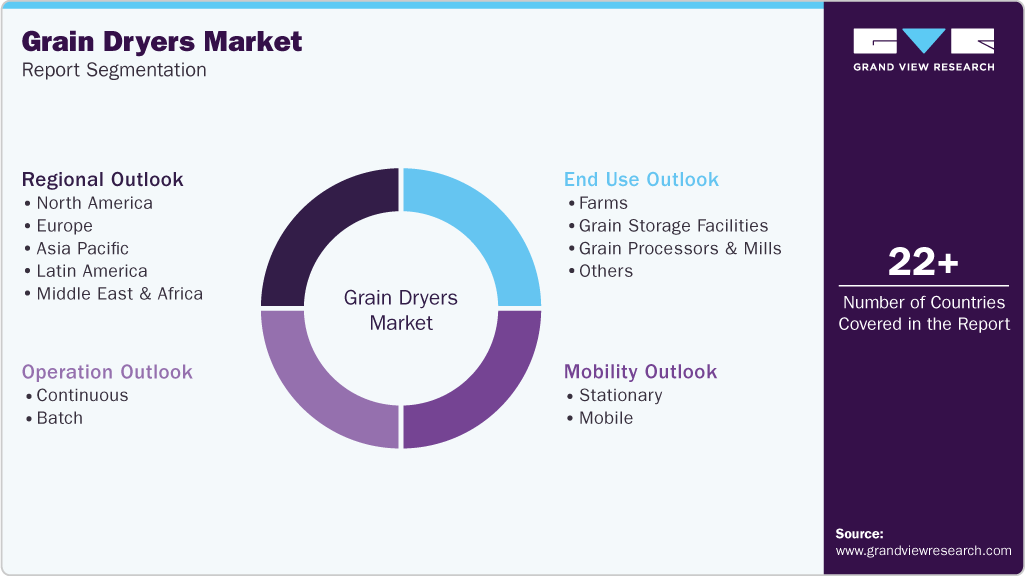
This report forecasts revenue growth at global, regional & country levels and provides an analysis on the industry trends in each of the sub-segments from 2021 to 2033. For the purpose of this study, Grand View Research has segmented the grain dryers market on the basis of operation, mobility, end use, and region:
 To learn more about this report, Download Free Sample Report
-
Operation Outlook (Revenue, USD Billion, 2021 - 2033)
-
Continuous
-
Batch
-
-
Mobility Outlook (Revenue, USD Billion, 2021 - 2033)
-
Stationary
-
Mobile
-
-
End Use Outlook (Revenue, USD Billion, 2021 - 2033)
-
Farms
-
Grain Storage Facilities
-
Grain Processors & Mills
-
Others
-
-
Regional Outlook (Revenue, USD Billion, 2021 - 2033)
-
North America
-
U.S.
-
Canada
-
Mexico
-
-
Europe
-
Germany
-
France
-
UK
-
Spain
-
Italy
-
-
Asia Pacific
-
China
-
India
-
Japan
-
South Korea
-
Australia
-
-
Latin America
-
Brazil
-
Argentina
-
-
Middle East & Africa
-
Saudi Arabia
-
UAE
-
South Africa
-
-
Research Methodology
The grain dryers market figures in this report are based on a proven research process that combines executive interviews with secondary research from proprietary databases, company filings, and recognized regulatory and institutional sources. Market size is built through value-chain sizing - reconciling supply-side and demand-side estimates - and triangulated with bottom-up and top-down approaches. Every estimate passes multiple levels of expert validation before publication, with each grain dryers segment quantified using the revenue-capture definitions in the table below.
Segment Definition
Operation
Revenue Capture Definition
Continuous
Revenue generated through the sale of continuous grain dryers designed for uninterrupted grain movement through the drying chamber. These systems are generally supplied for operations requiring consistent throughput and extended drying cycles.
Batch
Revenue generated through the sale of batch grain dryers that process specified quantities in individual drying cycles. These systems cater to operations requiring flexibility in batch size, crop type, and drying conditions.
Mobility
Revenue Capture Definition
Stationary
Revenue generated through the sale of stationary grain dryers intended for permanent installation at designated operating sites. Equipment is supplied across farms, storage facilities, mills, and other fixed grain-drying locations.
Mobile
Revenue generated through the sale of mobile grain dryers designed for relocation between operating sites. These systems serve users requiring drying capacity across multiple farms, collection points, or temporary processing locations.
End Use
Revenue Capture Definition
Farms
Revenue generated through the sale of grain dryers to farms and agricultural producers for post-harvest crop drying. Demand covers equipment installed for farm-level drying requirements across different crop types and production scales.
Grain Storage Facilities
Revenue generated through the sale of grain dryers to grain elevators, warehouses, storage centers, and related facilities. Equipment is used to prepare incoming grain for storage and maintain required grain condition.
Grain Processors & Mills
Revenue generated through the sale of grain dryers to mills and grain-processing facilities. Systems are used to prepare grain for milling, feed production, and other downstream processing activities.
Others
Revenue generated through the sale of grain dryers to commercial and specialized users outside the defined end-use categories. This includes applications with drying requirements not classified under farms, storage facilities, or processors and mills.
Estimation Model
Layer No.
Layer Name
Key Question
Description
01
Grain Production & Drying Demand Layer
Where is drying capacity required?
Assess grain-drying requirements across major producing regions and crop categories by examining harvested volumes, initial grain moisture, climatic and harvesting conditions, post-harvest handling practices, and the need for controlled moisture reduction before storage, transportation, or processing.
02
Storage & Infrastructure Investment Layer
Where is additional drying capacity being created?
Evaluate investments in grain storage facilities, silos, elevators, commercial handling infrastructure, agricultural processing units, farm modernization, and replacement of aging drying equipment. Link additions to storage and handling capacity with corresponding requirements for grain-drying systems.
03
Dryer Technology & Adoption Layer
Which dryer configurations are being adopted?
Assess equipment adoption across batch, continuous-flow, mixed-flow, tower, portable, and in-bin dryers by capacity, operating mode, automation level, and application. Examine purchasing requirements related to throughput, moisture removal, grain quality, energy consumption, temperature control, and operating scale.
04
Revenue Generation Layer
How is market revenue captured?
Estimate annual revenue from the sale of grain-drying equipment across dryer type, operating mode, capacity, application, and region. Revenue capture covers equipment purchased by farms, grain elevators, storage facilities, commercial grain handlers, and agricultural processing operations, excluding revenue from grain storage, handling, processing, and drying services.
Delivered Customizations
This report has been delivered with the following In-depth customizations
Client Request
Customization Delivered
Value Adds
Competitive Benchmarking
Assessed grain dryer manufacturers across dryer configuration, drying technology, operating mode, capacity range, automation, moisture and temperature management, energy-efficiency features, product portfolio, application coverage, distribution reach, aftermarket support, strategic developments, and geographic presence.
Enabled detailed comparison of manufacturer capabilities, technology specialization, product breadth, service infrastructure, and competitive positioning across farm-level, commercial, and industrial grain-drying operations.
Regional Segmentation
Evaluated North America, Europe, Asia Pacific, Latin America, and the Middle East & Africa based on grain production, harvesting cycles, climatic conditions, storage infrastructure, farm structure, drying requirements, and adoption of on-farm and commercial drying equipment.
Provided a differentiated understanding of regional demand conditions, equipment preferences, infrastructure maturity, and market development potential, supporting geographic expansion, distributor selection, and regional sales planning.
Opportunity Assessment
Examined opportunities across continuous-flow, batch, mixed-flow, tower, portable, and in-bin dryers, incorporating capacity requirements, automation, moisture management, energy consumption, grain quality considerations, storage expansion, equipment replacement, and modernization trends.
Identified potential areas for new product development, technology upgrades, capacity expansion, and investment, while supporting product positioning, commercialization priorities, market-entry planning, and long-term growth strategies.
Frequently Asked Questions About This Report
The global grain dryers market was valued at USD 3.2 billion in 2025 and is estimated to reach USD 3.4 billion in 2026.
The global grain dryers market is projected to grow at a compound annual growth rate (CAGR) of 5.6% from 2026 to 2033, reaching USD 4.9 billion by 2033.
Asia Pacific dominated the global grain dryers market with the largest revenue share of 36.0% in 2025.
Continuous dryers dominated the operation segment with a revenue share of 58.0% in 2025, supported by their suitability for uninterrupted grain movement and high-throughput applications such as commercial farms, grain elevators, cooperatives, and processing facilities.
Mobile grain dryers are projected to register the fastest CAGR of 6.5% during the forecast period, driven by their flexibility to be relocated between farms, fields, and grain collection points.
Farms dominated the end-use segment with a revenue share of 44.9% in 2025, supported by the need for on-site drying to condition harvested grain before storage, sale, or processing.
Grain processors & mills are projected to register the fastest CAGR of 6.1% from 2026 to 2033, supported by expanding commercial grain-processing capacity and the need for controlled moisture levels before milling, feed production, and other downstream processing.
Key players include AGCO Corporation, Bühler Holding AG, Sukup Manufacturing Co., Alvan Blanch Development Company Limited, Cimbria A/S, Mathews Company, Chief Industries Inc., Mysilo Grain Storage Systems (Özyürek A.Ş.), Shivvers Manufacturing Inc., Brock Grain Systems (CTB Inc.), Perry Engineering Services Ltd., Agridry Dryers Pty Ltd., Grain Handler USA Inc., Fratelli Pedrotti S.r.l., and Mecmar S.p.A.
The market is driven by increasing grain production, rising post-harvest handling requirements, mechanization, storage expansion, and adoption of advanced drying technologies.
About the Author(s)
Advanced Interior Materials Research Team
Advanced Materials · Advanced Interior MaterialsThis report was authored by the advanced interior materials research team at Grand View Research - comprising two research analysts, one senior research analyst, and one industry expert - with specialized expertise in the advanced interior materials segment of the advanced materials industry. All findings are based on proprietary advanced materials databases, executive interviews, and regulatory analysis, subject to internal peer review prior to publication.
Last Updated:
Speak to Analyst

Customize this report to your needs - add regions, segments, or data points, with 20% free customization.
Or view our licence options:


ISO 9001:2015 & 27001:2022 Certified
We are GDPR and CCPA compliant! Your transaction & personal information is safe and secure. For more details, please read our privacy policy.


