
- Home
- »
- Food Additives & Nutricosmetics
- »
-
Grape Seed Oil Market Size And Share Report, 2026-2033GVR Report cover

Grape Seed Oil Market (2026 - 2033)
Size, Share & Trends Analysis Report By Extraction Process (Mechanically By Pressing, Chemically Extracted), By Application (Food Industry, Personal Care & Cosmetics, Supplements & Healthcare), By Region, And Segment Forecasts
Market Size, 2025
$659.4MMarket Estimate, 2026
$723.4MMarket Forecast, 2033
$1,496.1MCAGR, 2026–2033
10.9%Grape Seed Oil Market Summary
The global grape seed oil market size was valued at USD 659.4 million in 2025 and is projected to grow from USD 723.4 million in 2026 to USD 1,496.1 million by 2033, at a CAGR of 10.9% from 2026 to 2033. The market in North America dominated with a revenue share of 36.8% in 2025. The demand for the product is expected to be driven by the wide usage in the cosmetics industry as a base makeup in anti-acne creams, under-eye serums, and night care serums.
 Source: Grand View Research, IR Documents, Primary Interviews, Paid DatabasesTo learn more about this report,
 Download Free Sample Report
 Key Market Trends & Insights
- By extraction process: Mechanically by pressing segment held the largest market share of 52.3% in 2025.
- By application: Food industry segment held the largest market share of 37.5% in 2025.
Regional Highlights
- Largest regional market: North America (36.8% revenue share, 2025)
- Fastest-growing regional market: Asia Pacific (highest CAGR, 2026-2033)
- By country: The U.S. held the largest market share in 2025
Market Size & Forecast
- Market size in 2025: USD 659.4 Million
- Estimated market size in 2026: USD 723.4 Million
- Projected market size by 2033: USD 1,496.1 Million
- CAGR (2026-2033): 10.9%
Three ways to get this report
Buy it, customize it, or ask a question.Ask an Analyst
Analyst response in 1 business day
- AccessReport author, directly
- Reply timeWithin 1 working day
- No sales callDirect answer only
- FormatEmail reply
- CostFree, no cost
Get the Full Report
What the study covers
- FormatsPDF · Excel · Dashboard
- Timeline2026–2033 annual, 2025 base
- Coverage20+ countries, 5 regions
- Companies10+ key players profiled
Customize the Report
20% free customization
- IncludeCountries, segments, points
- TailorTo your product definition
- ExtendDeeper competitor detail
- OrA fully bespoke study
- Turnaround5–10 working days
It is a type of carrier oil used in combination with other essential oils in different skin care products. The product is derived from grape seeds and is a by-product of winemaking. Grape seed oil is used in various personal care and cosmetic products owing to its skin-lightening, anti-inflammatory, acne reduction, and moisture retention properties. The U.S. is a major consumer of the product in North America with a revenue share of 82.9% in 2022. The product market is expected to witness significant growth during the forecast period owing to the rising demand for the product from numerous end-use industries such as healthcare, personal care & cosmetics, and food & beverages. Rising disposable income of the consumers, increasing health consciousness among customers, and growing spending power of the people, especially of the young population are the factors anticipated to fuel demand during the forecast period. To learn more about this report, Download Free Sample Report
 Grape seed oil is used for massaging and relieving body pains and muscular aches that occur post-physical workouts. In addition, it is also used in the treatment of psoriasis, eczema, rosacea, etc. owing to its anti-inflammatory and antioxidant properties. As consumers worldwide are becoming increasingly health-conscious and prefer natural/vegan cosmetic products, it is anticipated to surge the global product demand over the forecast period.
The product market is highly fragmented in nature, owing to the presence of companies that operate on international as well as domestic levels and have established themselves as leading companies in terms of production capacity, product portfolio, and geographical presence.
Market Dynamics
The grape seed oil market is influenced by the growing consumer preference for plant-based, naturally derived ingredients across food, personal care, and nutraceutical applications. Rising awareness of the oil's favorable fatty acid profile, antioxidant content, and multifunctional properties is supporting its adoption in premium edible oils, cosmetics, and wellness products. Market participants are expanding cold-pressed and organic product portfolios while strengthening sourcing and processing capabilities to address increasing demand for high-quality, sustainably produced grape seed oil.
The increasing preference for natural, plant-derived ingredients is driving demand for grape seed oil across the food, cosmetics, and personal care industries. Food manufacturers are incorporating grape seed oil into premium cooking oils, dressings, and functional food products due to its neutral flavor, high smoke point, and favorable fatty acid composition. At the same time, growing consumer interest in clean-label and minimally processed products is supporting broader product adoption.
In the personal care sector, grape seed oil is gaining traction as an ingredient in skincare, haircare, and massage formulations owing to its lightweight texture and antioxidant-rich composition. Manufacturers are expanding product portfolios with cold-pressed and organic variants while strengthening sustainable sourcing strategies to meet evolving consumer preferences and enhance product differentiation across premium market segments.
The grape seed oil market is constrained by fluctuations in the availability of grape seeds, as the raw material is largely dependent on grape production and wine processing activities. Variations in harvest yields caused by changing climatic conditions and seasonal factors can affect the consistency of raw material supply, creating procurement challenges for manufacturers.
Rising processing, transportation, and energy costs increase overall production expenses, particularly for premium cold-pressed and organic grape seed oil. These cost pressures can reduce profit margins and limit price competitiveness against widely available edible oils, influencing purchasing decisions in price-sensitive markets.
The growing consumer focus on preventive healthcare and wellness is creating significant opportunities for grape seed oil in nutraceuticals and premium health products. Its antioxidant-rich composition and plant-based origin are supporting its incorporation into dietary supplements, functional foods, and specialized wellness formulations as manufacturers expand portfolios targeting health-conscious consumers.
Increasing demand for natural and sustainably sourced ingredients is encouraging innovation in premium personal care and cosmetic products. Companies are investing in organic certifications, clean-label formulations, and value-added grape seed oil products to strengthen brand positioning and capitalize on the rising preference for high-quality botanical ingredients across global markets.
Analyst Perspective
The grape seed oil market is expected to benefit from increasing demand for natural, plant-based ingredients across food, personal care, and nutraceutical industries. Market participants are focusing on product quality, sustainable sourcing, and premium offerings such as cold-pressed and organic grape seed oils to strengthen their competitive positioning. Continued innovation in extraction technologies and the expansion of value-added applications are expected to support long-term market development, despite challenges related to raw material availability and production costs.
Extraction Process Insights
By extraction process, mechanically by pressing held a dominant position, contributing 52.3% of total revenue in 2025. This is attributed to the high nutritional value and non-toxic attributes of the extracted oil. In addition, the resultant product has no residue at the end of the extraction process which makes it more desirable for numerous consumers.
Although the product extracted using the cold pressing extraction method has a lower yield than the conventional extraction process, the cold pressing extraction method is widely used as chemical or heat treatment approaches are not used in this process. It results in the production of grape seed oil in large volumes that offers numerous health benefits owing to the presence of natural antioxidants in it.
The chemical extraction segment involves the utilization of solvents. It is a diffusion process performed by the immersion of grape seeds in solvents. These solvents are recovered from a mixture of oil and solvents using evaporators and recycled into the process. The chemical extraction method has high yield efficiency, enables recycling, and is cost-effective plus easy to perform. However, during the recovery process of solvents, unsaturated fatty acid decomposition takes place resulting in a high value of crude oil and solvent residues.
Application Insights
Food Industry segment accounted for the largest revenue of 37.5% in 2025. This high share is attributed to the use of the product as an excellent cooking oil in household applications. It has a clean taste and does not add any unwanted taste to the food items. Furthermore, the product is extensively used in cooking due to its high smoke point property.
Naturally sourced grape seed oil demand has increased due to the growing awareness regarding the benefits of natural products and simultaneously due to the harm caused by chemicals used. However, grape seed oil is treated with chemical substances to increase its yield. It has a variety of applications in food products other than its usage as cooking oil. It is extensively used in many bakery products, salad dressings, and in the production of mayonnaise. This is expected to drive the product demand in the global market over the forecast period.
 To learn more about this report, Download Free Sample Report
 Rising mindfulness among the growing population about the use of natural grape seed oil in the cosmetics industry and its benefits, especially in Europe and Asia Pacific, is expected to drive market growth. Cosmetic products such as night care cream and under-eye serum contain grape seed oil as one of the main ingredients. In addition, it is used in skincare products as a skin softener and helps to maintain the skin tone and prevents it from any possible sun damage.
Regional Insights
North America dominated the grape seed oil market with the highest revenue share of 36.8% in 2025. This is attributed to the presence of multiple manufacturers, especially in the U.S. Companies like MONINI, Salute Santé, Conn Oils LLC, POMPEIAN, Plant Therapy Essential Oils, and Heritage Store are operational in the region and collectively hold a significant share of the regional market.
 To learn more about this report, Download Free Sample Report
 The U.S. product market is driven by the advancement and development in the supplements market in the country. As the product is used extensively in the formulation of various healthcare and supplement products, the product demand is anticipated to increase. In addition, the current consumer trend for the usage of organic and naturally derived products is driving market growth in the country.
In Europe, rising disposable income, high living standards, and a strong presence of food & beverage manufacturers are likely to positively contribute to the growth of the overall product market. The rising demand for chemical-free cosmetics in Europe has forced cosmetic manufacturers to utilize grape seed oil as a substitute for conventional chemicals. Moreover, the region is characterized by a high obesity rate, which in turn, is driving the healthcare industry. Pharmaceutical and nutraceuticals sectors account for a major share in terms of product consumption. Ongoing advancements in the medical industry across the region are expected to boost the growth of the product market in Europe during the coming years.
Key Companies & Market Share Insights
The competition in the market is majorly based on product quality, production capacity, and product cost. Big manufacturers including OLVEA, Alvinesa Natural Ingredients, and Mediacovrac have increased their production capacities and expanded their geographical presence using acquiring other companies or inaugurating their offices or production facilities in untapped locations. Manufacturers are concentrating profoundly on enhancing their portfolio of products as well as introducing organic and pure products, intended for keeping pace with future requirements in support of sustainable development. Some prominent players in the global grape seed oil market include:
Key Grape Seed Oil Companies
The following key companies have been profiled for this study on the Grape Seed Oil market
-
Mediacovrac
-
BORGES AGRICULTURAL & INDUSTRIAL EDIBLE OILS, S.A.U.
-
Tampieri
-
OLITALIA S.R.L.
-
Gustav Heess Oleochemische Erzeugnisse GmbH
-
Salute Santé
-
Oleificio Salvadori
-
Alvinesa Natural Ingredients
-
VedOils
-
Henan Province Kunhua Biological Technology Co., Ltd.
Delivered Customizations
Category
Operating Strategies
Competitive Edge
Weakness
Established Players (BORGES AGRICULTURAL & INDUSTRIAL EDIBLE OILS, S.A.U.
Tampieri
OLITALIA S.R.L.
Gustav Heess Oleochemische Erzeugnisse GmbH
Alvinesa Natural Ingredients
Oleificio Salvadori)
- Focus on vertically integrated sourcing and large-scale processing to ensure consistent raw material supply.
- Expand premium product portfolios, including cold-pressed, organic, and food-grade grape seed oils.
- Strengthen global distribution through retail, foodservice, industrial, and B2B ingredient channels.
- Invest in quality certifications, traceability, and sustainable production practices.
- Strong brand recognition and established customer relationships across multiple end-use industries.
- Advanced extraction technologies with high production efficiency and consistent product quality.
- Broad international distribution networks and diversified geographic presence.
- Ability to serve food, cosmetic, pharmaceutical, and nutraceutical manufacturers at scale.
- Higher operating costs associated with quality compliance, sustainability initiatives, and global operations.
- Dependence on grape harvests and wine industry by-products for raw material availability.
- Slower response to niche market trends due to larger organizational structures.
- Margin pressure from volatile raw material and energy costs.
Emerging Players (Mediacovrac
Salute Santé
VedOils
Henan Province Kunhua Biological Technology Co., Ltd.)
- Target niche markets with organic, cold-pressed, and specialty grape seed oil products.
- Expand sales through e-commerce platforms and regional distribution partnerships.
- Differentiate through customized formulations and flexible production capabilities.
- Focus on cost-efficient operations while building brand awareness in domestic and export markets.
- Greater flexibility to respond quickly to changing consumer preferences.
- Ability to develop specialized and value-added products for premium applications.
- Lean operating models supporting competitive pricing in regional markets.
- Strong focus on innovation and customer-specific product offerings.
- Limited production capacity and comparatively smaller distribution networks.
- Lower brand recognition in international markets.
- Greater dependence on third-party suppliers and contract manufacturing in some regions.
- Limited financial resources for large-scale expansion, R&D, and global marketing initiatives
Grape Seed Oil Market Report Scope
Report Attribute
Details
Market size in 2025
USD 659.4 million
Estimated market size in 2026
USD 723.4 million
Projected market size by 2033
USD 1,496.1 million
Growth rate
CAGR of 10.9% from 2026 to 2033
Base year for estimation
2025
Historical data
2021 - 2024
Forecast period
2026 - 2033
Quantitative units
Revenue in USD billion/million, Volume in kilotons and CAGR from 2026 to 2033
Report coverage
Revenue forecast, company ranking, competitive landscape, growth factors, and trends
Segments covered
Extraction Process, Application and Region
Regional scope
North America; Europe; Asia Pacific; Latin America; MEA
Country scope
U.S.; Canada; UK; Germany; France; Italy; Spain; Russia; Turkey; China; India; Japan; South Korea; Australia; New Zealand; Mexico; Brazil; Argentina; Chile; Columbia; Saudi Arabia; UAE; Egypt; South Africa
Key companies profiled
Mediacovrac; BORGES AGRICULTURAL & INDUSTRIAL EDIBLE OILS, S.A.U.; Tampieri; OLITALIA S.R.L.; Gustav Heess Oleochemische Erzeugnisse GmbH; Salute Santé; Oleificio Salvadori; Alvinesa Natural Ingredients; VedOils; Henan Province Kunhua Biological Technology Co., Ltd.
Customization scope
Free report customization (equivalent up to 8 analysts' working days) with purchase. Addition or alteration to country, regional & segment scope.
Pricing and purchase options
Avail customized purchase options to meet your exact research needs. Explore purchase options
Global Grape Seed Oil Market Report Segmentation
This report forecasts revenue and volume growth at global, regional, and country levels and provides an analysis on the latest industry trends in each of the sub-segments from 2021 to 2033. For this study, Grand View Research has segmented the global grape seed oil market report based on extraction process, application, and region:
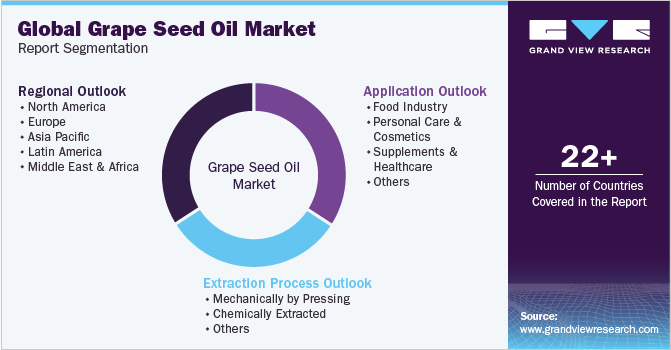 To learn more about this report, Download Free Sample Report
 -
Extraction Process Outlook (Volume, Tons; Revenue, USD Thousand, 2021 - 2033)
-
Mechanically by Pressing
-
Chemically Extracted
-
Others
-
-
Application Outlook (Volume, Tons; Revenue, USD Thousand, 2021 - 2033)
-
Food Industry
-
Natural
-
Conventional
-
-
Personal Care & Cosmetics
-
Natural
-
Conventional
-
-
Supplements & Healthcare
-
Natural
-
Conventional
-
-
Others
-
Natural
-
Conventional
-
-
-
Regional Outlook (Volume, Tons; Revenue, USD Thousand, 2021 - 2033)
-
North America
-
U.S.
-
Canada
-
-
Europe
-
UK
-
Germany
-
France
-
Italy
-
Spain
-
Russia
-
Turkey
-
-
Asia Pacific
-
China
-
India
-
Japan
-
South Korea
-
Australia
-
New Zealand
-
-
Latin America
-
Mexico
-
Brazil
-
Argentina
-
Chile
-
Columbia
-
-
Middle East & Africa
-
Saudi Arabia
-
UAE
-
Egypt
-
South Africa
-
-
Research Methodology
The grape seed oil market figures in this report are based on a proven research process that combines executive interviews with secondary research from proprietary databases, company filings, and recognized regulatory and institutional sources. Market size is built through value-chain sizing - reconciling supply-side and demand-side estimates - and triangulated with bottom-up and top-down approaches. Every estimate passes multiple levels of expert validation before publication, with each Grape Seed Oil segment quantified using the revenue-capture definitions in the table below.
Segment Definition
Segment - Extraction Process
Revenue capture definition
Mechanically by Pressing
This segment includes grape seed oil extracted through mechanical pressing methods, including cold pressing and expeller pressing, without the use of chemical solvents. It primarily serves premium food, personal care, and wellness applications where natural processing and product quality are key purchasing criteria.
Chemically Extracted
This segment covers grape seed oil produced using solvent-based extraction processes to maximize oil recovery from grape seeds. It is widely utilized in large-scale industrial applications where production efficiency, cost optimization, and higher extraction yields are prioritized.
Others
This segment includes grape seed oil produced through alternative extraction techniques such as supercritical fluid extraction and other emerging processing technologies. These methods are adopted for specialized applications requiring enhanced purity, improved bioactive compound retention, or premium product positioning.
Segment - Application
Revenue capture definition
Food Industry
This segment comprises grape seed oil used in edible applications, including cooking oils, salad dressings, marinades, bakery products, and processed foods. Demand is supported by its neutral taste, high smoke point, and suitability for premium food formulations.
Personal Care & Cosmetics
This segment includes grape seed oil incorporated into skincare, haircare, body care, massage oils, and cosmetic formulations. Its lightweight texture and antioxidant-rich composition make it a preferred ingredient in natural and premium personal care products.
Supplements & Healthcare
This segment covers grape seed oil utilized in dietary supplements, nutraceutical products, and health-focused formulations. Adoption is driven by increasing consumer interest in plant-based ingredients and wellness products containing naturally derived oils.
Others
This segment includes industrial and niche applications of grape seed oil, such as aromatherapy products, animal care formulations, and specialty chemical products. Growth is supported by expanding research into new commercial applications and value-added product development.
Estimation Model
Layer Name
Key Question
Description
Grape Production & Grape Seed Availability
What is the availability of grape seeds for oil extraction?
Evaluates grape cultivation, wine and juice production volumes, grape seed generation, regional raw material availability, and supply chain dynamics influencing grape seed oil production.
Extraction & Processing Analysis
How is grape seed oil produced and what are the key extraction trends?
Assesses extraction methods, processing capacities, technology adoption, oil recovery rates, production costs, and the availability of mechanically pressed, chemically extracted, and other extraction technologies.
Product Demand & Application Assessment
Which applications are driving demand for grape seed oil?
Analyzes consumption across food industry, personal care & cosmetics, supplements & healthcare, and other industrial applications, considering evolving consumer preferences and end-use requirements.
Pricing & Trade Assessment
How do pricing and trade influence the market?
Examines raw material pricing, finished product pricing, import-export trends, distribution channels, value chain dynamics, and regional supply-demand balances affecting market performance.
Delivered Customizations
This report has been delivered with the following In-depth customizations
Client Request
Customization Delivered
Value Adds
Regional Segmentation
A comprehensive regional assessment of the grape seed oil market was conducted across North America, Europe, Asia Pacific, Latin America, and Middle East & Africa. The study evaluated country-level demand for mechanically pressed and chemically extracted grape seed oil while examining consumption across food, personal care & cosmetics, supplements & healthcare, and other applications. Regional preferences for natural and conventional products, along with production and consumption trends, were also assessed.
Provides deeper visibility into regional consumption patterns and country-specific demand for natural and conventional grape seed oil. Supports market expansion planning, regional product positioning, and investment prioritization.
Competitive Benchmarking
Leading grape seed oil manufacturers were benchmarked based on extraction capabilities, product portfolio, natural and conventional product offerings, manufacturing capacity, distribution network, sustainability initiatives, and strategic developments. Competitive positioning across food, cosmetics, and healthcare applications was also evaluated.
Helps identify competitive strengths, operational advantages, and product differentiation opportunities. Facilitates strategic planning, partnership evaluation, and long-term market positioning.
Opportunity Assessment
Growth opportunities were assessed across clean-label food products, plant-based nutrition, premium skincare formulations, dietary supplements, and sustainable ingredient sourcing. The analysis also examined increasing demand for natural oils and value-added applications derived from winery by-products.
Enables identification of high-growth application areas and emerging investment opportunities. Supports innovation planning, portfolio expansion, and long-term business growth strategies.
Frequently Asked Questions About This Report
The global grape seed oil market size was valued at USD 659.4 million in 2025 and is estimated at USD 723.4 million in 2026.
The global grape seed oil market is expected to grow at a compound annual growth rate of 10.9% from 2026 to 2033, reaching USD 1,496.1 million by 2033.
North America dominated the grape seed oil market with the highest revenue share of 36.8% in 2025.This is attributable to rising disposable income, health consciousness, and spending power, especially among the younger population.
Some key players operating in the grape seed oil market include Mediaco Vrac, Alvinesa, Borges Mediterranean Group, Tampieri Group, Gustav Heess, Olitalia, Pietro Coricelli, Food & Vine, Oleificio Salvadori, Kunhua Biological Technology, and Hebei Xinqidian Biotechnology, among others.
Key factors that are driving the grape seed oil market growth include the rising demand from numerous end-use industries such as healthcare, personal care & cosmetics, and food & beverage, and the rising number of investments by different key manufacturers for the research & development of plant-based ingredient formulations.
By extraction process, mechanically by pressing held a dominant position, contributing 52.3% of total revenue in 2025.
The food industry segment accounted for the largest revenue share of 37.5% in 2025.
The Grape Seed Oil Market is constrained by the inconsistent availability of grape seeds, as the supply largely depends on grape production and wine industry output. Seasonal variations, changing climatic conditions, and fluctuations in vineyard yields can affect raw material availability, resulting in price volatility and increased production costs for manufacturers.
The growing use of natural and plant-based ingredients in skincare and personal care products presents a significant opportunity for the Grape Seed Oil Market. Rich in antioxidants, vitamin E, and essential fatty acids, grape seed oil is increasingly incorporated into moisturizers, serums, massage oils, and hair care formulations, creating new avenues for market expansion.
About the Author(s)
Food Additives & Nutricosmetics Research Team
Specialty & Chemicals · Food Additives & NutricosmeticsThis report was authored by the food additives & nutricosmetics research team at Grand View Research - comprising two research analysts, one senior research analyst, and one industry expert - with specialized expertise in the food additives & nutricosmetics segment of the specialty & chemicals industry. All findings are based on proprietary specialty & chemicals databases, executive interviews, and regulatory analysis, subject to internal peer review prior to publication.
Last Updated:
Speak to Analyst

Customize this report to your needs - add regions, segments, or data points, with 20% free customization.
Or view our licence options:


ISO 9001:2015 & 27001:2022 Certified
We are GDPR and CCPA compliant! Your transaction & personal information is safe and secure. For more details, please read our privacy policy.


