
- Home
- »
- Advanced Interior Materials
- »
-
Hafnium Market Size, Share, Analysis Report, 2026-2033GVR Report cover

Hafnium Market (2026 - 2033)
Size, Share & Trends Analysis Report By Application (Aerospace & Superalloys, Nuclear, Optical Coatings & Ceramics, Semiconductor & Electronics), By Region (North America, Europe, APAC, Latin America, MEA), And Segment Forecasts
Market Size, 2025
$361.0MMarket Estimate, 2026
$382.7MMarket Forecast, 2033
$615.9MCAGR, 2026–2033
7.0%Hafnium Market Summary
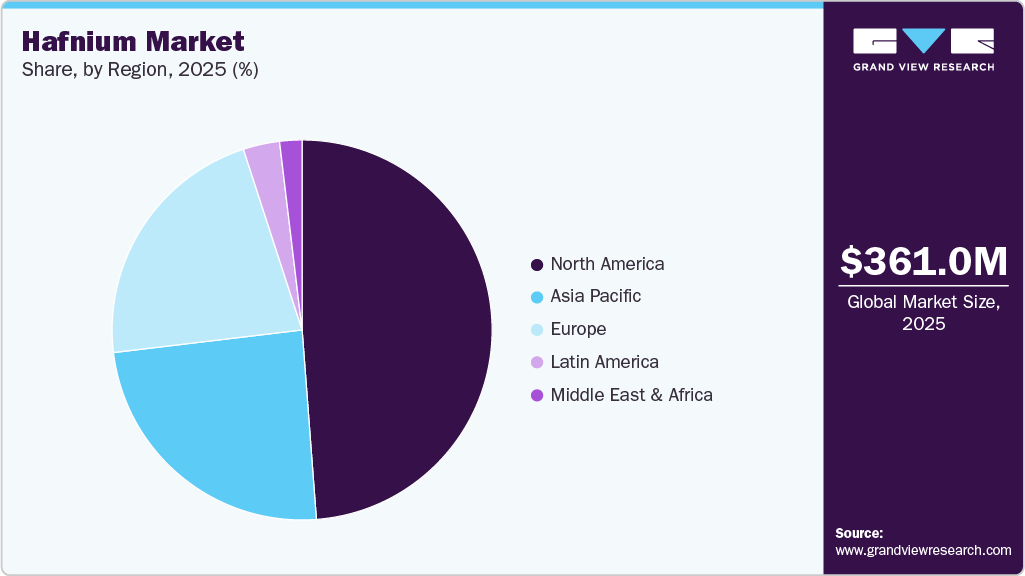
The global hafnium market size was valued at USD 361.0 million in 2025 and is projected to grow from USD 382.7 million in 2026 to USD 615.9 million by 2033, at a CAGR of 7.0% from 2026 to 2033. The market in North America dominated with a revenue share of 48.0% in 2025. Hafnium is a lustrous, silvery-gray transition metal primarily obtained as a byproduct of zirconium refining. Since zirconium and hafnium are found together in nature at a ratio of approximately 1:50 in zircon sands, their supply is inherently linked to the production of nuclear-grade zirconium.
 Source: Grand View Research, IR Documents, Primary Interviews, Paid DatabasesTo learn more about this report,
 Download Free Sample Report
 Key Market Trends & Insights
- By application: Aerospace and superalloys segment held the largest market share of 40.0% in 2025.
Regional Highlights
- Largest regional market: North America (48.0% revenue share, 2025)
- Fastest-growing regional market: Asia Pacific (highest CAGR, 2026-2033)
- By country: U.S. held the largest market share in 2025
Market Size & Forecast
- Market size in 2025: USD 361.0 Million
- Estimated market size in 2026: USD 382.7 Million
- Projected market size by 2033: USD 615.9 Million
- CAGR (2026-2033): 7.0%
Three ways to get this report
Buy it, customize it, or ask a question.Ask an Analyst
Analyst response in 1 business day
- AccessReport author, directly
- Reply timeWithin 1 working day
- No sales callDirect answer only
- FormatEmail reply
- CostFree, no cost
Get the Full Report
What the study covers
- FormatsPDF · Excel · Dashboard
- Timeline2026–2033 annual, 2025 base
- Coverage20+ countries, 5 regions
- Companies10+ key players profiled
Customize the Report
20% free customization
- IncludeCountries, segments, points
- TailorTo your product definition
- ExtendDeeper competitor detail
- OrA fully bespoke study
- Turnaround5–10 working days
The market is experiencing strong growth due to increasing demand from the aerospace and defense industries. The metal is widely used in superalloys, such as MAR M 247, which contains roughly 1.5% hafnium, and in specialized materials, such as niobium-hafnium alloys for jet engines and turbine blades. These components must withstand extreme environments where temperatures often exceed 1,200°C. Major industry players such as GE Aerospace and RTX Corporation use hafnium-modified alloys to improve the structural stability of engine components.
 To learn more about this report, Download Free Sample Report
 The recovery of commercial aviation production, along with rising defense expenditures across major economies such as the U.S. and China, is significantly increasing the consumption of hafnium-based alloys. Furthermore, hafnium carbide, which has a melting point near 3,900°C, is a critical material for heat shields in next-generation hypersonic technologies and rocket nozzles.
The expansion of the global semiconductor industry is another major factor driving the market. Hafnium oxide became an essential material in advanced semiconductor manufacturing when Intel introduced it for its 45nm process node to replace traditional silicon dioxide. This "high-k" dielectric material is vital for improving transistor efficiency and preventing electrical leakage in miniaturized electronic devices. In modern 5nm and 3nm chip architectures, hafnium-based layers allow for thinner insulation without sacrificing power.
Market Dynamics
Hafnium is used in high-temperature superalloys, turbine blades, rocket propulsion systems, and aerospace coatings owing to its excellent thermal stability, oxidation resistance, and mechanical strength under extreme operating conditions. As global aircraft production increases and air travel demand recovers, manufacturers are investing heavily in next-generation jet engines and lightweight high-performance materials, which is accelerating the consumption of hafnium-based alloys and compounds across the aerospace industry. Boeing delivered around 600 commercial aircraft in 2025, while Airbus delivered approximately 793 aircraft during the same year, reflecting strong production activity and rising demand for high-performance aerospace materials.
Increasing defense modernization programs and space exploration activities are further supporting hafnium demand worldwide. Governments across countries such as the U.S., China, India, and Russia are expanding investments in hypersonic missiles, military aircraft, spacecraft, and satellite technologies that require materials capable of withstanding extremely high temperatures and harsh environments. Hafnium’s ability to maintain structural integrity under extreme thermal conditions makes it a critical material for aerospace and defense applications, thereby contributing to long-term market growth.
Hafnium is primarily obtained as a byproduct during zirconium extraction and requires complex separation processes because of the chemical similarity between hafnium and zirconium. The refining process involves advanced technologies, high energy consumption, and stringent purification procedures to achieve the required purity levels for aerospace, semiconductor, and nuclear applications. These factors significantly increase overall production costs, making hafnium one of the more expensive specialty metals in the global market.
Application Insights
The aerospace and superalloys segment is a major growth driver for the hafnium market due to the increasing production of advanced aircraft engines, gas turbines, and space propulsion systems. The expansion of global aircraft manufacturing programs by major aerospace companies such as Boeing and Airbus is further supporting market growth. For instance, Boeing is increasing 737 MAX production toward 42 aircraft per month, while Airbus continues ramping up A320neo family production to meet rising passenger traffic and airline fleet modernization demand. Increasing engine production is directly boosting the requirement for high-performance hafnium-based superalloys used in hot-section engine components.
The nuclear segment is anticipated to register the fastest CAGR over the forecast period. Growing investments in nuclear energy infrastructure are supporting the expansion of the market globally. Hafnium possesses exceptional neutron absorption capabilities, with a thermal neutron absorption cross-section of approximately 105 barns, making it roughly 600 times more effective than zirconium for nuclear reactor control rods. Many countries are extending the operational life of existing Pressurized Water Reactors (PWRs) while simultaneously investing in new nuclear power projects, such as China's rapid fleet expansion, to enhance energy security and reduce carbon emissions. As governments increasingly focus on clean energy, hafnium is favored for its ability to withstand constant neutron bombardment without significant degradation.
Regional Insights
The North America market is being driven by substantial investments in domestic semiconductor manufacturing and advanced electronics production, particularly in the U.S. Government initiatives such as the CHIPS and Science Act, which are encouraging the establishment of new semiconductor fabrication facilities across states, including Arizona, Texas, and Ohio.
U.S. Hafnium Market Trends
The U.S. continues to increase spending on military aircraft modernization, missile defense systems, hypersonic weapons, and space exploration programs through agencies such as the Department of Defense and NASA. These investments are generating strong demand for advanced materials used in aerospace propulsion systems and defense technologies. At the same time, the growing focus on clean energy transition and energy security is supporting investments in advanced nuclear reactors and small modular reactor projects across the country.
Asia Pacific Hafnium Market Trends
The Asia Pacific market is witnessing strong growth due to the rapid expansion of the aerospace and semiconductor industries across China, Japan, South Korea, Taiwan, and India. Rising aircraft production, increasing defense spending, and growing investments in indigenous aerospace manufacturing programs are significantly supporting regional demand.
Hafnium market in China is heavily investing in domestic semiconductor fabrication capacity under its technology self-sufficiency initiatives, which is increasing the consumption of hafnium oxide for advanced high-k dielectric applications in next-generation integrated circuits. Government support for domestic chip manufacturing, coupled with rising production of AI processors, memory chips, and advanced electronics, is significantly strengthening hafnium demand across the electronics sector.
 To learn more about this report, Download Free Sample Report
 Europe Hafnium Market Trends
The European market is experiencing steady growth due to the region’s strong aerospace manufacturing base and increasing investments in defense modernization programs. Countries such as France, Germany, and the UK are major centers for aircraft engine production, aerospace component manufacturing, and advanced turbine technologies.
Latin America Hafnium Market Trends
The Latin American market is witnessing gradual growth due to increasing investments in industrial manufacturing, aerospace activities, and advanced materials research across countries such as Brazil and Argentina. Brazil remains the primary growth center in the region due to its expanding aerospace sector, supported by domestic aircraft manufacturing and defense modernization initiatives. Rising investments in industrial equipment production, power generation infrastructure, and metallurgical industries are creating demand for high-performance materials used in extreme operating environments.
Key Hafnium Company Insights
Some of the key players operating in the market include Framatome Inc., ACI Alloys Inc., among others.
-
Framatome Inc. is a France-based nuclear technology company and a global supplier of nuclear reactor components, fuel systems, and advanced materials for power generation and high-performance industrial applications. The company offers ultra-pure hafnium, hafnium tetrachloride, hafnium alloys, and related specialty metal products for nuclear and non-nuclear applications.
-
ACI Alloys Inc. is a U.S.-based advanced materials manufacturer specializing in high-purity metals, custom alloys, sputtering targets, evaporation materials, and thin film deposition products for research and industrial applications. Founded in 1985 and headquartered in California, the company serves aerospace, semiconductor, defense, energy, and academic research sectors through its expertise in vacuum arc melting, powder metallurgy, machining, and custom alloy fabrication.
Key Hafnium Companies:
The following key companies have been profiled for this study on the hafnium market.
- ACI Alloys Inc.
- Advanced Engineering Materials Limited
- Alkane Resources Ltd.
- American Elements
- Baoji City Hengxin Rare Metal Co., Ltd.
- Framatome Inc.
- Nanjing Youtian Metal Technology Co., Ltd.
- Nantong JP New Material Tech Co. LTD
- Neo
- Westinghouse Electric Company LLC
Delivered Customizations
Operating Strategies
Competitive Edge
Weaknesses
Mature Players: Framatome Inc.; Westinghouse Electric Company LLC; American Elements; Neo; Alkane Resources Ltd.; Nanjing Youtian Metal Technology Co., Ltd.
- Mature participants in the hafnium market primarily focus on long term supply security, vertically integrated processing capabilities, and strategic partnerships with aerospace, nuclear, and semiconductor manufacturers.
- These companies generally operate across the zirconium to hafnium value chain, enabling them to control purification, alloy production, and distribution processes more efficiently.
- Mature market participants possess strong competitive advantages through their established refining infrastructure, long operational history, and strong relationships with nuclear and aerospace customers.
- Their ability to produce reactor grade and semiconductor grade hafnium with extremely high purity levels provides them with a significant advantage over smaller competitors.
- Despite their strong market position, mature players face challenges associated with high operational costs and dependence on zirconium extraction activities.
- Since hafnium is produced as a byproduct of zirconium refining, production volumes are indirectly linked to zirconium market dynamics, limiting operational flexibility.
Emerging Players: ACI Alloys Inc.; American Elements; Baoji City Hengxin Rare Metal Co., Ltd.; Nantong JP New Material Tech Co., Ltd.; Advanced Engineering Materials Limited
- Emerging participants in the hafnium market are primarily concentrating on niche specialization, advanced material innovation, and regional supply chain development.
- These companies often target fast growing applications such as semiconductor grade hafnium oxide, ultra-high temperature ceramics, and advanced aerospace coatings.
- Emerging companies benefit from operational flexibility, faster innovation cycles, and stronger alignment with evolving high technology applications.
- Their smaller organizational structures allow them to adapt quickly to changing customer requirements and rapidly growing sectors such as AI infrastructure, advanced semiconductors, and hypersonic aerospace systems.
- Emerging participants face considerable limitations related to production scale, technological maturity, and customer qualification requirements. Since hafnium applications often involve highly regulated industries such as nuclear energy and aerospace, new suppliers may struggle to secure certifications and long term procurement contracts.
- Their limited operational history can reduce customer confidence, especially where material reliability and consistency are essential.
Recent Developments
- In May 2026, Critical Metals Corp. publicized Tanbreez’s potential as a Western hafnium source after 2025 assays and development updates showed consistent by‑product hafnium across the project’s corridors, and the company moved forward with a USD 30 million acceleration program and ongoing offtake/refinery discussions to fast‑track Tanbreez toward production and downstream processing partnerships.
Hafnium Market Report Scope
Report Attribute
Details
Market definition
The market represents total consumption of hafnium in various applications.
Market size in 2025
USD 361.0 million
Estimated market size in 2026
USD 382.7 million
Projected market size by 2033
USD 615.9 million
Growth rate
CAGR of 7.0% from 2026 to 2033
Base year for estimation
2025
Historical data
2021 - 2024
Forecast period
2026 - 2033
Quantitative Units
Revenue in USD million/billion, volume in tons, and CAGR from 2026 to 2033
Report coverage
Revenue and volume forecast, company ranking, competitive landscape, growth factors, and trends
Segments covered
Application, region
Regional scope
North America; Europe; Asia Pacific; Latin America; Middle East & Africa
Country scope
U.S.; Canada; Mexico; Germany; UK; France; China; India; Japan; South Korea; Australia; Brazil; Saudi Arabia; South Africa
Key companies profiled
Framatome Inc.; Alkane Resources Ltd.; American Elements; Nanjing Youtian Metal Technology Co., Ltd.; ACI Alloys Inc.; Westinghouse Electric Company LLC; Baoji City Hengxin Rare Metal Co., Ltd.; Nantong JP New Material Tech Co. LTD; Advanced Engineering Materials Limited; Neo
Customization scope
Free report customization (equivalent to up to 8 analysts working days) with purchase. Addition or alteration to country, regional & segment scope.
Pricing and purchase options
Avail customized purchase options to meet your exact research needs. Explore purchase options
Global Hafnium Market Report Segmentation
This report forecasts revenue and volume growth at global, regional, and country levels and provides an analysis of the latest industry trends in each of the sub-segments from 2021 to 2033. For this study, Grand View Research has segmented the global hafnium market report based on application, and region:
 To learn more about this report, Download Free Sample Report
 -
Application Outlook (Volume, Tons; Revenue, USD Million, 2021 - 2033)
-
Aerospace & Superalloys
-
Nuclear
-
Semiconductor & Electronics
-
Plasma Cutting
-
Optical Coatings & Ceramics
-
Others
-
-
Regional Outlook (Volume, Tons; Revenue, USD Million, 2021 - 2033)
-
North America
-
U.S.
-
Canada
-
Mexico
-
-
Europe
-
Germany
-
UK
-
France
-
Italy
-
Spain
-
-
Asia Pacific
-
China
-
India
-
Japan
-
South Korea
-
Australia
-
-
Latin America
-
Brazil
-
Argentina
-
-
Middle East & Africa
-
Saudi Arabia
-
South Africa
-
-
Customization Delivered
This report has been delivered with the following In-depth customizations
Client Request
Customization Delivered
Value Adds
Regional Segmentation
Detailed regional analysis of the hafnium market across North America, Europe, Asia Pacific, Latin America, and Middle East & Africa with country level demand assessment. Evaluated consumption trends, production capacities, import dependency, aerospace manufacturing, semiconductor investments, and nuclear infrastructure developments across key countries.
Identified high growth regional demand centers and emerging investment hotspots. Enabled strategic market entry planning and regional expansion prioritization based on demand growth and industrial development trends.
Opportunity Assessment
Identification of high growth opportunities across aerospace, semiconductor fabrication, advanced ceramics, nuclear reactors, and plasma cutting applications. Assessed untapped regional demand, investment attractiveness, and future technology adoption trends across key markets.
Enabled prioritization of the most attractive growth segments and emerging application areas. Supported long term investment planning and strategic business expansion decisions.
Trade Flow & Supply Security Analysis
Evaluated global hafnium trade flows, export-import dependencies, refining concentration, and geopolitical supply risks. Included analysis of zirconium linked supply chains and regional supply security challenges affecting hafnium availability.
Highlighted supply chain vulnerabilities and sourcing diversification opportunities. Supported procurement planning and risk mitigation strategies for downstream consumers.
Frequently Asked Questions About This Report
North America dominated with a 48.0% revenue share in 2025.
Asia Pacific is the fastest-growing region over the forecast period.
The global hafnium market size was estimated at USD 361.0 million in 2025 and is expected to reach USD 382.7 million in 2026.
The global hafnium market is expected to grow at a compound annual growth rate of 7.0% from 2026 to 2033 to reach USD 615.9 million by 2033.
The aerospace & superalloys segment dominated the hafnium market with a revenue share of over 40% in 2025.
Some of the key vendors of the global hafnium market are Framatome Inc., Alkane Resources Ltd., American Elements, Nanjing Youtian Metal Technology Co., Ltd., ACI Alloys Inc., Westinghouse Electric Company LLC, Baoji City Hengxin Rare Metal Co., Ltd., Nantong JP New Material Tech Co. LTD, Advanced Engineering Materials Limited, Neo, among others.
The key factors that are driving the hafnium market include rising demand from the aerospace and defense sectors, increasing use of hafnium in nuclear reactors and superalloys, growing semiconductor manufacturing activities, expanding applications in plasma cutting and high temperature ceramics, and technological advancements in optical coatings & ceramics and advanced materials industries.
About the Author(s)
Advanced Interior Materials Research Team
Advanced Materials · Advanced Interior MaterialsThis report was authored by the advanced interior materials research team at Grand View Research - comprising two research analysts, one senior research analyst, and one industry expert - with specialized expertise in the advanced interior materials segment of the advanced materials industry. All findings are based on proprietary advanced materials databases, executive interviews, and regulatory analysis, subject to internal peer review prior to publication.
Last Updated:
Speak to Analyst

Customize this report to your needs - add regions, segments, or data points, with 20% free customization.
Or view our licence options:


ISO 9001:2015 & 27001:2022 Certified
We are GDPR and CCPA compliant! Your transaction & personal information is safe and secure. For more details, please read our privacy policy.


