
- Home
- »
- Clothing, Footwear & Accessories
- »
-
Headwear Market Size, Share & Trends Report, 2026-2033GVR Report cover

Headwear Market (2026 - 2033)
Size, Share & Trends Analysis Report By Product Type (Caps, Beanies, Neckwear, Hats), By Material (Cotton, Wool, Polyester, Nylon), By End-user (Men, Women, Kids), By Sports/Activities, By Distribution Channel, By Region, And Segment Forecasts
Market Size, 2025
$37.0BMarket Estimate, 2026
$39.4BMarket Forecast, 2033
$62.8BCAGR, 2026–2033
6.9%Headwear Market Summary
The global headwear market size was valued at USD 37.0 billion in 2025 and is projected to grow from USD 39.4 billion in 2026 to USD 62.8 billion by 2033, at a CAGR of 6.9% from 2026 to 2033. Asia Pacific dominated the market, accounting for a revenue share of 39.9% of total revenue in 2025.
 Source: Grand View Research, IR Documents, Primary Interviews, Paid DatabasesTo learn more about this report,
 Download Free Sample Report
 Key Market Trends & Insights
- By product type: Caps segment dominated the global market with a 37.9% revenue share in 2025.
- By end-user: Men accounted for the largest revenue share of 51.5% in 2025.
- By material: Cotton segment accounted for the largest market share of 31.8% in 2025.
- By sports/activity: Running & Fitness segment accounted for the largest revenue share of 24.8% in 2025.
- By distribution channel: Retail accounted for the largest revenue share of 69.4% in 2025.
Regional Highlights
- Largest regional market: Asia Pacific (39.9% revenue share, 2025)
- By country: China held the largest market share in 2025.
Market Size & Forecast
- Market Size in 2025: USD 37.0 Billion
- Estimated Market Size in 2026: USD 39.4 Billion
- Projected Market Size in 2033: USD 62.8 Billion
- CAGR (2026–2033): 6.9%
Three ways to get this report
Buy it, customize it, or ask a question.Ask an Analyst
Analyst response in 1 business day
- AccessReport author, directly
- Reply timeWithin 1 working day
- No sales callDirect answer only
- FormatEmail reply
- CostFree, no cost
Get the Full Report
What the study covers
- FormatsPDF · Excel · Dashboard
- Timeline2026–2033 annual, 2025 base
- Coverage20+ countries, 5 regions
- Companies10+ key players profiled
Customize the Report
20% free customization
- IncludeCountries, segments, points
- TailorTo your product definition
- ExtendDeeper competitor detail
- OrA fully bespoke study
- Turnaround5–10 working days
The market is driven by rising fashion consciousness, expanding participation in sports and outdoor recreation, growing demand for athleisure apparel, increasing adoption of premium and branded headwear, and continuous product innovation in sustainable and performance-oriented materials. The global headwear market is experiencing steady growth as hats, caps, beanies, bucket hats, and other headwear products increasingly serve both functional and fashion purposes. Once primarily purchased for sun protection and weather resistance, headwear has evolved into an integral component of everyday apparel, influenced by streetwear culture, luxury fashion, celebrity endorsements, and social media trends. Consumers are increasingly purchasing multiple headwear styles to complement different outfits, occasions, and seasons, supporting higher replacement rates and repeat purchases. Fashion brands such as New Era, Nike, Adidas, Ralph Lauren, Prada, Gucci, Tommy Hilfiger, and Loro Piana continue to expand their headwear portfolios through seasonal launches, designer collaborations, and premium collections, reinforcing headwear as a high-frequency lifestyle accessory.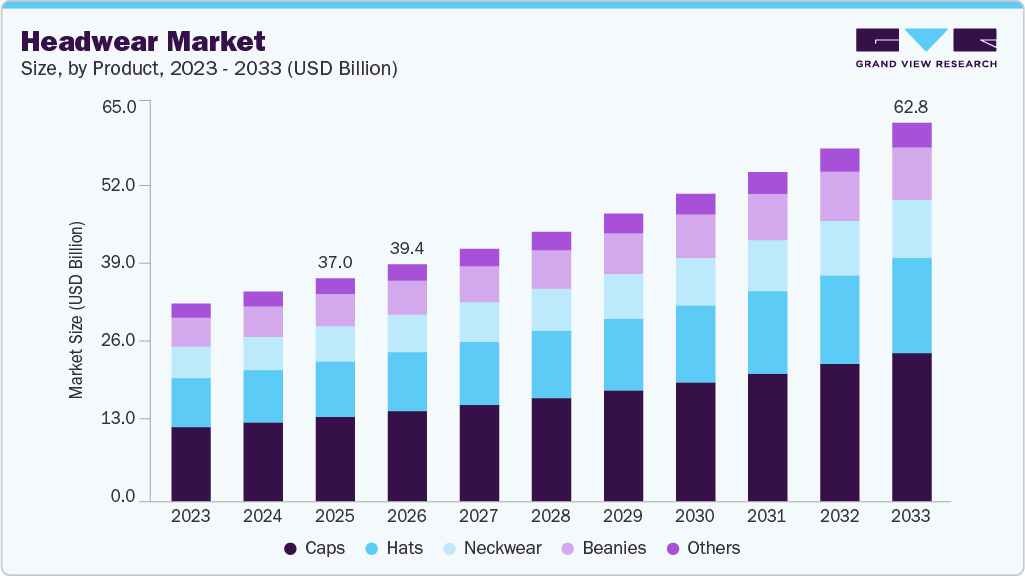 To learn more about this report, Download Free Sample Report
 The market is also benefiting from the growing popularity of sports participation, athleisure, and outdoor recreation. Increasing engagement in activities such as running, cycling, hiking, golf, tennis, and fitness training is driving demand for lightweight, breathable, moisture-wicking, and UV-protective headwear. Simultaneously, the commercialization of professional sports has significantly expanded the licensed headwear segment, with team-branded caps becoming one of the most widely purchased merchandise categories across leagues including Major League Baseball (MLB), the National Basketball Association (NBA), the National Football League (NFL), and international football clubs. Brands such as New Era, '47 Brand, Fanatics, Nike, and Adidas continue to strengthen partnerships with sports leagues and teams, introducing exclusive collections that capitalize on major sporting events and fan engagement.
Another important growth driver is increasing product innovation focused on sustainability, comfort, and technical performance. Manufacturers are introducing recycled polyester, organic cotton, moisture-management fabrics, antimicrobial finishes, and UPF-rated materials to address evolving consumer preferences for environmentally responsible and functional apparel. Companies including Patagonia, Outdoor Cap, Buff, Columbia Sportswear, and The North Face are expanding their portfolios with eco-friendly and performance-oriented headwear designed for outdoor activities and everyday wear. At the same time, rapid growth in e-commerce, direct-to-consumer channels, and customization platforms has improved product accessibility, enabling brands to reach broader consumer groups through personalized designs, limited-edition releases, and digital-first retail strategies. Together, these trends are positioning the global headwear market for sustained growth across fashion, sports, outdoor, and lifestyle applications.
Market Dynamics
The growing influence of fashion trends and lifestyle-driven apparel is a major driver of the global headwear market, as caps, hats, beanies, and bucket hats have evolved beyond functional accessories into essential fashion items across streetwear, luxury, athleisure, and casual wear. Consumers are increasingly purchasing multiple headwear styles to complement different outfits, seasonal collections, and personal aesthetics, resulting in higher purchase frequency and shorter replacement cycles.
The trend is being reinforced by luxury fashion houses and global apparel brands that increasingly position headwear as a core component of their collections. Major brands including Prada, Tommy Hilfiger, Giorgio Armani, Moschino, and Loro Piana have prominently featured baseball caps, bucket hats, and structured hats in recent runway collections, while collaborations such as Swarovski × '47 × MLB (2026) and Brooks Brothers Japan × New Era have expanded the appeal of premium and limited-edition headwear. Simultaneously, social media influencers, celebrity endorsements, and fashion weeks continue to accelerate trend adoption, encouraging manufacturers to launch seasonal collections, designer collaborations, and customizable products. As headwear increasingly serves both functional and fashion purposes, brands are investing in premium materials, sustainable fabrics, and exclusive collections to capitalize on growing consumer demand.
The widespread availability of counterfeit headwear and the dominance of low-cost unorganized manufacturers remain significant restraints for the global headwear market. Fake versions of branded baseball caps, sports caps, luxury hats, and fashion headwear are widely sold through informal retail channels, street markets, and cross-border e-commerce platforms at substantially lower prices, reducing sales of authentic brands while weakening consumer confidence. Counterfeit products typically imitate licensed sports merchandise and premium fashion labels without meeting quality, safety, or durability standards, creating pricing pressure for legitimate manufacturers and distributors.
According to the Organisation for Economic Co-operation and Development (OECD) and the European Union Intellectual Property Office (EUIPO), global trade in counterfeit and pirated goods is estimated at approximately USD 467 billion annually, accounting for around 2.3% of global imports, with apparel, footwear, and accessories among the most frequently counterfeited product categories. The EUIPO further estimates that counterfeiting causes the EU clothing, footwear, and accessories sector to lose approximately EUR 12 billion in sales annually, alongside significant employment losses. Licensed sports headwear is particularly vulnerable, with counterfeit caps featuring logos of leagues such as the MLB, NFL, NBA, FIFA, and major football clubs commonly seized by customs authorities before global sporting events. Luxury fashion brands including New Era, Nike, Adidas, Gucci, Louis Vuitton, and Moncler also continue to invest heavily in anti-counterfeiting technologies, authentication systems, and intellectual property enforcement to protect brand equity. Despite these efforts, the continued expansion of online marketplaces and cross-border counterfeit distribution networks is expected to constrain revenue growth, particularly within the premium and licensed headwear segments.
The increasing consumer preference for personalized fashion and branded merchandise is creating significant growth opportunities for the global headwear market. Advances in digital embroidery, direct-to-garment printing, and on-demand manufacturing allow brands to produce customized caps, beanies, bucket hats, and visors with shorter lead times and minimal inventory risk. This trend is being driven by sports teams, universities, corporate branding, music artists, esports organizations, influencers, and small businesses seeking unique headwear designs for merchandise and promotional campaigns. Companies such as Lids, New Era Cap, Nike (Nike By You), and Yupoong/Flexfit have expanded customization services, enabling consumers to personalize products with names, logos, colors, and artwork through online platforms.
The opportunity is further supported by the continued expansion of the global creator economy. According to YouTube, more than 3 million channels are enrolled in the YouTube Partner Program, reflecting the growing number of creators launching branded merchandise. Simultaneously, Shopify reports continued growth in independent direct-to-consumer businesses utilizing print-on-demand and customized merchandise models. As consumers increasingly seek unique, limited-edition, and identity-driven products, customized headwear is expected to become a high-margin growth segment for manufacturers and brands worldwide.
Consumer Insights
Consumer behavior in the headwear market is shaped by a combination of fashion trends, functionality, brand affinity, and increasing demand for versatile lifestyle accessories. Purchasing decisions are increasingly influenced by comfort, material quality, UV protection, weather adaptability, and alignment with personal style. Consumers are seeking headwear that can transition across sports, outdoor activities, travel, and everyday casual wear, while growing sustainability awareness is encouraging demand for products manufactured using recycled polyester, organic cotton, and responsibly sourced materials. The popularity of athleisure, streetwear culture, and licensed sports merchandise continues to make headwear an essential fashion accessory rather than merely a functional product.
 To learn more about this report, Download Free Sample Report
 Gender-wise consumer behavior reflects a predominantly male buyer base, although female participation continues to expand rapidly.
-
Male consumers account for approximately 55–60% of the market, driven by strong demand for baseball caps, sports team merchandise, outdoor hats, golf caps, and workwear headwear. Brands such as New Era Cap, Nike, Adidas, Under Armour, Columbia Sportswear, and Carhartt continue to cater to this segment through performance-focused and sports-inspired collections.
-
Female consumers represent approximately 40–45% of the market, with demand growing for bucket hats, wide-brim hats, visors, beanies, and fashion-forward caps. Luxury brands, including Gucci, Prada, Dior, Chanel, and Ralph Lauren, along with sportswear companies such as Lululemon, Adidas, and Nike, continue expanding women's headwear collections featuring seasonal designs, sustainable materials, and lifestyle-oriented aesthetics.
-
Headwear purchasing is increasingly becoming fashion and lifestyle-driven, particularly among Millennials and Generation Z, who frequently purchase multiple headwear styles to complement different outfits, sports activities, travel, and social media trends. Celebrity collaborations, influencer marketing, and limited-edition product launches by brands such as New Era, Nike, Adidas, Supreme, and Fear of God Essentials continue to stimulate repeat purchases.
By age group, consumers aged 35–54 years constitute the largest buyer segment, supported by stable disposable incomes, active participation in sports and outdoor recreation, and strong interest in athleisure fashion. This demographic regularly purchases premium branded caps, performance headwear, and seasonal fashion accessories. Consumers aged 45 years and above primarily drive demand for functional sun-protection hats, outdoor and travel headwear, winter hats, and premium lifestyle brands that emphasize comfort and durability. Meanwhile, the 18–24-year age group represents the fastest-growing consumer base, driven by rapid adoption of streetwear culture, esports and sports merchandise, social media influence, music and entertainment collaborations, and increasing online shopping through digital marketplaces.
Consumers in the headwear market commonly face several challenges throughout the purchasing journey.
-
Counterfeit and imitation branded products remain a major concern, particularly for premium sportswear and luxury fashion labels sold through online marketplaces.
-
Fit and sizing inconsistencies across brands often result in lower consumer satisfaction and higher product return rates, especially for e-commerce purchases.
-
Consumers increasingly expect lightweight, breathable, moisture-wicking, UV-protective, and sustainable materials, making product performance an important purchasing criterion alongside aesthetics.
-
Growing environmental awareness has also increased demand for recycled fabrics, ethical sourcing, and transparent sustainability claims, while consumers seek greater product durability and long-term value.
In response to these evolving preferences, purchasing behavior is increasingly shifting toward omnichannel retail and direct-to-consumer ecosystems. Consumers increasingly prefer purchasing through official brand websites, branded retail stores, and trusted online marketplaces that provide authentic products, customization services, flexible return policies, and faster delivery. Companies including Nike, Adidas, New Era Cap, Lids, Patagonia, and Columbia Sportswear have expanded digital customization, virtual product visualization, loyalty programs, and omnichannel fulfillment capabilities. In addition, e-commerce platforms such as Amazon, Zalando, Tmall, Myntra, and Flipkart continue improving consumer confidence through verified brand stores, customer reviews, and streamlined return policies, making online headwear purchases more convenient and reliable.
Analyst Perspective
The headwear market is witnessing a structural shift from seasonal fashion accessories to functional, lifestyle-driven products supported by sports participation, outdoor recreation, and sun protection awareness. Demand is increasingly concentrated in performance caps, technical hats, and UV-protective headwear, while fashion-led categories are benefiting from limited-edition collaborations and licensed merchandise. Premiumization is evident through the use of moisture-wicking fabrics, recycled materials, and customization options. E-commerce and direct-to-consumer channels continue to reshape purchasing behavior by enabling personalization and faster product launches. Meanwhile, brands are balancing fashion trends with performance features, making product innovation and brand collaborations key competitive differentiators across both athletic and casual segments.
Product Type Insights
Caps accounted for the largest revenue share of 37.9% in 2025. The segment's dominance is driven by its versatility across sports, casual wear, corporate branding, and fashion applications. Baseball caps, snapbacks, trucker caps, and dad caps remain the most widely purchased headwear styles owing to their year-round usability and broad demographic appeal. Global brands such as Nike, Adidas, New Era Cap, Under Armour, Puma, and 47 Brand continue expanding their cap portfolios through licensed sports merchandise, athlete collaborations, and limited-edition collections. New Era's official partnerships with Major League Baseball (MLB), the National Football League (NFL), and the National Basketball Association (NBA), along with Adidas and Nike's football club collections, continue to support sustained consumer demand. Increasing corporate promotional spending and customization services offered by companies such as Yupoong/Flexfit have further strengthened the segment's market leadership.
 To learn more about this report, Download Free Sample Report
 Caps are also projected to register the fastest CAGR of 7.4% from 2026 to 2033. Growth is expected to be supported by expanding athleisure trends, rising outdoor recreation, and increasing consumer preference for functional products incorporating moisture-wicking fabrics, UV protection, and recycled materials. The launch of sustainable cap collections by Patagonia, Adidas (Primegreen), and Nike (Move to Zero initiative), together with growing demand for personalized and direct-to-consumer products, is expected to accelerate adoption globally.
Material Insights
Cotton accounted for the largest revenue share of 31.8% in 2025. The segment's leadership is attributed to cotton's breathability, comfort, durability, and suitability across both casual and sports headwear. Cotton remains the preferred material for baseball caps, bucket hats, and promotional headwear due to its affordability and ease of customization. Leading manufacturers including New Era Cap, Nike, Adidas, Puma, and Under Armour continue to utilize premium cotton and organic cotton fabrics across their core product lines. Growing consumer preference for natural fibers has also supported continued demand.
 To learn more about this report, Download Free Sample Report
  To learn more about this report, Download Free Sample Report
 Polyester is expected to register the fastest CAGR of 7.6% from 2026 to 2033. Growth is driven by increasing demand for lightweight, moisture-wicking, quick-drying, and performance-oriented headwear used in running, cycling, golf, and outdoor sports. Companies including Nike (Dri-FIT), Adidas (AEROREADY), Under Armour (HeatGear), and Columbia Sportswear (Omni-Wick) increasingly utilize recycled polyester and technical fabrics to improve product performance while supporting corporate sustainability goals. Rising adoption of recycled PET fibers is expected to further strengthen segment growth.
End-user Insights
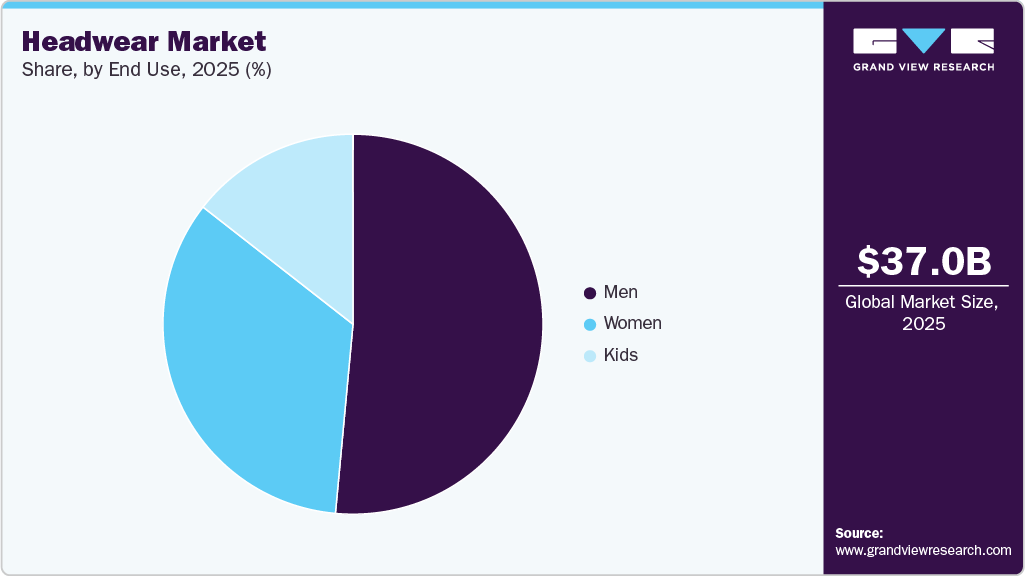
Men accounted for the largest revenue share of 51.5% in 2025. The segment benefits from strong demand for sports caps, outdoor hats, workwear headwear, and licensed team merchandise. Global sporting events, professional leagues, and outdoor recreational activities continue to drive purchases of branded headwear. Companies such as New Era Cap, Nike, Adidas, Columbia Sportswear, and Carhartt offer extensive men's product portfolios spanning athletic, lifestyle, and occupational applications. Demand is also supported by increasing popularity of golf, baseball, hiking, and fishing apparel, where headwear serves both functional and fashion purposes.
 To learn more about this report, Download Free Sample Report
 Women are projected to register the fastest CAGR of 7.3% from 2026 to 2033. Growth is driven by rising fashion consciousness, expanding athleisure adoption, and increasing demand for multifunctional accessories that combine style with UV protection. Premium fashion brands including Gucci, Dior, Prada, Chanel, and Ralph Lauren, alongside sportswear companies such as Lululemon, Adidas, and Nike, continue introducing seasonal collections featuring bucket hats, visors, wide-brim hats, and fashion caps. The influence of social media, celebrity endorsements, and designer collaborations is expected to further stimulate demand among female consumers.
Sports/Activities Insights
Running & Fitness accounted for the largest revenue share of 24.8% in 2025. The segment is driven by increasing participation in running events, gym memberships, marathons, and outdoor fitness activities worldwide. Consumers increasingly seek lightweight, breathable, sweat-resistant caps and visors that enhance comfort during exercise. Companies such as Nike, Adidas, Under Armour, ASICS, Brooks Running, and Lululemon continue expanding their performance headwear portfolios featuring moisture-management technologies, laser-cut ventilation, and reflective elements for enhanced visibility.
 To learn more about this report, Download Free Sample Report
 Athleisure/Sports-Inspired is projected to register the fastest CAGR of 7.5% from 2026 to 2033. Growth is supported by the continued convergence of sportswear and everyday fashion, where caps and bucket hats have become staple lifestyle accessories rather than purely athletic products. Collaborations such as Adidas x Gucci, Nike x Jacquemus, Puma x Rihanna (Fenty), and New Era's collaborations with fashion designers and entertainment franchises have broadened consumer appeal beyond traditional sports users. Rising demand for versatile everyday apparel is expected to sustain strong growth.
Distribution Channel Insights
Retail accounted for the largest revenue share of 69.4% in 2025. The segment continues to dominate as consumers prefer evaluating product fit, material quality, and styling before purchase. Brand-owned stores, sporting goods retailers, department stores, specialty fashion outlets, and hypermarkets remain key sales channels. Companies including Nike, Adidas, Lids, Decathlon, JD Sports, Dick's Sporting Goods, and Foot Locker continue expanding omnichannel retail strategies while enhancing in-store product personalization and customization services. Licensed sports merchandise sold through stadium stores and specialty retailers also contributes significantly to retail sales.
E-commerce is projected to register the fastest CAGR of 7.2% from 2026 to 2033. Growth is fueled by increasing online apparel purchases, expanding smartphone penetration, AI-powered product recommendations, and convenient customization options. Global marketplaces such as Amazon, Zalando, Tmall, Flipkart, Myntra, and eBay, alongside direct-to-consumer platforms operated by Nike, Adidas, New Era, and Under Armour, continue expanding digital sales through exclusive online launches, virtual product visualization, and personalized embroidery services. Improvements in fulfillment capabilities and cross-border e-commerce are expected to further accelerate online headwear sales.
Regional Insights
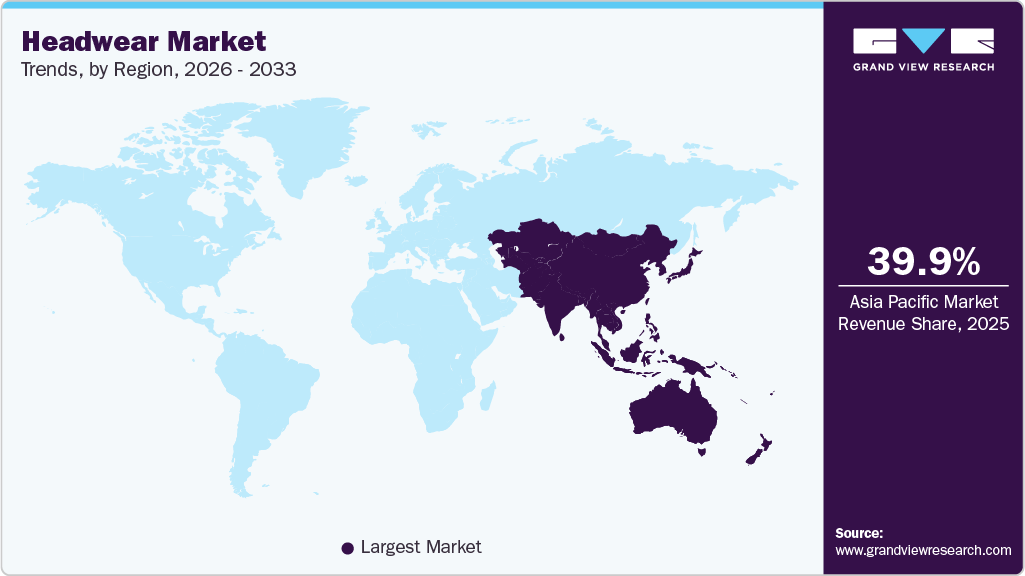
The Asia Pacific headwear market accounted for the largest revenue share of 39.9% in 2025, and is projected to register the fastest regional CAGR of 7.5% from 2026 to 2033. The region benefits from its position as the global manufacturing hub for headwear, supported by extensive textile and apparel production capabilities across China, India, Vietnam, and Southeast Asia. Rising disposable incomes, expanding sports participation, rapid urbanization, and the growing influence of athleisure and streetwear fashion are driving demand across both premium and mass-market categories. Increasing e-commerce penetration and brand localization strategies are further strengthening regional growth.
 To learn more about this report, Download Free Sample Report
 China Headwear Market Trends
The China headwear market accounted for the largest share of 26.9% of the Asia Pacific market in 2025, reaching approximately USD 4.0 billion. The country's dominance is supported by its extensive domestic manufacturing ecosystem, strong sportswear consumption, and growing demand for fashion-forward and branded headwear. The popularity of baseball caps, bucket hats, and winter accessories, coupled with expanding online retail channels and collaborations between domestic designers and global brands, continues to reinforce China's market leadership.
The India headwear market is projected to register the fastest CAGR of 8.7% from 2026 to 2033. Growth is driven by rising disposable incomes, increasing participation in organized sports, expanding youth fashion trends, and rapid penetration of e-commerce platforms into Tier II and Tier III cities. Growing demand for affordable branded products, promotional headwear, and protective headwear for outdoor occupations is expected to sustain robust long-term growth.
North America Headwear Market Trends
The North America headwear market accounted for 26.0% of global revenue in 2025. Demand is supported by high consumer spending on sportswear, outdoor recreation, and lifestyle apparel, along with strong brand loyalty toward premium headwear manufacturers. The widespread popularity of licensed sports merchandise, customization trends, and increasing adoption of performance fabrics with UV protection and moisture management continue to support market expansion across the region.
The U.S. dominated the North American market with an 81.0% revenue share in 2025, representing nearly USD 7.8 billion. Strong demand for athletic caps, outdoor hats, workwear headwear, and fashion accessories, combined with the presence of leading global brands and major sports leagues, continues to drive market leadership. Rising consumer preference for sustainable materials and limited-edition collaborations is further supporting premium product sales.
The Canada headwear market is projected to grow at a CAGR of 6.8% from 2026 to 2033. Growth is driven by increasing participation in outdoor recreational activities, rising winter apparel demand, and growing consumer preference for premium and sustainable headwear. Expanding online retail availability and higher adoption of functional cold-weather accessories are expected to support market growth.
Europe Headwear Market Trends
The Europe headwear market accounted for 20.9% of global revenue in 2025, equivalent to approximately USD 7.7 billion, and is projected to grow at a CAGR of 6.2% through 2033. Demand is supported by the region's strong fashion heritage, premium apparel industry, and increasing preference for sustainable textiles. Seasonal demand for winter headwear, rising sports participation, and growing consumer interest in luxury and designer accessories continue to support market expansion.
Germany accounted for the largest share of the European market at 20.0% in 2025, with a market size of approximately USD 1.5 billion. The country's strong purchasing power, well-established retail network, and growing demand for functional outdoor and sports headwear continue to support market leadership. Increasing adoption of eco-friendly fabrics and premium branded products is further contributing to growth.
The Poland headwear market is projected to register the fastest CAGR of 7.5% from 2026 to 2033. Rapid expansion of apparel manufacturing, increasing fashion consciousness, rising disposable incomes, and growing exports of textile products are supporting market growth. International brands are also expanding their presence through organized retail and digital commerce platforms.
Central & South America Headwear Market Trends
The Central & South America headwear market accounting for 5.0% of global revenue, and is projected to grow at a CAGR of 6.8% through 2033. Market growth is supported by expanding sports culture, increasing urban fashion adoption, and rising demand for affordable branded headwear. Growth in organized retail and digital commerce is also improving product accessibility across the region.
Brazil accounted for the largest share of the Central & South America market in 2025 of about 64.5%, supported by its large consumer base, strong sports culture, and growing demand for casual and athletic headwear. Increasing football merchandise sales, fashion awareness, and expansion of organized retail continue to strengthen the country's leadership within the regional market.
Middle East & Africa Headwear Market Trends
The Middle East & Africa headwear market accounted for 8.3% of global revenue in 2025, and is projected to grow at a CAGR of 7.1% from 2026 to 2033. Growth is supported by rising demand for functional sun-protective headwear, increasing fashion consciousness among younger consumers, expansion of organized retail, and growing participation in sports and outdoor recreational activities. The region is also benefiting from the rapid penetration of international apparel brands, increasing tourism, and rising adoption of premium lifestyle accessories across the Gulf countries.
Saudi Arabia accounted for the largest share of the Middle East headwear market at 29.9% in 2025, with a market size of approximately USD 0.6 billion. The country's leadership is supported by strong consumer spending on fashion apparel, a growing youth population, expanding organized retail, and increasing adoption of international sportswear and lifestyle brands. Rising investments in retail infrastructure and entertainment under Vision 2030 are further supporting demand for branded headwear.
The Oman headwear market is projected to register the fastest CAGR of 8.4% from 2026 to 2033. Growth is driven by increasing disposable incomes, expanding tourism, rising participation in outdoor activities, and greater demand for functional and fashion-oriented headwear. The continued expansion of modern retail formats and international apparel brands is expected to accelerate market growth during the forecast period.
South Africa accounted for the largest share of the Africa headwear market at 42.0% in 2025, supported by a well-developed retail sector, increasing sports participation, strong demand for school and workwear headwear, and rising adoption of branded fashion accessories. Expanding e-commerce penetration and growing consumer preference for premium and performance headwear continue to strengthen the country's leading position within Africa.
Key Headwear Company Insights
The global headwear market is characterized by a fragmented competitive landscape comprising global sportswear brands, fashion retailers, outdoor apparel companies, performance footwear brands, specialty sporting goods retailers, and digitally native activewear companies. Competition is increasingly centered on brand recognition, product innovation, functional performance, fashion-led collections, omnichannel retail expansion, licensing partnerships, and sustainability initiatives. Companies are strengthening their market positions by expanding premium product portfolios, collaborating with sports teams and fashion designers, integrating recycled and bio-based materials, and leveraging direct-to-consumer (DTC) channels alongside global retail distribution.
-
Global Sportswear & Performance Brands: Companies such as Under Armour, New Balance, Asics, Fila, Anta Group, Li Ning, Hoka, Brooks Sports, and On Running represent leading performance-oriented participants in the market. These companies compete through technologically advanced sports caps, running hats, training headwear, moisture-wicking materials, UV-protection fabrics, and athlete endorsements. Product innovation, sponsorship of sporting events, and expansion into premium performance apparel continue to strengthen their competitive positioning.
-
Fashion Retailers & Lifestyle Brands: H&M (Sport), Inditex, Superdry, Crocs Inc., and Lululemon compete by integrating headwear into broader lifestyle, athleisure, and seasonal fashion collections. Their strategies emphasize trend-driven product launches, fast-fashion supply chains, influencer collaborations, and omnichannel retailing. Frequent collection refreshes and affordable pricing enable these brands to capture demand from fashion-conscious consumers across multiple demographics.
-
Outdoor & Technical Apparel Specialists: Companies including Patagonia, Columbia Sportswear, Icebreaker, Salomon, Kari Traa, Odlo, and X-Bionic focus on performance headwear designed for hiking, skiing, mountaineering, trail running, and other outdoor activities. These companies differentiate themselves through technical fabrics, weather-resistant designs, thermal insulation, merino wool products, and sustainability initiatives, while benefiting from growing participation in outdoor recreation and adventure sports.
-
Sporting Goods Retailers & Omnichannel Distribution Networks: Intersport, JD Sports, Dick's Sporting Goods, Zalando, and Lidl (Sport) play a significant role in market expansion through extensive retail and e-commerce networks. These companies offer a broad assortment of branded and private-label headwear across sports, casual, and outdoor categories. Competitive differentiation is driven by merchandising capabilities, exclusive brand partnerships, loyalty programs, localized assortments, and seamless omnichannel shopping experiences, enabling them to reach a wide consumer base across developed and emerging markets.
 To learn more about this report, Download Free Sample Report
Key Headwear Companies
The following key companies have been profiled for this study on the headwear market.
-
Crocs Inc.
-
Intersport
-
H&M (Sport)
-
Zalando
-
Inditex
-
Dick's Sporting Goods
-
Lululemon
-
Skechers
-
New Balance
-
Columbia Sportswear
-
Lidl (Sport)
-
Hoka
-
Deckers
-
JD Sports
-
Brooks (Brooks Sports, Inc.)
-
Fila
-
Under Armour
-
Superdry
-
Asics
-
Icebreaker
-
Patagonia
-
Anta Group
-
Li Ning
-
Kari Traa
-
Salomon
-
Odlo
-
Gymshark
-
X-Bionic
-
On Running
Recent Developments
-
In June 2026, Headsweats launched its new Elite Collection, a premium performance headwear range featuring upgraded fabrics, refined silhouettes, and enhanced moisture-wicking technology across its running, crusher, and supervisor styles.
-
In March 2026, Ahead launched its Fall 2026 headwear collection, introducing performance-driven innovations including Vento laser-perforated fabric, retro-inspired designs, and expanded women's styles that combine enhanced breathability, comfort, and contemporary aesthetics for the premium headwear market.
-
In December 2025, Pukka launched its premium custom headwear range in the UK and Europe, introducing fully customizable golf caps with flexible order volumes, fast turnaround times, and extensive design options for retailers and golf clubs.
-
In November 2025, Ronnie Fieg and '47 partnered to launch a premium Winter 2025 headwear collection, featuring luxury materials such as cashmere and Italian wool across elevated cap silhouettes, with exclusive co-branded designs.
-
In November 2025, Foremost Hat launched its new Autumn/Winter 2025 beanie collection designed for brands and retailers, made with certified sustainable materials such as RWS‑merino wool, GOTS‑organic cotton, and GRS‑recycled yarns.
Headwear Market Report Scope
Report Attribute
Details
Market size in 2025
USD 37.0 billion
Estimated market size value in 2026
USD 39.4 billion
Projected market size in 2033
USD 62.8 billion
Growth rate
CAGR of 6.9% from 2026 to 2033
Base year
2025
Actuals
2021 - 2025
Forecast period
2026 - 2033
Quantitative units
Revenue in volume in million units, USD million/billion and CAGR from 2026 to 2033
Report coverage
Revenue forecast, company ranking, competitive landscape, growth factors, and trends
Segments covered
Product type, material, end-user, distribution channel, region
Regional scope
North America; Europe; Asia Pacific; Central & South America; Middle East & Africa
Country scope
U.S.; Canada; UK; Germany; France; Italy; Spain; Poland; Czech Republic; Croatia; Hungary; China; India; Japan; Australia & New Zealand; South Korea; Indonesia; Thailand; Malaysia; Vietnam; Brazil; South America; Bahrain; Kuwait; Oman; Qatar; Saudi Arabia; UAE; South Africa
Key companies profiled
Crocs Inc.; Intersport; H&M (Sport); Zalando; Inditex; Dick's Sporting Goods; Lululemon; Skechers; New Balance; Columbia Sportswear; Lidl (Sport); Hoka; Deckers; JD Sports; Brooks (Brooks Sports, Inc.); Fila; Under Armour; Superdry; Asics; Icebreaker; Patagonia; Anta Group; Li Ning; Kari Traa; Salomon; Odlo; Gymshark; X-Bionic; and On Running
Customization scope
Free report customization (equivalent up to 8 analysts’ working days) with purchase. Addition or alteration to country, regional & segment scope.
Pricing and purchase options
Avail customized purchase options to meet your exact research needs. Explore purchase options
Global Headwear Market Segmentation
This report forecasts revenue growth at global, regional & country levels and provides an analysis of the latest trends and opportunities in each of the sub-segments from 2026 to 2033. For this study, Grand View Research has segmented the global headwear market on the basis of product type, material, end user, sports/activities, distribution channel, and region.
-
Product Type Outlook (Volume Million Units; Revenue, USD Billion, 2021 - 2033)
-
Caps
-
Beanies
-
Neckwear
-
Hats
-
Others
-
-
Material Outlook (Volume Million Units; Revenue, USD Billion, 2021 - 2033)
-
Cotton
-
Wool
-
Polyester
-
Nylon
-
Others
-
-
End-user Outlook (Volume Million Units; Revenue, USD Billion, 2021 - 2033)
-
Men
-
Women
-
Kids
-
-
Sports/Activities Outlook (Volume Million Units; Revenue, USD Billion, 2021 - 2033)
-
Running & Fitness
-
Outdoor & Adventure Sports
-
Winter Sports
-
Team Sports
-
Golf
-
Cycling
-
Water Sports
-
Tennis & Racquet Sports
-
Motorsports
-
Athleisure/Sports-Inspired
-
-
Distribution Channel Outlook (Volume Million Units; Revenue, USD Billion, 2021 - 2033)
-
Retail
-
E-commerce
-
DTC
-
-
Regional Outlook (Volume Million Units; Revenue, USD Billion, 2021 - 2033)
-
North America
-
U.S.
-
Canada
-
-
Europe
-
Germany
-
UK
-
France
-
Italy
-
Spain
-
Poland
-
Czech Republic
-
Croatia
-
Hungary
-
-
Asia Pacific
-
China
-
India
-
Japan
-
Australia & New Zealand
-
South Korea
-
Indonesia
-
Thailand
-
Malaysia
-
Vietnam
-
-
Central & South America
-
Brazil
-
South America
-
-
Middle East & Africa
-
Bahrain
-
Kuwait
-
Oman
-
Qatar
-
Saudi Arabia
-
UAE
-
South Africa
-
-
Research Methodology
The headwear market figures in this report are based on a proven research process that combines executive interviews with secondary research from proprietary databases, company filings, and recognized regulatory and institutional sources. Market size is built through value-chain sizing-reconciling supply-side and demand-side estimates-and triangulated with bottom-up and top-down approaches. Every estimate passes multiple levels of expert validation before publication, with each headwear segment quantified using the revenue-capture definitions in the table below.
Segment Definition
Segment - Product Type
Revenue capture definition
Caps
Includes close-fitting headwear with a crown and front visor/peak, primarily used for sun protection, sportswear, branding, uniforms, and casual/athleisure use. Covers baseball caps, snapbacks, trucker caps, running caps, performance caps, and similar structured or unstructured peaked caps. Excludes open-crown visors, beanies, hats, balaclavas, and skull caps.
Beanies
Includes soft, brimless, close-fitting headwear generally made from knitted, fleece, wool, acrylic, or thermal performance fabrics. Covers cuffed beanies, slouch beanies, pom-pom beanies, fleece beanies, and thermal sports beanies. Excludes skull caps, balaclavas, caps with peaks, and broad-brim hats.
Neckwear
Includes fabric-based products primarily worn around the neck and lower face for warmth, sweat control, sun protection, wind protection, or multifunctional outdoor use. Covers neck gaiters, buffs, snoods, neck warmers, tubular scarves, and performance neck covers. Products are classified here when their primary marketed use is neck/face coverage rather than crown/head coverage. Excludes fashion scarves and head-only products such as beanies or balaclavas.
Hats
Includes headwear with a defined crown and full or partial brim, primarily used for sun protection, outdoor recreation, lifestyle/fashion, travel, golf, fishing, and adventure activities. Covers bucket hats, Boonie hats, sun hats, wide-brim hats, safari hats, fedora-style outdoor hats, and golf hats that are not classified as caps. Excludes peaked sports caps, beanies, visors, and neckwear.
Others
Includes specialized or secondary headwear products that do not fit into caps, beanies, neckwear, or hats. Covers headbands, bandanas, visors, balaclavas, and skull caps. These products are generally used for sweat absorption, hair control, sun shielding, thermal protection, under-helmet comfort, or full-face coverage in specific sports and outdoor activities.
Segment – Material
Revenue capture definition
Cotton
Includes headwear products made primarily from cotton or cotton-rich fabrics, including woven cotton, cotton twill, canvas, jersey cotton, and cotton blends where cotton is the dominant material. Commonly covers casual caps, bucket hats, lifestyle hats, and lightweight everyday headwear. Excludes products where synthetic fibers are the dominant material.
Wool
Includes headwear products made primarily from wool or wool-rich blends, including merino wool, lambswool, felted wool, and wool-acrylic blends where wool is the key marketed material. Covers beanies, winter hats, thermal headwear, and premium outdoor/fashion headwear. Excludes synthetic fleece, acrylic-only beanies, and non-wool thermal fabrics.
Polyester
Includes headwear products made primarily from polyester-based fabrics, including recycled polyester, fleece polyester, microfiber polyester, mesh polyester, and performance polyester blends. Covers sports caps, neckwear, running headwear, outdoor headwear, and athleisure products. Excludes nylon-dominant products and cotton/wool-dominant blends.
Nylon
Includes headwear products made primarily from nylon or nylon-rich fabrics, including ripstop nylon, woven nylon, stretch nylon, and technical nylon blends. Commonly covers outdoor, adventure, cycling, water sports, and performance headwear. Excludes polyester-dominant performance fabrics and natural-fiber products.
Others
Includes headwear products made from materials not classified under cotton, wool, polyester, or nylon as the primary material. Covers acrylic, elastane/spandex blends, fleece blends, leather, straw, bamboo fiber, linen, viscose/rayon, neoprene, synthetic insulation fabrics, and mixed-material constructions where no listed material is dominant.
Segment – End User
Revenue capture definition
Men
Includes headwear products designed, marketed, sized, or purchased primarily for adult male consumers. Covers sports, outdoor, casual, performance, and fashion headwear positioned for men through fit, styling, branding, product labeling, or retail placement. Excludes women-specific, kids-specific, and clearly unisex products unless sales are allocated based on male consumer usage or purchase behavior.
Women
Includes headwear products designed, marketed, sized, or purchased primarily for adult female consumers. Covers performance headwear, fashion hats, caps, beanies, neckwear, and other headwear positioned for women through fit, styling, branding, or merchandising. Excludes men-specific, kids-specific, and clearly unisex products unless sales are allocated based on female consumer usage or purchase behavior.
Kids
Includes headwear products designed, sized, marketed, or purchased primarily for infants, toddlers, children, and teenagers. Covers caps, beanies, hats, neckwear, and other headwear featuring child sizing, character licensing, school/sports use, or age-specific merchandising. Excludes adult-sized men's and women's products.
Segment – Sports/Activities
Revenue capture definition
Running & Fitness
Includes headwear used for running, jogging, gym workouts, training, yoga, and general fitness activities. Covers performance caps, visors, headbands, and lightweight sports headwear designed for sweat control, breathability, comfort, and sun protection.
Outdoor & Adventure Sports
Includes headwear used in hiking, trekking, camping, climbing, trail activities, fishing, and other outdoor recreation. Covers hats, caps, neckwear, and protective outdoor headwear designed for sun, wind, dust, and weather protection.
Winter Sports
Includes headwear used for skiing, snowboarding, ice skating, snow trekking, and other cold-weather sports. Covers insulated beanies, thermal hats, neck gaiters, and winter headwear designed for warmth, insulation, and thermal comfort.
Team Sports
Includes headwear used in organized or recreational sports such as baseball, football, cricket, basketball, rugby, and similar team-based activities. Covers performance caps, fan merchandise, team-branded headwear, and uniform-related products.
Golf
Includes headwear used specifically for golf and golf-related leisure activities. Covers golf caps, visors, bucket hats, and sun hats designed for sun protection, comfort, moisture management, and premium sports styling.
Cycling
Includes headwear used for road cycling, mountain biking, commuting, and recreational cycling. Covers cycling caps, skull caps, helmet liners, and thermal cycling headwear used for sweat management, sun protection, and comfort beneath helmets.
Water Sports
Includes headwear used in swimming, surfing, sailing, kayaking, boating, fishing, and beach sports. Covers quick-dry caps, UV-protection hats, waterproof headwear, and products designed for water resistance, secure fit, and outdoor exposure.
Tennis & Racquet Sports
Includes headwear used in tennis, badminton, pickleball, squash, and other racquet sports. Covers performance caps, visors, and sweat-management headwear designed for sun protection, visibility, and moisture absorption.
Motorsports
Includes headwear used in motor racing, karting, motorcycling, and related racing activities. Covers helmet liners, skull caps, branded caps, team merchandise, and products designed for under-helmet comfort, sweat control, and motorsport branding.
Athleisure/Sports-Inspired
Includes headwear worn for casual, lifestyle, and fashion use inspired by sports designs rather than active participation. Covers branded caps, fashion beanies, bucket hats, and sports-inspired lifestyle collections driven by streetwear and everyday wear trends.
Segment – Distribution Channel
Revenue capture definition
Retail
Includes offline sales of headwear through physical stores such as sportswear stores, specialty outdoor stores, department stores, supermarkets/hypermarkets, brand outlets, and multi-brand retail stores. Covers all in-store consumer purchases.
E-Commerce
Includes headwear sold through third-party online platforms, online marketplaces, sports retail websites, and multi-brand e-commerce stores. Covers products purchased online through intermediary retail channels rather than directly from the brand.
DTC (Direct-to-Consumer)
Includes headwear sold directly by brands through their own websites, mobile applications, brand-owned stores, pop-up stores, and social commerce channels. Excludes sales through third-party marketplaces, distributors, wholesalers, and independent retailers.
Estimation Model
Headwear Consumer Universe Layer
Retail & Purchasing Accessibility Layer
Adoption & Replacement Layer
Monetisation Layer
Who has a recurring need for headwear?
Who has access to headwear products?
Who actively purchases headwear?
How much revenue is generated?
Begin with the global population segmented by end users such as men, women, and children. Overlay participation in outdoor activities, sports, commuting, industrial occupations, school attendance, and fashion-conscious consumers to identify individuals with recurring demand for functional or fashion-oriented headwear. Headwear demand is driven by sun protection, weather conditions, occupational use, sports participation, and lifestyle fashion.
Filter the eligible consumer base using urbanization, apparel retail penetration, e-commerce adoption, disposable income, and organized retail presence. This derives the addressable market that can purchase headwear through specialty stores, sports retailers, department stores, supermarkets, brand outlets, and online platforms.
Apply ownership, purchase frequency, and replacement rates across fashion consumers, sports participants, outdoor workers, students, travelers, and occupational users. Account for seasonal purchases, sports merchandise, promotional merchandise, and fashion trend cycles to estimate annual active buyers.
Multiply annual unit demand by blended ASPs across caps, hats, beanies, visors, bucket hats, and other headwear categories. Include premium pricing from branded collections, licensed sports merchandise, designer collaborations, technical performance headwear, and corporate promotional products to estimate total market revenue.
Delivered Customizations
This report has been delivered with the following In-depth customizations
Client Request
Customization Delivered
Value Adds
Lifestyle & Occasion-Based Demand Mapping Across Product Categories
Comprehensive analysis mapping caps, beanies, hats, neckwear, and other headwear against major usage occasions including sports & fitness, outdoor recreation, travel, commuting, fashion & streetwear, workwear, winter protection, and promotional/corporate merchandise. The study further evaluates regional differences in adoption across North America, Europe, Asia Pacific, Latin America, and Middle East & Africa.
Helps identify which product categories are driven by functional demand versus fashion-led purchases. Enables brands to optimize product portfolios by season, climate, and consumer lifestyle, while identifying high-growth opportunities in athleisure, outdoor recreation, and branded merchandise. The analysis also highlights where year-round demand reduces dependence on seasonal sales.
Brand Positioning & Competitive Benchmarking Across Fashion, Sportswear & Retail Channels
In-depth benchmarking of global sportswear brands, fashion retailers, outdoor brands, private-label players, and digital-first brands offering headwear. The assessment compares product breadth, pricing architecture, material innovation, customization capabilities, licensing strategies, omnichannel presence, and geographic footprint.
Distinguishes performance-driven brands from fashion-led and value-oriented competitors while identifying competitive white spaces in premium headwear, sustainable collections, licensed merchandise, and customized products. The benchmarking also evaluates how brands leverage collaborations, limited-edition collections, and sports affiliations to strengthen market positioning.
Material Innovation & Climate Adaptability Assessment
Detailed evaluation of material adoption across cotton, polyester, wool, nylon, and emerging sustainable fabrics, assessing their suitability across different climatic conditions, consumer segments, and product categories. The analysis compares moisture management, UV protection, thermal insulation, durability, recyclability, and manufacturing economics.
Helps manufacturers optimize material selection for different regional climates and end-use applications. Identifies opportunities for premiumization through recycled fibers, organic materials, lightweight performance fabrics, and climate-adaptive designs while supporting sustainability initiatives and product differentiation.
Frequently Asked Questions About This Report
Key factors that are driving the headwear market growth include growth of the fashion industry which has resulted in the rise of fashion sense among the global population.
The caps segment led with a 37.9% revenue share in 2025.
The cotton headwear segment held the largest market share in 2025.
The men’s headwear segment held the largest market share of 51.5% in 2025.
Retail accounted for the largest revenue share of 69.4% in 2025.
The global headwear market size was valued at USD 37.0 billion in 2025 and is estimated at USD 39.4 billion for 2026.
The global headwear market is expected to grow at a CAGR of 6.9% from 2026 to 2033, reaching USD 62.8 billion by 2033.
Asia Pacific dominated with a 39.9% revenue share in 2025.
Key players include Intersport; H&M (sport); Zalando; Inditex; Dick's Sporting Goods; Lululemon; Skechers; New Balance; Columbia Sportswear; Lidl; Hoka; Deckers; JD Sports; Brooks (Brooks Sports, Inc); Fila; Under Armour; Superdry; Asics; Ice Breaker; Patagonia; Anta Group; Li Ning; Kari Traa; Salomon; Odlo; Gymshark; Xbionic; On Running
About the Author(s)
Clothing, Footwear & Accessories Research Team
Consumer Goods · Clothing, Footwear & AccessoriesThis report was authored by the clothing, footwear & accessories research team at Grand View Research - comprising two research analysts, one senior research analyst, and one industry expert - with specialized expertise in the clothing, footwear & accessories segment of the consumer goods industry. All findings are based on proprietary consumer goods databases, executive interviews, and regulatory analysis, subject to internal peer review prior to publication.
Last Updated:
Speak to Analyst

Customize this report to your needs - add regions, segments, or data points, with 20% free customization.
Or view our licence options:


ISO 9001:2015 & 27001:2022 Certified
We are GDPR and CCPA compliant! Your transaction & personal information is safe and secure. For more details, please read our privacy policy.


