
- Home
- »
- Homecare & Decor
- »
-
Helicopter Tourism Market Size & Share Report, 2026-2033GVR Report cover

Helicopter Tourism Market (2026 - 2033)
Size, Share & Trends Analysis Report By Tourism Type (Sightseeing & Scenic Tourism, Luxury & Private Tourism), By Destination Type (Urban, Mountain), By Booking Channel Type, By Region, And Segment Forecasts
Market Size, 2025
$1.7BMarket Estimate, 2026
$1.8BMarket Forecast, 2033
$2.3BCAGR, 2026–2033
3.9%Helicopter Tourism Market Summary
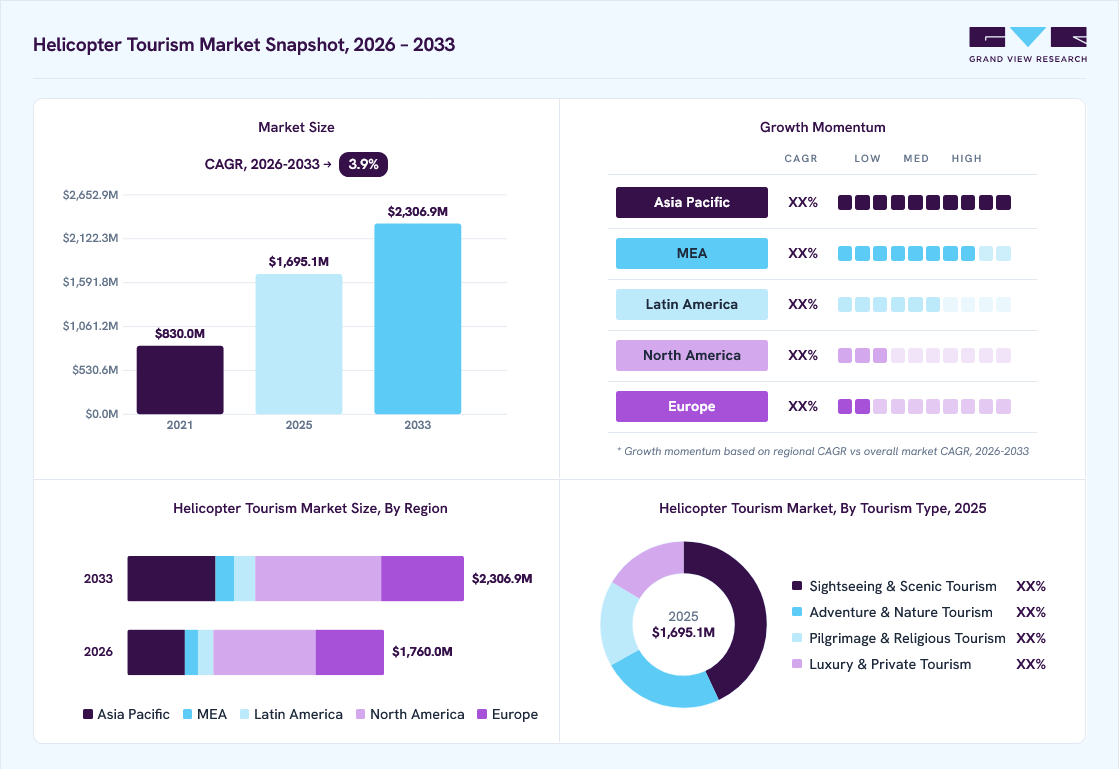
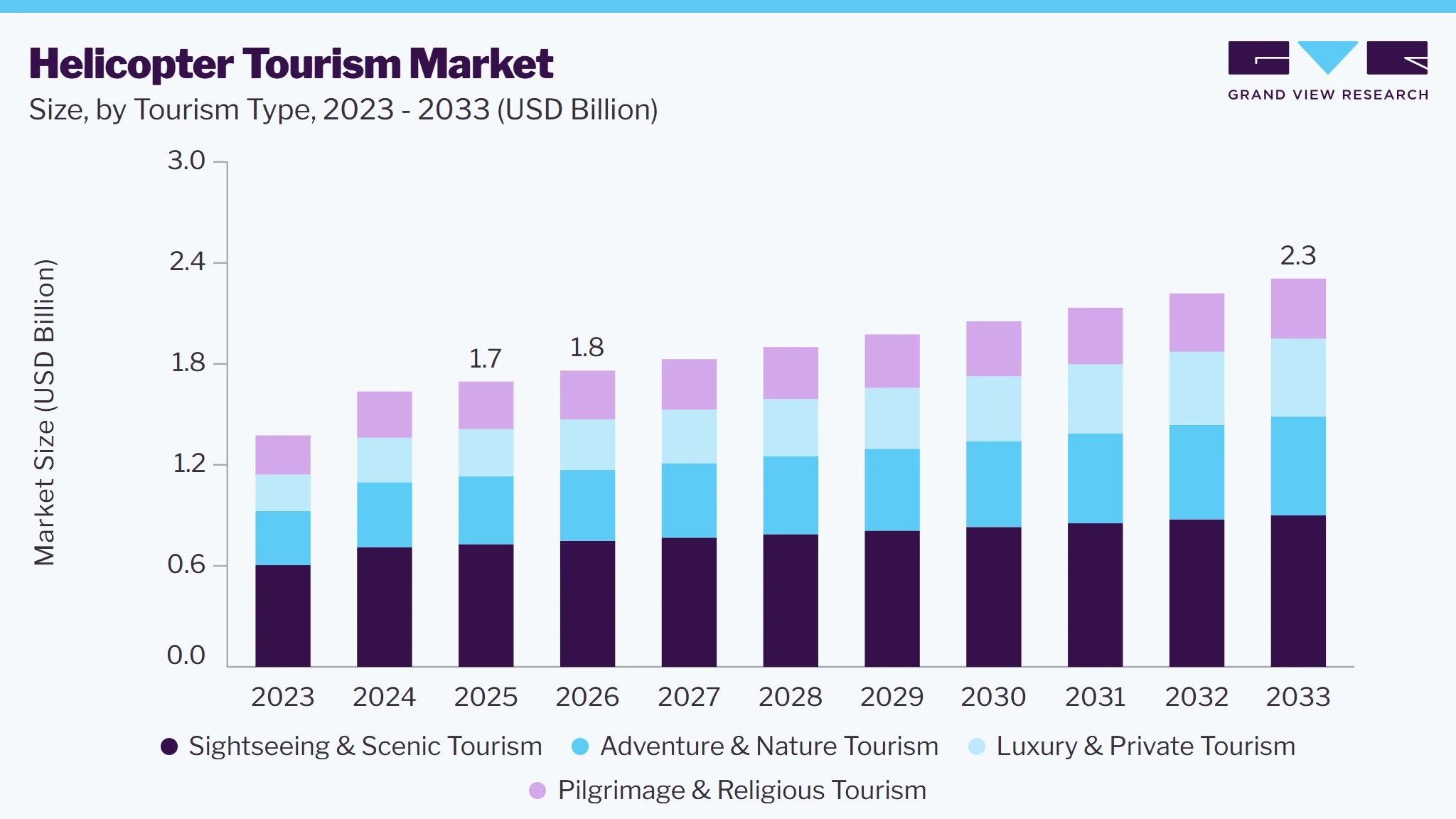
The global helicopter tourism market size was valued at USD 1.7 billion in 2025 and is projected to grow from USD 1.8 billion in 2026 to USD 2.3 billion by 2033, at a CAGR of 3.9% from 2026 to 2033. The market in North America dominated with a revenue share of 40.1% in 2025. The market is supported by rising demand for experiential and premium travel, as tourists increasingly seek unique aerial sightseeing and exclusive access to scenic destinations.
 Source: Grand View Research, IR Documents, Primary Interviews, Paid DatabasesTo learn more about this report,
 Download Free Sample Report
 Key Market Trends & Insights
- By tourism type: Sightseeing & scenic tourism segment held the largest market share of 43.0% in 2025.
- By destination type: Urban segment held the largest market share of 31.8% in 2025.
- By booking channel type: Direct/operator segment held the largest market share of 47.7% in 2025.
Regional Highlights
- Largest regional market: North America (40.1% revenue share, 2025)
- Fastest-growing regional market: Asia Pacific (highest CAGR, 2026-2033)
- By country: The U.S. held the largest market share in 2025
Market Size & Forecast
- Market size in 2025: USD 1.7 Billion
- Estimated market size in 2026: USD 1.8 Billion
- Projected market size by 2033: USD 2.3 Billion
- CAGR (2026-2033): 3.9%
Three ways to get this report
Buy it, customize it, or ask a question.Ask an Analyst
A direct answer, usually in 1 working day
- AccessReport author, directly
- Reply timeWithin 1 working day
- No sales callDirect answer only
- FormatEmail reply
- CostFree, no cost
Get the Full Report
What the study covers
- FormatsPDF · Excel · Dashboard
- Timeline2026–2033 annual, 2025 base
- Coverage20+ countries, 5 regions
- Companies10+ key players profiled
Customize the Report
20% free customization
- IncludeCountries, segments, points
- TailorTo your product definition
- ExtendDeeper competitor detail
- OrA fully bespoke study
- Turnaround5–10 working days
Growing demand for experiential tourism is driving helicopter sightseeing, particularly in destinations where aerial access offers a distinctive view of natural attractions. According to the Hawaii Tourism Authority’s Visitor Satisfaction and Activity Report, published in 2025, 10.6% of European visitors to Hawaii took helicopter or airplane tours, indicating strong demand for aerial sightseeing among international travelers. In the U.S., the National Park Service’s 2023 Visitor Use Statistics recorded more than 325 million recreation visits to national parks, providing a large addressable visitor base for scenic air-tour operators serving major natural attractions such as the Grand Canyon and the Hawaiian Islands. The continued concentration of tourism around visually distinctive destinations, therefore, supports helicopter tourism as a premium experiential activity.The introduction of new helicopter tourism destinations is also expanding the market by making aerial experiences available at festivals and previously underserved destinations. In November 2025, Nagaland's Tourism Department launched Aerial Experience Helicopter Rides for the Hornbill Festival, offering sightseeing around Kohima, aerial views of Dzükou Valley, flights between Kohima and Kigwema, and charter services across Nagaland. The service operated from three access points, Dimapur Airport, Kohima Heliport, and Kigwema Heliport, and was specifically positioned as an additional tourism experience for domestic and international visitors.
 To learn more about this report, Download Free Sample Report
 Tourism authorities are increasingly using helicopter services to connect multiple attractions and expand tourism beyond conventional transport networks. In November 2025, the Madhya Pradesh government in India launched its first state-run helicopter tourism service, connecting pilgrimage sites, wildlife destinations, and other tourist locations across the state. The initiative was designed to improve access while promoting tourism across geographically dispersed destinations, demonstrating how government-backed heli-tourism networks can create new routes and stimulate demand beyond traditional sightseeing locations.
Market Dynamics
Helicopter tourism is benefiting from the growing use of aerial services for pilgrimage routes, where travelers value shorter journey times and improved access to religious destinations. The segment also generates relatively predictable seasonal demand around major pilgrimage periods. For instance, according to an article by The Hindu published in May 2025, helicopter services for the Char Dham Yatra in Uttarakhand recorded strong advance demand, with authorities expanding arrangements to accommodate pilgrims traveling to Kedarnath and other high-altitude shrines. The increasing integration of helicopter services into organized pilgrimage travel is creating an additional passenger base beyond conventional sightseeing.
Helicopter tourism is highly sensitive to weather conditions such as strong winds, heavy rainfall, fog, low cloud cover, and poor visibility, which can result in flight cancellations, delays and reduced aircraft utilization. This is particularly relevant for mountain and coastal tourism routes where weather conditions can change rapidly. For example, according to an Associated Press article published in May 2025, helicopter operations around Nepal's Everest region faced weather-related disruptions during the climbing season, with poor visibility affecting aviation activity. Such operational uncertainty can reduce the number of daily flights an operator can perform and increase refund and rescheduling requirements.
The increasing scale of destination weddings and other high-value celebrations is creating opportunities for helicopter operators to offer charter flights, guest transfers, aerial experiences, and customized services. These bookings can generate higher revenue per flight because operators can sell the aircraft on a private or charter basis rather than relying exclusively on individual sightseeing passengers. According to an article by The Economic Times published in February 2025, India's destination-wedding sector continued to attract high-spending domestic and international customers, with wedding-related travel increasingly extending to premium and experiential services. This provides helicopter operators with an opportunity to integrate aerial transportation and sightseeing into wedding packages, particularly in resort, island, and heritage destinations.
Analyst Perspective
The global helicopter tourism market is evolving from a sightseeing-led activity into a broader premium experiential tourism market, where scenic flights remain a major revenue contributor while adventure, pilgrimage, luxury, and private tourism experiences are gaining importance alongside traditional sightseeing tours. Rising international tourism, increasing demand for unique travel experiences, and growing disposable incomes are supporting demand for helicopter-based tourism, particularly across scenic, coastal, mountain, and culturally significant destinations. Operators are expanding offerings across different tourism and destination types, introducing customized itineraries, private charters, premium experiences, and digital booking platforms to increase passenger volumes, improve aircraft utilization, and strengthen revenue generation across the growing tourism ecosystem.
Consumer Insights
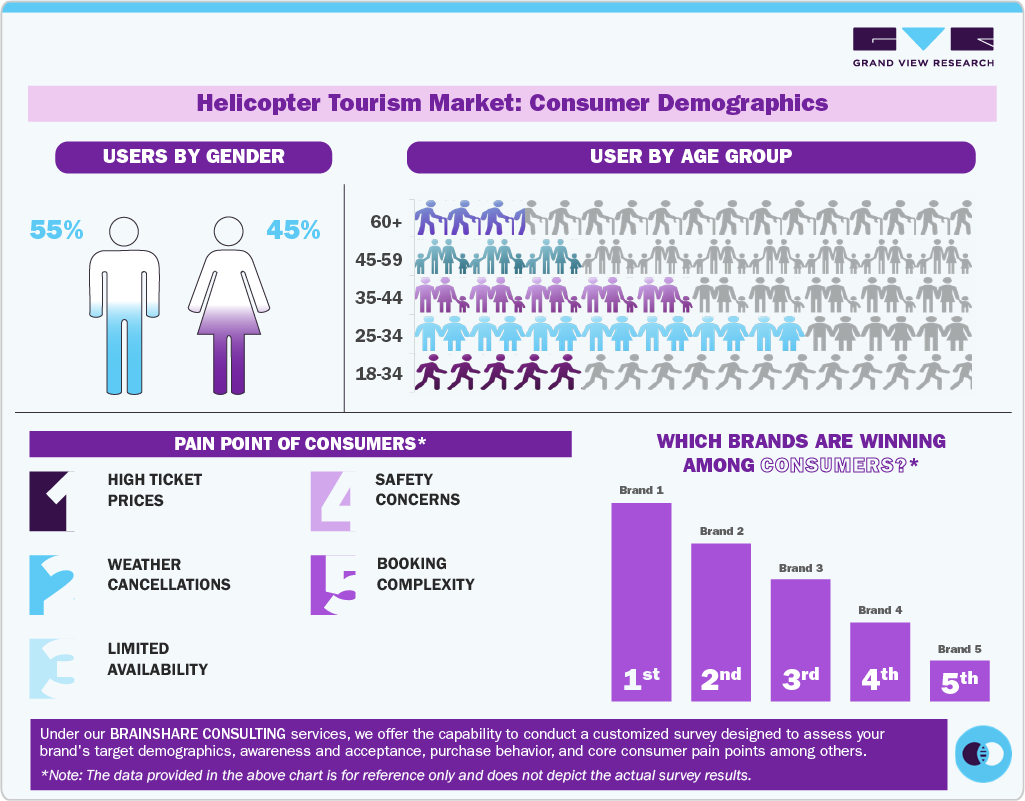
Consumer demand in the helicopter tourism market is primarily influenced by gender, age, income, travel preferences, and willingness to spend on premium experiences, with purchasing decisions increasingly shifting toward tourism activities that provide convenience, exclusivity, and memorable experiences.
 To learn more about this report, Download Free Sample Report
 -
Male consumers account for the larger share of helicopter tourism users at an estimated 55.0%, supported by stronger participation in adventure tourism, outdoor activities, and aviation-related experiences. Female consumers account for approximately 45.0%, with demand increasingly supported by leisure sightseeing, luxury travel, couples' experiences, celebrations, and special occasions.
-
Consumers aged 25-34 account for the largest share of helicopter tourism users at 27.0%, supported by higher participation in experiential, adventure, and activity-based travel. Consumers aged 35-44 account for 25.0%, followed by the 45-59 age group at 23.0%, with demand from these groups supported by greater discretionary travel spending and preference for premium sightseeing and destination experiences.
-
Consumers aged 18-24 account for 12.0% of users, with participation primarily associated with adventure-oriented tourism and first-time experiential activities. Consumers aged 60 and above account for 13.0%, with demand concentrated in comfortable sightseeing, premium tourism, pilgrimage travel, and destinations where helicopter transportation can reduce travel time.
Consumers in the helicopter tourism market commonly encounter several pain points and challenges during booking and travel planning.
-
High ticket prices remain a major barrier, particularly for younger and price-sensitive travelers who may consider helicopter tourism an occasional rather than a routine travel activity.
-
Weather cancellations can disrupt planned itineraries, as helicopter operations are highly dependent on visibility, wind, rainfall, and other weather conditions.
-
Limited availability during peak tourism periods can make preferred flight schedules difficult to secure, particularly at popular destinations and during festivals or holiday seasons.
-
Safety concerns can influence purchase decisions, particularly among first-time passengers who may have limited familiarity with helicopter operations.
Booking complexity can arise when helicopter experiences are distributed across operators, hotels, travel agencies, and online platforms, making it difficult for consumers to compare schedules, prices, and inclusions.
These consumer insights reflect purchasing behavior only within the helicopter tourism segment. As a result, operators are increasingly focusing on flexible booking options, transparent pricing, improved digital reservation systems, clear safety communication, shared-flight options, and packaged tourism experiences to attract a broader consumer base while maintaining the premium positioning of helicopter tourism.
Tourism Type Insights
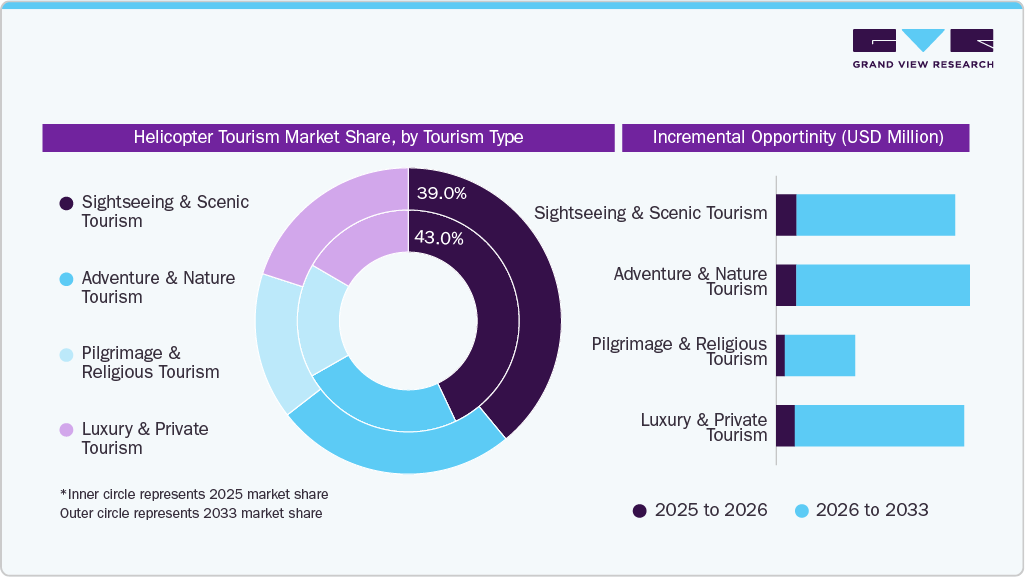
The sightseeing & scenic tourism segment accounted for 43.0% of global revenue in 2025, supported by the ability of helicopter operators to convert well-known natural and cultural attractions into short, high-value experiences that can be added easily to a tourist itinerary. Demand is particularly strong where aerial views provide a substantially different experience from conventional ground-based sightseeing.
 To learn more about this report, Download Free Sample Report
 The luxury & private tourism segment is projected to grow at a CAGR of 6.4% from 2026 to 2033, driven by the integration of helicopter services with premium hotels, private aviation, and customized travel experiences. Rather than selling only a fixed sightseeing seat, operators can generate higher-value demand through private transfers, exclusive tours, and personalized itineraries for affluent travelers. According to a press release published by Flexjet in July 2024, Flexjet and The Emory hotel in London launched an arrangement in which guests arriving by private jet could receive helicopter transfers directly to London Heliport, with the helicopter arrival experience incorporated into the hotel stay. This demonstrates the increasing use of helicopters as part of the overall luxury hospitality experience, supporting demand for private and customized helicopter services.
Destination Type Insights
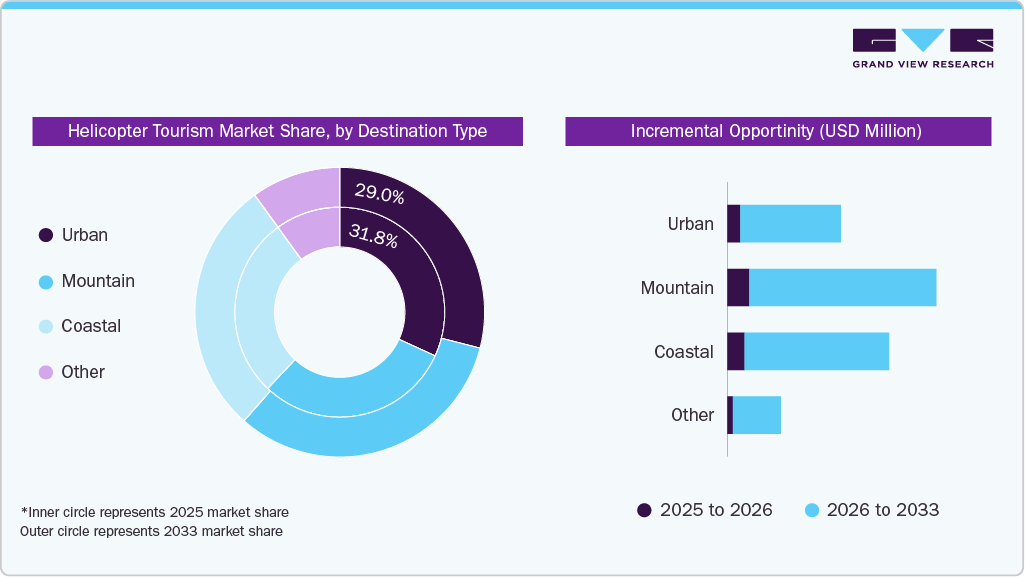
The urban segment accounted for 31.8% of global revenue in 2025, supported by the concentration of tourists, premium hotels, landmarks and entertainment activities within major cities, allowing operators to offer short-duration flights with relatively convenient departure points. Urban tours can also be sold as an additional experience during short city breaks, when travelers have limited time to cover multiple attractions. According to an article by ThePrint published in April 2025, JTB Global Marketing & Travel launched its SUNRISE TOURS Premier brand for affluent international visitors and introduced a private helicopter tour combining Tokyo and Mount Fuji. The launch demonstrates how major metropolitan destinations can serve as both the starting point and core attraction for premium aerial tourism, while also linking urban sightseeing with nearby scenic destinations.
 To learn more about this report, Download Free Sample Report
 The mountain segment is projected to grow at a CAGR of 4.9% from 2026 to 2033, supported by the difficulty and time required to access high-altitude destinations by road or conventional transport, particularly for pilgrimage, adventure, and scenic travel. Helicopters can significantly shorten access times while providing an additional aerial sightseeing component to the journey. According to All India Radio in June 2024, online helicopter bookings were opened for the Amarnath Yatra, covering the Baltal-Panjtarni and Pahalgam-Panjtarni routes for the 52-day pilgrimage. The continued development of scheduled helicopter access to Himalayan destinations shows how tourism authorities are using aviation to expand visitor access to mountainous locations, while the combination of pilgrimage and scenic value creates multiple demand drivers for mountain helicopter tourism.
Booking Channel Type Insights
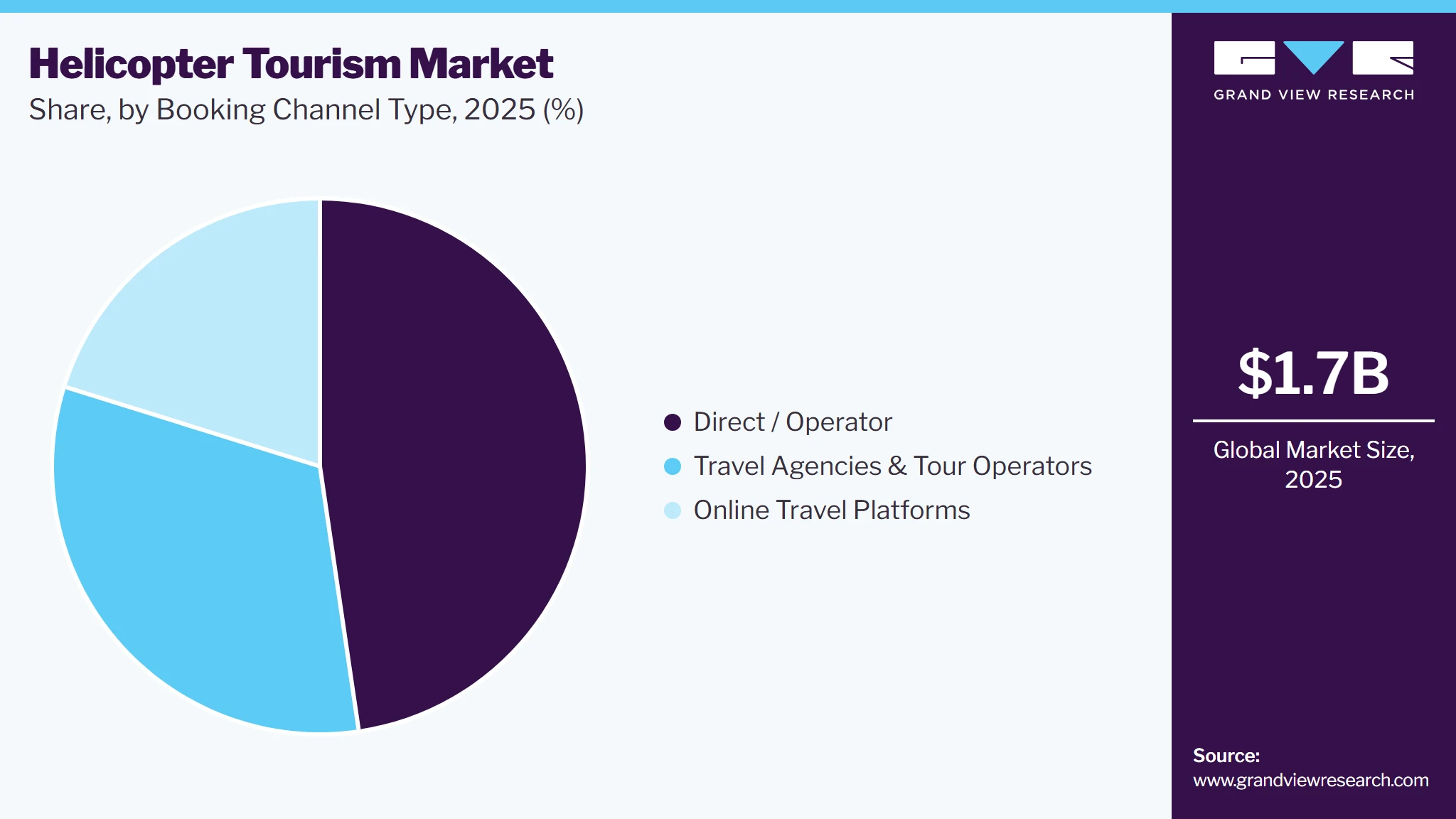
The direct/operator channel accounted for 47.7% of global revenue in 2025. The continued dominance of Direct/Operator booking reflects the importance of trust, schedule coordination and route-specific information in helicopter travel, where customers often need to select an exact departure time, aircraft experience and destination. Operators also have an incentive to retain direct relationships because they can control pricing, customer communication and ancillary services. For insatnce, Kerala Tourism's newsletter published in January 2024 reported the launch of its heli-tourism initiative along with a dedicated microsite providing information on helicopter packages, trip details and booking methods. The development of operator- and tourism-authority-led booking infrastructure illustrates why direct channels remain important even as third-party digital distribution expands.
 To learn more about this report, Download Free Sample Report
 The online travel platforms segment is projected to grow at a CAGR of 7.7% from 2026 to 2033. The faster growth is being driven by the increasing digitization of experience booking and the ability of platforms to aggregate helicopter tours across multiple destinations, making a traditionally fragmented service easier to discover and purchase. According to an article by The Economic Times published in July 2025, MakeMyTrip launched a global Tours and Attractions Booking Platform offering more than 200,000 bookable experiences across over 1,100 cities in 130 countries. Although the platform covers attractions beyond helicopter tourism, its expansion demonstrates the broader shift toward digitally booking destination experiences before or during a trip. This trend creates greater visibility for helicopter operators and reduces the friction associated with discovering and reserving specialized aerial experiences.
Regional Insights
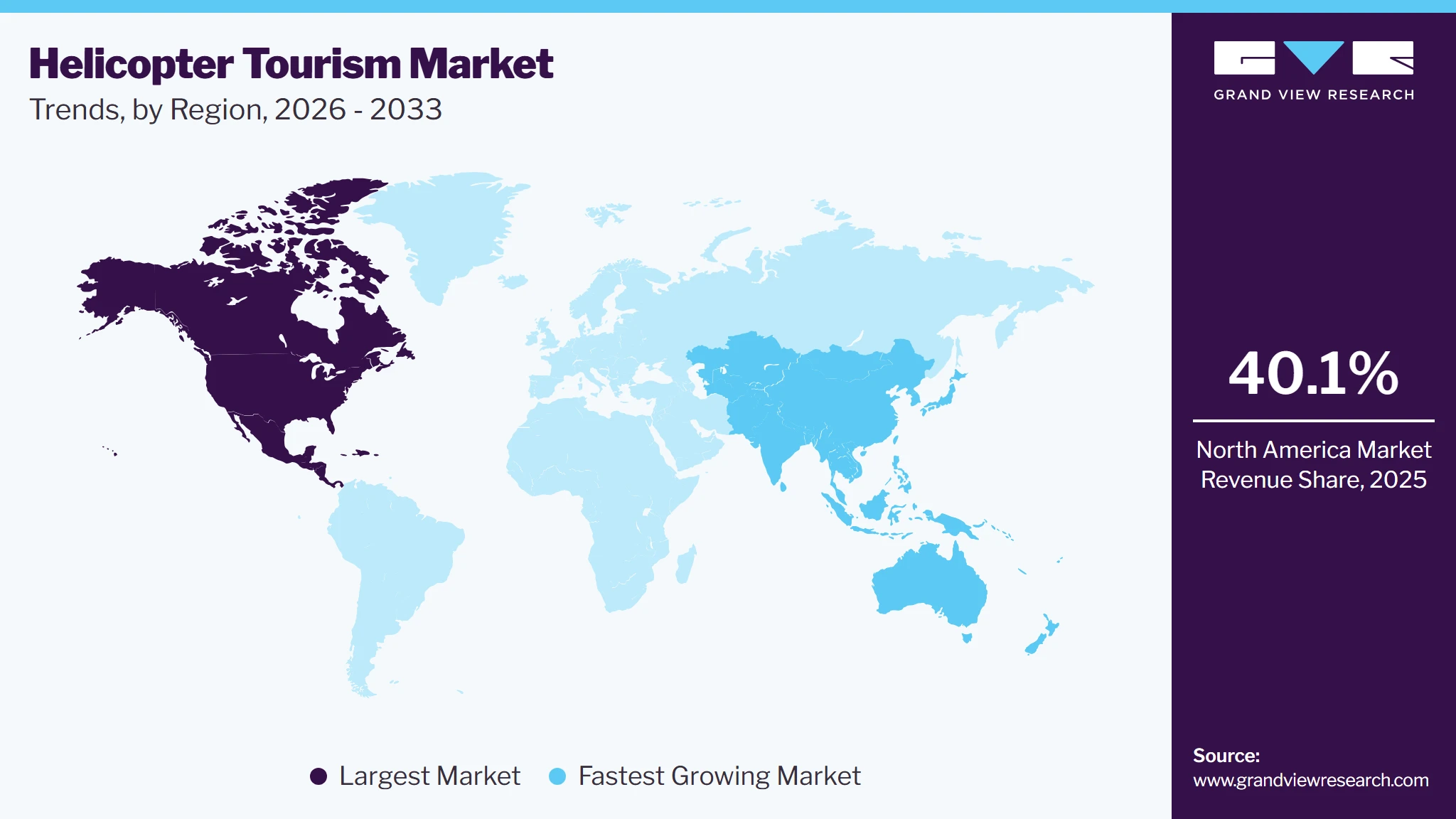
The helicopter tourism market in North America led the global market, accounting for the largest revenue share of 40.1% in 2025, supported by a mature sightseeing ecosystem around destinations such as the Grand Canyon, Hawaii, New York, and Alaska. The U.S. alone was forecast by the National Travel and Tourism Office to receive 77.1 million international visitors in 2025, up 6.5% from 2024, providing a large customer base for premium tourism experiences.
 To learn more about this report, Download Free Sample Report
 U.S. Helicopter Tourism Market Trends
The U.S. accounted for approximately 85.0% of the North American helicopter tourism market in 2025, reflecting its extensive network of scenic-tour operators and major tourism destinations. In 2025, international inbound air travelers to the U.S. spent an average of USD 1,829 per visitor, indicating substantial expenditure capacity for paid tourism activities.
Europe Helicopter Tourism Market Trends
The helicopter tourism market in Europe accounted for 27.0% of the global market in 2025, supported by its dense concentration of established tourism destinations, including the Alps, Mediterranean coastline, and major cultural cities. Strong international tourism flows continue to provide a broad addressable customer base for helicopter sightseeing and premium transfers.
The helicopter tourism market in Germany accounted for the largest revenue share of around 25.0% in 2025. Demand is supported by Germany's large domestic tourism base and its position as a major gateway for European leisure travel, while helicopter experiences are increasingly used for sightseeing and premium event-related travel.
The helicopter tourism industry in the UK is projected to grow at a CAGR of 3.2% from 2026 to 2033, supported by strong inbound tourism and established helicopter operations around London, Scotland, and other scenic destinations. The market also benefits from premium experiences associated with luxury hotels, events, and countryside tourism.
The helicopter tourism industry in France is projected to grow at a CAGR of 3.4% from 2026 to 2033. supported by tourism across Paris, the French Riviera and Alpine destinations. The country's blend of luxury tourism and geographically diverse attractions offers opportunities for both sightseeing and private helicopter tours.
Asia Pacific Helicopter Tourism Market Trends
The Asia Pacific helicopter tourism market is projected to grow at the fastest CAGR of 6.3% from 2026 to 2033, driven by the expansion of helicopter sightseeing and pilgrimage services across emerging tourism destinations, alongside increasing investment in dedicated heli-tourism infrastructure. For instance, according to a January 2025 article in The Hindu, the Indian government identified 52 tourism routes under the Regional Connectivity Scheme, including helicopter routes, to improve access to remote tourist destinations. In addition, Japan Airlines launched helicopter sightseeing services in 2025 in partnership with local operators, expanding premium aerial experiences around major Japanese destinations. These developments are increasing the availability of helicopter-based tourism products across the region and supporting market expansion.
The China helicopter tourism industry led the Asia Pacific market and accounted for 32.1% of the market in 2025. The country's large and rapidly expanding domestic tourism base provides substantial potential for helicopter sightseeing, particularly around scenic and mountainous destinations.
The India helicopter tourism market is projected to grow at a CAGR of 7.0% from 2026 to 2033, the fastest growth among the major country markets considered. India's Ministry of Tourism recorded 4.29 billion domestic tourist visits in 2025, representing a 45.6% increase from 2024, creating a large potential customer base for emerging heli-tourism routes.
Central & South America Helicopter Tourism Market Trends
The Central & South America helicopter tourism industry is projected to grow at a CAGR of 4.4% from 2026 to 2033, supported by scenic destinations across the Andes, Amazon, Caribbean-facing coastlines, and major urban tourism centers. The region's strong concentration of natural attractions provides opportunities for scenic and adventure-oriented helicopter experiences.
Middle East & Africa Helicopter Tourism Market Trends
The Middle East & Africa helicopter tourism market is projected to grow at a CAGR of 5.3% from 2026 to 2033, supported by luxury tourism, destination development, and rising international visitor volumes. Dubai alone recorded 19.59 million international overnight visitors in 2025, up 5% from 2024, while hotel occupancy reached 80.7%, supporting demand for premium tourism experiences and helicopter-based sightseeing.
Key Helicopter Tourism Company Insights
-
The global helicopter tourism market is moderately fragmented, with competition among established helicopter tour operators, aviation groups, luxury travel companies, and regional sightseeing specialists. Competitive positioning varies significantly by service type: large operators benefit from established fleets, tourism partnerships, operating licenses, and destination coverage, while smaller specialists compete through customized tours, private charters, premium experiences, and access to niche destinations. Competition is increasingly shifting from conventional sightseeing flights to integrated tourism experiences that combine helicopter flights with luxury accommodation, transfers, adventure activities, and private itineraries.
-
Major Helicopter Tour Operators: Maverick Helicopters, Papillon Grand Canyon Helicopters, Sundance Helicopters, and Liberty Helicopters maintain strong positions across major U.S. sightseeing destinations. Their competitive advantages include established operating infrastructure, large tourist volumes, extensive route networks, airport and heliport access, and strong relationships with hotels and travel distributors. Their primary exposure is the dependence on tourism volumes at specific destinations and sensitivity to weather and operating restrictions.
-
Premium & Luxury Helicopter Experience Providers: Blade, VELTRA, JTB, and other premium travel and aviation providers compete through private helicopter charters, luxury transfers, customized sightseeing, and helicopter-linked travel packages. Their differentiation comes from digital booking capabilities, integration with luxury hotels and private aviation, flexible itineraries, and the ability to bundle helicopter services with broader premium travel experiences.
-
Destination & Regional Specialists: A broad group of regional operators competes across destinations such as the Alps, Hawaii, New Zealand, Australia, Japan, India, Southeast Asia, and the Middle East. These companies typically differentiate through local destination expertise, scenic routes, pilgrimage services, adventure tourism, and access to locations where larger international operators have limited presence. Their localized relationships with tourism authorities, hotels, resorts, and travel agencies remain important competitive advantages.
-
Integrated Aviation & Tourism Providers: Aviation companies and tourism groups are increasingly entering helicopter tourism through partnerships, charter services, and dedicated tourism products. These participants leverage existing aircraft fleets, aviation infrastructure, customer databases, and distribution networks to expand into tourism applications. This model is particularly relevant for airport transfers, resort connectivity, private charters, and premium destination experiences, where helicopter tourism can be integrated with other high-value travel services.
 To learn more about this report, Download Free Sample Report
 Key Helicopter Tourism Companies:
The following key companies have been profiled for this study on the helicopter tourism market.
-
Maverick Helicopters
-
Papillon Grand Canyon Helicopters
-
Blue Hawaiian Helicopters
-
Liberty Helicopters
-
Sundance Helicopters
-
Niagara Helicopters
-
Air Maui Helicopters
-
Sydney Helicopters
-
Glacier Helicopters
-
Cape Town Helicopters
Competitive Benchmarking
Category
Operating Strategies
Competitive Edge
Key Challenges
Established Players (Maverick Helicopters; Papillon Grand Canyon Helicopters; Blue Hawaiian Helicopters; Sundance Helicopters; Liberty Helicopters; Niagara Helicopters)
- Focus on expanding sightseeing operations across established tourist destinations while increasing fleet utilization, route coverage, private charter offerings, and partnerships with hotels, travel agencies, destination management companies, and online booking platforms. Continue investing in fleet modernization, safety systems, digital reservations, and premium tour packages.
- Strong destination recognition, established operating licenses and infrastructure, experienced pilots and crews, large customer bases, established tourism partnerships, extensive route knowledge, and strong brand reputation.
- High aircraft acquisition and maintenance costs, exposure to weather-related cancellations, regulatory restrictions on air tours, dependence on tourism traffic at specific destinations, and relatively high fixed operating costs.
Emerging & Regional Players (Sydney Helicopters; Cape Town Helicopters; Auckland Helicopters; Heli Austria; Rotorua Helicopters)
- Focus on destination-specific sightseeing, adventure tourism, private charters, scenic flights, resort transfers, and specialized tourism packages. Leverage local tourism partnerships, flexible itineraries, digital booking channels, and niche destinations to compete with larger operators.
- Strong local destination expertise, greater operational flexibility, customized tourism experiences, lower organizational complexity, and the ability to identify underserved routes and emerging tourism destinations quickly.
- Smaller fleets and operating networks, limited brand recognition outside their core destinations, lower bargaining power with distribution partners, greater dependence on seasonal tourism, and comparatively limited financial capacity for fleet expansion.
Recent Developments
-
In March 2025, Airbus Helicopters launched the H140, a new 3-tonne-class light twin-engine helicopter at VERTICON 2025 in Dallas. The aircraft can accommodate up to six passengers and is designed for passenger transport and private/business aviation in addition to other applications, providing a newer aircraft platform relevant to the tourism and premium passenger segment.
-
In January 2026, Heritage Aviation signed a contract for one Airbus H130 helicopter to expand its heli-pilgrimage and regional connectivity operations under India's UDAN scheme. Airbus reported that delivery was scheduled for September 2026, making this a genuine 2026 fleet-expansion development rather than a 2025 announcement being retrospectively dated.
-
In December 2025, Ladakh expanded its B-3 helicopter services to strengthen tourism and connectivity across remote destinations. The revised service was inaugurated on December 12, 2025, with operations subsequently launched at Diskit in Nubra on December 16, 2025. The administration explicitly positioned the expansion as supporting tourism as well as regional connectivity and emergency services.
-
In October 2025, Niagara Helicopters completed the renewal of its aerial-tour fleet with four Airbus H130 helicopters. Airbus stated that the four aircraft would support Niagara Helicopters' aerial tourism operations over Niagara Falls, representing a concrete fleet-modernization investment by an established tourism operator.
-
In October 2025, Airbus Helicopters and Tata Advanced Systems announced the establishment of India's first private-sector helicopter Final Assembly Line in Karnataka. The facility will produce the Airbus H125, with the companies stating that it is intended to serve the growing rotorcraft market in India and South Asia. This is relevant to helicopter tourism because the H125 is widely used for sightseeing and charter operations.
Helicopter Tourism Market Report Scope
Report Attribute
Details
Market size in 2025
USD 1.7 billion
Estimated market size in 2026
USD 1.8 billion
Projected market size by 2033
USD 2.3 billion
Growth rate
CAGR of 3.9% from 2026 to 2033
Base year
2025
Actual data
2021 - 2024
Forecast period
2026 - 2033
Quantitative units
Revenue in USD million and CAGR from 2026 to 2033
Report coverage
Revenue forecast, company ranking, competitive landscape, growth factors, and trends
Segments covered
Tourism type, destination type, booking channel type, and region
Regional scope
North America; Europe; Asia Pacific; Central & South America; Middle East & Africa
Country scope
U.S.; Canada; Mexico; Germany; UK; France; Italy; Spain; China; Japan; India; South Korea; Australia & New Zealand; Brazil; South Africa
Key companies profiled
Maverick Helicopters; Papillon Grand Canyon Helicopters; Blue Hawaiian Helicopters; Sundance Helicopters; Liberty Helicopters; Niagara Helicopters; Air Maui Helicopters; Sydney Helicopters; Glacier Helicopters; Cape Town Helicopters
Customization scope
Free report customization (equivalent up to 8 analysts’ working days) with purchase. Addition or alteration to country, regional & segment scope.
Pricing and purchase options
Avail customized purchase options to meet your exact research needs. Explore purchase options
Global Helicopter Tourism Market Report Segmentation
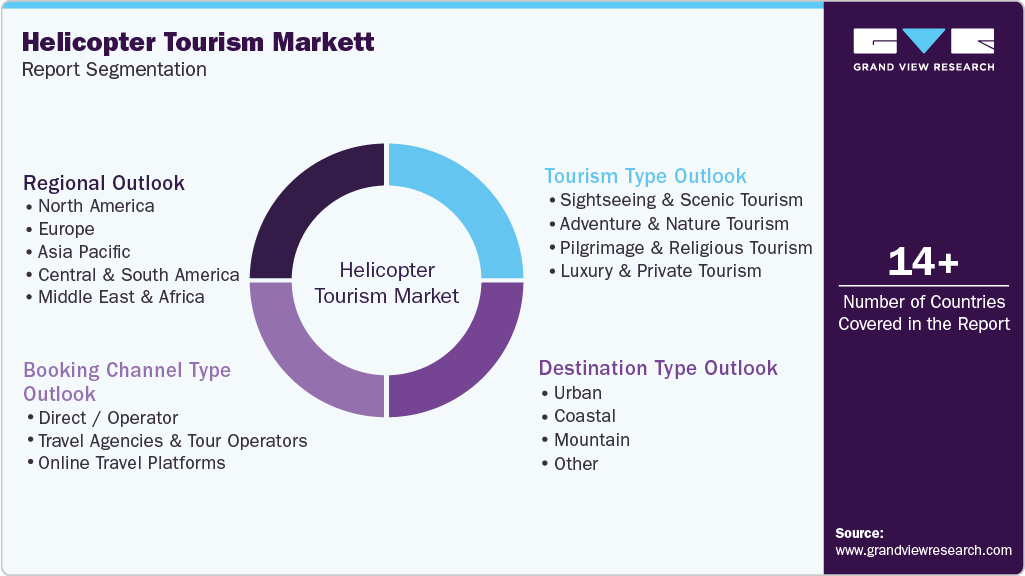
This report forecasts revenue growth at the global, regional & country levels and provides an analysis of the latest trends and opportunities in each sub-segment from 2026 to 2033. For the purposes of this study, Grand View Research has segmented the helicopter tourism market by tourism type, destination type, booking channel type and region.
 To learn more about this report, Download Free Sample Report
 -
Tourism Type Outlook (Revenue, USD Million, 2021 - 2033)
-
Sightseeing & Scenic Tourism
-
Adventure & Nature Tourism
-
Pilgrimage & Religious Tourism
-
Luxury & Private Tourism
-
-
Destination Type Outlook (Revenue, USD Million, 2021 - 2033)
-
Urban
-
Coastal
-
Mountain
-
Other
-
-
Booking Channel Type Outlook (Revenue, USD Million, 2021 - 2033)
-
Direct / Operator
-
Travel Agencies & Tour Operators
-
Online Travel Platforms
-
-
Regional Outlook (Revenue, USD Million, 2021 - 2033)
-
North America
-
U.S.
-
Canada
-
Mexico
-
-
Europe
-
Germany
-
UK
-
France
-
Italy
-
Spain
-
-
Asia Pacific
-
China
-
Japan
-
India
-
South Korea
-
Australia & New Zealand
-
-
Central & South America
-
Brazil
-
-
Middle East & Africa
-
South Africa
-
-
Research Methodology
The helicopter tourism market figures in this report are based on a proven research process that combines executive interviews with secondary research from proprietary databases, company filings, and recognized regulatory and institutional sources. Market size is built through value-chain sizing-reconciling supply-side and demand-side estimates-and triangulated with bottom-up and top-down approaches. Every estimate passes multiple levels of expert validation before publication, with each helicopter tourism segment quantified using the revenue-capture definitions in the table below.
Segment Definition
Tourism Type
Revenue capture definition
Sightseeing & Scenic Tourism
Revenue from helicopter flights primarily undertaken to view landscapes, landmarks, cityscapes, coastlines, mountains, waterfalls, and other tourist attractions from the air, including shared sightseeing flights and scheduled scenic tours. Excludes helicopter transportation undertaken primarily for point-to-point travel, emergency services, or non-tourism purposes.
Adventure & Nature Tourism
Revenue from helicopter experiences associated with adventure, outdoor, and nature-based tourism, including helicopter-supported mountain tours, glacier or wilderness experiences, aerial wildlife viewing, heli-skiing, and helicopter access to adventure destinations. Excludes conventional sightseeing flights where the primary purpose is general scenic viewing.
Pilgrimage & Religious Tourism
Revenue from helicopter services used primarily to access religious and pilgrimage destinations, including helicopter transfers to temples, shrines, monasteries, and other religious sites, as well as pilgrimage packages incorporating helicopter transportation. Excludes general tourism flights that only incidentally visit religious landmarks.
Luxury & Private Tourism
Revenue from private or premium helicopter tourism experiences, including exclusive sightseeing flights, private charters, customized aerial tours, luxury hotel or resort transfers, destination-wedding services, and other personalized helicopter experiences. Excludes standard shared sightseeing flights and routine point-to-point transportation not positioned as a premium tourism experience.
Estimation Model
Layer Name
Key Question
Description
Tourist Base Layer
Who forms the addressable traveler base?
International and domestic tourists visiting destinations with established leisure, adventure, pilgrimage, coastal, mountain, or urban tourism activity.
Helicopter Tourism Demand Layer
Which travelers choose helicopter tourism?
Travelers with sufficient discretionary spending and interest in premium, scenic, adventure, pilgrimage, or private tourism experiences who are potential helicopter-tourism users.
Service, Destination & Booking Layer
What type of helicopter experience do they choose?
Travelers selecting Sightseeing & Scenic, Adventure & Nature, Pilgrimage & Religious, or Luxury & Private Tourism, further differentiated by destination type and booking channel.
Monetisation Layer
How much revenue is generated?
The estimated number of helicopter tourism users and flights is converted into market revenue using average ticket prices, passenger capacity, flight frequency, utilization, private-tour premiums, and applicable service-specific pricing assumptions.
Delivered Customizations
This report has been delivered with the following In-depth customizations
Client Request
Customization Delivered
Value Adds
Market Entry & Destination Prioritization
Developed a three-dimensional opportunity model linking tourist arrivals, destination attractiveness, existing helicopter services, accessibility constraints, heliport infrastructure, ticket prices, and passenger demand across major tourism destinations.
Identified high-potential and underserved destinations, enabling operators and investors to prioritize new routes, heliport development, fleet deployment, and market-entry opportunities.
Fleet Deployment & Route Profitability Assessment
Assessed helicopter tourism economics by linking route distance, flight duration, aircraft capacity, passenger load factor, flight frequency, ticket pricing, and operating utilization to estimate revenue potential at the route level.
Identified high-revenue routes, capacity gaps, and optimal aircraft deployment, supporting route expansion, scheduling, fleet acquisition, and pricing decisions.
Premiumization & Revenue Diversification Strategy
Compared shared sightseeing, private tours, charter flights, luxury transfers, and tourism packages across passenger profile, pricing, utilization, revenue per flight, and destination demand.
Identified profitable premiumization and revenue diversification opportunities, helping operators optimize service mix, increase revenue per passenger, and reduce reliance on conventional sightseeing tours.
Frequently Asked Questions About This Report
The global helicopter tourism market size was valued at USD 1.7 billion in 2025 and is estimated at USD 1.8 billion for 2026.
Key factors driving the helicopter tourism market growth include rising demand for experiential and premium travel, as tourists increasingly seek unique aerial sightseeing and exclusive access to scenic destinations.
North America dominated with a 40.1% revenue share in 2025.
Asia Pacific is the fastest-growing region over the forecast period.
The sightseeing & scenic helicopter tourism led with a 43.0% revenue share in 2025, while luxury & private helicopter tourism is the fastest-growing segment.
Urban helicopter tourism accounted for the largest revenue share in 2025, while mountain helicopter tourism is the fastest-growing segment.
Key players include Maverick Helicopters; Papillon Grand Canyon Helicopters; Blue Hawaiian Helicopters; Sundance Helicopters; Liberty Helicopters; Niagara Helicopters; Air Maui; Sydney Helicopters; Cape Town Helicopters; Volcanic Air
The global helicopter tourism market is expected to grow at a CAGR of 3.9% from 2026 to 2033, reaching USD 2.3 billion by 2033.
Booking helicopter tourism through the direct / operator channel accounted for a revenue share of 47.7% in 2025, while booking helicopter tourism through online travel platforms is the fastest growing segment.
About the Author(s)
Homecare & Decor Research Team
Consumer Goods · Homecare & DecorThis report was authored by the homecare & decor research team at Grand View Research - comprising two research analysts, one senior research analyst, and one industry expert - with specialized expertise in the homecare & decor segment of the consumer goods industry. All findings are based on proprietary consumer goods databases, executive interviews, and regulatory analysis, subject to internal peer review prior to publication.
Last Updated:
Speak to Analyst

Customize this report to your needs - add regions, segments, or data points, with 20% free customization.
Or view our licence options:


ISO 9001:2015 & 27001:2022 Certified
We are GDPR and CCPA compliant! Your transaction & personal information is safe and secure. For more details, please read our privacy policy.


