
- Home
- »
- Advanced Interior Materials
- »
-
High Performance Alloys Market Size Report, 2026-2033GVR Report cover

High Performance Alloys Market (2026 - 2033)
Size, Share & Trends Analysis Report By Alloying Element (Nickel, Titanium, Aluminum, Cobalt, Magnesium, Refractory Metals), By End Use, By Region, And Segment Forecasts
Market Size, 2025
$10.4BMarket Estimate, 2026
$11.1BMarket Forecast, 2033
$15.8BCAGR, 2026–2033
5.2%High Performance Alloys Market Summary
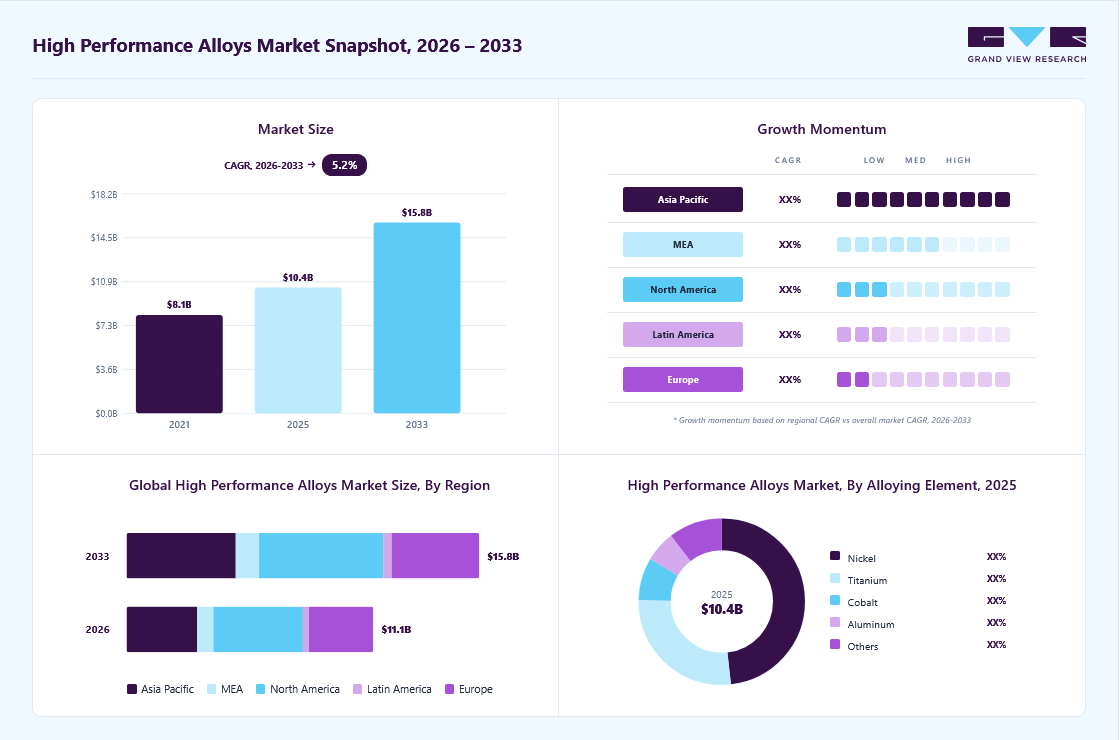
The global high performance alloys market size was valued at USD 10.4 billion in 2025 and is projected to grow from USD 11.1 billion in 2026 to USD 15.8 billion by 2033, at a CAGR of 5.2% from 2026 to 2033. North America dominated the market, accounting for the largest revenue share of 36.4% in 2025. Growth is primarily driven by increasing demand for advanced metallic materials across aerospace and defense, power generation, oil and gas, and chemical processing industries.
 Source: Grand View Research, IR Documents, Primary Interviews, Paid DatabasesTo learn more about this report,
 Download Free Sample Report
Key Market Trends & Insights
- By end use: Aerospace and defense segment accounted for the largest revenue share at 46.1% in 2025.
- By alloying element: Magnesium segment is projected to register the fastest revenue CAGR of 6.0% from 2026 to 2033.
Regional Highlights
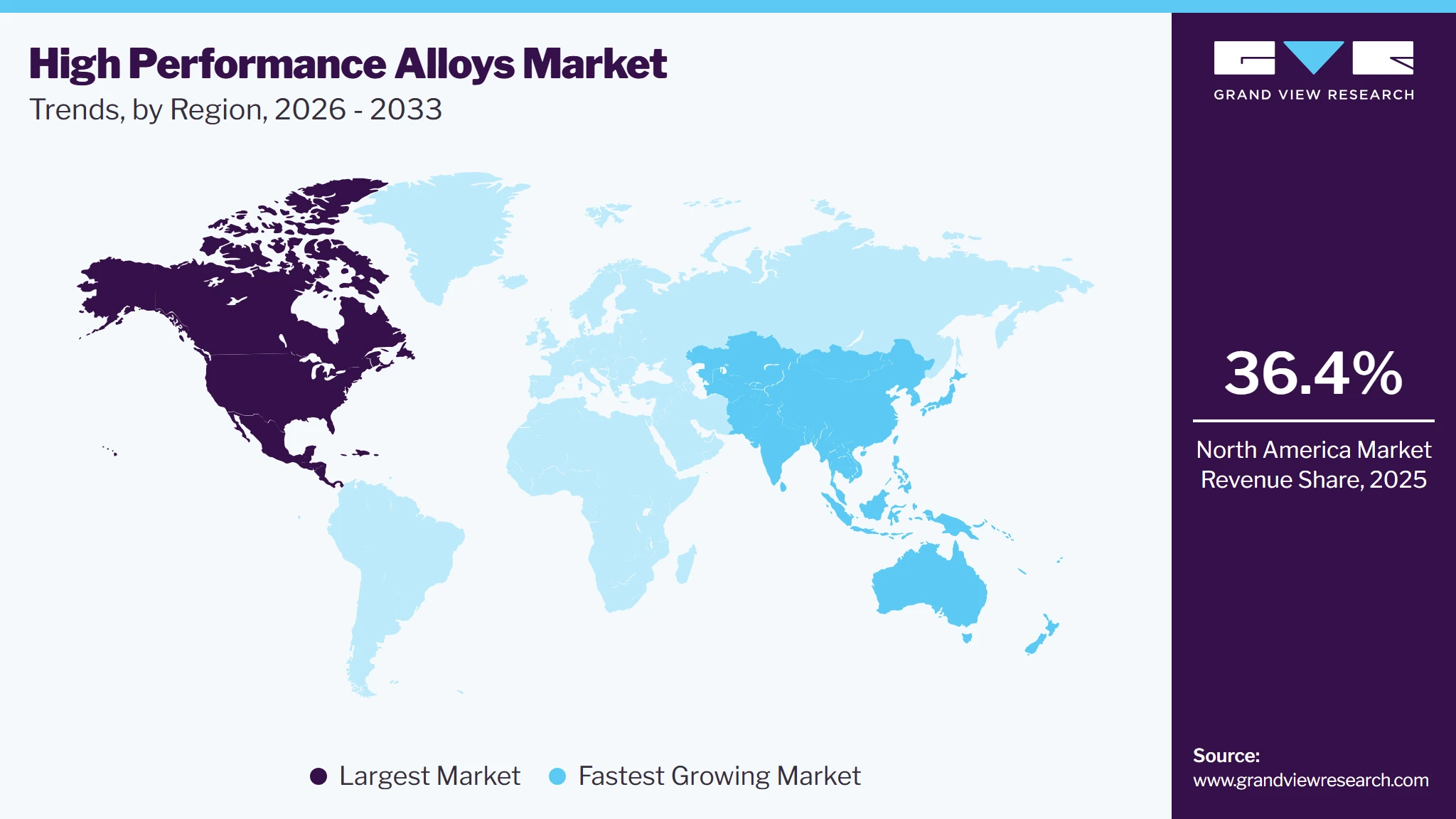
- Largest regional market: North America (36.4% revenue share, 2025)
- Fastest-growing regional market: Asia Pacific (highest CAGR, 2026-2033)
- By country: The U.S. held the largest market share in 2025
Market Size & Forecast
- Market size in 2025: USD 10.4 Billion
- Estimated market size in 2026: USD 11.1 Billion
- Projected market size by 2033: USD 15.8 Billion
- CAGR (2026-2033): 5.2%
Three ways to get this report
Buy it, customize it, or ask a question.Ask an Analyst
Analyst response in 1 business day
- AccessReport author, directly
- Reply timeWithin 1 working day
- No sales callDirect answer only
- FormatEmail reply
- CostFree, no cost
Get the Full Report
What the study covers
- FormatsPDF · Excel · Dashboard
- Timeline2026–2033 annual, 2025 base
- Coverage20+ countries, 5 regions
- Companies10+ key players profiled
Customize the Report
20% free customization
- IncludeCountries, segments, points
- TailorTo your product definition
- ExtendDeeper competitor detail
- OrA fully bespoke study
- Turnaround5–10 working days
Rising aircraft production, expanding defense manufacturing, and investments in energy infrastructure are supporting the adoption of nickel-based alloys, cobalt-based alloys, titanium alloys, and other specialty materials. Increasing focus on resource efficiency and sustainable industrial operations is encouraging manufacturers to optimize alloy production, improve raw material recovery, and minimize manufacturing waste. It contains valuable elements such as nickel, cobalt, chromium, and molybdenum, making scrap recovery and recycling important for controlling material costs and reducing dependence on primary metal supplies. Manufacturers are investing in improved melting technologies, efficient refining processes, and closed-loop recycling systems to enhance production efficiency.
 To learn more about this report, Download Free Sample Report
Advancements in metallurgical engineering and precision manufacturing are improving the performance characteristics of specialized alloys. Developments in alloy composition, heat treatment, powder metallurgy, and additive manufacturing are enabling the production of components with enhanced strength, fatigue resistance, thermal stability, and corrosion protection. These improvements are particularly relevant for aerospace engines, industrial turbines, chemical processing equipment, and other applications exposed to extreme operating conditions.
Market Dynamics
Rising demand for lightweight, durable, and high-strength materials across aerospace and defense applications is supporting the adoption of high-performance alloys. Aircraft engines, turbine blades, exhaust systems, and structural components require materials capable of withstanding high temperatures, repeated mechanical stress, and oxidation without compromising performance. Increasing aircraft production, fleet modernization, defense equipment procurement, and the development of next-generation propulsion systems are strengthening requirements for nickel-based superalloys, titanium alloys, and cobalt-based materials.
Growing investment in power generation, industrial equipment, and oil and gas infrastructure is further contributing to consumption. Gas turbines, heat exchangers, chemical reactors, and high-pressure processing systems require specialized materials that can withstand thermal cycling, corrosive substances, and prolonged exposure to harsh environments. The need to improve equipment efficiency, reduce maintenance requirements, and extend operating life is encouraging end users to adopt advanced alloy grades tailored to specific technical requirements.
Fluctuations in the prices of nickel, cobalt, molybdenum, chromium, and other alloying elements can affect manufacturing costs and supplier profitability. High-performance alloys often require carefully controlled compositions and specialized processing techniques, increasing their production costs compared with conventional steel and other standard engineering materials. Additional expenditure on vacuum melting, precision casting, heat treatment, inspection, and mechanical testing can further increase the final component cost.
Investment in advanced energy technologies is creating opportunities for specialized alloy suppliers. Hydrogen production and transportation, nuclear power generation, geothermal energy, and high-efficiency gas turbines require materials capable of operating under elevated temperatures, pressure, and chemically aggressive conditions. Nickel-based alloys and other specialized materials are suitable for selected applications involving heat exchangers, turbine components, pressure vessels, and corrosion-resistant equipment. Meanwhile, the development of hydrogen infrastructure is increasing the need for materials with appropriate resistance to hydrogen-related degradation and embrittlement.
Analyst Perspective
The market is increasingly benefiting from rising demand for advanced materials across aerospace and defense, power generation, oil and gas, and chemical processing. Growing emphasis on operational reliability, thermal efficiency, corrosion resistance, and component durability is encouraging the adoption of nickel-based superalloys, titanium alloys, cobalt-based alloys, and specialty steels. Manufacturers are investing in advanced metallurgical processes, precision forging, powder metallurgy, and additive manufacturing to enhance material properties and produce complex components for demanding operating environments. Fluctuations in alloying element prices, high production costs, stringent qualification requirements, and the need for continuous technological innovation are shaping competitive strategies and investment priorities.
Alloying Element Insights
Magnesium alloys are projected to record the fastest revenue growth among the alloying element categories, with a CAGR of approximately 6.0% from 2026 to 2033. Their growth outlook reflects demand for lightweight materials in automotive, industrial, and other applications where reducing component weight while maintaining suitable mechanical performance is important. The wider alloying element mix also includes titanium, aluminum, cobalt, refractory metals, and other specialty materials selected according to application-specific performance requirements.
Nickel-based alloys accounted for the largest revenue share in 2025, representing approximately 48.2% of total revenue. Their leading position reflects extensive use in high-temperature and corrosive environments, particularly in aerospace engines, industrial gas turbines, chemical processing equipment, and oil and gas systems. Nickel alloys are valued for their combination of strength, creep resistance, oxidation resistance, and performance at elevated temperatures.
End Use Insights
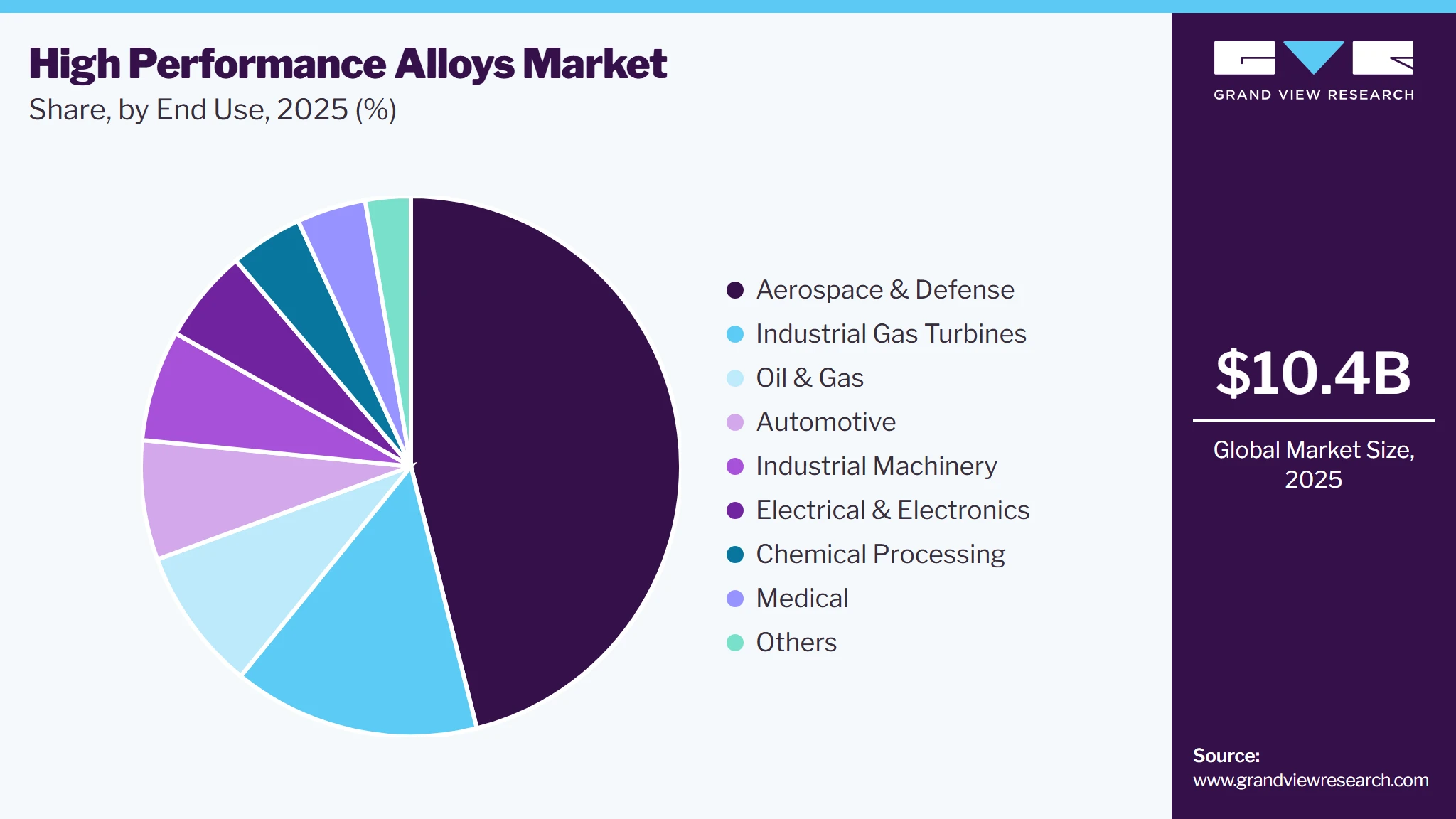
Aerospace and defense accounted for the largest end-use revenue share, at 46.1%, in 2025. Aircraft engines, turbine blades, structural components, landing gear, and defense equipment require materials that combine high strength with fatigue resistance, thermal stability, and low weight where required. Nickel-based superalloys are used in hot-section engine components, while titanium and high-strength aluminum alloys serve selected structural and airframe applications. Aircraft production, fleet upgrades, and defense modernization support continued demand for alloys that meet stringent performance and qualification requirements.
 To learn more about this report, Download Free Sample Report
The electrical and electronics end-use segment is projected to record the fastest revenue growth, with a CAGR of approximately 6.0% from 2026 to 2033. Demand is supported by specialized materials used in electronic equipment, connectors, thermal-management systems, and components requiring a combination of electrical, mechanical, thermal, or corrosion-resistance properties. Industrial gas turbines also remain an important application, supported by requirements for high-temperature materials in power generation and industrial energy systems.
Regional Insights
North America dominated the high performance alloys market with the largest revenue share of 36.4% in 2025, is supported by aerospace engine manufacturing, defense procurement, and investments in domestic advanced-materials production. In September 2026, U.S.-based Elmet Technologies announced a USD 36 million Defense Logistics Agency contract to supply high-performance molybdenum and tungsten alloys and precision wire for aerospace and jet-engine applications. The contract highlights the strategic importance of specialized materials and secure domestic supply chains for defense-related manufacturing.
 To learn more about this report, Download Free Sample Report
U.S. High Performance Alloys Market Trends
The high performance alloys market in the U.S. is strengthening its advanced-materials manufacturing capabilities through investments in aerospace, defense, and specialized titanium components. In May 2026, IperionX commissioned a 300-ton, six-axis powder metallurgy press at its Titanium Manufacturing Campus in Virginia, tripling its existing powder metallurgy capacity and expanding production capabilities for high-value titanium components used in aerospace, defense, and industrial applications. This investment supports the development of domestic manufacturing capabilities for specialized alloy components.
Asia Pacific High Performance Alloys Market Trends
The high performance alloys market in the Asia Pacific is supported by expanding aerospace manufacturing, industrial modernization, and investments in domestic specialty-metal production. In July 2026, India's Raghu Vamsi Aerospace Group announced an investment exceeding INR 600 crore in an integrated nickel-based superalloy manufacturing facility in Telangana, with planned annual capacity of approximately 5,000 tons and commercial production targeted for January 2028. The facility is intended to serve aerospace, defense, and energy applications, reflecting efforts to strengthen regional supply capabilities for advanced materials.
China high performance alloys market is strengthening its domestic capabilities in advanced specialty alloys and high-end metallic materials for aerospace, marine engineering, energy, and industrial applications. In August 2026, China media reported that the country had achieved mass production of several advanced specialty steels, including materials for offshore wind turbines, aircraft manufacturing, and electronics. These developments reflect ongoing efforts to improve domestic materials technology and reduce reliance on imported specialized materials.
Europe High Performance Alloys Market Trends
The high performance alloys market in Europe is supported by aerospace production, advanced engineering, and the need for high-performance materials in aircraft engines and other critical components. In April 2026, Austria-based voestalpine announced aerospace orders worth approximately USD 110.0 billion for delivery over five years through its High Performance Metals Division. The orders cover high-performance materials, forged components, and associated services, with production planned at its Austrian facilities and its Brazilian subsidiary. This development highlights sustained demand for specialized metals and precision-forged components within the aerospace supply chain.
Latin America High Performance Alloys Market Trends
The high performance alloys market in Latin America is supported by aerospace component manufacturing, industrial equipment production, oil and gas operations, and power generation. Mexico's aerospace manufacturing and export industry contributes to regional requirements for specialized metallic materials, including titanium alloys, nickel-based superalloys, and high-strength steels used in aircraft engines, structural components, and precision-engineered parts. Across the region, investments in energy infrastructure and industrial processing also support the use of corrosion-resistant alloys in demanding operating environments.
Middle East & Africa High Performance Alloys Market Trends
The high performance alloys market in MEA is associated with oil and gas operations, desalination, offshore engineering, power generation, and industrial maintenance, where corrosion-resistant and high-temperature materials are important. In September 2026, Dubai-based IER MRO Industries partnered with U.S.-based Chromalloy to expand alternative engine-parts and repair services across the region. While the agreement focuses on aircraft engine aftermarket services rather than alloy production, it highlights ongoing investment in aerospace maintenance capabilities that rely on specialized materials and engineered components.
Key High Performance Alloys Company Insights
Some of the key players operating in the market include ATI Inc., Carpenter Technology Corporation, and others.
-
ATI Inc. is a U.S.-based specialty materials manufacturer with a corporate history spanning several decades and a portfolio focused on materials for demanding industrial environments. The company produces nickel-based alloys, titanium alloys, specialty stainless steels, and other advanced materials used in aerospace, defense, energy, and industrial applications. Its product portfolio includes high-temperature and corrosion-resistant alloys, as well as precision-engineered components designed to withstand extreme temperatures, mechanical stress, and aggressive operating conditions. ATI focuses on developing advanced metallurgical solutions and maintaining an integrated supply chain to support critical applications requiring high strength, durability, and reliable performance.
-
Carpenter Technology Corporation, established in 1889, is a U.S.-based manufacturer specializing in premium specialty alloys and engineered materials for critical industrial applications. The company offers nickel-based, cobalt-based, and titanium alloys, along with stainless steels, high-temperature superalloys, powder metals, and specialty materials designed for advanced manufacturing. Its products serve aerospace, defense, medical technology, transportation, energy, and industrial applications where material strength, fatigue resistance, and performance consistency are essential.
-
Haynes International, established in 1912, is a manufacturer specializing in high-performance nickel-based and cobalt-based alloys designed for high-temperature and corrosive environments. Its product portfolio includes HASTELLOY and HAYNES alloy families, available in forms such as sheets, plates, bars, billets, pipes, tubes, wires, and welding consumables. These materials are used in aerospace engines, power generation equipment, chemical processing facilities, and industrial systems exposed to elevated temperatures, oxidation, and aggressive chemicals.
Key High Performance Alloys Companies
The following key companies have been profiled for this study on the high performance alloys market.
-
ATI Inc.
-
Aubert & Duval
-
Carpenter Technology Corporation
-
Doncasters Group
-
Haynes International
-
Nippon Yakin Kogyo Co., Ltd.
-
Precision Castparts Corp. (PCC)
-
Special Metals Corporation
-
VDM Metals
-
voestalpine High Performance Metals
Competitive Benchmarking
Category
Operating Strategies
Competitive Edge
Weakness
Established Players (ATI Inc.; Carpenter Technology Corporation; Haynes International; Precision Castparts Corp. (PCC); Special Metals Corporation; VDM Metals; voestalpine High Performance Metals)
- Establish long-term supply relationships with aerospace, defense, energy, and industrial equipment manufacturers to secure recurring demand.
- Invest in advanced melting, forging, casting, and powder metallurgy technologies to expand specialized alloy production capabilities.
- 3Develop customized alloy grades that meet stringent requirements for thermal stability, corrosion resistance, mechanical strength, and fatigue performance.
- Extensive metallurgical expertise and established manufacturing capabilities support the production of complex, high-specification alloys.
- Long-standing customer relationships and qualification experience strengthen access to aerospace, defense, and other critical industrial supply chains.
- Broad product portfolios and integrated processing capabilities enable the supply of multiple alloy forms and specialized components.
- High capital expenditure for specialized production equipment, testing infrastructure, and manufacturing upgrades can constrain financial flexibility.
- Exposure to fluctuations in nickel, cobalt, titanium, and other alloying element prices can increase production costs.
- Stringent customer qualification requirements and complex manufacturing processes can lengthen development cycles and limit rapid capacity adjustments.
Specialized / Regional Established Players: (Aubert & Duval; Doncasters Group; Nippon Yakin Kogyo Co., Ltd.)
- Target niche applications through specialized alloy formulations designed for regional aerospace, defense, energy, and industrial requirements.
- Develop technical partnerships with research institutions, component manufacturers, and end users to accelerate product validation and commercialization.
- Expand production selectively and focus on high-value alloy grades to manage capital requirements while building customer relationships.
- Specialized product portfolios can support faster responses to customer-specific technical requirements.
- Regional manufacturing facilities may improve delivery responsiveness and proximity to local customers.
- Focused operations can allow companies to concentrate resources on niche alloy grades and underserved applications.
- Limited production scale and narrower product portfolios can restrict competitiveness against established international manufacturers.
- Obtaining qualification from aerospace, defense, and other critical customers can require substantial testing, investment, and time.
- Limited access to specialized equipment, technical expertise, and cost-effective alloying element supplies can constrain production expansion and profitability.
Recent Development
-
In September 2026, Haynes International broke ground on a new vacuum induction melting facility and an SMS rotary forge at its U.S. operations. The project is intended to strengthen its specialty alloy manufacturing capabilities as part of the Acerinox Group, alongside VDM Metals and North American Stainless. The investment supports production capabilities for advanced alloys used in demanding industrial applications and reflects continued investment in specialized melting and forging infrastructure.
-
In October 2026, India's Raghu Vamsi Group signed a memorandum of understanding with the University of Sheffield's Advanced Manufacturing Research Centre (AMRC) to develop advanced manufacturing capabilities, including superalloys and single-crystal castings. The three-year collaboration will support technology development for the group's planned superalloy manufacturing facility and research and development centre in Telangana. The initiative is intended to strengthen domestic capabilities in specialized materials for aerospace and defense applications while improving manufacturing processes, technical expertise, and supply-chain efficiency.
-
In October 2026, Carpenter Technology highlighted the development and industrial scale-up of a next-generation precipitation-hardening stainless steel designed to combine high strength and toughness with improved corrosion resistance. The material is intended for demanding defense applications, including structural components where conventional high-strength steels can require protective coatings and additional maintenance. The company reported that the alloy had been scaled up into bar and strip product forms, with a specification submission planned by the end of 2026.
High Performance Alloys Report Scope
Report Attribute
Details
Market definition
The market size represents the total annual consumption of high performance alloys - nickel- and cobalt-based superalloys, titanium alloys, high-strength aluminum and magnesium alloys, and refractory metal alloys - used in applications requiring high strength, corrosion, creep, and temperature resistance, such as aerospace & defense, industrial gas turbines, oil & gas, and chemical processing.
Market size in 2025
USD 10.4 billion
Estimated market size in 2026
USD 11.1 billion
Projected market size by 2033
USD 15.8 billion
Growth rate
CAGR of 5.2% from 2026 to 2033
Historical data
2021 - 2025
Forecast period
2026 - 2033
Quantitative Units
Volume in kilotons, revenue in USD billion, and CAGR from 2026 to 2033
Report coverage
Volume & revenue forecast, competitive landscape, growth factors, and trends
Segments covered
Alloying element, end use, region
Regional scope
North America; Europe; Asia Pacific; Latin America; Middle East & Africa
Country scope
U.S.; Canada; Mexico; Germany; UK; France; Italy; Spain; China; India; Japan; South Korea
Key companies profiled
ATI Inc.; Aubert & Duval; Carpenter Technology Corporation; Doncasters Group; Haynes International; Nippon Yakin Kogyo Co., Ltd.; Precision Castparts Corp. (PCC); Special Metals Corporation; VDM Metals; voestalpine High Performance Metals
Customization scope
Free report customization (equivalent up to 8 analysts working days) with purchase. Addition or alteration to country, regional & segment scope.
Pricing and purchase options
Avail customized purchase options to meet your exact research needs. Explore purchase options
Global High Performance Alloys Market Report Segmentation
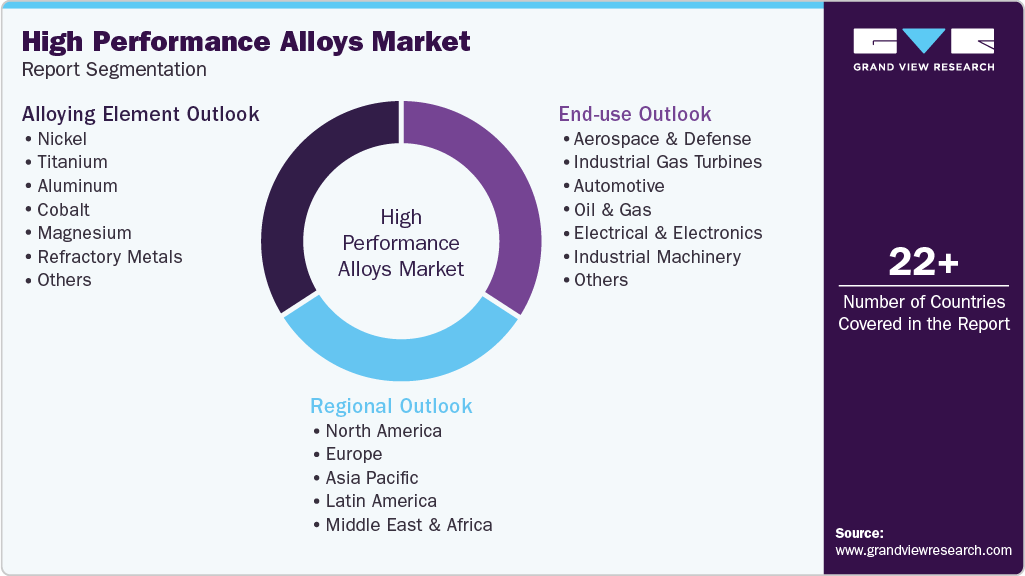
This report forecasts revenue and volume growth at global, regional, and country levels and provides an analysis of the latest industry trends in each of the sub-segments from 2021 to 2033. For this study, Grand View Research has segmented the global high performance alloys market report based on alloying element, end use, and region:
 To learn more about this report, Download Free Sample Report
-
End Use Outlook (Volume, Kilotons; Revenue, USD Million, 2021 - 2033)
-
Aerospace & Defense
-
Industrial Gas Turbines
-
Automotive
-
Oil & Gas
-
Electrical & Electronics
-
Industrial Machinery
-
Chemical Processing
-
Medical
-
Others
-
-
Alloying Element Outlook (Volume, Kilotons; Revenue, USD Million, 2021 - 2033)
-
Nickel
-
Titanium
-
Aluminum
-
Cobalt
-
Magnesium
-
Refractory Metals
-
Others
-
-
Regional Outlook (Volume, Kilotons; Revenue, USD Million, 2021 - 2033)
-
North America
-
U.S.
-
Canada
-
Mexico
-
-
Europe
-
Germany
-
UK
-
France
-
Italy
-
Spain
-
-
Asia Pacific
-
China
-
Japan
-
India
-
South Korea
-
-
Latin America
-
Middle East & Africa
-
Research Methodology
The high performance alloys market figures in this report are based on a proven research process that combines executive interviews with secondary research from proprietary databases, company filings, and recognized regulatory and institutional sources. Market size is built through value-chain sizing - reconciling supply-side and demand-side estimates - and triangulated with bottom-up and top-down approaches. Every estimate passes multiple levels of expert validation before publication, with each high performance alloys segment quantified using the revenue-capture definitions in the table below.
Segment Definition
End Use
Revenue Capture Definition
Aerospace & Defense
Revenue from high performance alloys supplied for aircraft engines, airframes, defense systems, turbine blades, landing gear, and other components requiring strength, fatigue resistance, thermal stability, or a high strength-to-weight ratio.
Industrial Gas Turbines
Revenue from alloys used in hot-section turbine components, combustion systems, casings, and related equipment designed to withstand high temperatures, creep, oxidation, and thermal cycling.
Automotive
Revenue from alloys used in automotive powertrain, exhaust, turbocharger, structural, and other components requiring lightweighting, strength, heat resistance, or corrosion protection.
Oil & Gas
Revenue from alloys used in exploration, production, refining, subsea equipment, pipelines, valves, and pressure systems requiring resistance to corrosion, pressure, and demanding operating environments.
Electrical & Electronics
Revenue from high performance alloys used in electronic equipment, connectors, thermal-management systems, and components requiring specialized electrical, mechanical, thermal, or corrosion-resistance properties.
Industrial Machinery
Revenue from alloys used in machinery, tooling, precision equipment, and industrial components exposed to mechanical stress, wear, elevated temperatures, or corrosive conditions.
Chemical Processing
Revenue from alloys used in reactors, heat exchangers, vessels, piping, and other equipment exposed to corrosive chemicals, elevated temperatures, and pressure.
Medical
Revenue from specialized alloys used in medical instruments, implants, and equipment where strength, corrosion resistance, biocompatibility, or precision performance is required.
Others
Revenue from high-performance alloys used in other applications not included in the categories above.
Alloying Element
Revenue Capture Definition
Nickel
Revenue from nickel-based alloys and superalloys used in high-temperature, corrosion-resistant, and creep-resistant applications, including aerospace engines, industrial gas turbines, chemical processing, oil and gas equipment.
Titanium
Revenue from titanium alloys used in aerospace structures, engine components, medical applications, and industrial equipment requiring high strength-to-weight ratio and corrosion resistance.
Aluminum
Revenue from high-strength aluminum alloys used in aerospace, automotive, and industrial applications requiring lightweight structures and suitable mechanical performance.
Cobalt
Revenue from cobalt-based alloys used in high-temperature, wear-resistant, and corrosion-resistant components for aerospace, power generation, and industrial processing.
Magnesium
Revenue from magnesium-based alloys used in selected lightweighting applications where weight reduction and application-specific mechanical properties are required.
Refractory Metals
Revenue from refractory metal alloys, including materials based on metals such as molybdenum and tungsten, used in applications requiring very high melting points, thermal stability, or specialized physical properties.
Others
Revenue from other high performance alloy categories not included in the alloying element groups above.
Estimation Model
Layer No.
Layer Name
Key Question
Description
01
End-Use Industry Assessment
Which industries generate demand for high performance alloys?
Evaluate demand from aerospace and defense, power generation, oil and gas, chemical processing, medical devices, and other relevant industrial sectors. Assess industry output, equipment production, infrastructure investments, and alloy-intensive applications across key countries to establish the addressable demand base.
02
Alloy Type and Application Assessment
Which alloy types are required across different applications?
Analyze demand for nickel-based alloys, cobalt-based alloys, titanium alloys, and other high performance alloy categories included within the study scope. Assess their use in turbine engines, aircraft structures, industrial heat exchangers, chemical processing equipment, and other applications based on temperature resistance, mechanical strength, corrosion resistance, and operating requirements.
03
Volume and Consumption Assessment
What is the annual consumption of high performance alloys?
Estimate annual consumption by applying relevant material intensity coefficients to production volumes across selected end-use industries. Incorporate component-level alloy requirements, equipment manufacturing output, replacement demand, material utilization, and manufacturing scrap considerations. Quantify demand in metric tons and segment the estimates by alloy type, application, and geography.
04
Pricing and Revenue Assessment
What is the monetary value of high-performance alloy sales?
Calculate revenue by multiplying estimated alloy sales volumes by the corresponding average selling prices. Account for differences in alloy composition, grade, product form, processing requirements, and application-specific specifications. Distinguish raw and semi-finished alloy sales from finished components to prevent double counting and ensure consistency in revenue estimates.
Delivered Customizations
This report has been delivered with the following In-depth customizations
Client Request
Customization Delivered
Value Adds
Raw Material Cost and Price Sensitivity
Evaluate the impact of nickel, cobalt, chromium, molybdenum, titanium, and other relevant alloying element prices, along with energy and processing costs, on finished alloy pricing.
Supports procurement planning, cost benchmarking, pricing strategy, and assessment of exposure to input price volatility.
Import-Export and Trade Flow Analysis
Examine relevant trade flows, import and export values and volumes, major trading partners, and dependence on overseas specialty alloy supplies using available trade classifications.
Supports sourcing diversification, trade risk assessment, and identification of potential export destinations.
Manufacturing Technology and Production Cost Assessment
Evaluate relevant production processes, including vacuum induction melting, vacuum arc remelting, precision forging, powder metallurgy, and additive manufacturing, where applicable.
Identifies process-related cost drivers, technology requirements, and opportunities to improve production efficiency and product quality.
About the Author(s)
Advanced Interior Materials Research Team
Advanced Materials · Advanced Interior MaterialsThis report was authored by the advanced interior materials research team at Grand View Research - comprising two research analysts, one senior research analyst, and one industry expert - with specialized expertise in the advanced interior materials segment of the advanced materials industry. All findings are based on proprietary advanced materials databases, executive interviews, and regulatory analysis, subject to internal peer review prior to publication.
Last Updated:
Speak to Analyst

Customize this report to your needs - add regions, segments, or data points, with 20% free customization.
Or view our licence options:


ISO 9001:2015 & 27001:2022 Certified
We are GDPR and CCPA compliant! Your transaction & personal information is safe and secure. For more details, please read our privacy policy.


