
- Home
- »
- Drilling & Extraction Equipments
- »
-
High Pressure Grinding Roller (HPGR) Market Report, 2022GVR Report cover

High Pressure Grinding Roller (HPGR) Market (and Segment Forecasts till 2022) Analysis by Power Rating (2 x 100 kW - 2 x 650 kW, 2 x 650 kW - 2 x 1,900 kW, 2 x 1,900 kW - 2 x 3,700 kW, 2 x 3,700 kW, and above), Application (Diamond Liberation, Base Metal Liberation, Precious Metal Beneficiation, Pellet Feed Preparation), by Type (Ferrous Metals and Ferroalloys Processing, Non-Ferrous Minerals Processing)
"The increasing adoption of HPGR in the mining and cement industry is expected to propel the market growth"
The global High Pressure Grinding Roller (HPGR) market is anticipated to witness a robust growth owing to the increase in the adoption of the mining and cement industry. As grinding consumes a majority of the energy required in the overall mining process, companies dealing with the mining sector are expected to focus on adopting energy efficient solutions in their workflow.
The increasing operational cost due to mining taxes and the growing cost of energy are anticipated to drive the market growth over the forecast period. HPGRs are being increasingly used for hard rock mining applications. Technological advancements in HPGR, such as wear abatement, enable the successful implementation of HPGR in extremely rough ores.
North America High Pressure Grinding Roller Market By Application, 2012 - 2022 (USD Million)
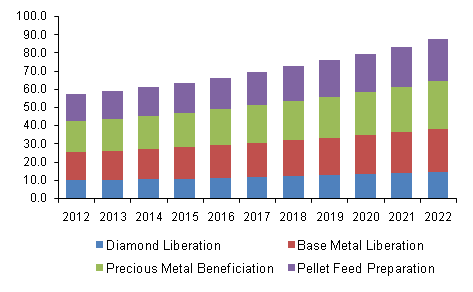 Source: Grand View Research, IR Documents, Primary Interviews, Paid DatabasesTo learn more about this report,
 Download Free Sample Report
 HPGR provides flexible crushing solutions, as it is suitable for both new installations and upgrades in the mining and construction industry. Moreover, it is a highly energy-efficient technology for comminution and involves the short-term exposure of raw materials such as iron ore to a very high pressure.
However, environmental regulations related to mining sites, such as the Surface Mining Control and Reclamation Act, 1977, restrict the high pressure grinding roller market growth over the forecast period.
Market Dynamics
The increasing demand for energy-efficient and high-throughput grinding technologies in the mining and cement industries is a major factor driving the high-pressure grinding roller (HPGR) market. Mining companies are continually seeking advanced comminution solutions to reduce operational costs, improve mineral recovery rates, and lower overall energy consumption. HPGR systems are gaining significant adoption because they consume considerably less energy than conventional grinding technologies such as SAG mills and ball mills, while delivering higher processing efficiency.
In the mining sector, growing global demand for metals and minerals including iron ore, copper, gold, and rare earth elements is accelerating investments in modern mineral processing infrastructure. HPGR technology helps improve downstream beneficiation efficiency by generating micro-fractures in ore particles, which enhances leaching performance and mineral liberation.
Despite their operational advantages, high pressure grinding roller systems face challenges related to high initial investment and demanding maintenance requirements. Installation of HPGR equipment involves substantial capital expenditure on grinding rolls, hydraulic systems, drive mechanisms, wear protection technologies, and automation infrastructure. For many small and medium-sized mining operators, particularly in developing regions, the high upfront cost of adopting HPGR systems can create significant financial barriers.
In addition, HPGR equipment operates under extremely high pressure and abrasive processing conditions, leading to continuous wear of roller surfaces and other critical components. Mining applications involving hard and abrasive ores can accelerate wear rates, resulting in frequent maintenance requirements, replacement costs, and operational downtime.
"The 2 x 1,900 kW - 2 x 3,700 kW power rating segment is expected to witness the highest adoption over the forecast period"
The HPGR market can be segmented based on power rating as 2 x 100 kW - 2 x 650 kW, 2 x 650 kW - 2 x 1,900 kW, 2 x 1,900 kW - 2 x 3,700 kW, and 2 x 3,700 kW, and above. The 2 x 1,900 kW - 2 x 3,700 kW power rating segment is predicted to witness significant growth and is projected to reach 37.1% by 2022 (in terms of revenue). The increasing adoption in large mining sites and low ore grades is anticipated to impel the growth in the 2 x 1,900 kW - 2 x 3,700 kW segment.
The demand for 2 x 100 - 2 x 650 kW segment is expected to be driven by the use of rollers in smaller mining projects for achieving energy efficiency.
"The base metal liberation segment is energizing the industry growth opportunities"
The industry has been segmented based on application as base metal liberation, diamond liberation, pellet feed preparation, and precious metal beneficiation. The HPGRs are majorly operational in diamond mines and iron ore. When HPGR is used in combination with ball mills or as a standalone grinding device, it offers benefit such as fineness, improved throughput, and quality of the ultimate product in iron ore pellet feed preparation. The HPGR comminution solution is anticipated to show tremendous growth owing to its better liberation of large, rare and high-value diamonds, as well as small ones, with minimal damage.
Base metals such as nickel, zinc, copper, and lead are widely used in various industrial and commercial applications. Copper as a base metal is widely used in infrastructure and electrical applications, whereas nickel and zinc are used in iron ore extraction and refining.
The demand for gold is anticipated to grow owing to its financial, cultural, and emotional value. With an increase in the demand for low emission, energy efficient, and low-cost solutions, the market presents a significant opportunity for this technology in precious metals and minerals mining sector."The non-ferrous metal processing segment growth is driven by its low power requirements"
The market by type segment includes ferrous metal and ferroalloys processing, and non-ferrous minerals processing. Non-ferrous metals include precious metals such as silver, gold, and copper that need an optimum extraction index. The HPGR technology provides a scope for lower power requirement, throughput optimization, increased availability, and less wearability in non-ferrous metal processing.
The non-ferrous minerals processing segment is anticipated to be major type over the forecast period. The segment was valued at USD 193.9 million in 2015 and is expected to expand at a CAGR of 5.9% over the forecast period. Ferrous metals and ferroalloys processing involve the extraction of iron and its minerals such as ferromanganese, ferrochrome, ferronickel, ilmenite, and ferroniobium. The non-ferrous metals extracted in mineral processing include silver, gold, platinum, lead, copper, pyrite, zinc, and tin.
"The large-scale infrastructural development projects in Asia Pacific are impelling the demand for HPGR in this region"
The Asia Pacific high pressure grinding roller market accounted for over 30% of the overall revenue share in 2015. This region is anticipated to remain the key market opportunity over the next seven years. The growth would be mainly driven by infrastructure development and manufacturing activities along with the increasing mining activities in China, Australia, and India. China has emerged as one of the largest gold markets and is anticipated to drive gold mining activities in the near future.
The mining industry may witness increased operating cost owing to the high cost of labor and mining taxes. These factors may affect the demand for HPGR in the Asia Pacific region. The expansion of Brownfield iron ore project and increase in Greenfield mining activities is anticipated to favor the Asia Pacific regional growth.
"ThyssenKrupp International Solutions AG and the Köppern Group are the major players in the industry"
The key players in the global high pressure grinding roller market include ABB Ltd., FLSmidth & Co. A/S, SGS S.A., KHD Humboldt, Köppern Group, Metso Oyj, Outotec Oyj, ThyssenKrupp Industrial Solutions AG (Polysius AG), and CITIC Heavy Industries, Co., Ltd. (CITIC HIC).
Metso Oyi’s HRC is used for crushing hard rock with relatively low moisture content. This product is used in various applications such as iron ore, diamond, copper, platinum, gold, molybdenum, and industrial minerals. ABB Ltd. offers variable-speed drive system and provides a high throughput, operational flexibility, minimizes roller wear, and ensures the lowest operational and capital cost.Thyssenkrupp Industrial Solutions AG is focused on providing its customers with benefits such as high throughput rate, low operating expenses, short delivery and commissioning times, and metallurgical advancements. These factors are, in turn, helping the company strengthen its brand in the HPGR market space.
Competitive Benchmarking
Operating Strategies
Competitive Edge
Weaknesses
Mature Players: Metso Corporation, FLSmidth & Co. A/S, thyssenkrupp Industrial Solutions AG, KHD Humboldt Wedag, Köppern Group, CITIC Heavy Industries Co., Ltd.
- Strong investments in energy-efficient comminution technologies and advanced mineral processing solutions
- Expansion of HPGR systems for large-scale mining and cement grinding applications
- Focus on automation integration, predictive maintenance, and wear optimization technologies
- Strong global brand recognition and extensive expertise in mining and cement processing equipment
- High operational reliability, throughput efficiency, and energy-saving capabilities
- Established customer base across mining, cement, and mineral beneficiation industries
- High dependence on mining and cement industry capital expenditure cycles
- Significant project execution timelines and working capital requirements
- High equipment and maintenance costs compared to conventional grinding technologies
Emerging Players: TAKRAF GmbH, Weir Group PLC, Shanghai Clirik Machinery Co., Ltd., Shandong Huate Magnet Technology Co.,
- Focus on cost-effective grinding solutions and regional mineral processing market expansion
- Increasing emphasis on customized HPGR systems for mid-sized mining and cement operations
- Expansion into retrofit projects and energy-efficient grinding applications
- Competitive pricing and flexibility in customized grinding system integration
- Strong responsiveness to localized mineral processing requirements
- Growing adoption in regional mining and industrial processing projects
- Comparatively lower global market penetration and brand visibility
- Limited financial scale for large international EPC and R&D investments
- Lower diversification compared to multinational mineral processing equipment providers
Delivered Customizations
This report has been delivered with the following In-depth customizations
Client Request
Customization Delivered
Value Adds
Regional Segmentation
Detailed market estimates and forecasts for the HPGR market across North America, Europe, Asia Pacific, Latin America, and Middle East & Africa. Country-level demand analysis covering mining, cement, and mineral processing industries.
Identify high-growth mining and industrial processing markets. Enable benchmarking of mining modernization and energy-efficient grinding technology adoption trends across regions.
Competitive Benchmarking
Detailed benchmarking of leading HPGR manufacturers based on grinding efficiency, automation capabilities, regional presence, and strategic initiatives.
Enable competitive intelligence and technology benchmarking. Support partnership evaluation, project bidding strategy development, and innovation planning.
Opportunity Assessment
Identification of emerging growth opportunities driven by increasing mining automation, rising demand for energy-efficient grinding technologies, expansion of mineral beneficiation projects, and sustainability-focused mining operations.
Prioritize high-growth applications and investment opportunities. Support innovation roadmap development and long-term strategic planning.
About the Author(s)
Drilling & Extraction Equipments Research Team
Bulk Chemicals · Drilling & Extraction EquipmentsThis report was authored by the drilling & extraction equipments research team at Grand View Research - comprising two research analysts, one senior research analyst, and one industry expert - with specialized expertise in the drilling & extraction equipments segment of the bulk chemicals industry. All findings are based on proprietary bulk chemicals databases, executive interviews, and regulatory analysis, subject to internal peer review prior to publication.
Last Updated:
Speak to Analyst

Customize this report to your needs - add regions, segments, or data points, with 20% free customization.
Or view our licence options:


ISO 9001:2015 & 27001:2022 Certified
We are GDPR and CCPA compliant! Your transaction & personal information is safe and secure. For more details, please read our privacy policy.


