
- Home
- »
- Organic Chemicals
- »
-
Hydrogen Gas For Semiconductor Etching Market Report 2035GVR Report cover

Hydrogen Gas For Semiconductor Etching Market (2027 - 2035)
Size, Share & Trends Analysis Report By Semiconductor Application (Logic, Memory, Power & Compound Semiconductor, Other Semiconductor Devices), By Region (North America, Europe, Asia Pacific, Latin America, MEA), Forecasts
Hydrogen Gas For Semiconductor Etching Market Summary
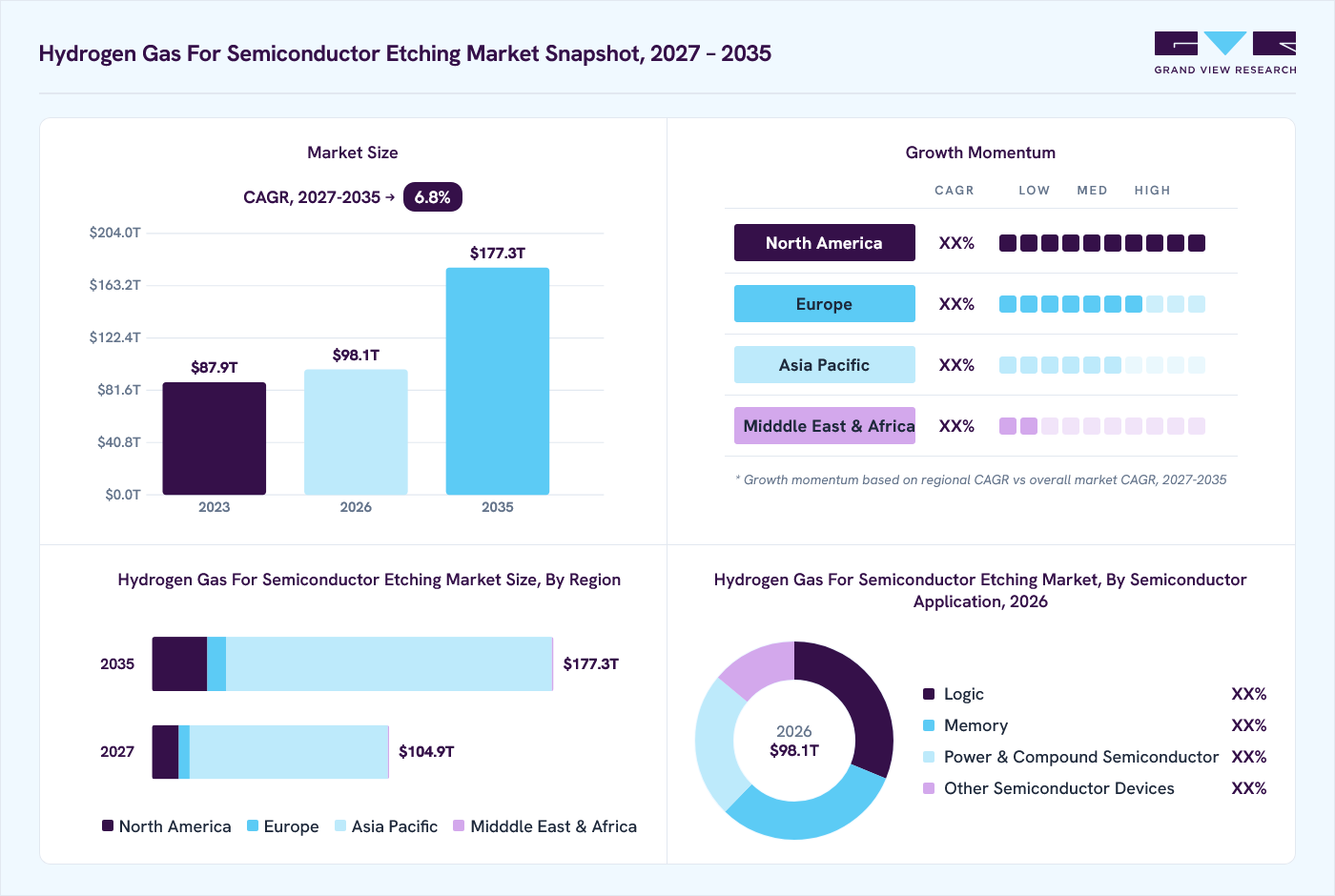
The global hydrogen gas for semiconductor etching market size was valued at USD 98.1 thousand in 2026 and is projected to grow from USD 104.9 thousand in 2027 to USD 177.3 thousand by 2035, at a CAGR of 6.8% from 2027 to 2035. Asia Pacific dominated the market, accounting for a revenue share of 83.8% in 2025. Demand is driven by the increasing complexity of etching processes as manufacturers transition toward advanced logic nodes and three-dimensional chip architectures.
 Source: Grand View Research, IR Documents, Primary Interviews, Paid DatabasesTo learn more about this report,
 Download Free Sample Report
Key Market Trends & Insights
- By semiconductor application: the memory segment dominated with a share of 31.2% 2026.
Regional Highlights
- Largest Region: Asia Pacific (83.8% revenue share, 2026)
- Fastest-growing region: North America (fastest CAGR, 2027-2035)
Market Size & Forecast
- Market size in 2026: USD 98.1 thousand
- Estimated market size in 2027: USD 104.9 thousand
- Projected market size by 2035: USD 158.3 thousand
- CAGR (2027-2035): 6.8%
Prism AI by Grand View Research Free to tryAsk a question about the hydrogen gas for semiconductor etching marketTry asking✓Every figure cited from GVR research Prefer the report? Download free sample →
The industry benefits from the use of hydrogen as a functional component in specialized etching gas mixtures. Hydrogen can influence plasma chemistry and surface reactions during selected etching processes, supporting controlled material removal and the formation of specific wafer profiles. Its adoption is therefore linked to process recipes that require hydrogen to achieve defined etching characteristics. One important application is silicon etching, where hydrogen can be added to the process-gas mixture to modify the interaction between the plasma and the wafer surface. According to manufacturer SK hynix, hydrogen can help form a protective lining during silicon removal, increasing etching directionality. This illustrates hydrogen's role as an additive that can influence etching performance rather than simply serving as a general-purpose manufacturing gas.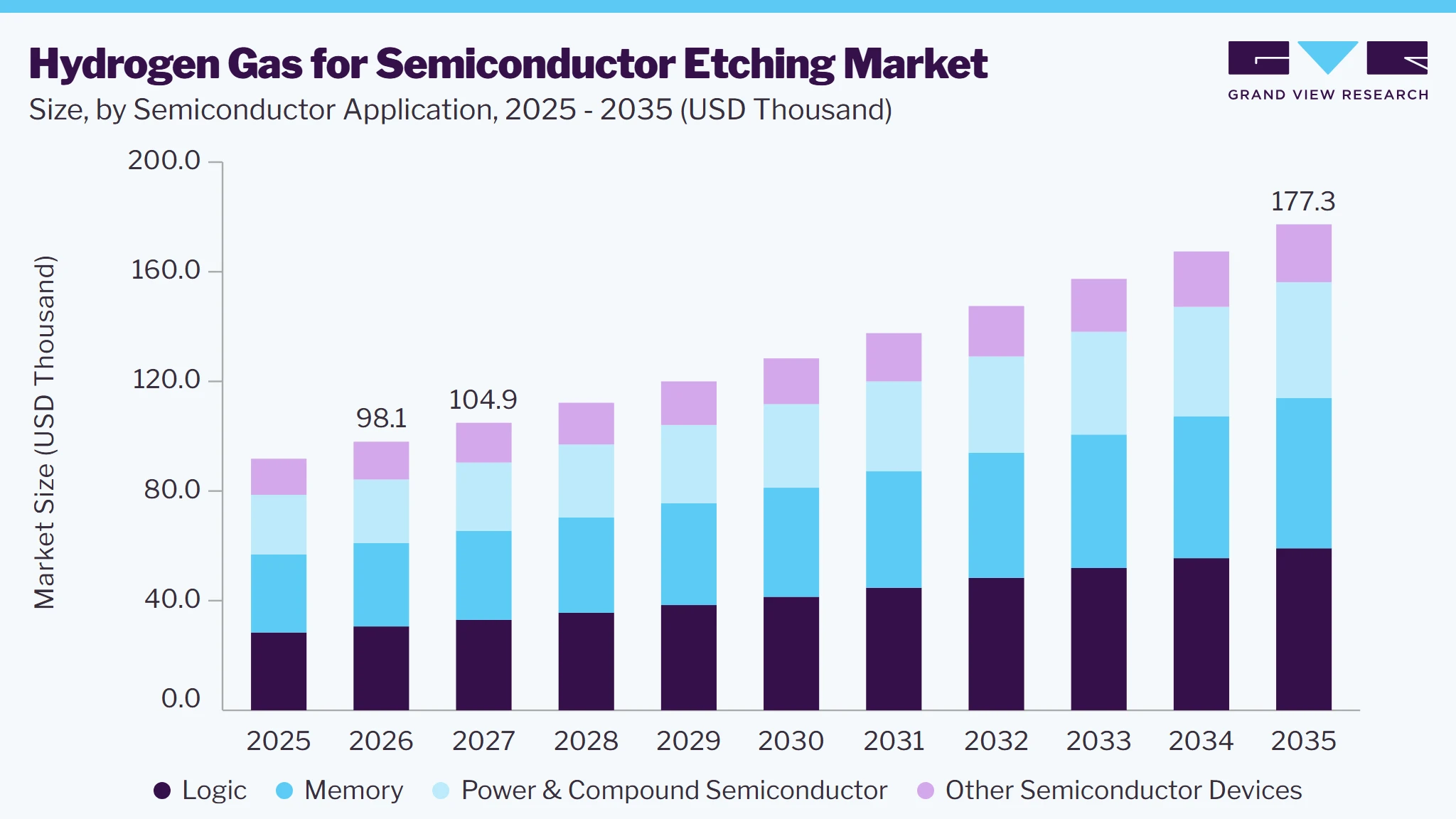 To learn more about this report, Download Free Sample Report
The growing focus on reducing industrial emissions presents an opportunity for suppliers to introduce low-carbon solutions for manufacturing. Hydrogen production can contribute to the industry's indirect emissions, creating scope for suppliers to offer alternatives with a lower production-related carbon footprint while meeting the stringent purity requirements of applications. Hydrogen producers can capitalize on this opportunity by expanding production through renewable-powered electrolysis and other lower-emission production pathways. Integrating these production methods with advanced purification and quality-control systems can help suppliers develop products suited to the demanding specifications of fabrication.
Market Dynamics
The market depends on the adoption in specific etch processes, advances in fabrication technology, and the expansion of production capacity. Commercial opportunities will be influenced by suppliers' ability to deliver consistent high-purity products, maintain dependable supply arrangements, and meet stringent gas handling and contamination-control requirements. Investment in advanced fabrication can expand the addressable opportunity, but actual demand will depend on technical suitability and adoption across individual manufacturing processes. Suppliers that combine reliable quality assurance, specialized gas-delivery capabilities, and strong technical support may be better positioned to secure long-term customer relationships.
The increasing complexity of architectures is driving demand for precise and controlled wafer-etching processes, supporting the use of high-purity gas in specialized manufacturing applications. As chipmakers transitions toward smaller process nodes and more complex transistor structures, manufacturers must achieve greater dimensional accuracy, control material removal, and improved feature definition during etching. These requirements increase the importance of carefully controlled plasma environments and specialized process chemistry. Hydrogen gas is used in selected etching applications and associated wafer-processing steps, creating opportunities for market growth as fabrication requirements become more sophisticated.
The transition toward advanced logic technologies, including 5-nanometer, 3-nanometer, and 2-nanometer-class processes, is a key factor supporting this demand. At these technology nodes, manufacturers face greater challenges in controlling nanoscale features, maintaining etching uniformity, and minimizing defects that can affect device performance and manufacturing yields. Depending on the etching technique, equipment configuration, and process recipe, support plasma chemistry, surface reactions, or material-selective processing. The growing technical complexity of manufacturing can increase demand where it is specified for etching applications.
The global market faces cost and operational constraints associated with supplying H2 that meets stringent manufacturing requirements. Maintaining the required gas purity, preventing contamination during storage and distribution, and ensuring consistent delivery can increase the cost of supplying specialized etching applications. These requirements may limit adoption where alternative process gases or established etching chemistries are more commercially practical. Hydrogen supply systems require specialized storage vessels, compatible piping, pressure regulators, valves, and gas-delivery controls. These systems must be designed to maintain safe operating conditions and prevent leaks or contamination. The U.S. Occupational Safety and Health Administration (OSHA) specifies requirements for storage and distribution systems, including suitable equipment, ventilation, leak testing, and protective measures.
The growing focus on reducing industrial emissions presents an opportunity for suppliers to introduce low-carbon solutions for manufacturing. Hydrogen production can contribute to the industry's indirect emissions, creating scope for suppliers to offer alternatives with a lower production-related carbon footprint while meeting the stringent purity requirements of applications. Hydrogen producers can capitalize on this opportunity by expanding production through renewable-powered electrolysis and other lower-emission production pathways. Integrating these production methods with advanced purification and quality-control systems can help suppliers develop products suited to the demanding specifications of fabrication.
Market Concentration & Characteristics
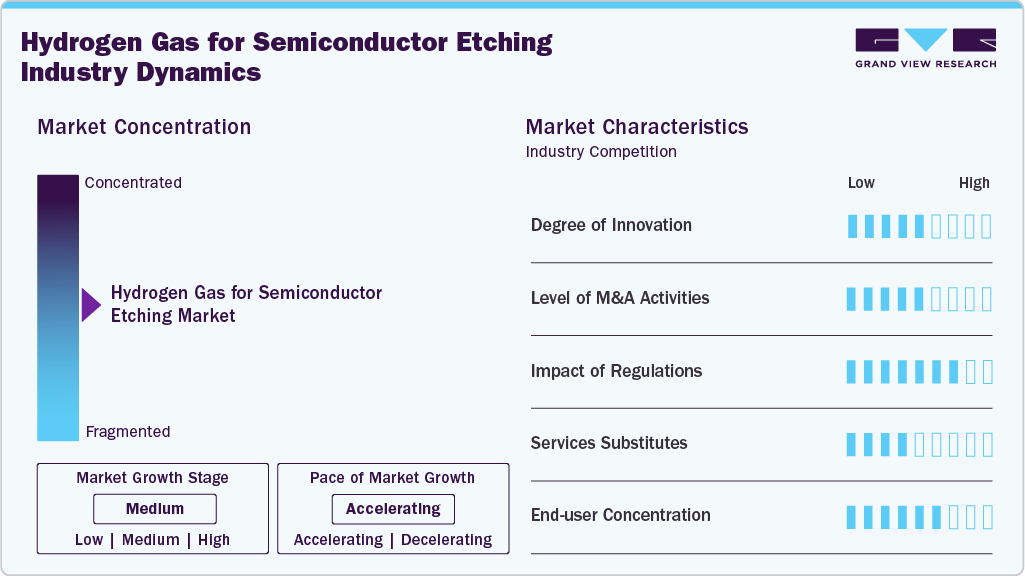
The industry is moderately consolidated, with competition shaped by the presence of established industrial gas suppliers offering semiconductor-grade, specialized purification capabilities, and reliable delivery infrastructure. Key players, including Air Liquide, Linde, Air Products and Iwatani Corporation, compete through gas-purity assurance, supply reliability, and long-term relationships with manufacturers. Partnerships between producers, industrial gas companies, and manufacturers can further support the development of dedicated low-carbon supply arrangements.
 To learn more about this report, Download Free Sample Report
Such collaborations can help suppliers demonstrate product quality, establish reliable supply channels, and align offerings with manufacturers' emissions-reduction initiatives. The opportunity lies in converting sustainability commitments into commercial demand for lower-carbon products. As producers evaluate the environmental performance of their supply chains, suppliers offering verified lower-carbon products at competitive costs may gain access to new procurement programs and strengthen their position in the gas supply market. The extent of this opportunity will depend on customer adoption, production economics, and compliance with semiconductor-grade quality requirements.
Analyst Perspective
As manufacturers invest in advanced logic, high-bandwidth memory, and increasingly sophisticated chip architectures, process requirements are becoming more demanding, increasing the importance of gas purity, delivery precision, and supply reliability. Taiwan, China, and South Korea remain important manufacturing centers, while capacity investments in the United States and other markets are broadening the geographic footprint of the industry. These developments create opportunities for gas suppliers capable of meeting stringent technical requirements and supporting manufacturers throughout process development and commercial production.
Semiconductor Application Insights
Logic segment dominated the market, with a revenue share of 31.2% in 2026, as the segment represents a key application area, as logic chips used in CPUs, GPUs, AI accelerators, and other computing devices require multiple precision etching steps during fabrication. The transition toward advanced transistor architectures, including nanosheet and gate-all-around (GAA) structures, is increasing the need for highly controlled material removal, selective etching, and consistent feature profiles. Where H2-containing chemistries are qualified for these processes, these requirements can support demand for semiconductor-grade offerings.
Power & compound semiconductor is expected to grow with a CAGR of 6.9% from 2027 to 2035. Demand across this segment is influenced by the expansion of wide-bandgap production, device complexity, and the qualification of material-specific etching recipes. In May 2026, the Government of India announced approval for a compound project involving a commercial GaN-based Mini/Micro-LED display facility in Gujarat. This reflects expanding manufacturing activity in compound applications.
Region Insights
Asia Pacific Hydrogen Gas For Semiconductor Etching Market Trends
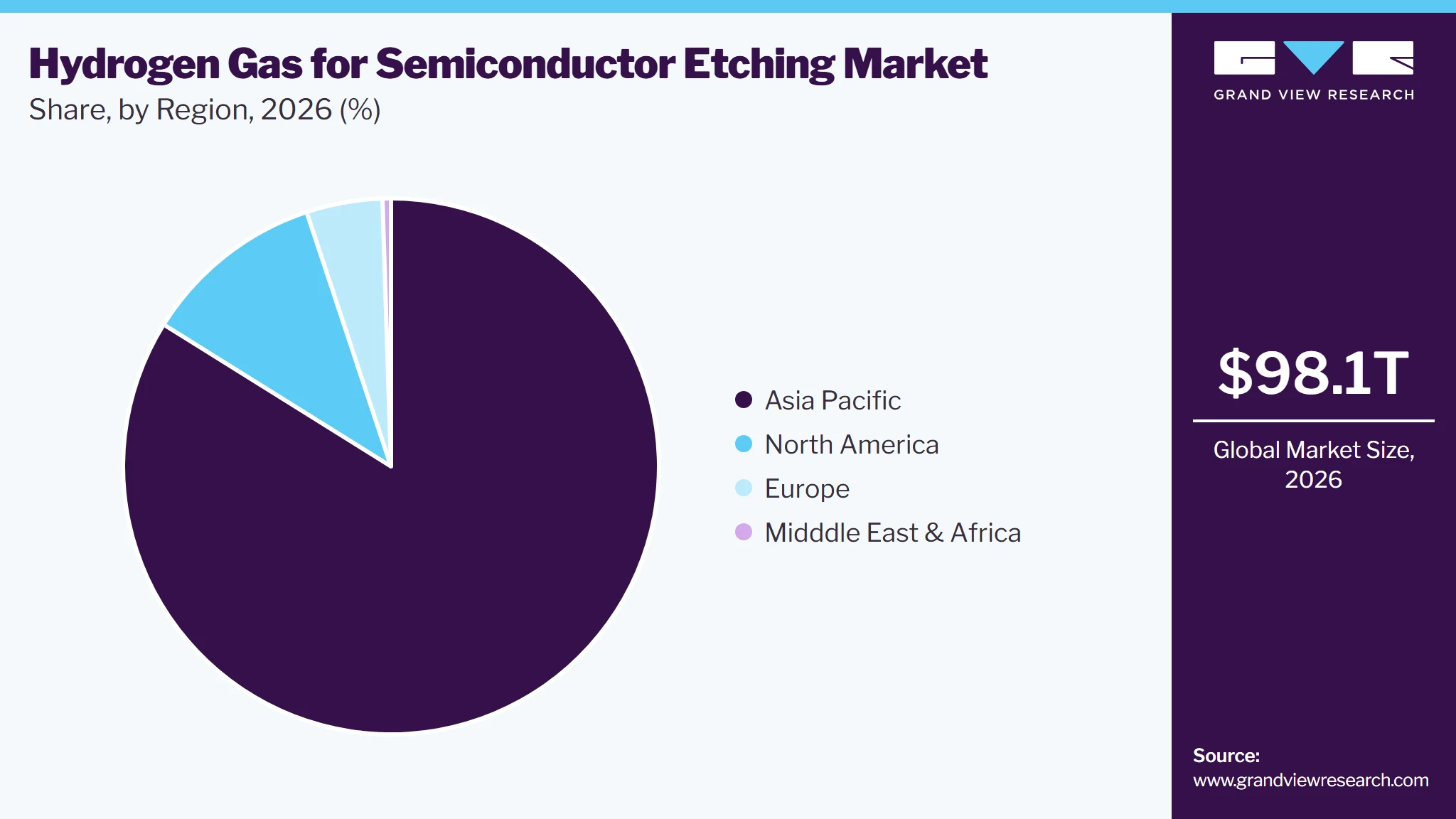
Asia Pacific dominated with the highest market share of 83.8% in 2026, as it is a major market for process gases, supported by its concentration of foundries, memory manufacturers, integrated device manufacturers, and fabrication facilities. China, Taiwan, and South Korea are central to large-scale chip production, while Japan contributes advanced materials and manufacturing technologies. Singapore and Malaysia strengthen the regional ecosystem through wafer fabrication, assembly, testing, packaging, and supply-chain services.
China is growing at a CAGR of 5.8% from 2027 to 2035, supported by the expansion of domestic fabrication capacity across foundry services, memory, power devices, and mature-node chips. Manufacturing growth in automotive electronics, industrial equipment, and consumer electronics increases the need for specialized process gases. Demand specifically depends on its use in etching chemistry and related wafer-processing steps at individual fabrication facilities.
 To learn more about this report, Download Free Sample Report
North America Hydrogen Gas For Semiconductor Etching Market Trends
North America is the fastest growing region with a CAGR of 9.4% from 2027 to 2035, representing an important market supported by manufacturing investments, advanced fabrication facilities, and an established industrial gas supply network. The U.S. accounts for the region's principal demand opportunities, while Canada contributes through specialized manufacturing, compound semiconductors, photonics, and microelectronics development. The expansion of domestic chip production is increasing the strategic importance of reliable supplies of high-purity process gases.
U.S. Hydrogen Gas For Semiconductor Etching Market Trends
The U.S. is the leading demand center within North America influenced by investments in advanced fabrication facilities, memory chip production, and domestic supply chains. Arizona, Idaho, Texas, and other established hubs that provide opportunities for specialty gas suppliers to expand production capacity and establish long-term supply relationships. Demand is linked to fab utilization, wafer processing requirements, and the specific manufacturing processes adopted by chip producers.
Europe Hydrogen Gas For Semiconductor Etching Market Trends
Growth prospects are linked to capacity expansion, advanced process development, and Europe’s efforts to strengthen regional supply chains. As fabrication operations scale, gas suppliers must support consistent purity, stable delivery, contamination control, and rigorous safety requirements. However, demand will depend on the specific chemistries and process steps used at each facility; broader investment does not translate directly into equivalent growth in consumption.
Germany is one of Europe’s most important for manufacturing, driven by its concentration of chip fabrication facilities in Saxony and its strong automotive and industrial electronics sectors. The potential is tied to power semiconductors, analog and mixed-signal devices, and the expansion of wafer-processing capacity. These applications require dependable supplies of high-purity process gases, with demand varying by manufacturing process.
Middle East & Africa Hydrogen Gas For Semiconductor Etching Market Trends
The Middle East & Africa market remains concentrated in a limited number of manufacturing and technology hubs, with Israel representing an established center for chip development and fabrication. Elsewhere in the region, initiatives are at different stages, ranging from chip design and research to proposed manufacturing projects. The demand specifically for etching is closely tied to the development of wafer-fabrication facilities rather than broader electronics-sector expansion.
Key Hydrogen Gas For Semiconductor Etching Company Insights
Companies are adopting strategic initiatives to improve gas purity, enhance production efficiency, and address the evolving requirements of semiconductor fabrication. These efforts include investments in research and development, advanced gas purification technologies, process optimization, supply-chain reliability, and lower-emission production. Companies are also strengthening technical support, developing specialized gas-delivery solutions, and exploring emerging technologies to meet the stringent quality and operational requirements of advanced manufacturing.
-
Iwatani Corporation is an integrated energy and industrial gases company offering solutions across industrial gases, machinery, and advanced materials. Relevant to semiconductor manufacturing, its portfolio includes, material gases, and gas supply equipment designed to support industrial production requirements. The company supplies gases such as oxygen, nitrogen, and argon, while its H2 business encompasses production, storage, transportation, and supply infrastructure. Iwatani serves customers through an international network spanning Asia, North America, Europe, and the Middle East.
-
Air Water Inc. is a diversified industrial company operating across industrial gases, energy solutions, healthcare, agriculture, food products, and engineering services. Its offerings relevant to manufacturing include specialty gases, high-purity materials, and gas-related equipment supporting advanced production processes. The company operates internationally, with businesses spanning Japan, India, North America, and other markets. Its technical capabilities cover industrial gas production, engineering, and semiconductor-related materials.
Key Hydrogen Gas For Semiconductor Etching Companies:
The following key companies have been profiled for the study on the hydrogen gas for semiconductor etching market.
-
Linde plc
-
Air Liquide
-
Air Products and Chemicals, Inc.
-
Sinopec Corporation
-
Iwatani Corporation
-
Messer SE & Co. KGaA
-
Taiyo Nippon Sanso Corporation
-
MATHESON Tri-Gas, Inc.
-
Air Water, Inc.
-
Versum Materials
Competitive Benchmarking
Operating Strategies
Competitive Edge
Weaknesses
Mature Players: Linde plc, Air Liquide, Air Products and Chemicals, Inc., Sinopec Corporation, Iwatani Corporation, Messer SE & Co. KGaA, Taiyo Nippon Sanso Corporation, MATHESON Tri-Gas, Inc.
- Expand high-purity hydrogen production and distribution infrastructure near major semiconductor manufacturing hubs to ensure a consistent and reliable supply.
- Invest in advanced gas purification, storage, handling, and delivery technologies to meet stringent semiconductor manufacturing requirements.
- Strengthen long-term partnerships with semiconductor manufacturers through customized gas-supply agreements and on-site production facilities.
- Diversify electronic-grade gas portfolios and increase production capabilities to support evolving semiconductor fabrication processes.
- Established global presence with extensive production facilities, distribution networks, and supply infrastructure across key industrial regions.
- Strong technical expertise in hydrogen production, gas purification, and electronic-grade gas handling.
- Established relationships with semiconductor manufacturers and other industrial customers, supporting long-term business opportunities.
- Broad product portfolios covering industrial gases, specialty gases, high-purity hydrogen, and associated gas-management technologies.
- High capital investment requirements for establishing and maintaining specialised gas production, purification, and distribution infrastructure.
- Exposure to fluctuations in energy prices, raw material costs, and transportation expenses, which can affect operating margins.
- Dependence on semiconductor industry investment cycles, which may influence demand for electronic-grade gases and related services.
- Complex regulatory requirements and stringent quality standards increase operational costs and require continuous investment in safety and compliance systems.
Emerging Players: Air Water, Inc., Versum Materials
- Expand semiconductor-grade hydrogen capabilities through targeted investments in high-purity gas production and specialised processing technologies.
- Strengthen regional distribution networks to improve access to semiconductor manufacturing clusters and emerging electronics markets.
- Develop strategic collaborations with semiconductor manufacturers and technology providers to improve product development and market penetration.
- Focus on specialised gas applications, customised supply arrangements, and improvements in production efficiency to establish a stronger market position.
- Greater flexibility in targeting specific regional markets and addressing specialised customer requirements.
- Opportunities to develop differentiated gas-supply solutions through focused investments in purification and handling technologies.
- Ability to establish strategic partnerships and strengthen customer relationships in developing semiconductor manufacturing markets.
- Specialised technical capabilities and application-focused product offerings can support competition in selected semiconductor gas segments.
- Comparatively limited production scale and distribution infrastructure can restrict their ability to serve large semiconductor manufacturing facilities.
- Lower brand recognition and fewer established relationships with major semiconductor manufacturers may create barriers to market entry.
- Significant investment requirements for advanced purification facilities, quality-control systems, and electronic-grade gas production can constrain expansion.
- Limited geographic coverage and dependence on selected customer segments may increase exposure to regional demand fluctuations.
Recent Developments
-
In October 2026, EMD Electronics opened a new 38,000-square-foot research and development facility in Sheboygan Falls, Wisconsin, US. The facility is designed to accelerate innovation in advanced semiconductor materials. This investment strengthens the company's research capabilities and supports the development of materials for next-generation chip manufacturing.
-
In October 2026, Iwatani Corporation and Cosmo Energy Group announced plans to advance their hydrogen business at Cosmo Oil’s Chiba Refinery. The initiative builds on their existing cooperation in hydrogen-related businesses and engineering. The companies are exploring opportunities to strengthen hydrogen production and supply capabilities at the refinery.
Hydrogen Gas For Semiconductor Etching Market Report Scope
Report Attribute
Details
Market Definition
The Hydrogen Gas for Semiconductor Etching Market refers to the use of high-purity hydrogen gas in semiconductor fabrication processes to enable precise material removal, surface modification, and plasma-based etching, ensuring accurate pattern formation, improved etching performance, and enhanced semiconductor device quality.
Market size value in 2026
USD 98.1 thousand
Estimated Market Size in 2027
USD 104.9 thousand
Revenue forecast in 2035
USD 177.3 thousand
Growth rate
CAGR of 6.8% from 2027 to 2035
Base year for estimation
2026
Historical data
2023 - 2025
Forecast period
2027 - 2035
Quantitative units
Revenue in USD thousand, and CAGR from 2027 to 2035
Report coverage
Revenue forecast, volume forecast, company ranking, competitive landscape, growth factors, and trends
Segments covered
Semiconductor application, region
Regional Scope
North America; Europe; Asia Pacific; Middle East & Africa
Country scope
U.S.; Canada; Germany; UK; France; Italy; Ireland; Austria, Netherlands; China; Taiwan; Japan; Singapore, Malaysia; South Korea; Israel.
Key companies profiled
Linde plc; Air Liquide; Air Products and Chemicals, Inc.; Sinopec Corporation; Iwatani Corporation; Messer SE & Co. KGaA; Taiyo Nippon Sanso Corporation; MATHESON Tri-Gas, Inc.; Air Water, Inc.; Versum Materials
Customization scope
Free report customization (equivalent up to 8 analysts’ working days) with purchase. Addition or alteration to country, regional & segment scope.
Pricing and purchase options
Avail customized purchase options to meet your exact research needs. Explore purchase options
Global Hydrogen Gas For Semiconductor Etching Market Report Segmentation
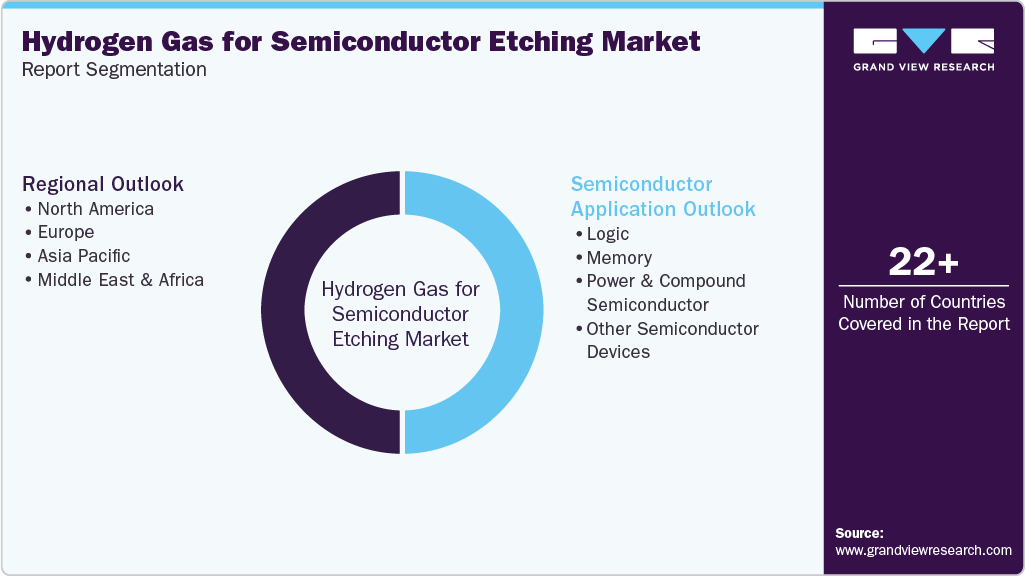
This report forecasts volume & revenue growth at regional, and country levels and provides an analysis of the latest industry trends in each of the sub-segments from 2023 to 2035. For this study, Grand View Research has segmented the hydrogen gas for semiconductor etching market report based on semiconductor application, and region:
 To learn more about this report, Download Free Sample Report
-
Semiconductor Application Outlook (Revenue, USD Thousand, Volume Tons, 2023 - 2035)
-
Logic
-
Advanced Logic / GAA
-
Mature Logic
-
-
Memory
-
3D NAND
-
DRAM
-
-
Power & Compound Semiconductor
-
SiC
-
GaN
-
Other compound semiconductors
-
-
Other Semiconductor Devices
-
-
Regional Outlook (Revenue, USD Thousand, Volume Tons, 2023 - 2035)
-
North America
-
U.S.
-
Canada
-
-
Europe
-
UK
-
Germany
-
France
-
Italy
-
Ireland
-
Austria
-
Netherlands
-
-
Asia Pacific
-
China
-
Taiwan
-
Japan
-
South Korea
-
Singapore
-
Malaysia
-
-
Middle East and Africa (MEA)
-
Israel
-
-
Research Methodology
The hydrogen gas for semiconductor etching market figures in this report are based on a proven research process that combines executive interviews with secondary research from proprietary databases, company filings, and recognized regulatory and institutional sources. Market size is built through value-chain sizing-reconciling supply-side and demand-side estimates-and triangulated with bottom-up and top-down approaches. Every estimate passes multiple levels of expert validation before publication, with each hydrogen gas for semiconductor etching segment quantified using the revenue-capture definitions in the table below.
Segment Definition
Semiconductor Application
Revenue capture definition
Logic
Revenue is generated through the supply of high-purity hydrogen and specialty gases used in plasma etching and other semiconductor fabrication processes. Commercial demand is influenced by logic chip production volumes, process complexity, gas purity specifications, fabrication capacity expansions, and the adoption of advanced node technologies.
Memory
Sales revenue originates from hydrogen gas supplied for etching processes involved in memory chip fabrication, including DRAM and NAND manufacturing. Market demand is shaped by memory production capacity, wafer processing requirements, technological transitions toward advanced memory architectures, gas consumption per wafer, and semiconductor manufacturers' procurement strategies.
Power & Compound Semiconductor
Turnover arises from hydrogen gas consumption in specialised etching and surface-processing applications associated with power and compound semiconductor devices. Revenue performance depends on demand for SiC and GaN-based devices, fabrication process requirements, adoption of wide-bandgap technologies, manufacturing yields, and investments in power electronics production.
Other Semiconductor Devices
Commercial earnings are derived from hydrogen gas applications across discrete semiconductors, sensors, optoelectronic components, and other specialised electronic devices. Purchasing patterns are influenced by production volumes, device-specific fabrication requirements, gas purity standards, process compatibility, and the expansion of applications across automotive electronics, telecommunications, and industrial equipment.
Estimation Model
Layer Name
Key Question
Description
Raw Material & Production Layer
What forms the supply base?
Examine hydrogen gas production for semiconductor etching by assessing feedstock availability, hydrogen generation technologies, production facilities, purification processes, and manufacturing capacity. The assessment also covers hydrogen sourcing through steam methane reforming, electrolysis, and other production pathways, alongside gas separation, impurity removal, quality assurance, storage systems, cylinder and bulk supply formats, transportation infrastructure, supplier relationships, safety standards, and regulatory compliance. Additional considerations include production costs, energy requirements, supply reliability, and fluctuations in feedstock prices across major producing countries.
Application Adoption Layer
Where is hydrogen gas for semiconductor etching utilized?
Evaluate the adoption of hydrogen gas across semiconductor fabrication processes, particularly plasma etching, reactive ion etching, and other plasma-based material removal applications where hydrogen serves as a process gas or gas mixture component. Utilization depends on semiconductor device architecture, wafer materials, etching requirements, process selectivity, chamber conditions, gas purity specifications, and compatibility with existing fabrication equipment. The assessment also considers demand from logic, memory, power semiconductor, and other integrated circuit manufacturing facilities, alongside advancements in semiconductor fabrication technologies and the growing complexity of chip designs.
Consumption Intensity Layer
How extensively is hydrogen gas for semiconductor etching consumed?
Assess hydrogen consumption according to semiconductor fabrication capacity, wafer production volumes, etching process requirements, gas flow rates, chamber operating conditions, process duration, and the frequency of manufacturing cycles. Consumption varies with wafer size, device complexity, etching technology, process recipes, equipment utilisation, and the number of fabrication facilities operating across different regions. Additional considerations include gas utilisation efficiency, process optimisation, recycling and recovery systems, production yields, and demand fluctuations across semiconductor manufacturing segments. These parameters help determine hydrogen consumption intensity and estimate demand across major semiconductor-producing economies.
Revenue Layer
How is market revenue generated?
Evaluate revenue generated through the production and commercialisation of high-purity hydrogen gas supplied to semiconductor manufacturers, fabrication facilities, electronic materials companies, and industrial gas distributors. Commercial returns are influenced by hydrogen purity grades, production technologies, manufacturing scale, purification costs, selling prices, supply contracts, distribution margins, and delivery arrangements. Higher-value opportunities may arise from ultra-high-purity hydrogen, specialised gas mixtures, on-site generation systems, and integrated gas supply solutions. Product quality certifications, technical support, long-term supply agreements, strategic collaborations, and expansion into semiconductor manufacturing hubs further influence profitability and competitive positioning.
Delivered Customizations
This report has been delivered with the following In-depth customizations
Client Request
Customization Delivered
Value Adds
Regional segmentation
The study provides country-level estimates and forecasts by analysing semiconductor manufacturing capacity, wafer fabrication facilities, hydrogen production infrastructure, electronics industry investments, and regional demand for high-purity gases. It also examines semiconductor fabrication expansion, hydrogen production technologies, industrial gas supply networks, import-export activity, local manufacturing capabilities, and regulatory frameworks across major semiconductor-producing economies.
Supports geographic prioritisation and market-entry decisions by identifying leading semiconductor manufacturing hubs, emerging fabrication centres, infrastructure gaps, and countries with favourable conditions for hydrogen gas supply expansion and strategic partnerships.
Opportunity Assessment
A comprehensive evaluation identifies growth prospects across hydrogen production pathways, including steam methane reforming, electrolysis, and other hydrogen generation technologies, alongside opportunities in high-purity hydrogen, specialised gas mixtures, purification systems, and on-site supply solutions. The assessment considers demand across logic chips, memory devices, power semiconductors, and other integrated circuit manufacturing applications, while examining advancements in plasma etching, semiconductor miniaturization, fabrication technologies, and low-carbon hydrogen adoption.
Helps prioritise attractive production technologies, semiconductor applications, and emerging regional markets by identifying evolving gas purity requirements, unmet supply needs, and opportunities for technological differentiation. Findings support infrastructure investments, production capacity expansion, portfolio development, and commercialisation strategies.
Competitive Benchmarking
Comparative profiling of leading industrial gas manufacturers and semiconductor gas suppliers examines hydrogen product portfolios, purity specifications, production technologies, purification capabilities, manufacturing infrastructure, geographic presence, distribution networks, and relationships with semiconductor manufacturers. The analysis also reviews capacity expansions, investments in electronic-grade gases, supply agreements, technological developments, strategic collaborations, and corporate initiatives undertaken by established industrial gas companies and specialised semiconductor materials providers.
Enables businesses to evaluate their competitive standing, identify technological and operational advantages, and recognise gaps in product offerings or supply capabilities. The findings inform decisions concerning production efficiency, infrastructure development, product differentiation, customer acquisition, strategic alliances, and expansion into semiconductor-focused gas applications.
About the Author(s)
Organic Chemicals Research Team
Bulk Chemicals · Organic ChemicalsThis report was authored by the organic chemicals research team at Grand View Research - comprising two research analysts, one senior research analyst, and one industry expert - with specialized expertise in the organic chemicals segment of the bulk chemicals industry. All findings are based on proprietary bulk chemicals databases, executive interviews, and regulatory analysis, subject to internal peer review prior to publication.
Last Updated:
Speak to Analyst

Customize this report to your needs - add regions, segments, or data points, with 20% free customization.
Or view our licence options:


ISO 9001:2015 & 27001:2022 Certified
We are GDPR and CCPA compliant! Your transaction & personal information is safe and secure. For more details, please read our privacy policy.


