
- Home
- »
- Medical Devices
- »
-
Incontinence And Ostomy Care Products Market Report, 2026-2033GVR Report cover

Incontinence And Ostomy Care Products Market (2026 - 2033)
Size, Share & Trends Analysis Report By Type (Incontinence Care Products, Ostomy Care Products), By Region (North America, Europe, Asia Pacific, Latin America, Middle East & Africa), And Segment Forecasts
Market Size, 2025
$19.8BMarket Estimate, 2026
$20.9BMarket Forecast, 2033
$30.2BCAGR, 2026–2033
5.4%Incontinence and Ostomy Care Products Market Summary
The global incontinence and ostomy care products market size was valued at USD 19.8 billion in 2025 and is projected to grow from USD 20.9 billion in 2026 to USD 30.2 billion by 2033, at a CAGR of 5.4% from 2026 to 2033. Europe dominated the market, accounting for the largest revenue share of over 43.0% in 2025. The rising incidence of Inflammatory Bowel Disease (IBD) and colorectal cancer, technological advancements in ostomy care products, and the growing awareness about ostomy are expected to contribute to market growth.
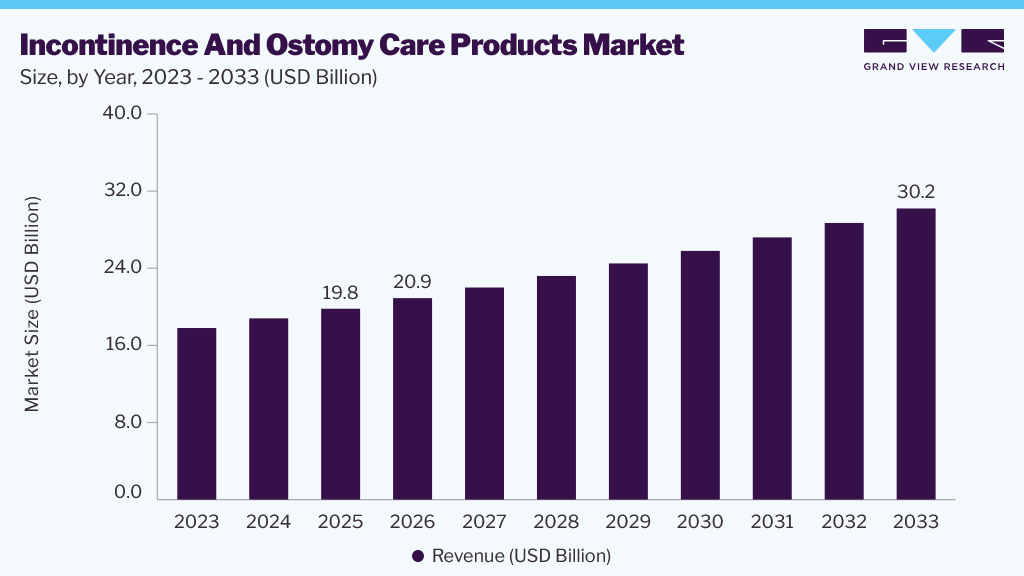 Source: Grand View Research, IR Documents, Primary Interviews, Paid DatabasesTo learn more about this report,
 Download Free Sample Report
Key Market Trends & Insights
- By type: The incontinence care products segment held the largest market share of over 75.0% in 2025.
Regional Highlights
- Largest regional market: Europe (43.0% revenue share, 2025)
- Fastest-growing regional market: Asia Pacific (highest CAGR, 2026-2033)
Market Size & Forecast
- Market size in 2025: USD 19.8 Billion
- Estimated market size in 2026: USD 20.9 Billion
- Projected market size by 2033: USD 30.2 Billion
- CAGR (2026-2033): 5.4%
Three ways to get this report
Buy it, customize it, or ask a question.Ask an Analyst
Analyst response in 1 business day
- AccessReport author, directly
- Reply timeWithin 1 working day
- No sales callDirect answer only
- FormatEmail reply
- CostFree, no cost
Get the Full Report
What the study covers
- FormatsPDF · Excel · Dashboard
- Timeline2026–2033 annual, 2025 base
- Coverage20+ countries, 5 regions
- Companies10+ key players profiled
Customize the Report
20% free customization
- IncludeCountries, segments, points
- TailorTo your product definition
- ExtendDeeper competitor detail
- OrA fully bespoke study
- Turnaround5–10 working days
Moreover, the increase in the geriatric population is another significant driver of the incontinence and ostomy care products industry. An increasing predisposition to colorectal & urinary bladder cancers is predicted to surge the demand for ostomy care products and accessories. As per a study published by NCBI, colorectal cancer is identified as the second leading cause of cancer-related deaths and the fourth most common cancer across the U.S. The risk of colorectal cancer increases with age, as it is usually diagnosed in people aged 65 to 74 years. For instance, as per the WHO reports, around 80% of elderly people are expected to live in low- or middle-income countries by 2050. In addition, the number of people aged 80 or older is anticipated to reach around 426 million by 2050.
Among the three types of ostomies, colostomy is the most common procedure in North America. People living with an ostomy are mostly above the age of 50. The U.S. is expected to experience a significant shift in its population demographics, with the Association of America (UOAA) predicting that the number of elderly individuals will increase to 24% of the overall population by 2050. This growth is likely to lead to an increase in ostomy cases across the country. Furthermore, according to the National Center for Biotechnology Information (NCBI), patients aged 70 and older are more likely to undergo permanent ostomy procedures than younger individuals. These procedures often result in extended hospital stays and higher mortality rates, which are anticipated to drive demand for incontinence and ostomy care products.
Moreover, the rising number of initiatives being undertaken by various private players and nonprofit organizations to raise awareness regarding ostomy care and incontinence care across the globe is anticipated to drive the demand for incontinence and ostomy care products. For instance, the European Ostomy Association arranges World Ostomy Day (WOD) every year. It aims to educate the global population about the rehabilitation of ostomates by bringing them together. Furthermore, in Australia, the government implemented the Stoma Appliance Scheme that offers subsidized ostomy supplies to eligible individuals. The government also supports awareness and education campaigns to ensure individuals receive proper information and support for ostomy care. These initiatives are expected to streamline the management of ostomy care.
Innovations in ostomy care products have greatly enhanced their functionality, comfort, and user-friendliness, thereby driving market growth. Technological advancements include the development of skin-friendly adhesives, odor control mechanisms, and more discreet and ergonomic pouch designs. For instance, companies such as Hollister Incorporated and Coloplast Corp. have introduced products with advanced features, including odor-control filter technology and skin barriers that protect against leakage and skin irritation. Even Convatec launched the “My Ostomy Journey” app for patients living with an ostomy. Some key features of this app include daily tracking of fluid intake, logging pouch changes, identifying new products, and direct access to ostomy product experts and certified Wound, Ostomy, and Continence (WOC) nurses through the app.
Analyst Perspective
The incontinence and ostomy care industry is expected to witness steady growth, driven by the increasing prevalence of ostomy procedures among the aging population and continuous improvements in patient support initiatives. As the incidence of colorectal cancer, inflammatory bowel disease, and other gastrointestinal disorders rises with age, the demand for long-term ostomy care products is anticipated to increase correspondingly. At the same time, government-backed reimbursement programs and awareness campaigns by nonprofit organizations are improving patient access to ostomy supplies and encouraging better disease management. Product innovation is a key strategy for manufacturers, focusing on skin-friendly materials, leak-proof designs, odor-control technologies, and digital health solutions to enhance patient comfort and quality of life. The integration of mobile health applications and personalized patient support services is further strengthening treatment adherence and user engagement.
Type Insights
The incontinence care products segment led the market with the largest revenue share of over 75.0% in 2025 and is expected to grow at the fastest CAGR of approximately 5.5% over the forecast period, due to the increasing awareness and acceptance of incontinence as a common medical condition. Technological innovations in incontinence care products have significantly enhanced their effectiveness, comfort, and convenience, making them more appealing to users. Moreover, the growing geriatric population and the increasing prevalence of bladder-related conditions are expected to drive growth in this segment over the forecast period. Incontinence care products include adult diapers, pads, underwear, and guards designed for patients with bladder & bowel control problems.
The growing prevalence of Urinary Incontinence (UI), especially among the geriatric population, is driving the demand for absorbents and incontinence bags. For instance, as per the Continence Foundation of Australia, around 5 million Australians, i.e., approximately 1 in 4 people aged 15 years or over, experience bowel control problems. This number is projected to increase to around 6.5 million by the year 2030. Absorbent products are the most widely used incontinence care products, designed to absorb and manage urine and fecal incontinence. These products are available in various forms, including pads, underwear, and adult diapers. Absorbent products are made from a variety of materials, including superabsorbent polymers, fluff pulp, and other breathable materials. They are designed to provide comfort, protection, and leakage protection for individuals with urinary or fecal incontinence.
Regional Insights
The incontinence and ostomy care products market in North America held a significant share in 2025, driven by the increasing prevalence of Urinary Incontinence (UI), advanced healthcare infrastructure, and growing awareness about available treatment options. According to the Government of Canada, bladder cancer is the fifth most prevalent cancer in the country, ranking fourth among the most common cancers diagnosed in men and tenth among the most common cancers diagnosed in women. Hence, rising cases of bladder cancer and the increasing number of benign prostatic hyperplasia (BPH)-related surgical procedures are expected to boost the North America market.
U.S. Incontinence and Ostomy Care Products Market Trends
The incontinence and ostomy care products market in the U.S. is driven by the increasing geriatric population, vulnerable to conditions like colorectal cancer, bladder obstruction, UI, and urinary retention. In addition, the growing development in the medical devices market is expected to contribute to market growth. According to the Urology Care Foundation report, a staggering one in four men and one in three women in the U.S. are affected by urinary incontinence, equating to a massive number of millions of Americans. Specifically, approximately 33 million individuals suffer from overactive bladder (OAB), characterized by symptoms of urgency, frequency, and sometimes accompanied by urge incontinence. This widespread condition underscores the significant need for effective solutions and greater awareness of this common health issue. Furthermore, according to Johns Hopkins University, around 200,000 procedures for Benign Prostatic Hyperplasia (BPH) are conducted in the U.S. annually. As a result, the growing number of overactive bladder cases and BPH procedures is boosting the market growth in the U.S.
Europe Incontinence and Ostomy Care Products Market Trends
Europe dominated the global incontinence and ostomy care products market with the largest revenue share of over 43.0% in 2025. The increasing number of stoma patients due to Crohn’s disease, ulcerative colitis, or inflammatory bowel disease (IBD) is expected to drive the incontinence & ostomy care products market growth across Europe. According to a research article published in the National Cancer Institute for Biotechnology Information, IBD comprises Crohn’s disease or ulcerative colitis, and its occurrence in European countries is steadily rising. According to the Journal of Crohn’s and Colitis, the incidence of ulcerative colitis and Crohn’s disease in Europe is increasing annually. The highest number of people diagnosed with these diseases was witnessed in the UK, while the lowest was in eastern and southern Europe.
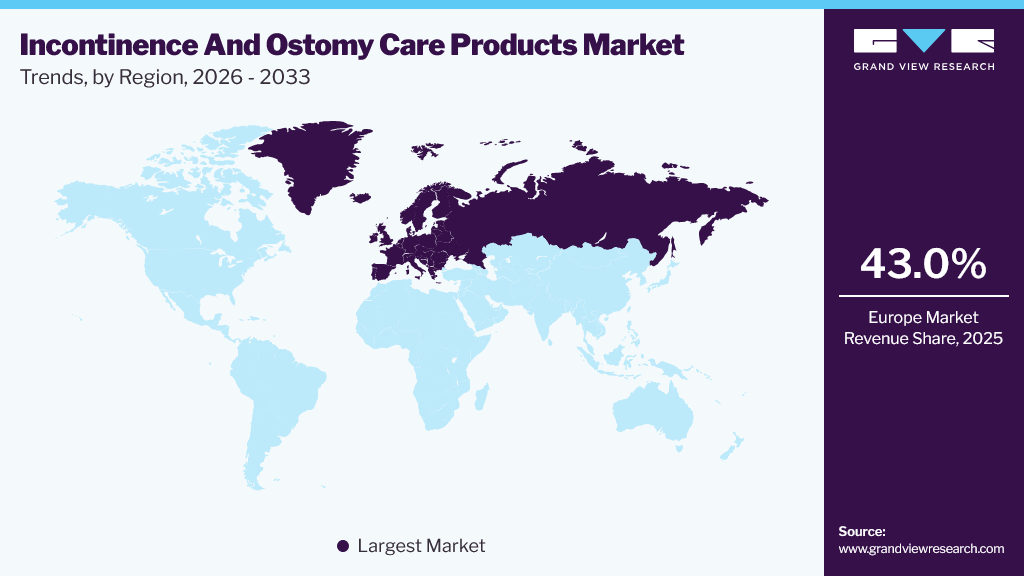 To learn more about this report, Download Free Sample Report
The UK incontinence and ostomy care products market is significantly driven by the increasing cases of stoma or ostomy and growing government initiatives to promote awareness about ostomy care. Several campaigns have been run across the country to raise awareness of stoma surgery, which may contribute to market growth. This is expected to increase the demand for ostomy care & accessories as more people feel comfortable seeking and using these products.
The incontinence and ostomy care products market in Germany is significantly driven by the increasing number of elderly people with colorectal cancer and the established regulatory framework in the region. The healthcare system in Germany is primarily based on Statutory Health Insurance (SHI), with most of the population covered by SHI funds. The German statutory health insurance (SHI) system comprises 110 sickness funds, which act as third-party payers and cover approximately 88% of the population. Those who are self-employed or earn above a certain income threshold have the option to either remain in the SHI system or opt for private health insurance (PHI) offered by 41 private insurers. Moreover, individuals also have the choice to supplement their SHI coverage with private health insurance. Such initiatives are expected to propel the regional market expansion.
Asia Pacific Incontinence and Ostomy Care Products Market Trends
The incontinence and ostomy care products in the Asia Pacific is anticipated to grow at the fastest CAGR during the forecast period, due to the presence of numerous organizations raising awareness about ostomy. For instance, the Australian Council of Stoma Associations provides support services to stoma patients across the country.
The Japan Incontinence and ostomy care products market is driven by the quality-of-life issues and promotion of the welfare of ostomates. For instance, the Yokohama Ostomy Association provides education, information, and support to ostomates, especially to those with intestinal & urinary diversions. The association is focused on improving the quality of life of stoma patients through mutual support & encouragement, education, and training.
The incontinence and ostomy care products market in China is significantly driven by the rising incidence of Crohn’s disease. According to the China Crohn’s and Colitis Foundation (CCCF), numerous people suffer from IBD in China. This foundation has been established to improve the quality of life for these people and to conduct motivational programs to boost their morale. Hence, the increasing awareness among people suffering from IBD is expected to drive market growth in China.
Latin America Incontinence and Ostomy Care Products Market Trends
The incontinence and ostomy care products market in Latin America held a substantial share during the forecast period, due to the rising geriatric population and the increasing prevalence of incontinence. According to the National Institute of Statistics, the geriatric population in Latin America is 65 million and is expected to double by 138 million by 2050. Moreover, the growing healthcare expenditure in most Latin American countries is expected to create lucrative opportunities for players in the global market.
The Argentina incontinence and ostomy care products market is driven by rising production capacity in neighboring markets that supply continence products to Argentina. For instance, in July 2026, Suzano and Kimberly-Clark announced their new joint venture, Arbex, to be the world’s largest player in the tissue and hygiene products market. The Kimberly-Clark plant in Suzano, Brazil, can produce 200 million diapers monthly. This plant in Brazil supplies diapers to the Argentine market. Such expansions in the production capacities of neighboring countries can help increase the accessibility of products in Argentina’s market, which is expected to boost the market in the coming decade. Further, the country has also been witnessing a growth in its aging population for a decade. This growing elderly population is expected to contribute to the expansion of Argentina's continence care market.
MEA Incontinence and Ostomy Care Products Market Trends
The incontinence and ostomy care products market in the MEA is growing slowly due to the technological advancements in the healthcare system and growing partnerships to expand the distribution of incontinence care products. Many MEA companies are initiating to provide care. For instance, in September 2025, Coloplast announced its new 5-year strategy, Impact4, to help 4 million people over the long term. Furthermore, high-income countries such as the UAE, Saudi Arabia, and South Africa are focused on adopting the latest devices for their healthcare setup. The increasing healthcare expenditure and the gradual adoption of technologically advanced products in these countries are expected to propel market growth. Hence, supportive government efforts and the development of healthcare infrastructure in the Middle East & Africa are expected to fuel market growth.
The UAE incontinence and ostomy care products market is expected to witness significant growth over the forecast period due to the increasing government spending on developing smart hospitals, expanding IT & telecommunications infrastructure, rising number of multispecialty hospitals, growing spending on the digitalization of the healthcare industry, and expanding patient base. The UAE federal government, which monitors the healthcare sector and funds most of the non-private healthcare organizations in the northern emirates, has developed strategic plans to meet the growing demand for healthcare services. The growing awareness about urological disorders among UAE residents is anticipated to boost the market. Various organizations are undertaking initiatives to increase awareness about urological diseases. For instance, in September 2025, a Patient Awareness Campaign on Urinary Incontinence was launched at Mediclinic Airport Road Hospital, Abu Dhabi, UAE.
Key Incontinence and Ostomy Care Products Company Insights
The market is highly competitive, and various companies across the globe are investing in enhancing product portfolios, expanding market reach, and gaining access to new technologies. Collaborations with healthcare providers and patient advocacy groups also help companies improve product adoption and customer loyalty.
Key Incontinence and Ostomy Care Products Companies
The following key companies have been profiled for this study on the global 0incontinence and ostomy care products market:
-
Essity
-
Kimberly-Clark Corporation
-
Attends Healthcare Products, Inc.
-
ABENA A/S
-
Coloplast Corp
-
Ontex Group
-
PAUL HARTMANN AG
-
First Quality Enterprises, Inc.
-
Hollister Incorporated
-
Cardinal Health
Recent Developments
-
In July 2024, Coloplast announced the launch of its world-first digital leakage notification system, Heylo, to benefit patients living with a stoma. According to NHS data, more than 176,000 people in the UK are living with a stoma.
-
In May 2024, Coloplast Corp. announced the expansion to its Luja Portfolio by introducing a next-generation catheter designed specifically for women. Compared to Coloplast's existing SpeediCath Compact Eve, Luja Female features 28% less plastic and a 22% reduced carbon footprint. Additionally, the product's container material is fully recyclable, further aligning with Coloplast's commitment to sustainability.
-
In April 2024, Medline and Consure Medical announced a strategic partnership, under which Medline will exclusively distribute the QiVi MEC male external urine management device. This innovative solution is designed to help prevent catheter-associated urinary tract infections (CAUTI) and incontinence-associated dermatitis (IAD), improving the health and well-being of individuals who rely on the device.
Incontinence and Ostomy Care Products Market Report Scope
Report Attribute
Details
Market size in 2025
USD 19.5 billion
Estimated market size in 2026
USD 20.9 billion
Projected market size by 2033
USD 30.2 billion
Growth rate
CAGR of 5.4% from 2026 to 2033
Base year for estimation
2025
Historical data
2021 – 2024
Forecast period
2026 – 2033
Quantitative units
Revenue in USD million/billion, and CAGR from 2026 to 2033
Report coverage
Revenue forecast, company ranking, competitive landscape, growth factors, and trends
Segments covered
Type, region
Regional scope
North America; Europe; Asia Pacific; Latin America; Middle East & Africa
Country scope
U.S.; Canada; Mexico; Germany; UK; France; Italy; Spain; Sweden Denmark; Norway; Japan; China, India; South Korea; Singapore; Australia; Thailand; Brazil; Argentina; South Africa; Saudi Arabia; UAE; Kuwait
Key companies profiled
Essity; Kimberly-Clark Corporation; Attends Healthcare Products, Inc.; ABENA A/S; Coloplast Corp; Ontex Group; PAUL HARTMANN AG; First Quality Enterprises, Inc.; Hollister Incorporated; Cardinal Health
Customization scope
Free report customization (equivalent up to 8 analysts working days) with purchase. Addition or alteration to country, regional & segment scope.
Pricing and purchase options
Avail of customized purchase options to meet your exact research needs. Explore purchase options
Global Incontinence and Ostomy Care Products Market Report Segmentation
This report forecasts revenue growth at global, regional, and country levels and provides an analysis of the latest industry trends and opportunities in each of the sub-segments from 2021 to 2033. For this study, Grand View Research has segmented the global incontinence and ostomy care products market report based on type, and region:
-
Type Outlook (Revenue, USD Billion, 2021 - 2033)
-
Incontinence Care Products
-
Absorbents
-
Incontinence Bags
-
Others
-
-
Ostomy Care Products
-
Ostomy Bags
-
Colostomy Bags
-
Ileostomy Bags
-
Urostomy Bags
-
Deodorants
-
Skin Barriers
-
Irrigation Products
-
-
-
Regional Outlook (Revenue, USD Billion, 2021 - 2033)
-
North America
-
U.S.
-
Canada
-
Mexico
-
-
Europe
-
UK
-
Germany
-
France
-
Italy
-
Spain
-
Norway
-
Sweden
-
Denmark
-
-
Asia Pacific
-
Japan
-
China
-
India
-
Australia
-
South Korea
-
Thailand
-
-
Latin America
-
Brazil
-
Argentina
-
-
Middle East and Africa
-
South Africa
-
Saudi Arabia
-
UAE
-
Kuwait
-
-
Frequently Asked Questions About This Report
The incontinence care segment accounted for the largest revenue share of approximately 75.0% in 2025.
Key factors that are driving the incontinence & ostomy care products market growth include high prevalence rates of diseases such as inflammatory bowel disease, ulcerative colitis, Crohn’s disease, increasing awareness levels, and growing patient affordability globally.
Some key players operating in the incontinence & ostomy care products market include Essity, Kimberly-Clark Corporation, Attends Healthcare Products, Inc., ABENA A/S, Coloplast Corp, Ontex Group, PAUL HARTMANN AG, First Quality Enterprises, Inc., Hollister Incorporated, Cardinal Health, and others.
The global incontinence and ostomy care products market size was estimated at USD 19.8 billion in 2025 and is expected to reach USD 20.9 billion in 2026.
The global incontinence and ostomy care products market is expected to grow at a compound annual growth rate of 5.4% from 2026 to 2033 to reach USD 30.2 billion by 2033.
Europe dominated with approximately 43.0% revenue share in 2025.
About the Author(s)
Medical Devices Research Team
Healthcare · Medical DevicesThis report was authored by the medical devices research team at Grand View Research - comprising two research analysts, one senior research analyst, and one industry expert - with specialized expertise in the medical devices segment of the healthcare industry. All findings are based on proprietary healthcare databases, executive interviews, and regulatory analysis, subject to internal peer review prior to publication.
Last Updated:
Speak to Analyst

Customize this report to your needs - add regions, segments, or data points, with 20% free customization.
Or view our licence options:


ISO 9001:2015 & 27001:2022 Certified
We are GDPR and CCPA compliant! Your transaction & personal information is safe and secure. For more details, please read our privacy policy.


