
- Home
- »
- Advanced Interior Materials
- »
-
Industrial Weighing Equipment Market Size Report, 2033GVR Report cover
![Industrial Weighing Equipment Market (2026 - 2033)Report]()
Industrial Weighing Equipment Market (2026 - 2033)
Size, Share & Trends Analysis Report By Technology (Digital Weighing Systems, Analog Weighing Systems), By Equipment, By End Use (Logistics & Warehousing, Manufacturing & General Industrial), By Region, And Segment Forecasts
Market Size, 2025
$5.5BMarket Estimate, 2026
$5.8BMarket Forecast, 2033
$8.8BCAGR, 2026–2033
6.1%Industrial Weighing Equipment Market Summary
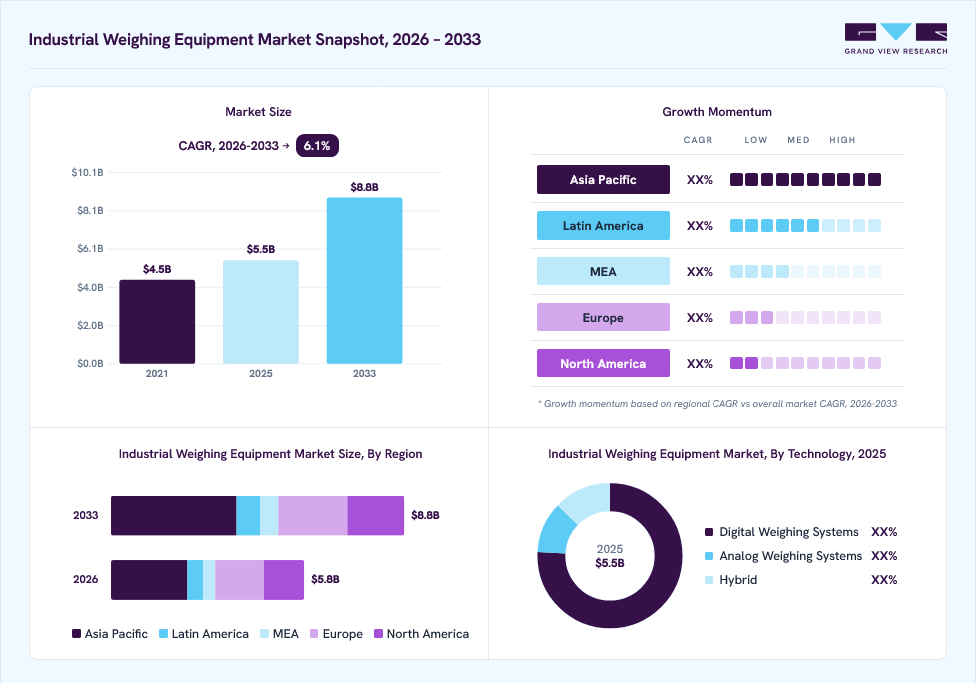
The global industrial weighing equipment market size was valued at USD 5.5 billion in 2025 and is projected to grow from USD 5.8 billion in 2026 to USD 8.8 billion by 2033, at a CAGR of 6.1% from 2026 to 2033. Asia Pacific dominated the market, accounting for a revenue share of 39.0% in 2025. The increasing adoption of automation and digitalization across industrial operations is a key factor supporting the market growth.
Key Market Trends & Insights
- By technology: Digital weighing systems segment led the market with the largest revenue share of 75.7% in 2025.
- By equipment: Platform scales segment led the market with the largest revenue share of 24.7% in 2025.
- By end use: Manufacturing & general industrial segment led the market with the largest revenue share of 27.0% in 2025.
Regional Highlights
- Largest Regional Market: Asia Pacific (39.0% revenue share, 2025).
- By Country: China held the largest market share in 2025.
Market Size & Forecast
- Market size in 2025: USD 5.5 Billion
- Estimated market size in 2026: USD 5.8 Billion
- 2033 Projected Market Size: USD 8.8 Billion
- CAGR (2026-2033): 6.1%
Three ways to get this report
Buy it, customize it, or ask a question.Get the Full Report
What the study covers
- FormatsPDF · Excel · Dashboard
- Timeline2026–2033 annual, 2025 base
- Coverage20+ countries, 5 regions
- Companies10+ key players profiled
Customize the Report
20% free customization
- IncludeCountries, segments, points
- TailorTo your product definition
- ExtendDeeper competitor detail
- OrA fully bespoke study
- Turnaround5–10 working days
Ask Prism AI
A cited answer in seconds
- Corpus30K studies, 1.2M points
- ScopeAll markets, not just this
- CitationTraced to report & table
- HonestySays "not covered" if so
- SpeedSeconds, not days
Manufacturers are increasingly integrating weighing systems with production lines, enterprise software, warehouse management platforms, and industrial control systems to enable real-time measurement, automated batching, inventory tracking, and process monitoring.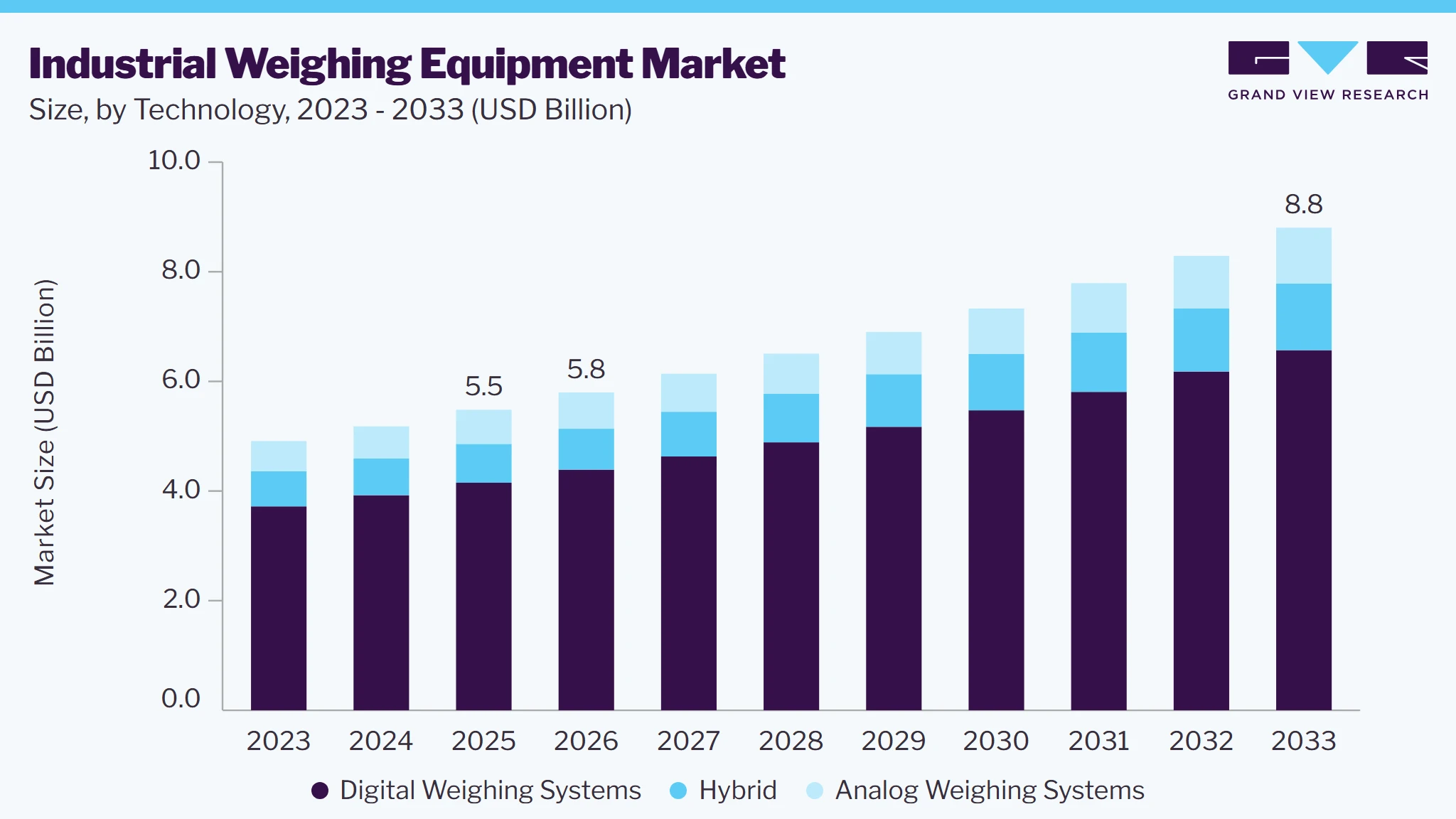
Rising demand for accurate material handling and process control across manufacturing, logistics, food & beverage, mining, and chemical industries is further contributing to market growth. Industrial operators rely on precise weight measurements for raw-material dosing, quality control, vehicle loading, shipment verification, and finished-product management. The expansion of high-volume manufacturing and organized warehousing, along with greater movement of bulk commodities and packaged goods, is increasing the need for reliable platform scales, weighbridges, hopper scales, checkweighers, and belt weighing systems.
Market Dynamics
The market is influenced by rising requirements for measurement precision, automated material handling, process optimization, and real-time operational visibility. Increasing modernization of production facilities, expansion of logistics infrastructure, greater movement of bulk materials, and replacement of aging weighing assets are supporting demand across diverse applications. However, capital requirements, integration challenges, calibration needs, and maintenance expenses can slow adoption of sophisticated systems. At the same time, connected weighing, automated inspection, cloud-based monitoring, and data-driven process management are creating new avenues for market expansion.
The increasing adoption of automated processes is a major driver for industrial weighing equipment. Modern facilities are integrating weighing systems into batching, filling, dosing, pallet handling, inventory control, quality inspection, and material-transfer operations to reduce manual intervention and improve consistency. Digital equipment can communicate measurement data directly with control systems and enterprise platforms, allowing operators to make faster decisions and maintain tighter control over material usage and production parameters.
The transition toward connected operations also increase the value of advanced weighing solutions. Equipment with wireless connectivity, intelligent indicators, remote monitoring, and automated data capture enables continuous tracking of weight information throughout production and distribution workflows. This helps organizations minimize measurement errors, improve traceability, optimize material utilization, and streamline routine activities, encouraging replacement of conventional weighing equipment with more integrated systems.
The relatively high investment required for advanced weighing equipment can restrain adoption, particularly among smaller operators. Sophisticated systems may require precision sensors, specialized indicators, software, structural modifications, installation, calibration, and integration with existing infrastructure. Recurring expenses for servicing, calibration, component replacement, and technical support can further increase total ownership costs, leading some users to extend the operating life of existing equipment rather than upgrade to newer systems.
The growing adoption of IoT-enabled, data-connected weighing solutions presents a significant opportunity for market participants. Connected equipment can transmit weight measurements to centralized platforms, enabling remote monitoring, automated reporting, inventory visibility, performance analysis, and equipment diagnostics. Integration with warehouse, production, and enterprise systems can transform weighing from a standalone measurement activity into a source of operational data, allowing manufacturers to generate additional value through software, analytics, remote services, and integrated weighing solutions.
Market Concentration & Characteristics
The market is fragmented, with a large number of global, regional, and specialized manufacturers competing across different product categories and end use applications. While established players have strong positions in advanced weighing systems and integrated solutions, numerous smaller and regional suppliers serve specific applications such as platform scales, weighbridges, hopper scales, load cells, and heavy-duty weighing equipment. Differences in customer requirements, customization needs, local service capabilities, and pricing allow multiple companies to maintain market positions, limiting the dominance of any single player.
The market has a high degree of innovation, driven by the integration of digital technologies, automation, connectivity, and advanced sensing capabilities. Modern systems increasingly incorporate IoT connectivity, wireless communication, real-time data monitoring, predictive maintenance, and software integration with enterprise and manufacturing platforms. Innovation is also focused on improving measurement precision, durability, speed, and energy efficiency while enabling weighing equipment to operate seamlessly within automated production and material-handling environments.
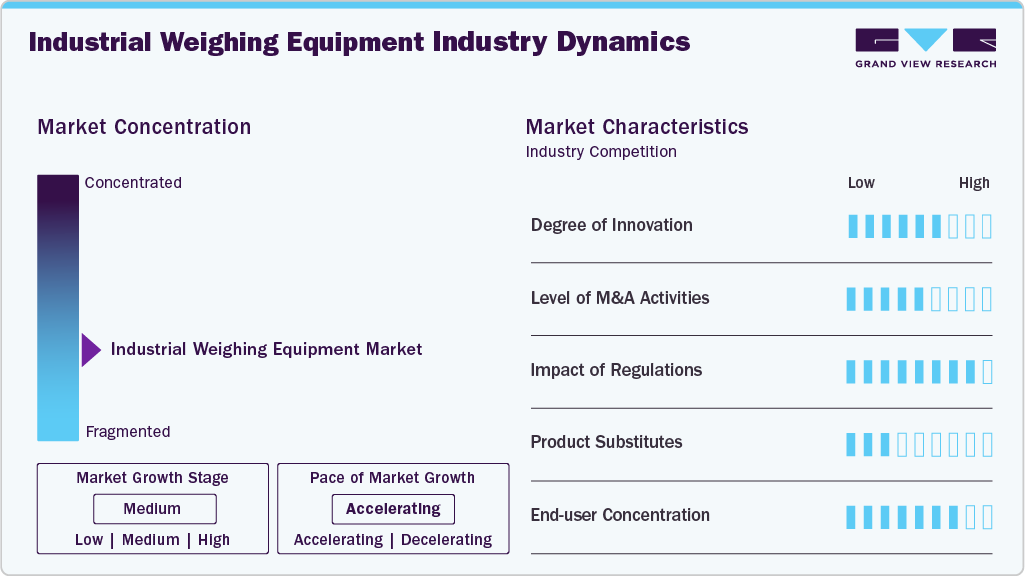
Regulation has a moderate-to-high impact on the market because weighing accuracy is critical for commercial transactions, production control, quality assurance, and material handling. Equipment used for trade-related weighing must generally meet applicable metrology and accuracy requirements, while industry-specific applications may require additional standards concerning hygiene, safety, traceability, and equipment performance. These requirements encourage manufacturers to maintain calibration accuracy, certification, documentation, and reliable measurement performance, while also increasing the development and compliance costs associated with certain weighing systems.
End-user concentration in the market is relatively low, as demand is distributed across a broad range of industries and applications. Manufacturing, logistics, food and beverage, mining, chemicals, agriculture, pharmaceuticals, and other industrial sectors use weighing systems for different operational requirements. Although large industrial facilities and multinational manufacturers can represent substantial individual customers, the overall customer base remains diverse, reducing dependence on any single end-use industry and supporting a broad market for different types of weighing equipment.
Analyst Perspective
From an analyst perspective, the market is positioned for steady expansion, supported by the modernization of production facilities, increasing automation of material-handling activities, and the transition toward digitally connected measurement systems. Demand is shifting beyond standalone weighing toward integrated solutions that provide real-time data, process monitoring, traceability, and automated control. Platform scales remain important due to their broad application base, while weighbridges, checkweighing, belt weighing, and hopper & tank systems offer strong opportunities in specialized applications. Asia Pacific is expected to remain a key growth center due to its expanding manufacturing and logistics infrastructure, while established markets in North America and Europe will continue to drive replacement and upgrade demand.
Equipment Insights
The platform scales segment dominated the market in 2025, supported by its broad applicability across material handling, inventory management, production control, pallet weighing, and finished-goods verification. Their versatile configurations, high load-bearing capacity, ease of installation, and availability in different sizes make them suitable for diverse operational environments. Continued modernization of warehouses, production sites, and distribution facilities is also encouraging the replacement of conventional weighing equipment with more accurate and digitally integrated platform systems.
The weighbridge scales segment is projected to be the fastest-growing at a CAGR of 7.3%, driven by increasing requirements for accurate vehicle and bulk-material measurement at transportation hubs, storage yards, commodity handling facilities, and large processing sites. Rising movement of raw materials and finished products, combined with greater emphasis on load verification, inventory reconciliation, and automated data capture, is strengthening demand for weighbridges. Integration with cameras, RFID, software platforms, and automated identification systems is further improving throughput and reducing manual weighing procedures.
Technology Insights
The digital weighing systems segment dominated the market in 2025, owing to their high measurement accuracy, faster data processing, and compatibility with automated operations. Digital systems enable electronic data capture, programmable functions, remote monitoring, and integration with control and enterprise platforms, making them well suited for modern production, warehousing, material handling, and quality-control activities. Their ability to provide consistent measurements while reducing manual recording requirements has accelerated the shift from conventional mechanical solutions.
The hybrid segment is projected to be the fastest growing segment over the forecast period at a CAGR of 7.2%, as users seek to combine the reliability of established weighing mechanisms with the precision and connectivity offered by digital technologies. Hybrid systems can support the modernization of existing installations without requiring complete infrastructure replacement, making them attractive for facilities operating legacy equipment. Their ability to incorporate digital indicators, electronic controls, and data interfaces while retaining proven mechanical components is expected to support adoption during phased equipment upgrades.
End Use Insights
The manufacturing & general industrial segment dominated the market in 2025, driven by extensive use of weighing systems for raw-material measurement, batching, production control, quality verification, inventory management, and finished-product handling. The need for consistent measurement accuracy across production facilities, coupled with ongoing equipment modernization and process automation, continues to sustain demand. Platform scales, bench scales, hopper and tank scales, and checkweighing systems are widely deployed to support different stages of industrial operations.
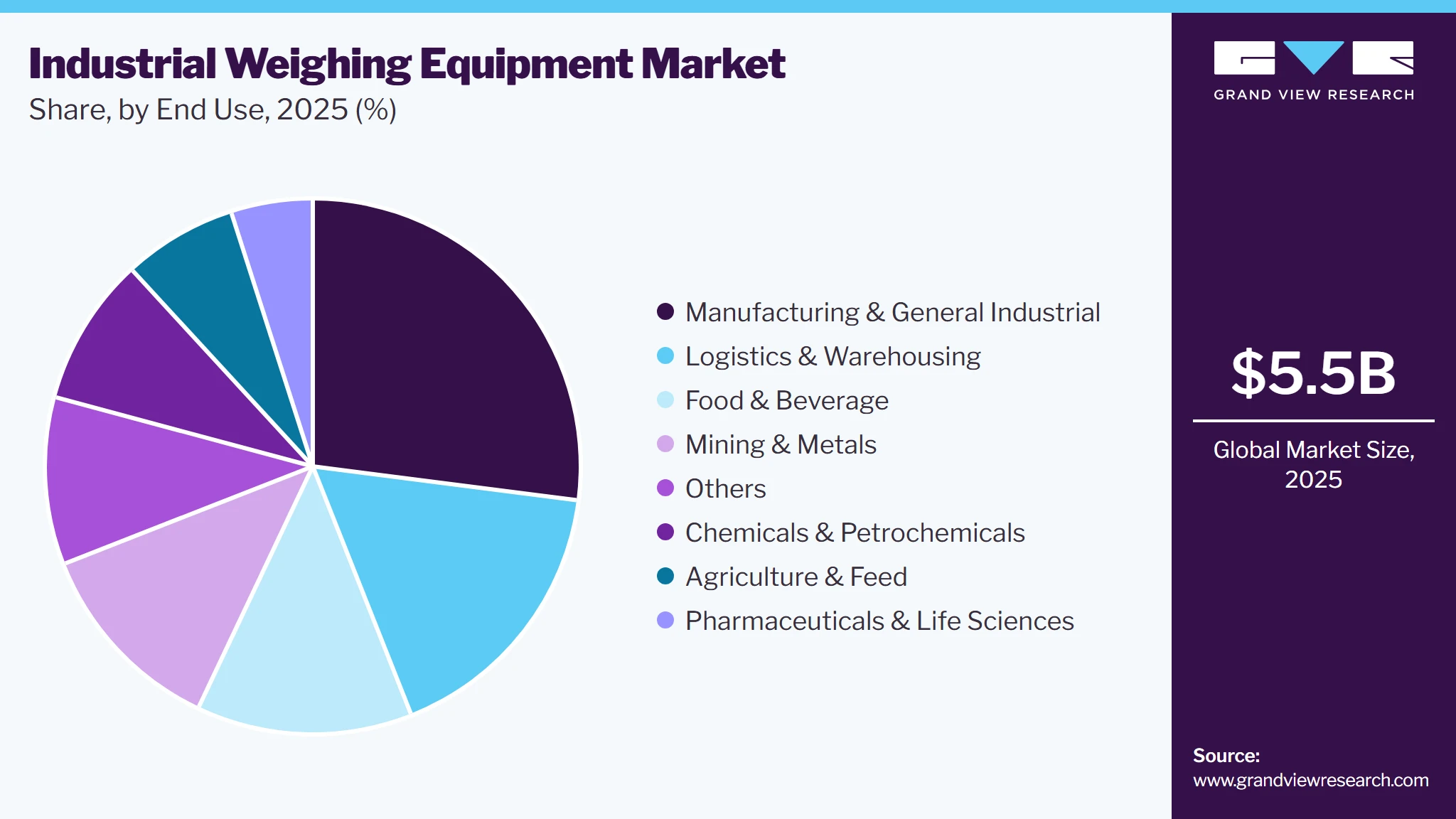
The logistics & warehousing segment is projected to be the fastest-growing segment over the forecast period, at a CAGR of 7.5%, supported by the expansion of organized distribution networks, automated storage facilities, e-commerce fulfillment, and high-volume freight movement. Accurate weight measurement is increasingly important for shipment verification, freight calculation, inventory control, pallet handling, and space optimization. Integration of weighing equipment with warehouse management software, barcode systems, RFID, and automated material-handling equipment is further accelerating adoption as operators seek faster throughput and greater visibility across distribution workflows.
Regional Insights
Asia Pacific Industrial Weighing Equipment Market Trends
The industrial weighing equipment industry in Asia Pacific dominated the global market in 2025 with a share of 39.0%, and it is also expected to remain the fastest-growing region during the forecast period. Rapid expansion of production capacity, logistics networks, food processing facilities, and bulk-material handling infrastructure across major economies is generating substantial demand for weighing solutions. Increasing automation, warehouse modernization, and investment in smart production facilities are further accelerating the replacement of conventional equipment with digitally enabled systems.
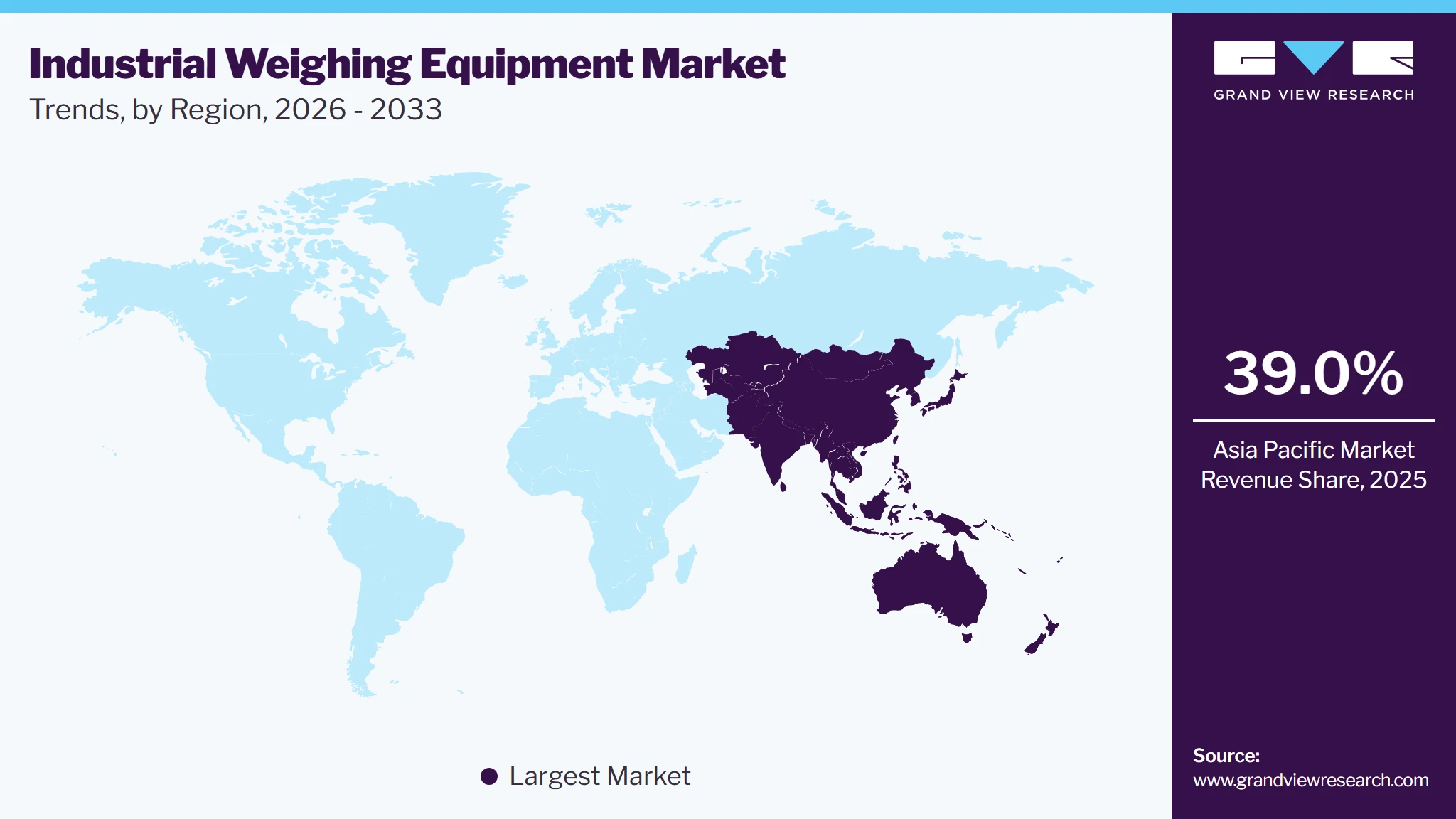
China industrial weighing equipment industry dominated the Asia Pacific market in 2025, supported by its extensive production ecosystem, large-scale processing capacity, expanding logistics infrastructure, and strong investment in advanced equipment. The country’s broad industrial base creates demand for weighing solutions across material handling, bulk measurement, production control, quality verification, and transportation activities. Continued growth in equipment manufacturing and high-technology industries is also encouraging the adoption of automated and digitally connected weighing systems.
The industrial weighing equipment industry in India is emerging as a high-growth market in Asia Pacific, supported by expanding production capacity, infrastructure development, and increasing integration with global supply chains. According to India’s Ministry of Statistics and Programme Implementation, manufacturing GVA is estimated to have increased 11.4% in FY2025-26, reaching approximately USD 491.4 billion at current prices, compared with USD 441.2 billion in FY2024-25. India's overall real GDP was also estimated to grow 7.7% in FY2025-26, while the Economic Survey 2025-26 noted that India maintained strong industrial growth and recorded 1.3% quarter-on-quarter manufacturing output growth in Q3 2025. These developments are creating opportunities for weighing equipment across production facilities, distribution networks, agricultural handling, food processing, and other expanding applications.
North America Industrial Weighing Equipment Market Trends
The industrial weighing equipment industry in North America is expected to witness steady growth over the forecast period, supported by widespread adoption of automated weighing, advanced inventory systems, and connected material-handling technologies. The region's established distribution infrastructure and emphasis on operational efficiency encourage investment in high-precision scales, checkweighing systems, weighbridges, and integrated measurement platforms. Demand for equipment upgrades and replacement of aging installations will also contribute to market expansion.
U.S. Industrial Weighing Equipment Market Trends
The industrial weighing equipment industry in the U.S. dominated the North American market in 2025, supported by its extensive production base, large distribution network, and substantial investment in automated industrial infrastructure. According to the U.S. Bureau of Labor Statistics, the country had approximately 403,603 private manufacturing establishments in Q1 2026, while transportation and warehousing accounted for another 317,547 private establishments, providing a substantial customer base for weighing and measurement systems. The U.S. Census Bureau also reported USD 334.8 billion in new orders for manufactured durable goods in June 2026, highlighting the scale of equipment-intensive industrial activity. In addition, the BEA reported that real value added by private goods-producing industries increased 4.5% in Q1 2026, reflecting continued economic activity across production-oriented sectors. These conditions support sustained demand for platform scales, weighbridges, checkweighing systems, hopper scales, and other industrial measurement solutions.
Europe Industrial Weighing Equipment Market Trends
The industrial weighing equipment industry in Europe is projected to experience consistent growth as businesses focus on process optimization, equipment modernization, and integration of weighing systems with digital industrial infrastructure. Strong demand from food production, pharmaceuticals, logistics, and specialized processing facilities supports the deployment of highly accurate and traceable measurement solutions. Increasing adoption of automated inspection and data-driven production practices is creating additional opportunities for technologically advanced weighing equipment.
Germany industrial weighing equipment industry dominated the European market in 2025, supported by its well-established production base, strong machinery and equipment ecosystem, automotive manufacturing, and extensive logistics infrastructure. The country’s diverse industrial landscape creates demand for weighing solutions across material handling, batching, quality verification, inventory management, and finished-product movement. Continued emphasis on automation, production efficiency, and modernization of industrial facilities is also encouraging the adoption of digitally enabled weighing systems. Germany’s industrial sector remains substantial, with manufacturing and related activities forming an important part of the national economy and providing a broad installed base for industrial measurement equipment.
The industrial weighing equipment industry in the UK is expected to be a growing market in Europe, supported by its established production base, expanding distribution activities, and continued adoption of automated measurement technologies. The Office for National Statistics reported that UK manufacturers recorded USD 596.1 billion in product sales in 2025, demonstrating the substantial scale of domestic production activity. In addition, UK production output increased 0.2% during 2025, while manufacturing output rose 0.9% in the three months to December 2025 compared with the preceding three-month period. These trends, alongside investment in modern production and logistics infrastructure, are expected to support demand for platform scales, checkweighing systems, vehicle weighing equipment, and digitally connected solutions.
Middle East & Africa Industrial Weighing Equipment Market Trends
Middle East & Africa industrial weighing equipment industry is poised for continued growth as infrastructure development, logistics expansion, food supply-chain investments, and large-scale construction and processing projects increase the need for dependable measurement systems. Demand is supported by vehicle weighing, bulk-material management, warehouse operations, and production-site applications. Greater investment in automated facilities and modernization of industrial assets is likely to gradually increase the penetration of digital and connected weighing technologies.
The industrial weighing equipment industry in South Africa is an important market within the Middle East & Africa region, supported by its diversified production base, established freight networks, agricultural activities, and extensive movement of bulk commodities. The country’s well-developed mining, manufacturing, food production, logistics, and agricultural ecosystems generate demand for platform scales, weighbridges, hopper and tank scales, belt weighing systems, and heavy-duty solutions. Ongoing infrastructure development, warehouse modernization, and efforts to improve operational efficiency are also encouraging the adoption of reliable and digitally enabled weighing equipment across the country.
Latin America Industrial Weighing Equipment Market Trends
Latin America industrial weighing equipment industry is anticipated to grow gradually, aided by investment in agricultural handling, commodity logistics, food production, warehousing, and resource-based activities. Weighbridges, platform scales, hopper systems, and other heavy-duty equipment are particularly relevant for bulk-material movement and commercial measurement. Improvements in transportation infrastructure and modernization of storage and processing facilities are expected to encourage wider adoption over the forecast period.
The industrial weighing equipment industry in Brazil dominated the Latin American market in 2025, supported by its large agricultural economy, diversified production base, extensive logistics network, and substantial movement of bulk commodities. The country’s grain handling, food production, storage, transportation, and processing activities create broad demand for platform scales, weighbridges, hopper systems, belt scales, and other heavy-duty weighing solutions. Increasing investment in industrial automation and sensor-based process control is also supporting the transition toward digitally connected weighing equipment, particularly as Brazilian facilities modernize their production and logistics infrastructure.
Key Industrial Weighing Equipment Company Insights
Some of the key players operating in the market include METTLER TOLEDO, Avery Weigh-Tronix, and Rice Lake Weighing Systems.
-
METTLER TOLEDO is a global provider of precision measurement instruments and services, offering a broad portfolio of industrial weighing solutions. Its industrial range includes bench, floor, pallet, rail, and truck scales, along with load cells, weighing modules, terminals, software, and weighbridge systems. The company also provides calibration, verification, preventive maintenance, installation, and technical support services, enabling customers to integrate weighing into production, quality-control, material-handling, and logistics operations.
-
Avery Weigh-Tronix is a leading provider of industrial weighing scales, systems, and equipment, offering solutions designed for diverse commercial and industrial applications. Its portfolio includes bench scales, floor and platform scales, weighbridges, truck scales, checkweighers, load cells, weighing indicators, and automation and software solutions. The company also provides calibration, maintenance, and technical support services, with its products and services marketed across more than 80 countries.
Key Industrial Weighing Equipment Companies:
The following key companies have been profiled for this study on the industrial weighing equipment market.
-
METTLER TOLEDO
-
Avery Weigh-Tronix
-
Rice Lake Weighing Systems
-
Minebea Intec GmbH
-
A&D Company Limited
-
Sartorius AG
-
Fairbanks Scales Inc.
-
YAMATO-SCALE
-
Precia Molen Group
-
OHAUS
-
Cardinal / Detecto Scale
-
Bizerba SE & Co. KG
-
KERN & SOHN GmbH
-
Flintec
-
CAS Corporation
Competitive Benchmarking
Category
Operating Strategies
Competitive Edge
Weakness
Established Players (e.g., METTLER TOLEDO; Avery Weigh-Tronix; Rice Lake Weighing Systems; Minebea Intec; Bizerba SE & Co. KG)
- Expand integrated portfolios covering platform, process, vehicle, and automated weighing applications.
- Invest in digital connectivity, software integration, and automation to improve equipment functionality.
- Strengthen global distribution, installation, calibration, and after-sales service capabilities.
- Broad product portfolios and established relationships with large industrial customers.
- Strong technical expertise enables customized solutions for complex weighing requirements.
- Extensive geographic presence and service infrastructure provide greater customer reach.
- Higher equipment and service costs can restrict adoption among price-sensitive customers.
- Large organizational structures may reduce flexibility in serving highly specialized requirements.
- Longer replacement cycles in established markets can limit short-term equipment demand.
Emerging & Regional Players (e.g., A&D Company Limited; Sartorius AG; Fairbanks Scales Inc.; YAMATO-SCALE; Precia Molen Group)
- Focus on customized and application-specific weighing solutions for regional customers.
- Compete through localized manufacturing, competitive pricing, and responsive technical support.
- Gradually introduce digital, automated, and connected features into existing product portfolios.
- Greater flexibility in adapting equipment to specific customer and application requirements.
- Competitive pricing can support penetration in cost-sensitive markets.
- Strong understanding of local market conditions and established regional distribution relationships.
- Smaller geographic and service networks compared with multinational competitors.
- Relatively lower investment capacity for advanced automation, software, and sensor technologies.
- Greater reliance on external suppliers for specialized components can affect cost and supply stability.
Recent Developments:
-
In February 2026, Minebea Intec entered into a strategic partnership with Safeland Technical Supplies Company LLC to strengthen its presence in Saudi Arabia. Safeland will represent Minebea Intec’s industrial weighing portfolio, including bench, floor, pallet, platform, load-cell, vessel, silo, and truck-scale solutions. The partnership is expected to improve local product availability, technical support, installation, calibration, and after-sales services.
-
In October 2025, A&D Company expanded its presence in the North American weighing sector through the acquisition of Thompson Scale Company’s business. The transaction added industrial weighing, filling, packaging, and checkweighing capabilities to A&D’s existing measurement portfolio. By combining the two companies’ technical expertise and market reach, A&D can strengthen its offering for industrial customers.
Industrial Weighing Equipment Market Report Scope
Report Attribute
Details
Market size in 2025
USD 5.5 billion
Estimated market size in 2026
USD 5.8 billion
Revenue forecast in 2033
USD 8.8 billion
Growth rate
CAGR of 6.1% from 2026 to 2033
Historical data
2021 - 2024
Forecast period
2026 - 2033
Quantitative units
Revenue in USD billion and CAGR from 2026 to 2033
Report coverage
Revenue forecast, company ranking, competitive landscape, growth factors, and trends
Segments covered
Technology, equipment, end use, and region
Regional scope
North America; Europe; Asia Pacific; Latin America; Middle East & Africa
Country scope
U.S.; Canada; Mexico; UK; Germany; France; Spain; Italy; China; Japan; India; Australia; South Korea; Brazil; Argentina; Saudi Arabia; UAE; South Africa
Key companies profiled
METTLER TOLEDO; Avery Weigh-Tronix; Rice Lake Weighing Systems; Minebea Intec GmbH; A&D Company Limited; Sartorius AG; Fairbanks Scales Inc.; YAMATO-SCALE; Precia Molen Group; OHAUS; Cardinal / Detecto Scale; Bizerba SE & Co. KG; KERN & SOHN GmbH; Flintec; CAS Corporation.
Customization scope
Free report customization (equivalent up to 8 analysts working days) with purchase. Addition or alteration to country, regional & segment scope.
Pricing and purchase options
Avail customized purchase options to meet your exact research needs. Explore purchase options
Global Industrial Weighing Equipment Market Report Segmentation
This report forecasts revenue growth at global, regional, and country levels and provides an analysis of the latest industry trends in each of the sub-segments from 2021 to 2033. For this study, Grand View Research has segmented the global industrial weighing equipment market report based on technology, equipment, end use, and region.
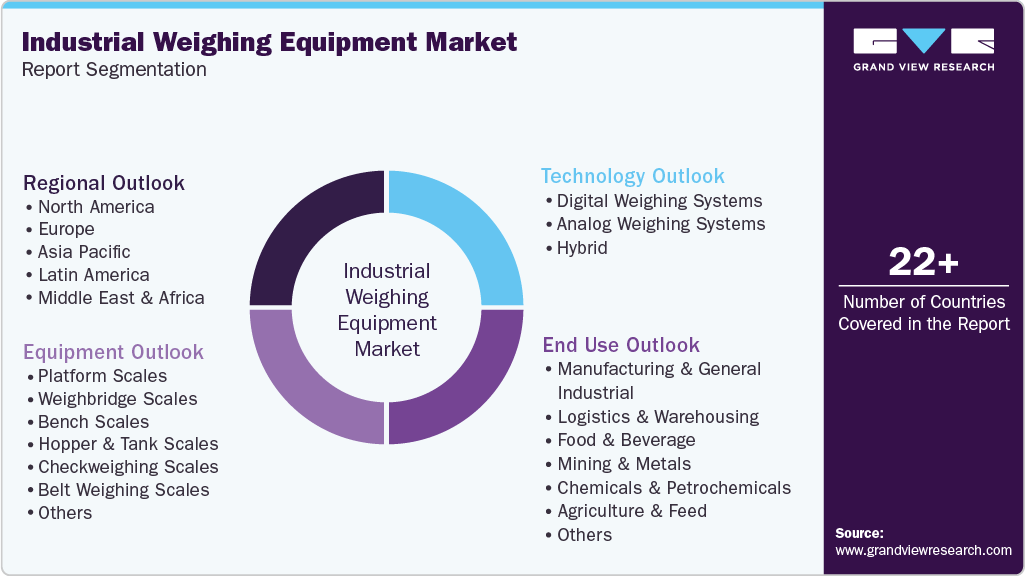
-
Technology Outlook (Revenue, USD Billion, 2021 - 2033)
-
Digital Weighing Systems
-
Analog Weighing Systems
-
Hybrid
-
-
Equipment Outlook (Revenue, USD Billion, 2021 - 2033)
-
Platform Scales
-
Weighbridge Scales
-
Bench Scales
-
Hopper & Tank Scales
-
Checkweighing Scales
-
Belt Weighing Scales
-
Crane & Heavy-Duty Scales
-
Others
-
-
End Use Outlook (Revenue, USD Billion, 2021 - 2033)
-
Manufacturing & General Industrial
-
Logistics & Warehousing
-
Food & Beverage
-
Mining & Metals
-
Chemicals & Petrochemicals
-
Agriculture & Feed
-
Pharmaceuticals & Life Sciences
-
Others
-
-
Regional Outlook (Revenue, USD Billion, 2021 - 2033)
-
North America
-
U.S.
-
Canada
-
Mexico
-
-
Europe
-
Germany
-
France
-
Italy
-
Spain
-
UK
-
-
Asia Pacific
-
China
-
India
-
Japan
-
South Korea
-
Australia
-
-
Latin America
-
Brazil
-
Argentina
-
-
Middle East & Africa
-
Saudi Arabia
-
UAE
-
South Africa
-
-
Research Methodology
The industrial weighing equipment market figures in this report are based on a proven research process that combines executive interviews with secondary research from proprietary databases, company filings, and recognized regulatory and institutional sources. Market size is built through value-chain sizing—reconciling supply-side and demand-side estimates—and triangulated with bottom-up and top-down approaches. Every estimate passes multiple levels of expert validation before publication, with each industrial weighing equipment segment quantified using the revenue-capture definitions in the table below.
Segment Definition
Technology
Revenue Capture Definition
Digital Weighing Systems
Revenue generated from the sale of Industrial Weighing Equipment using electronic and digital technology to measure, process, display, and transmit weight information.
Analog Weighing Systems
Revenue generated from the sale of Industrial Weighing Equipment using mechanical or analog technology to measure and display weight.
Hybrid
Revenue generated from the sale of Industrial Weighing Equipment combining digital and analog weighing technologies for measuring, processing, and displaying weight information.
Equipment
Revenue Capture Definition
Platform Scales
Revenue generated from the sale of Industrial Weighing Equipment used for weighing products, materials, containers, pallets, and other loads placed directly on a weighing platform, including platform scales used across industrial and commercial applications.
Weighbridge Scales
Revenue generated from the sale of Industrial Weighing Equipment used for weighing trucks, trailers, and other heavy vehicles, including weighbridge scales used for inbound and outbound material weighing.
Bench Scales
Revenue generated from the sale of Industrial Weighing Equipment used for weighing small and medium-sized products, components, packages, and materials on workbenches, counters, and other surfaces.
Hopper & Tank Scales
Revenue generated from the sale of Industrial Weighing Equipment used for weighing materials stored or processed in hoppers, tanks, bins, and other containers, including equipment used for batch and process weighing.
Checkweighing Scales
Revenue generated from the sale of Industrial Weighing Equipment used for checking the weight of products and packages against specified weight limits, including automatic and in-line checkweighing systems.
Belt Weighing Scales
Revenue generated from the sale of Industrial Weighing Equipment used for continuously measuring the weight and flow rate of bulk materials transported on conveyor belts.
Crane & Heavy-Duty Scales
Revenue generated from the sale of Industrial Weighing Equipment used for weighing heavy loads during lifting, handling, and material movement operations, including crane scales and heavy-duty weighing scales.
Others
Revenue generated from the sale of Industrial Weighing Equipment for other weighing applications, including counting scales, floor scales, axle scales, and livestock scales, among others.
End Use
Revenue Capture Definition
Manufacturing & General Industrial
Revenue generated from the sale of Industrial Weighing Equipment used in manufacturing and general industrial operations, including production, material handling, batching, process control, and inventory management.
Logistics & Warehousing
Revenue generated from the sale of Industrial Weighing Equipment used in logistics and warehousing operations, including weighing goods, packages, pallets, shipments, and materials during storage and transportation.
Food & Beverage
Revenue generated from the sale of Industrial Weighing Equipment used in food and beverage processing and production, including weighing, batching, portioning, packaging, and quality control.
Mining & Metals
Revenue generated from the sale of Industrial Weighing Equipment used in mining and metals operations, including weighing ores, minerals, metals, raw materials, and finished products.
Chemicals & Petrochemicals
Revenue generated from the sale of Industrial Weighing Equipment used in chemical and petrochemical operations, including weighing, batching, blending, and handling of chemicals, raw materials, and finished products.
Agriculture & Feed
Revenue generated from the sale of Industrial Weighing Equipment used in agriculture and animal feed operations, including weighing grains, seeds, livestock feed, agricultural products, and other materials.
Pharmaceuticals & Life Sciences
Revenue generated from the sale of Industrial Weighing Equipment used in pharmaceutical and life sciences operations, including weighing, batching, formulation, production, and quality control of pharmaceutical and life science products.
Others
Revenue generated from the sale of Industrial Weighing Equipment for other end uses, including construction, waste management, recycling, transportation, and retail, among others.
Estimation Model
Layer No.
Layer Name
Key Question
Description
01
Industrial Activity & Demand Base
What level of industrial activity generates demand for weighing equipment?
Assess production activity, logistics volumes, bulk-material movement, facility expansion, and modernization across major end-use sectors to establish the overall demand base.
02
Equipment & Technology Penetration
What types of weighing equipment and technologies are being adopted?
Estimate the penetration of digital, analog, and hybrid systems across platform scales, weighbridges, bench scales, hopper & tank scales, checkweighers, belt scales, and heavy-duty weighing equipment.
03
Equipment Demand & Installation Volume
How much weighing equipment is required across applications?
Estimate new equipment installations, replacement demand, equipment upgrades, and adoption of automated and connected weighing solutions across end-use industries and regions.
04
Market Revenue
What is the total revenue generated by industrial weighing equipment?
Calculate total market revenue by aggregating equipment demand and market value across technology, equipment, end use, and geographic segments.
Delivered Customizations
This report has been delivered with the following In-depth customizations
CLIENT REQUEST
CUSTOMIZATION DELIVERED
VALUE ADDS
Regional Segmentation
Provided detailed regional and country-level analysis covering North America, Europe, Asia Pacific, Latin America, and Middle East & Africa, with key country insights for the U.S., Germany, UK, China, India, Brazil, and South Africa.
Enables assessment of regional market concentration, country-level demand patterns, industrial activity, logistics development, and growth opportunities for market expansion and investment decisions.
Competitive Benchmarking
Delivered comprehensive benchmarking of major manufacturers, including company profiles, headquarters, competitive positioning, operating strategies, competitive advantages, weaknesses, and recent market-relevant developments.
Provides a clear view of the competitive landscape, differentiation strategies, portfolio strengths, geographic presence, and areas where established and regional players compete.
Opportunity Assessment
Provided a dedicated opportunity assessment covering smart and connected weighing systems, automation, digital integration, equipment modernization, logistics and warehousing expansion, and demand for advanced weighing solutions across major applications and regions.
Helps identify high-potential technologies, applications, equipment categories, and geographic markets that can support future growth and strategic prioritization.
About the Author(s)
Advanced Interior Materials Research Team
Advanced Materials · Advanced Interior MaterialsThis report was authored by the advanced interior materials research team at Grand View Research - comprising two research analysts, one senior research analyst, and one industry expert - with specialized expertise in the advanced interior materials segment of the advanced materials industry. All findings are based on proprietary advanced materials databases, executive interviews, and regulatory analysis, subject to internal peer review prior to publication.
Last Updated:
Speak to Analyst


Customize this report to your needs - add regions, segments, or data points, with 20% free customization.
Or view our licence options:


ISO 9001:2015 & 27001:2022 Certified
We are GDPR and CCPA compliant! Your transaction & personal information is safe and secure. For more details, please read our privacy policy.


