
- Home
- »
- Agrochemicals & Fertilizers
- »
-
Insecticides Market Size, Share & Growth Report, 2026-2033GVR Report cover

Insecticides Market (2026 - 2033)
Size, Share & Trends Analysis Report By Type (Organophosphates, Pyrethroids), By Application (Cereals & Grains, Oilseeds & Pulses), By Region (Asia Pacific, North America, Europe), And Segment Forecasts
Market Size, 2025
$10.4BMarket Estimate, 2026
$10.9BMarket Forecast, 2033
$14.9BCAGR, 2026–2033
4.6%Insecticides Market Summary
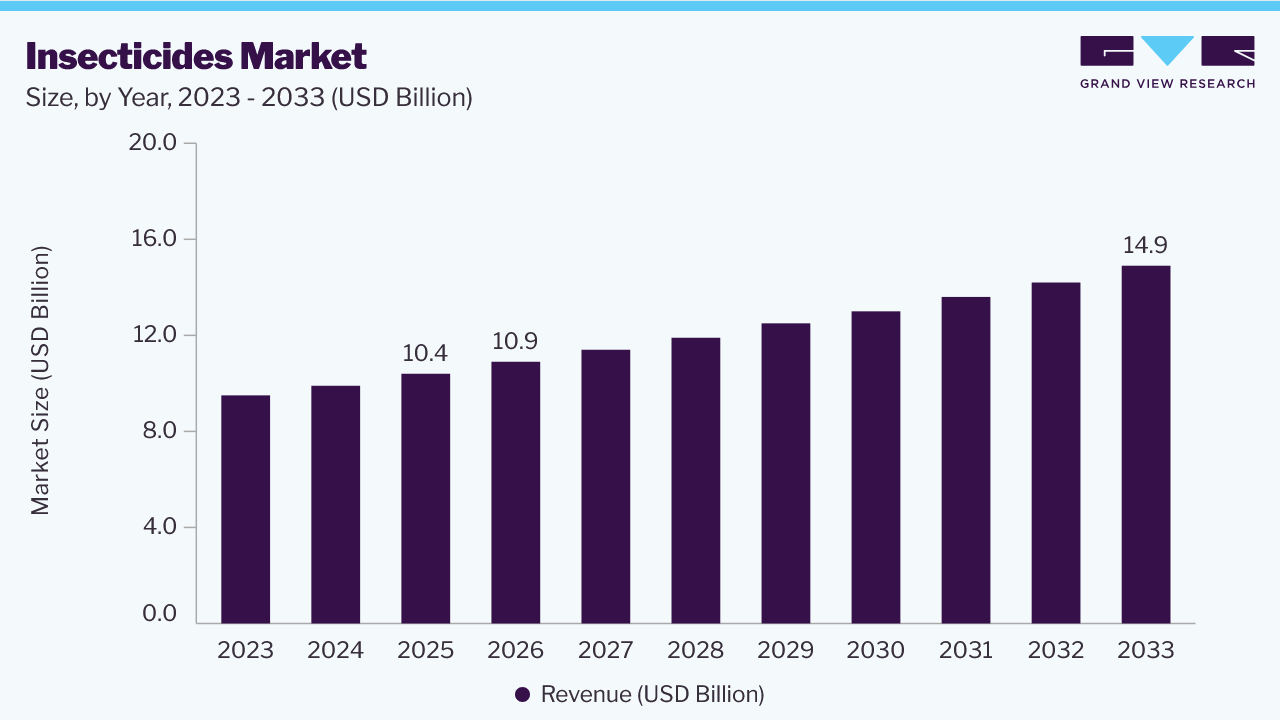
The global insecticides market size was valued at USD 10.4 billion in 2025 and is projected to grow from USD 10.9 billion in 2026 to USD 14.9 billion by 2033, at a CAGR of 4.6% from 2026 to 2033. Asia Pacific dominated the global market, accounting for the largest revenue share of 55.0% in 2025. The market growth is attributable to its increasing use for pest and insect control in agricultural fields.
Key Market Trends & Insights
- By type: The organophosphate segment held the significant market share in 2025.
- By application: The cereals & grains segment held the largest market share of more than 40.0% in 2025.
Regional Highlights
- Largest regional market: Asia Pacific (55.0% revenue share, 2025)
Market Size & Forecast
- Market size in 2025: USD 10.4 Billion
- Estimated market size in 2026: USD 10.9 Billion
- Projected market size by 2033: USD 14.9 Billion
- CAGR (2026-2033): 4.6%
Three ways to get this report
Buy it, customize it, or ask a question.Ask an Analyst
Analyst response in 1 business day
- AccessReport author, directly
- Reply timeWithin 1 working day
- No sales callDirect answer only
- FormatEmail reply
- CostFree, no cost
Get the Full Report
What the study covers
- FormatsPDF · Excel · Dashboard
- Timeline2026–2033 annual, 2025 base
- Coverage20+ countries, 5 regions
- Companies10+ key players profiled
Customize the Report
20% free customization
- IncludeCountries, segments, points
- TailorTo your product definition
- ExtendDeeper competitor detail
- OrA fully bespoke study
- Turnaround5–10 working days
 Source: Grand View Research, IR Documents, Primary Interviews, Paid DatabasesTo learn more about this report,
 Download Free Sample Report
Market Dynamics
Rising global food demand and increased agricultural production are driving growth in the insecticide industry. The continuous growth in global population is increasing the need for higher crop yields and improved food security, encouraging farmers to adopt crop protection products to minimize losses from insects and pests. Insecticides play a crucial role in protecting crops and enhancing agricultural productivity. In addition, government initiatives promoting modern farming practices and the growing adoption of high-value crops are expected to support market growth further. For instance, in March 2025, Bayer Crop Science highlighted its continued investments in crop protection innovations to help farmers increase yields and improve food security amid rising global food demand.
Strict environmental regulations and growing concerns regarding the impact of chemical insecticides on human health and biodiversity are negatively impacting market growth. The registration and approval of new insecticide products require extensive testing, regulatory compliance, and significant investments in research and development, increasing costs for manufacturers. In addition, rising consumer preference for organic farming and biological crop protection solutions is reducing the adoption of conventional chemical insecticides in several regions. These factors are also referred to as key restraining factors limiting the growth of the insecticide market. For instance, in 2025, Syngenta Group continued to emphasize integrated pest management and biological solutions as part of sustainable agriculture initiatives, reflecting the industry's response to tightening environmental regulations.
The growing adoption of precision agriculture and the development of bio-based crop protection solutions are creating significant growth opportunities for the insecticide industry. Farmers are increasingly utilizing advanced farming technologies to improve pest management efficiency, reduce crop losses, and enhance agricultural productivity. In addition, the rising demand for sustainable agriculture and environmentally friendly pest control products is encouraging manufacturers to invest in biological and next-generation insecticide solutions. Continuous innovation in crop protection technologies, coupled with increasing investments in agricultural modernization across emerging economies, is expected to create lucrative opportunities for market growth during the forecast period.
Analyst Perspective
The insecticides industry is increasingly influenced by the need to balance crop protection with environmental and regulatory requirements. As farmers face rising pressure to improve productivity while managing resistance, demand is gradually shifting toward more effective, targeted solutions. Companies with strong research capabilities, established distribution networks, and broad product portfolios are likely to maintain a competitive edge. In the coming years, market players are likely to depend on the ability to adapt to changing regulations, address pest resistance challenges, and provide integrated crop protection solutions.
Type Insights
The organophosphate segment accounted for the significant market revenue share in 2025, driven by increasing crop losses due to declining arable land and rising insect attacks, which are anticipated to drive demand for insecticides, especially organophosphates, owing to their low cost. Carbamates are a class of insecticides that are mechanically and structurally similar to organophosphates. These are used as bait or sprays to kill unwanted insects by directly affecting their nervous system and brain. Botanical refers to products that consist of dried ground plant material, chemicals isolated from plants, or crude plant extracts used for killing or repelling insects. Many plants, such as Pyrethrum (Tanacetum cinerariifolium) and sweet wormwood, are toxic to insects due to their insecticidal properties; thus, naturally occurring chemicals derived from these plants are widely used as botanical insecticides.
The pyrethroids segment is expected to grow at a significant CAGR during the forecast period, driven by their broad-spectrum insect control, high effectiveness at low application rates, and extensive use across cereals, fruits, vegetables, and oilseed crops. Pyrethroid insecticides are commonly preferred for their rapid knockdown effect against a wide range of agricultural pests, helping farmers minimize crop losses and improve yields. In addition, the growing demand for food production, the increasing adoption of modern crop protection practices, and the continued use of pyrethroid-based formulations in both agricultural and public health applications are expected to support segment growth through 2025 and beyond.
Application Insights
The cereals & grains application segment led the market with the largest revenue share of more than 40.0% in 2025. Its high share is driven by the increasing consumption of cereals & grains, such as rice, oats, corn, wheat, sorghum, and barley, due to their nutritional benefits. The oilseeds and pulses segment also accounted for a significant share of revenue in 2025. The segment includes oilseeds and pulses, such as soybean, sunflower seeds, and leguminous seeds (pulses).
The growing focus of farmers on oilseed production is expected to drive this segment's growth over the coming years. According to the Food and Agriculture Organization (FAO), the Asia-Pacific region continued to account for the largest share of global cereal production in 2025, supported by strong output from major agricultural economies such as China and India.In addition, according to the Ministry of Agriculture & Farmers Welfare, Government of India, India remains one of the world's leading producers of cereals and oilseeds, contributing significantly to global agricultural output.
Regional Insights
Asia Pacific Insecticides Market Trends
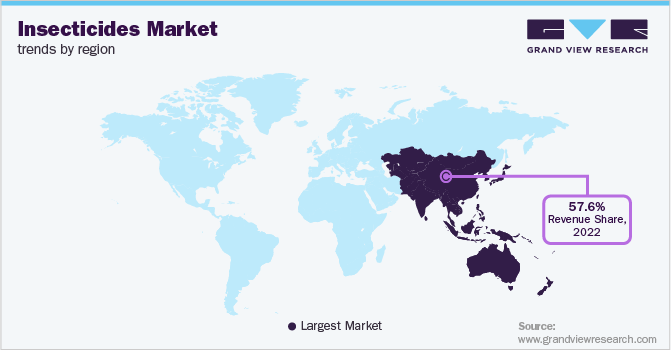
Asia Pacific dominated the global insecticides market with the largest revenue share of over 55.0% in 2025. The high share is driven by rising food demand due to the region's rapidly growing population. Agriculture is the primary sector in many Asian countries, including India and Vietnam. Insecticides are the primary crop protection chemicals used in these countries due to pests such as diamondback moths, aphids, caterpillars, and onion thrips on widely grown crops like rice, maize, wheat, and onion.
 To learn more about this report, Download Free Sample Report
The Central & South America insecticides market is also one of the leading regional markets for insecticides, driven by large-scale production of pulses, soybeans, and sugarcane, which increased insecticide consumption to improve yield and productivity. Brazil is a major contributor to the region's GDP and a key consumer of insecticides, herbicides, fungicides, and biopesticides.
The Insecticides market in North America is expected to be a lucrative region during the forecast period, driven by rising food demand and increased agricultural activity.
Key Insecticides Company Insights
The global industry is highly competitive in terms of market share and new product development. The growing research & development activities, coupled with constant product upgrades, have created an intensely competitive environment in the global industry.
Key Insecticides Companies
The following key companies have been profiled for this study on the insecticides market.
-
AMVAC Chemical Corp.
-
UPL Ltd.
-
Bayer AG
-
BASF SE
-
FMC Corp.
-
Corteva Agriscience
-
Nufarm Ltd.
-
Bioworks, Inc.
-
Syngenta Group
Recent Developments
-
In December 2025, Syngenta US announced that its PLINAZOLIN technology received registration from the U.S. Environmental Protection Agency (EPA). The technology will power five new insecticide products for use across corn, cotton, vegetables, cereals, tree fruits, and other crops, strengthening the company's insect pest management portfolio.
-
In June 2025, Syngenta announced the expansion of its biological crop protection business through new manufacturing capabilities and an enhanced innovation pipeline. The company stated that growing demand for sustainable pest management solutions is driving investments in next-generation crop protection technologies, including insect control products.
Insecticides Market Report Scope
Report Attribute
Details
Market size in 2025
USD 10.4 billion
Estimated market size in 2026
USD 10.9 billion
Projected market size by 2033
USD 14.9 billion
Growth rate
CAGR of 4.6% from 2026 to 2033
Base year for estimation
2025
Historical data
2021 - 2024
Forecast period
2026 - 2033
Quantitative units
Revenue in USD million/billion, and CAGR from 2026 to 2033
Report coverage
Revenue forecast, company ranking, competitive landscape, growth factors, and trends
Segments covered
Type, application, region
Regional scope
North America; Europe; Asia Pacific; Central & South America; Middle East & Africa
Country scope
U.S.; Canada; Mexico; Germany; UK; France; Italy; Spain; China; India; Japan; South Korea; Indonesia; Brazil; Argentina; Saudi Arabia; South Africa
Key companies profiled
AMVAC Chemical Corp.; UPL Ltd.; Bayer AG; BASF SE; FMC Corp.; Corteva Agriscience; Nufarm Ltd.; Bioworks, Inc.; Syngenta Group
Customization scope
Free report customization (equivalent up to 8 analysts working days) with purchase. Addition or alteration to country, regional & segment scope.
Pricing and purchase options
Avail of customized purchase options to meet your exact research needs. Explore purchase options
Global Insecticides Market Report Segmentation
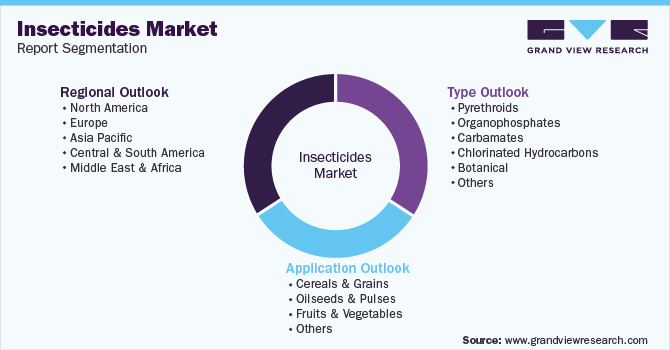
This report forecasts revenue growth at global, regional, and country levels and provides an analysis of the latest industry trends in each of the sub-segments from 2021 to 2033. For this study, Grand View Research has segmented the global insecticides market report based on type, application, and region:
 To learn more about this report, Download Free Sample Report
-
Type Outlook (Volume, Kilotons; Revenue, USD Million, 2021 - 2033)
-
Pyrethroids
-
Organophosphates
-
Carbamates
-
Chlorinated Hydrocarbons
-
Botanical
-
Others
-
-
Application Outlook (Volume, Kilotons; Revenue, USD Million, 2021 - 2033)
-
Cereals & Grains
-
Oilseeds & Pulses
-
Fruits & Vegetables
-
Others
-
-
Regional Outlook (Volume, Kilotons; Revenue, USD Million, 2021 - 2033)
-
North America
-
U.S.
-
Canada
-
Mexico
-
Europe
-
Germany
-
U.K.
-
-
France
-
Italy
-
Spain
-
Asia Pacific
-
China
-
India
-
Japan
-
South Korea
-
Indonesia
-
Central & South America
-
Brazil
-
Argentina
-
Middle East & Africa
-
Saudi Arabia
-
South Africa
-
Frequently Asked Questions About This Report
The global insecticides market size was valued at USD 10.4 billion in 2025 and is estimated at USD 10.9 billion in 2026.
Cereals & grains segment held the largest market share of more than 40.0% in 2025.
The global insecticides market is expected to grow at a CAGR of 4.6% from 2026 to 2033, reaching USD 14.9 billion by 2033.
Asia Pacific dominated with a revenue share of 55.0% in 2025.
Some key players operating in insecticides market include AMVAC Chemical Corporation, UPL Limited, Bayer AG, and FMC Corporation.
About the Author(s)
Agrochemicals & Fertilizers Research Team
Bulk Chemicals · Agrochemicals & FertilizersThis report was authored by the agrochemicals & fertilizers research team at Grand View Research - comprising two research analysts, one senior research analyst, and one industry expert - with specialized expertise in the agrochemicals & fertilizers segment of the bulk chemicals industry. All findings are based on proprietary bulk chemicals databases, executive interviews, and regulatory analysis, subject to internal peer review prior to publication.
Last Updated:
Speak to Analyst

Customize this report to your needs - add regions, segments, or data points, with 20% free customization.
Or view our licence options:


ISO 9001:2015 & 27001:2022 Certified
We are GDPR and CCPA compliant! Your transaction & personal information is safe and secure. For more details, please read our privacy policy.


