
- Home
- »
- Organic Chemicals
- »
-
Isobutanol Market Size, Share & Trends Report, 2026-2033GVR Report cover

Isobutanol Market (2026 - 2033)
Size, Share & Trends Analysis Report By Product (Synthetic, Biobased), By Application (Oil & Gas, Solvents & Coatings, Chemical Intermediate), By Region, And Segment Forecasts
Market Size, 2025
$1.5BMarket Estimate, 2026
$1.6BMarket Forecast, 2033
$2.8BCAGR, 2026–2033
8.1%Isobutanol Market Summary
The global isobutanol market size was valued at USD 1.5 billion in 2025 and is projected to grow from USD 1.6 billion in 2026 to USD 2.8 billion in 2033, at a CAGR of 8.1% from 2026 to 2033. Asia Pacific dominated the market, accounting for a revenue share of 40.0% in 2025. The market is poised for significant growth, driven by its multifaceted applications across industries, including automotive fuel, chemicals, personal care, and pharmaceuticals. With a focus on sustainability, technological advancements, and regulatory support for greener technologies, the market is expected to exhibit a steady growth trajectory in the coming years.
Key Market Trends & Insights
- By product: the synthetic isobutanol segment dominated the market with the highest revenue share of around 55.0% in 2025.
- By application: the chemical intermediate segment accounted for the highest revenue share in 2025.
Regional Highlights
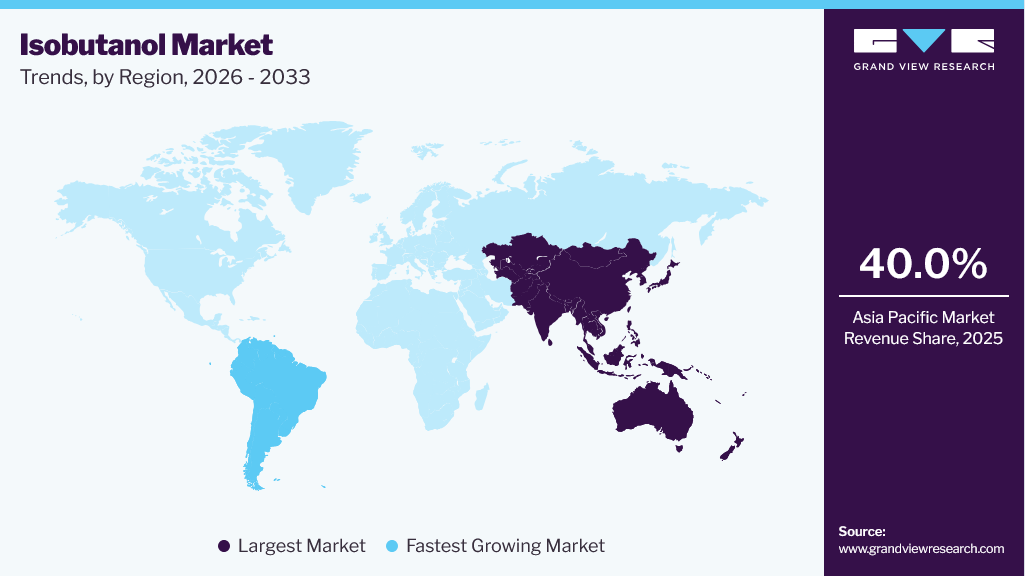
- Largest regional market: Asia Pacific (40.0% revenue share, 2025)
- Fastest-growing regional market: Latin America (highest CAGR, 2026-2033)
Market Size & Forecast
- Market size in 2025: USD 1.5 Billion
- Estimated market size in 2026: USD 1.6 Billion
- Projected market size by 2033: USD 2.8 Billion
- CAGR (2026-2033): 8.1%
Three ways to get this report
Buy it, customize it, or ask a question.Ask an Analyst
Analyst response in 1 business day
- AccessReport author, directly
- Reply timeWithin 1 working day
- No sales callDirect answer only
- FormatEmail reply
- CostFree, no cost
Get the Full Report
What the study covers
- FormatsPDF · Excel · Dashboard
- Timeline2026–2033 annual, 2025 base
- Coverage20+ countries, 5 regions
- Companies10+ key players profiled
Customize the Report
20% free customization
- IncludeCountries, segments, points
- TailorTo your product definition
- ExtendDeeper competitor detail
- OrA fully bespoke study
- Turnaround5–10 working days
Market growth is significant due to the increasing adoption of isobutanol as a gasoline replacement, driven by its ability to boost octane ratings and reduce emissions. This trend is particularly appealing to automotive companies seeking to comply with stringent emissions standards. Furthermore, the rising demand for biofuels and the shift towards cleaner energy sources are fueling the use of isobutanol.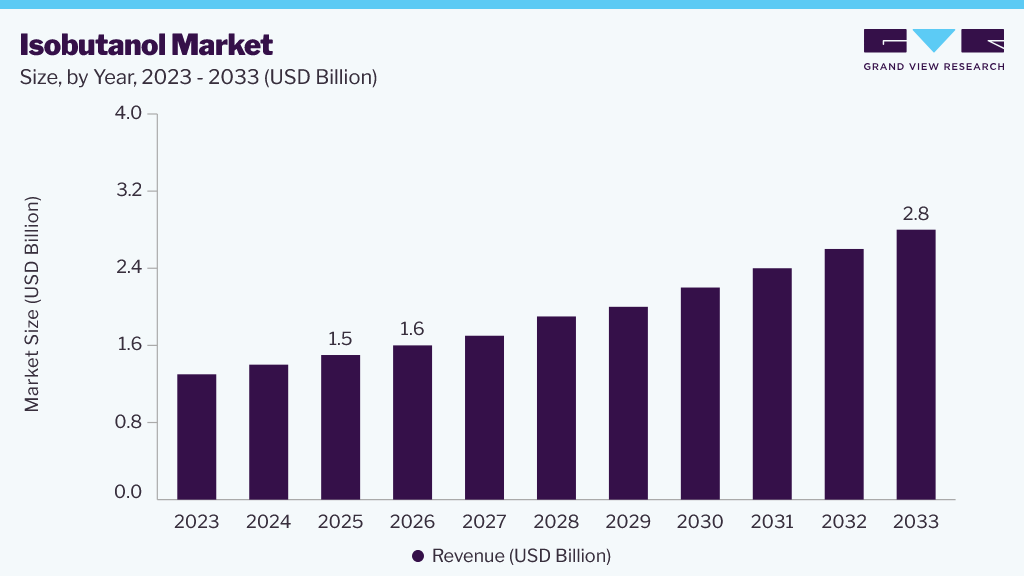 Source: Grand View Research, IR Documents, Primary Interviews, Paid DatabasesTo learn more about this report,
 Download Free Sample Report
Isobutanol’s versatility is also driving its demand across various industries. As a chemical intermediate, it is used in the production of butyl acrylate, butyl acetate solvents, and other products. The growth in chemical production, particularly in developing nations, is a key driver of demand for isobutanol in the coatings, adhesives, and plastic products sectors. Moreover, the personal care industry leverages isobutanol as a solvent for cosmetics and fragrances in perfumes, lotions, hair products, and other products.
The ease of manufacturing isobutanol from renewable feedstocks such as corn or sugarcane via fermentation has made it an attractive option for manufacturers. Technological innovations have not only reduced production costs but also improved yield efficiency, making it a preferred choice among manufacturers. Major market players are collaborating and investing in research and development to enhance production processes and explore new end-use applications for isobutanol. For instance, in October 2024, Eastman Chemical Company announced an off-list price increase of USD 0.05/lb (USD 0.11/kg) for Eastman Isobutyl Alcohol across North America and Latin America, citing elevated operating costs, particularly higher raw material expenses.
Analyst Perspective
The market is driven by rising demand from the paints and coatings, automotive, construction, and biofuel industries, as well as growing interest in renewable chemicals that support global sustainability goals. Manufacturers are expanding production capacity, investing in bio-based isobutanol technologies, and strengthening their portfolios with high-purity grades for fuel additives, solvents, and chemical intermediates. However, the market continues to face challenges related to fluctuations in feedstock prices, evolving environmental regulations, and competition from alternative alcohols and petrochemical derivatives. Companies that secure reliable raw material supplies, improve production efficiency, accelerate the commercialization of bio-based isobutanol, and expand their global distribution networks will be well-positioned to strengthen their competitive advantage.
Product Insights
Synthetic isobutanol accounted for the highest revenue share, at around 55.0%, in 2025. Synthetic isobutanol is primarily produced through large-scale petrochemical processes that use readily available feedstocks such as propylene and butylene derived from crude oil refining or natural gas production. This method yields higher purity products, making it ideal for applications in pharmaceuticals and cosmetics where high-quality products are required.
Biobased isobutanol is expected to register the fastest CAGR during the forecast period. The growing concern about climate change and environmental degradation is driving demand for sustainable alternatives. Biobased isobutanol, produced from renewable biomass sources such as corn or sugarcane, offers a carbon-neutral solution. It can be used as a solvent, a gasoline additive, or a feedstock for other chemicals, promoting global sustainability and reducing petroleum-based emissions.
Application Insights
The chemical intermediate segment dominated the market, accounting for around 45.0% of revenue in 2025. Isobutanol serves as a raw material for producing various chemicals, including Butyl Acrylate, Isobutyl Acetate, and Plasticizers. Its versatility enables widespread adoption across industries, driving demand in the chemical intermediate segment. This versatility will enable manufacturers to capitalize on its diverse applications and drive growth.
The oil & gas segment is expected to register the fastest CAGR during the forecast period. Isobutanol plays a significant role in the oil and gas industry, particularly in fuel formulation, where it enhances gasoline octane numbers, improving engine performance and economic benefits. Moreover, government initiatives aimed at reducing reliance on fossil fuels have driven the development of alternative fuel sources, ensuring isobutanol’s relevance in the sector.
Regional Insights
The Asia Pacific isobutanol market dominated with a share of around 40.0% in 2025. The Asia Pacific region has experienced rapid economic growth, driving demand for chemicals such as isobutanol. Developing countries in the region are industrializing, necessitating increased isobutanol production. Advanced production techniques in countries such as China and Japan have enabled efficient synthesis from various sources.
 To learn more about this report, Download Free Sample Report
China Isobutanol Market Trends
The China isobutanol market dominated the Asia Pacific region with the largest revenue share in 2025. China has been actively investing in its chemical manufacturing sector, with a focus on isobutanol production. The country boasts multiple large-scale production facilities that leverage advanced technologies to optimize output. This scale enables Chinese manufacturers to meet both domestic and international demand efficiently, solidifying their position as a major player in the industry.
Latin America Isobutanol Market Trends
The isobutanol market in Latin America is expected to register the fastest CAGR during the forecast period. Latin America offers several natural resources, including agricultural feedstock, suitable for synthesizing bio-based chemicals such as isobutanol. The region’s climate fosters the growth of crops such as sugarcane, corn, and cassava, which can be fermented to produce isobutanol. Brazil, in particular, has established itself as a leading producer of bioethanol, a key precursor to isobutanol through fermentation.
Brazil isobutanol market is expected to grow lucratively in the forecast period. Brazil, a leading sugarcane producer, leverages this feedstock to manufacture bio-based chemicals such as isobutanol. By modifying fermentation processes to yield isobutanol, Brazil can optimize production. Moreover, the country has implemented initiatives to promote renewable energy and reduce greenhouse gas emissions, solidifying its commitment to sustainability.
Key Isobutanol Companies Insights
The isobutanol industry features a range of global, regional, and local players, making it a competitive market. The world’s leading companies are using partnerships, collaborations, acquisitions, mergers, and agreements as strategies to withstand the intense competition and increase their market share. Isobutanol manufacturers are investing heavily in product enhancements and new product development.
Key Isobutanol Companies
The following key companies have been profiled for this study on the isobutanol market:
-
Tokyo Chemical Industry Co., Ltd.
-
Mitsubishi Chemical Group Corporation.
-
Nexchem Ltd
-
KH Neochem Co., Ltd.
-
BASF
-
ChemBK.com
-
Advanced Biotech
-
Exxon Mobil Corporation
-
SANKYO CHEMICAL CO., LTD.
-
KANTO KAGAKU
Recent Developments
-
In July 2024, OQ Chemicals announced a price increase of USD 110 per metric ton for Iso-Butanol and n-Butanol in North America and Europe, effective August 1, 2024, driven by tight propylene supply, force majeure events, and production disruptions caused by Hurricane Beryl.
Isobutanol Market Report Scope
Report Attribute
Details
Market size in 2025
USD 1.5 billion
Estimated market size in 2026
USD 1.6 billion
Projected market size by 2033
USD 2.8 billion
Growth rate
CAGR of 8.1% from 2026 to 2033
Base year for estimation
2025
Actual data
2021 - 2024
Forecast period
2026 - 2033
Quantitative units
Volume in kilotons, revenue in USD billion, and CAGR from 2026 to 2033
Report coverage
Volume & revenue forecast, company ranking, competitive landscape, growth factors, and trends
Segments covered
Product, application, region
Regional scope
North America; Europe; Asia Pacific
Country scope
U.S.; Canada; Mexico; UK; Germany; France; China; India; Japan
Key companies profiled
Tokyo Chemical Industry Co., Ltd.; Mitsubishi Chemical Group Corporation.; Nexchem Ltd; KH Neochem Co., Ltd.; BASF; ChemBK.com; Advanced Biotech; Exxon Mobil Corporation; SANKYO CHEMICAL CO.,LTD.; KANTO KAGAKU
Customization scope
Free report customization (equivalent up to 8 analysts working days) with purchase. Addition or alteration to country, regional & segment scope.
Pricing and purchase options
Avail of customized purchase options to meet your exact research needs. Explore purchase options
Global Isobutanol Market Report Segmentation
This report forecasts volume & revenue growth at global, regional, and country levels and provides an analysis of the latest industry trends and opportunities in each of the sub-segments from 2021 to 2033. For this study, Grand View Research has segmented the global isobutanol market report based on product, application, and region:
- Product Outlook (Volume, Kilotons; Revenue, USD Million, 2021 - 2033)
- Synthetic
- Biobased
- Application Outlook (Volume, Kilotons; Revenue, USD Million, 2021 - 2033)
- Oil & Gas
- Solvents & Coatings
- Chemical Intermediate
- Others
- Regional Outlook (Volume, Kilotons; Revenue, USD Million, 2021 - 2033)
- North America
- U.S.
- Canada
- Mexico
- Europe
- UK
- Germany
- France
- Italy
- Spain
- Russia
- Asia Pacific
- China
- India
- Japan
- North America
Frequently Asked Questions About This Report
Asia Pacific dominated with an approximately 40.0% revenue share in 2025.
Key players in the market include Tokyo Chemical Industry Co., Ltd., Mitsubishi Chemical Group Corporation, Nexchem Ltd., KH Neochem Co., Ltd., BASF SE, ChemBK.com, Advanced Biotech, Exxon Mobil Corporation, SANKYO CHEMICAL CO., LTD., KANTO KAGAKU, and others.
The global isobutanol market size was valued at USD 1.5 billion in 2025 and is estimated at USD 1.6 billion for 2026.
The global isobutanol market is expected to grow at a CAGR of 8.1% from 2026 to 2033, reaching USD 2.8 billion.
The synthetic isobutanol segment accounted for the largest revenue share of approximately 55.0% in 2025.
About the Author(s)
Organic Chemicals Research Team
Bulk Chemicals · Organic ChemicalsThis report was authored by the organic chemicals research team at Grand View Research - comprising two research analysts, one senior research analyst, and one industry expert - with specialized expertise in the organic chemicals segment of the bulk chemicals industry. All findings are based on proprietary bulk chemicals databases, executive interviews, and regulatory analysis, subject to internal peer review prior to publication.
Last Updated:
Speak to Analyst

Customize this report to your needs - add regions, segments, or data points, with 20% free customization.
Or view our licence options:


ISO 9001:2015 & 27001:2022 Certified
We are GDPR and CCPA compliant! Your transaction & personal information is safe and secure. For more details, please read our privacy policy.


