
- Home
- »
- IT Services & Applications
- »
-
IT Asset Disposition Market Size & Share Report, 2026-2033GVR Report cover

IT Asset Disposition Market (2026 - 2033)
Size, Share & Trends Analysis Report By Asset Type (Computers/Laptops, Smartphones & Tablets, Peripherals, Storages, Servers), By End Use (BFSI, IT & Telecom, Healthcare, Government), By Region, And Segment Forecasts
Market Size, 2025
$28.3BMarket Estimate, 2026
$31.9BMarket Forecast, 2033
$65.7BCAGR, 2026–2033
10.9%IT Asset Disposition Market Summary
The global IT asset disposition market size was valued at USD 28.3 billion in 2025 and is projected to grow from USD 31.9 billion in 2026 to USD 65.7 billion by 2033, growing at a CAGR of 10.9% from 2026 to 2033. Asia Pacific dominated the global market, accounting for the largest revenue share of 42.7% in 2025. As businesses and consumers frequently upgrade their IT equipment to keep up with evolving software and hardware requirements, the need for secure and sustainable disposal of outdated assets has surged.
 Source: Grand View Research, IR Documents, Primary Interviews, Paid DatabasesTo learn more about this report,
 Download Free Sample Report
 Key Market Trends & Insights
- By asset type: the computers/laptops segment led the market with the largest revenue share of 43.3% in 2025.
- By end use: the IT & telecom segment led the market with the largest revenue share of 29.8% in 2025.
Regional Highlights
- Largest regional market: Asia Pacific (42.7% revenue share, 2025)
- By country: The China held the largest market share in 2025.
Market Size & Forecast
- Market size in 2025: USD 28.3 Billion
- Estimated market size in 2026: USD 31.9 Billion
- Projected market size by 2033: USD 65.7 Billion
- CAGR (2026-2033): 10.9%
Three ways to get this report
Buy it, customize it, or ask a question.Ask an Analyst
Analyst response in 1 business day
- AccessReport author, directly
- Reply timeWithin 1 working day
- No sales callDirect answer only
- FormatEmail reply
- CostFree, no cost
Get the Full Report
What the study covers
- FormatsPDF · Excel · Dashboard
- Timeline2026–2033 annual, 2025 base
- Coverage20+ countries, 5 regions
- Companies10+ key players profiled
Customize the Report
20% free customization
- IncludeCountries, segments, points
- TailorTo your product definition
- ExtendDeeper competitor detail
- OrA fully bespoke study
- Turnaround5–10 working days
This trend is further amplified by the growing adoption of cloud computing, IoT devices, and 5G technology, accelerating hardware refresh cycles and increasing the volume of end-of-life IT assets requiring proper disposal. The increasing emphasis on data security and regulatory compliance also contributes to the growth of the IT asset disposition industry. With stringent data protection laws such as GDPR, HIPAA, and CCPA, organizations are under pressure to ensure that sensitive data stored on retired IT assets is destroyed. ITAD providers offer certified data destruction services, mitigating the risk of data breaches and ensuring compliance with legal requirements. The rising awareness of cybersecurity threats has pushed businesses to adopt professional ITAD services rather than relying on informal or unsecured disposal methods.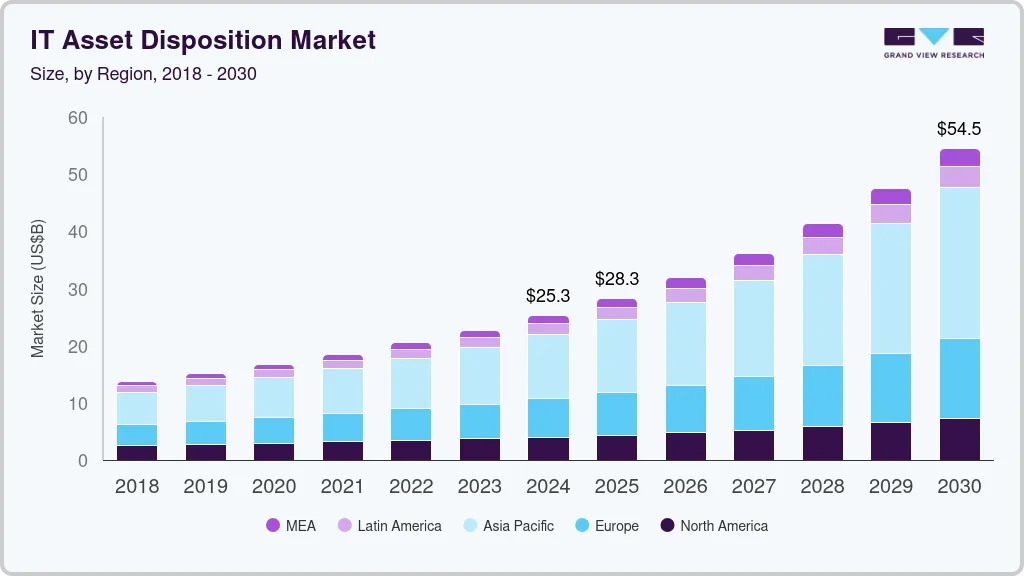 To learn more about this report, Download Free Sample Report
 Environmental sustainability and corporate social responsibility (CSR) initiatives are also fueling the expansion of the ITAD market. Businesses increasingly prioritize eco-friendly disposal practices, including recycling and refurbishing IT assets to reduce electronic waste (e-waste). Governments and regulatory bodies worldwide are implementing stricter e-waste management policies, encouraging companies to partner with certified ITAD providers. Additionally, the circular economy model, which promotes reuse and resource recovery, is gaining traction, making ITAD an essential component of sustainable business operations. These factors collectively contribute to the robust growth of the ITAD market globally.
Market Dynamics
The market is gaining momentum as organizations prioritize the secure, compliant, and sustainable management of end-of-life IT assets. ITAD solutions encompass services such as data sanitization and destruction, asset tracking, refurbishment, remarketing, recycling, and value recovery, enabling enterprises to mitigate data security risks while maximizing returns from retired hardware. The growing volume of obsolete IT equipment generated by digital transformation initiatives, cloud migration, data center modernization, and frequent technology refresh cycles is driving demand for professional ITAD services. Additionally, rising concerns regarding cybersecurity, data privacy, electronic waste management, and regulatory compliance are encouraging organizations to adopt certified disposition practices. The increasing emphasis on environmental sustainability, circular economy principles, and ESG commitments is further supporting market growth, as enterprises seek to extend asset lifecycles, reduce environmental impact, and improve resource utilization through responsible IT asset management.
The IT Asset Disposition (ITAD) market is being driven by the rising volume of retired IT assets generated through rapid digital transformation, frequent hardware refresh cycles, and large-scale enterprise infrastructure upgrades, as organizations increasingly replace legacy systems with high-performance computing, cloud-enabled architectures, and advanced digital technologies. This accelerated pace of IT modernization is significantly shortening device lifecycles for servers, laptops, storage systems, and networking equipment, leading to a continuous rise in end-of-life IT assets requiring secure, compliant, and environmentally responsible management. As a result, demand for ITAD services such as certified data destruction, asset recovery, refurbishment, recycling, and resale is increasing, positioning ITAD as a critical enabler of secure asset lifecycle management and sustainable value recovery in the global enterprise ecosystem.
For instance, in 2022, global e-waste generation reached 62 million tonnes, according to the Global E-waste Monitor 2024 published by UNITAR and ITU, making it the fastest-growing waste stream worldwide, while only 22.3% of this waste was formally collected and recycled in an environmentally sound manner, highlighting a major gap in structured end-of-life asset management systems. This growing imbalance between rapidly increasing electronic waste volumes and limited formal recycling infrastructure underscores the urgent need for organized ITAD solutions, as enterprises seek secure data sanitization, regulatory compliance, and efficient recovery of value from discarded IT assets.
The growth of the IT Asset Disposition (ITAD) market is restrained by the high costs and operational complexities associated with secure asset handling, certified data destruction, regulatory compliance, and environmentally responsible recycling processes. Organizations are required to maintain detailed asset tracking, chain-of-custody documentation, secure transportation, auditing, and compliance with evolving data privacy and e-waste regulations, which can significantly increase disposition costs. Additionally, the need for specialized infrastructure, skilled personnel, and certified recycling facilities creates financial challenges, particularly for small and medium-sized enterprises (SMEs) operating with limited IT budgets. These factors often discourage organizations from adopting comprehensive ITAD programs and can lead to delays in asset disposal or reliance on less formal disposal methods.
For instance, according to the U.S. Environmental Protection Agency (EPA), the recycling rate for selected consumer electronics in the United States was only 38.5% in 2018, despite growing awareness regarding electronic waste management and sustainability initiatives. This relatively moderate recycling rate highlights the persistent challenges associated with collection, processing, and recovery of end-of-life electronic equipment, reflecting the financial and operational barriers that continue to limit the widespread adoption of formal ITAD and electronics recycling services.
The increasing emphasis on sustainability, resource conservation, and circular economy initiatives presents a significant growth opportunity for the IT Asset Disposition (ITAD) market. Organizations are seeking to extend the lifecycle of IT equipment through refurbishment, redeployment, remarketing, and recycling rather than disposing of assets after a single use cycle. This shift is being driven by corporate ESG commitments, rising environmental regulations, and growing pressure from stakeholders to reduce carbon emissions and electronic waste. As enterprises focus on maximizing asset value recovery while minimizing environmental impact, demand for advanced ITAD services that support sustainable asset management, and material recovery is expected to increase substantially. Furthermore, the growing market for refurbished IT equipment, particularly among small businesses, educational institutions, and emerging economies, is creating additional revenue opportunities for ITAD providers.
For instance, according to the Global E-waste Monitor 2024 published by UNITAR and ITU, the total value of recoverable materials contained in global e-waste generated in 2022 was estimated at approximately USD 91 billion, including valuable metals such as copper, gold, and rare earth elements. However, a significant portion of these resources remain unrecovered due to inadequate collection and recycling practices. This substantial untapped value is encouraging organizations and governments to invest in circular economy initiatives and formal asset recovery programs, creating significant opportunities for ITAD providers specializing in refurbishment, remarketing, and responsible recycling services.
Analyst Perspective
The IT Asset Disposition (ITAD) market is positioned at the convergence of several long-term growth drivers, including accelerating digital transformation, rising cybersecurity concerns, increasing volumes of electronic waste, and expanding corporate sustainability commitments. As enterprises continue to modernize IT infrastructure, migrate workloads to the cloud, and shorten hardware replacement cycles, the volume of retired IT assets requiring secure and compliant disposition is expected to grow significantly. At the same time, stricter data privacy regulations and ESG reporting requirements are elevating ITAD from a back-office operational function to a strategic component of enterprise risk management and sustainability programs.
The key competitive advantage in the evolving ITAD landscape will belong to providers that can integrate secure data destruction, asset tracking, refurbishment, remarketing, recycling, and sustainability reporting into a unified lifecycle management platform. Organizations are increasingly seeking partners capable of maximizing asset value recovery while ensuring regulatory compliance and measurable environmental outcomes. As circular economy initiatives gain traction globally, ITAD providers that combine advanced technology, global logistics capabilities, and transparent chain-of-custody management will be best positioned to establish long-term enterprise relationships and capture a growing share of the expanding end-of-life IT asset management market.
Asset Type Insights
Based on asset type, the computers/laptops segment led the market with the largest revenue share of 43.3% in 2025, driven by the shortening lifespan of devices due to rapid advancements in hardware and software. Businesses and consumers frequently upgrade their PCs and laptops to keep up with performance demands, security updates, and new operating systems, leading to a steady influx of retired devices that require proper disposal. The shift to hybrid and remote work models has also accelerated device turnover, as companies refresh their fleets to ensure employees have modern, efficient, and secure machines.
The mobile devices segment is anticipated to grow at a CAGR of 15.3% during the forecast period, driven by the accelerated replacement cycle of smartphones and tablets, fueled by frequent technological advancements, shorter product lifespans, and consumer demand for newer models. Mobile device manufacturers release upgraded versions annually, pushing businesses and individuals to retire older devices faster. Additionally, the rise of 5G technology has further accelerated upgrades, as older devices often lack compatibility with new network standards, creating a surge in end-of-life mobile devices that require secure and sustainable disposal.
End Use Insights
Based on end use, the IT & telecom segment led the market with the largest revenue share of 29.8% in 2025. The rise of network virtualization and Open RAN (O-RAN) deployments is another key growth catalyst, as telecom providers replace proprietary hardware with standardized, disaggregated solutions. This shift generates large volumes of decommissioned telecom gear, from base stations to switches, which require specialized ITAD handling due to their complex components and regulatory classifications (e.g., radiation safety in RF equipment). Meanwhile, IT leasing models and the as-a-service economy are increasing asset turnover rates, as businesses increasingly favor flexible OPEX-based hardware consumption over ownership, further expanding the ITAD opportunity.
 To learn more about this report, Download Free Sample Report
 The media and entertainment segment is expected to grow significantly over the forecast period due to digital transformation, content proliferation, and heightened data security needs. One of the primary drivers is the rapid obsolescence of production and post-production equipment, driven by relentless advancements in high-resolution formats (4K/8K, HDR), virtual production (LED volumes, AR/VR), and AI-powered editing tools. Studios, broadcasters, and streaming platforms frequently upgrade their IT infrastructure, including servers, storage arrays, and workstations, to handle larger file sizes and real-time rendering demands, generating a continuous stream of decommissioned assets that require secure, compliant disposal.
Regional Insights
North America's IT asset disposition market held a share of nearly 16.7% in 2025, due to strict e-waste regulations (e.g., U.S. state laws like California’s SB 20) and high corporate sustainability commitments. The region’s mature IT infrastructure, rapid tech refresh cycles, and strong emphasis on data security compliance (e.g., HIPAA, CCPA) drive demand for certified ITAD services. Additionally, the circular economy push and corporate ESG goals encourage businesses to adopt ITAD solutions that maximize asset recovery while minimizing environmental impact.
U.S. IT Asset Disposition Market Trends
The IT asset disposition market in the U.S. is expected to grow significantly at a CAGR of 8.2% from 2026 to 2033, due to frequent hardware upgrades in enterprises and data centers, alongside fragmented but stringent state-level e-waste laws. High cybersecurity awareness and litigation risks from data breaches push companies toward professional ITAD providers. The growing refurbished electronics market, supported by trade-in programs from Apple and Dell, further fuels demand for secure and value-driven disposition services.
Europe IT Asset Disposition Market Trends
The IT asset disposition market in Europe is anticipated to grow considerably from 2026 to 2033. The Green Deal initiative promotes circular economy practices, pushing businesses to prioritize ITAD for compliance. High tech adoption rates in industries like automotive (IoT/5G) and finance (cloud migration) also contribute to increased ITAD demand as legacy systems are phased out.
The UK IT asset disposition market is expected to grow rapidly in the coming years. Strong financial and healthcare sectors, which handle sensitive data, require certified ITAD services for secure disposal. The government’s net-zero targets further incentivize businesses to adopt sustainable ITAD practices, including refurbishment and carbon-neutral recycling.
The Germany IT asset disposition market held a substantial market share in 2025. The country’s rigorous enforcement of WEEE and data protection laws ensures high demand for compliance. Additionally, a strong secondary market for refurbished enterprise hardware supports ITAD vendors specializing in remarketing.
Asia Pacific IT Asset Disposition Market Trends
Asia Pacific dominated the IT asset disposition market with the largest revenue share of 42.7% in 2025, due to rapid digital transformation in emerging economies and increasing e-waste regulation (e.g., India’s E-Waste Rules). The growing middle class drives electronics consumption, while manufacturing hubs like China and Vietnam produce surplus IT assets needing disposal. However, informal recycling remains a challenge, creating opportunities for formal ITAD providers.
 To learn more about this report, Download Free Sample Report
 The Japan IT asset disposition market is expected to grow rapidly in the coming years. The country’s aging IT infrastructure and shift to Society 5.0 (smart cities, IoT) accelerate hardware turnover. Additionally, high data security standards in automotive and electronics manufacturing industries drive demand for certified ITAD services.
China IT Asset Disposition Market Trends
The IT asset disposition market in China held the largest share in the Asia Pacific region in 2025, driven by government policies promoting a circular economy and crackdowns on informal e-waste processing. The booming domestic tech sector (e.g., Huawei, Alibaba) generates massive volumes of retired IT assets, while data localization laws (e.g., Cybersecurity Law) mandate secure onshore disposal. However, cost sensitivity and a strong refurbishment market shape ITAD strategies toward value recovery over pure recycling.
Key IT Asset Disposition Company Insights
Key players operating in the IT asset disposition industry are CompuCom Systems, Inc., Sims Lifecycle Services, Inc., Iron Mountain, Dell Inc., and IBM Corporation. The companies are focusing on various strategic initiatives, including new product development, partnerships and collaborations, and agreements, to gain a competitive advantage over their rivals. The following are some instances of such initiatives.
-
In February 2025, CompuCom Systems, Inc. announced a strategic partnership with Verkada to enhance security solutions for businesses through advanced cloud-based technology. This collaboration merges Compucom’s deep IT service expertise with Verkada’s innovative physical security systems, offering organizations a streamlined, data-driven approach to safeguarding people, assets, and operations. By leveraging intelligent analytics and integrated security infrastructure, the partnership aims to deliver smarter, more efficient protection while unlocking valuable operational insights.
-
In September 2024, Iron Mountain acquired IT asset disposition (ITAD) firm Wisetek, a strategic move that enhances its capabilities in delivering comprehensive and innovative IT lifecycle solutions. With Wisetek's expertise, Iron Mountain aims to expand its service offerings and provide customers with more advanced, secure, and sustainable options for managing end-of-life IT assets.
-
In January 2024, Sims Lifecycle Services, Inc. and MOLG, a U.S.-based digital and automation tools entered into a collaboration focused on automating the repurposing of Open Compute Project (OCP) data center materials. The partnership aims to address growing demands in the reverse data center supply chain by combining technical capabilities to support scalable operations. The initiative is also expected to contribute to sustainability efforts within the sector.
Key IT Asset Disposition Companies:
The following key companies have been profiled for this study on the IT asset disposition market.
-
Apto Solutions Inc.
-
CompuCom Systems, Inc.
-
Dell Inc.
-
Hewlett Packard Enterprise Development LP
-
IBM Corporation
-
Ingram Micro Services
-
Iron Mountain
-
ITRenew
-
LifeSpan International Inc.
-
Sims Lifecycle Services, Inc.
Competitive Benchmarking
Category Operating Strategies Competitive Edge Weakness Established Players (Dell Inc.; Hewlett Packard Enterprise Development LP; IBM Corporation; Ingram Micro Services; Iron Mountain; CompuCom Systems, Inc.) - Expand global ITAD capabilities through integrated lifecycle management, asset recovery, refurbishment, and recycling services.Strengthening partnerships with enterprises, cloud providers, and channel ecosystems while investing in automation, asset tracking, and certified data destruction solutions.
- Extensive global service networks and established compliance certifications.Ability to offer end-to-end IT lifecycle services, including procurement, deployment, maintenance, disposition, and sustainability reporting.
- Higher operational costs are associated with global compliance, logistics, and facility management.Longer decision-making processes and lower flexibility in addressing specialized or regional ITAD requirements compared to smaller providers.
Emerging Players (Apto Solutions Inc.; ITRenew; LifeSpan International Inc.; Sims Lifecycle Services, Inc.) - Focus on asset value recovery, circular economy initiatives, data center decommissioning, and refurbishment services.Expand through strategic partnerships, specialized remarketing programs, and sustainable recycling solutions targeting enterprise and hyperscale customers.
- Greater agility in adopting innovative asset recovery and sustainability-focused business models.Strong expertise in niche ITAD segments such as data center asset disposition, refurbishment, and secondary-market remarketing.
- More limited geographic reach and customer base compared to large multinational competitors.Lower financial resources and brand recognition, which can constrain large-scale expansion and enterprise contract acquisition.
IT Asset Disposition Market Report Scope
Report Attribute
Details
Market size value in 2025
USD 28.3 billion
Estimated market size in 2026
USD 31.9 billion
Projected market size by 2033
USD 65.7 billion
Growth rate
CAGR of 10.9% from 2026 to 2033
Base year for estimation
2025
Historical data
2021 - 2024
Forecast period
2026 - 2033
Quantitative units
Revenue in USD million/billion and CAGR from 2026 to 2033
Report coverage
Revenue forecast, company market share analysis, competitive landscape, growth factors, and trends
Segments covered
Asset type, end use, region
Regional scope
North America; Europe; Asia Pacific; Latin America; MEA
Country scope
U.S.; Canada; Mexico; Germany; UK; France; Italy; Spain; China; Japan; India; South Korea; Australia; Brazil; Saudi Arabia; South Africa; UAE
Key companies profiled
Apto Solutions Inc.; CompuCom Systems, Inc.; Dell Inc.; Hewlett Packard Enterprise Development LP; IBM Corporation; Ingram Micro Services; Iron Mountain; ITRenew; LifeSpan International Inc.; Sims Lifecycle Services, Inc.
Customization scope
Free report customization (equivalent up to 8 analysts' working days) with purchase. Addition or alteration to country, regional & segment scope.
Pricing and purchase options
Avail customized purchase options to meet your exact research needs. Explore purchase options
Global IT Asset Disposition Market Report Segmentation
This report forecasts revenue growth at global, regional, and country levels and provides an analysis of the latest industry trends in each of the sub-segments from 2018 to 2030. For this study, Grand View Research has segmented the IT asset disposition market report based on asset type, end use, and region.
-
Asset Type Outlook (Revenue, USD Billion, 2026 - 2033)
-
Computers/Laptops
-
Smartphones and Tablets
-
Peripherals
-
Storages
-
Servers
-
Others
-
-
End Use Outlook (Revenue, USD Billion, 2026 - 2033)
-
BFSI
-
IT & Telecom
-
Government
-
Energy and Utilities
-
Healthcare
-
Media and Entertainment
-
Others
-
-
Regional Outlook (Revenue, USD Billion, 2026 - 2033)
-
North America
-
U.S.
-
Canada
-
Mexico
-
-
Europe
-
UK
-
Germany
-
France
-
-
Asia Pacific
-
China
-
India
-
Japan
-
South Korea
-
Australia
-
-
Latin America
-
Brazil
-
-
Middle East & Africa
-
UAE
-
Saudi Arabia
-
South Africa
-
-
Research Methodology
Segment Definition
Segment - Asset Type
Revenue capture definition
Computers/Laptops
As the largest asset type segment, revenue is primarily generated through data sanitization, refurbishment, remarketing, redeployment, and recycling services for enterprise desktops and laptops. Additional revenue is captured through resale of refurbished devices in secondary markets, particularly among SMEs, educational institutions, and emerging economies.
Smartphones and Tablets
Revenue is earned through secure device collection, certified data wiping, refurbishment, trade-in programs, and resale activities. The growing adoption of enterprise mobility and Bring Your Own Device (BYOD) policies has increased device replacement frequency, creating recurring ITAD revenue opportunities.
Peripherals
Revenue is generated from the disposition, recycling, and material recovery of peripherals such as monitors, printers, scanners, keyboards, networking accessories, and communication devices. Value recovery is primarily driven by component harvesting, metals recovery, and environmentally compliant recycling services.
Storages
Revenue is captured through specialized services including secure data destruction, degaussing, shredding, and certified disposal of storage devices such as hard disk drives (HDDs), solid-state drives (SSDs), and backup media. Compliance-driven demand from highly regulated industries represents a major revenue contributor.
Servers
Revenue is generated through data center decommissioning, server refurbishment, component recovery, resale, and secure data sanitization services. Growing cloud migration initiatives and hyperscale data center upgrades have accelerated server retirement cycles, increasing demand for enterprise-grade ITAD solutions.
Others
This segment includes networking equipment, telecommunications hardware, IoT devices, point-of-sale systems, and industrial IT equipment. Revenue is derived from asset recovery, recycling, remarketing, and environmentally compliant end-of-life management services that fall outside the primary asset classifications.
Segment - End Use
Revenue capture definition
BFSI
Revenue is predominantly generated through secure data destruction, regulatory compliance services, asset tracking, and disposition of end-of-life IT infrastructure. Financial institutions require certified chain-of-custody management and audit-ready documentation to comply with stringent data privacy and cybersecurity regulations.
IT & Telecom
As one of the largest end-use segments, revenue is captured through large-scale disposition of servers, networking equipment, storage systems, laptops, and mobile devices. Frequent technology upgrades, network modernization projects, and cloud migration initiatives drive recurring demand for ITAD services.
Government
Revenue is earned through secure disposal, recycling, and asset recovery services for government-owned IT equipment, often requiring strict compliance with national security, data protection, and environmental regulations. Long-term contracts and public-sector modernization programs contribute significantly to revenue generation.
Energy and Utilities
Revenue is generated through the disposition of operational technology (OT) assets, industrial computing systems, communication equipment, and enterprise IT infrastructure. Increasing digitalization of utility operations and smart grid deployments are driving replacement of legacy hardware and associated ITAD requirements.
Healthcare
Revenue is captured through secure disposition of medical IT systems, storage devices, workstations, and networking equipment containing sensitive patient information. Regulatory requirements related to patient data protection and electronic health records (EHRs) make certified data destruction a key revenue stream within this segment.
Media and Entertainment
Revenue is generated through retirement, refurbishment, and recycling of creative workstations, storage infrastructure, broadcasting equipment, and mobile devices. Rapid adoption of high-performance computing and digital content production technologies contributes to shorter equipment replacement cycles.
Others
This segment includes manufacturing, retail, education, transportation, and other commercial industries. Revenue is derived from enterprise asset recovery, secure disposal, refurbishment, recycling, and sustainability-focused lifecycle management services as organizations seek to maximize residual asset value and meet ESG objectives.
Estimation Model
IT Asset Base Layer
ITAD Service Accessibility Layer
Disposition & Recovery Utilization Layer
Monetisation Layer
Who generates end-of-life IT assets?
Which assets can be processed through ITAD services?
Which organizations actively utilize ITAD services?
How much revenue is generated?
Identify the total installed base of enterprise IT equipment including laptops, desktops, servers, storage systems, mobile devices, and networking hardware across commercial, government, and institutional organizations to define the potential asset pool requiring disposition services.
Apply data security regulations, e-waste management policies, certified recycling infrastructure availability, refurbishment capabilities, reverse logistics networks, and asset recovery ecosystems to determine the operationally serviceable IT asset disposition market.
Apply enterprise IT refresh cycles, cloud migration rates, data center modernization initiatives, ESG adoption trends, and cybersecurity compliance requirements to convert the serviceable asset base into active users of ITAD solutions including data destruction, refurbishment, remarketing, and recycling services.
Assess revenue generation potential by analyzing spending on data sanitization, asset recovery, refurbishment, resale, recycling, logistics, compliance management, sustainability reporting, and data center decommissioning services across organizations actively disposing of end-of-life IT assets.
Delivered Customizations
This report has been delivered with the following In-depth customizations
Client Request
Customization Delivered
Value Adds
Southeast Asia ITAD Market Assessment
Delivered a detailed analysis of the Southeast Asia ITAD market, including country-level demand trends, regulatory landscape, e-waste management initiatives, enterprise technology adoption, and growth opportunities across key markets such as Singapore, Malaysia, Indonesia, Thailand, Vietnam, and the Philippines.
Enables informed regional expansion decisions by identifying high-growth countries, regulatory drivers, competitive dynamics, and emerging opportunities within the rapidly evolving Southeast Asian ITAD ecosystem.
Sustainability & Circular Economy Adoption Trends
Evaluated adoption trends related to circular economy practices, ESG-driven asset management, electronics recycling, refurbishment programs, and value recovery strategies, including regulatory compliance and environmental sustainability initiatives.
Provides insights into emerging sustainability priorities, regulatory developments, and commercially attractive opportunities in asset reuse, recycling, and responsible e-waste management.
Data Security, Compliance & Infrastructure Opportunity Assessment
Assessed demand for certified data destruction, chain-of-custody tracking, IT asset tracking platforms, data center decommissioning services, and secure disposition solutions, along with cybersecurity, compliance, and governance requirements.
Supports investment and expansion strategies by identifying high-demand security and compliance services, evaluating technology readiness, and highlighting long-term growth opportunities in enterprise IT lifecycle management.
Frequently Asked Questions About This Report
Some key players operating in the IT asset disposition market include Apto Solutions Inc., CompuCom Systems, Inc., Dell Inc., Hewlett Packard Enterprise Development LP, IBM Corporation, Ingram Micro Services, Iron Mountain, ITRenew, LifeSpan International Inc., Sims Lifecycle Services, Inc.
Key factors driving market growth include the rapid pace of technological advancements, which leads to shorter device lifecycles. As businesses and consumers frequently upgrade their IT equipment to keep up with evolving software and hardware requirements, the need for secure and sustainable disposal of outdated assets has surged.
Asia Pacific is the fastest-growing region over the forecast period.
The computers/laptops segment led with a 43.3% revenue share in 2025.
Mobile devices is projected to witness the fastest growth during the forecast period.
The IT & telecom segment led with a 29.8% revenue share in 2025.
The global IT asset disposition market size was estimated at USD 28.3 billion in 2025 and is expected to reach USD 31.9 billion in 2026.
The global IT asset disposition market is expected to grow at a compound annual growth rate of 10.9% from 2026 to 2033 to reach USD 65.7 billion by 2033.
Asia Pacific dominated the IT asset disposition market with a share of 42.7% in 2025. This is attributable to technology advancements, rapid digital transformation in emerging economies, and increasing e-waste regulation.
About the Author(s)
IT Services & Applications Research Team
Technology · IT Services & ApplicationsThis report was authored by the it services & applications research team at Grand View Research - comprising two research analysts, one senior research analyst, and one industry expert - with specialized expertise in the it services & applications segment of the technology industry. All findings are based on proprietary technology databases, executive interviews, and regulatory analysis, subject to internal peer review prior to publication.
Last Updated:
Speak to Analyst

Customize this report to your needs - add regions, segments, or data points, with 20% free customization.
Or view our licence options:


ISO 9001:2015 & 27001:2022 Certified
We are GDPR and CCPA compliant! Your transaction & personal information is safe and secure. For more details, please read our privacy policy.


