
- Home
- »
- Consumer F&B
- »
-
Jam Market Size, Share And Trends Report, 2026-2035GVR Report cover

Jam Market (2026 - 2035)
Size, Share & Trends Analysis Report By Product (Fruit Jam, Jelly, Marmalade, Preserves, Fruit Spreads), By Distribution Channel (Supermarkets & Hypermarkets), By Region, And Segment Forecasts
Market Size, 2025
$12.7BMarket Estimate, 2026
$13.3BMarket Forecast, 2035
$19.5BCAGR, 2026–2035
4.4%Jam Market Summary
The global jam market size was valued at USD 12.7 billion in 2025 and is projected to grow from USD 13.3 billion in 2026 to USD 19.5 billion by 2035, at a CAGR of 4.4% from 2026 to 2035. Europe dominated the market, accounting for the largest revenue share in 2025. The market represents a mature yet steadily evolving segment within the broader packaged food and confectionery spreads industry. Jam continues to hold a strong position in breakfast and bakery-accompaniment categories across both developed and emerging economies.
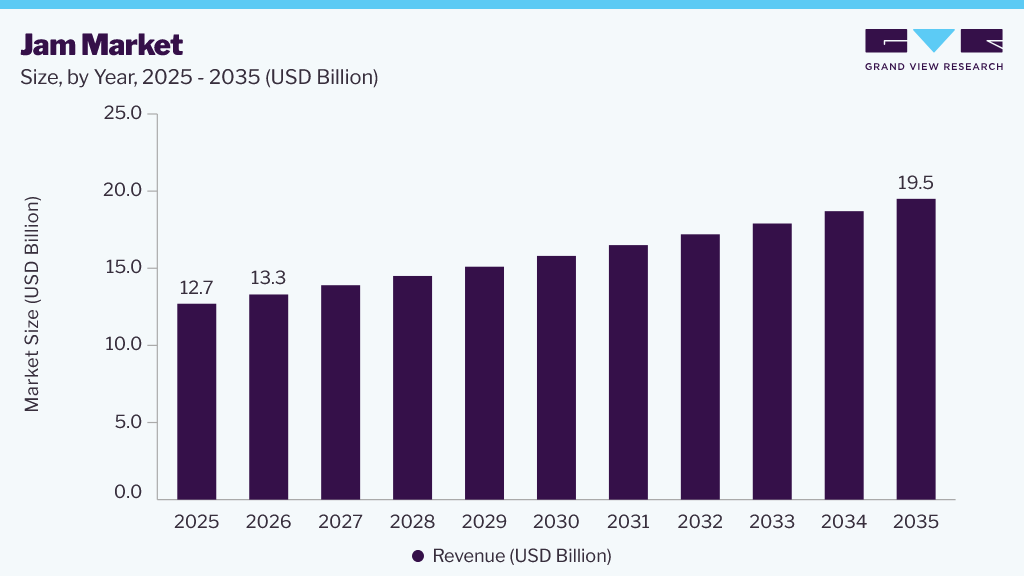 Source: Grand View Research, IR Documents, Primary Interviews, Paid DatabasesTo learn more about this report,
 Download Free Sample Report
 Key Market Trends & Insights
- By product: Fruit jam held the largest market share in 2025.
- By distribution channel: Supermarkets and hypermarkets held the largest share in 2025.
Regional Highlights
- Largest regional market: Europe (largest revenue share, 2025)
- Fastest-growing regional market: Asia Pacific (highest CAGR, 2026-2035)
Market Size & Forecast
- Market size in 2025: USD 12.7 Billion
- Estimated market size in 2026: USD 13.3 Billion
- Projected market size by 2035: USD 19.5 Billion
- CAGR (2026-2035): 4.4%
Three ways to get this report
Buy it, customize it, or ask a question.Ask an Analyst
A direct answer, usually in 1 working day
- AccessReport author, directly
- Reply timeWithin 1 working day
- No sales callDirect answer only
- FormatEmail reply
- CostFree, no cost
Get the Full Report
What the study covers
- FormatsPDF · Excel · Dashboard
- Timeline2026–2035 annual, 2025 base
- Coverage20+ countries, 5 regions
- Companies10+ key players profiled
Customize the Report
20% free customization
- IncludeCountries, segments, points
- TailorTo your product definition
- ExtendDeeper competitor detail
- OrA fully bespoke study
- Turnaround5–10 working days
Consumer demand remains supported by convenience, extended shelf life, and versatile applications across household and foodservice settings. However, category growth is expected to remain gradual as consumers increasingly prioritize healthier food choices. Manufacturers are responding by introducing reduced-sugar, clean-label, organic, and natural fruit-based formulations, making health and nutrition a key driver of market development. Growing preference for products with fewer preservatives and recognizable ingredients is further influencing product innovation.Raw material cost volatility remains a key market restraint, particularly fluctuations in fruit prices caused by changing weather conditions, crop yields, and supply chain disruptions. Rising procurement costs can increase production expenses and retail prices, placing greater pressure on smaller manufacturers with limited purchasing power and supply chain flexibility.
At the same time, premiumization and product innovation are creating new growth opportunities. Organic, low-sugar, exotic fruit, and functional jam variants are gaining attention among health-conscious and premium-oriented consumers. The expansion of e-commerce and direct-to-consumer channels is also enabling brands to reach broader customer segments and introduce niche products more easily. Meanwhile, private-label offerings from major retailers are expanding access to categories across different price points.
Overall, the jam market outlook remains stable, supported by established consumption patterns, continued household demand, and ongoing product innovation. Long-term market growth likely to depend on manufacturers’ ability to manage raw material and production costs while responding effectively to changing consumer preferences for healthier, natural, and premium food products.
Analyst Perspective
The jam market is evolving as consumers seek healthier and more varied food choices, with reduced-sugar and sugar-free jams creating new product development opportunities. Flavor innovation and unique fruit combinations are attracting younger consumers and supporting premium products, while clean-label demand is encouraging natural ingredients and simpler formulations. However, fluctuating fruit prices and seasonal supply can affect production costs and pricing. Online retail is helping brands reach consumers seeking niche products, while sustainable packaging supports product differentiation. Overall, balancing taste, health, price, and convenience can help companies strengthen their market position.
Product Insights
The fruit jam segment led the market with the largest revenue share in 2025. Fruit jams benefit from strong household demand across breakfast and snacking occasions. Their broad flavor range supports frequent product purchases and repeat consumption. Retailers also offer fruit jams across value, premium, organic, and reduced-sugar categories. This wide positioning helps brands serve diverse consumer preferences. Product innovation is expanding choices through tropical fruits, mixed berries, and seedless recipes. For instance, in 2026, Bonne Maman introduced Pineapple and Passion Fruit Conserve in the UK. The company described it as its first tropical conserve within the range. The product was launched through Tesco, Morrisons, and Ocado channels. Bonne Maman also introduced Seedless Raspberry Conserve through major UK retailers.
Fruit spreads are expected to witness the fastest growth during the forecast period. Consumer interest is shifting toward products with simpler ingredient profiles. Lower-sugar formulations are gaining attention among health-conscious consumers. Fruit spreads also offer wider flavor flexibility than traditional jam products. Brands are expanding premium options with mixed fruits and natural ingredients. Product innovation is supporting broader usage across breakfast and snacking occasions. For instance, in May 2025, GOOD introduced a new line of fruit spreads nationwide. The range included Strawberry, Raspberry, Apricot, and Five Fruits varieties. The products contained no added sugar and used more fruit. The launch also expanded distribution through Whole Foods stores nationwide.
Distribution Channel Insights
The supermarkets & hypermarkets segment led the market with the largest revenue share in 2025. These channels provide broad product visibility and convenient household purchasing. Large retailers also encourage frequent purchases through promotions and a variety of pack sizes. Their extensive networks help jam brands reach mainstream consumers across regions. Private-label offerings further strengthen shelf presence and price competition within this channel.
Online retail is expected to witness the fastest growth during the forecast period. E-commerce gives consumers convenient access to a wider selection of jam products. Online platforms also support the discovery of premium and specialty products. Direct-to-consumer stores allow brands to reach customers beyond traditional retail networks. Digital channels further support product launches, seasonal drops, and subscription-based purchases, for instance, in April 2025, As Ever launched its first collection through its website. The collection included raspberry fruit spread and several pantry products. Products were available for nationwide shipping across all 50 U.S. states.
Regional Insights
Europe jam market led the global market with the largest revenue share in 2025, supported by established household consumption. Consumers regularly use jams across breakfast and snacking occasions. Strong retail networks provide wide access to branded and private-label products. Product innovation increasingly focuses on fruit content, sugar reduction, and cleaner labels. Regulatory changes are also shaping product formulation across European markets. For instance, in June 2026, the European Commission issued formal notices to 11 Member States. The notices addressed the incomplete implementation of the revised breakfast food rules, which cover composition and labeling requirements for jams and related products. The updated rules support higher fruit content and clearer consumer information. The measures reinforce regulatory focus across Europe's established jam industry.
Asia Pacific Jam Market Trends
Asia Pacific is expected to witness the fastest growth during the forecast period due to rising urbanization is changing breakfast and snacking habits across the region. Growing retail access is improving the availability of packaged fruit products. Consumers increasingly seek convenient foods with recognizable fruit ingredients. Local brands are developing products suited to regional tastes and lifestyles. Product innovation is creating new usage occasions beyond traditional breakfast consumption. For instance, in March 2026, Kewpie launched a Gen Z co-development project for new jam products. Aohata plans to launch the jointly developed product in spring 2027. The project uses workshops, tastings, and package reviews with younger consumers. Kewpie also planned a recipe book to promote broader use of jam. The initiative targets changing eating habits among younger consumers. It also explores new product formats and usage occasions.
Key Jam Market Company Insights
The jam market remains competitive due to product innovation and shifting consumer preferences. Companies expand their product ranges to include fruit flavors, low-sugar, organic, and premium options. Partnerships strengthen sourcing, distribution, and retail access. Manufacturing expansion supports growing demand across regional markets. Digital transformation improves online sales and customer engagement. AI supports demand forecasting and production planning. Companies focus on regional expansion, product quality, and strategic positioning across retail channels.
Key Jam Companies
The following key companies have been profiled for this study on the jam market:
-
The Kraft Heinz Company
-
Conagra Brands, Inc.
-
The J.M. Smucker Co.
-
Andros Group
-
Hero Group
-
Orkla ASA
-
Wilkin & Sons Limited
-
Bonne Maman
Recent Developments
-
In March 2025, Hero Group introduced a lightweight glass jar for its standard jam range, reducing glass usage without compromising product safety. The redesigned packaging is expected to reduce the company’s annual carbon emissions by approximately 600 tonnes of CO₂, with plans to extend the lightweighting approach to other natural spread formats. The initiative highlights the growing focus on packaging efficiency and sustainability in the jam market.
-
In June 2025, New Zealand Food Safety reported recalls of Bonne Maman jams and spreads in Japan and Macau following concerns related to mould contamination. The incident highlighted the importance of food safety, quality control, and traceability across international fruit-spread supply chains and reinforced the need for stringent supplier and manufacturing controls.
Jam Market Report Scope
Report Attribute
Details
Market size in 2025
USD 12.7 billion
Estimated market size in 2026
USD 13.3 billion
Projected market size by 2035
USD 19.5 billion
Growth rate
CAGR of 4.4% from 2026 to 2035
Base year for estimation
2025
Actual data
2021 - 2024
Forecast period
2026 - 2035
Quantitative units
Revenue in USD billion, and CAGR from 2026 to 2035
Report coverage
Revenue forecast, company ranking, competitive landscape, growth factors, and trends
Segments covered
Product, distribution channel, region
Regional Scope
North America; Europe; Asia Pacific; Latin America; Middle East & Africa
Country Scope
U.S.; Canada; Mexico; UK; Germany; France; China; Japan; India; Australia; South Korea; Brazil; Argentina; South Africa; Saudi Arabia; UAE
Key companies profiled
The Kraft Heinz Company; Conagra Brands, Inc.; The J.M. Smucker Co.; Andros Group; Hero Group; Orkla ASA; Wilkin & Sons Limited; Bonne Maman
Customization scope
Free report customization (equivalent to 8 analyst working days) with purchase. Addition or alteration to country, regional & segment scope.
Pricing and purchase options
Avail of customized purchase options to meet your exact research needs. Explore purchase options
Global Jam Market Report Segmentation
This report forecasts revenue growth at the global, regional, and country levels and provides an analysis of the latest industry trends and opportunities across each sub-segment from 2021 to 2035. For this study, Grand View Research has segmented the global jam market report based on product, distribution channel, and region:
-
Product Outlook (Revenue, USD Billion, 2021 - 2035)
-
Fruit Jam
-
Jelly
-
Marmalade
-
Preserves
-
Fruit spreads
-
-
Distribution Channel Outlook (Revenue, USD Billion, 2021 - 2035)
-
Supermarkets & Hypermarkets
-
Convenience Stores
-
Specialty Stores
-
Online Retail
-
Other Channels
-
-
Regional Outlook (Revenue, USD Billion, 2021 - 2035)
-
North America
-
U.S.
-
Canada
-
Mexico
-
-
Europe
-
UK
-
Germany
-
France
-
-
Asia Pacific
-
China
-
Japan
-
India
-
Australia
-
South Korea
-
-
Latin America
-
Brazil
-
Argentina
-
-
Middle East and Africa (MEA)
-
South Africa
-
Saudi Arabia
-
UAE
-
-
Frequently Asked Questions About This Report
The global jam market size was valued at USD 12.7 billion in 2025 and is estimated at USD 13.3 billion in 2026.
The global jam market is expected to grow at a CAGR of 4.4% from 2026 to 2035, reaching USD 19.5 billion in 2035.
Europe dominated the global jam market with the largest revenue share in 2025.
The fruit jam segment accounted for the largest revenue share in 2025.
Key players in the market include The Kraft Heinz Company, Conagra Brands, Inc., The J.M. Smucker Co., Andros Group, Hero Group, Orkla ASA, Wilkin & Sons Limited, and Bonne Maman, among others.
About the Author(s)
Consumer F&B Research Team
Consumer Goods · Consumer F&BThis report was authored by the consumer f&b research team at Grand View Research - comprising two research analysts, one senior research analyst, and one industry expert - with specialized expertise in the consumer f&b segment of the consumer goods industry. All findings are based on proprietary consumer goods databases, executive interviews, and regulatory analysis, subject to internal peer review prior to publication.
Last Updated:
Speak to Analyst

Customize this report to your needs - add regions, segments, or data points, with 20% free customization.
Or view our licence options:


ISO 9001:2015 & 27001:2022 Certified
We are GDPR and CCPA compliant! Your transaction & personal information is safe and secure. For more details, please read our privacy policy.


