
- Home
- »
- Disinfectants & Preservatives
- »
-
Laboratory filtration Market Size & Share Report, 2026-2033GVR Report cover
![Laboratory Filtration Market (2026 - 2033)Report]()
Laboratory Filtration Market (2026 - 2033)
Size, Share & Trends Analysis Report By Technology (Microfiltration, Nanofiltration, Vacuum Filtration, Ultrafiltration), By Product (Filtration Media, Filtration Assemblies, Filtration Accessories), By Region And Segment Forecasts
Market Size, 2025
$4.5BMarket Estimate, 2026
$4.9BMarket Forecast, 2033
$8.6BCAGR, 2026–2033
8.4%Laboratory Filtration Market Summary
The global laboratory filtration market size was valued at USD 4.5 billion in 2025 and is projected to grow from USD 4.9 billion in 2026 to USD 8.6 billion by 2033, at a CAGR of 8.4% from 2026 to 2033. The market in North America dominated with a revenue share of 35.5% in 2025. The market is primarily driven by increasing research activities in pharmaceuticals, biotechnology, environmental testing, food analysis, and academic laboratories.

Key Market Trends & Insights
- By technology: Microfiltration segment held the largest market share of 35.3% in 2025.
- By product: Filtration media segment held the largest market share of 58.3% in 2025.
Regional Highlights
- Largest regional market: North America (35.5% revenue share, 2025)
- Fastest-growing regional market: Asia Pacific (highest CAGR, 2026-2033)
- By country: U.S. held the largest market share in 2025
Market Size & Forecast
- Market size in 2025: USD 4.5 Billion
- Estimated market size in 2026: USD 4.9 Billion
- Projected market size by 2033: USD 8.6 Billion
- CAGR (2026-2033): 8.4%
Rising demand for sample preparation, purification, and contamination control is supporting the use of membrane filters, filtration assemblies, and related consumables. Growth in biologics development, vaccine production, and molecular diagnostics is also increasing filtration requirements in laboratory workflows.
Automation in laboratory processes is increasing the use of filtration systems that can handle larger sample volumes with consistent performance and reduced manual intervention. Laboratories are adopting automated filtration equipment to support faster workflows in pharmaceuticals, biotechnology, environmental testing, and clinical diagnostics.
Market Dynamics
Research laboratories involved in drug discovery, biologics development, vaccine production, and molecular studies require filtration systems for sample preparation, purification, sterilization, and contamination control. Filtration products such as membrane filters, filter papers, and filtration assemblies are regularly used in laboratory workflows to maintain testing accuracy and process reliability.
The expansion of clinical research and biologics manufacturing has increased demand for laboratory filtration technologies. Academic institutions, pharmaceutical companies, and biotechnology firms are investing more in research infrastructure, leading to greater use of filtration equipment and consumables. As laboratory testing volumes continue to increase, filtration systems are becoming essential for maintaining efficient processing and consistent research outcomes across pharmaceutical and life science applications.
High costs associated with advanced laboratory filtration systems are restraining market growth, particularly for small and medium-sized laboratories. Modern filtration technologies often require expensive membranes, cartridges, sterile filtration units, and replacement consumables, increasing overall operational expenses. Laboratories conducting specialized pharmaceutical and biotechnology research may also need certified filtration products that meet strict quality standards, further adding to cost pressures.
In addition, advanced filtration systems require periodic maintenance and validation procedures, thereby increasing long-term ownership costs. Budget constraints in academic laboratories, diagnostic centers, and smaller research facilities may hinder the adoption of advanced filtration equipment. In developing regions, many laboratories continue using conventional filtration methods due to lower upfront investment requirements. The high cost of premium filtration products and recurring consumable purchases can limit the wider adoption of advanced laboratory filtration technologies in cost-sensitive markets.
Market Concentration & Characteristics
The laboratory filtration industry is fragmented, with numerous global, regional, and local manufacturers supplying a range of filtration products and technologies. Companies compete across membrane filters, filter papers, filtration assemblies, cartridges, and consumables for pharmaceutical, biotechnology, food, and environmental laboratories. Large multinational firms operate alongside specialized filtration companies focusing on niche applications. Variations in product specifications, laboratory requirements, pricing, and regional distribution networks further fragment the market, creating a highly competitive operating environment.
Manufacturers are developing advanced membrane materials, automated filtration systems, and high-efficiency separation technologies. Companies are introducing filtration products with improved chemical resistance, faster flow rates, and better contamination control for laboratory applications. Innovation is also focused on single-use filtration systems, nanofiltration, and microfiltration technologies to support biotechnology, pharmaceutical research, and clinical diagnostics. Digital monitoring and automation features are further improving operational efficiency and process accuracy.
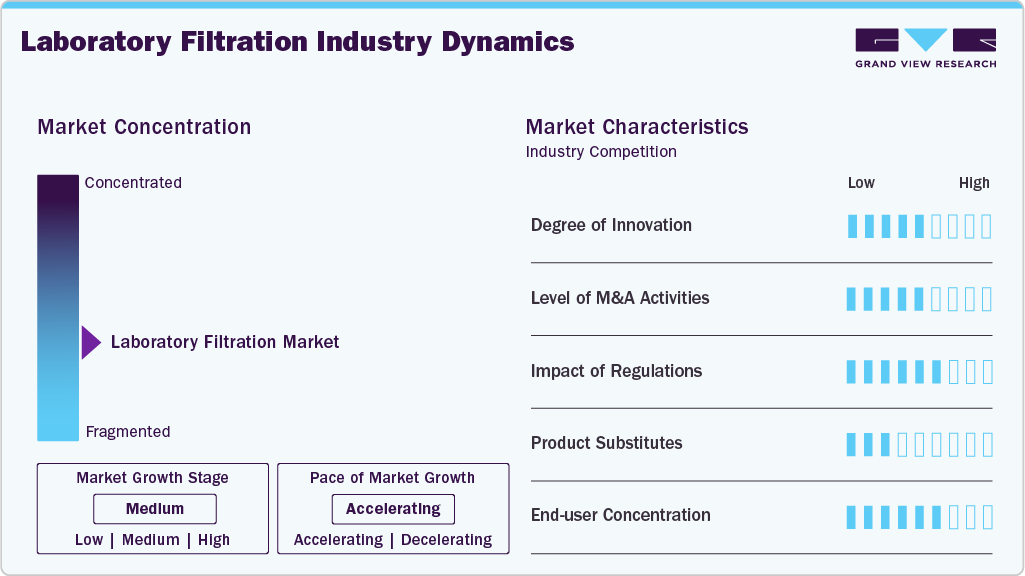
Merger and acquisition activities in the laboratory filtration industry are increasing as companies expand product portfolios, strengthen regional presence, and enhance filtration technology capabilities. For instance, in September 2025, Thermo Fisher Scientific completed the acquisition of Solventum’s Purification & Filtration business. The acquired business, now part of Thermo Fisher’s Life Sciences Solutions segment, has expanded its filtration and separation capabilities across bioprocessing, healthcare, industrial filtration, and membrane technologies.
Regulations are significantly influencing the laboratory filtration industry by increasing requirements for contamination control, product quality, and testing accuracy across pharmaceutical, biotechnology, food, and environmental laboratories. Regulatory standards from healthcare and environmental agencies require laboratories to maintain validated filtration processes and reliable sample preparation methods. Compliance with GMP, ISO, and laboratory testing standards is driving demand for certified filtration products and high-performance membranes. Regulations related to water purity, sterile filtration, and laboratory safety are also encouraging the adoption of advanced filtration technologies.
Technology Insights
The microfiltration segment dominated the market in 2025, accounting for 35.3% share, driven by increasing use in sample clarification, particle removal, and sterilization processes across pharmaceutical, biotechnology, and research laboratories. Microfiltration systems are widely used for separating microorganisms and suspended particles while maintaining sample integrity. Rising laboratory testing activities and demand for contamination control are further supporting the adoption of microfiltration technologies.
The reverse osmosis segment is expected to grow the fastest during the forecast period, driven by rising demand for high-purity water for analytical testing, pharmaceutical research, and biotechnology applications. Reverse osmosis systems remove dissolved salts, impurities, and contaminants from water, supporting reliable laboratory processes. The expansion of research facilities and growing demand for purified laboratory water are driving greater adoption of reverse osmosis filtration systems.
Product Insights
The filtration media segment accounted for the largest revenue share of 58.3% in 2025, due to increasing demand for membrane filters, filter papers, and specialized filtration materials used in pharmaceutical, biotechnology, and environmental testing laboratories. Filtration media are essential for sample preparation, particle separation, and contamination control. Rising laboratory research activities and the need for accurate analytical testing are supporting higher consumption of filtration media products.

The filtration accessories segment is expected to grow the fastest during the forecast period, driven by the increasing use of laboratory filtration systems across research, pharmaceutical, and clinical applications. Accessories such as filter holders, vacuum pumps, funnels, tubing, and connectors are required to support filtration workflows and system compatibility. Growing laboratory automation and expanding testing activities are driving demand for compatible, efficient filtration accessories in routine laboratory operations.
Regional Insights
North America dominated the market in 2025 due to strong pharmaceutical, biotechnology, and clinical research activities across the region. Laboratories increasingly use advanced filtration systems for sample preparation, sterilization, and contamination control. The presence of major life science companies, research institutions, and laboratory equipment manufacturers supports product demand.

U.S. Laboratory Filtration Market Trends
The laboratory filtration market in the U.S. is driven by increasing investments in pharmaceutical research, biotechnology development, and clinical diagnostics. Research laboratories require filtration technologies for analytical testing, biologics production, and sterile sample processing. For instance, in September 2025, Ritedose Corporation announced a USD 17 million investment to expand its in-house cGMP laboratory facilities and analytical chemistry capabilities in South Carolina. Expanded laboratory operations require membrane filters, filtration assemblies, sterile filtration systems, and purified water technologies for sample preparation and contamination control.
Europe Laboratory Filtration Market Trends
The laboratory filtration market in Europe is expected to grow significantly, due to the strong pharmaceutical manufacturing, biotechnology research, and environmental testing activities. Laboratories across the region are adopting advanced filtration technologies for contamination control, sterile filtration, and sample purification. Strict quality and regulatory standards in the pharmaceutical and food testing industries are supporting demand for filtration systems and consumables. The region also benefits from established research institutions, increasing biologics development, and the expansion of laboratory automation technologies used in analytical and clinical research applications.
Germany laboratory filtration market is growing due to its strong pharmaceutical, biotechnology, and industrial research sectors. Laboratories require filtration technologies for analytical testing, biologics processing, and contamination control applications. The country’s advanced manufacturing capabilities and research infrastructure support the adoption of membrane filtration systems and laboratory consumables. Increasing investment in life science research and laboratory automation is also contributing to market growth. Germany’s focus on precision testing and quality standards further supports filtration product demand.
The laboratory filtration market in the UK is driven by the increasing pharmaceutical research, biotechnology development, and academic laboratory activities. Laboratories use filtration systems for sample preparation, sterile processing, and analytical testing applications. Expansion of clinical research and biologics development is supporting demand for membrane filters and filtration consumables. The presence of established research institutions and healthcare laboratories also contributes to market growth. The increased focus on laboratory efficiency and contamination control is further supporting the adoption of filtration technology across research and testing facilities.
Asia Pacific Laboratory Filtration Market Trends
The laboratory filtration market in the Asia Pacific is expected to grow at 9.1% CAGR during the forecast period. Expanding pharmaceutical production, biotechnology research, and healthcare infrastructure development in the Asia Pacific is fueling the market. Increasing investments in laboratory facilities across countries such as China, India, Japan, and South Korea are supporting demand for filtration technologies. Growth in food testing, environmental monitoring, and clinical diagnostics is also contributing to market expansion.
China laboratory filtration market is growing due to increasing pharmaceutical manufacturing, biotechnology research, and the expansion of testing laboratories. Rising investments in healthcare infrastructure and life science research are supporting demand for filtration systems and membrane technologies. For instance, in March 2025, AstraZeneca announced a USD 2.5 billion investment in Beijing to establish its sixth global strategic R&D center. The expansion of research infrastructure and laboratory capabilities is expected to increase demand for laboratory equipment, analytical technologies, and filtration systems used in pharmaceutical and biotechnology research.
The laboratory filtration market in India is growing due to expanding pharmaceutical manufacturing, biotechnology research, and clinical testing activities. Increasing investments in healthcare infrastructure and laboratory modernization are supporting the adoption of filtration technologies for sample preparation and contamination control. Growth in generic drug production and vaccine research is also increasing demand for membrane filters and laboratory consumables.
Middle East & Africa Laboratory Filtration Market Trends
The laboratory filtration market in MEA is growing significantly, driven by the increasing healthcare investments, pharmaceutical development, and expansion of diagnostic laboratories. Governments and private organizations are improving laboratory infrastructure for clinical testing, research, and environmental monitoring activities. Demand for filtration systems is increasing for sample preparation, sterile filtration, and purified water applications.
Saudi Arabia laboratory filtration market is growing due to increasing investments in healthcare infrastructure, pharmaceutical production, and research facilities. Laboratories are adopting filtration systems for analytical testing, contamination control, and purified water applications. Expansion of clinical diagnostics and environmental testing activities is also contributing to market demand. Government initiatives supporting healthcare and industrial development are encouraging laboratory modernization.
Latin America Laboratory Filtration Market Trends
The laboratory filtration market in Latin America is fueled by the expanding pharmaceutical manufacturing, healthcare testing, and environmental monitoring activities. Laboratories in the region increasingly require filtration technologies for sample preparation, contamination control, and purified water systems. Growth in academic research and food safety testing is supporting demand for filtration consumables and membrane systems.
Brazil laboratory filtration market is growing due to increasing pharmaceutical production, clinical diagnostics, and biotechnology research activities. Laboratories are adopting filtration systems for analytical testing, sterilization, and contamination control applications. The expansion of healthcare infrastructure and environmental testing laboratories is driving demand for membrane filters and filtration consumables.
Key Laboratory Filtration Company Insights
Some key players in the market include Advantec Toyo Roshi Kaisha, Ltd., Sterlitech Corporation, and Veolia Water Technologies.
-
Advantec Toyo Roshi Kaisha, Ltd. is a Japanese company engaged in the manufacturing of filtration and laboratory products. Its portfolio includes filter papers, membrane filters, filtration equipment, and related laboratory consumables used in pharmaceutical, biotechnology, environmental, and industrial applications. The company supports laboratory testing, sample preparation, and contamination control processes.
-
AMD Manufacturing Inc. manufactures laboratory filtration equipment and related products for pharmaceutical, biotechnology, and industrial applications. The company supplies stainless steel filter holders, pressure vessels, membrane filtration systems, and laboratory-scale filtration equipment for research and analytical testing.
Key Laboratory Filtration Companies:
The following key companies have been profiled for this study on the laboratory filtration market.
-
Advantec Toyo Roshi Kaisha, Ltd.
-
AMD Manufacturing Inc.
-
Danaher Corporation
-
Steris plc
-
Hawach Scientific Co. Ltd.
-
Sterlitech Corporation
-
Veolia Water Technologies
-
Macherey-Nagel GmbH & Co. KG
-
Thermo Fisher Scientific, Inc.
-
Merck KGaA
-
Sartorius AG
-
Pall Corporation
-
Agilent Technologies, Inc.
-
GVS S.p.A.
-
Meissner Filtration Products, Inc.
Competitive Benchmarking
Operating Strategies
Competitive Edge
Weaknesses
Mature Players: Danaher Corporation, Steris plc, Veolia Water Technologies, Thermo Fisher Scientific, Inc., Merck KGaA, Sartorius AG
- Mature players in the market focus on large-scale production, global distribution networks, and integration of filtration products with laboratory workflows. They emphasize standardized manufacturing, long-term supply agreements, and continuous product development for pharmaceutical, biotechnology, and research laboratories.
- Many also invest in automation and technical support services to maintain operational efficiency and a broad market presence.
- Mature companies benefit from established brand recognition, extensive product portfolios, and advanced manufacturing capabilities. Their strong distribution networks and long-term relationships with pharmaceutical and research laboratories support consistent sales.
- Many possess certified testing facilities, broad regulatory compliance capabilities, and integrated filtration technologies, allowing them to supply filtration systems, consumables, and laboratory equipment across multiple industrial and scientific applications.
- Mature players often face high operational and manufacturing costs due to large production facilities and global distribution systems. Their broad organizational structures may limit the ability to respond quickly to specialized laboratory requirements or niche applications.
- Dependence on highly regulated pharmaceutical and biotechnology markets can also increase compliance costs and extend product approval timelines for new filtration technologies.
Emerging Players: AMD Manufacturing Inc., Hawach Scientific Co. Ltd., Sterlitech Corporation, Macherey-Nagel GmbH & Co. KG, Meissner Filtration Products, Inc.
- Emerging players generally focus on niche laboratory filtration applications, flexible manufacturing, and regional distribution partnerships. Many target specialized membrane technologies, laboratory consumables, or customized filtration systems for research laboratories and smaller pharmaceutical companies.
- These companies often compete through shorter lead times, application-specific products, and cost-focused strategies while gradually expanding product portfolios and regional market presence.
- Emerging companies gain an advantage through operational flexibility, quicker product adaptation, and lower overhead costs. Their smaller organizational structures allow faster response to customer-specific laboratory filtration requirements.
- Many also focus on specialized filtration technologies or regional laboratory markets underserved by larger manufacturers. Competitive pricing and customized product offerings further help emerging players attract research laboratories and small-scale biotechnology customers.
- Emerging players often face limitations in production capacity, distribution reach, and financial resources compared to established manufacturers. Limited investment in research, regulatory certification, and testing infrastructure can affect market expansion.
- Many also depend on third-party suppliers for filtration materials and components, creating supply chain risks and making it difficult to compete with globally recognized laboratory filtration brands.
Recent Developments
-
In April 2026, Merck expanded its Bengaluru facility in Peenya to increase production of filtration hardware and Pellicon 2 ultrafiltration cassettes. The investment supports manufacturing capacity for filtration technologies used in bioprocessing and laboratory applications. The expansion strengthens supply capabilities for membrane filtration products and supports the growing demand from the pharmaceutical, biotechnology, and research sectors for advanced filtration systems and separation technologies.
-
In June 2025, Merck Millipore Molsheim collaborated with Actemium to design the next generation of tangential flow filtration systems. The development focuses on improving filtration process efficiency, automation, and operational control for biopharmaceutical and laboratory applications. Advanced tangential flow filtration systems support sample concentration, purification, and separation processes used in biotechnology, pharmaceutical research, and laboratory filtration workflows.
Laboratory Filtration Market Report Scope
Report Attribute
Details
Market size in 2025
USD 4.5 billion
Estimated market size in 2026
USD 4.9 billion
Projected market size by 2033
USD 8.6 billion
Growth rate
CAGR of 8.4% from 2026 to 2033
Historical data
2021 - 2025
Forecast period
2026 - 2033
Quantitative units
Revenue in USD billion and CAGR from 2026 to 2033
Report coverage
Revenue forecast, company ranking, competitive landscape, growth factors, and trends
Segments covered
Technology, product, region
Regional scope
North America; Europe; Asia Pacific; Latin America; MEA
Country scope
U.S.; Canada; Mexico; UK; Germany; France; Spain; Italy; China; Japan; India; Australia; South Korea; Brazil; Argentina; Saudi Arabia; South Africa; UAE
Key companies profiled
Advantec Toyo Roshi Kaisha, Ltd.; AMD Manufacturing Inc.; Danaher Corporation; Steris plc; Hawach Scientific Co., Ltd.; Sterlitech Corporation; Veolia Water Technologies; Macherey-Nagel GmbH & Co. KG; Thermo Fisher Scientific, Inc.; Merck KGaA; Sartorius AG; Pall Corporation; Agilent Technologies, Inc.; GVS S.p.A.; Meissner Filtration Products, Inc.
Customization scope
Free report customization (equivalent up to 8 analysts working days) with purchase. Addition or alteration to country, regional & segment scope.
Pricing and purchase options
Avail customized purchase options to meet your exact research needs. Explore purchase options
Global Laboratory Filtration Market Report Segmentation
This report forecasts revenue growth at global, regional, and country levels and provides an analysis of the latest industry trends in each of the sub-segments from 2021 to 2033. For this study, Grand View Research has segmented the global laboratory filtration market report based on technology, product, and region:

-
Technology Outlook (Revenue, USD Million, 2021 - 2033)
-
Microfiltration
-
Nanofiltration
-
Vacuum Filtration
-
Reverse Osmosis
-
Ultrafiltration
-
-
Product Outlook (Revenue, USD Million, 2021 - 2033)
-
Filtration Media
-
Membrane Filters
-
Filter Paper
-
Quartz Filter
-
Cellulose Filter Papers
-
Glass Microfiber Filter Papers
-
-
Syringe Filters
-
Syringeless Filters
-
Capsule Filters
-
Filtration Microplates
-
Other Filtration Media
-
-
Filtration Assemblies
-
Ultrafiltration Assemblies
-
Microfiltration Assemblies
-
Vacuum Filtration Assemblies
-
Reverse Osmosis Assemblies
-
Other Filtration Assemblies
-
-
Filtration Accessories
-
Filter Holders
-
Filter Dispensers
-
Filter Flasks
-
Cartridge Filters
-
Filter Funnels
-
Filter Housings
-
Seals
-
Vacuum Pumps
-
Other Laboratory Filtration Accessories
-
-
-
Regional Outlook (Revenue, USD Million, 2021 - 2033)
-
North America
-
U.S.
-
Canada
-
Mexico
-
-
Europe
-
Germany
-
France
-
Italy
-
Spain
-
UK
-
-
Asia Pacific
-
China
-
India
-
Japan
-
South Korea
-
Australia
-
-
Latin America
-
Brazil
-
Argentina
-
-
Middle East and Africa
-
Saudi Arabia
-
South Africa
-
UAE
-
-
Delivered Customizations
This report has been delivered with the following In-depth customizations
Client Request
Customization Delivered
Value Adds
Regional Segmentation
A detailed regional analysis was conducted across North America, Europe, Asia Pacific, Latin America, and the Middle East & Africa, including country-level assessments for key markets such as the U.S., Germany, China, India, Brazil, and Saudi Arabia. The study evaluated pharmaceutical and biotechnology research activities, laboratory infrastructure expansion, healthcare investments, environmental testing demand, and regulatory standards influencing laboratory filtration adoption across regional markets.
Helped identify high-growth regional markets, country-specific opportunities, and evolving demand trends across pharmaceutical, biotechnology, healthcare, and research industries. The analysis also supported market entry strategies, regional expansion planning, and identification of emerging laboratory filtration demand centers.
Competitive benchmarking
Comprehensive benchmarking was conducted across major market participants based on product portfolio, filtration technologies, membrane capabilities, laboratory consumables, regional presence, pricing strategy, manufacturing capabilities, and distribution network strength. The assessment also compared established and developing companies operating in the market.
Assisted clients in understanding competitor positioning, technology capabilities, and competitive gaps within the market. The study supported strategic planning, partnership evaluation, and differentiation opportunities across pharmaceutical, biotechnology, environmental testing, and laboratory research applications.
Opportunity assessment
An in-depth opportunity assessment was conducted by analyzing pharmaceutical R&D investments, biotechnology expansion, laboratory modernization trends, growth in clinical diagnostics, and the increasing adoption of automated filtration systems. The study also identified emerging opportunities in membrane filtration technologies, single-use filtration systems, sterile filtration applications, and advanced laboratory water purification solutions.
Enabled clients to identify attractive investment areas, prioritize target markets, and evaluate future revenue opportunities across pharmaceutical, biotechnology, clinical diagnostics, and research laboratory sectors. The analysis also supported expansion planning and long-term growth strategy development.
Frequently Asked Questions About This Report
The global laboratory filtration market size was valued at USD 4.5 billion in 2025 and is estimated at USD 4.9 billion for 2026.
The global laboratory filtration market is expected to grow at a CAGR of 8.4% from 2026 to 2033, reaching USD 8.6 billion by 2033.
North America dominated with a 35.5% revenue share in 2025.
Asia Pacific is the fastest-growing region over the forecast period.
Key players include Advantec Toyo Roshi Kaisha, Ltd.; AMD Manufacturing Inc.; Danaher Corporation; Steris plc; Hawach Scientific Co., Ltd.; Sterlitech Corporation; Veolia Water Technologies; Macherey-Nagel GmbH & Co. KG; Thermo Fisher Scientific, Inc.; Merck KGaA; Sartorius AG; Pall Corporation; Agilent Technologies, Inc.; GVS S.p.A.; Meissner Filtration Products, Inc.
The laboratory filtration market is driven by increasing pharmaceutical and biotechnology research, rising demand for contamination control and sample preparation, expansion of clinical diagnostics and testing laboratories, growing biologics production, and increasing adoption of advanced filtration technologies in research, healthcare, environmental testing, and analytical laboratory applications.
The microfiltration segment led with a 35.3% revenue share in 2025, while the reverse osmosis segment is the fastest-growing.
The filtration media segment led with a 58.3% revenue share in 2025, while the filtration accessories segment is the fastest-growing.
About the Author(s)
Disinfectants & Preservatives Research Team
Bulk Chemicals · Disinfectants & PreservativesThis report was authored by the disinfectants & preservatives research team at Grand View Research - comprising two research analysts, one senior research analyst, and one industry expert - with specialized expertise in the disinfectants & preservatives segment of the bulk chemicals industry. All findings are based on proprietary bulk chemicals databases, executive interviews, and regulatory analysis, subject to internal peer review prior to publication.
Last Updated:
Speak to Analyst

Customize this report to your needs — add regions, segments, or data points, with 20% free customization.
Or view our licence options:


ISO 9001:2015 & 27001:2022 Certified
We are GDPR and CCPA compliant! Your transaction & personal information is safe and secure. For more details, please read our privacy policy.












