
- Home
- »
- Nutraceuticals & Functional Foods
- »
-
Lactation Support Supplements Market Size Report, 2033GVR Report cover

Lactation Support Supplements Market (2026 - 2033)
Size, Share & Trends Analysis Report By Ingredients (Fenugreek, Oatmeal, Moringa, Milk Thistle, Fennel), By Formulation (Capsules/Tablets, Liquid), By Sales Channel, By Region, And Segment Forecasts
Market Size, 2025
$684.6MMarket Estimate, 2026
$729.4MMarket Forecast, 2033
$1,171.2MCAGR, 2026–2033
7.0%Lactation Support Supplements Market Summary
The global lactation support supplements market size was valued at USD 684.6 million in 2025 and is projected to grow from USD 729.4 million in 2026 to USD 1,171.2 million by 2033, at a CAGR of 7.0% from 2026 to 2033. The market in Asia Pacific dominated with a revenue share of 38.8% in 2025. The market is primarily driven by growing awareness of breastfeeding support and postpartum nutritional needs.
 Source: Grand View Research, IR Documents, Primary Interviews, Paid DatabasesTo learn more about this report,
 Download Free Sample Report
Key Market Trends & Insights
- By ingredients: Fenugreek segment held the largest market share of 28.3% in 2025.
- By formulation: Capsules/tablets segment held the largest market share of 52.5% in 2025.
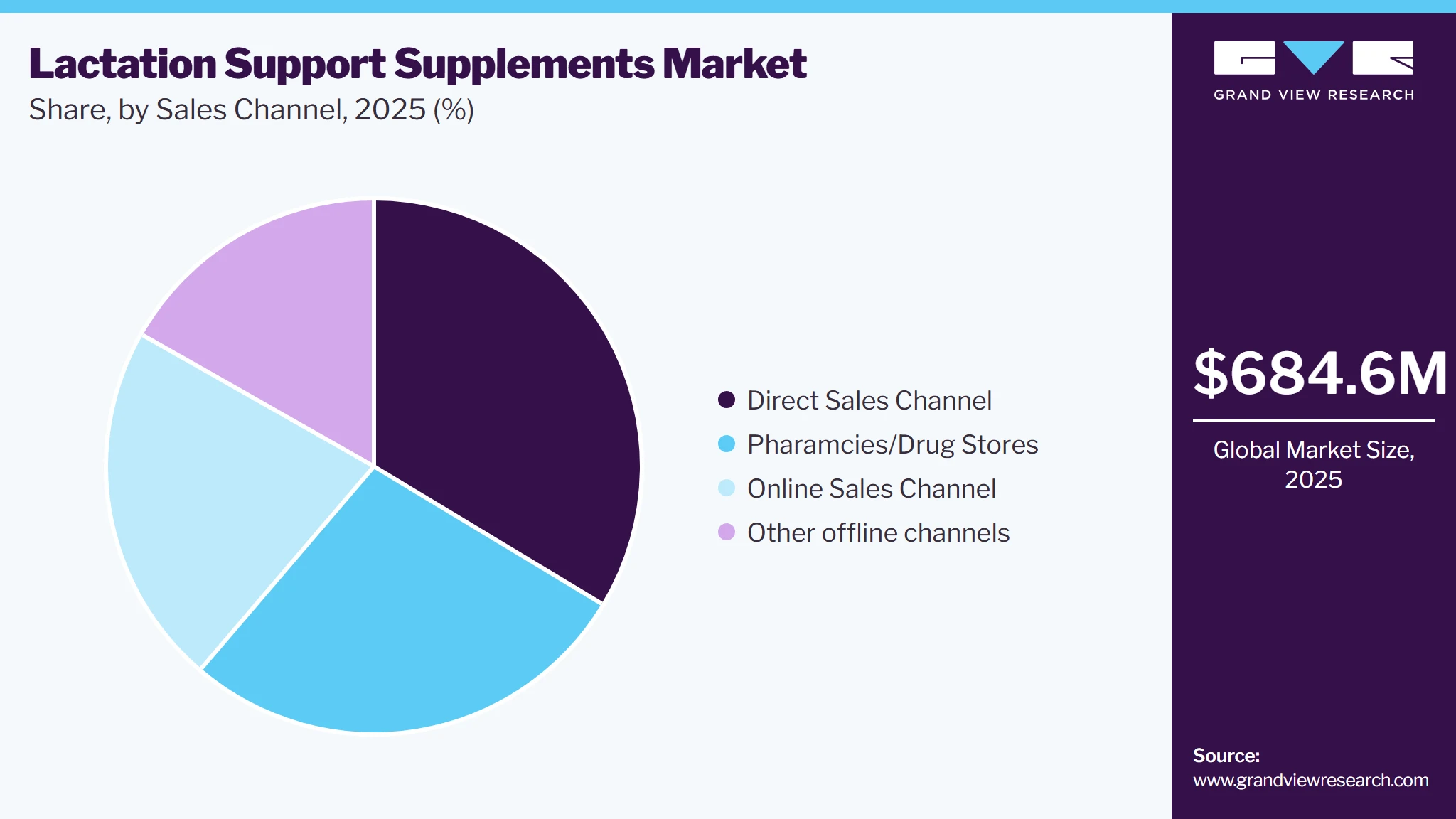
- By sales channel: Direct sales channel segment held the largest market share of 33.6% in 2025.
Regional Highlights
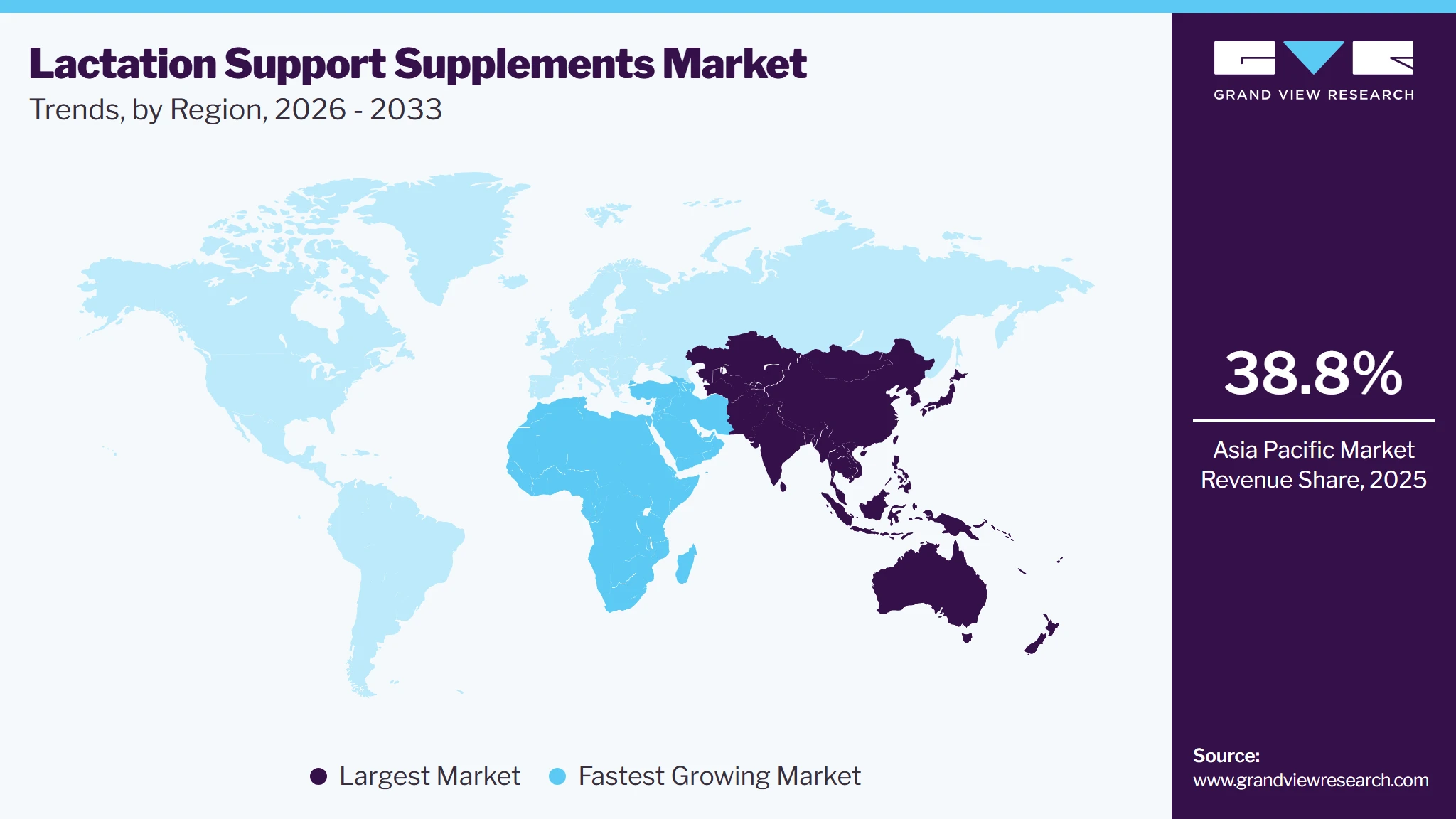
- Largest regional market: Asia Pacific (38.8% revenue share, 2025)
- Fastest-growing regional market: Middle East & Africa (highest CAGR, 2026-2033)
- By country: China held the largest market share in 2025.
Market Size & Forecast
- Market size in 2025: USD 684.6 Million
- Estimated market size in 2026: USD 729.4 Million
- Projected market size by 2033: USD 1,171.2 Million
- CAGR (2026-2033): 7.0%
Prism AI by Grand View Research Free to tryAsk a question about the lactation support supplements marketTry asking✓Every figure cited from GVR research Prefer the report? Download free sample →
Rising demand for convenient and herbal-based supplements is further supporting market growth. In addition, increasing the availability of capsules, powders, liquids, and other easy-to-use formats is encouraging adoption among breastfeeding mothers. Product innovation is also shaping the market, with companies introducing supplements containing ingredients such as fenugreek, moringa, milk thistle, and fennel. Different formulations, including capsules, powders, liquids, and gummies, are being offered to suit varying consumer preferences.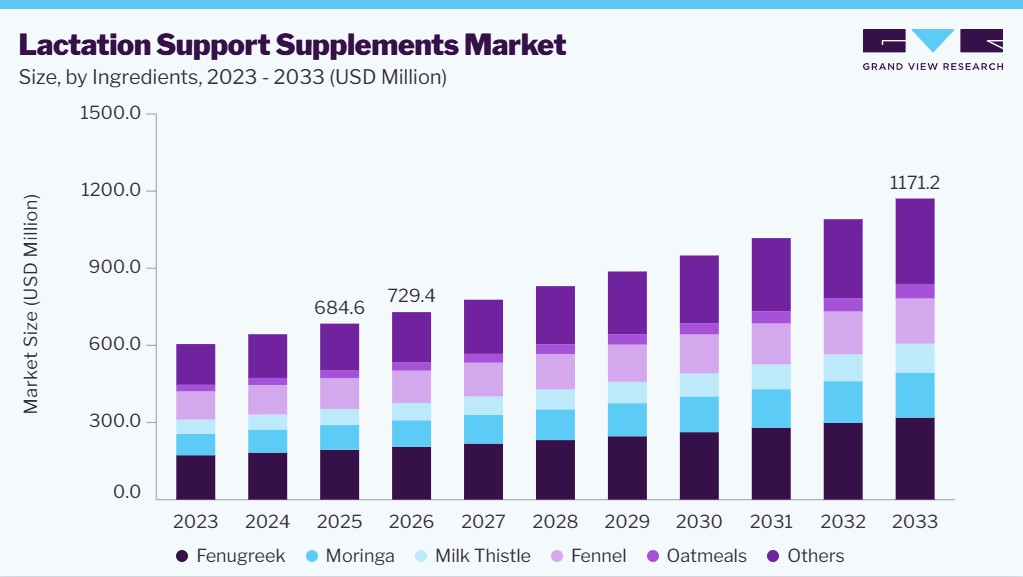 To learn more about this report, Download Free Sample Report
The growing presence of lactation support supplements across online platforms, pharmacies, specialty stores, and direct-to-consumer channels is making these products easier to access. Brand awareness, ingredient transparency, convenience, and consumer interest in natural formulations are also influencing purchasing decisions.
Market Dynamics
Growing awareness of breastfeeding support and maternal nutrition is driving demand for lactation-support supplements among breastfeeding mothers. Consumers are increasingly looking for products that can complement their postpartum routines and provide nutritional or lactation-focused support. A national Australian survey published in March 2025 found that 99.6% of 810 pregnant and breastfeeding women used dietary supplements, while 57.3% used herbal medicines. The high level of supplement use indicates continued consumer interest in nutritional and botanical products during pregnancy and breastfeeding.
Limited and inconsistent clinical evidence surrounding some herbal galactagogues can create challenges for the market. Consumers and healthcare professionals may remain cautious when product benefits are not supported by sufficient clinical research. A systematic review published in December 2025 assessed 10 randomized controlled trials of herbal galactagogues and concluded that the available evidence was generally of low or very low certainty, with further high-quality research needed to confirm effectiveness. This uncertainty can affect consumer confidence and make product positioning more challenging for manufacturers.
The market has opportunities to develop convenient products that combine lactation-support ingredients with hydration and broader postpartum wellness benefits. In June 2026, Legendairy Milk launched She’s Flowing, a fenugreek-free powdered drink mix containing moringa, goat’s rue, and milk thistle, positioned around hydration and milk-production support. Such launches indicate opportunities for manufacturers to introduce easy-to-use powders and other multifunctional formats that fit into mothers’ daily routines while targeting specific breastfeeding needs.
Analyst Perspective
The market is shaped by growing demand for convenient postpartum nutrition and products designed around breastfeeding needs. Companies are differentiating through herbal ingredients, clean-label formulations, convenient formats, and targeted product positioning. Established brands benefit from broader distribution and consumer recognition, while specialized players compete through focused lactation expertise and closer engagement with breastfeeding consumers. Competitive opportunities remain in formulation innovation, online distribution, personalized maternal nutrition, and products addressing specific postpartum preferences.
Consumer Insights
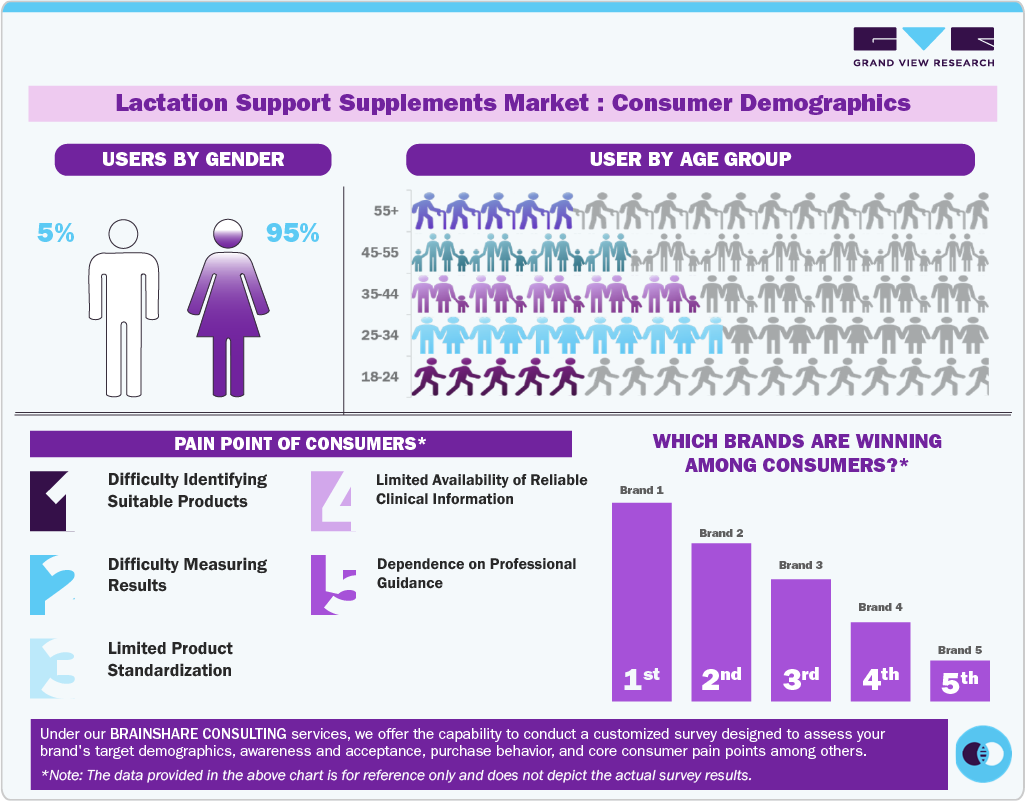
Consumer focus on breastfeeding support and maternal wellness is driving interest in specialized lactation formulations. Glanbia Nutritionals reports that 35% of new women’s supplement launches and 72% of women-focused food and beverage launches were positioned around pregnancy or breastfeeding, emphasizing product activity in this area. A U.S. study of 1,294 breastfeeding women found that 57.5% had used a galactagogue, while 27.7% used herbal supplements specifically, indicating demand for products intended to support milk production. These developments are encouraging manufacturers to develop targeted lactation products using herbal ingredients and convenient supplement formats.
 To learn more about this report, Download Free Sample Report
Consumer trends and preferences in the lactation support supplements industry are increasingly shaped by interest in maternal wellness, natural ingredients, and trusted product information. In April 2025, a national Australian survey of 810 pregnant and breastfeeding women found that 99.6% used dietary supplements and 57.3% used herbal medicines, highlighting the importance of supplementation during the maternal period.
Consumers are also showing interest in herbal and botanical ingredients for breastfeeding support. A study published in January 2025 among breastfeeding mothers in Türkiye found that 75.1% used at least one complementary medicine product, with 69.2% using dietary supplements and 29.9% using herbal medicines. Fennel was the most used herbal product, reported by 21.3% of participants, indicating continued interest in plant-based options.
Trust and product safety are also important factors in purchasing decisions. The April 2025 Australian survey found that 27.0% of women identified general practitioners as their most trusted healthcare professionals, while breastfeeding women also placed greater trust in pharmacists, herbalists, naturopaths, and lactation consultants. This suggests that professional recommendations and clear information about ingredients and appropriate use can influence consumer acceptance of lactation-related supplements.
Ingredients Insights
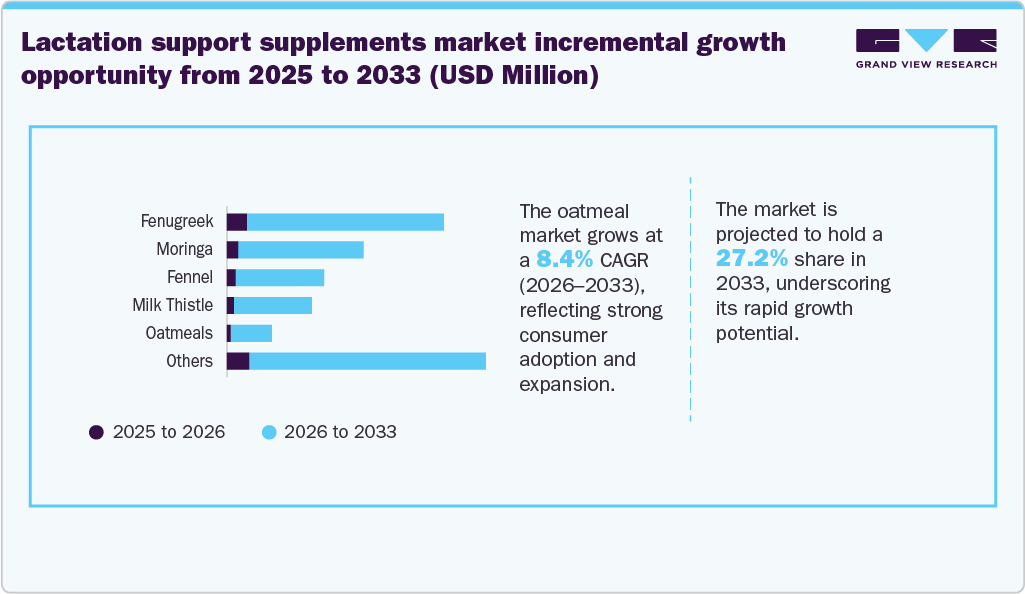
The fenugreek segment accounted for the largest share of 28.3% in 2025, reflecting their established use in lactation-support products. Fenugreek is commonly included in capsules, powders, teas, and combination supplements. Moringa, milk thistle, and fennel are also used in herbal formulations. Manufacturers are increasingly combining these ingredients to develop differentiated products. The availability of multiple ingredient-based options is giving consumers greater choice based on their individual preferences.
 To learn more about this report, Download Free Sample Report
The oatmeal segment is projected to register the fastest CAGR of 8.4% from 2026 to 2033, reflecting rising interest in familiar, food-based ingredients for lactation support. Oats are being incorporated into cookies, bars, powders, and other supplement formats. Their nutritional content also supports their use in postpartum-focused products. Manufacturers are exploring oatmeal-based formulations as a convenient alternative to traditional capsules and tablets. The ingredient’s familiarity may help brands appeal to mothers seeking simple and recognizable options. This trend is creating scope for further product development within the segment.
Formulation Insights
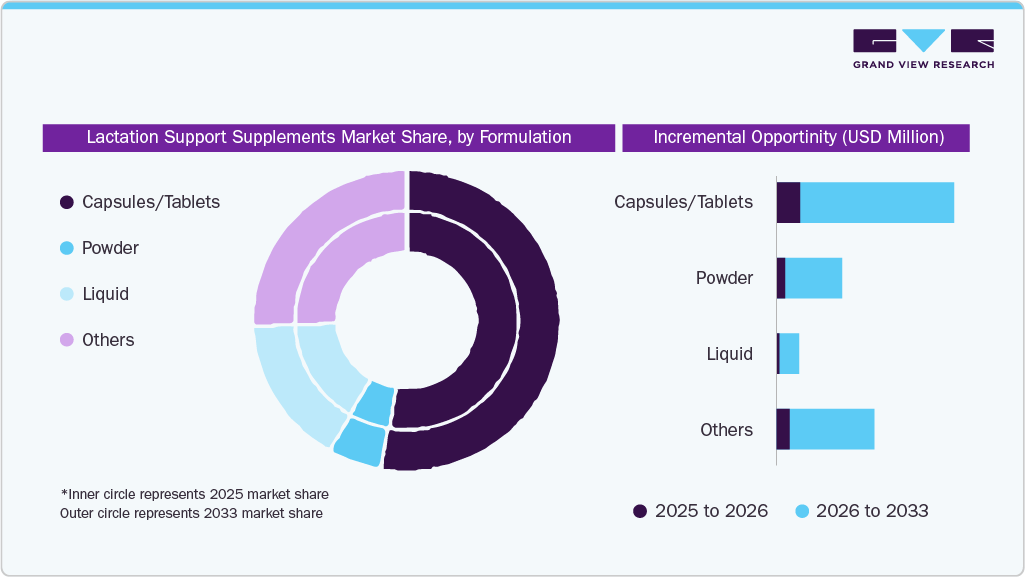
The capsules/tablets form accounted for the largest share of revenue at 52.5% in 2025, reflecting consumer preference for convenient, easy-to-use lactation support products. Capsules and tablets offer simple dosage and portability, making them suitable for mothers managing busy postpartum routines. Powder and liquid formats provide alternatives for consumers who prefer flexible consumption methods. Manufacturers are also introducing varied formulations to address different preferences and usage habits. This variety is creating opportunities for brands to differentiate their products through formulation, convenience, and targeted nutritional benefits.
 To learn more about this report, Download Free Sample Report
The liquid is projected to register the fastest CAGR of 7.2% from 2026 to 2033, supported by the convenience and ease of consumption offered by liquid lactation support supplements. Liquid formulations can be easier to consume during the postpartum period and may offer flexible dosing options. Manufacturers are also developing liquid products with combinations of herbal extracts, vitamins, and other ingredients commonly used in lactation-support formulations. The increasing availability of flavored, ready-to-use liquid products is further driving consumer interest in this segment.
Sales Channel Insights
The direct sales channel accounted for the largest share of 33.6% of global revenue in 2025, reflecting the importance of direct-to-consumer purchasing in the market. Brands can interact directly with breastfeeding mothers through their websites, subscription programs, and personalized product offerings. Direct sales also provide companies with greater control over pricing, promotions, customer feedback, and brand communication. This channel can support repeat purchases by offering convenient ordering and product recommendations based on consumer needs.
 To learn more about this report, Download Free Sample Report
The online sales channel is projected to grow at the fastest CAGR of 8.2% from 2026 to 2033, supported by the convenience of home delivery and easy access to specialized products. E-commerce platforms allow consumers to compare ingredients, formulations, prices, and reviews before making purchases. Online channels also provide brands with opportunities to reach breastfeeding mothers directly and introduce subscription-based purchasing options. The increasing availability of maternal health products on digital platforms is expected to further support online sales during the forecast period.
Regional Insights
The lactation support supplements market in the Asia Pacific accounted for the largest share of 38.8% in 2025. Traditional use of herbal ingredients and growing awareness of maternal nutrition are supporting demand across the region. The availability of products through pharmacies, specialty retailers, and online platforms is improving consumer access. Manufacturers are also offering formulations based on ingredients such as fenugreek, moringa, and fennel. Rising interest in convenient and plant-based lactation-support products is creating further opportunities for market development.
 To learn more about this report, Download Free Sample Report
China Lactation Support Supplements Market Trends
The lactation support supplements market in China led the Asia Pacific in 2025, holding a 35.9% share of regional revenue. Consumer preferences are increasingly influenced by traditional wellness practices and greater attention to nutritional support during breastfeeding. Product choices are also shaped by formulation convenience, ingredient familiarity, and perceived suitability for postpartum routines. Manufacturers are responding with products that combine traditional ingredients with modern supplement formats and clearer product positioning. This is creating scope for brands to differentiate through formulation variety, consumer education, and targeted maternal-health offerings.
North America Lactation Support Supplements Market Trends
The lactation support supplements market in North America accounted for 33.7% of revenue in 2025, reflecting established demand for maternal nutrition and breastfeeding support products. The region has broad access to dietary supplements through retail and digital channels. Consumer interest in herbal ingredients and convenient formulations is supporting product adoption. Manufacturers are introducing products tailored to postpartum nutritional and lactation needs. Growing product variety is creating opportunities for further market development across North America.
The U.S. lactation support supplements market led North America in 2025, holding the largest market share with 90.2% of the region’s total revenue. The market is supported by established demand for breastfeeding and postpartum nutrition products. Consumers have access to a wide range of herbal and nutritional formulations through pharmacies, specialty retailers, and online platforms. Product innovation across capsules, powders, liquids, and other convenient formats is also shaping consumer choices. The availability of specialized brands and the growing variety of products are creating opportunities for continued market development.
Europe Lactation Support Supplements Market Trends
The lactation support supplements market in Europe is projected to grow at a CAGR of 7.0% from 2026 to 2033. Demand is supported by interest in postpartum nutrition and breastfeeding-related wellness products. Consumers are increasingly considering herbal and natural ingredients as part of their lactation-support routines. The availability of supplements in capsules, powders, liquids, and other formats is providing greater choice. Online and pharmacy-based distribution is also improving access to specialized maternal-health products across the region.
Germany lactation support supplements market held the largest share of Europe at 16.1% in 2025. The country’s market is supported by consumer interest in postpartum nutrition and breastfeeding-related wellness. Demand is also shaped by preferences for herbal ingredients and convenient supplement formats. Pharmacies, specialty retailers, and online platforms provide multiple purchasing options. Product variety and greater awareness of maternal nutritional needs are creating further opportunities for market development in Germany.
Latin America Lactation Support Supplements Market Trends
The lactation support supplements market in Latin America is projected to grow at a CAGR of 7.1% from 2026 to 2033. The region offers opportunities for brands to introduce products suited to local breastfeeding and postpartum nutrition needs. Herbal and food-based formulations can appeal to consumers familiar with traditional ingredients. Greater availability through pharmacies, specialty retailers, and online channels can improve access to products. Manufacturers can also differentiate through affordable, convenient, and locally relevant formulations.
Middle East & Africa Lactation Support Supplements Market Trends
The lactation support supplements market in MEA is expected to grow at a CAGR of 7.9% from 2026 to 2033. The market is seeing greater interest in products that combine traditional botanical ingredients with modern supplement formats. Consumers are also looking for convenient options that can fit into postpartum routines. Manufacturers have opportunities to introduce products suited to regional preferences and different consumption habits. Online availability and pharmacy-based distribution can further improve access to lactation-support products across the region.
Key Lactation Support Supplements Company Insights
The lactation support supplements industry comprises specialized maternal-health brands and established dietary supplement companies offering a diverse range of products for breastfeeding mothers. Companies are differentiating their offerings through herbal blends, botanical ingredients, vitamins, minerals, probiotics, and multi-ingredient formulations available in capsules, powders, gummies, teas, and liquid formats. Product development is increasingly centered on convenience, ingredient transparency, and formulations tailored to the nutritional needs of lactating women.
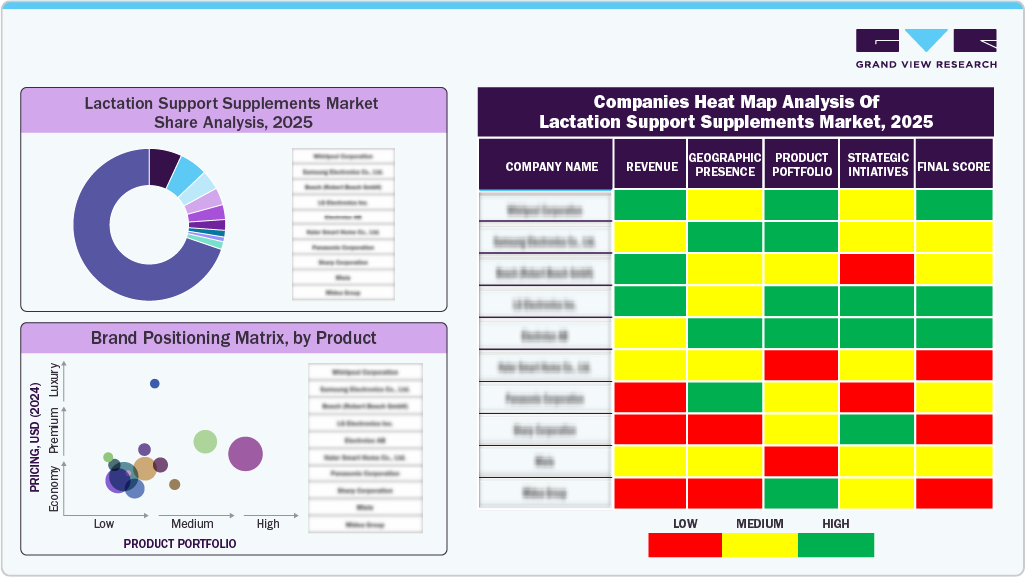
Competitive positioning is also influenced by brand reputation, online retail presence, pharmacy and specialty-store distribution, and direct-to-consumer sales. Companies are introducing new formulations and strengthening distribution networks to reach a broader consumer base. The market remains competitive across product types, ingredients, and sales channels, creating opportunities for manufacturers to gain market share through product innovation, targeted maternal nutrition solutions, and broader geographic availability.
 To learn more about this report, Download Free Sample Report
Key Lactation Support Supplements Companies
The following key companies have been profiled for this study on the lactation support supplements market.
-
Nestlé S.A.
-
Nature’s Way Products LLC
-
Munchkin Inc.
-
Traditional Medicinals Inc.
-
Pink Stork LLC
-
UpSpring Baby LLC
-
Motherlove Herbal Company
-
Earth Mama Organics LLC
-
Fairhaven Health LLC
-
Legendairy Milk LLC
Competitive Benchmarking
Category
Operating Strategies
Competitive Edge
Weakness
Established Players (Nestlé S.A., Nature’s Way Products LLC, Munchkin Inc., Traditional Medicinals Inc.)
- Broaden lactation-support portfolios, invest in product development, use established retail and online distribution, and strengthen maternal-health brand positioning.
- Established brand recognition, diversified product portfolios, broad distribution networks, established consumer trust, and extensive product-development capabilities.
- Larger organizational structures, higher operating costs, complex decision-making, and less flexibility than specialized niche brands.
Emerging & Specialized Players (Pink Stork LLC, UpSpring Baby LLC, Motherlove Herbal Company, Earth Mama Organics LLC, Fairhaven Health LLC, Legendairy Milk LLC)
- Focus on targeted lactation products, develop ingredient-specific and convenient formulations, strengthen online sales, and build direct engagement with breastfeeding consumers.
- Specialized product expertise, focused maternal-health positioning, faster product innovation, strong niche appeal, and closer consumer engagement.
- Smaller geographic presence, comparatively limited financial resources, narrower product portfolios, and greater reliance on specific maternal-health categories.
Recent Developments
-
In June 2026, Legendairy Milk launched She’s Flowing, a fenugreek-free powdered lactation drink mix formulated with moringa, goat’s rue, and milk thistle. The product was positioned as a convenient beverage-based option for breastfeeding mothers seeking lactation support.
-
In February 2026, Himalaya Wellness launched Galactosure, a lactation-support granule formulated with Shatavari, saffron, and moringa. The product was introduced for postpartum women to support breastfeeding and milk production through a botanical-based formulation.
-
In September 2025, Bayer launched Supradyn Mom’s and Supradyn Naturals Calcium+, targeting women during the preconception, pregnancy, and lactation stages. The products were positioned to provide nutritional support during key maternal life stages, strengthening Bayer’s presence in the women’s health and maternal nutrition segment.
Lactation Support Supplements Market Report Scope
Report Attribute
Details
Market size in 2025
USD 684.6 million
Estimated market size in 2026
USD 729.4 million
Projected market size by 2033
USD 1,171.2 million
Growth rate (revenue)
CAGR of 7.0% from 2026 to 2033
Actuals
2021 - 2025
Forecast period
2026 - 2033
Quantitative (revenue) units
Revenue in USD million, and CAGR from 2026 to 2033
Report coverage
Revenue forecast, company ranking, competitive landscape, growth factors, and trends
Segments covered
Ingredients, formulation, sales channel, region
Regional scope
North America; Europe; Asia Pacific; Latin America; MEA
Country scope
U.S.; Canada; Mexico; UK; Germany; France; Italy; Spain; Denmark; Sweden; Norway; China; Japan; India; Australia; South Korea; Thailand; Brazil; Argentina; South Africa; Saudi Arabia; UAE; Kuwait
Key companies profiled
Nestlé S.A.; Nature’s Way Products LLC; Munchkin Inc.; Traditional Medicinals Inc.; Pink Stork LLC; UpSpring Baby LLC; Motherlove Herbal Company; Earth Mama Organics LLC; Fairhaven Health LLC; Legendairy Milk LLC.
Customization scope
Free report customization (equivalent up to 8 analysts’ working days) with purchase. Addition or alteration to country, regional & segment scope.
Pricing and purchase options
Avail customized purchase options to meet your exact research needs. Explore purchase options
Global Lactation Support Supplements Market Report Segmentation
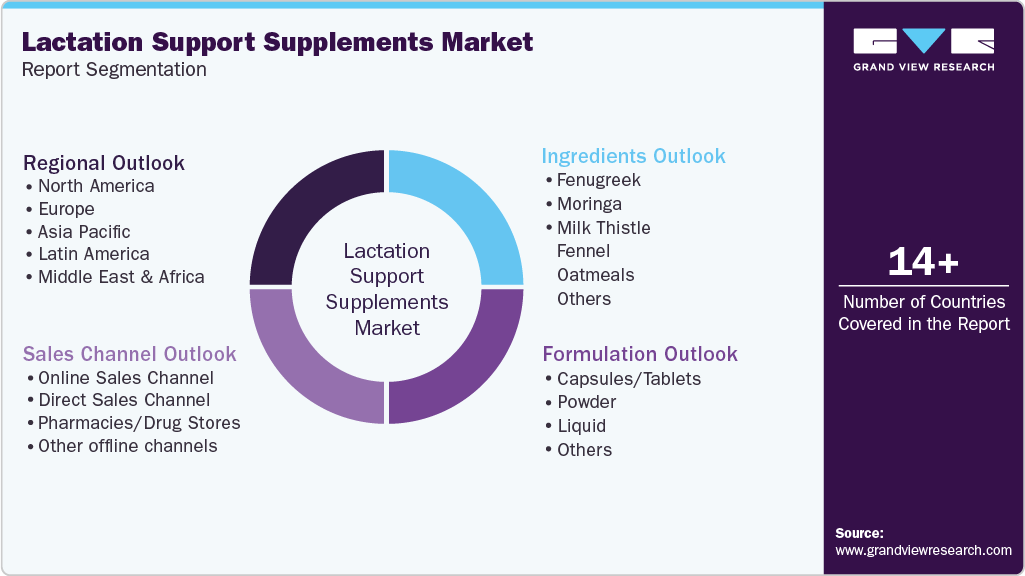
This report forecasts revenue growth at the regional and country levels and provides an analysis of the latest industry trends and opportunities in each of the sub-segments from 2021 to 2033. For this study, Grand View Research has segmented the global lactation support supplements market report based on ingredients, formulation, sales channel, and region:
 To learn more about this report, Download Free Sample Report
-
Ingredients Outlook (Revenue, USD Million, 2021 - 2033)
-
Fenugreek
-
Moringa
-
Milk Thistle
-
Fennel
-
Oatmeals
-
Others
-
-
Formulation Outlook (Revenue, USD Million, 2021 - 2033)
-
Capsules/Tablets
-
Powder
-
Liquid
-
Others
-
-
Sales Channel Outlook (Revenue, USD Million, 2021 - 2033)
-
Online Sales Channel
-
Direct Sales Channel
-
Pharmacies/Drug Stores
-
Other offline channels
-
-
Regional Outlook (Revenue, USD Million, 2021 - 2033)
-
North America
-
U.S.
-
Canada
-
-
Europe
-
UK
-
Germany
-
France
-
Italy
-
Spain
-
Denmark
-
Sweden
-
Norway
-
-
Asia Pacific
-
China
-
Japan
-
India
-
Australia
-
South Korea
-
Thailand
-
-
Latin America
-
Brazil
-
Mexico
-
Argentina
-
-
Middle East & Africa
-
South Africa
-
Saudi Arabia
-
UAE
-
Kuwait
-
-
Research Methodology
The lactation support supplements market figures in this report are based on a proven research process that combines executive interviews with secondary research from proprietary databases, company filings, and recognized regulatory and institutional sources. Market size is built through value-chain sizing - reconciling supply-side and demand-side estimates - and triangulated with bottom-up and top-down approaches. Every estimate passes multiple levels of expert validation before publication, with each lactation support supplements segment quantified using the revenue-capture definitions in the table below.
Segment Definition
Ingredients
Revenue capture definition
Fenugreek
This segment includes sales of lactation support supplements formulated with fenugreek as the primary active ingredient.
Moringa
This segment includes sales of lactation support supplements formulated with moringa as the primary active ingredient.
Milk Thistle
This segment includes sales of lactation support supplements formulated with milk thistle as the primary active ingredient.
Fennel
This segment includes sales of lactation support supplements formulated with fennel as the primary active ingredient.
Oatmeal’s
This segment includes sales of lactation support supplements formulated with oatmeal or oat-based ingredients as the primary ingredient.
Others
This segment includes the sales of lactation support supplements formulated with ingredients other than fenugreek, moringa, milk thistle, fennel, and oatmeal.
Formulation
Revenue capture definition
Capsules/Tablets
This segment includes the sales of lactation support supplements provided in capsule or tablet form.
Powder
This segment includes sales of lactation support supplements provided in powdered form, typically intended to be mixed with beverages or food.
Liquid
This segment includes sales of lactation support supplements provided in liquid form, including liquid drops, concentrates, and ready-to-consume formulations.
Others
This segment includes sales of lactation support supplements in formulations other than capsules/tablets, including powder and liquid, such as gummies, teas, lozenges, and granules.
Estimation Model
Layer Name
Key Question
Description
Consumption Profile Layer
Who consumes lactation support supplements?
Covers breastfeeding mothers who use lactation supplements to support milk production, postpartum nutrition, and overall maternal wellness, with choices shaped by personal needs and ingredient preferences.
Market Reach Layer
Where are lactation support supplements available?
Covers product availability through pharmacies, specialty stores, supermarkets, online marketplaces, e-commerce websites, and direct-to-consumer channels, making lactation supplements accessible across different purchasing preferences.
Purchase & Retention Layer
What drives repeat consumption?
Focuses on product effectiveness, ingredient quality, ease of use, taste, price, convenience, and brand trust, which can influence mothers’ willingness to continue using products and repurchase them.
Revenue Realization Layer
How much revenue is generated?
Generates revenue through varied ingredients, convenient formulations, targeted postpartum products, product bundles, and differentiated offerings sold through online and offline channels to meet breastfeeding mothers’ needs
Customization Table
This report has been delivered with the following In-depth customizations
Client Request
Customization Delivered
Value Adds
Global Lactation Support Supplements Market Landscape Assessment
Assessed market development, consumer demand, product formulations, key ingredients, emerging trends, and competitive intensity across major lactation support supplement categories.
Helps identify attractive product segments, understand competitive positioning, and support informed market-entry and expansion strategies.
Global Lactation Support Supplements Regulatory & Safety Assessment
Reviewed regulatory requirements, ingredient considerations, labeling standards, product claims, safety requirements, and compliance factors applicable to lactation support supplements across priority markets.
Helps reduce regulatory risks, supports compliant product development, and identifies markets with clearer pathways for commercialization.
Global Lactation Support Supplements Channel & Retail Assessment
Assessed pharmacies, specialty stores, supermarkets, e-commerce platforms, direct-to-consumer channels, and distribution models used for lactation support supplements.
Helps identify effective routes to consumers, prioritize high-potential sales channels, and uncover opportunities to improve product availability and distribution.
Frequently Asked Questions About This Report
The global lactation support supplements market size was valued at USD 684.6 million in 2025 and is estimated at USD 729.4 million for 2026.
The global lactation support supplements market is expected to grow at a CAGR of 7.0% from 2026 to 2033, reaching USD 1,171.2 million by 2033.
The fenugreek segment led with a 28.3% revenue share in 2025, while oatmeal is the fastest-growing segment.
Capsules/tablets held the largest revenue share in 2025, while liquids are the fastest-growing area.
The direct sales channel held the largest share (over 33.0%) in 2025.
Key players include Nestlé S.A., Nature’s Way Products LLC, Munchkin Inc., Traditional Medicinals Inc., Pink Stork LLC, UpSpring Baby LLC, Motherlove Herbal Company, Earth Mama Organics LLC, Fairhaven Health LLC, and Legendairy Milk LLC.
Asia Pacific dominated with a 38.8% revenue share in 2025.
Middle East & Africa is the fastest-growing region over the forecast period.
Key factors include increasing awareness of maternal nutrition, growing demand for products that support breast milk production, rising preference for natural and herbal ingredients, and increasing focus on postpartum health and recovery.
About the Author(s)
Nutraceuticals & Functional Foods Research Team
Consumer Goods · Nutraceuticals & Functional FoodsThis report was authored by the nutraceuticals & functional foods research team at Grand View Research - comprising two research analysts, one senior research analyst, and one industry expert - with specialized expertise in the nutraceuticals & functional foods segment of the consumer goods industry. All findings are based on proprietary consumer goods databases, executive interviews, and regulatory analysis, subject to internal peer review prior to publication.
Last Updated:
Speak to Analyst

Customize this report to your needs - add regions, segments, or data points, with 20% free customization.
Or view our licence options:


ISO 9001:2015 & 27001:2022 Certified
We are GDPR and CCPA compliant! Your transaction & personal information is safe and secure. For more details, please read our privacy policy.


