
- Home
- »
- Medical Devices
- »
-
Lensmeters Market Size, Share & Trends Report, 2026-2033GVR Report cover

Lensmeters Market (2026 - 2033)
Size, Share & Trends Analysis Report By Type (Digital, Manual), By Application (Prescription Verification and Lens Management, Lens Marking and Alignment), By End Use, By Region, And Segment Forecasts
Market Size, 2025
$89.1MMarket Estimate, 2026
$91.9MMarket Forecast, 2033
$118.6MCAGR, 2026–2033
3.7%Lensmeters Market Summary
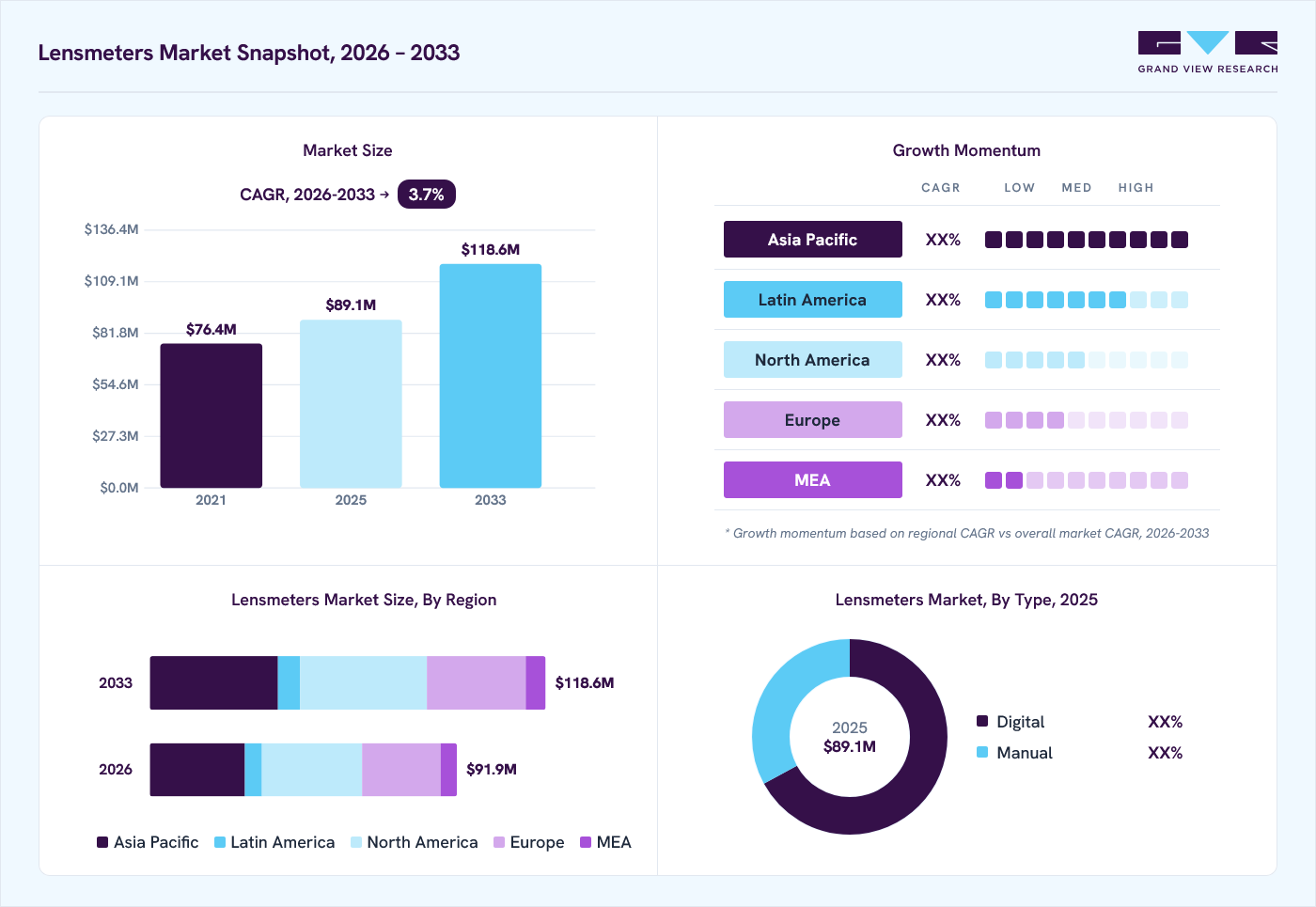
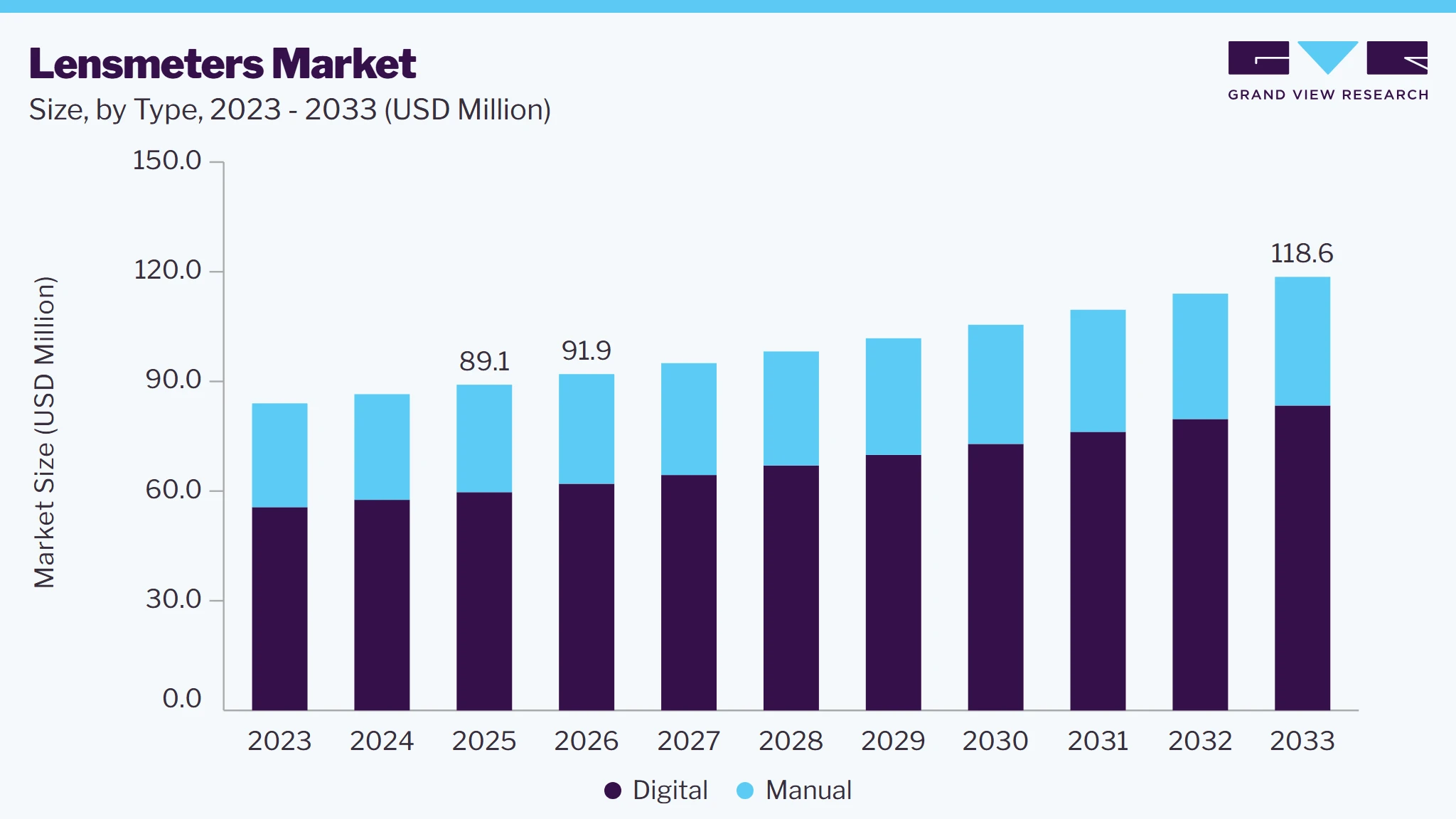
The global lensmeters market size was valued at USD 89.1 million in 2025 and is projected to grow from USD 91.9 million in 2026 to USD 118.6 million by 2033, at a CAGR of 3.7% from 2026 to 2033. North America dominated the market, accounting for a revenue share of 32.7% in 2025. The lensmeter market consists of the revenues earned from the sale of manual and automatic/digital lens meters that are used to measure the power of spectacle lenses, ensure accurate prescriptions and help align and quality test spectacle lenses. The market is growing due to increased demand for treatment for vision defects, an increase in refractive errors, optical retail and eye care services, plus increased adoption of more advanced optical measuring equipment. Automatic and digital lens meters are increasing capabilities for opticians, optometrists, ophthalmology clinics and optical labs by enabling quicker, more accurate and efficient prescription verification.
 Source: Grand View Research, IR Documents, Primary Interviews, Paid DatabasesTo learn more about this report,
 Download Free Sample Report
Key Market Trends & Insights
- By type: Digital segment dominated the market, with a revenue share of 67.0% in 2025.
- By application: Prescription verification and lens measurement segment held the largest market share of 63.4% in 2025.
- By end use: Optical retail stores and chains segment accounted for the largest revenue share of 42.7% in 2025.
Regional Highlights
- Largest regional market: North America (32.7% revenue share, 2025)
- Fastest-growing regional market: Asia Pacific (highest CAGR, 2026-2033)
- By country: The U.S. held the largest market share in 2025.
Market Size & Forecast
- Market size in 2025: USD 89.1 Million
- Estimated market size in 2026: USD 91.9 Million
- Projected market size by 2033: USD 118.6 Million
- CAGR (2026-2033): 3.7%
Prism AI by Grand View Research Free to tryAsk a question about the lensmeters marketTry asking✓Every figure cited from GVR research Prefer the report? Download free sample →One of the main drivers for the growth of this market is the increased need for accurate prescription verification. Automatic and digital lens metres provide opticians and eye care professionals with a much faster way of measuring lens power, cylinder axis, prism power etc. Advancements in technology have meant that automatic, digital lens metres have become available, providing opticians with more consistency and a quicker way of measuring lenses. This has encouraged many optical retailers, optometrists, ophthalmology clinics and optical laboratories to use modern lens metres to verify prescriptions, align lenses and improve product quality. However, how quickly they will adopt these new technologies will depend on cost of equipment, current infrastructure, what they need to measure and staff training.
 To learn more about this report, Download Free Sample Report
Another reason lens meters are experiencing increased demand is due to increasing demand for correcting vision problems. Refractive errors such as myopia, hyperopia, astigmatism and presbyopia can all lead to an increased requirement for glasses and associated eye care services throughout different age groups. Un-corrected refractive errors are identified by the WHO as a leading cause for vision impairment, therefore it is imperative that we improve access to services for refractive errors. With an increasing amount of people having access to eye exams, prescription glasses and optical retail services, there will be an increased requirement for accurate equipment when verifying spectacle prescriptions. Additionally, demand for lens meters will increase due to the increase in optical retail chains, independent optometrists and quality checks required in optical laboratories. However, the amount of equipment sold will depend on how many facilities are functioning, replacement cycle, digital devices, cost and investment in eye care within specific markets.
 To learn more about this report, Download Free Sample Report
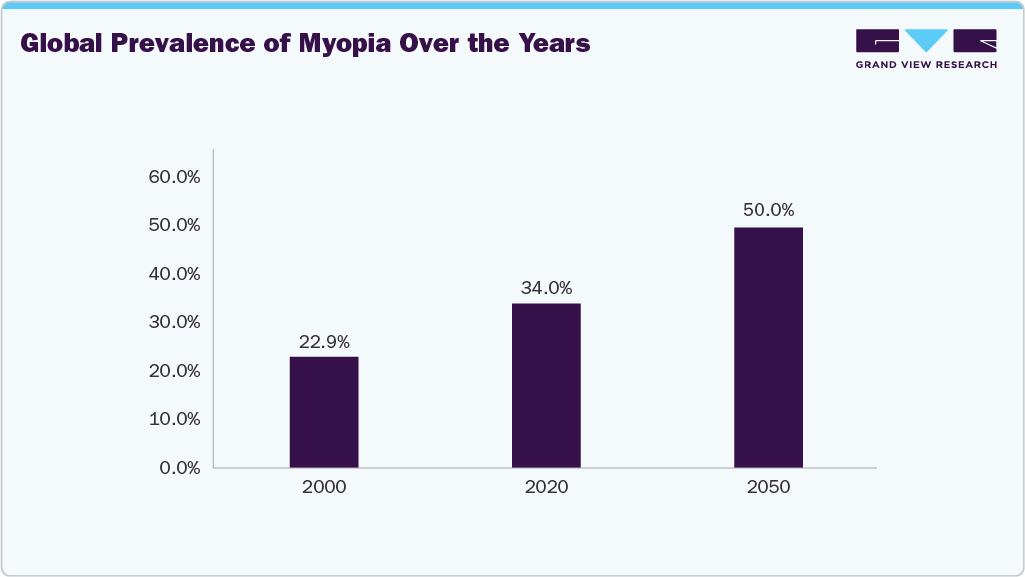
The growing prevalence of myopia is driving up the need for vision correction. Optical retailers, opticians’ practices and eye care centres use lens meters to measure the strength of the lenses and ensure correct prescriptions are being given. This could be driving demand for lens meters, especially automatic and digital lens meters, as they provide faster and accurate results. The expansion of eye care services and the importance of ensuring quality control will also help drive growth in the market.
Optical retailers, opticians and specialized eyesight care centers are becoming more widely available, providing better access to visual correction services. This is driving demand for lensmeters. The increasing availability of prescription eyewear to consumers and online selling of eyewear means there is an increased need for accurate prescriptions to be verified. In addition, new technologies are encouraging practitioners to move to automated digital lensmeters. This is expected to help drive demand from optical retailers, eyesight care centres and optical labs. However this will depend on how affordable the equipment is, how often they are replaced and how digital the market is.
Market Dynamics
The market is driven by an increase in vision correction needs, growth of optical retail and eye care services, as well as accurate spectacle lens measurements. Refractive errors such as myopia, hyperopia, astigmatism and presbyopia increase the demand for prescription wear meaning there is a requirement for equipment to ensure lenses have the correct power. The WHO predicts that by 2030 3.36 billion people will be affected by myopia, whilst presbyopia will affect 2.1 billion people by this date meaning there is a significant requirement for refractive error treatment. However, this will depend on how many people are receiving eye tests, how many people are receiving spectacle lenses and how much investment is put into optical equipment.
There are both manual and automatic/digital models available in the market. Digital models include features that make it easier to measure lenses and check prescriptions. Examples of manufacturers providing both digital and manual models include AMETEK Reichert. Adoption can be driven by many factors including the size and throughput of optical practices, cost of equipment, speed of measuring and replacing old equipment. In mature optical markets there are opportunities to upgrade equipment, whereas in emerging markets there is potential for increased adoption.
The increasing requirement for accurate prescriptions has resulted in increased demand for lens meters. Lens meters are used to measure the power in spectacle lenses. This ensures that the finished spectacle product matches the specific prescription of the lenses. Optical retailers, Optometry practices, Ophthalmology clinics and optical labs will all be handling prescription eyewear and therefore accurate lens measuring will help during dispensing and quality assurance. Automatic lens meters can assist by making the process simpler and digital versions can be used with digital screens and extra functions.
New technologies are being developed to help the move away from manual instruments. AMETEK Reichert have developed their LensChek Pro digital lensometer which has added in-built pupillary distance and UV measuring functions. They have a range of both digital and manual instruments. However, the speed at which this will be adopted will depend on their budget to purchase the device, they will need to consider what is required within their workflow, they will have existing equipment in place and how beneficial to them the new technology will be.
Market growth can be limited by the costs of acquiring and upgrading lensmeters. Independent optical stores, smaller practices and those in price sensitive markets will be more affected. While basic manual lensmeters may be affordable, high-end automated and digital devices can be more costly. Referring to sample price data from Indian optical equipment providers shows that there is a large difference between basic manual models and automated versions. This data is just an example of what is available on the market.
There are also additional costs to consider with purchasing a new piece of equipment including installation, training, servicing, calibration and replacement. In smaller practices where there is less patient turnover, it can be hard to justify upgrading to an automated piece of equipment if they have a fully functioning manual device. In emerging markets, lack of access to eye care and affordability issues can cause problems. According to the WHO availability of services, affordability and lack of trained personnel are still major barriers to providing refractive error care in many low and middle income countries. This could cause an indirect barrier to high specification lensmeters.
Lensmeters can take advantage of growing infrastructure and improving refractive error care. WHO are working on a program to improve the effective coverage of refractive error by increasing the quality of service delivery, human resource development, awareness raising, cost and surveillance as part of their SPECS 2030 initiative. By improving access to eye exams and spectacle supply there will be a greater demand for reliable equipment that can help confirm prescriptions and check completed lenses. This offers opportunities for lensmeter providers to target areas that lack infrastructure.
Manufacturers will benefit from offering low cost, small devices for smaller optical practices. More advanced models can be offered for larger high volume retailers and optical labs. The automatic features and ease of use can be appealing to optical providers looking to increase efficiency. Replacing outdated equipment may also present an opportunity within mature markets. Overall the size of the market will be dependent on how many skilled staff are available, how willing they are to purchase, how much service and maintenance will be available and how much investment optical providers have into their equipment.
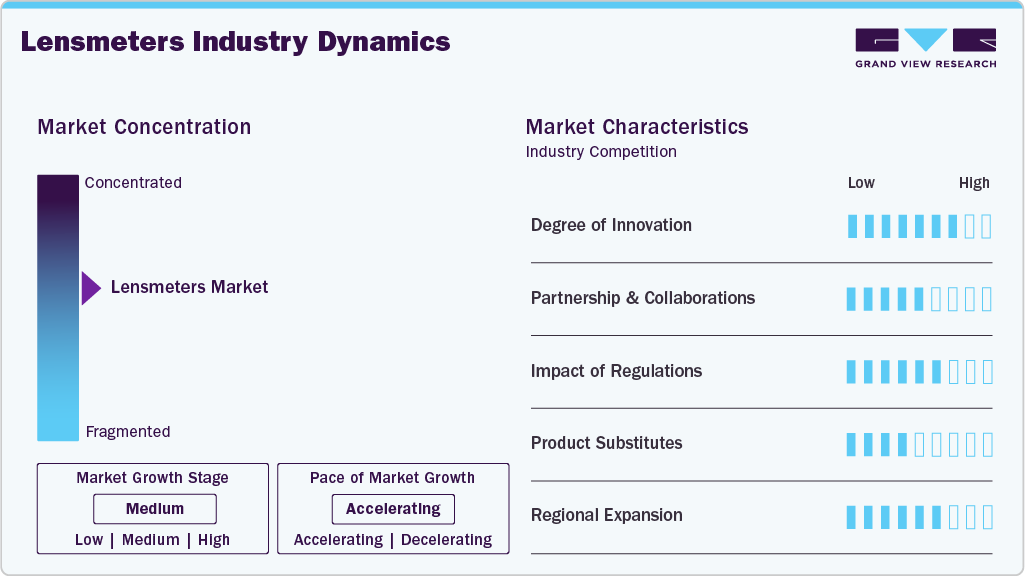
Market Concentration & Characteristics
The lensmeter market comprises established ophthalmic equipment manufacturers and optical instrument suppliers competing across manual and automatic/digital lensmeters. Key participants include NIDEK, Topcon, Huvitz, and AMETEK Reichert, which offer products for measuring spectacle lens power, verifying prescriptions, and assessing lens characteristics.
There is constant innovation within the lensmeter market. Manual lensmeters remain popular due to their cost effective nature however automatic and digital lensmeters have become increasingly important with the introduction of multiple features such as multi-point sensors, automated lens type recognition, digital screen readings and digital data transmission. NIDEK produce an automatic lensmeter (LM-7P/7) that includes a 108-point Hartmann sensor, automatic lens type recognition, pupillary distance and UV transmittance measurement. Topcon also produce a digital lensmeter (CL-300) with UV transmittance measurement capabilities. There has also been innovation around connecting the lensmeter to other optical devices and practice management systems and measuring progressive and multifocal lenses more efficiently. However it is not guaranteed that the more advanced features will provide better results so validation, calibration and ease of use should be considered.
 To learn more about this report, Download Free Sample Report
In the lensmeter market partnerships and collaboration typically occur between ophthalmic instrument manufacturers, optical instrument distribution companies, optometry groups, eye care professionals and optical lens labs. Manufacturers will partner with regional distribution companies to increase reach and offer support for installation, servicing and user training. Ophthalmic and optical instrument integration will also play a part in partnerships where lens measurements can be passed into the integrated device. NIDEK's LM-7 series offers standard data communication connections, optional LAN/WLAN connections and AMETEK Reichert's LensChek Plus has an RS-232C port for integration with electronic medical records and other devices. This can help manufacturers stand out by offering improved workflow compatibility. Collaborating with optical retailers, educational institutions and training organisations may help demonstrate and train users on the product. This will depend on the product and market you are looking at.
The lensmeter industry is regulated with devices classified, standards applicable, quality manufacturing requirements and local market requirements. A lens meter is used to measure optical aspects such as optical power of spectacle lenses which means a reliable measurement function is required. General purpose focimeters have requirements and testing methods set out by international standard ISO 8598-1:2014. This includes measurements of vertex power, cylinder axis and prism power. In the U.S. devices used for measuring lenses are classified under Class I of the FDA. Depending on what class the device falls into will determine what regulations apply. In India automated lens meters fall under Class A devices within the CDSCOs classification list for ophthalmology medical devices. As a manufacturer it is important to consider what requirements apply to your device depending on your target market. This could affect how quickly you can enter the market, the cost of compliance, distribution strategy and availability of products.
In the lensmeter market there is an issue of replacement between manual and automatic/digital models. Some optical systems will have automatic measurement built in or there will be centralised lab equipment. This can provide a cheaper option for optical retailers and smaller practices. Automatic lensmeters are quicker with digital displays and extra measuring functionality. However depending on the situation some optical systems will have built in functionality that can provide some lens measurements. This would not be a direct replacement for a lensmeter but again depends on what needs to be measured. It depends on factors such as cost of purchase, measuring requirements, types of lenses being measured, staff knowledge, how much they need to measure and integration with systems. Therefore the availability of cheaper manual options can limit the use of high end digital models but integration can increase demand.
There are opportunities to expand to new regions, using local distributors, to increase market penetration in the optical retail sector and increased access to optometry and vision correction services. North America and European markets will provide an opportunity for sales into markets replacing equipment and upgrading to digital solutions. As optical retail and eye care services increase in Asia Pacific countries such as China and India, there is potential for companies to sell affordable manual systems and automatic lensmeters. Emerging markets in Latin America, the Middle East and Africa may also provide opportunities as prescription eyewear becomes more accessible. Local distributorship, training, after-sales and offering a variety of products to suit varying budgets can help companies enter these markets. However, success in these regions will depend on the price of equipment, availability of trained staff, importing and registering requirements, availability of service and the developed nature of optical retail and labs in the region.
Type Insights
The digital lensmeters segment dominated the market in 2025 and accounted for the 67.0% of the revenue and is also expected to register the fastest CAGR over the forecast period. The growth in this market is being driven primarily through a desire to utilise automated lensmeters, ensure quick prescription verification and increased efficiency within optician stores, optometrists and eye care practices. Digital lens meters offer automated lens recognition, an electronic screen display and extra features to measure multifocal and progressive lenses, pupillary distance and UV transmission. This helps to streamline the process of measurement along with quality control when dispensing spectacles. Digital lens meters are expected to increase due to optical professionals wanting to make their processes more efficient and handle a greater variety of spectacle lenses. However, they will still depend on cost, maintenance and benefits of upgrading from manual lens meters.
The manual lensmeters segment is expected to witness a significant CAGR over the forecast period. They are affordable, easy to use and ideal for everyday measurements and verification of spectacle prescriptions. Handheld lens meters are an ideal choice for independent optical retail outlets, smaller optometry practices or locations with financial constraints. They are able to provide an accurate measurement of the power and cylinder axis of spectacle lenses. They do not include the advanced components included within automatic lens meters and therefore are ideal for those who want to use traditional measurements and have minimal servicing requirements.
Application Insights
The prescription verification and lens measurement segment held the largest revenue share of 63.4% in 2025. This is due to the requirement to confirm the power of spectacle lenses. The device is widely used by optical retailers, optometrists and ophthalmic clinics to assess the sphere, cylinder, axis and prismatic power of lenses. An increase in the demand for corrective glasses and an increase in optical retailers, alongside a greater focus on accuracy, will continue to drive demand for this application. Automatic and digital lensmeters make it easier to measure lenses and reduces the amount of manual work required. This is particularly useful when measuring progressive and multifocal lenses.
The lens quality control and inspection segment is expected to witness a significant CAGR over the forecast period. This can be seen to be supported by the need to ensure lenses are measured the same throughout the spectacle manufacturing process. Lens meters are used within optical laboratories and spectacle manufacturers to measure the power of the lenses and to ensure that they meet the required specifications. With more bespoke, progressive and complicated spectacle lenses becoming available there is an increased need to ensure they are measured and checked accurately. As well as this, with more organised spectacle retailers and online spectacle sales it is important to check the quality of lenses to ensure there aren’t any differences. Digital lens meters have advanced and offer automatic measurement and better measurement of complicated lens designs meaning they could be used in quality control. However, there are many aspects to optical quality control and additional equipment may be needed to check for things like surface imperfections, coatings and lens strength.
End Use Insights
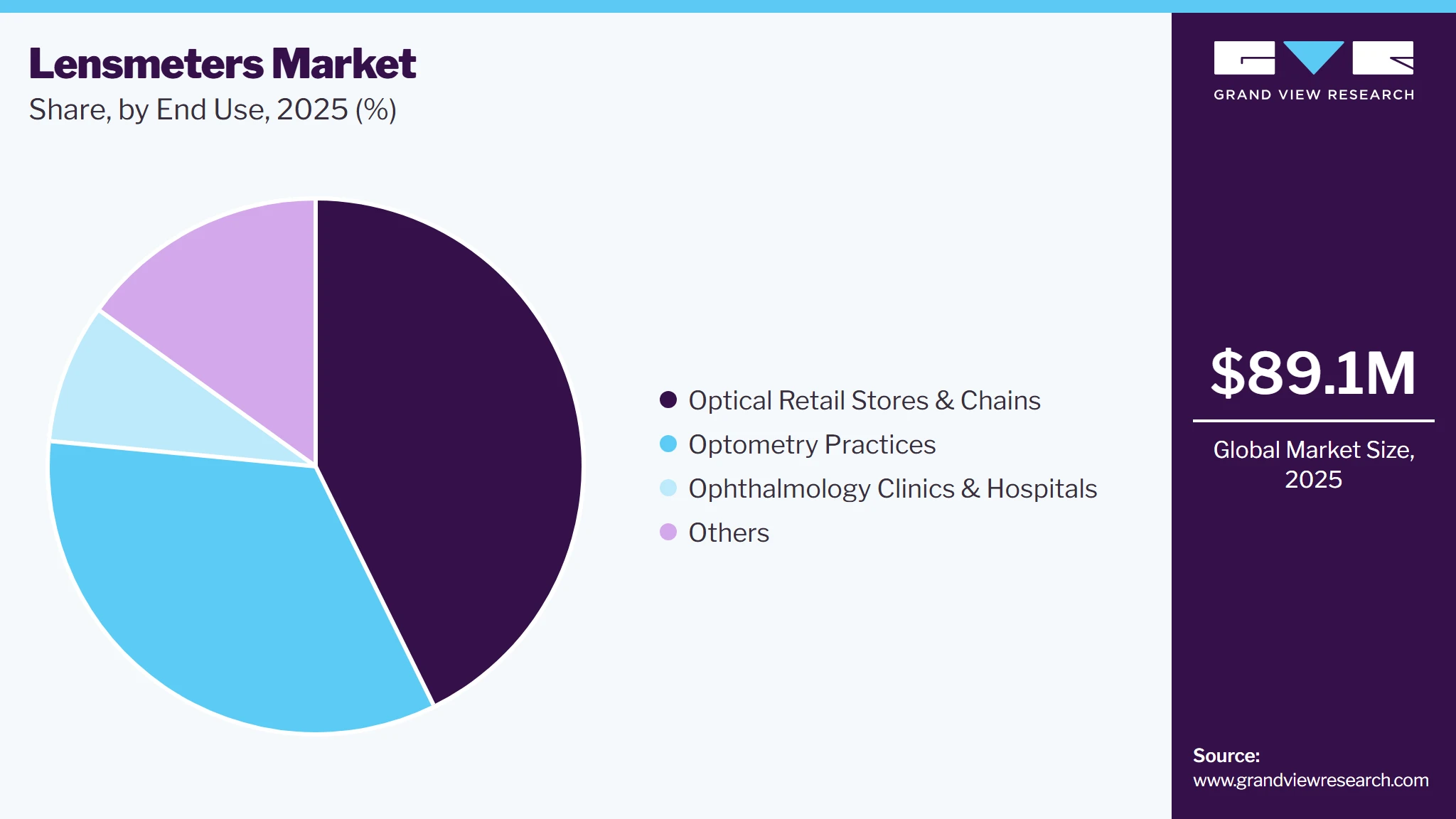
The optical retail stores and chains segment held the largest revenue share of 42.7% in 2025. Lensmeters are widely used within the sector to ensure accurate prescriptions and quality spectacles. Optical retailers will often use a lensmeter to ensure the finished lenses have been manufactured to the required prescription. As well as ensuring the prescription is correct, the device can also be used to determine the power of the lenses, as well as ensuring custom and progressive lenses are appropriate before fitting into the spectacle. With an increase in structured optical retail outlets, there is demand for accurate prescriptions and ensuring quality of service from a number of outlets. Automated and digital models are a key consideration when considering high volume retail. Overall optical stores are likely to be a key market for lensmeters, however depending on the size of the store, customer numbers and budget the type of equipment will differ.
 To learn more about this report, Download Free Sample Report
The optometry practices segment is anticipated to grow at fastest CAGR over the forecast period. This is supported by a focus on providing full eye exams, ensuring accurate refractive measurements are made and glasses have been verified. Lens meters are used within optometry to measure patients' glasses, ensuring they are wearing the correct prescription. Increased accessibility to optometry services, increased independent practices and multiple location optometry services, and digital equipment can all help to increase growth within this sector. Advanced lens meters can assist optometrists to easily measure complicated lenses. However, the size of the practice, budgeting for equipment, patient volumes and availability of servicing and technical support can affect how quickly optometrists will adopt these devices. Growth may be faster in more mature markets however slower in areas where optometry is not as developed.
Regional Insights
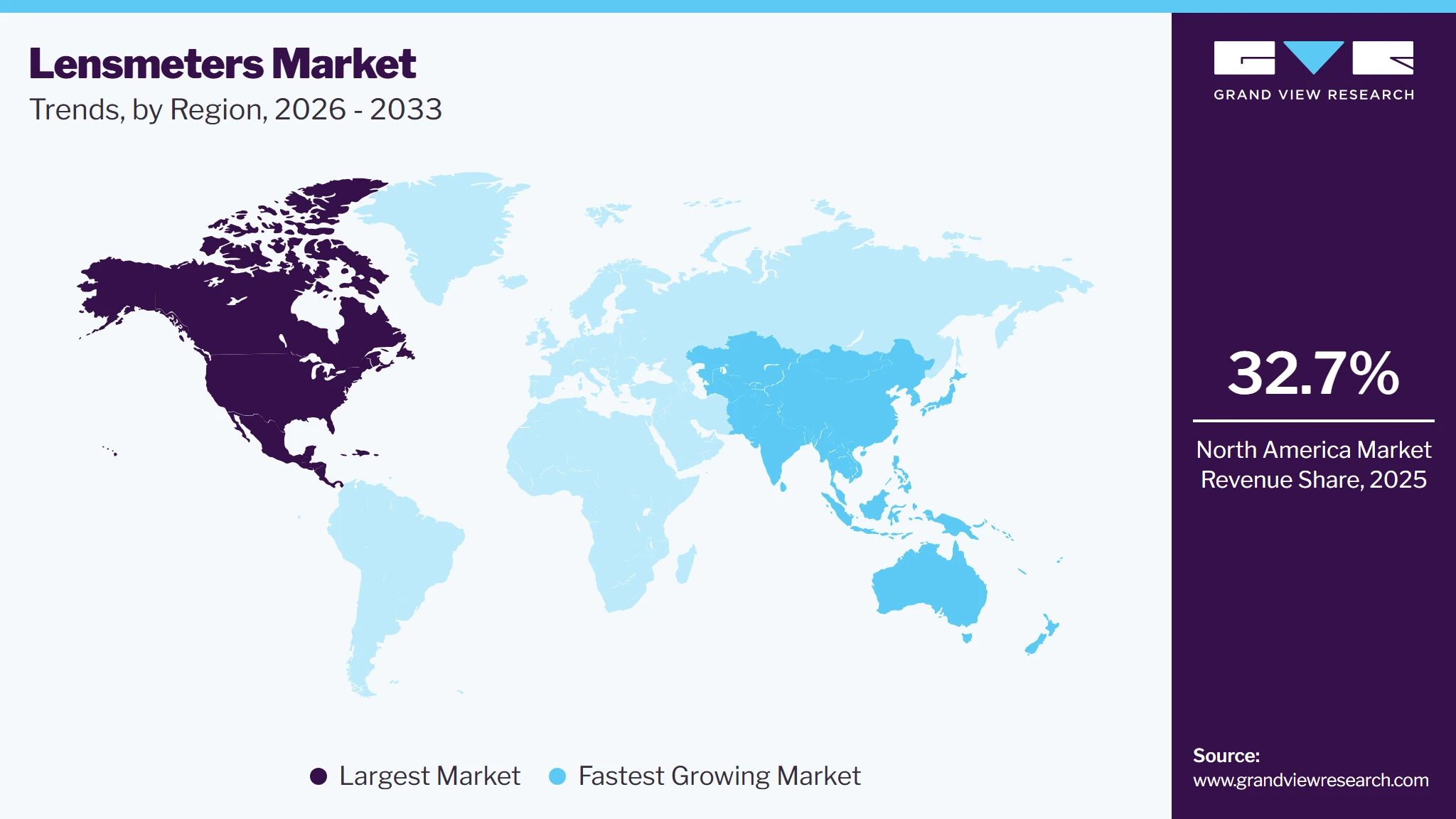
The North America lensmeters market accounted for the largest revenue share of 32.7% in 2025 and is supported by established optical retail networks, optometry practices, ophthalmology services, and demand for prescription eyewear. The region provides opportunities for manual and digital lensmeters, with purchasing decisions influenced by measurement accuracy, operational efficiency, equipment costs, and integration with existing optical systems. Digital lensmeters are particularly relevant to high-volume optical retailers and eye-care facilities seeking to streamline prescription verification and lens measurement. The presence of established ophthalmic equipment manufacturers and distribution networks also supports product availability, servicing, and technology upgrades.
 To learn more about this report, Download Free Sample Report
U.S. Lensmeters Market Trends
The U.S. lensmeters market is supported by an established network of optical goods stores and optometry practices that provide prescription eyewear and related vision-care services. The U.S. Census Bureau recorded 45,000 employer establishments in the offices of optometrists category. These businesses represent potential customer groups for lensmeter manufacturers, although not every establishment purchases or operates a separate lensmeter. Demand is influenced by the volume of eyewear dispensing, the need to verify prescriptions, equipment replacement cycles, and the adoption of digital measurement technologies. Manufacturers can differentiate their products through automated measurements, compatibility with different lens designs, connectivity, and after-sales support.
Europe Lensmeters Market Trends
Increasing optical dispensing services, optometry & ophthalmology services and increasing demand for corrective eyewear in countries with varying delivery models is driving the Europe lensmeters market. This regional market has opportunities for both manual and digital lensmeters and is driven by the size and distribution of optical retail chains, budgets spent on purchasing equipment plus availability of trained personnel. Digital lens meters can be used to increase efficiency in verifying prescriptions and performing quality control processes within structured optical chains and optical laboratories. However, there are variations between countries due to differences in the role of optometrists/opticians, service structures and modernisation of equipment.
The UK lensmeters market expected to grow steadily due to the growing optical retail sector and professional eye-care services that provide sight testing, prescription eyewear, and lens verification. Optical retailers and optometry practices are potential users of lensmeters for checking lens power and confirming that finished spectacles meet prescription specifications. Demand for digital equipment may be supported by the need to improve dispensing efficiency and accommodate progressive and multifocal lenses. However, purchasing decisions are likely to vary between independent optical practices and larger retail chains, particularly in relation to equipment budgets, service requirements, and the expected benefits of upgrading existing instruments.
Asia Pacific Lensmeters Market Trends
Asia Pacific lensmeters market is expected to witness fastest CAGRof4.4% over the forecast period. There are various levels of infrastructure, disposable income and acceptance of optical equipment in countries such as China, India, Japan and South Korea which will mean that there is demand for different types of lensmeters. Opportunities exist in developed markets for digitisation and replacements. In developing markets there may be an opportunity for low cost manual and automatic lensmeters. Government programmes to tackle refractive error and increase availability of eye care can create a strong need for prescription checking equipment. However the actual effect on lensmeters will depend on how they are purchased and used.
China's lensmeters market is experiencing rapid expansion, driven by the country's focus on myopia prevention, refractive error management, and the development of eye-care services. China's National Health Commission issued an updated version of their Myopia Prevention and Control Guidelines in 2024 demonstrating the ongoing importance of eye health for children and young people. This could drive demand in vision screening and correction services. Lensmeters for the optical retail, optical lab and healthcare market will benefit. Manufacturers can compete on the accuracy of readings, digital features, local availability and price. But these initiatives should be seen as drivers for indirect demand rather than a specific growth driver for lensmeter sales.
India’s lensmeters market offers opportunities associated with the need to improve access to refractive error services and prescription eyewear. The government provides health programs for refractive errors along with other major eye diseases. The growth of optometry education and eye care will increase the demand for optical measuring devices. Lensmeters will be required by optical retailers, optometry practices, hospitals and optical labs to measure the lens powers and ensure completed spectacles meet standards. As price is a key factor there will still be a demand for manual and low cost automatic lens meters due to the lack of infrastructure in major cities compared to smaller areas. Growth will depend on how affordable the equipment is, availability, servicing and trained staff.
South Korea's lensmeters market is growing due to established optical retail and eye-care services, creating demand for equipment used in prescription verification and spectacle dispensing. Digital lensmeters may appeal to providers seeking faster measurements and more efficient handling of progressive and multifocal lenses. Competition is likely to depend on product performance, pricing, connectivity, distributor support, and the availability of maintenance services. The adoption of advanced equipment will also depend on the size of the practice, the volume of spectacles handled, and the benefits of replacing existing instruments.
Latin America Lensmeters Market Trends
The Latin America lensmeters market is growing due to private optical retail networks, demand for prescription eyewear, and the development of vision-care services in major urban centres. Market opportunities differ across countries according to consumer purchasing power, the availability of trained optical professionals, and the maturity of local distribution networks. Both manual and digital lensmeters can serve the region, with affordability remaining an important consideration for independent retailers and smaller practices. Suppliers may expand their reach through local distributors, equipment servicing, training, and product portfolios suited to different purchasing budgets. However, publicly available industry data on optical retail activity do not directly establish lensmeter market revenue or growth rates, making country-level equipment estimates dependent on additional validation.
The Brazil lensmeters market is growing. According to Abióptica, the Brazilian optical industry association, the country had 71,226 optical points of sale at the end of 2024, following the opening of 5,885 outlets during the year. This expanding retail network provides a potential customer base for lensmeter manufacturers supplying equipment for prescription verification and spectacle dispensing. Opportunities exist for affordable instruments serving independent optical stores as well as digital models suited to larger retailers and higher-volume operations. Nevertheless, the number of optical outlets should be treated as an indicator of the potential customer base, not as a direct measure of lensmeter installations or sales.
Middle East & Africa Lensmeters Market Trends
The Middle East & Africa (MEA) lensmeters market is witnessing steady growth, through the expansion of private optical retail, eye-care facilities, and access to prescription eyewear. Market development varies considerably across the region, reflecting differences in healthcare infrastructure, purchasing power, local distribution networks, and the availability of trained professionals. Digital lensmeters may appeal to larger optical chains and well-equipped clinical facilities, while manual and lower-cost automatic models may remain relevant in price-sensitive markets. Manufacturers can support regional expansion through distributor partnerships, product training, maintenance services, and equipment portfolios adapted to local budgets. However, differences in market maturity and limited lensmeter-specific public data make it important to validate regional estimates using country-level evidence.
The Saudi Arabia lensmeters market is experiencing notable growth, driven by the rising prevalence of eye disorders such as myopia, presbyopia etc. Optical stores, optometry practices, and ophthalmology facilities represent potential users of lensmeters for measuring spectacle lenses and verifying prescriptions. Suppliers can compete through digital measurement capabilities, product reliability, service coverage, and the ability to support local procurement and maintenance requirements. Adoption will depend on the scale of optical retail operations, equipment budgets, and the availability of trained personnel. The development of eye-care infrastructure may support underlying demand, but its direct effect on lensmeter sales requires validation through local distributor information, procurement records, and manufacturer data.
Key Lensmeters Company Insights
The lensmeters market is characterized by competition among established ophthalmic equipment manufacturers and specialized optical instrument suppliers offering manual and automatic/digital lensmeters. Key participants include NIDEK Co., Ltd., Topcon Corporation, Huvitz Co., Ltd., AMETEK Reichert, EssilorLuxottica, and Carl Zeiss. These companies compete through measurement accuracy, product reliability, automated functionality, ease of use, pricing, and after-sales support. Technological differentiation is particularly relevant in the digital segment, where features such as automatic lens detection, multi-point measurement, UV transmittance measurement, and data connectivity can help improve prescription verification and optical dispensing workflows.
Key Lensmeters Companies
The following key companies have been profiled for this study on the Lensmeters Market.
-
NIDEK Co., Ltd.
-
Topcon Corporation
-
Huvitz Co., Ltd.
-
Carl Zeiss
-
AMETEK Reichert
-
Tomey Corporation
-
REXXAM Co., Ltd.
-
EssilorLuxottica
-
Righton
-
Takagi Seiko Co., Ltd.
-
Chongqing Yeasn Science & Technology Co., Ltd.
Recent Developments
-
In October 2026, NIDEK Co., Ltd. launched its LM-1PD/1P/1 automatic lensmeter series, introducing improvements in measurement accuracy, usability, and lens assessment. The new series incorporates a larger 7-inch display, a redesigned interface, and simultaneous measurement of 161 data points. An enhanced measurement algorithm is designed to improve measurement of the near-vision area in low-power progressive lenses.
-
In September 2026, the International Organization for Standardization (ISO) advanced the revision of ISO 8598-1, the standard covering general-purpose focimeters, also known as lensmeters. The revised edition entered the committee-draft consultation stage and is intended to replace ISO 8598-1:2014. The existing standard specifies requirements and test methods for measuring spectacle-lens parameters, including vertex power, cylinder axis, and prismatic power. The revision highlights the continued development of technical standards governing optical measurement instruments.
-
In December 2024, Topcon Healthcare highlighted its SOLOS Automatic Lens Analyzer, a multifunctional instrument combining automated lens measurement with spectral transmittance analysis. The system can automatically identify lens types, perform lens mapping for single-vision and progressive lenses, and measure UV, blue-light, and visible-light transmittance. It also supports data transfer to electronic medical records and compatible refraction systems.
Lensmeters Market Report Scope
Report Attribute
Details
Market size in 2025
USD 89.1 million
Estimated Market size in 2026
USD 91.9 million
Projected Market size by 2033
USD 118.6 million
Growth rate
CAGR of 3.7% from 2026 to 2033
Base year for estimation
2025
Historical data
2021 - 2024
Forecast period
2026 - 2033
Quantitative units
Revenue in USD million and CAGR from 2026 to 2033
Report coverage
Revenue forecast, company ranking, competitive landscape, growth factors, and trends
Segments covered
Type, application, end-use, region
Regional scope
North America; Europe; Asia Pacific; Latin America; MEA
Country scope
U.S.; Canada; Mexico; U.K.; Germany; France; Italy; Spain; Denmark; Sweden; Norway; Japan; China; India; Australia; Thailand; South Korea; Brazil; Argentina; South Africa; Saudi Arabia; UAE; Kuwait
Key companies profiled
NIDEK Co., Ltd.; Topcon Corporation; Huvitz Co., Ltd.; AMETEK Reichert; Tomey Corporation; REXXAM Co., Ltd.; EssilorLuxottica; Righton; Takagi Seiko Co., Ltd.; Chongqing Yeasn Science & Technology Co., Ltd.
Customization scope
Free report customization (equivalent up to 8 analyst’s working days) with purchase. Addition or alteration to country, regional, and segment scope
Pricing and purchase options
Avail customized purchase options to meet your exact research needs. Explore purchase options
Global Lensmeters Market Report Segmentation
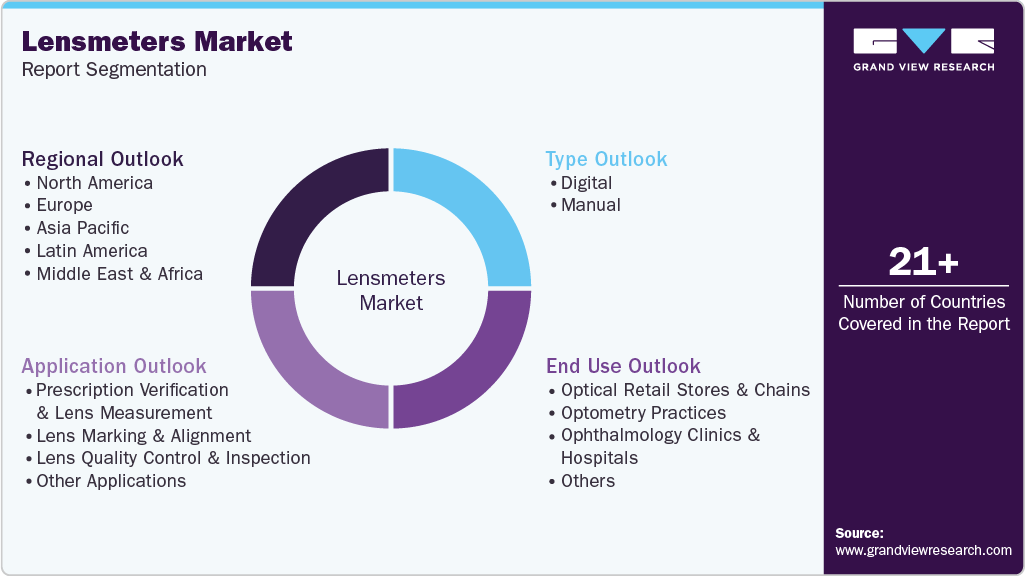
This report forecasts revenue growth at global, regional, and country levels and provides an analysis of the latest industry trends in each of the sub-segments from 2021 to 2033. For the purpose of this study, Grand View Research has segmented the global lensmeters market report based on type, application, end use, and region:
 To learn more about this report, Download Free Sample Report
-
Type Outlook (Revenue, USD Unit, 2021 - 2033)
-
Digital
-
Manual
-
-
Application Outlook (Revenue, USD Unit, 2021 - 2033)
-
Prescription Verification and Lens Measurement
-
Lens Marking and Alignment
-
Lens Quality Control and Inspection
-
Other Applications
-
-
End Use Outlook (Revenue, USD Unit, 2021 - 2033)
-
Optical Retail Stores and Chains
-
Optometry Practices
-
Ophthalmology Clinics and Hospitals
-
Others
-
-
Region Outlook (Revenue, USD Unit, 2021 - 2033)
-
North America
-
U.S.
-
Canada
-
Mexico
-
-
Europe
-
UK
-
Germany
-
France
-
Italy
-
Spain
-
Norway
-
Denmark
-
Sweden
-
-
Asia Pacific
-
China
-
Japan
-
South Korea
-
Thailand
-
Australia
-
India
-
-
Latin America
-
Brazil
-
Argentina
-
-
MEA
-
South Africa
-
Saudi Arabia
-
UAE
-
Kuwait
-
-
Research Methodology
The lensmeters market figures in this report are based on a proven research process that combines executive interviews with secondary research from proprietary databases, company filings, and recognized regulatory and institutional sources. Market size is built through value-chain sizing - reconciling supply-side and demand-side estimates - and triangulated with bottom-up and top-down approaches. Every estimate passes multiple levels of expert validation before publication, with each lensmeters segment quantified using the revenue-capture definitions in the table below.
Segment Definition
Type
Revenue capture definition
Digital
Revenue is generated through the sale of digital and automatic lensmeters used to measure spectacle lens power, verify prescriptions, and assess lens characteristics. Manufacturers generate revenue through equipment sales, with pricing varying according to measurement capabilities, automation features, connectivity, and additional functions such as UV transmittance measurement and pupillary distance assessment. Additional revenue may arise from equipment upgrades, accessories, servicing, maintenance, and technical support.
Manual
Revenue is generated through the sale of manual lensmeters used to measure the optical power and other characteristics of spectacle lenses through operator-controlled measurement procedures. Manufacturers and suppliers capture revenue through instrument sales, with pricing influenced by product design, measurement capabilities, build quality, and included accessories. Additional revenue may arise from replacement parts, calibration, repairs, and maintenance services. Demand is supported by optical retailers, optometry practices, and other users seeking cost-effective solutions for routine lens measurement and prescription verification.
Application
Revenue capture definition
Prescription Verification and Lens Measurement
Revenue is generated through the sale of lensmeters used to measure spectacle lens power and verify that lenses meet prescribed optical specifications. Manufacturers capture revenue through equipment sales to optical retailers, optometry practices, ophthalmology facilities, and optical laboratories. Demand is influenced by the volume of prescription eyewear dispensed, the need for accurate lens measurement, and the adoption of digital instruments that streamline verification procedures. Additional revenue may arise from equipment upgrades, maintenance, calibration, and related accessories.
Lens Marking and Alignment
Revenue is generated through the sale of lensmeters that support the identification of optical reference points and the marking and alignment of spectacle lenses during dispensing, fitting, and lens-processing activities. Manufacturers capture revenue through the supply of manual and digital instruments, with pricing varying according to marking capabilities, automation, lens compatibility, and integration with other optical equipment. Additional revenue may arise from accessories, replacement components, software or connectivity features where applicable, and servicing. Demand is influenced by the volume of spectacles fitted, the handling of multifocal and progressive lenses, and the need for accurate lens positioning.
Lens Quality Control and Inspection
Revenue is generated through the sale of lensmeters used to verify optical power and assess whether finished spectacle lenses meet specified measurement requirements during manufacturing, laboratory processing, and dispensing. Manufacturers generate revenue through equipment sales to optical laboratories, lens manufacturers, optical retailers, and other organizations performing lens quality checks. Revenue varies according to measurement accuracy, automation, throughput requirements, compatibility with different lens designs, and the sophistication of inspection workflows. Additional revenue may arise from calibration, maintenance, equipment upgrades, and technical support.
Other Applications
Revenue is generated through the sale of lensmeters used for specialized optical measurement activities, including educational demonstrations, research, training, and other applications outside routine prescription verification, lens marking, and quality control. Manufacturers and suppliers capture revenue through equipment sales to educational institutions, research facilities, training centers, and other users requiring lens measurement capabilities. Revenue varies according to instrument specifications, measurement requirements, and the intended operating environment. Additional revenue may arise from accessories, maintenance, calibration, and replacement components.
End-use
Revenue capture definition
Optical Retail Stores and Chains
Revenue is generated through the sale of manual and digital lensmeters to independent optical stores and organized eyewear retail chains for prescription verification, lens measurement, and spectacle quality checks before dispensing. Manufacturers and distributors capture revenue through equipment sales, with pricing varying according to store size, customer volumes, automation requirements, and product functionality. Additional revenue may arise from replacement equipment, upgrades across retail outlets, maintenance contracts, calibration, and technical support. Demand is influenced by prescription eyewear sales, the expansion of organized optical retail networks, and the need to maintain consistent dispensing procedures across locations.
Optometry Practices
Revenue is generated through the sale of lensmeters to independent optometrists and multi-location optometry practices for measuring existing spectacles, verifying prescriptions, and checking newly dispensed corrective lenses. Manufacturers and suppliers capture revenue through equipment sales, with purchasing decisions influenced by practice size, patient volumes, measurement requirements, and preference for manual or digital instruments. Additional revenue may arise from equipment upgrades, calibration, servicing, accessories, and technical support. Demand is influenced by the expansion of optometry services, the volume of vision assessments and spectacle prescriptions, and the adoption of digital equipment to improve practice efficiency.
Ophthalmology Clinics and Hospitals
Revenue is generated through the sale of lensmeters to ophthalmology clinics, eye hospitals, and multispecialty hospitals with ophthalmology departments for spectacle lens measurement and prescription verification. Manufacturers and distributors capture revenue through equipment sales, with pricing influenced by instrument capabilities, measurement requirements, expected usage, and the facility's equipment budget. Additional revenue may arise from maintenance contracts, calibration, repairs, replacement equipment, and technical support. Demand is influenced by patient volumes, the availability of refraction and optical services, and investments in ophthalmic equipment and clinical infrastructure.
Others
Revenue is generated through the sale of lensmeters to users outside optical retail stores, optometry practices, and ophthalmology clinics and hospitals. This segment may include optical laboratories, spectacle lens manufacturers, educational institutions, research facilities, and other specialized users that require lens measurement or verification equipment. Manufacturers and suppliers capture revenue through equipment sales, with pricing varying according to measurement requirements, production volumes, automation needs, and product specifications. Additional revenue may arise from equipment servicing, calibration, replacement parts, accessories, and technical support.
Estimation Model
01
02
03
04
Scope Definition
Build the Service Base
Estimate Service Utilization
Revenue Conversion
Which is the market to product/service related revenues are included in the market?
How many law enforcement currently used across the addressable market?
How many law enforcement are purchased and replaced annually?
How is annual law enforcement demand converted into market revenue?
PROCESSING STEPS
PROCESSING STEPS
PROCESSING STEPS
PROCESSING STEPS
1. Outline market and revenue segmentation that is aligned to the market definition.
1. Estimate law enforcement or optical retail stores by geographic region, optical radiology city, hospitals and other relevant facilities by country.
1. Estimate annual procurement/replacement from facility expansion, expansion of existing facilities and replacement of capex.
1. Collect average selling price of normal and digital law enforcement by country, product configuration, and supplier.
2. Segment the market by type, application, and end-user.
2. Associate proportion of facilities equipped with law enforcement systems to estimate the installed base by services type.
2. Assess replacement demand using estimated equipment life span, replacement cycles, and the timing of installed.
2. Calculate annual market revenue by multiplying estimated equipment sales by the corresponding average selling price.
3. Include equipment used for prescription verification, lens measurement, frame fitting, and equipment used by custom.
3. Determine the installed base by product type, driving a significant service market and digital services.
3. Estimate the adoption and replacement rate for digital law enforcement services and wearable.
3. Incorporate separately identifiable information from directly related equipment accessories or services only if substitution demand remains low.
4. Exclude revenue from market ophthalmic equipment, spectacle chemical, lens solutions, and eye-care service.
4. Cross-check estimates using manufacturer disclosures, distribution networks, facility data, and primary research.
4. Validate annual equipment demand against supplier installation, procurement records, product sales data, and primary research.
4. Validate market estimates against available company disclosures, distribution data, government statistics, and primary research.
DATA SOURCES
DATA SOURCES
DATA SOURCES
DATA SOURCES
Market reports and product catalogs of major optical care equipment suppliers, company websites, industry associations, distributor coverage.
Official law enforcement association websites, available government statistics databases, service licenses, manufacturer annual reports, investor presentations, and primary interviews.
Manufacturer annual reports and investor presentations, government and customs data, product industry association reports, equipment procurement records, and primary interviews.
Market research reports, manufacturer websites, government and customs publications, company disclosures, and primary research conducted through industry participants.
Delivered Customizations
This report has been delivered with the following In-depth customizations
Client Request
Customization Delivered
Value Adds
Technological Advancement
Conducted a comprehensive assessment of technological advancements shaping the lensmeter market, covering the transition from manual to automated and digital lensmeters. The analysis evaluated developments in automated lens measurement, multi-point measurement sensors, progressive lens detection, digital displays, UV transmittance measurement, and electronic data connectivity. It also assessed product launches, enhancements in measurement algorithms, compatibility with complex spectacle lens designs, and developments supporting integration with optical equipment and digital workflows.
Enables stakeholders to understand how technological innovation is influencing measurement efficiency, product differentiation, and purchasing decisions. The analysis supports the evaluation of digital adoption opportunities, identification of high-value product features, and assessment of how manufacturers can differentiate their offerings through automation, connectivity, and enhanced measurement capabilities.
Porter's Analysis
Conducted a detailed Porter's Five Forces analysis of the global lensmeters market, assessing competitive rivalry, the threat of new entrants, supplier bargaining power, buyer bargaining power, and the threat of substitutes. The assessment considered competition among established ophthalmic equipment manufacturers and specialized optical instrument suppliers, customer price sensitivity, equipment replacement cycles, technological requirements, distribution networks, and after-sales service. It also examined substitution between manual and digital lensmeters, the importance of product reliability and measurement accuracy, and the influence of brand reputation, procurement practices, and maintenance requirements on competitive conditions.
Enables stakeholders to evaluate competitive intensity, supplier positioning, and the factors influencing pricing and profitability. The analysis supports strategic decisions related to product development, pricing, distribution partnerships, customer acquisition, and service differentiation. It also highlights the impact of equipment affordability, switching considerations, technological capabilities, and established supplier relationships on competitive advantage.
Geographic Analysis
Conducted a comprehensive geographic assessment of the lensmeters market across North America, Europe, Asia-Pacific, Latin America, and the Middle East & Africa. The analysis evaluated regional differences in optical retail infrastructure, optometry services, prescription eyewear demand, healthcare access, equipment affordability, and adoption of digital equipment technologies. Country-level assessments considered the presence of optical retail chains, independent opticians, and optical laboratories, optometry practices, ophthalmology facilities, differences in digital adoption, purchasing power, and relevant equipment distribution networks. The analysis also assessed infrastructure, equipment replacement requirements, technician support, purchasing preferences, availability of import support, import and regulatory requirements, and opportunities for expanding access to manual and digital lensmeters.
Enables stakeholders to identify attractive regional markets, understand demand drivers, assess country-level opportunities, and prioritize expansion and investment strategies. The analysis supports decisions regarding distributor selection, product positioning, regional service support, local partnerships, and digital adoption, purchasing power, optical infrastructure, and equipment replacement requirements that may influence market entry and long-term growth.
About the Author(s)
Medical Devices Research Team
Healthcare · Medical DevicesThis report was authored by the medical devices research team at Grand View Research - comprising two research analysts, one senior research analyst, and one industry expert - with specialized expertise in the medical devices segment of the healthcare industry. All findings are based on proprietary healthcare databases, executive interviews, and regulatory analysis, subject to internal peer review prior to publication.
Last Updated:
Speak to Analyst

Customize this report to your needs - add regions, segments, or data points, with 20% free customization.
Or view our licence options:


ISO 9001:2015 & 27001:2022 Certified
We are GDPR and CCPA compliant! Your transaction & personal information is safe and secure. For more details, please read our privacy policy.


