
- Home
- »
- Next Generation Technologies
- »
-
LEO Space Situational Awareness Market Report, 2026-2033GVR Report cover

LEO Space Situational Awareness Market (2026 - 2033)
Size, Share & Trends Analysis Report By Offering (Ground-based Sensors, Data-as-a-Service), By Capability (Detect, Track & Identify, Threat Warning & Assessment), By End Use (Commercial), By Region, And Segment Forecasts
Market Size, 2025
$667.3MMarket Estimate, 2026
$711.0MMarket Forecast, 2033
$991.7MCAGR, 2026–2033
4.9%LEO Space Situational Awareness Market Report Summary
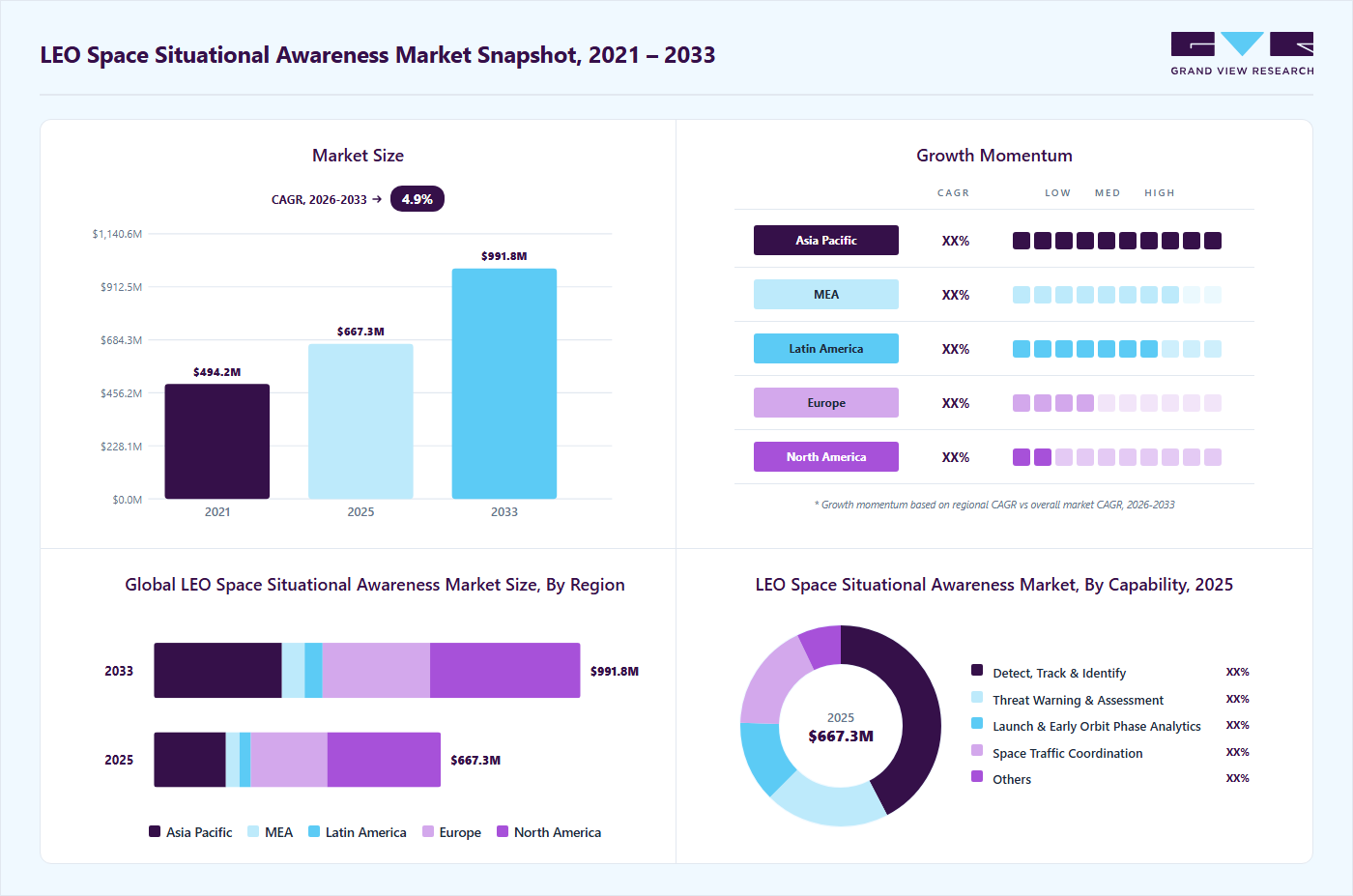
The global LEO space situational awareness market size was valued at USD 667.3 million in 2025 and is projected to grow from USD 711.0 million in 2026 to USD 991.7 million by 2033, at a CAGR of 4.9% from 2026 to 2033. The market in North America dominated with a revenue share of 39.6% in 2025. The rapid expansion of LEO satellite deployments-driven by broadband mega-constellations, Earth observation networks, and IoT-based systems is emerging as a defining trend within the broader space domain awareness market.
 Source: Grand View Research, IR Documents, Primary Interviews, Paid DatabasesTo learn more about this report,
 Download Free Sample Report
Key Market Trends & Insights
- By offering: Ground-based sensors segment held the largest market share of 60.7% in 2025.
- By capability: Detect, track & identity segment held the largest market share in 2025.
- By end use: Government & military segment held the largest market share of 69.2% in 2025.
Regional Highlights
- Largest regional market: North America (39.6% revenue share, 2025)
- Fastest-growing regional market: Asia Pacific (highest CAGR, 2026-2033)
- By country: U.S. held the largest market share in 2025
Market Size & Forecast
- Market size in 2025: USD 667.3 Million
- Estimated market size in 2026: USD 711.0 Million
- Projected market size by 2033: USD 991.7 Million
- CAGR (2026-2033): 4.9%
Three ways to get this report
Buy it, customize it, or ask a question.Ask an Analyst
Analyst response in 1 business day
- AccessReport author, directly
- Reply timeWithin 1 working day
- No sales callDirect answer only
- FormatEmail reply
- CostFree, no cost
Get the Full Report
What the study covers
- FormatsPDF · Excel · Dashboard
- Timeline2026–2033 annual, 2025 base
- Coverage20+ countries, 5 regions
- Companies10+ key players profiled
Customize the Report
20% free customization
- IncludeCountries, segments, points
- TailorTo your product definition
- ExtendDeeper competitor detail
- OrA fully bespoke study
- Turnaround5–10 working days
As the volume of orbital assets continues to surge, the risk of collisions is intensifying, creating a heightened demand for advanced detection, tracking, and monitoring capabilities. This evolving landscape is accelerating the adoption of sophisticated surveillance systems to enhance situational awareness, mitigate in-orbit risks, and ensure the long-term sustainability and operational integrity of both government and commercial space assets. Regulatory frameworks and international efforts aimed at space traffic management, data sharing, and space sustainability are strengthening the foundations of the SSA market. Countries and coalitions are moving toward common standards for collision-avoidance reporting, debris-mitigation guidelines, and the coordinated use of tracking information. This policy ecosystem enhances safety in LEO and creates market opportunities for standardized SSA solutions, driving broader adoption across borders and sectors.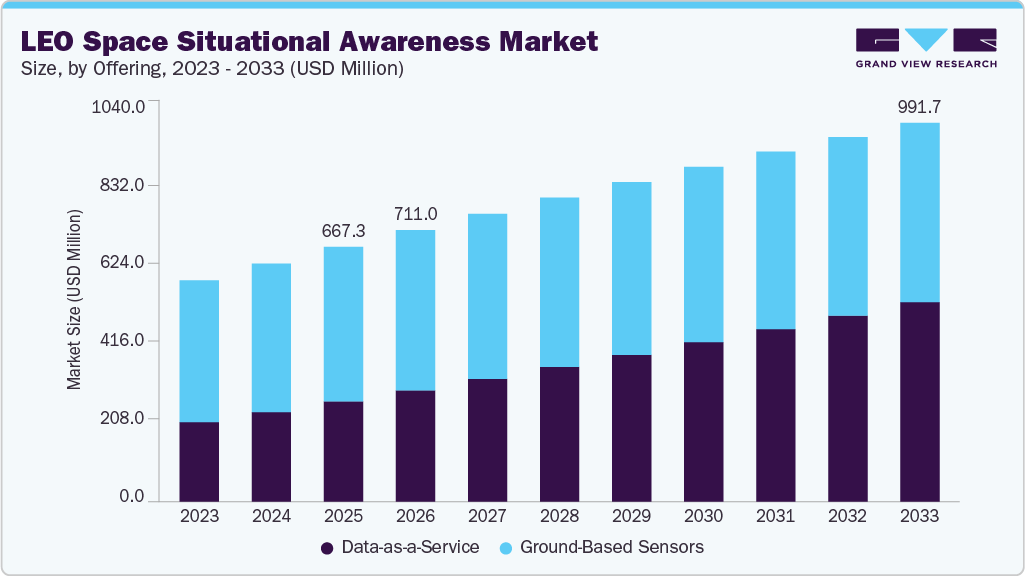 To learn more about this report, Download Free Sample Report
Additionally, the growing number of active satellites, defunct spacecraft, and collision fragments significantly increases the risk of in-orbit accidents. This heightened debris environment creates an urgent need for advanced detection, tracking, and predictive analytics systems to protect operational satellites, ensure safe navigation, and support long-term sustainability of LEO operations, with implications extending to the space weather market for integrated risk assessment. Governments and commercial operators are investing heavily in radar networks, optical sensors, and AI-enabled monitoring platforms to manage congestion and mitigate collision risks effectively.
Furthermore, the rising reliance on space-based services such as communication, navigation, and Earth observation has significantly increased the economic and strategic stakes of orbital safety, prompting both governments and private operators to implement proactive SSA measures, invest in real-time debris tracking, and adopt automated collision-avoidance solutions to protect critical infrastructure, which is expected to play a pivotal role in accelerating the LEO space situational awareness industry.
Moreover, companies are accelerating the adoption of Data-as-a-Service (DaaS), cloud-based SSA analytics, and AI-powered tracking platforms to optimize satellite operations, reduce operational risks, and comply with emerging global space traffic management regulations, particularly amid space weather market influences on orbital dynamics. These factors, alongside advancements in the SSA market, are expected to collectively drive the expansion of the LEO space situational awareness industry in the coming years.
Offering Insights
The ground-based sensors segment accounted for the largest share of over 60.7% in 2025, driven by their cost-effectiveness, wide coverage, and established deployment across global SSA networks, enabling continuous monitoring of LEO objects through radar and optical systems, along with strong government investments in upgrading legacy surveillance infrastructure and integrating advanced sensing technologies for accurate tracking and debris detection. Additionally, their ability to deliver high-accuracy tracking and reliable, all-weather performance, combined with easier maintenance, scalability, and integration with existing defense and space surveillance systems, further drives the segmental growth.
The data-as-a-service segment is projected to register the highest CAGR of over 8% from 2026 to 2033, driven by increasing demand for scalable, real-time SSA insights without significant upfront infrastructure costs. As commercial operators and governments move toward cloud-based analytics, subscription models, and API-driven data access, supported by rising satellite launches, the need for actionable intelligence and advancements in AI-powered space data processing is fueling segmental growth.
Capability Insights
The detect, track & identity segment accounted for the largest market revenue share in 2025, driven by the critical need for continuous monitoring of satellites, debris, and potential threats in increasingly congested LEO orbits, along with strong demand from government and defense agencies for real-time surveillance, collision avoidance, and space domain awareness capabilities. Additionally, the growing advancements in radar, optical sensors, and AI-based tracking systems are driving segmental growth.
The space traffic coordination segment is expected to grow at the fastest rate from 2026 to 2033, owing to the rapid rise in satellite constellations and orbital congestion, Additionally, the growing need for automated traffic management, regulatory compliance, and data-sharing frameworks to ensure safe and efficient space operations, alongside growing global efforts toward space governance, standardization, and commercial SSA service adoption are the key factors significantly accelerating the segmental growth.
End Use Insights
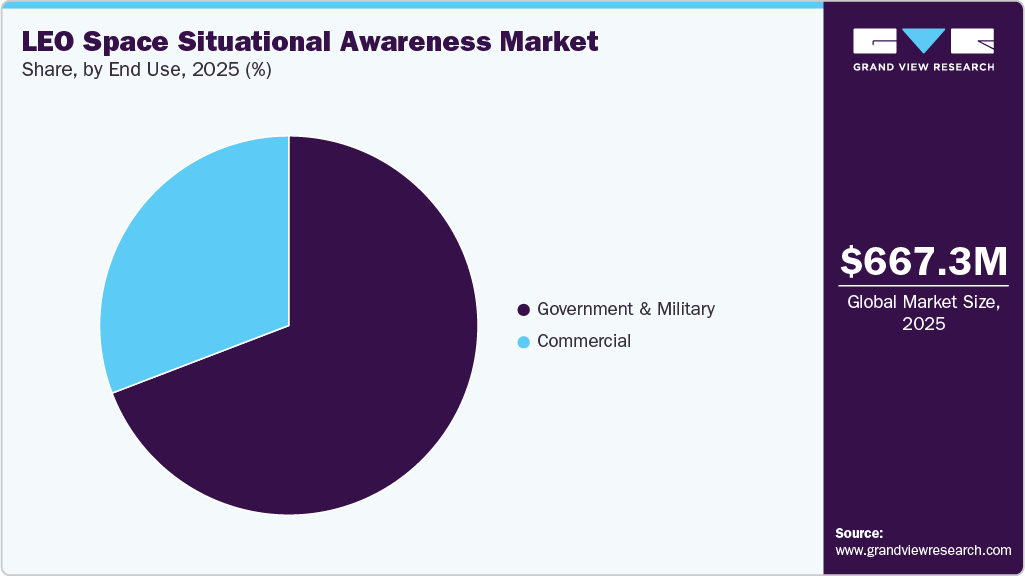
The government & military segment accounted for the largest market share of 69.2% in 2025, fueled by the growing recognition of space as a contested warfighting and strategic domain. Defense agencies invest heavily in SSA for missile warning, adversary satellite monitoring, and protection of critical national space assets, alongside maintaining sovereign control over space data and infrastructure. Rising geopolitical tensions, increasing dependence on space-based systems, and the need for real-time tracking, threat detection, and autonomous response systems further accelerate spending, supported by long-term defense budgets and national space programs.
 To learn more about this report, Download Free Sample Report
The commercial segment is anticipated to grow at the highest CAGR in the coming years, driven by the rapid proliferation of LEO satellite constellations and private space operators. Companies require SSA for collision avoidance, fleet management, regulatory compliance, and insurance risk mitigation, especially as orbital congestion and debris increase. The rise of mega-constellations, stricter global space regulations, and the need to ensure operational continuity and asset safety are pushing the adoption of cloud-based SSA analytics, automation, and data services, transforming SSA into a critical operational tool for day-to-day satellite missions.
Regional Insights
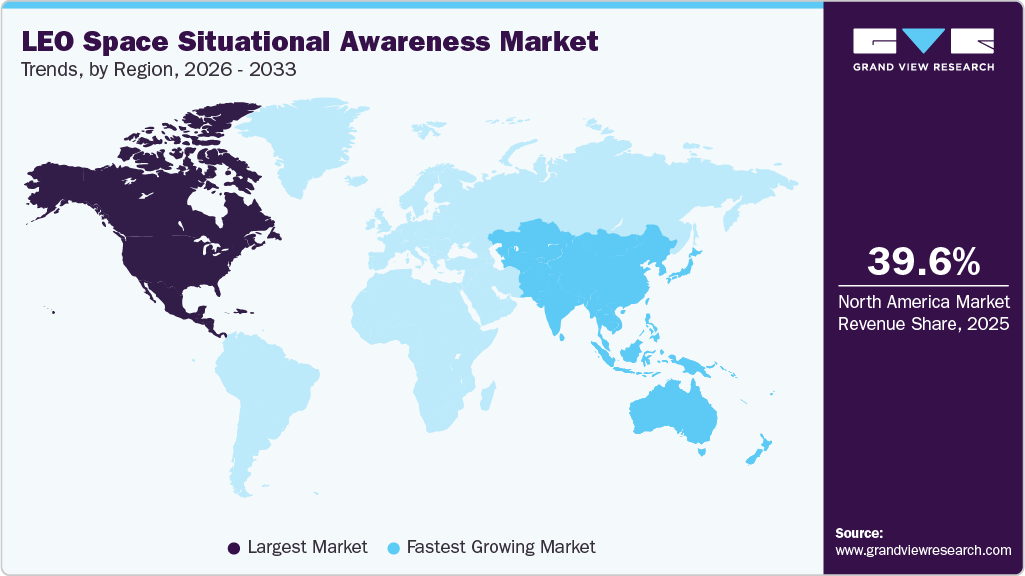
North America dominated the market with a revenue share of over 39.6% in 2025, driven primarily by strong defense spending, national security priorities, and advanced space infrastructure, especially in the United States. Government agencies and military bodies invest heavily in SSA for space surveillance, collision avoidance, and protection of critical assets, with support from organizations such as NASA and the DoD. The region also benefits from a mature private space ecosystem, robust R&D, and public–private partnerships, while rising orbital congestion and debris further accelerate demand for advanced SSA solutions.
 To learn more about this report, Download Free Sample Report
U.S. LEO Space Situational Awareness Market Trends
The U.S. LEO space situational awareness industry accounted for the largest market share of over 84% in 2025, owing to its largest space surveillance network, high defense budgets, and leadership in LEO satellite deployments. Key drivers include increasing reliance on space for military and commercial applications, rapid expansion of mega-constellations, and continuous investments in AI-enabled tracking, sensor systems, and space traffic management.
Europe LEO Space Situational Awareness Market Trends
Europe LEO space situational awareness industry accounted for a significant share of over 26% from 2026 to 2033. In Europe, the market is driven by collaborative frameworks and regulatory focus on space sustainability, led by initiatives from the European Space Agency and member states. The region emphasizes space debris monitoring, collision avoidance, and space weather tracking, alongside increasing investments in sovereign space capabilities.
The UK LEO space situational awareness industry is expected to grow rapidly in the coming years, fueled by growing investments in space surveillance infrastructure, data analytics, and private-sector partnerships, while aligning closely with international SSA programs. The market growth is also supported by increasing domestic launch capabilities and emphasis on space traffic management and sustainability policies.
The Germany LEO space situational awareness industry is driven by its strong aerospace manufacturing base and engineering capabilities. The country focuses on high-precision sensor systems, radar technologies, and space research programs, supported by government funding and ESA collaboration. Trends include increasing participation in EU-led SSA initiatives, defense modernization, and integration of SSA with broader digital and AI capabilities, particularly for tracking debris and ensuring operational safety in LEO.
Asia Pacific LEO Space Situational Awareness Market Trends
The Asia Pacific LEO space situational awareness industry is anticipated to register the highest CAGR of over 7% from 2026 to 2033, driven by rapid expansion of national space programs, rising satellite launches, and increasing geopolitical competition in space. Countries across APAC are investing heavily in SSA infrastructure, AI-based analytics, and regional cooperation frameworks to manage space traffic and debris.
The Japan LEO space situational awareness industry is gaining momentum, through defense-driven space policies and technological innovation, with strong involvement from JAXA and national security agencies. The ongoing development of space surveillance systems, debris tracking, and integration of SSA into national security frameworks, along with investments in AI, robotics, and precision sensing technologies, are the key factors driving the market growth.
The China LEO space situational awareness industry is experiencing significant growth, fueled by the rapid expansion of space capabilities, large-scale satellite deployments, and a strategic emphasis on space dominance. The country is also improving AI-powered SSA systems and space traffic management, while increasing involvement in global space operations and competition in LEO constellations.
Key LEO Space Situational Awareness Company Insights
Some of the key players operating in the market are Lockheed Martin Corporation and L3 Harris Technologies, Inc., among others.
-
Lockheed Martin Corporation provides integrated space surveillance networks including the Space Fence radar and iSpace C2 platforms, for comprehensive LEO object cataloging, collision risk assessment, real-time maneuver detection, and mission planning, supporting U.S. Space Force and allied SSA operations with decades of proven defense-grade reliability, multi-sensor data fusion, and persistent monitoring capabilities essential for national security in increasingly congested orbital environments.
-
L3Harris Technologies, Inc. offers Space Sentry's global electro-optical sensor array combined with advanced radar solutions for persistent LEO/GEO tracking, space traffic coordination, threat characterization, and automated decision support through sophisticated data fusion, analytics platforms, and resilient communication networks that enable commercial operators and defense missions to maintain orbital safety and operational tempo amid rising debris and satellite densities.
Some of the emerging players operating in the market include LeoLabs, Inc., and NorthStar Earth & Space Inc., among others.
-
LeoLabs, Inc. provides commercial phased-array radar constellations spanning multiple continents delivering high-precision LEO object tracking at >10 cm resolution, comprehensive collision warnings, launch/reentry support services, maneuver detection analytics, and customized orbit determination for satellite operators worldwide, revolutionizing commercial SSA access with scalable, 24/7 global coverage and API-integrated data delivery.
-
NorthStar Earth & Space Inc. offers the pioneering Skylark space-based SSA microsatellite network that scans LEO/MEO/GEO orbits continuously from orbit itself, providing weather-independent detection of debris and satellites, low-latency proximity alerts, precise conjunction analysis, and space weather monitoring with unmatched revisit rates and global coverage for both government and commercial customers navigating complex orbital regimes.
Key LEO Space Situational Awareness Companies:
The following key companies have been profiled for this study on the LEO space situational awareness market.
- Lockheed Martin Corporation
- L3Harris Technologies, Inc.
- Kratos Defense & Security Solutions, Inc.
- Parsons Corporation
- ExoAnalytic Solutions
- RTX Corporation
- LeoLabs, Inc.
- NorthStar Earth & Space Inc.
- Peraton Corp.
- Vision Engineering Solutions, LLC
Recent Developments
-
In February 2026, SpaceX unveiled Stargaze, its innovative space situational awareness (SSA) and traffic management system leveraging star tracker cameras from ~10,000 Starlink satellites to generate 30 million daily object observations, delivering near real-time collision warnings, maneuver detection, and conjunction data messages (CDMs) to operators free of charge, enhancing LEO safety amid orbital congestion.
-
In August 2025, Lockheed Martin announced that its first Next-Generation Overhead Persistent Infrared (Next-Gen OPIR) Geosynchronous Earth Orbit (GEO) Block 0 missile warning satellite successfully completed environmental testing at its Sunnyvale, California facility.
-
In April 2025, LeoLabs launched its next-generation expeditionary radar system, designed for advanced Space Domain Awareness (SDA) missions, delivering enhanced detection, tracking, and characterization of objects in low Earth orbit (LEO) to support military and commercial space operations with deployable, high-resolution capabilities.
LEO Space Situational Awareness Market Report Scope
Report Attribute
Details
Market size in 2025
USD 667.3 million
Estimated Market size in 2026
USD 711.0 million
Projected Market size by 2033
USD 991.7 million
Growth rate
CAGR of 4.9% from 2026 to 2033
Base year for estimation
2025
Historical data
2021 - 2024
Forecast period
2026 - 2033
Quantitative units
Revenue in USD Million and CAGR from 2026 to 2033
Report Product
Revenue forecast, company ranking, competitive landscape, growth factors, and trends
Segments covered
Offering, capability, end use, region
Regional scope
North America; Europe; Asia Pacific; Latin America; Middle East & Africa
Country scope
U.S.; Canada; Mexico; UK; Germany; France; China; Japan; India; South Korea; Australia; Brazil; UAE; Saudi Arabia; South Africa
Key companies profiled
Lockheed Martin Corporation; L3Harris Technologies; Kratos Defense & Security Solutions; Parsons Corporation; ExoAnalytic Solutions; RTX Corporation; LeoLabs; NorthStar Earth & Space; Peraton Corp.; Vision Engineering Solutions
Customization scope
Free report customization (equivalent to up to 8 analyst’s working days) with purchase. Addition or alteration to country, regional & segment scope.
Pricing and purchase options
Avail customized purchase options to meet you exact research needs. Explore purchase options
Global LEO Space Situational Awareness Market Report Segmentation
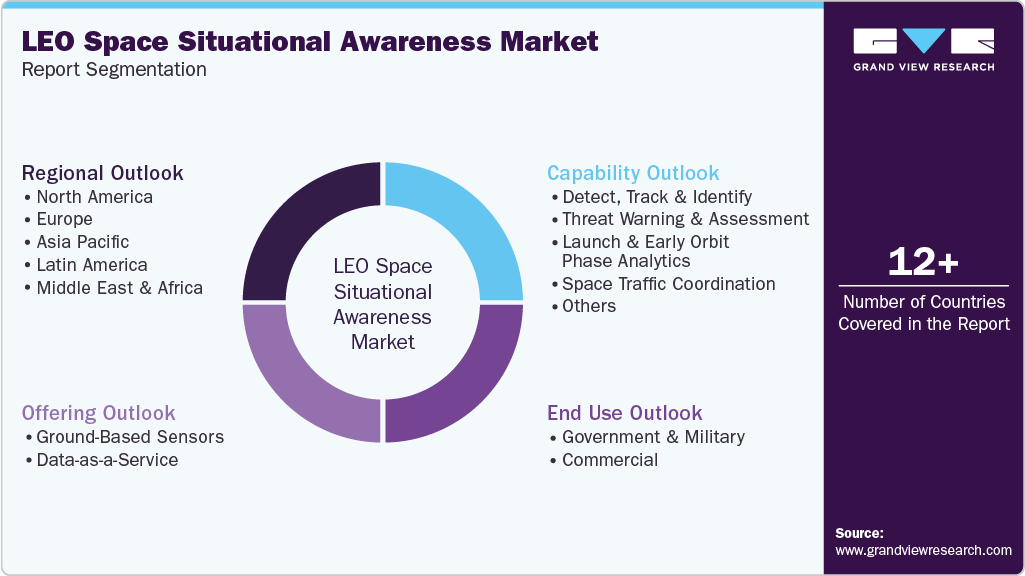
This report forecasts revenue growth at the global, regional, and country levels and provides an analysis of the latest industry trends across sub-segments from 2021 to 2033. For this study, Grand View Research has segmented the global LEO space situational awareness market based on offering, capability, end use, and region:
 To learn more about this report, Download Free Sample Report
-
Offering Outlook (Revenue, USD Million, 2021 - 2033)
-
Ground-Based Sensors
-
Radar Systems
-
Optical Telescopes
-
Laser Ranging Systems
-
Sensor Network Infrastructure
-
-
Data-as-a-Service
-
Satellite Collision Avoidance
-
Space Debris Tracking
-
Launch & Early Orbit Monitoring
-
Others
-
-
-
Capability Outlook (Revenue, USD Million, 2021 - 2033)
-
Detect, Track & Identify
-
Threat Warning & Assessment
-
Launch & Early Orbit Phase Analytics
-
Space Traffic Coordination
-
Others
-
-
End Use Outlook (Revenue, USD Million, 2021 - 2033)
-
Government & Military
-
Commercial
-
-
Regional Outlook (Revenue, USD Million, 2021 - 2033)
-
North America
-
U.S.
-
Canada
-
Mexico
-
-
Europe
-
UK
-
Germany
-
France
-
-
Asia Pacific
-
China
-
India
-
Japan
-
Australia
-
South Korea
-
Australia
-
-
Latin America
-
Brazil
-
-
MEA
-
UAE
-
South Africa
-
Kingdom of Saudi Arabia (KSA)
-
-
Frequently Asked Questions About This Report
North America dominated with a 39.6% revenue share in 2025.
Asia Pacific is the fastest-growing region over the forecast period.
The detect, track & identity segment held the largest revenue share in 2025, while space traffic coordination is the fastest-growing capability.
The government & military segment led with a 69.2% revenue share in 2025, while commercial is the fastest-growing segment.
The global LEO space situational awareness market size was valued at USD 667.3 million in 2025 and is estimated at USD 711.0 million for 2026.
The global LEO space situational awareness market is expected to grow at a CAGR of 4.9% from 2026 to 2033, reaching USD 991.7 million by 2033.
The ground-based sensors segment accounted for the largest share of over 60% in 2025, driven by their cost-effectiveness, wide coverage, and established deployment across global SSA networks
Key players include Lockheed Martin Corporation; L3Harris Technologies; Kratos Defense & Security Solutions; Parsons Corporation; ExoAnalytic Solutions; RTX Corporation; LeoLabs; NorthStar Earth & Space; Peraton Corp.; Vision Engineering Solutions.
Key factors driving the LEO space situational awareness market include increasing satellite constellations in low Earth orbit, rising orbital congestion and collision risks, growing threats from space debris, and demand for enhanced space security and traffic management.
About the Author(s)
Next Generation Technologies Research Team
Technology · Next Generation TechnologiesThis report was authored by the next generation technologies research team at Grand View Research - comprising two research analysts, one senior research analyst, and one industry expert - with specialized expertise in the next generation technologies segment of the technology industry. All findings are based on proprietary technology databases, executive interviews, and regulatory analysis, subject to internal peer review prior to publication.
Last Updated:
Speak to Analyst

Customize this report to your needs - add regions, segments, or data points, with 20% free customization.
Or view our licence options:


ISO 9001:2015 & 27001:2022 Certified
We are GDPR and CCPA compliant! Your transaction & personal information is safe and secure. For more details, please read our privacy policy.


