
- Home
- »
- Consumer Goods
- »
-
Life Jacket Market Size, Share & Growth Report, 2026-2033GVR Report cover
![Life Jacket Market (2026 - 2033)Report]()
Life Jacket Market (2026 - 2033)
Size, Share & Trends Analysis Report By Product (Foam, Inflatable, Hybrid), By End User (Recreational, Professional & Rescue), By Distribution Channel (Offline Retail & Dealers, Direct & Institutional), By Region, And Segment Forecasts
Market Size, 2025
$1,040.5MMarket Estimate, 2026
$1,085.2MMarket Forecast, 2033
$1,496.7MCAGR, 2026–2033
4.7%Life Jacket Market Summary
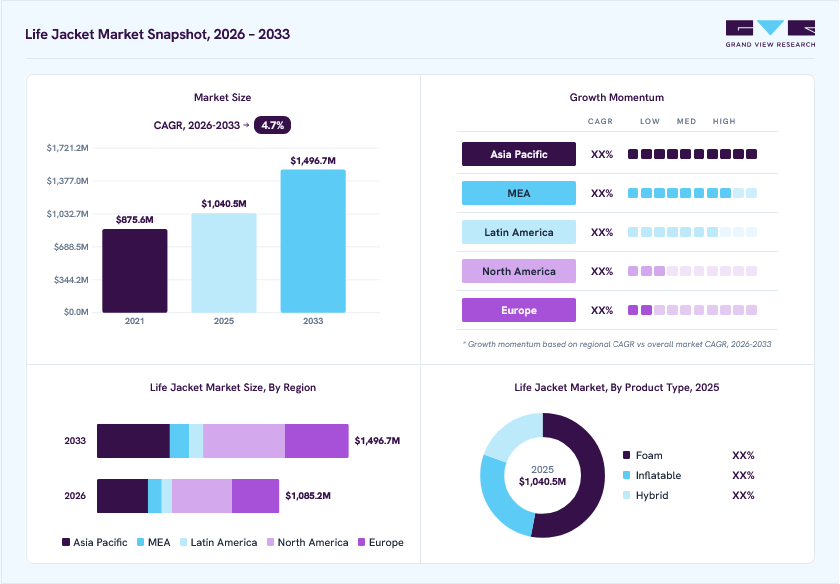
The global life jacket market size was valued at USD 1,040.5 million in 2025 and is projected to grow from USD 1,085.2 million in 2026 to USD 1,496.7 million in 2033, at a CAGR of 4.7% from 2026 to 2033. North America dominated the market, accounting for the largest revenue share of 33.1% in 2025. The market is growing due to stricter maritime safety requirements, expanding commercial and passenger water transport, rising participation in marine tourism and water sports, and increasing demand for the replacement of certified life jackets.
Key Market Trends & Insights
- By product: Foam life jacket held the largest revenue share of 53.0% in 2025
- By end user: Recreational life jacket segment dominated the life jacket industry, accounting for 73.6% of global revenue share in 2025
- By distribution channel: Sales of life jackets through offline retail & dealers held the largest revenue share of 42.3% in 2025
Regional Highlights
- Largest regional market: North America (33.1% revenue share, 2025)
- Fastest-growing regional market: Asia Pacific (highest CAGR, 2026-2033)
- By country: The U.S led North America with a revenue share of 87.9% in 2025
Market Size & Forecast
- 2025 Revenue: USD 1,040.5 Million
- Estimated Market Size in 2026: USD 1,085.2 Million
- 2033 Projected Market Size: USD 1,496.7 Million
- CAGR (2026-2033): 4.7%
Stricter maritime safety requirements remain a major market driver, particularly across commercial shipping, passenger vessels, high-speed craft, and professional marine operations. The IMO’s LSA Code requires life-saving appliances to meet defined technical standards, while amendments effective January 1, 2026, strengthened requirements for lifejackets, including improved performance for turning unconscious persons face-up. This regulatory environment supports recurring demand for certified replacement equipment and creates opportunities for higher-specification products.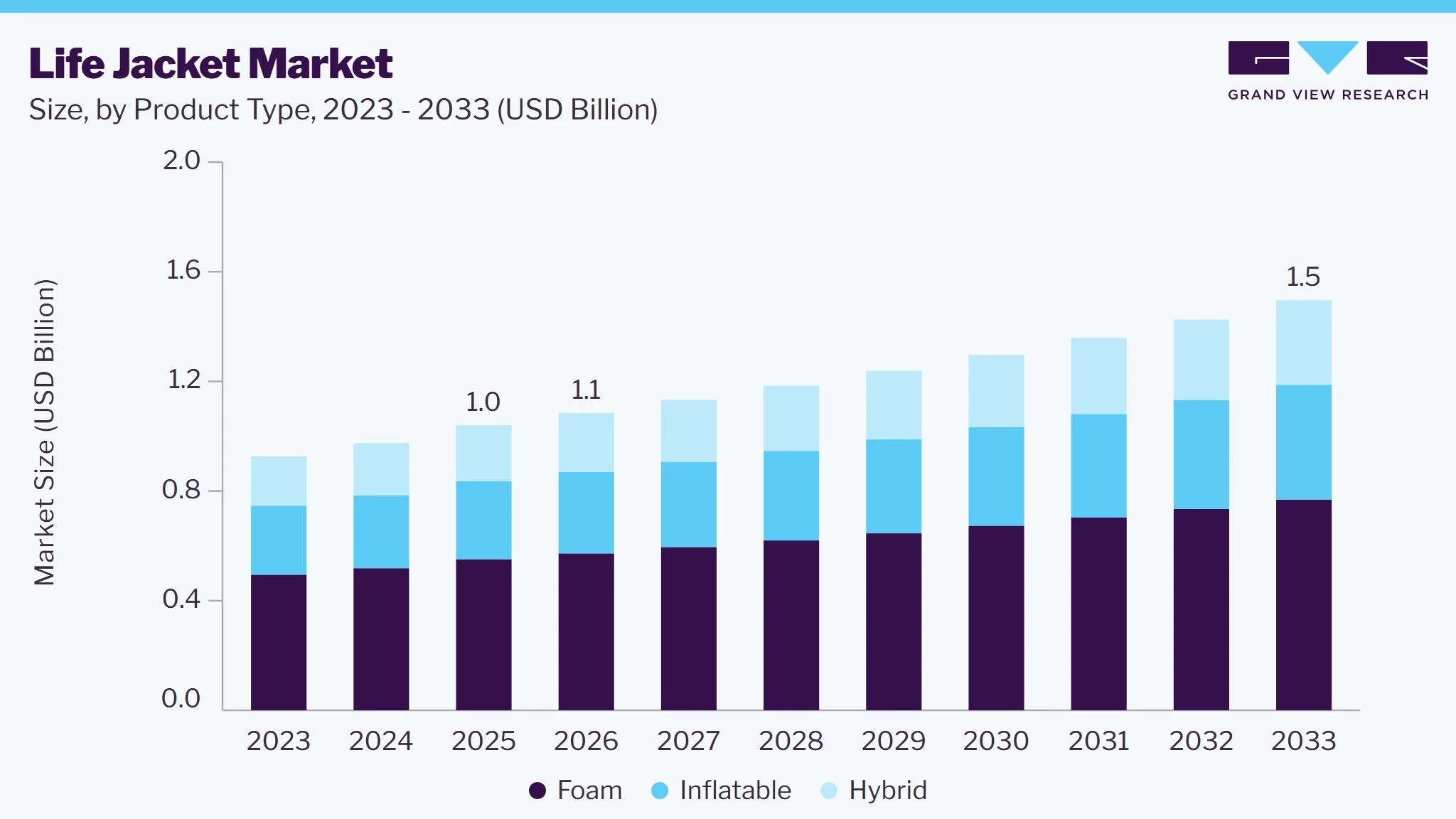
Rising water-based activity and the need to improve PFD usage are also supporting demand across recreational boating, fishing, water sports, and marine tourism. In the U.S., the Coast Guard recorded 3,887 recreational boating incidents, 556 deaths, and 2,170 injuries in 2024, while its latest wear-rate study continues to identify substantial non-use of life jackets among drowning victims. This creates demand for products that improve comfort, fit, visibility, and ease of use, supporting the foam life jacket market and growth in inflatable and hybrid designs.
Product innovation and application-specific designs are expanding the addressable market beyond conventional foam PFDs. Manufacturers are developing lower-profile inflatable products, specialized rescue PFDs, and designs for aviation and other specialized applications. This supports niche categories such as the siamese life jacket market and aircraft life jacket market, where products are designed around specific operational and safety requirements. The FAA also continues to regulate self-inflating personal safety devices, including inflatable life jackets, reflecting the need for specialized certified equipment across aviation-related applications.
Market Dynamics
The market is supported by demand from commercial fishing, passenger vessels, offshore operations, rescue services, and other professional marine activities, where PFDs are part of required safety equipment rather than discretionary purchases. The U.S. Coast Guard classifies commercial PFDs separately from recreational PFDs and covers inherently buoyant, inflatable, and hybrid designs, creating a diversified institutional demand base.
Even when life jackets are available or required, discomfort and restricted movement can discourage consistent use, particularly during long-duration fishing, sailing, and other water sports. This is pushing manufacturers toward better-fitting, lower-profile designs, but balancing comfort with flotation performance remains a challenge. NRS, for example, has introduced graded sizing and body-contoured flotation to improve fit across different users.
Manufacturers can capture premium demand by tailoring life jackets to specific activities rather than offering a single standard design. Rescue, fishing, paddling, offshore, and professional users increasingly require different combinations of storage, mobility, visibility, buoyancy, and protection. The U.S. Coast Guard itself distinguishes commercial PFDs by inherently buoyant, inflatable, and hybrid construction, while specialized products such as rescue PFDs demonstrate the opportunity for higher-value application-specific designs.
Analyst Perspective
The global life jacket market is evolving from a basic safety product into a broader water-safety and recreational equipment market, with foam jackets remaining widely used while inflatable and hybrid designs gain traction. Rising participation in boating, water sports, fishing, and marine tourism, along with stricter safety regulations and growing awareness of personal flotation devices, is supporting market growth. Manufacturers are focusing on lightweight, comfortable, durable, and application-specific designs to expand adoption across recreational, commercial, rescue, and government applications.
Consumer Insights
Users by Gender
-
Male: Represents a significant user base across boating, fishing, sailing, water sports, commercial marine activities, and other water-based applications.
-
Female: Demand is supported by increasing participation in recreational boating, water sports, marine tourism, and family-oriented water activities.
Users by Age Group
-
Under 18 (Children): Demand is primarily safety-driven, with parents prioritizing appropriate sizing, buoyancy, visibility, and secure fit.
-
18-34 Years: Higher participation in water sports, boating, fishing, adventure activities, and marine recreation.
-
35-54 Years: Broad usage across recreational boating, fishing, sailing, family water activities, and commercial applications.
-
55+ Years: Demand is supported by boating, fishing, sailing, and marine leisure activities, with greater emphasis on comfort, ease of use, and reliable buoyancy.
Pain Points of Consumers
-
Poor Fit & Comfort: Bulky or poorly fitted designs can restrict movement and discourage consistent use.
-
Limited Mobility: Conventional foam designs can feel restrictive during sailing, fishing, and water sports.
-
Inflatable Maintenance: Inflatable PFDs require cylinder replacement, inspection, and proper maintenance.
-
Product Selection: Consumers may find it difficult to choose the appropriate size, buoyancy rating, inflation mechanism, and certification.
-
Price Sensitivity: Premium inflatable and hybrid products can be considerably more expensive than basic foam alternatives.
-
Safety & Certification: Consumers and institutional buyers increasingly prioritize certified products from established manufacturers to ensure reliable performance.
Product Insights
Form life jacket accounted for 53.0% of global revenue share in 2025, owing to their immediate buoyancy, low maintenance, durability, and suitability for children and non-swimmers make them the preferred choice across a broad range of users and activities. Unlike inflatable products, foam jackets do not require activation or CO₂ cartridges and provide flotation as soon as the wearer enters the water. The U.S. Coast Guard notes that most adults require only 7-12 lb of additional buoyancy, while Type III foam PFDs typically provide at least 15.5 lb, making foam designs suitable for general boating and watersports.
The hybrid life jacket segment is projected to grow at a CAGR of 5.3% from 2026 to 2033. Hybrid life jackets are expected to grow as users seek a balance between the reliability of foam and the lower profile and comfort of inflatable systems. The inherent foam provides immediate baseline buoyancy, while the inflatable chamber can provide additional flotation when required, making hybrids attractive for users who want greater mobility without completely sacrificing passive flotation. For example, U.S. Coast Guard specifications list hybrid Type V PFDs at 7.5 lb buoyancy when deflated and 22 lb when fully inflated, illustrating the substantial increase in flotation available after activation.
End User Insights
The recreational life jacket segment dominated the life jacket industry, accounting for 73.6% of global revenue share in 2025, as life jackets are required for a wide range of boating and leisure water activities, including fishing, kayaking, canoeing, water skiing, and general boating. Regulatory requirements also create a broad, recurring consumer base: the U.S. Coast Guard requires recreational vessels to carry an approved wearable PFD for each person on board. In addition, research published in Risk Analysis found that life-jacket use was associated with an approximately 80% reduction in deaths per vessel in the analyzed recreational-boating accident data, reinforcing consumer and safety-education demand for recreational PFDs.
The professional & rescue life jacket market segment is projected to grow at a CAGR of 4.6% from 2026 to 2033. Professional and rescue life jackets are projected to grow as commercial marine, emergency response, offshore, and specialized water operations increasingly require higher-performance flotation equipment. These users typically need products offering greater buoyancy, durability, visibility, mobility, and task-specific features rather than basic recreational protection. For instance, the U.S. Coast Guard classifies Type I PFDs for open ocean, rough seas, remote waters, commercial vessels, and passenger vessels, while special-purpose PFDs are designed for specific operational environments, supporting demand for specialized professional equipment.
Distribution Channel Insights
The sale of life jackets through offline retail and dealers accounted for 42.3% of global revenue in 2025, as purchasing a life jacket often requires physical fitting, inspection, sizing, and product-specific advice before purchase. This is particularly important because an incorrect fit can affect both comfort and flotation performance. Specialized marine and sporting goods retailers can also advise customers on the appropriate PFD type for activities such as fishing, paddling, or offshore boating. Industry research similarly identifies physical inspection, immediate availability, and knowledgeable sales assistance as key reasons for the continued dominance of offline channels.
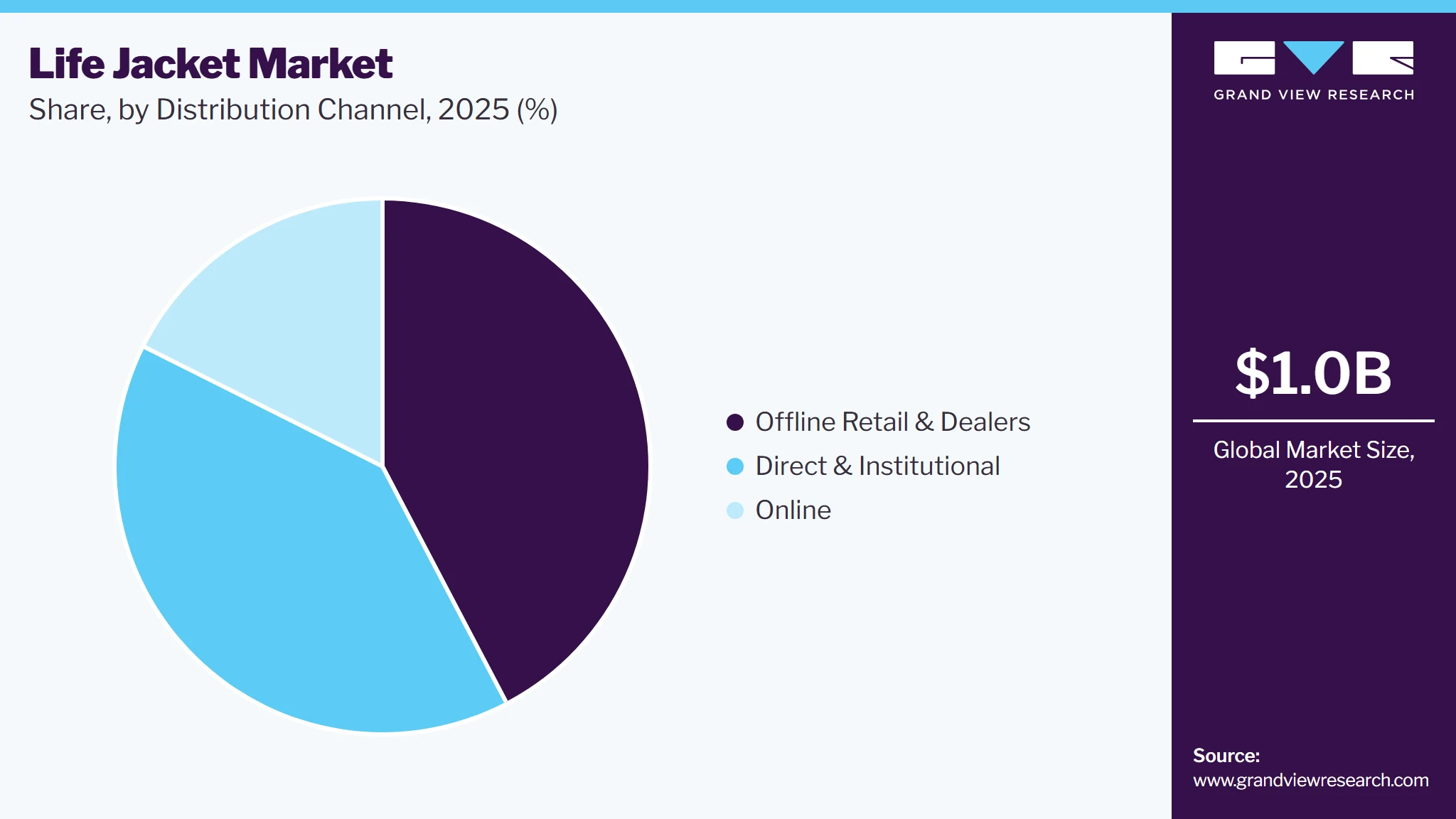
The sale of life jackets through online channels is projected to grow at a CAGR of 5.0% from 2026 to 2033, driven primarily by rising recreational participation and the increasing availability of activity-specific life jackets online. Recreational users can increasingly compare PFDs by buoyancy, fit, certification, and intended activity, while smaller commercial and professional operators can source specialized products online without relying solely on local marine dealers.
Regional Insights
The life jacket industry in North America led the global market, accounting for the largest revenue share of 33.1% in 2025. Demand is supported by the region’s large recreational boating base and continued focus on PFD usage and boating safety. In the U.S., the Coast Guard reported 556 recreational boating fatalities in 2024, with 76% of fatal victims drowning and 87% of victims with known PFD usage not wearing one, highlighting substantial room for increased life-jacket adoption.

U.S. Life Jacket Market Trends
The U.S. life jacket industry accounted for approximately 87.9% of North America in 2025. The U.S. market is supported by a large installed recreational boating base, with 11.67 million registered recreational vessels in 2024, up 1.1% from 2023. Continued spending on boating equipment, accessories, and vessel outfitting also supports recurring demand for PFD replacement and upgrades.
Europe Life Jacket Market Trends
The life jacket industry in Europe accounted for 26.1% of the global market in 2025. European demand is supported by extensive recreational boating and sailing, coastal tourism, professional marine activities, and stringent maritime safety requirements. The region also has a substantial professional rescue ecosystem; the RNLI reported more than 9,000 lifeboat launches and 272 lives saved in 2025, reinforcing demand for reliable personal flotation and rescue equipment.
The life jacket market in Germany accounted for the largest revenue share of around 18.2% in 2025. Germany's market is supported by its established recreational boating, sailing, inland waterways, and professional marine sectors, with demand increasingly favoring certified, comfortable, and technologically advanced PFDs. Strong European safety and certification requirements also support demand for replacements and premium products.
The UK life jacket market is projected to grow at a CAGR of 4.1% from 2026 to 2033. The UK market benefits from extensive coastal and recreational boating activity and strong water-safety awareness. In 2025, RNLI lifeboats launched more than 9,000 times and helped 8,290 people, creating continued demand for reliable flotation and rescue equipment across recreational and professional applications.
The life jacket market in France is projected to grow at a CAGR of 4.4% from 2026 to 2033. Demand is supported by France's large coastal tourism, sailing, boating, and water sports ecosystem. Growth is also reinforced by demand for certified PFDs across recreational and professional marine activities, with manufacturers increasingly emphasizing lighter designs, improved fit, and inflatable solutions.
Asia Pacific Life Jacket Market Trends
The Asia Pacific life jacket industry is projected to grow at a fastest CAGR of 5.2% from 2026 to 2033. Asia Pacific has a broader demand base spanning commercial shipping, fishing, inland-water transport, passenger ferries, marine tourism, water sports, and government/rescue operations. Increasing enforcement of water-safety requirements is strengthening institutional demand alongside consumer markets.
The China life jacket market led Asia Pacific with the largest revenue share of 40.23 % in 2025. China is supported by commercial and passenger water transport, water-sports activities, tourism, and government-led safety enforcement. In 2025-2026, China's State General Administration of Sport required participants in water sports, including mass-participation events, to wear compliant life jackets, thereby reinforcing demand beyond conventional boating.
The life jacket market in India is projected to grow at a CAGR of 6.0% from 2026 to 2033. India has a strong regulatory-driven demand base for inland passenger vessels, ferries, commercial vessels, and water transport, as well as for tourism and recreational applications. India's Inland Vessels (Life Saving Appliances) Rules require vessels to carry life jackets and other lifesaving equipment, creating a recurring institutional replacement market.
Central & South America Life Jacket Market Trends
The Central & South America life jacket industry is projected to grow at a CAGR of 4.8% from 2026 to 2033. Demand is driven by commercial and passenger water transport, fishing, river operations, coastal tourism, water sports, and maritime safety requirements. Large river systems and extensive coastlines make life jackets relevant to both organized transport operations and tourism-related water activities.
Middle East & Africa Life Jacket Market Trends
The Middle East & Africa life jacket industry is projected to grow at a CAGR of 5.0% from 2026 to 2033. The market is supported by commercial shipping, offshore oil & gas, fishing, passenger transport, coastal tourism, diving, water sports, and marine rescue. Expansion of coastal tourism and marine infrastructure is increasing demand for certified flotation equipment across professional and leisure applications.
Key Life Jacket Company Insights
The global life jacket market is moderately fragmented, with competition among established marine-safety companies, recreational PFD brands, specialized safety providers, and regional/private-label manufacturers. Competition is increasingly focused on product safety, comfort, durability, certification, product innovation, and distribution reach, with inflatable and hybrid designs gaining importance alongside traditional foam products.
-
Established Global Players: Survitec Group Limited, VIKING Life-Saving Equipment A/S, Mustang Survival Corp., LALIZAS Group, and Hansen Protection AS compete through broad product portfolios, international certifications, established distribution networks, and strong presence across commercial, recreational, and professional marine applications.
-
Recreational & Water-Sports Specialists: Johnson Outdoors (Stearns), NRS, Spinlock Ltd., and Crewsaver focus on boating, fishing, paddling, sailing, and water sports. Their differentiation centers on lightweight construction, ergonomic fit, comfort, specialized buoyancy systems, and application-specific designs.
-
Safety & Professional Application Specialists: SECUMAR GmbH, Survitec, VIKING, and Hansen Protection compete in commercial, offshore, rescue, and professional applications through certified safety performance, high-visibility designs, automatic inflation systems, durability, and regulatory compliance.
-
Regional & Private-Label/OEM Manufacturers: Regional manufacturers and OEM suppliers compete primarily through cost efficiency, customization, flexible production, localized distribution, and private-label manufacturing, particularly across recreational and institutional markets. Their key limitations include lower brand recognition, narrower distribution networks, and comparatively limited global market presence.
Key Life Jacket Companies
The following key companies have been profiled for this study of the life jacket market.
-
Survitec Group Limited
-
VIKING Life-Saving Equipment A/S
-
Mustang Survival Corp.
-
Johnson Outdoors Inc. (Stearns)
-
LALIZAS Group
-
Hansen Protection AS
-
Secumar GmbH
-
Spinlock Ltd.
-
NRS (Northwest River Supplies)
-
Crewsaver
Competitive Benchmarking
Category
Operating Strategies
Competitive Edge
Key Challenges
Established Players (Survitec Group Limited; VIKING Life-Saving Equipment A/S; Mustang Survival Corp.; Johnson Outdoors Inc. (Stearns); LALIZAS Group; Hansen Protection AS)
- Focus on broad product portfolios covering recreational, commercial, professional & rescue, and government applications. Invest in inflatable and hybrid technologies, product certifications, safety performance, distribution networks, and relationships with marine equipment distributors, retailers, vessel operators, and institutional buyers.
- Strong brand recognition, extensive product portfolios, regulatory and certification expertise, established distribution networks, long-standing customer relationships, manufacturing capabilities, and global market presence.
- Intense competition across mature markets, certification and regulatory compliance costs, raw-material and manufacturing costs, product liability exposure, and pressure to balance safety performance with comfort, weight, and affordability.
Specialized & Regional Players (SECUMAR GmbH; Spinlock Ltd.; NRS; Crewsaver)
- Focus on specific applications such as sailing, paddling, water sports, rescue, and professional marine activities. Differentiate through specialized designs, ergonomic fit, lightweight construction, advanced inflation systems, application-specific features, and targeted dealer or online distribution.
- Strong technical specialization, product innovation, close understanding of niche user requirements, faster product development, and ability to address underserved applications and customer segments.
- Smaller geographic reach, narrower product portfolios, dependence on specific applications or customer groups, lower purchasing power, and challenges in competing with larger brands on distribution scale and marketing investment.
Recent Developments
-
In June 2026, NRS launched the Vector PFD with integrated RECCO locator technology, making it the first whitewater rescue PFD to incorporate RECCO technology. The product is designed to improve search-and-rescue visibility for whitewater users through built-in, maintenance-free RECCO reflectors.
-
In July 2025, Mustang Survival launched the Elite 120 and Elite 190 inflatable PFDs, expanding its inflatable portfolio with lighter, lower-profile designs using the company's ADAPT bladder technology. The products target anglers, high-speed boaters, and coastal sailors seeking greater comfort and mobility.
-
In April 2025, NRS launched its Every Body Design life jacket line, introducing graded sizing and the Orbit Fit system to provide a more adaptable fit across different body shapes and sizes. The range also incorporates recycled materials and PVC- and PFAS-free construction.
-
In March 2025, Mustang Survival launched the Atlas 190 DLX Hammar Life Jacket across North America and the UK. The ISO-approved inflatable PFD incorporates a Hammar MA1 hydrostatic inflator and ADAPT technology and is designed for offshore sailing and boating applications.
-
In March 2025, Eyson launched its Highly Visible Automatic Inflatable Life Jacket, offering automatic inflation with 150N and 275N buoyancy options and targeting maritime professionals, outdoor users, and emergency responders.
Life Jacket Market Report Scope
Report Attribute
Details
Market size in 2025
USD 1,040.5 million
Estimated market size in 2026
USD 1,085.2 million
Projected market size by 2033
USD 1,496.7 million
Growth rate
CAGR of 4.7% from 2026 to 2033
Base year
2025
Actuals
2021 - 2024
Forecast period
2026 - 2033
Quantitative units
Revenue in USD million and CAGR from 2026 to 2033
Report coverage
Revenue forecast, company ranking, competitive landscape, growth factors, and trends
Segments covered
Product, end user, distribution channel, region
Regional scope
North America; Europe; Asia Pacific; Central & South America; Middle East & Africa
Country scope
U.S.; Canada; Mexico; Germany; UK; France; Italy; Spain; China; Japan; India; South Korea; Australia & New Zealand; Brazil; South Africa
Key companies profiled
Survitec Group Limited; VIKING Life-Saving Equipment A/S; Mustang Survival Corp.; Johnson Outdoors Inc. (Stearns); LALIZAS Group; Hansen Protection AS; SECUMAR GmbH; Spinlock Ltd.; NRS (Northwest River Supplies); Crewsaver
Customization scope
Free report customization (equivalent up to 8 analysts’ working days) with purchase. Addition or alteration to country, regional & segment scope.
Pricing and purchase options
Avail customized purchase options to meet your exact research needs. Explore purchase options
Global Life Jacket Market Report Segmentation
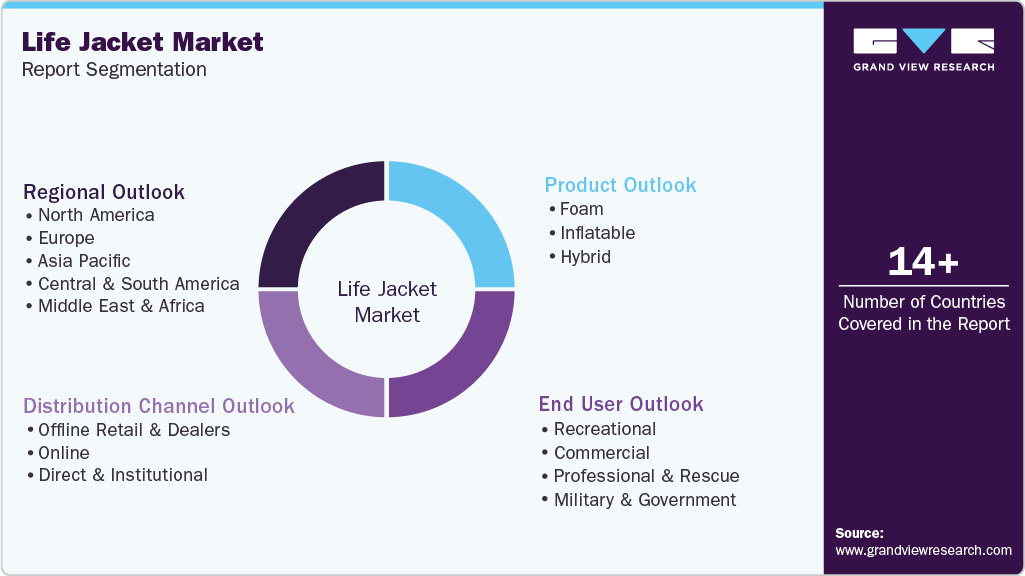
This report forecasts revenue growth at the global, regional & country levels and provides an analysis of the latest trends and opportunities in each sub-segment from 2026 to 2033. For this study, Grand View Research has segmented the global life jacket market report based on product, end user, distribution channel, and region:
-
Product Outlook (Revenue, USD Million, 2021 - 2033)
-
Foam
-
Inflatable
-
Hybrid
-
-
End User Outlook (Revenue, USD Million, 2021 - 2033)
-
Recreational
-
Commercial
-
Professional & Rescue
-
Military & Government
-
-
Distribution Channel Outlook (Revenue, USD Million, 2021 - 2033)
-
Offline Retail & Dealers
-
Online
-
Direct & Institutional
-
-
Regional Outlook (Revenue, USD Million, 2021 - 2033)
-
North America
-
U.S.
-
Canada
-
Mexico
-
-
Europe
-
Germany
-
UK
-
France
-
Italy
-
Spain
-
-
Asia Pacific
-
China
-
Japan
-
India
-
South Korea
-
Australia & New Zealand
-
-
Central & South America
-
Brazil
-
-
Middle East & Africa
-
South Africa
-
-
Research Methodology
The life jacket market figures in this report are based on a proven research process that combines executive interviews with secondary research from proprietary databases, company filings, and recognized regulatory and institutional sources. Market size is built through value-chain sizing-reconciling supply-side and demand-side estimates-and triangulated with bottom-up and top-down approaches. Every estimate passes multiple levels of expert validation before publication, with each life jacket segment quantified using the revenue-capture definitions in the table below.
Segment Definition
Segment - Product
Revenue capture definition
Foam
Revenue from life jackets using inherently buoyant foam materials as the primary flotation mechanism, including closed-cell foam and other permanently buoyant designs used across recreational, commercial, professional & rescue, and military & government applications. Includes adult, child, and specialized foam life jackets. Excludes inflatable and hybrid life jackets.
Inflatable
Revenue from life jackets that rely primarily on manually or automatically inflated air chambers for buoyancy, including manual-inflation and automatic-inflation designs used across recreational, commercial, professional & rescue, and government applications. Includes CO₂-cylinder-based inflatable systems and associated integrated inflation mechanisms. Excludes inherently buoyant foam-only and hybrid designs.
Hybrid
Revenue from life jackets combining inherently buoyant materials, such as foam, with inflatable buoyancy chambers to provide enhanced flotation, comfort, or performance. Includes hybrid designs used for recreational boating, water sports, commercial marine activities, rescue operations, and other professional applications. Excludes foam-only and inflatable-only life jackets.
Estimation Model
Layer
Title
Key Question
Description
01
Water Activity Base Layer
Who forms the addressable user base?
Individuals and organizations participating in boating, water sports, fishing, marine tourism, commercial marine activities, rescue operations, and other activities requiring personal flotation devices.
02
Life Jacket Demand Layer
Which users require life jackets?
Users with safety requirements or a need for personal flotation devices across recreational, commercial, professional & rescue, and military & government applications.
03
Product, End User & Distribution Layer
Which life jacket do they purchase?
Demand is segmented by Foam, Inflatable, and Hybrid products, Recreational, Commercial & Rescue, and Military & Government end users, and through Offline Retail & Dealers, Online, and Direct & Institutional channels.
04
Monetisation Layer
How much revenue is generated?
The estimated number of life jacket units sold is converted into market revenue using average selling price, product mix, replacement frequency, end-user pricing, and channel-specific price differences.
Delivered Customizations
This report has been delivered with the following In-depth customizations
Client Request
Customization Delivered
Value Adds
Product Portfolio Optimization
Assessed Foam, Inflatable, and Hybrid life jackets across application requirements, safety regulations, price positioning, replacement patterns, and end-user preferences to identify shifts in product demand.
Highlighted product categories with stronger growth and pricing potential, supporting portfolio rationalization, new-product development, premium product launches, and resource allocation.
Channel & Customer Acquisition Strategy
Evaluated Offline Retail & Dealers, Online, and Direct & Institutional channels by end-user segment, purchasing behavior, channel economics, accessibility, and competitive presence.
Identified priority channels and customer segments for incremental sales, supporting distributor selection, e-commerce expansion, institutional account development, and channel-specific pricing strategies.
Competitive Benchmarking & Strategic Positioning
Benchmarked leading manufacturers across product portfolio, geographic footprint, target applications, pricing positioning, distribution reach, product differentiation, and strategic focus.
Revealed competitive gaps and whitespace opportunities, enabling the client to differentiate its portfolio, target underserved applications, and strengthen its competitive position.
About the Author(s)
Consumer Goods Research Team
Research · Consumer GoodsThis report was authored by the consumer goods research team at Grand View Research - comprising two research analysts, one senior research analyst, and one industry expert - with specialized expertise in the consumer goods segment of the research industry. All findings are based on proprietary research databases, executive interviews, and regulatory analysis, subject to internal peer review prior to publication.
Last Updated:
Speak to Analyst


Customize this report to your needs — add regions, segments, or data points, with 20% free customization.
Or view our licence options:


ISO 9001:2015 & 27001:2022 Certified
We are GDPR and CCPA compliant! Your transaction & personal information is safe and secure. For more details, please read our privacy policy.


