
- Home
- »
- Power Distribution
- »
-
Low-Voltage Circuit Breaker Market Size Report, 2026-2033GVR Report cover

Low-Voltage Circuit Breaker Market (2026 - 2033)
Size, Share & Trends Analysis Report By Product (Molded Case Circuit Breakers (MCCB), Air Circuit Breakers (ACB)), By Current Rating, By Voltage Rating, By Mounting, By Application, By Region, And Segment Forecasts
Market Size, 2025
$1.6BMarket Estimate, 2026
$1.7BMarket Forecast, 2033
$2.8BCAGR, 2026–2033
7.2%Low-Voltage Circuit Breaker Market Summary
The global low-voltage circuit breaker market size was estimated at USD 1.6 billion in 2025 and is projected to grow from USD 1.7 billion in 2026 to USD 2.8 billion by 2033, at a CAGR of 7.2% from 2026 to 2033. Asia Pacific dominated the market, accounting for a revenue share of 34.2% in 2025. The market is driven by global electrification and grid modernization, data center expansion and industrial automation, renewable energy integration, and infrastructure investments.
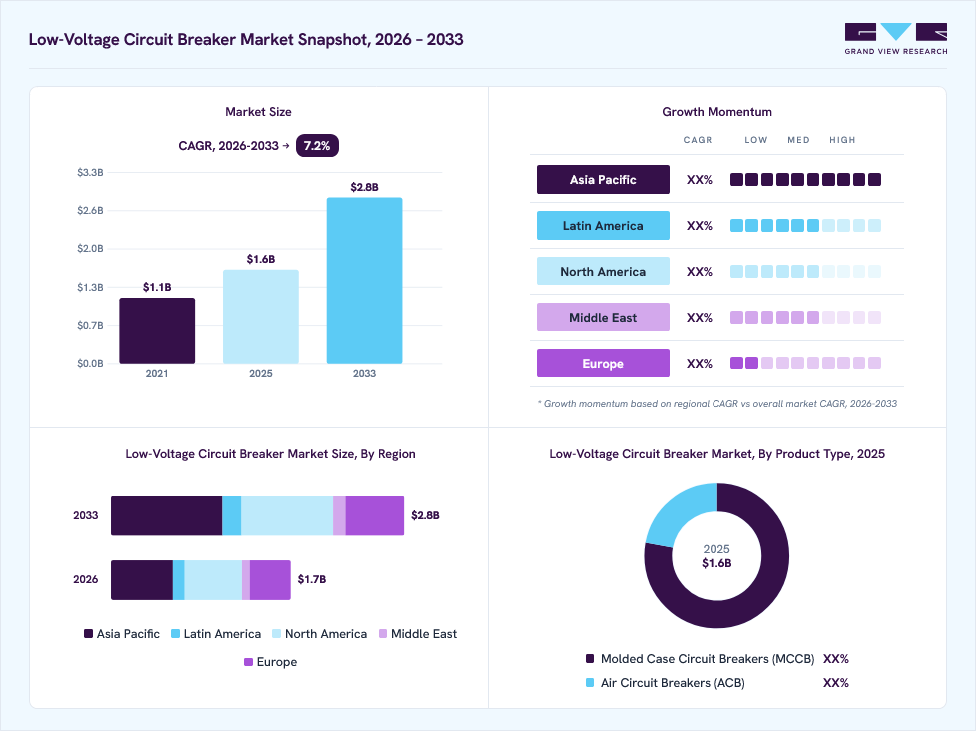 Source: Grand View Research, IR Documents, Primary Interviews, Paid DatabasesTo learn more about this report,
 Download Free Sample Report
 Key Market Trends & Insights
- By product: Molded Case Circuit Breakers (MCCB) held the largest revenue share of 77.8% in 2025.
- By current rating: 251A-630A segment held the largest revenue share of 32.4% in 2025.
- By voltage rating: Up to 415V segment held the largest revenue share of 61.4% in 2025.
- By mounting: Fixed segment held the largest revenue share of 58.5% in 2025.
- By application: Commercial buildings dominated the market with a revenue share of 19.4% in 2025.
Regional Highlights
- Largest regional market: Asia Pacific (34.2% revenue share, 2025)
- By country: China held the largest market share in 2025.
Market Size & Forecast
- Market size in 2025: USD 1.6 Billion
- Estimated market size in 2026: USD 1.7 Billion
- Projected market size by 2033: USD 2.8 Billion
- CAGR (2026-2033): 7.2%
Three ways to get this report
Buy it, customize it, or ask a question.Ask an Analyst
A direct answer, usually in 1 working day
- AccessReport author, directly
- Reply timeWithin 1 working day
- No sales callDirect answer only
- FormatEmail reply
- CostFree, no cost
Get the Full Report
What the study covers
- FormatsPDF · Excel · Dashboard
- Timeline2026–2033 annual, 2025 base
- Coverage20+ countries, 5 regions
- Companies10+ key players profiled
Customize the Report
20% free customization
- IncludeCountries, segments, points
- TailorTo your product definition
- ExtendDeeper competitor detail
- OrA fully bespoke study
- Turnaround5–10 working days
As electricity demand rises and power systems become more complex, MCCBs and ACBs are increasingly required for overcurrent protection, circuit isolation, equipment safety, and reliable power distribution across commercial, industrial, and infrastructure applications.
 To learn more about this report, Download Free Sample Report
 Market Dynamics
The market is evolving toward smart and connected breakers with digital trip units, remote monitoring, and higher breaking capacities, while regulatory developments are driving improvements in safety, testing, protection performance, and application-specific certifications. On the supply side, manufacturers are increasingly focusing on local sourcing and supply-chain diversification to reduce lead times and procurement risks. At the same time, buyers are placing greater emphasis on reliability, safety, lifecycle costs, product availability, technical support, and after-sales service rather than upfront equipment costs.
Rising electricity demand, global electrification, and grid modernization are increasing the need for reliable low-voltage distribution infrastructure. The expansion of commercial and industrial facilities is increasing the use of MCCBs and ACBs for power distribution and circuit protection. Data centers, EV charging infrastructure, and electrified industrial operations are also creating new demand for reliable protection equipment. Modernization of aging electrical networks is further supporting the replacement and upgrading of existing circuit breakers.According to the IEA, global grid investment increased from USD 338 billion in 2015 to USD 452 billion in 2024, reflecting higher spending on electricity infrastructure. The increase was supported by investments in grid expansion, network upgrades, and modernization projects. The IEA expects annual grid investment to reach nearly USD 550 billion in 2026, almost 20% higher than the previous year. This investment is expected to create opportunities for MCCBs and ACBs across new installations, upgrades, and replacement of aging equipment.Raw material price volatility is a key restraint, given the dependence of MCCB and ACB manufacturing on copper, aluminum, silver, and engineering plastics. Copper prices increased from around USD 8,973/tonne in January 2025 to USD 11,280/tonne in December 2025, making input costs more difficult to predict. Rising electrification, renewable energy deployment, grid expansion, and data center development may further increase copper demand and supply pressure. Higher material costs can increase manufacturing expenses, complicate procurement and pricing, and reduce profit margins when costs cannot be immediately passed on to customers. This can also increase equipment prices and limit demand in price-sensitive projects.The growing adoption of smart MCCBs and ACBs is creating opportunities for manufacturers to offer advanced monitoring, diagnostics, and remote connectivity. Demand is increasing across data centers, industrial facilities, commercial buildings, and critical infrastructure, where reliability and reduced downtime are important. For instance, ABB launched the SACE Emax 3 air circuit breaker in 2025, featuring real-time data analytics, predictive maintenance, temperature monitoring, and remote connectivity. These developments allow manufacturers to move beyond conventional protection and offer higher-value, digitally enabled circuit breaker solutions.Analyst Perspective
The market is expected to benefit from the increasing need for reliable power protection across critical electrical systems, while technological developments are creating a shift toward more intelligent and application-specific equipment. Manufacturers are focusing on advanced protection, condition monitoring, and integration with energy management systems to meet changing customer requirements. Volatile input costs, extended equipment replacement cycles, and higher compliance requirements are putting pressure on manufacturers to improve cost management and product performance. Overall, suppliers with strong technology capabilities, efficient sourcing strategies, and broad application expertise are better positioned to capture emerging opportunities.
Product Insights
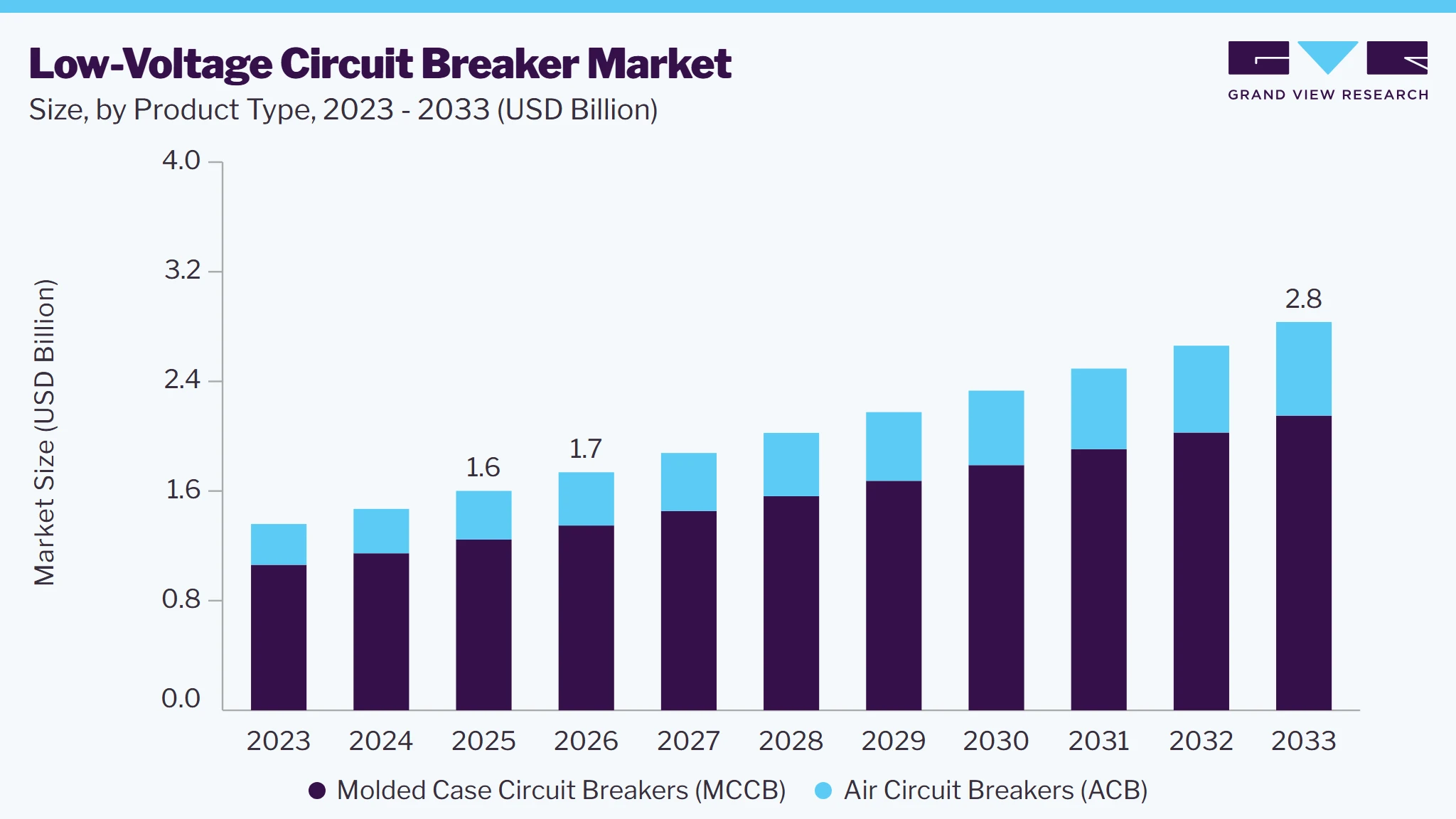
The Molded Case Circuit Breakers (MCCB) segment dominated the market with a revenue share of 77.8% in 2025. This dominance is due to the widespread use of MCCBs for feeder, equipment, and downstream distribution protection across commercial, industrial, and infrastructure applications. Their higher current ratings, breaking capacity, and flexible configurations make them suitable for applications requiring greater protection than miniature circuit breakers. Demand is further supported by the expansion and modernization of low-voltage electrical distribution infrastructure, the replacement of aging equipment, and increasing electrification. The adoption of advanced MCCBs with electronic trip units, adjustable protection, monitoring, and communication capabilities is also contributing to segment growth.
The Air Circuit Breakers (ACB) segment is anticipated to register the fastest CAGR of 8.4% during the forecast period. This growth is due to increasing demand for reliable protection in high-current low-voltage distribution systems across industrial, commercial, and infrastructure applications. Growing investments in manufacturing facilities, data centers, power distribution networks, and critical infrastructure are driving the adoption of ACBs for their high breaking capacity and adjustable protection capabilities. In addition, the replacement of aging electrical equipment and increasing focus on system reliability, selectivity, monitoring, and operational safety are supporting ACB demand.
Current Rating Insights
The 251A-630A segment held the largest revenue share of 32.4% in 2025, driven by its broad use in higher-capacity power distribution across industrial facilities, commercial buildings, infrastructure, renewable-energy installations, large HVAC systems, and motor control applications. Breakers in this range are widely used at feeder and sub-main levels, where high interrupting capacity, adjustable protection, coordination, thermal performance, and operational reliability are critical. Growing adoption of digital trip units and energy-monitoring capabilities is further supporting demand, particularly in facilities requiring improved power visibility and equipment monitoring.
The above 1,600A to 6,300A segment is anticipated to register the fastest CAGR of 8.9% during the forecast period. This is due to increasing demand for high-capacity ACBs in data centers, large industrial plants, hospitals, airports, utilities, infrastructure facilities, and renewable energy projects. Growing deployment of power-intensive facilities, particularly AI-driven data centers, is increasing the need for reliable high-capacity low-voltage distribution systems. In addition, rising adoption of advanced ACBs with electronic protection, remote operation, energy metering, fault recording, and predictive maintenance capabilities is supporting segment growth.
Voltage Rating Insights
The up to 415V segment dominated the market with a revenue share of 61.4% in 2025, supported by its extensive use in conventional electrical distribution across commercial, industrial, and institutional facilities. The widespread adoption of 400-415V three-phase systems for motors, HVAC systems, pumps, lighting, and other electrical loads creates strong demand for circuit breakers in both new installations and replacement applications. In addition, the large installed base of electrical systems operating at these voltage levels provides a broad addressable market compared with higher-voltage LV categories. The availability of breakers across different current ratings, interruption capacities, trip-unit configurations, and installation arrangements further supports the segment's broad applicability.
The above 690V to 1,000V segment is expected to register the fastest CAGR of 9.2% from 2026 to 2033. This growth is driven by increasing adoption of higher voltage low-voltage systems in high-power renewable energy, industrial, and power-conversion applications. The ability to operate at higher LV voltages can support efficient power distribution in applications with higher power requirements while remaining within the low-voltage classification. In addition, the development of high-power electrical architectures requiring enhanced insulation, switching, and fault-interruption performance is supporting demand for circuit breakers in this voltage range.
Mounting Insights
The fixed segment held the largest revenue share of 58.5% in 2025. This is due to its relatively simple construction, lower installation costs, and suitability for a wide range of commercial, industrial, and general-purpose electrical systems. Fixed-mounted circuit breakers are widely used in distribution boards, industrial panels, OEM equipment, and applications where frequent removal or replacement is not required. Their compact design and straightforward installation make them particularly suitable where cost efficiency and space utilization are key considerations. In addition, the availability of fixed configurations across major MCCB product platforms supports their continued adoption in conventional low-voltage distribution applications.
The plug-in segment is anticipated to register the fastest CAGR of 8.0% during the forecast period, supported by increasing demand for flexible and serviceable circuit breaker configurations in commercial and industrial distribution panels, OEM switchboards, and modular power systems. Plug-in breakers allow easier removal, replacement, and circuit modification compared with fixed configurations, reducing maintenance time and wiring intervention. Their ability to support equipment upgrades and future panel modifications is particularly valuable in modular power distribution systems. In addition, growing emphasis on faster installation, simplified servicing, and lower lifecycle costs is encouraging manufacturers and end users to adopt plug-in architectures.
Application Insights
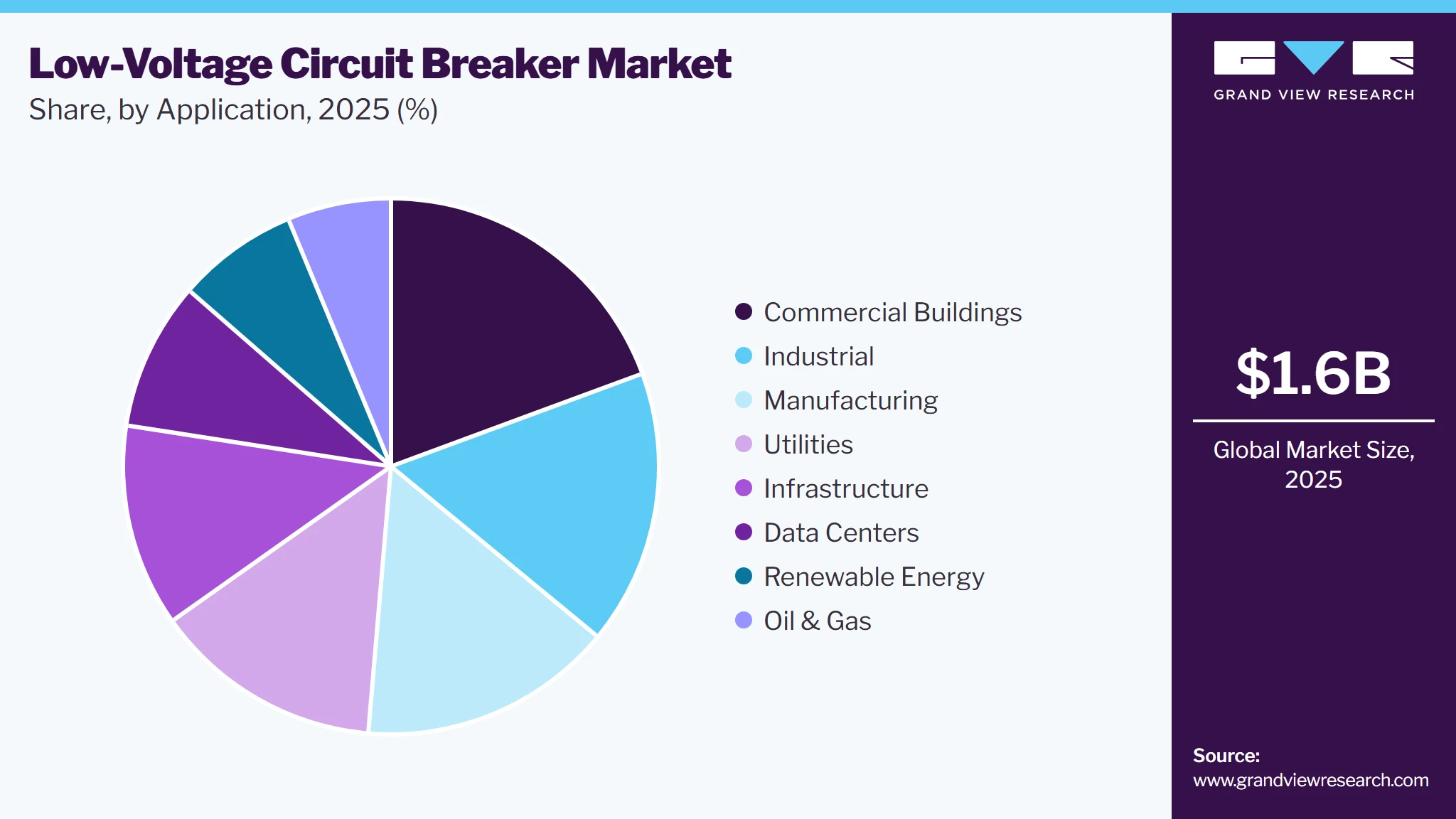
Commercial buildings dominated the market with a revenue share of 19.4% in 2025, driven by the widespread use of low-voltage circuit breakers across offices, retail complexes, hotels, hospitals, educational facilities, and mixed-use developments. Increasing electrical intensity in modern buildings, supported by HVAC systems, elevators, building automation, EV charging, IT equipment, and other electrically powered services, is increasing the number and capacity of circuits requiring protection. In addition, growing emphasis on power continuity and selective fault isolation in large commercial facilities is supporting demand for reliable circuit protection systems. Continued expansion of commercial real estate, IT campuses, and large urban facilities further strengthens the segment's demand.
 To learn more about this report, Download Free Sample Report
 Data centers are expected to register the fastest CAGR, at 10.0%, from 2026 to 2033. This is due to the continued expansion of hyperscale, colocation, and enterprise data centers, along with rising power requirements from AI computing and other high-density digital workloads. The need for continuous operation, redundancy, and localized fault isolation is driving the deployment of MCCBs and ACBs across incoming power distribution, generators, UPS systems, busways, and downstream feeders. In addition, increasing emphasis on monitoring, maintainability, and coordinated protection is supporting the adoption of circuit breakers with electronic trip and communication capabilities.
Regional Insights
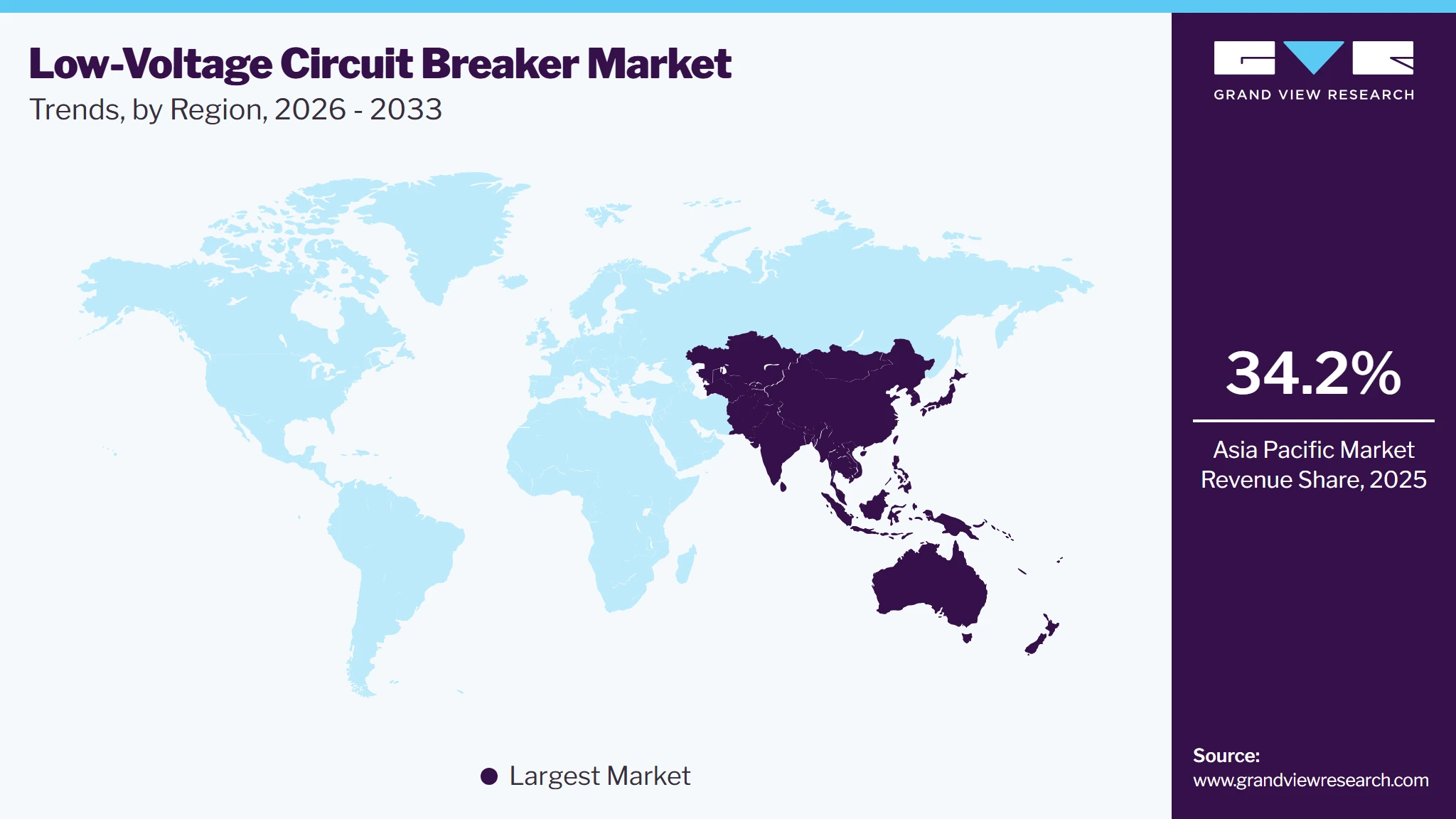
The low-voltage circuit breaker industry in Asia Pacific region dominated the market with a revenue share of 34.2% in 2025. The region is also expected to register the fastest CAGR over the forecast period. This is supported by the region's large industrial base, expanding electricity infrastructure, increasing penetration of renewable generation, and development of electricity-intensive facilities. However, the underlying demand structure varies substantially across countries. China and India represent major demand centers, driven by extensive electricity networks and industrial investment, while Japan, South Korea, and Taiwan have stronger exposure to advanced manufacturing and high-load technology facilities. Southeast Asian markets are more strongly associated with new distribution infrastructure, industrial development, renewable energy integration, and the expansion of electricity access. These differences influence both the addressable volume of MCCBs used across feeder and equipment protection and the requirement for ACBs in high-capacity main distribution systems.
 To learn more about this report, Download Free Sample Report
 China's low-voltage circuit breaker industry is the largest in the region, supported by the scale of its electricity distribution system and extensive industrial activity. According to the National Energy Administration, national power-grid investment reached approximately USD 89,500 million in 2025, of which approximately USD 45,050 million was invested in distribution networks at 110 kV and below. The scale of distribution investment is particularly relevant to the LV circuit-breaker market because it expands and modernizes the electrical infrastructure that connects substations, commercial facilities, industrial consumers, and other downstream loads.
Europe Low-Voltage Circuit Breaker Market Trends
The low-voltage circuit breaker industry in Europe represents a mature market, with demand increasingly driven by the modernization of electricity infrastructure, electrification, and the integration of renewable generation, rather than solely by new construction. The region has a substantial installed base of electrical distribution equipment, creating recurring opportunities for replacement and refurbishment alongside new installations. Changing power-system requirements are increasing the need for additional distribution capacity and more flexible electrical infrastructure. For example, the European investment environment is increasingly focused on strengthening electricity networks to accommodate higher electricity demand and greater renewable energy penetration, creating opportunities for new distribution equipment and the modernization of existing installations.
North America Low-Voltage Circuit Breaker Market Trends
The low-voltage circuit breaker industry in North America represents a mature but investment-intensive market, with demand supported by the replacement of established electrical infrastructure, as well as substantial new investment in power systems, manufacturing, data centers, energy infrastructure, and electrification. The region's market dynamics are increasingly influenced by the need to accommodate higher electricity demand from industrial reshoring, critical-mineral and battery projects, data centers, EV-related infrastructure, and other power-intensive developments.
The Canada low-voltage circuit breaker industry is characterized by the combination of large-scale electricity system investment, industrial electrification, clean energy development, and the replacement of aging electrical infrastructure. Electricity demand is expected to rise substantially as industries such as critical minerals, battery manufacturing, and other energy-intensive activities expand, while data-center development adds another high-load source. The federal government's national electricity strategy estimates that Canada's electricity system infrastructure may need to at least double by 2050, with more than USD 1 trillion in investment required across generation, transmission, and distribution infrastructure. This creates a broad addressable market for LV protection equipment across utility facilities, industrial plants, commercial developments, and new electricity connections.
Latin America Low-Voltage Circuit Breaker Market Trends
The low-voltage circuit breaker industry in Latin America is anticipated to register the second-fastest CAGR of 7.0% during the forecast period. The region represents a diverse and increasingly investment-driven market for low-voltage circuit breakers, with demand shaped by electricity network expansion, renewable energy development, industrial investment, and the modernization of existing electrical infrastructure. The region's electricity systems are undergoing a gradual transition from predominantly centralized generation to a more diversified structure incorporating large-scale solar and wind, distributed generation, and energy storage technologies.
Middle East Low-Voltage Circuit Breaker Market Trends
The low-voltage circuit breaker industry in the Middle East is a project-driven market, supported by large-scale investment in electricity generation, transmission, and distribution infrastructure, industrial facilities, commercial developments, and energy transition projects. Electricity demand is also being reshaped by economic diversification, urban development, and the development of new industrial and infrastructure clusters. These investments create requirements for LV protection equipment across substations, auxiliary systems, industrial plants, commercial facilities, and renewable energy installations. The market, therefore, combines conventional demand from power and industrial infrastructure with emerging requirements associated with renewable generation, battery storage, and increasingly automated electricity networks.
Key Low-Voltage Circuit Breaker Company Insights
Some of the key players operating in the global low-voltage circuit breaker industry include Eaton and Legrand, among others.
- Eaton focuses on intelligent power-management solutions, with its electrical business offering MCCB and ACB products for industrial, commercial, data center, utility, and renewable-energy applications. Its portfolio combines circuit protection with intelligent monitoring and power-management capabilities, supporting customers seeking improved electrical safety, reliability, and system visibility. The company also benefits from broad distribution capabilities and strong exposure to electrification and digitalization trends, particularly in data center and critical infrastructure applications.
- Legrand has a broad presence in low-voltage electrical infrastructure, with circuit breakers forming part of its wider portfolio of power distribution and protection products. The company serves residential, commercial, industrial, and data center customers through products such as MCCBs, distribution boards, enclosures, busways, and related systems. Its integrated product offering allows Legrand to address complete electrical distribution requirements rather than just circuit protection. Its established position in building infrastructure and growing exposure to data centers further supports its role in the market.
Key Low-Voltage Circuit Breaker Companies:
The following key companies have been profiled for this study on the low-voltage circuit breaker market.
-
ABB
-
Schneider Electric
-
Siemens
-
Eaton
-
Mitsubishi Electric
-
Legrand
-
Fuji Electric
-
LS Electric
-
Hitachi Energy
-
CHINT
Competitive Benchmarking
Category
Operating Strategies
Competitive Edge
Weakness
Established Players (ABB, Schneider Electric, Siemens, Eaton, Hitachi Energy, Mitsubishi Electric)
- Expanding MCCB and ACB portfolios across wider current and voltage ranges.
- Investing in smart breakers with electronic trip units, communication, energy monitoring, and remote diagnostics.
- Strengthening local manufacturing, distribution, and application-engineering capabilities in key markets.
- Strong brands and established relationships with utilities, industrial users, panel builders, and EPCs.
- Broad product coverage across standard LV distribution, data centers, renewable energy, and critical infrastructure.
- Strong R&D and digital capabilities support customized and connected protection solutions.
- High R&D and certification costs for advanced circuit breaker platforms.
- Complex product portfolios can increase customization and lifecycle-management requirements.
- Premium pricing can limit competitiveness in highly price-sensitive emerging markets.
Emerging Players (Legrand, Fuji Electric, LS Electric, CHINT)
- Focusing on application-specific MCCBs/ACBs for industrial, commercial, renewable energy, and critical-power applications.
- Developing compact, high-breaking-capacity, and digitally enabled circuit breakers.
- Increasing localization to improve cost competitiveness and regional availability.
- Flexible solutions for specific current ratings, mounting configurations, and application requirements.
- Strong technical expertise in selected industrial and electrical-equipment segments.
- Local manufacturing and established regional distribution provide faster response and competitive pricing.
- Smaller geographic reach and brand visibility compared with leading multinational suppliers.
- Greater dependence on selected application segments and regional customers.
- Lower economies of scale can constrain pricing competitiveness against major global manufacturers.
Recent Developments
- In July 2026, Schneider Electric expanded its low-voltage protection portfolio with the launch of the EasyPact NW Air Circuit Breaker (ACB), a next-generation solution designed for commercial buildings, light industrial facilities, utilities, and other non-critical low-voltage applications. The product offers a breaking capacity of up to 66 kA and incorporates features such as native connectivity, health-status indication, and event diagnostics to improve operational visibility and maintenance planning. The development reflects the growing adoption of intelligent monitoring and connected protection technologies in low-voltage circuit breakers, as end users increasingly seek enhanced reliability, asset management, and system performance.
Low-Voltage Circuit Breaker Market Report Scope
Report Attribute
Details
Market Definition
Low-voltage circuit breakers are protective devices designed to interrupt electrical circuits during overloads or short circuits, ensuring the safe operation of low-voltage electrical systems. The market represents the annual revenues generated from the sale of MCCBs and ACBs up to 1,000V and 6,300A, including IEC/EN 60947-2 and NEMA-compliant products. The study excludes MCBs.
Market size in 2025
USD 1.6 billion
Estimated market size in 2026
USD 1.7 billion
Revenue forecast in 2033
USD 2.8 billion
Growth rate
CAGR of 7.2% from 2026 to 2033
Base year for estimation
2025
Historical data
2021 - 2024
Forecast period
2026 - 2033
Quantitative Units
Revenue in USD billion, Volume in Thousand Units, and CAGR from 2026 to 2033
Report coverage
Revenue forecast, competitive landscape, growth factors, and trends
Segments covered
Product, current rating, voltage rating, mounting, application, and region
Regional scope
North America; Europe; Asia Pacific; Latin America; Middle East & Africa
Country scope
Canada; Mexico; UK; Ireland; Spain; Portugal; China; India; Indonesia; Japan; Malaysia; Philippines; Singapore; South Korea; Taiwan; Thailand; Vietnam; Brazil; UAE; Saudi Arabia
Key companies profiled
ABB; Schneider Electric; Siemens; Eaton; Mitsubishi Electric; Legrand; Fuji Electric; LS Electric; Hitachi Energy; CHINT
Customization scope
Free report customization (equivalent up to 8 analysts working days) with purchase. Addition or alteration to country, regional & segment scope.
Pricing and purchase options
Avail customized purchase options to meet your exact research needs. Explore purchase options
Global Low-Voltage Circuit Breaker Market Report Segmentation
This report forecasts revenue & volume growth at global, regional, and country levels and provides an analysis of the latest industry trends in each of the sub-segments from 2021 to 2033. For this study, Grand View Research has segmented the global low-voltage circuit breaker market report based on product, current rating, voltage rating, mounting, application, and region.
-
Product Outlook (Volume, Thousand Units; Revenue, USD Billion, 2021 - 2033)
-
Molded Case Circuit Breakers (MCCB)
-
Air Circuit Breakers (ACB)
-
-
Current Rating Outlook (Volume, Thousand Units; Revenue, USD Billion, 2021 - 2033)
-
Up to 100A
-
101A-250A
-
251A-630A
-
631A-1,600A
-
Above 1,600A to 6,300A
-
-
Voltage Rating Outlook (Volume, Thousand Units; Revenue, USD Billion, 2021 - 2033)
-
Up to 415V
-
416V-690V
-
Above 690V to 1,000V
-
-
Mounting Outlook (Volume, Thousand Units; Revenue, USD Billion, 2021 - 2033)
-
Fixed
-
Plug-in
-
Draw-out
-
-
Application Outlook (Volume, Thousand Units; Revenue, USD Billion, 2021 - 2033)
-
Industrial
-
Commercial Buildings
-
Utilities
-
Infrastructure
-
Data Centers
-
Renewable Energy
-
Oil & Gas
-
Manufacturing
-
-
Regional Outlook (Volume, Thousand Units; Revenue, USD Billion, 2021 - 2033)
-
North America
-
Canada
-
Mexico
-
-
Europe
-
UK
-
Ireland
-
Spain
-
Portugal
-
-
Asia Pacific
-
China
-
India
-
Indonesia
-
Japan
-
Malaysia
-
Philippines
-
Singapore
-
South Korea
-
Taiwan
-
Thailand
-
Vietnam
-
-
Latin America
-
Brazil
-
-
Middle East & Africa
-
UAE
-
Saudi Arabia
-
-
Research Methodology
The low-voltage circuit breaker market figures in this report are based on a proven research process that combines executive interviews with secondary research from proprietary databases, company filings, and recognized regulatory and institutional sources. Market size is built through value-chain sizing-reconciling supply-side and demand-side estimates-and triangulated with bottom-up and top-down approaches. Every estimate passes multiple levels of expert validation before publication, with each low-voltage circuit breaker segment quantified using the revenue-capture definitions in the table below.
Segment Definition
Segment - Product
Revenue capture definition
Molded Case Circuit Breakers (MCCB)
Sales of MCCBs incorporating a molded insulated enclosure and designed for overload and short-circuit protection within the defined market scope.
Air Circuit Breakers (ACB)
Sales of ACBs that use air as the arc-extinguishing medium and are intended for high-current switching and protection duties.
Segment - Current Rating
Revenue capture definition
Up to 100A
Product sales attributable to breakers rated at or below 100A, covering lower-current feeder, branch-circuit, and equipment protection requirements.
101A-250A
Revenue associated with breakers in the 101A-250A range, mainly covering feeder, motor, equipment, and distribution applications.
251A-630A
Sales value of circuit breakers rated between 251A and 630A, serving medium-current distribution and motor-control requirements.
631A-1,600A
Revenue from units within the 631A-1,600A range, including breakers deployed for high-current feeders, main distribution, transformer secondary, and busbar protection.
Above 1,600A to 6,300A
Sales attributable to high-capacity breakers rated above 1,600A and up to 6,300A, primarily covering main incomers, bus-couplers, and large-scale power distribution.
Segment - Voltage Rating
Revenue capture definition
Up to 415V
Sales value of breakers with voltage ratings up to 415V for conventional low-voltage distribution and protection duties.
416V-690V
Revenue from products rated between 416V and 690V, covering higher-rated industrial, commercial, renewable energy, data center, and process applications.
Above 690V to 1,000V
Sales of breakers rated above 690V and up to 1,000V, addressing specialized higher-voltage low-voltage distribution requirements.
Segment - Mounting
Revenue capture definition
Fixed
Revenue from breakers permanently installed within panels, switchboards, distribution boards, and related electrical assemblies.
Plug-in
Sales value of breakers incorporating plug-in mounting arrangements that support simplified installation, replacement, and servicing.
Draw-out
Revenue associated with withdrawable breaker configurations that permit movement between connected, test, and disconnected positions.
Segment - Application
Revenue capture definition
Industrial
Breaker sales supporting plant-level distribution, motor protection, equipment protection, and general industrial power management.
Commercial Buildings
Product revenue linked to offices, retail properties, hotels, hospitals, educational facilities, and similar buildings for electrical distribution and protection.
Utilities
Sales to electric utilities and distribution operators for substations, distribution networks, utility facilities, and related low-voltage systems.
Infrastructure
Revenue tied to transportation facilities, airports, railways, tunnels, water and wastewater systems, and other major infrastructure projects.
Data Centers
Breaker sales supporting critical power distribution, switchboards, feeders, backup systems, and protection of sensitive electrical loads.
Renewable Energy
Revenue from breakers deployed in solar, wind, energy-storage, and other renewable power installations for collection, distribution, and electrical protection.
Oil & Gas
Sales serving low-voltage electrical systems across production, processing, refining, petrochemical, terminal, pipeline, and other oil & gas facilities.
Manufacturing
Product revenue associated with production plants for machine protection, motor feeders, process equipment, and plant-level electrical distribution.
Estimation Model
Layer Name
Key Question
Description
Demand Layer
Which factors generate demand for low-voltage circuit breakers?
Assess demand driven by rising electricity consumption, grid modernization, industrial automation, data center expansion, infrastructure development, renewable energy integration, and increasing investments in commercial and industrial electrical systems.
Product Layer
Which circuit breaker products generate market revenue?
Evaluate revenue across MCCBs and ACBs based on their protection capabilities, current-handling requirements, installation environments, and use across low-voltage distribution systems.
Application Layer
Which ratings, configurations, and end-use applications generate market revenue?
Assess revenue across current ratings (Up to 100A, 101A-250A, 251A-630A, 631A-1,600A, and Above 1,600A to 6,300A), voltage ratings (Up to 415V, 416V-690V, and Above 690V to 1,000V), and mountings (Fixed, Plug-in, and Draw-out). Revenue is further analyzed across industrial, commercial buildings, utilities, infrastructure, data centers, renewable energy, oil & gas, and manufacturing applications.
Revenue Layer
How is market revenue generated?
Market revenue is quantified through the sales of MCCBs and ACBs used for circuit protection, isolation, and power distribution. Revenue varies based on product, current and voltage rating, mounting configuration, application requirements, protection features, and project scale across commercial, industrial, utility, and infrastructure installations.
Delivered Customizations
This report has been delivered with the following In-depth customizations
Client Request
Customization Delivered
Value Adds
Competitive Benchmarking
Conducted a detailed assessment of established and emerging low-voltage circuit breaker providers based on product portfolio, current and voltage ratings, mounting configurations, smart features, applications, geographic presence, partnerships, and overall market positioning.
Helps the client understand competitive strengths, identify product and technology gaps, and benchmark its position against key market participants.
Cross segmentation Analysis
Analyzed MCCBs and ACBs across industrial, commercial buildings, utilities, infrastructure, data centers, renewable energy, oil & gas, and manufacturing applications to assess product adoption, technical suitability, and market opportunities.
Enables the client to identify high-potential product and application combinations, understand demand patterns, and prioritize attractive market segments.
Regional Opportunity Assessment
Evaluated low-voltage circuit breaker market potential across key geographic markets by analyzing grid modernization, infrastructure investments, industrial development, data center expansion, renewable energy deployment, and electrification trends.
Enables identification of high-potential markets, key demand drivers, and priority regions for expansion and investment.
About the Author(s)
Power Distribution Research Team
Energy & Power · Power DistributionThis report was authored by the power distribution research team at Grand View Research - comprising two research analysts, one senior research analyst, and one industry expert - with specialized expertise in the power distribution segment of the energy & power industry. All findings are based on proprietary energy & power databases, executive interviews, and regulatory analysis, subject to internal peer review prior to publication.
Last Updated:
Speak to Analyst

Customize this report to your needs - add regions, segments, or data points, with 20% free customization.
Or view our licence options:


ISO 9001:2015 & 27001:2022 Certified
We are GDPR and CCPA compliant! Your transaction & personal information is safe and secure. For more details, please read our privacy policy.


