- Home
- »
- Drilling & Extraction Equipments
- »
-
Marine Mining Market Size, Share & Trends Report, 2033GVR Report cover
![Marine Mining Market (2026 - 2033)Report]()
Marine Mining Market (2026 - 2033)
Size, Share & Trends Analysis Report By Activity (Exploration, Environmental Studies), By Resource (Polymetallic Nodules, Seafloor Massive Sulfides, Cobalt-Rich Crusts), By Region, And Segment Forecasts
Market Size, 2025
$4.1BMarket Estimate, 2026
$4.3BMarket Forecast, 2033
$6.4BCAGR, 2026–2033
5.7%Marine Mining Market Summary
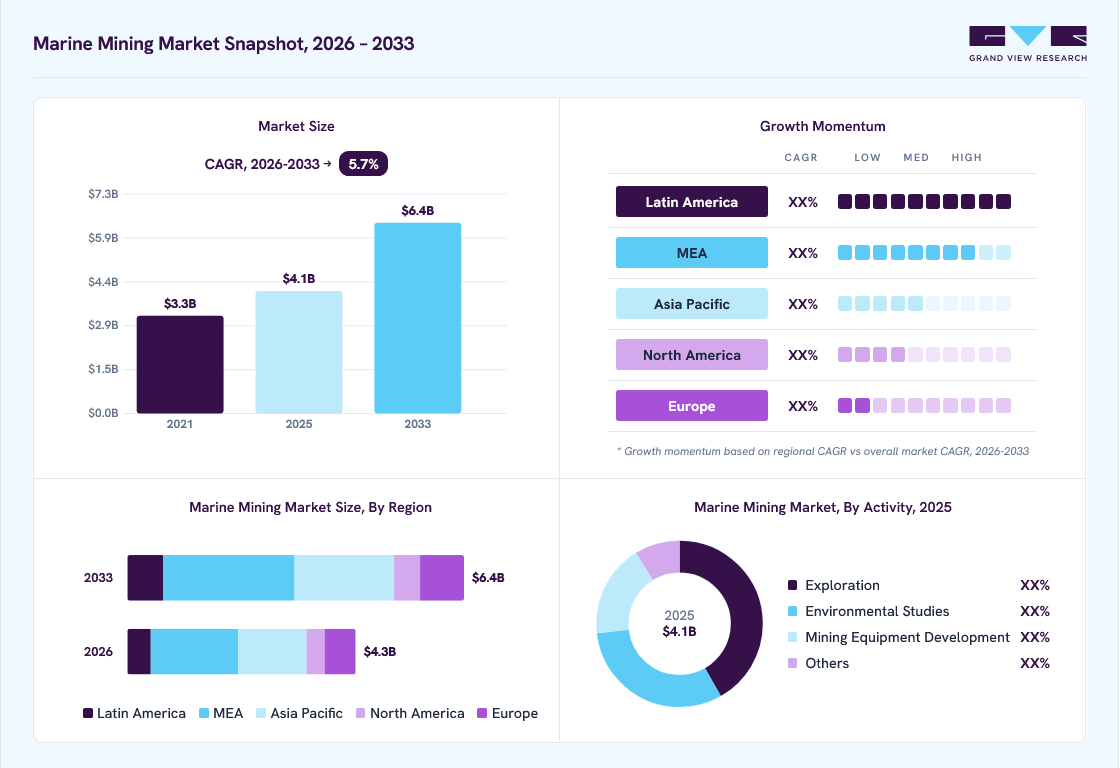
The global marine mining market size was valued at USD 4.1 billion in 2025 and is projected to grow from USD 4.3 billion in 2026 to USD 6.4 billion by 2033, at a CAGR of 5.7% from 2026 to 2033. Middle East & Africa dominated the market, accounting for the largest revenue share of 38.3% in 2025. The market comprises economic activities related to the exploration, assessment, extraction, and development of mineral resources located on the seabed, including polymetallic nodules, seafloor massive sulfides, and cobalt-rich crusts.
Key Market Trends & Insights
- By activity: Exploration held the largest revenue share of 41.7% in 2025
- By resource: Seafloor massive sulfides segment is expected to grow at the fastest CAGR of 6.2% from 2026 to 2033
Regional Highlights
- Largest regional market: Middle East & Africa (38.3% revenue share, 2025)
- Fastest-growing regional market: Latin America (highest CAGR, 2026-2033)
- By country: Namibia held a dominant position in 2025.
Market Size & Forecast
- Market size in 2025: USD 4.1 Billion
- Estimated market size in 2026: USD 4.3 Billion
- Projected market size by 2033: USD 6.4 Billion
- CAGR (2026-2033): 5.7%
The marine mining industry’s growth is primarily driven by the rising global demand for critical minerals required for electric vehicles, renewable energy systems, energy storage technologies, and advanced electronics. As the quality of terrestrial mineral deposits declines and governments seek to diversify critical mineral supply chains, seabed resources such as polymetallic nodules, seafloor massive sulfides, and cobalt-rich crusts are emerging as attractive alternative sources of nickel, cobalt, copper, manganese, and rare earth elements.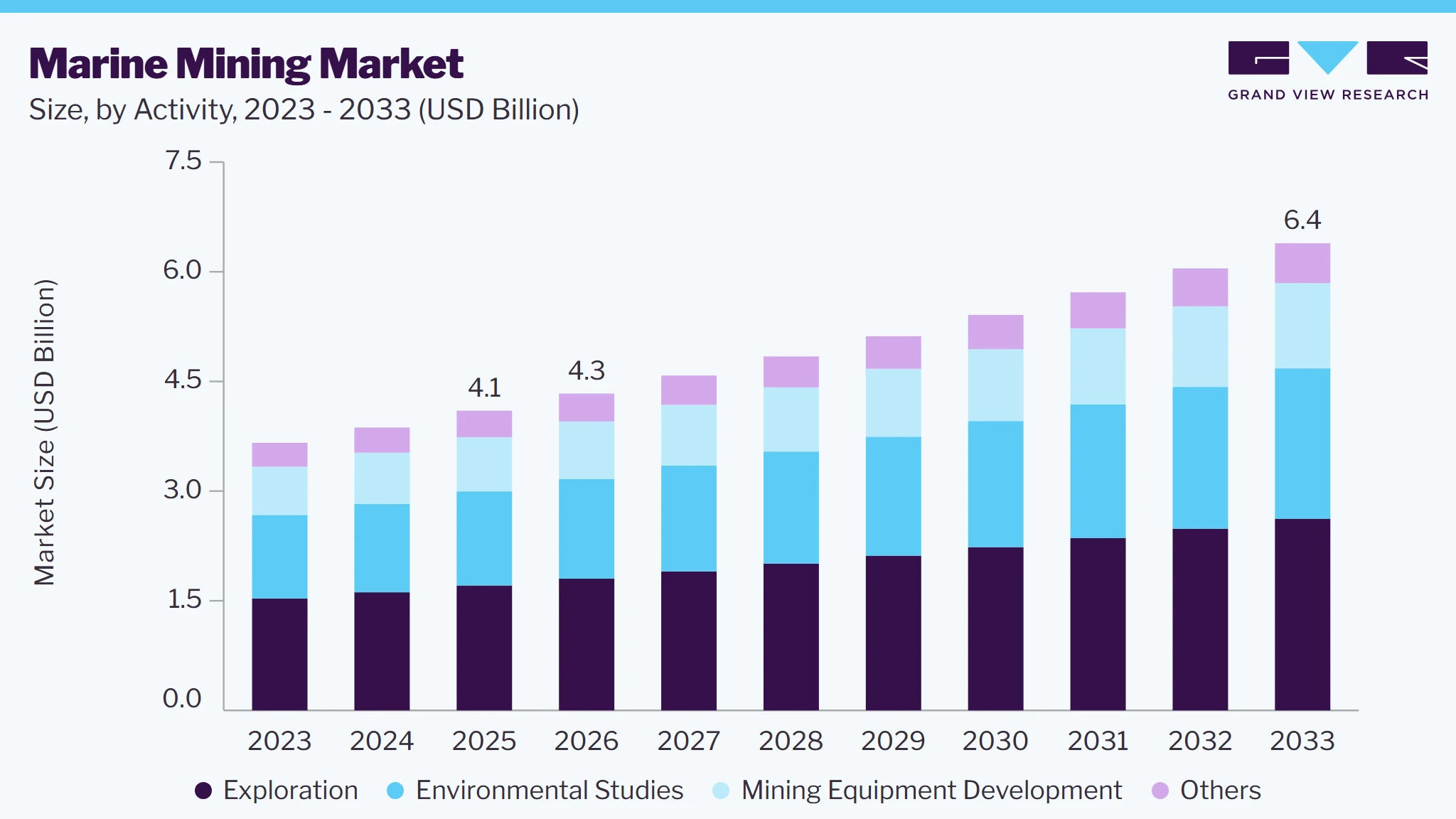
Advancements in deep-sea mining technologies, including remotely operated vehicles, autonomous underwater vehicles, subsea excavation systems, offshore production equipment, and real-time environmental monitoring solutions, are improving the technical feasibility and operational efficiency of marine mining projects. At the same time, increasing investments from mining companies, offshore engineering firms, marine technology providers, and private investors are accelerating exploration activities, pilot mining projects, and the development of commercial-scale extraction systems.
Market Dynamics
The growing global demand for critical minerals is a major driver for the market. These minerals are essential for electric vehicle batteries, renewable energy systems, energy storage technologies, and advanced electronics. As terrestrial mineral resources become increasingly constrained, interest in seabed mineral exploration and extraction is rising to secure long-term supplies of critical raw materials.
Technological advancements in underwater robotics, remotely operated vehicles, autonomous mining systems, and deep-sea exploration equipment are improving the technical feasibility of marine mining. These innovations enable more efficient exploration, resource assessment, and mineral recovery from polymetallic nodules, seafloor massive sulfides, and cobalt-rich crusts, encouraging governments and private companies to invest in offshore mineral development.
The marine mining market faces significant challenges due to concerns regarding the potential impact of deep-sea mining on marine biodiversity, ecosystems, and sediment disturbance. Uncertainty surrounding international regulations, environmental approvals, and licensing requirements can delay project development, increase compliance costs, and limit the commercial deployment of marine mining operations.
Large untapped deposits of polymetallic nodules, seafloor massive sulfides, and cobalt-rich ferromanganese crusts present substantial growth opportunities for the marine mining market. Rising investments in exploration programs, resource mapping, and pilot mining projects by governments and private companies are expected to strengthen the commercial potential of seabed mineral extraction, helping diversify global critical mineral supply chains and support the energy transition.
In July 2026, the U.S. administration announced plans to hold what could become the world's first deep-sea mining lease sale by offering more than 31 million acres of the U.S. outer continental shelf near American Samoa for 20-year mining rights. The proposal is part of the administration's strategy to strengthen domestic supplies of critical minerals such as cobalt, nickel, copper, and manganese for clean energy technologies and national security.
Analyst Perspective
The marine mining market is gradually transitioning from an exploration-focused industry toward commercial development as the global race to secure critical minerals intensifies. Rising demand for nickel, cobalt, copper, manganese, and rare earth elements used in electric vehicles, renewable energy systems, battery storage, and advanced electronics is encouraging governments and private companies to invest in seabed exploration, resource assessment, and next-generation deep-sea mining technologies.
Activity Insights
The exploration segment dominated the marine mining market, accounting for the largest revenue share of 41.7% in 2025. The rising demand for critical minerals such as cobalt, nickel, copper, manganese, and rare earth elements, driven by electric vehicles, renewable energy systems, and advanced electronics, is accelerating offshore exploration activities across polymetallic nodule, seafloor massive sulfide, and cobalt-rich crust deposits. Advancements in autonomous underwater vehicles, remotely operated vehicles, high-resolution seabed mapping, and geophysical survey technologies are improving the accuracy and efficiency of resource assessment while reducing exploration risks and costs.
The environmental studies segment is witnessing strong growth as regulatory authorities and stakeholders place greater emphasis on understanding and minimizing the ecological impacts of seabed mineral extraction. Comprehensive baseline environmental assessments, biodiversity surveys, oceanographic studies, sediment plume modeling, and long-term ecosystem monitoring are becoming essential prerequisites before exploration and mining activities can proceed. Increasing scrutiny from international regulatory bodies, environmental organizations, and coastal nations is driving investments in advanced monitoring technologies, including autonomous and remotely operated underwater vehicles, environmental sensors, and real-time data analytics.
Resource Insights
The polymetallic nodules segment dominated the marine mining industry, accounting for the largest revenue share of 64.7% in 2025, owing to the vast abundance of these mineral-rich deposits on the deep-ocean floor and their high concentrations of nickel, cobalt, copper, and manganese. The growing global demand for battery materials, electric vehicles, renewable energy infrastructure, and energy storage systems is increasing interest in polymetallic nodules as an alternative source of critical minerals.
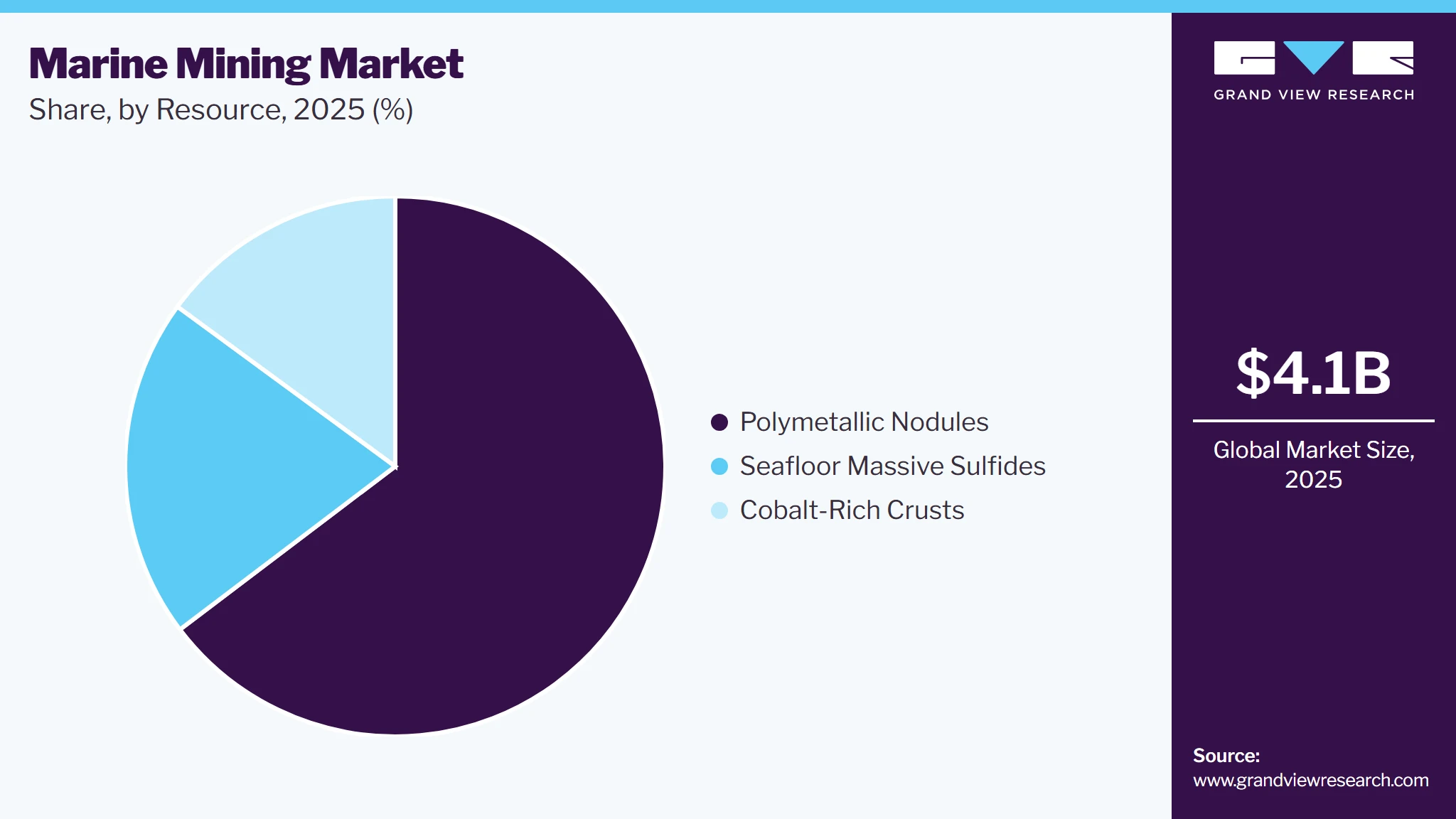
The seafloor massive sulfides (SMS) segment is expected to witness significant growth over the forecast period, driven by the high concentrations of valuable base and precious metals, including copper, zinc, gold, silver, and lead, found around hydrothermal vent systems. Rising demand for these metals across renewable energy, electrical infrastructure, electronics, and industrial manufacturing is encouraging investments in offshore exploration and resource assessment.
Regional Insights
The Middle East & Africa marine mining market dominated with the largest revenue share of 38.3% in 2025. The Middle East & Africa is gradually emerging as a leader, with coastal nations exploring offshore mineral resources to diversify their mining industries and strengthen long-term mineral security. African countries with extensive coastlines, particularly Namibia and South Africa, are expanding marine mineral exploration activities supported by international partnerships and technological advancements. Namibia has established commercial marine diamond mining operations, making it one of the world's leading examples of successful offshore mineral extraction, while South Africa continues to evaluate offshore deposits of strategic minerals through geological surveys and marine exploration programs.

Namibia Marine Mining Market Trends
Namibia’s marine mining market is primarily driven by its exceptionally rich offshore diamond deposits and the gradual depletion of accessible onshore diamond resources, which has shifted a greater share of national diamond production toward seabed mining. The country has extensive diamond-bearing deposits along its Atlantic coastline, with offshore operations conducted at depths of approximately 90 to 140 meters, creating a strong resource base for continued marine extraction. Continued investment in advanced marine mining technologies is another major growth driver, with Debmarine Namibia operating specialized recovery vessels, sophisticated seabed surveying systems, drilling technologies, and remotely supported exploration capabilities.
Asia Pacific Marine Mining Market Trends
Asia Pacific is a growing market due to increasing investments in offshore mineral exploration, strong government support for securing critical mineral supplies, and the presence of extensive Exclusive Economic Zones (EEZs). Countries such as Japan, China, South Korea, and India are actively conducting surveys for polymetallic nodules, cobalt-rich crusts, and seafloor massive sulfides to strengthen their supply of battery and clean energy minerals. Japan has been a pioneer in deep-sea mineral exploration, successfully conducting pilot extraction tests for seafloor massive sulfides near Okinawa, while China continues to expand its deep ocean exploration capabilities through advanced research vessels and remotely operated mining systems.
Europe Marine Mining Market Trends
Europe is witnessing steady growth in the marine mining industry, driven by rising demand for critical raw materials and growing investment in sustainable seabed exploration technologies. The region is focused on developing environmentally responsible mining practices through extensive scientific research, environmental impact assessments, and advanced subsea equipment. Norway has emerged as a leading country following the opening of parts of its continental shelf for potential seabed mineral exploration, targeting copper, cobalt, zinc, and rare earth elements required for the energy transition.
North America Marine Mining Market Trends
North America is experiencing growing interest in marine mining as governments and private companies seek alternative sources of critical minerals required for electric vehicles, defense, and renewable energy infrastructure. The region is investing in advanced ocean mapping, subsea robotics, and mineral resource assessments to evaluate offshore deposits while emphasizing environmental stewardship. Canada is expanding research into the potential of seabed minerals within its offshore territories, while the U.S. is supporting scientific studies and technology development to improve understanding of deep-ocean mineral resources and responsible extraction methods.
The U.S. is strengthening its position in the marine mining industry by increasing investments in deep-ocean exploration, critical-mineral security initiatives, and advanced subsea technologies. Federal agencies, research institutions, and private companies are collaborating to identify offshore sources of polymetallic nodules and other strategic minerals that can reduce dependence on imported raw materials. The U.S. Geological Survey and NOAA continue to conduct marine geological assessments, while domestic companies are developing autonomous underwater vehicles, remotely operated vehicles, and deep-sea monitoring systems that support future commercial seabed mining activities in compliance with environmental regulations.
Latin America Marine Mining Market Trends
Latin America’s marine mining market is being driven by the region’s substantial and underexplored seabed mineral potential, particularly in countries such as Brazil and Chile, where offshore areas contain polymetallic nodules, cobalt-rich ferromanganese crusts, phosphorites, and potential massive sulfide deposits containing valuable metals such as copper, nickel, cobalt, and manganese. The International Energy Agency highlights Latin America’s strong critical mineral resource base and the opportunity to capture greater economic value through expanded mineral development and processing.
Key Marine Mining Company Insights
Some of the key players operating in the market include De Beers Group and China Minmetals Corporation.
-
China Minmetals Corporation is one of China's largest state-owned metals and mining enterprises, established in 1950, with an integrated business spanning mineral exploration, mine development, engineering, metal processing, trading, and logistics. The company operates a broad portfolio of mines across Asia, Oceania, South America, and Africa and has extensive expertise in resource development and mining engineering. Although its primary focus is on terrestrial mining, its capabilities in mineral exploration, engineering design, project development, and critical mineral supply position it as a potential participant in future marine mining initiatives involving seabed mineral resources and associated infrastructure.
-
De Beers Group is a global leader in diamond exploration, mining, trading, and marketing with operations across Botswana, Namibia, South Africa, and Canada. Through its marine diamond mining subsidiary in Namibia, the company has pioneered offshore diamond recovery technologies and operates one of the world's most advanced marine mining fleets. De Beers combines advanced seabed mapping, precision dredging, remotely operated technologies, and environmental monitoring to recover diamonds from offshore deposits while maintaining strong sustainability and responsible mining practices, making it a leading commercial operator in the marine mining industry.
Key Marine Mining Companies:
The following key companies have been profiled for this study of the marine mining market.
-
China Minmetals Corporation
-
De Beers Group
-
Deep Ocean Engineering
-
Keppel Ltd.
-
Loke Marine Minerals
-
Nautilus Minerals Inc.
-
Ocean Minerals LLC
-
Royal IHC
-
Soil Machine Dynamics Ltd.
-
The Metals Company
Competitive Benchmarking
Category
Operating Strategies
Competitive Edge
Weakness
Established Players (e.g., China Minmetals Corporation, De Beers Group)
- Mature participants in the marine mining market primarily focus on integrated offshore resource exploration, seabed surveying, environmental impact assessment, mineral extraction system development, and offshore project management.
- Their strategies emphasize securing exploration licenses, investing in advanced subsea mining equipment, remotely operated vehicles, offshore support vessels, and mineral lifting systems capable of operating in deep-sea environments.
- Established players possess significant competitive advantages through extensive offshore engineering expertise, advanced marine equipment capabilities, and substantial financial resources required for deep-sea mining projects.
- Despite their strong market positions, mature players face challenges related to extremely high capital investment requirements, technological complexity, and uncertain regulatory frameworks governing deep-sea mining activities.
Emerging & Regional Players (e.g., Deep Ocean Engineering, Loke Marine Minerals)
- Emerging participants in the marine mining market generally focus on innovative exploration technologies, specialized subsea equipment, and critical mineral resource development rather than competing directly with established offshore engineering companies on project scale.
- Emerging companies benefit from operational flexibility and the ability to develop next-generation marine mining technologies without extensive legacy infrastructure.
- Their engineering teams can rapidly incorporate autonomous systems, digital monitoring platforms, advanced underwater robotics, and environmentally focused extraction methods into new project designs.
- Emerging participants face significant challenges related to limited financial resources, technology commercialization risks, and lengthy regulatory approval processes.
- Developing commercial marine mining technologies requires substantial investment in research, prototype testing, offshore demonstrations, environmental studies, and specialized marine equipment before generating commercial revenue.
Recent Developments
-
In August 2026, governments participating in the International Seabed Authority negotiations considered coordinated legal and diplomatic responses to the U.S.' decision to pursue deep-sea mining outside the UN-backed regulatory framework. Several countries expressed concern that unilateral U.S. actions could weaken international governance of seabed resources and undermine the principle that minerals in international waters are the common heritage of humankind.
-
In July 2026, Impossible Metals launched the first modern exploration survey of the western Pacific's Prime Crust Zone in more than four decades, marking a significant step toward assessing cobalt-rich ferromanganese crusts that contain critical minerals such as cobalt, nickel, manganese, and rare earth elements. The company deployed advanced autonomous underwater vehicles to map the seabed and collect geological and environmental data without disturbing the ocean floor, to support future resource evaluation while minimizing ecological impacts.
Marine Mining Market Report Scope
Report Attribute
Details
Market Definition
Market size represents the total value of investments directed toward marine mineral exploration, environmental studies, mining equipment development, pilot projects, and other related activities for the development of seabed mineral resources.
Market size value in 2025
USD 4.1 billion
Market size value in 2026
USD 4.3 billion
Revenue forecast in 2033
USD 6.4 billion
Growth rate
CAGR of 5.7% from 2026 to 2033
Base year for estimation
2025
Historical data
2021 - 2024
Forecast period
2026-2033
Quantitative units
Revenue in USD Million and CAGR from 2026 to 2033
Report coverage
Revenue forecast, competitive landscape, growth factors, and trends
Segments covered
Activity, resource, region
Regional scope
North America; Europe; Asia Pacific; Latin America; Middle East & Africa
Country scope
U.S.; Canada; Mexico; Finland; Sweden; Poland; Russia; China; India; Indonesia; Australia; Brazil; Chile; Peru; Namibia; South Africa
Key companies profiled
China Minmetals Corporation; De Beers Group; Deep Ocean Engineering; Keppel Ltd.; Loke Marine Minerals; Nautilus Minerals Inc.; Ocean Minerals LLC; Royal IHC; Soil Machine Dynamics Ltd.; The Metals Company
Customization scope
Free report customization (equivalent up to 8 analysts working days) with purchase. Addition or alteration to country, regional & segment scope.
Pricing and purchase options
Avail customized purchase options to meet your exact research needs. Explore purchase options
Global Marine Mining Market Report Segmentation
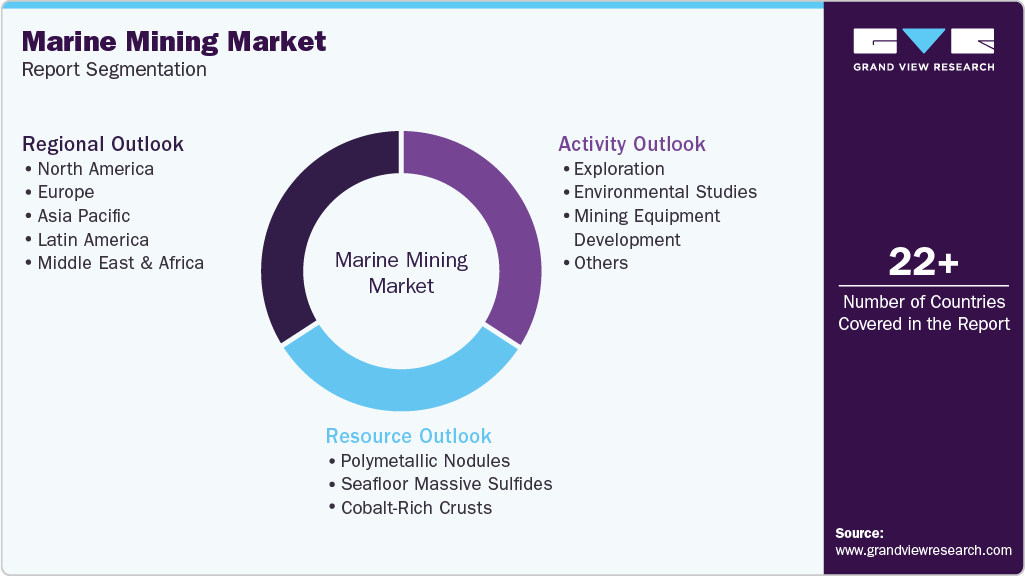
This report forecasts revenue growth at the global, regional & country levels and provides an analysis of the latest industry trends in each of the sub-segments from 2021 to 2033. For this study, Grand View Research has segmented the global marine mining market report based on activity, resource, and region:
-
Activity Outlook (Revenue, USD Million, 2021 - 2033)
-
Exploration
-
Environmental Studies
-
Mining Equipment Development
-
Others
-
-
Resource Outlook (Revenue, USD Million, 2021 - 2033)
-
Polymetallic Nodules
-
Seafloor Massive Sulfides
-
Cobalt-Rich Crusts
-
-
Regional Outlook (Revenue, USD Million, 2021 - 2033)
-
North America
-
U.S.
-
Canada
-
Mexico
-
-
Europe
-
Finland
-
Sweden
-
Poland
-
Russia
-
-
Asia Pacific
-
China
-
India
-
Indonesia
-
Australia
-
-
Latin America
-
Brazil
-
Chile
-
Peru
-
-
Middle East & Africa
-
Namibia
-
South Africa
-
-
Research Methodology
The marine mining market figures in this report are based on a proven research process that combines executive interviews with secondary research from proprietary databases, company filings, and recognized regulatory and institutional sources. Market size is built through value-chain sizing—reconciling supply-side and demand-side estimates—and triangulated with bottom-up and top-down approaches. Every estimate passes multiple levels of expert validation before publication, with each marine mining segment quantified using the revenue-capture definitions in the table below.
Segment Definition
Activity
Revenue Capture Definition
Exploration
The exploration segment captures revenue generated from activities related to the identification, mapping, and assessment of seabed mineral resources such as polymetallic nodules, seafloor massive sulfides, and cobalt rich crusts.
Ore Sorting & Pre-concentration
The ore sorting and pre-concentration segment represents revenue generated from technologies and systems designed to improve the quality of seabed mineral feedstock before further processing.
Mining Equipment Development
The mining equipment development segment includes revenue generated from the design, engineering, testing, and deployment of specialized marine mining equipment such as seabed collectors, riser and lifting systems, remotely operated vehicles, autonomous underwater vehicles, support vessels, and offshore processing systems.
Others
The others segment captures revenue generated from activities such as environmental baseline studies, environmental monitoring, permitting and regulatory compliance, resource modeling, offshore logistics, data management, and pilot mining operations.
Resource
Revenue Capture Definition
Polymetallic Nodules
The polymetallic nodules segment captures revenue generated from exploration, assessment, and development activities targeting potato shaped mineral deposits found on deep ocean floors.
Seafloor Massive Sulfides
The seafloor massive sulfides segment represents revenue generated from activities focused on the exploration and potential extraction of sulfide deposits formed around hydrothermal vent systems.
Cobalt-Rich Crusts
The cobalt rich crusts segment includes revenue generated from exploration and resource development activities targeting cobalt enriched ferromanganese crusts found on seamounts and underwater ridges.
Estimation Model
Layer Name
Key Question
Description
Critical Minerals Demand Base Layer
What forms the demand base?
Identify global demand for critical minerals including nickel, cobalt, copper, manganese, and rare earth elements from electric vehicles, energy storage systems, renewable energy, electronics, aerospace, and defense industries. Assess the increasing need for diversified mineral supply sources to establish the total addressable demand for marine mining activities.
Marine Mining Activity Penetration Layer
Where is marine mining utilized?
Estimate the penetration of marine mining activities across key stages including exploration, environmental studies, mining equipment development, pilot mining, and commercial extraction. Analyze adoption across resource types such as polymetallic nodules, seafloor massive sulfides, and cobalt rich crusts in different offshore regions based on regulatory approvals, technological readiness, and resource potential.
Marine Resource Recovery Intensity Layer
How much seabed mineral resource is developed?
Analyze resource recovery intensity based on exploration acreage, seabed survey activities, resource estimates, pilot mining capacity, mineral recovery rates, and offshore processing efficiency. Evaluate the extraction potential of polymetallic nodules, seafloor massive sulfides, and cobalt rich crusts according to geological characteristics, mining technologies, environmental constraints, and commercial feasibility.
Revenue Layer
How is market revenue generated?
Market revenue is quantified through investments in marine mineral exploration, environmental assessments, mining equipment development, pilot mining projects, offshore extraction systems, and commercial seabed mining operations. Revenue generation is driven by demand for critical minerals, technological advancements, government licensing, and investments from mining companies and strategic mineral supply initiatives. Market value is influenced by commodity prices, exploration expenditure, project development timelines, regulatory approvals, and commercialization of seabed mineral resources.
Delivered Customizations
This report has been delivered with the following In-depth customizations
Client Request
Customization Delivered
Value Adds
Regional Segmentation
Detailed regional analysis of the marine mining market across North America, Europe, Asia Pacific, Latin America, and Middle East & Africa, including assessment of the Pacific Ocean, Indian Ocean, Atlantic Ocean, and key Exclusive Economic Zones (EEZs). Evaluated seabed mineral exploration activities, offshore resource potential, regulatory frameworks, environmental studies, government licensing, and investments in deep sea mining technologies.
Identified high potential exploration regions, emerging licensing jurisdictions, and strategic investment hotspots. Enabled regional opportunity assessment based on resource availability, regulatory readiness, and exploration activity. Supported long term market forecasting and investment planning.
Opportunity Assessment
Identification of high growth opportunities across polymetallic nodule exploration, critical mineral recovery, subsea robotics, autonomous underwater vehicles, offshore mineral processing, environmental monitoring technologies, deep sea exploration services, and sustainable marine resource development.
Enabled prioritization of high return investment opportunities and emerging marine resource development projects. Supported long term technology investments, strategic partnerships, project pipeline development, and business expansion aligned with the global transition toward critical mineral security and sustainable resource exploration.
Cross Segmentation
Comprehensive cross segmentation analysis by activity, resource type, and region, including exploration, environmental studies, mining equipment development, and other activities across polymetallic nodules, seafloor massive sulfides, cobalt rich crusts, and other marine mineral resources.
Enabled identification of the most attractive activity and resource combinations. Supported investment prioritization, technology development planning, and strategic market positioning.
Frequently Asked Questions About This Report
The global marine mining market size was estimated at USD 4.1 billion in 2025 and is expected to reach USD 4.3 billion in 2026.
The global marine mining market is expected to grow at a CAGR of 5.7% from 2026 to 2033 to reach USD 6.4 billion by 2033.
Middle East & Africa dominated the market with revenue share of 38.3% in 2025.
Latin America is the fastest-growing region over the forecast period.
Exploration accounted for largest revenue share of 41.7% in 2025, while the environmental studies segment is fastest growing activity.
The key driver of growth in the global marine mining market is the increasing demand for critical minerals such as nickel, cobalt, copper, and rare earth elements to support the expanding electric vehicle, renewable energy, and advanced electronics industries.
Polymetallic nodules accounted for largest revenue share of 64.7% in 2025, while the seafloor massive sulfides (SMS) segment is fastest growing resource.
Some of the key players of the global marine mining market are China Minmetals Corporation, De Beers Group, Deep Ocean Engineering, Keppel Ltd., Loke Marine Minerals, Nautilus Minerals Inc., Ocean Minerals LLC, Royal IHC, Soil Machine Dynamics Ltd., The Metals Company, and others.
About the Author(s)
Drilling & Extraction Equipments Research Team
Bulk Chemicals · Drilling & Extraction EquipmentsThis report was authored by the drilling & extraction equipments research team at Grand View Research - comprising two research analysts, one senior research analyst, and one industry expert - with specialized expertise in the drilling & extraction equipments segment of the bulk chemicals industry. All findings are based on proprietary bulk chemicals databases, executive interviews, and regulatory analysis, subject to internal peer review prior to publication.
Last Updated:
Speak to Analyst

Customize this report to your needs — add regions, segments, or data points, with 20% free customization.
Or view our licence options:


ISO 9001:2015 & 27001:2022 Certified
We are GDPR and CCPA compliant! Your transaction & personal information is safe and secure. For more details, please read our privacy policy.