
- Home
- »
- Next Generation Technologies
- »
-
Marine Propeller Market Size & Share Report, 2026-2033GVR Report cover

Marine Propeller Market (2026 - 2033)
Size, Share & Trends Analysis Report By Propeller (Fixed Pitch, Controllable, Contra-Rotating, Surface Piercing), By Number Of Blades, By Material, By Propulsion System, By Sales Channel, By Application, By Region, And Segment Forecasts
Market Size, 2025
$4.4BMarket Estimate, 2026
$4.6BMarket Forecast, 2033
$7.1BCAGR, 2026–2033
6.4%Marine Propeller Market Summary
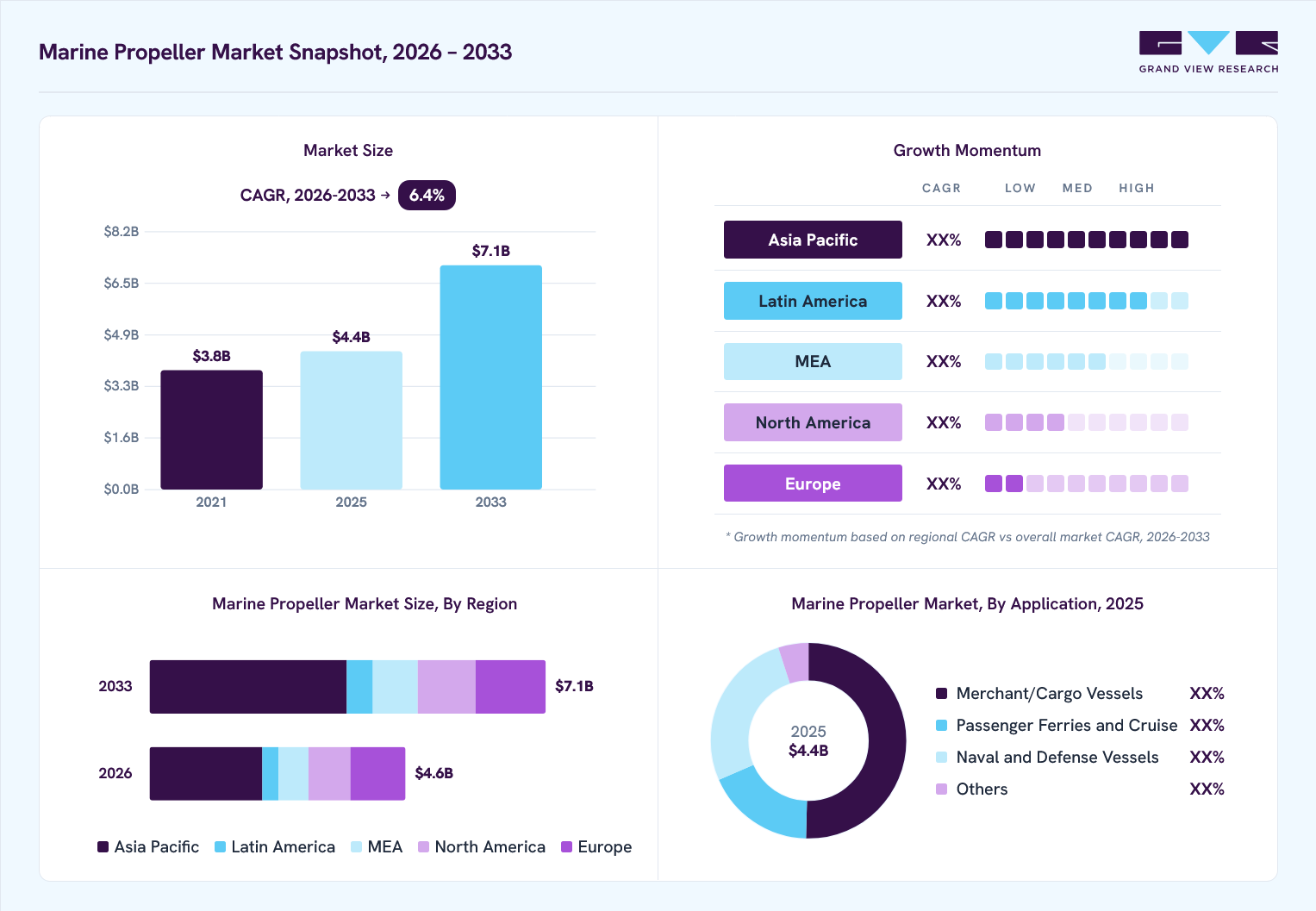
The global marine propeller market size was valued at USD 4.4 billion in 2025 and is projected to grow from USD 4.6 billion in 2026 to USD 7.1 billion by 2033, at a CAGR of 6.4% from 2026 to 2033. Asia Pacific dominated the market, accounting for a revenue share of 43.2% in 2025. The rising vessel fleet expansion and new shipbuilding activity are increasing demand for marine propeller systems.
 Source: Grand View Research, IR Documents, Primary Interviews, Paid DatabasesTo learn more about this report,
 Download Free Sample Report
 Key Market Trends & Insights
- By propeller: Fixed pitch propeller segment led the market and accounted for 52.8% of the global revenue in 2025.
- By number of blades: 4 blades segment led the market and accounted for 38.5% of the global revenue in 2025.
- By material: Nickel-Aluminum Bronze segment led the market and accounted for 45.1% of the global revenue in 2025.
- By propulsion system: Inboard segment led the market and accounted for the global revenue in 2025.
- By sales channel: OEM segment led the market and accounted for the global revenue in 2025.
- By application: Merchant/Cargo Vessels segment accounted for the largest share of global revenue in 2025.
Regional Highlights
- Largest regional market: Asia Pacific (43.2% revenue share, 2025)
- By country: China held the largest market share in 2025.
Market Size & Forecast
- Market size in 2025: USD 4.4 Billion
- Estimated market size in 2026: USD 4.6 Billion
- Projected market size by 2033: USD 7.1 Billion
- CAGR (2026-2033): 6.4%
Three ways to get this report
Buy it, customize it, or ask a question.Ask an Analyst
A direct answer, usually in 1 working day
- AccessReport author, directly
- Reply timeWithin 1 working day
- No sales callDirect answer only
- FormatEmail reply
- CostFree, no cost
Get the Full Report
What the study covers
- FormatsPDF · Excel · Dashboard
- Timeline2026–2033 annual, 2025 base
- Coverage20+ countries, 5 regions
- Companies10+ key players profiled
Customize the Report
20% free customization
- IncludeCountries, segments, points
- TailorTo your product definition
- ExtendDeeper competitor detail
- OrA fully bespoke study
- Turnaround5–10 working days
The increasing demand for fuel-efficient marine propulsion systems is driving the market growth as vessel operators seek to reduce fuel consumption and operating costs. Propeller design directly influences the efficiency of power transferred from the engine to the water, making optimized propellers increasingly important for commercial and other marine vessels. The focus on improving vessel energy performance is also encouraging the adoption of advanced propeller designs, propulsion-improving devices, and retrofit solutions. According to the International Maritime Organization (IMO), propeller optimization and improved propeller inflow are measures that can enhance propulsion efficiency and reduce fuel consumption.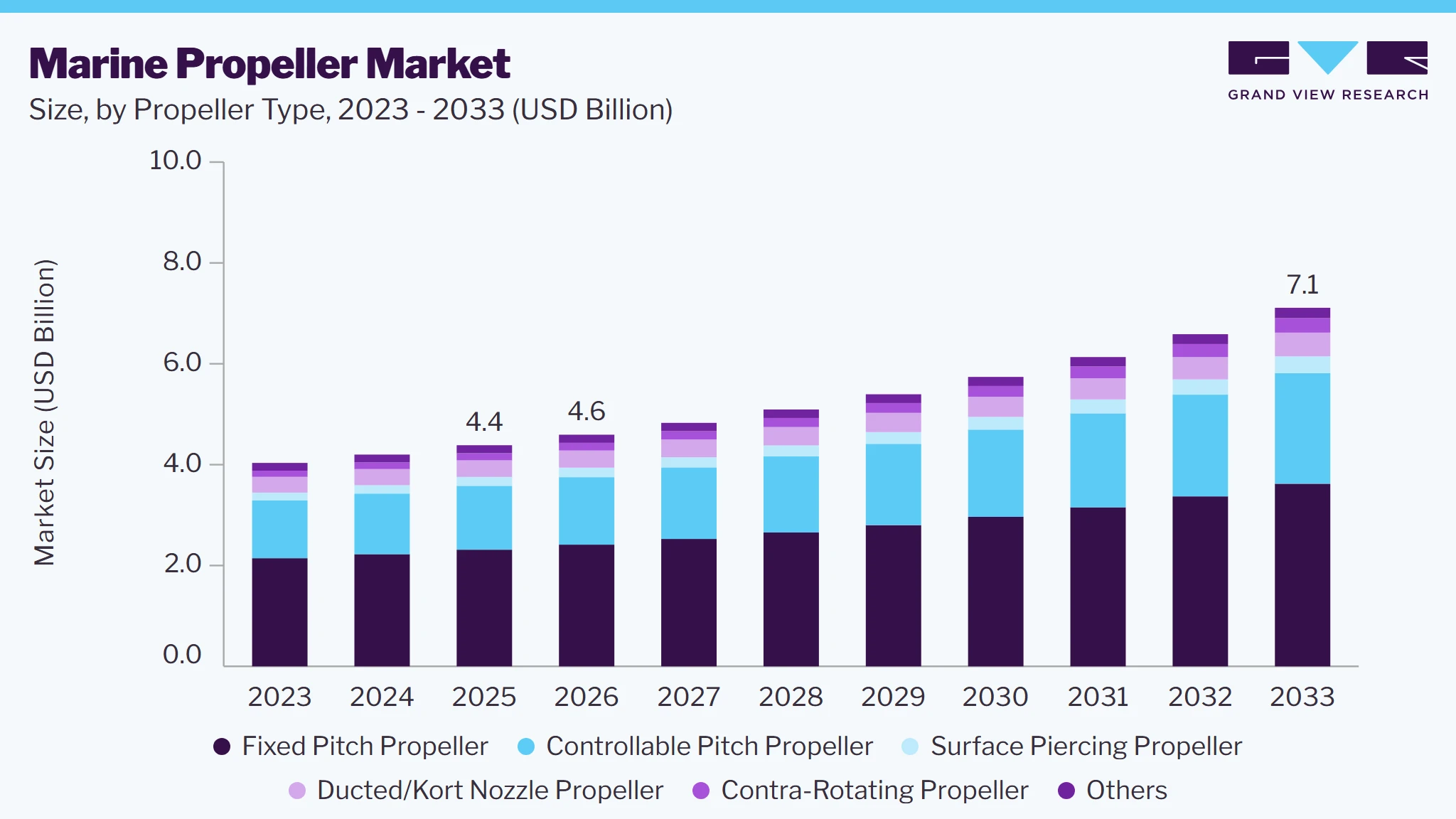 To learn more about this report, Download Free Sample Report
 Growing adoption of advanced propeller optimization technologies is emerging as a key trend in the market. Manufacturers are focusing on designs that improve water flow around the propeller and increase propulsion efficiency without requiring major changes to the vessel's propulsion system. Technologies such as contra-rotating propellers, pre-swirl devices, ducts, and other energy-saving devices are being considered to improve hydrodynamic performance. The increasing use of retrofit solutions is also creating opportunities for propeller manufacturers to upgrade existing vessels rather than relying only on new-build demand.
Increasing regulatory pressure on ship energy efficiency and greenhouse gas emissions is influencing the marine propulsion industry. For instance, in April 2025, the International Maritime Organization (IMO) finalized the draft legal text for its Net-Zero Framework, comprising amendments to MARPOL Annex VI to reduce greenhouse gas emissions from international shipping. The framework underscores the importance of energy-efficient propulsion solutions, including propeller technologies that enhance hydrodynamic efficiency and reduce fuel consumption. This regulatory direction is expected to encourage shipowners and shipbuilders to consider more efficient propeller designs and propulsion-improving technologies when developing or upgrading vessels.
High development, replacement, and integration costs can restrain the growth of the market, particularly for advanced and customized propulsion solutions. Large marine propellers require specialized engineering, manufacturing, installation, and testing, which can increase the overall investment required by vessel owners. Replacing a propeller may also require consideration of the broader propulsion system, as changing the propeller alone does not necessarily improve vessel efficiency. In addition, achieving higher propulsion efficiency may require complementary upgrades to other components of the propulsion system, further increasing project costs and implementation complexity.
Market Dynamics
The market is being shaped by increasing vessel fleet modernization, growing emphasis on fuel efficiency, stricter maritime environmental requirements, and advancements in propulsion technology. Vessel operators are increasingly seeking propulsion solutions that can reduce fuel consumption, improve maneuverability, lower emissions, and optimize overall operating performance. Technological developments in hydrodynamic blade design, controllable pitch systems, computational fluid dynamics, and energy-saving propulsion configurations are further influencing product development. These factors are creating opportunities across both newbuild and aftermarket applications.
The modernization of the global marine fleet is driving increased demand for efficient, technologically advanced propulsion components. Aging vessels require periodic replacement of propulsion equipment to maintain operational reliability, comply with evolving efficiency requirements, and control maintenance costs. Propellers are exposed to continuous hydrodynamic loads, corrosion, cavitation, and mechanical wear during vessel operation, which can gradually affect propulsion efficiency and performance. As vessel owners increasingly focus on extending fleet operating life while improving vessel performance, the replacement and upgrading of propeller systems are becoming important components of fleet modernization programs.
Fleet modernization directly expands demand for both new and replacement marine propellers across commercial, passenger, offshore, defense, and specialized vessels. Propeller replacement can involve redesigned blade geometry, upgraded materials, improved surface characteristics, or configurations better matched to the vessel's current operating profile. The availability of customized propeller designs also enables operators to address changes in vessel loading, engine configuration, operating routes, and speed requirements without replacing the entire vessel. This combination of replacement demand and propulsion optimization is expected to strengthen marine propeller sales across both OEM and aftermarket channels.
High upfront investment required for advanced marine propeller systems can constrain adoption, particularly among smaller-vessel operators and cost-sensitive commercial fleets. Advanced propulsion configurations may require specialized engineering, precision manufacturing, customized components, and additional control or hydraulic equipment, increasing the total acquisition cost compared with conventional propeller arrangements. Installation can also require modifications to existing shaft lines, propulsion controls, or other connected components, adding further project expenditure. As a result, vessel owners may prioritize lower-cost replacement solutions instead of investing in more advanced propulsion technologies.
The impact of this restraint is particularly significant in smaller commercial vessels, fishing vessels, recreational boats, inland-waterway vessels, and aging fleets, where capital expenditure decisions are highly cost-sensitive. Retrofit projects can become more complex when an upgraded propeller is not directly compatible with the existing propulsion arrangement, potentially increasing downtime and installation costs. The resulting longer replacement cycles can delay the adoption of technologically advanced products, even when they provide better fuel efficiency over their operating lifetimes. Consequently, price-sensitive segments may continue to favor conventional propeller configurations, limiting the penetration rate of premium propulsion technologies.
The large installed base of operating vessels creates significant potential for retrofit and replacement demand in the marine propeller industry. Existing vessels increasingly require efficiency improvements as operators seek to reduce fuel consumption, improve environmental performance, and extend the economic life of their fleets. Propeller replacement and propulsion optimization can provide a relatively targeted approach to improving vessel performance without requiring complete replacement of the vessel or its entire propulsion system. This creates an expanding addressable market for upgraded propellers, optimized blade designs, and other propulsion-efficiency solutions.
The opportunity is particularly attractive in aging commercial fleets, passenger vessels, offshore vessels, workboats, and other vessels with long operating lifecycles. Manufacturers with capabilities in customized propeller design, retrofit engineering, replacement components, and lifecycle support are positioned to capture recurring aftermarket demand. Revenue opportunities can extend beyond the initial propeller sale to include replacement blades and hubs, refurbishment, upgrades, engineering, and maintenance-related services. Increasing focus on vessel efficiency is therefore expected to strengthen the importance of aftermarket and retrofit activities alongside conventional newbuild demand.
Market Concentration & Characteristics
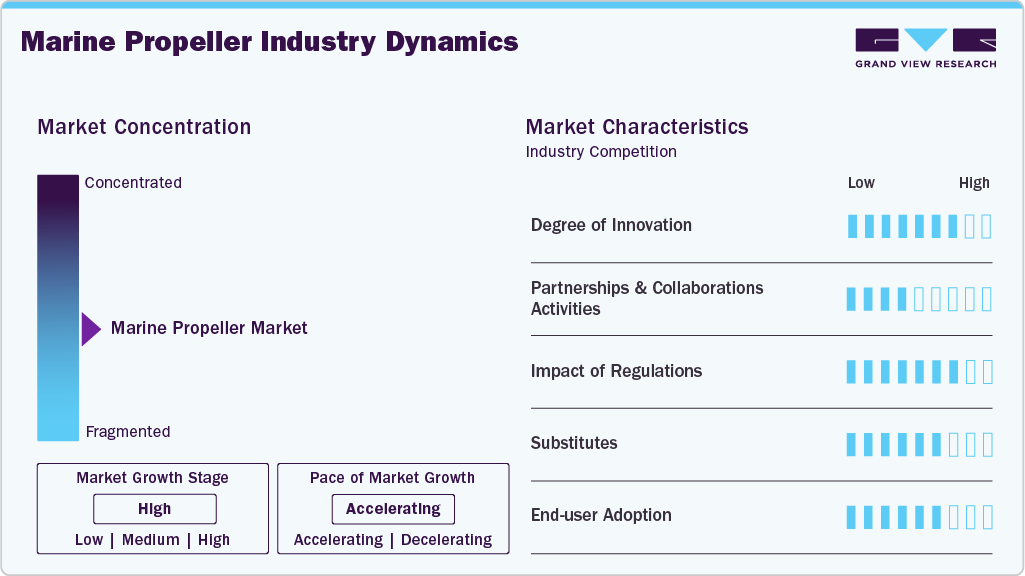
The market is moderately consolidated, indicating that a limited number of established manufacturers hold a significant share of the market, while several regional and specialized players continue to operate alongside them. The market requires substantial technical expertise, manufacturing capabilities, engineering know-how, and established relationships with shipbuilders, vessel operators, and marine engineering companies, which creates barriers for new entrants. Competition is therefore influenced not only by product availability but also by propeller efficiency, vessel-specific design capabilities, durability, customization, and after-sales support. The chart also indicates a medium-to-high level of innovation, as manufacturers increasingly focus on improving propulsion efficiency, reducing fuel consumption, optimizing hydrodynamic performance, and developing solutions that are compatible with evolving vessel requirements. Partnerships and collaborations are also meaningful, reflecting the need for propeller manufacturers to work with shipyards, propulsion-system providers, and marine technology companies.
 To learn more about this report, Download Free Sample Report
 The market characteristics further indicate a relatively high impact of regulations, as marine propulsion equipment must meet applicable safety, environmental, efficiency, and classification requirements, which influence product design and certification. In contrast, the threat from substitutes is relatively low because propellers remain a fundamental component of conventional marine propulsion systems. However, alternative propulsion technologies can influence demand in specific vessel categories. End-user adoption is at a medium-to-high level, supported by continued demand from commercial shipping, passenger vessels, offshore applications, naval vessels, and recreational marine segments. Moreover, the combination of established manufacturers, moderate competitive intensity, ongoing product innovation, regulatory requirements, and limited direct substitutes supports the classification of the market as moderately consolidated rather than highly fragmented or highly concentrated.
Analyst Perspective
The market is progressing toward higher-efficiency and application-specific propulsion solutions as vessel operators increasingly prioritize fuel economy, emissions reduction, and lifecycle operating costs. Hydrodynamic optimization, controllable pitch technology, advanced materials, and propulsion-system integration are reshaping product development and increasing the value of customized propeller solutions. Retrofit and replacement activity is expected to become increasingly important as existing fleets seek efficiency improvements without undertaking complete propulsion-system replacements. Competitive positioning is also expected to increasingly depend on the ability to provide integrated propulsion solutions and lifecycle services rather than standalone propeller products.
Propeller Insights
The fixed pitch propeller segment accounted for 52.8%, the largest share of global revenue in 2025, due to their relatively simple construction, established operating characteristics, and broad suitability across commercial and recreational vessels. Their fixed blade geometry enables a straightforward propulsion arrangement with fewer moving components, which can support lower maintenance requirements and dependable operation. Strong adoption across cargo vessels, fishing vessels, workboats, and other conventional marine applications continues to sustain demand for this segment. The widespread availability of manufacturing, repair, and replacement capabilities further reinforces the position of fixed pitch propellers in the market.
The contra-rotating propellers type segment is projected to grow at the fastest CAGR over the forecast period, as vessel operators increasingly seek propulsion configurations capable of extracting greater efficiency from available engine power. The arrangement uses two propellers rotating in opposite directions, enabling recovery of rotational energy from the first propeller and improving overall propulsion performance under suitable operating conditions. Demand is particularly supported by specialized vessels where fuel efficiency, compact propulsion arrangements, and higher power utilization are important purchasing considerations. Increasing development of advanced propulsion architectures is likely to create additional opportunities for contra-rotating configurations during the forecast period.
Number of Blades Insights
The 4 blades segment accounted for 38.5% share, the largest share of global revenue in 2025, driven by its practical balance of thrust generation, efficiency, vibration characteristics, and operating stability. This configuration is suitable for a broad range of commercial and passenger vessels with varying propulsion requirements. The relatively balanced performance profile makes four-bladed designs attractive for applications where consistent propulsion performance is more important than highly specialized operating characteristics. Continued demand from established vessel fleets and new build projects supports the segment's dominant market position.
The 5 blades are projected to grow at the fastest CAGR over the forecast period as vessel operators place greater emphasis on thrust performance, vibration reduction, and propulsion efficiency. The additional blade area can enable effective power absorption while maintaining suitable propulsion characteristics for vessels with demanding operating requirements. This configuration is gaining relevance in applications where smoother propulsion and reduced underwater noise are important considerations. Increasing adoption of higher-performance propulsion systems is expected to strengthen demand for five-bladed propellers over the forecast period.
Material Insights
The nickel-aluminum bronze segment accounted for 45.1%, the largest share of global revenue in 2025, due to its established use in marine propulsion applications and its combination of strength, corrosion resistance, and durability. These characteristics allow propellers manufactured from the alloy to withstand prolonged exposure to seawater and demanding operating environments. The material is widely suitable for commercial vessels, passenger ships, workboats, and other applications requiring durable propulsion components. Its established manufacturing processes and long operating history further support its continued dominance.
The composite segment is projected to grow at the fastest CAGR over the forecast period, as manufacturers and vessel operators increasingly explore lightweight materials for propulsion applications. Lower material weight can reduce rotational inertia and may improve propulsion-system responsiveness and overall vessel efficiency. Composite construction also enables application-specific blade designs and corrosion-resistant solutions. Growing interest in lightweight vessel technologies, efficiency optimization, and alternative propulsion architectures is expected to accelerate the adoption of composite propellers.
Propulsion System Insights
The inboard segment accounted for the largest share of global revenue in 2025. The inboard segment is widely used across commercial vessels, passenger vessels, workboats, fishing vessels, and other marine applications. The configuration places the engine within the vessel and transfers power to the propeller through a shaft-based propulsion arrangement, providing flexibility for larger and heavier vessels. Its established engineering architecture and compatibility with a broad range of vessel designs contribute to sustained demand. The extensive installed base of inboard-powered vessels also creates recurring replacement and aftermarket requirements for marine propellers.
The electric pod/Azipod propulsion is projected to grow at the fastest CAGR over the forecast period, supported by the maritime industry moves toward more efficient, maneuverable, and electrified propulsion architectures. These systems integrate propulsion and steering functions within a compact pod arrangement, which can improve maneuverability and provide greater flexibility in vessel design. Growing interest in hybrid-electric and fully electric marine propulsion is creating additional opportunities for electrically driven pod-based configurations. Increasing deployment across passenger vessels, cruise ships, ferries, and specialized vessels is expected to support rapid expansion of this segment.
Sales Channel Insights
Based on sales channel, the OEM segment accounted for the largest share of global revenue in 2025. This segment growth is attributed to the fact that marine propellers are frequently specified and installed during the construction of new vessels. Shipbuilders and propulsion-system integrators typically select propeller configurations according to vessel dimensions, engine characteristics, operating speed, and intended application during the design stage. New vessel construction generates substantial demand for complete propeller assemblies and customized propulsion components. The increasing incorporation of optimized propulsion systems into new build projects is expected to maintain the strong position of the OEM channel.
The aftermarket segment is projected to grow at the fastest CAGR over the forecast period, as vessel owners increasingly replace worn or damaged propellers and undertake propulsion upgrades. Continuous exposure to seawater, cavitation, corrosion, mechanical loading, and operational wear creates recurring requirements for replacement and refurbishment. Operators are also using retrofit projects to improve propulsion efficiency and adapt existing vessels to changing operating conditions. Rising fleet age and increasing focus on extending vessel service life are expected to generate sustained aftermarket opportunities.
Application Insights
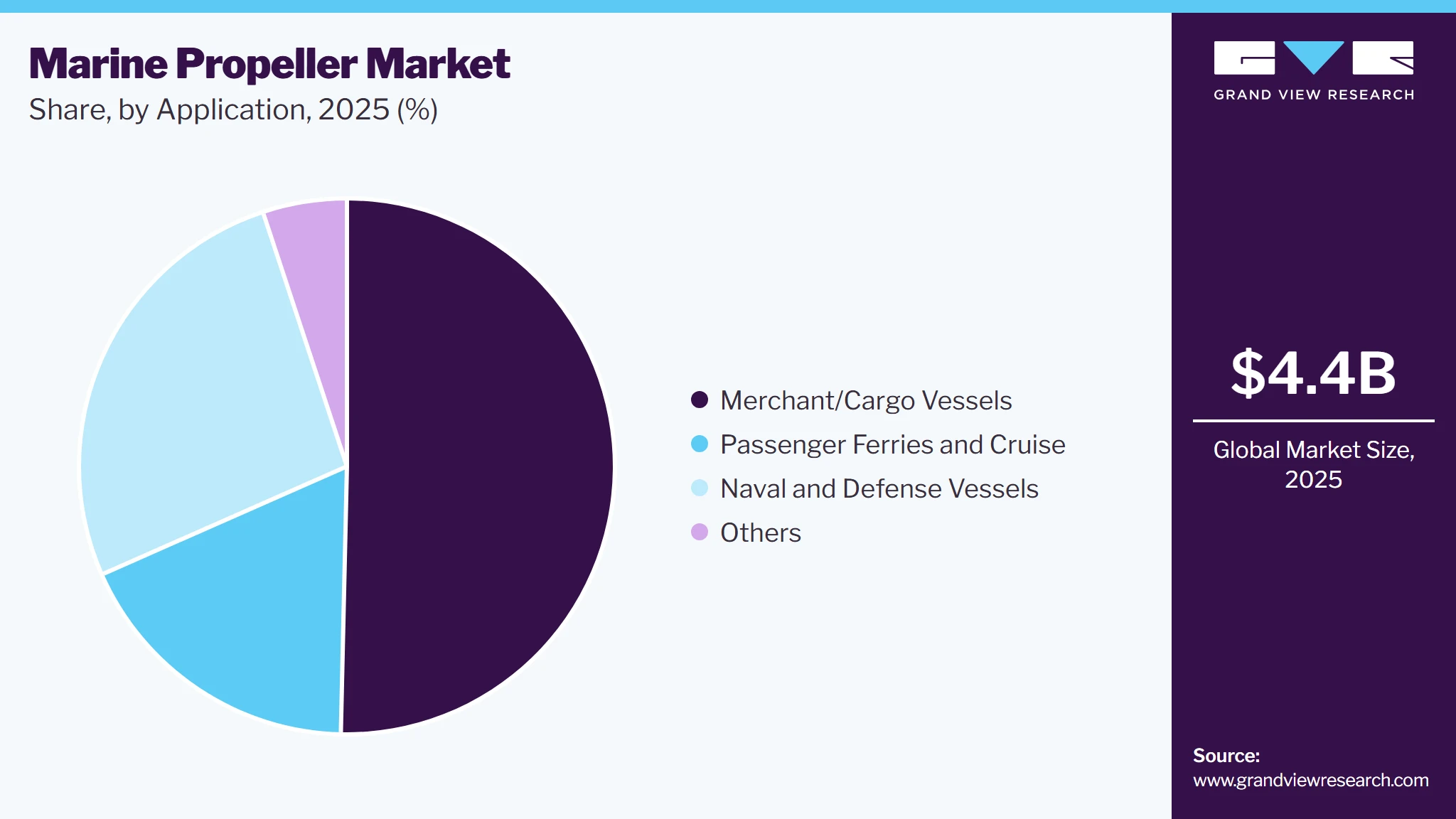
The merchant/cargo vessels segment accounted for the largest market revenue share in 2025, due to the substantial global fleet engaged in transporting commodities, manufactured goods, energy products, and other cargo. These vessels require reliable propulsion systems capable of supporting continuous operation over long routes and demanding duty cycles. Propeller performance directly influences fuel consumption, vessel speed, and overall voyage economics, making propulsion efficiency an important procurement consideration. Continued maritime trade activity, fleet replacement, and efficiency-focused upgrades are expected to sustain demand from merchant and cargo vessels.
 To learn more about this report, Download Free Sample Report
 The naval and defense vessels segment is projected to grow at the fastest CAGR over the forecast period, as governments increase investments in maritime security, fleet modernization, and advanced naval platforms. Modern defense vessels require propulsion systems capable of delivering high maneuverability, reliability, low acoustic signatures, and efficient performance under demanding operating conditions. Increasing procurement of patrol vessels, frigates, corvettes, submarines, and specialized naval platforms is creating additional demand for technologically advanced propeller solutions. The growing emphasis on indigenous naval manufacturing and modernization of existing defense fleets is further supporting opportunities in this application segment.
Regional Insights
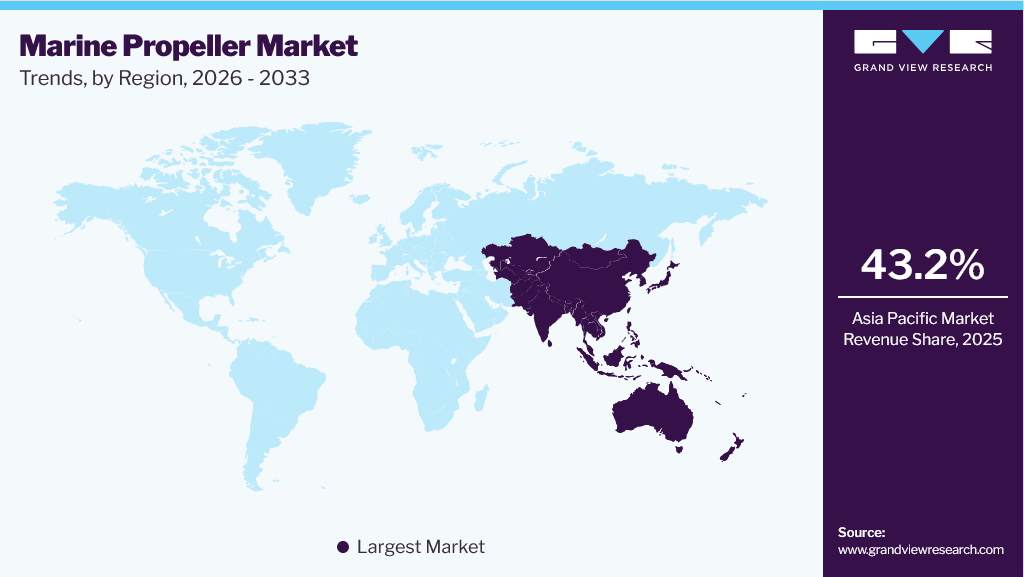
The Asia Pacific marine propeller industry led the global market and accounted for 43.2% of the global revenue in 2025 and is expected to register the fastest CAGR from 2026 to 2033. Asia Pacific is a major demand center for marine propellers due to its large shipbuilding base, expanding commercial fleets, and significant maritime trade. The region benefits from strong vessel production in China, South Korea, and Japan, while increasing fleet modernization and demand for energy-efficient propulsion systems are creating additional opportunities for propeller manufacturers.
 To learn more about this report, Download Free Sample Report
 China Marine Properller Market Trends
China marine propeller industry held a dominant share in the Asia Pacific market, creating a substantial installed base for marine propulsion components. High shipbuilding volumes across cargo, tanker, container, and other commercial vessel categories continue to generate demand for new propellers, while fleet renewal and efficiency improvements are supporting replacement opportunities.
The marine propeller industry in Japan is expected to grow at a significant CAGR over the forecast period. Japan maintains a strong position in technologically advanced shipbuilding, with a focus on smart and environmentally efficient vessels. It established a shipbuilding ecosystem and a large existing fleet, creating demand for both OEM-fitted propellers and replacement solutions, particularly as operators seek to improve vessel efficiency and modernize their vessels.
North America Marine Propeller Market Trends
North America marine propeller industry held a significant growth in the market, supported by commercial shipping, naval fleets, offshore activities, recreational vessels, and extensive vessel maintenance needs. The region's demand is indicated by a combination of new vessel construction and replacement of propulsion components across an extensive installed fleet.
The U.S. marine propeller industry is anticipated to register the fastest CAGR from 2026 to 2033, creating substantial demand for marine propeller products. The U.S. has a comparatively smaller commercial shipbuilding industry but remains a major global player in naval and defense shipbuilding. Marine propeller demand is strongly supported by naval vessel construction, fleet modernization, commercial vessel maintenance, and specialized marine applications.
Europe Marine Propeller Market Trends
The Europe marine propeller industry is poised for significant growth from 2026 to 2033. Europe has a developed maritime manufacturing ecosystem supported by established shipyards, marine equipment suppliers, and a strong vessel maintenance network. Demand is increasingly influenced by the transition toward greener and more digitally enabled vessels, creating opportunities for efficient propeller designs and advanced propulsion technologies.
The UK marine propeller industry has a well-established maritime industry supported by commercial shipping, naval activities, offshore operations, and marine engineering capabilities. Demand for marine propellers is expected to benefit from vessel modernization and the industry's growing emphasis on operational efficiency and environmental impact reduction.
The marine propeller industry in Germany held the largest share in the Europe market. Germany has a technologically advanced marine engineering industry with particular expertise in cruise ships, naval vessels, and specialized commercial vessels. Its focus on high-value shipbuilding and advanced vessel technologies creates demand for precision-engineered propulsion components and customized marine propeller solutions.
Key Marine Propeller Company Insights
Key players operating in the marine propeller industry include HD Hyundai Heavy Industries., AB Volvo, Kawasaki Heavy Industries, Ltd., and among others. Key players in the market are focusing on product development, propulsion efficiency improvements, strategic partnerships, acquisitions, and expansion of their global manufacturing and service networks to strengthen their market position. Companies are increasingly developing advanced propeller solutions designed to improve fuel efficiency, reduce emissions, enhance vessel maneuverability, and meet evolving maritime environmental requirements.
-
Volvo Group is a global provider of transportation and infrastructure solutions, with operations across commercial vehicles, construction equipment, and marine and industrial power solutions. Through Volvo Penta, the Volvo Group offers marine propulsion solutions, including engines and propulsion systems for various marine applications. Volvo Penta also provides marine propellers for powerboats and sailboats, with its propeller portfolio covering solutions for different marine propulsion systems and applications. The company’s marine propeller offerings form part of its broader portfolio of marine power and propulsion products.
-
HD Hyundai Heavy Industries is a global shipbuilder with businesses spanning shipbuilding, offshore and energy, naval and medium-sized ships, and engine and machinery. Its Engine & Machinery Business Unit provides marine engines, propellers, ship propulsion, and rudder systems. The company produces around 200 marine propellers annually and supplies them to its subsidiaries and other Korean shipyards.
Key Marine Propeller Companies
The following key companies have been profiled for this study on the marine propeller market.
-
HD Hyundai Heavy Industries.
-
AB Volvo
-
Kawasaki Heavy Industries, Ltd.
-
MAN Energy Solutions
-
NAKASHIMA PROPELLER Co., Ltd.
-
Rolls-Royce plc
-
SCHOTTEL Group
-
VEEM Ltd
-
Wärtsilä
-
Brunswick Corporation.
Company Categorization
Operating Strategies
Competitive Edge
Weaknesses
Mature Players: Wärtsilä, MAN Energy Solutions, NAKASHIMA PROPELLER Co., Ltd., SCHOTTEL Group
- Mature players in the marine propeller market are focus on broad marine propulsion portfolios, integrated propulsion solutions, newbuild projects, retrofit programs, and lifecycle services. These companies generally target multiple vessel categories and geographic markets to diversify revenue sources.
- Mature players gain a competitive advantage through strong engineering capabilities, established marine customer relationships, broad propulsion portfolios, international service networks, and ability to address complex vessel-specific requirements.
- These companies often face challenges related to higher organizational and system-integration costs can increase solution prices, while dependence on large marine projects can expose these players to shipbuilding and fleet investment cycles.
Emerging Players: Rolls-Royce plc, VEEM Ltd, Brunswick Corporation
- Emerging players in the marine propeller market are focused on specialized propulsion applications, differentiated product technologies, selected vessel categories, and expansion of aftermarket or specialized marine solutions. Their strategies generally emphasize product specialization and targeted market opportunities.
- Emerging players gain market traction through specialized technology capabilities, established positions in selected marine applications, strong product recognition, and potential to respond quickly to specific customer requirements.
- Emerging players face limitations due to their comparatively narrower marine-propeller focus or application coverage can limit addressable demand, while dependence on selected vessel segments may increase exposure to fluctuations in those markets.
Recent Developments
-
In July 2026, Kawasaki Heavy Industries, Ltd. partnered with NVIDIA Corporation, an American multinational technology company, to develop a next-generation digital shipyard using AI, robotics, and digital twin technologies. The collaboration aimed to connect vessel design and construction processes, improve shipyard productivity, and reduce rework. AI-enabled robotics were also planned for applications such as welding, painting, inspection, and material handling.
-
In May 2025, NAKASHIMA PROPELLER Co., Ltd. acquired 100% of Michigan Marine Propulsion (MMP), the European business of Michigan Wheel, and established Nakashima Marine Propulsion Limited in the UK to expand its presence in the European marine market and strengthen its distribution and after-sales network. The acquisition enabled MMP’s European market expertise and distributor network to be combined with Nakashima’s propeller development and manufacturing capabilities. The businesses were integrated under the NAKASHIMA brand.
Marine Propeller Market Report Scope
Report Attribute
Details
Market size in 2025
USD 4.4 billion
Estimated market size in 2026
USD 4.6 billion
Projected market size by 2033
USD 7.1 billion
Growth rate
CAGR of 6.4% from 2026 to 2033
Base year for estimation
2025
Historical data
2021 - 2024
Forecast period
2026 - 2033
Quantitative units
Revenue in USD billion and CAGR from 2026 to 2033
Report coverage
Revenue forecast, company ranking, competitive landscape, growth factors, and trends
Segments covered
Propeller, number of blades, material, propulsion system, sales channel, application, region
Regional scope
North America; Europe; Asia Pacific; Latin America; MEA
Country scope
U.S.; Canada; Mexico; Germany; UK; France; China; Japan; India; South Korea; Australia; Brazil; KSA; UAE; South Africa
Key companies profiled
HD Hyundai Heavy Industries; AB Volvo; Kawasaki Heavy Industries, Ltd.; MAN Energy Solutions; NAKASHIMA PROPELLER Co., Ltd.; Rolls-Royce plc; SCHOTTEL Group; VEEM Ltd; Wärtsilä; Brunswick Corporation
Customization scope
Free report customization (equivalent up to 8 analysts working days) with purchase. Addition or alteration to country, regional & segment scope.
Pricing and purchase options
Avail customized purchase options to meet your exact research needs. Explore purchase options
Global Marine Propeller Market Report Segmentation
The report forecasts revenue growth at global, regional, and country levels and provides an analysis of the latest industry trends in each of the sub-segments from 2021 to 2033. For the purpose of this study, Grand View Research has segmented the global marine propeller market report based on propeller, number of blades, material, propulsion system, sales channel, application, and region:
-
Propeller Outlook (Revenue, USD Billion, 2021 - 2033)
-
Fixed Pitch Propeller
-
Controllable Pitch Propeller
-
Contra-Rotating Propeller
-
Surface Piercing Propeller
-
Ducted/Kort Nozzle Propeller
-
Others
-
-
Number of Blades Outlook (Revenue, USD Billion, 2021 - 2033)
-
2 Blades
-
3 Blades
-
4 Blades
-
5 Blades
-
6+ Blades
-
-
Material Outlook (Revenue, USD Billion, 2021 - 2033)
-
Nickel-Aluminum Bronze
-
Stainless Steel
-
Aluminum
-
Composite
-
Others
-
-
Propulsion System Outlook (Revenue, USD Billion, 2021 - 2033)
-
Inboard
-
Outboard
-
Sterndrive
-
Electric Pod/Azipod
-
-
Sales Channel Outlook (Revenue, USD Billion, 2021 - 2033)
-
OEM
-
Aftermarket
-
-
Application Outlook (Revenue, USD Billion, 2021 - 2033)
-
Merchant/Cargo Vessels
-
Passenger Ferries and Cruise
-
Naval and Defense Vessels
-
Others
-
-
Regional Outlook (Revenue, USD Billion, 2021 - 2033)
-
North America
-
U.S.
-
Canada
-
Mexico
-
-
Europe
-
Germany
-
UK
-
France
-
-
Asia Pacific
-
China
-
India
-
Japan
-
South Korea
-
Australia
-
-
Latin America
-
Brazil
-
-
Middle East & Africa (MEA)
-
UAE
-
Kingdom of Saudi Arabia (KSA)
-
South Africa
-
-
Research Methodology
The marine propeller market figures in this report are based on a proven research process that combines executive interviews with secondary research from proprietary databases, company filings, and recognized regulatory and institutional sources. Market size is built through value-chain sizing-reconciling supply-side and demand-side estimates-and triangulated with bottom-up and top-down approaches. Every estimate passes multiple levels of expert validation before publication, with each marine propeller segment quantified using the revenue-capture definitions in the table below.
Segment Definition
Segment - Propeller
Revenue capture definition
Fixed Pitch Propeller
The segment revenue is generated from the sale of complete fixed-pitch propellers, replacement units, blades, hubs, customized propeller assemblies, and associated components supplied for newbuild, replacement, and retrofit applications.
Controllable Pitch Propeller
The segment revenue is generated from controllable-pitch propeller assemblies, adjustable blades, hubs, pitch-control mechanisms, hydraulic actuation equipment, control components, replacement units, and associated retrofit solutions.
Contra-Rotating Propeller
The segment revenue is generated from surface-piercing propellers, replacement assemblies, blades, hubs, customized propulsion units, and associated components supplied for applicable high-speed and specialized vessels.
Surface Piercing Propeller
The segment revenue is generated from propellers integrated with ducts or Kort nozzles, including complete assemblies, replacement units, nozzle components, customized propulsion packages, and related engineering services.
Ducted/Kort Nozzle Propeller
The segment revenue is generated from contra-rotating propeller systems, including forward and aft propellers, blades, hubs, associated shafts and transmission components, replacement units, and customized propulsion assemblies.
Others
The segment revenue is generated from specialized propeller configurations not classified under the other defined categories, including customized assemblies, replacement products, blades, hubs, and associated components.
Segment - Number of Blades
Revenue capture definition
2 Blades
The segment revenue is generated from nickel-aluminum bronze propellers, including complete assemblies, replacement units, blades, hubs, and customized cast or machined components.
3 Blades
The segment revenue is generated from stainless-steel propellers, including complete assemblies, replacement products, blades, hubs, and customized propulsion components.
4 Blades
The segment revenue is generated from aluminum propellers, including complete assemblies, replacement units, blades, hubs, and lightweight customized propulsion components.
5 Blades
The segment revenue is generated from composite propellers, including complete assemblies, replacement products, customized designs, blades, hubs, and related lightweight propulsion components.
6+ Blades
The segment revenue is generated from propellers manufactured using materials other than those separately identified, including specialized alloys and application-specific materials.
Segment - Material
Revenue capture definition
Nickel-Aluminum Bronze
The segment revenue is generated from nickel-aluminum bronze propellers, including complete assemblies, replacement units, blades, hubs, and customized cast or machined components.
Stainless Steel
The segment revenue is generated from stainless-steel propellers, including complete assemblies, replacement products, blades, hubs, and customized propulsion components.
Aluminum
The segment revenue is generated from aluminum propellers, including complete assemblies, replacement units, blades, hubs, and lightweight customized propulsion components.
Composite
The segment revenue is generated from composite propellers, including complete assemblies, replacement products, customized designs, blades, hubs, and related lightweight propulsion components.
Others
The segment revenue is generated from propellers manufactured using materials other than those separately identified, including specialized alloys and application-specific materials.
Segment - Propulsion System
Revenue capture definition
Inboard
The segment revenue is generated from propellers used with internally mounted engines and shaft-driven propulsion systems, including complete propellers, replacement units, and associated propulsion components.
Outboard
The segment revenue is generated from propellers designed for outboard propulsion systems, including replacement propellers, complete assemblies, customized products, and related components.
Sterndrive
The segment revenue is generated from propellers designed for sterndrive propulsion systems, including replacement products, complete assemblies, customized propellers, and associated components.
Electric Pod/Azipod
The segment revenue is generated from propellers integrated with electric pod, azimuth, or Azipod propulsion systems, including propeller assemblies, replacement components, customized units, and related engineering solutions.
Segment - Sales Channel
Revenue capture definition
OEM
The segment revenue is generated from original-equipment propellers and propulsion components supplied to shipbuilders, boat manufacturers, propulsion integrators, and other customers for installation in newly manufactured vessels.
Aftermarket
The segment revenue is generated from replacement propellers, spare blades, hubs, refurbishment components, retrofit products, upgrades, repairs, and other aftermarket propulsion-related products and services.
Segment - Application
Revenue capture definition
Merchant/Cargo Vessels
The segment revenue is generated from propellers supplied for container ships, bulk carriers, tankers, general cargo vessels, Ro-Ro vessels, and other commercial cargo vessels.
Passenger Ferries and Cruise
The segment revenue is generated from propellers supplied for passenger ferries, cruise vessels, Ro-Pax vessels, excursion vessels, and other passenger transportation vessels.
Naval and Defense Vessels
The segment revenue is generated from propellers and specialized propulsion systems supplied for naval vessels, patrol vessels, coast guard vessels, support ships, and other defense applications.
Others
The segment revenue is generated from propellers supplied for recreational boats, yachts, fishing vessels, offshore vessels, research vessels, dredgers, tugboats, workboats, and other applications.
Estimation Model
Layer Name
Key Question
Description
Vessel Fleet & Newbuild Assessment
What is the addressable vessel base?
The estimation begins by assessing the existing and newly constructed vessel population across major marine applications. The analysis considers merchant and cargo vessels, passenger vessels, naval vessels, recreational vessels, fishing vessels, offshore vessels, and other vessel categories. Vessel size, propulsion configuration, operating profile, and replacement requirements are considered to determine the potential demand for marine propellers. New vessel construction provides the foundation for estimating OEM propeller demand.
Propeller Penetration & Configuration Analysis
What type of propellers are used across the vessel base?
The second layer evaluates propeller adoption according to propeller, number of blades, material, and propulsion system. Differences in vessel size, speed, power requirements, maneuverability, and operating conditions influence the selection of propeller configurations. The analysis determines the share of vessels associated with fixed-pitch, controllable-pitch, ducted, surface-piercing, contra-rotating, and other configurations. This layer establishes the product mix used for market revenue estimation.
Pricing & Revenue Assessment
What is the revenue generated per propeller?
The third layer estimates average revenue associated with different marine propeller configurations. Pricing is assessed according to propeller size, material, blade count, propulsion arrangement, vessel application, customization requirements, and manufacturing complexity. Higher-value systems generally involve greater engineering requirements and more specialized components. The resulting pricing framework is applied across the estimated unit base to calculate segment-level revenue.
OEM, Aftermarket & Regional Validation
How is market revenue distributed and validated?
The final layer evaluates revenue distribution between OEM and aftermarket sales across major geographic markets. Regional vessel construction, fleet size, replacement cycles, maritime trade activity, defense procurement, and marine infrastructure are considered to validate demand estimates. Historical market developments and vessel fleet trends are used to cross-check the calculated market size. The resulting assessment provides the basis for current market valuation and future growth projections.
Delivered Customization
We have successfully delivered the following deep-dive customizations
Client Request
Customization Delivered
Value Adds
Regional Marine Propeller Market Opportunity Assessment
Country/region-wise market sizing and forecasts
Analysis of demand, adoption trends, and regulatory landscape
Identification of high-growth regions and investment hotspots
Identified region-specific growth opportunities
Supported expansion and go-to-market strategy
Enabled informed regional investment decisions
Cross-Segmentation Analysis for the Marine Propeller Market
Criss-cross market analysis by propeller, number of blades, material, propulsion system, sales channel, application
Demand and adoption assessment across key segments
Segment attractiveness and growth potential passenger benchmarking
Identified high-potential market segments
Supported targeted propeller positioning and marketing strategy
Improved customer and segment prioritization
Competitive Benchmarking and Strategic Positioning in the Marine Propeller Market
Benchmarking of key competitors across propellers, pricing, partnerships, and innovation
Comparative assessment of market share, capabilities, and strategies
Analysis of competitive strengths, gaps, and differentiation areas
Identified competitive white spaces and growth gaps
Supported strategic positioning and differentiation
Enabled data-driven competitive strategy development
Frequently Asked Questions About This Report
The global marine propeller market size was estimated at USD 4.4 billion in 2025 and is expected to reach USD 4.6 billion in 2026.
The global marine propeller market is expected to grow at a compound annual growth rate of 6.4% from 2026 to 2033 to reach USD 7.1 billion by 2033.
Fixed pitch propeller type segment accounted for 52.8%, the largest share of global revenue in 2025, due to their relatively simple construction, established operating characteristics, and broad suitability across commercial and recreational vessels.
The Asia Pacific marine propeller market led the global market and accounted for 43.2% of the global revenue in 2025 and is expected to register the fastest growth from 2026 to 2033. Asia Pacific is a major demand center for marine propellers due to its large shipbuilding base, expanding commercial fleets, and significant maritime trade
Rising vessel fleet expansion and new shipbuilding activity are increasing demand for marine propeller systems
Some key players operating in the marine propeller market include HD Hyundai Heavy Industries., AB Volvo, Kawasaki Heavy Industries, Ltd., MAN Energy Solutions, NAKASHIMA PROPELLER Co., Ltd., Rolls-Royce plc, SCHOTTEL Group, VEEM Ltd, Wärtsilä, Brunswick Corporation.
4 Blades segment accounted for 38.5%, the largest share of global revenue in 2025, while 5 blades are projected to grow at the fastest CAGR over the forecast period
Nickel-aluminum bronze segment accounted for 45.1%, the largest share of global revenue in 2025, while composite is projected to grow at the fastest CAGR over the forecast period
Inboard segment accounted for the largest share of global revenue in 2025, while electric pod/azipod propulsion are projected to grow at the fastest CAGR over the forecast period
About the Author(s)
Next Generation Technologies Research Team
Technology · Next Generation TechnologiesThis report was authored by the next generation technologies research team at Grand View Research - comprising two research analysts, one senior research analyst, and one industry expert - with specialized expertise in the next generation technologies segment of the technology industry. All findings are based on proprietary technology databases, executive interviews, and regulatory analysis, subject to internal peer review prior to publication.
Last Updated:
Speak to Analyst

Customize this report to your needs - add regions, segments, or data points, with 20% free customization.
Or view our licence options:


ISO 9001:2015 & 27001:2022 Certified
We are GDPR and CCPA compliant! Your transaction & personal information is safe and secure. For more details, please read our privacy policy.


