
- Home
- »
- Clothing, Footwear & Accessories
- »
-
Maternity Wear Market Size And Share Report, 2026-2033GVR Report cover

Maternity Wear Market (2026 - 2033)
Size, Share & Trends Analysis Report By Product (Outerwear, Innerwear, Nightwear), By Distribution Channel (Store-based, Online), By Region (North America, Europe, Asia Pacific, Latin America, MEA), And Segment Forecasts
Market Size, 2025
$24.5BMarket Estimate, 2026
$25.6BMarket Forecast, 2033
$35.8BCAGR, 2026–2033
4.9%Maternity Wear Market Summary
The global maternity wear market size was valued at USD 24.5 billion in 2025 and is projected to grow from USD 25.6 billion in 2026 to USD 35.8 billion by 2033, at a CAGR of 4.9% from 2026 to 2033. North America dominated the maternity wear market with the largest revenue share of 27.2% in 2025. The increasing awareness about the importance of comfortable and functional clothing during pregnancy is a major driver.
 Source: Grand View Research, IR Documents, Primary Interviews, Paid DatabasesTo learn more about this report,
 Download Free Sample Report
 Key Market Trends & Insights
- By product: Maternity outerwear segment held the largest market share of 35.8% in 2025.
- By distribution channel: Store-based segment held the largest market share of 65.8% in 2025.
Regional Highlights
- Largest regional market: North America (27.2% revenue share, 2025)
- Fastest-growing regional market: Asia Pacific (highest CAGR, 2026-2033)
- By country: The U.S. held the largest market share in 2025
Market Size & Forecast
- Market size in 2025: USD 24.5 Billion
- Estimated market size in 2026: USD 25.6 Billion
- Projected market size by 2033: USD 35.8 Billion
- CAGR (2026-2033): 4.9%
Three ways to get this report
Buy it, customize it, or ask a question.Ask an Analyst
A direct answer, usually in 1 working day
- AccessReport author, directly
- Reply timeWithin 1 working day
- No sales callDirect answer only
- FormatEmail reply
- CostFree, no cost
Get the Full Report
What the study covers
- FormatsPDF · Excel · Dashboard
- Timeline2026–2033 annual, 2025 base
- Coverage20+ countries, 5 regions
- Companies10+ key players profiled
Customize the Report
20% free customization
- IncludeCountries, segments, points
- TailorTo your product definition
- ExtendDeeper competitor detail
- OrA fully bespoke study
- Turnaround5–10 working days
As more women join the workforce and maintain active lifestyles during their pregnancy, the demand for stylish and comfortable maternity wear has surged. Additionally, the rise in disposable incomes and the growing fashion consciousness among expecting mothers have contributed to the market's expansion. To learn more about this report, Download Free Sample Report
 The influence of social media and the endorsement of maternity wear by celebrities and fashion influencers have also played a significant role in driving consumer interest. Furthermore, the availability of a wide range of maternity wear options, from casual to formal and activewear, has catered to pregnant women's diverse needs and preferences. The advancements in fabric technology, ensuring comfort and adaptability, and the growing e-commerce sector have made it easier for consumers to access various maternity wear products.
Market Dynamics
The maternity wear market is experiencing strong growth, driven by rising consumer demand for comfortable, functional, and fashionable apparel during pregnancy and the postpartum period. Rising maternal age, growing disposable incomes, and greater awareness regarding specialized clothing designed to accommodate changing body shapes are supporting market expansion. Furthermore, the rapid growth of e-commerce platforms, the introduction of inclusive sizing and sustainable maternity apparel collections, and increasing demand for products such as maternity leggings, nursing bras, and maternity workwear are expected to continue driving growth in the global maternity wear market.
The growing demand for maternity garments that seamlessly transition from pregnancy to postpartum and breastfeeding stages is emerging as a significant driver for the maternity wear market. Consumers are increasingly seeking products with extended usability, prompting manufacturers to develop multifunctional apparel incorporating nursing access, wearable pump compatibility, and adaptive stretch fabrics. This shift is reducing the need for separate purchases during different stages of motherhood and encouraging higher spending on premium, long-lasting products. As a result, brands are expanding beyond traditional maternity clothing to offer integrated solutions for pregnancy, nursing, and postpartum recovery. This trend is accelerating product innovation and broadening addressable consumer segments.
For instance, in September 2024, Lansinoh partnered with Kindred Bravely to launch the Kindred Bravely for Lansinoh Nursing & Wearable Pumping Bra, designed to support both breastfeeding and wearable breast pumps, highlighting the industry's focus on multifunctional maternity apparel.
The limited usage period of maternity apparel remains a key restraint for the market. Since maternity clothing is generally worn only during pregnancy and the early postpartum phase, many consumers are reluctant to invest in premium products and instead opt for oversized regular apparel, second-hand clothing, or rental options. This trend is particularly pronounced in price-sensitive markets where consumers prioritize affordability over specialized garments. The emergence of peer-to-peer resale platforms and maternity clothing rental services has further reduced repeat purchases, limiting volume growth for manufacturers and intensifying pricing pressures across the maternity wear industry.The increasing focus on postpartum recovery is creating opportunities for manufacturers to expand beyond traditional maternity wear into specialized recovery garments. Demand is rising for products such as compression leggings, C-section recovery underwear, pelvic support bands, and nursing-friendly sleepwear designed to address physical recovery after childbirth. Consumers are increasingly viewing these products as wellness essentials rather than discretionary purchases. This shift is encouraging brands to diversify into adjacent categories and establish long-term relationships with mothers beyond pregnancy. The opportunity is particularly strong in developed markets, where healthcare awareness and spending on maternal wellness products continue to increase, supporting premium product adoption and category expansion.Analyst Perspective
The maternity wear market is being shaped by rising consumer demand for multifunctional apparel, increased spending on maternal wellness, and the growing influence of digital-first brands offering personalized shopping experiences. The segment's most sustainable competitive advantage, however, is expected to reside with companies that can extend their offerings beyond pregnancy to encompass nursing and postpartum recovery needs through integrated product portfolios. As consumers increasingly seek garments with longer usage cycles and greater functional value, brands that can combine maternity apparel, nursing essentials, wearable pump-compatible products, and recovery wear under a single ecosystem are likely to strengthen customer retention. This evolution from pregnancy-specific clothing to comprehensive motherhood solutions is expected to increase average order values, support premium pricing, and enable manufacturers to establish enduring relationships with consumers across multiple stages of motherhood.
Product Insights
Based on product, the maternity outerwear segment led the market with the largest revenue share of 35.8% in 2025. Outerwear is an essential part of any wardrobe, providing comfort and protection against varying weather conditions, which is particularly important during pregnancy when women prioritize both functionality and style. The segment includes a wide range of products, such as maternity coats, jackets, and sweaters, designed to accommodate growing baby bumps while offering fashionable options. Additionally, the increasing trend of layering and the demand for versatile clothing that can be worn both during and after pregnancy have bolstered the popularity of maternity outerwear. Brands have responded to this demand by offering stylish, adaptable, and high-quality outerwear options, which appeal to fashion-conscious expecting mothers.
The nightwear segment is expected to grow at the fastest CAGR of 5.2% over the forecast period. Comfort and sleep quality are paramount for expectant mothers, and the demand for comfortable, supportive, and stylish nightwear has increased. Maternity nightwear, including pajamas, nightgowns, and robes, is designed to accommodate the changing body shape of pregnant women, providing both comfort and ease of movement. Additionally, the increasing awareness about the importance of good sleep during pregnancy and the impact of comfortable nightwear on sleep quality has driven demand. The availability of various fabrics, styles, and designs and the incorporation of features like nursing access has made maternity nightwear a popular choice among expectant mothers. Furthermore, the growing trend of online shopping and the influence of social media and e-commerce platforms have made it easier for women to explore and purchase nightwear that suits their needs and preferences.
Distribution Channel Insights
Based on distribution channel, the store-based segment led the market with the largest revenue share of 65.8% in 2025. Physical stores, including specialty maternity boutiques, department stores, and large retail chains, offer consumers the opportunity to try on clothing and assess fit, comfort, and style firsthand, which is especially important for maternity wear. The in-store shopping experience also allows for personalized customer service, where staff can provide guidance and recommendations tailored to expectant mothers' specific needs. Additionally, physical stores often carry a wider variety of sizes and styles, ensuring that shoppers can find garments that suit their preferences and body changes throughout pregnancy. Furthermore, the presence of frequent promotions, in-store events, and loyalty programs attract a steady flow of customers.
 To learn more about this report, Download Free Sample Report
 The online channel is expected to grow at the fastest CAGR over the forecast period. The convenience and ease of online shopping have become increasingly appealing to expectant mothers who prefer to browse and purchase maternity wear from the comfort of their homes. E-commerce platforms offer a vast selection of styles, sizes, and brands, making it easier for consumers to find the perfect fit and design. Additionally, the rise of digital marketing and social media has significantly boosted the visibility and attractiveness of online maternity wear retailers. Detailed product descriptions, customer reviews, and virtual try-on features provide shoppers with the confidence to make informed purchasing decisions. Furthermore, the frequent online promotions, discounts, and flexible return policies offered by e-commerce sites enhance the overall shopping experience.
Regional Insights
North America dominated the maternity wear market with the largest revenue share of 27.2% in 2025. The increasing number of working women and the growing trend of maintaining an active lifestyle during pregnancy have significantly boosted the demand for fashionable and comfortable maternity wear in the region. High disposable incomes and a strong emphasis on quality and style further drive the market. The presence of major maternity wear brands and extensive online and offline retail networks ensures wide accessibility and availability of diverse maternity clothing options. Additionally, the influence of social media and fashion trends, along with endorsements by celebrities and influencers, have heightened the popularity and demand for stylish maternity wear.
 To learn more about this report, Download Free Sample Report
 U.S. Maternity Wear Market Trends
The maternity wear market in the U.S. held the largest share in the North America region in 2025. The increasing number of working women and the trend of maintaining an active lifestyle during pregnancy have significantly driven the demand for stylish and practical maternity wear. Brands are focusing on offering versatile clothing that can be worn both during and after pregnancy, catering to the needs of modern, fashion-conscious expectant mothers. The influence of celebrities and fashion influencers, who often showcase their maternity styles on social media, has further boosted the popularity of trendy maternity wear. Additionally, the high disposable incomes and a preference for quality and branded products contribute to the market's growth.
Europe Maternity Wear Market Trends
Europe maternity wear industry was identified as a lucrative region in 2024. European consumers tend to prioritize high-quality materials and timeless designs that offer comfort and style throughout pregnancy. The market is influenced by a strong cultural emphasis on sustainable and eco-friendly fashion, with many brands focusing on organic and ethically produced maternity wear. The presence of well-established fashion houses and boutique brands offering bespoke maternity clothing options has also contributed to the market's growth. Additionally, the rising number of working women and the increasing awareness about the importance of suitable maternity clothing have driven demand. The diverse climate across Europe necessitates a variety of maternity wear options, from lightweight summer dresses to warm winter coats, ensuring that expectant mothers can find suitable clothing for all seasons.
Asia Pacific Maternity Wear Market Trends
The Asia Pacific maternity wear industry is expected to grow at the fastest CAGR of 5.5% over the forecast period. The region's diverse cultural landscape influences consumer preferences, with a growing demand for both traditional and contemporary maternity wear. In many Asia Pacific countries, there is a strong emphasis on modesty and comfort, leading to the popularity of loose-fitting and breathable maternity clothing. The influence of Western fashion trends and the rise of social media has led to an increasing demand for stylish and modern maternity wear. The market is also benefiting from the expansion of e-commerce platforms, making it easier for expectant mothers to access a wide range of maternity wear options. Additionally, the growing awareness about maternal health and the importance of comfortable clothing during pregnancy are driving the demand for quality maternity wear in the region.
Key Maternity Wear Company Insights
Some key companies in the maternity wear market include Seraphine, FirstCry, H&M Group, ASOS, Mamacouture, House of Napius, and others.
-
Seraphine is a renowned international maternity fashion label, founded in 2002 by French-born designer Cecile Reinaud. Based in London, Seraphine has expanded its presence globally with stores in Dubai, Hong Kong, the UK, the U.S., and France. Seraphine's collection includes chic dresses, trendy tops, maternity jeans, nursing wear, and even activewear. The brand gained significant attention when Kate Middleton was photographed in a Seraphine dress for her first official family portrait with Prince George.
-
FirstCry, founded in 2010 by Supam Maheshwari and Amitava Saha, is an Indian multinational retail company focused on infant, maternity, and children's products. Headquartered in Pune, FirstCry operates over 1,000 stores across India and offers a wide range of products through its website and mobile app. The company is known for its BabyHug and FirstCry brands, which provide a variety of maternity wear, baby care products, and children's clothing.
Key Maternity Wear Companies:
The following key companies have been profiled for this study on the maternity wear market.
- Seraphine
- FirstCry
- H&M Group
- ASOS
- Mamacouture
- House of Napius
- The Gap, Inc.
- Hotmilk Lingerie
- Pinkblush Maternity
- Belabumbum
Competitive Benchmarking
Category
Operating Strategies
Competitive Edge
Weakness
Established Players (Seraphine; FirstCry; H&M Group; ASOS; The Gap, Inc.)
- Expand through fashionable and functional maternity collections, omnichannel retail strategies, digital commerce platforms, collaborations with influencers and celebrities, and product diversification across maternity and nursing apparel categories.
- Strong brand recognition, extensive distribution networks, established customer bases, and robust supply chain and merchandising capabilities support customer retention and market leadership.
- Dependence on consumer spending trends, fluctuations in raw material and production costs, fast-changing fashion preferences, and intense competition from niche and direct-to-consumer brands may constrain profitability and growth.
Emerging Players (Mamacouture; House of Napius; Hotmilk Lingerie; Pinkblush Maternity; Belabumbum)
- Focus on niche maternity and nursing wear segments, personalized and comfort-oriented designs, direct-to-consumer sales channels, social media marketing, and sustainable or premium product offerings to strengthen market presence.
- Agility in responding to evolving consumer preferences, targeted product portfolios, strong customer engagement, and differentiated designs enables rapid adaptation and brand development.
- Limited brand awareness, smaller operational scale, and reliance on specific customer segments or regional markets may restrict expansion and increase competitive pressures from larger, established apparel retailers.
Recent Developments
-
In May 2023, Destination Maternity unveiled its Spring-Summer 2023 collection exclusively at Walmart, following a strategic distribution agreement with Marquee Brands.
Maternity Wear Market Report Scope
Report Attribute
Details
Market size in 2025
USD 24.5 billion
Estimated market size value in 2026
USD 25.6 billion
Projected market size by 2033
USD 35.8 billion
Growth rate
CAGR of 4.9% from 2026 to 2033
Base year for estimation
2025
Historical data
2021 - 2024
Forecast period
2026 - 2033
Quantitative units
Revenue in USD million/billion and CAGR from 2026 to 2033
Report coverage
Revenue forecast, company ranking, competitive landscape, growth factors, and trends
Segments covered
Product, distribution channel, region
Regional scope
North America; Europe; Asia Pacific; Latin America; MEA
Country scope
U.S.; Canada; Mexico; Germany; UK; France; Ireland; Spain; China; Japan; India; Australia; South Korea; Brazil; Saudi Arabia
Key companies profiled
Seraphine; FirstCry; H&M Group; ASOS; Mamacouture; House of Napius; The Gap, Inc.; Hotmilk Lingerie ; Pinkblush Maternity; Belabumbum
Customization scope
Free report customization (equivalent to up to 8 analysts' working days) with purchase. Addition or alteration to country, regional & segment scope.
Pricing and purchase options
Avail customized purchase options to meet your exact research needs. Explore purchase options
Global Maternity Wear Market Report Segmentation
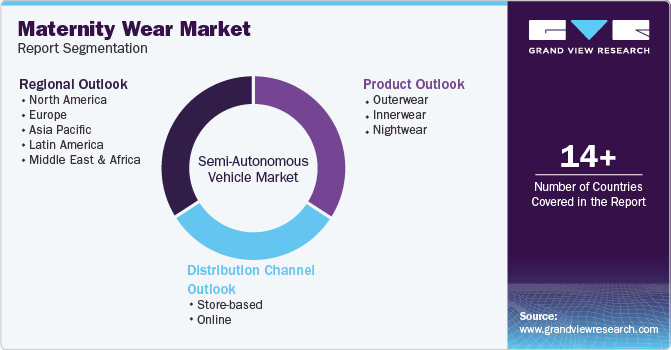
This report forecasts revenue growth at global, regional, and country levels and provides an analysis of the latest industry trends in each of the sub-segments from 2021 to 2033. For this study, Grand View Research has segmented the global maternity wear market report based on product, distribution channel, and region:
 To learn more about this report, Download Free Sample Report
 -
Product Outlook (Revenue, USD Million, 2021 - 2033)
-
Outerwear
-
Innerwear
-
Nightwear
-
-
Distribution Channel Outlook (Revenue, USD Million, 2021 - 2033)
-
Store-based
-
Online
-
-
Regional Outlook (Revenue, USD Million, 2021 - 2033)
-
North America
-
U.S.
-
Canada
-
Mexico
-
-
Europe
-
Germany
-
UK
-
France
-
Ireland
-
Spain
-
-
Asia Pacific
-
China
-
Japan
-
India
-
Australia
-
South Korea
-
-
Latin America
-
Brazil
-
-
Middle East and Africa (MEA)
-
Saudi Arabia
-
-
Research Methodology
The maternity Wear market figures in this report are based on a proven research process that combines executive interviews with secondary research from proprietary databases, company filings, and recognized regulatory and institutional sources. Market size is built through value-chain sizing - reconciling supply-side and demand-side estimates - and triangulated with bottom-up and top-down approaches. Every estimate passes multiple levels of expert validation before publication, with each maternity Wear segment quantified using the revenue-capture definitions in the table below.
Segment Definition
Segment - Distribution Channel
Revenue capture definition
Store-Based
As the largest distribution channel segment, revenue is generated from the sale of maternity apparel through physical retail formats, including specialty maternity stores, department stores, hypermarkets, supermarkets, and other brick-and-mortar outlets where consumers purchase pregnancy-specific clothing and related garments in person.
Online
Revenue is generated from the sale of maternity apparel through digital commerce channels, including brand-owned websites, online fashion retailers, and e-commerce marketplaces, with purchases of pregnancy-specific clothing fulfilled through online transactions and delivery services.
Estimation Model
Expectant Mother Consumer Base Layer
Maternity Apparel Spending Layer
Pregnancy & Nursing Usage Layer
Revenue Generation Layer
Who has the potential to use maternity wear products?
Who can afford maternity wear products?
Who actively purchases and uses maternity wear products?
How much revenue is generated?
Identify pregnant women, postpartum mothers, and first-time parents seeking apparel tailored for changing body shapes and comfort requirements.
Segment middle- and high-income households prioritizing specialized clothing, premium fabrics, and functional designs throughout pregnancy and nursing stages.
Focus on expectant and breastfeeding mothers requiring stretchable, supportive, and nursing-friendly apparel across work, casual, and active lifestyles.
Estimate revenue from stage-specific collections, repeat purchases across trimesters, nursing wear demand, and premium maternity fashion offerings.
Delivered Customizations
This report has been delivered with the following In-depth customizations
Client Request
Customization Delivered
Value Adds
Product Innovation, Functional Apparel & Fabric Technology Assessment for Maternity Wear
Conducted an assessment of product innovations across maternity tops, bottoms, dresses, activewear, sleepwear, and nursing apparel. Evaluated the adoption of stretch fabrics, moisture-wicking materials, seamless construction, and multifunctional designs catering to prenatal and postpartum needs. Assessed emerging trends in adaptive and size-inclusive maternity clothing.
Helped identify product development and premiumization opportunities across key categories. Supported innovation strategies aligned with evolving comfort and functionality requirements. Enabled benchmarking of fabric technologies and differentiation strategies across market segments.
Sustainability, Ethical Sourcing & Circular Fashion Analysis for Maternity Wear
Conducted an evaluation of sustainable manufacturing practices, eco-friendly fabrics, recycled materials, and ethical sourcing initiatives adopted within the maternity wear industry. Assessed the impact of certifications, circular fashion models, rental platforms, and resale trends on product positioning and brand perception. Evaluated regulatory and ESG developments influencing sustainable apparel production.
Helped identify opportunities for sustainable product positioning and circular business models. Supported ESG initiatives and responsible sourcing strategies. Enabled the development of environmentally conscious offerings to enhance brand value and customer loyalty.
Healthcare Ecosystem, Postpartum Care & Institutional Partnership Assessment for Maternity Wear
Conducted an analysis of collaborations between maternity wear brands and healthcare providers, maternity clinics, hospitals, and wellness platforms. Evaluated the role of postpartum recovery garments, nursing apparel, and medically supportive clothing in expanding product portfolios. Assessed opportunities arising from partnerships with prenatal care programs and maternal wellness services.
Helped identify high-growth opportunities beyond traditional retail channels. Supported partnership and portfolio expansion strategies targeting prenatal and postpartum care segments. Enabled the development of specialized offerings catering to the broader maternal health and wellness ecosystem.
Frequently Asked Questions About This Report
North America dominated with a 27.2% revenue share in 2025.
Asia Pacific is the fastest-growing region over the forecast period.
U.S. dominated the North America market with a 70.0% revenue share in 2025.
The maternity outerwear segment held the largest revenue share 35.8% in 2025, while nightwear is the fastest-growing segment.
The global maternity wear market size was valued at USD 24.5 billion in 2025 and is estimated at USD 25.6 billion for 2026.
Some key players operating in the maternity wear market include Seraphine, Firstcry, H&M, Asos, Mamacouture, House of Napius, GAP, Hotmilk Lingerie, and Pinkblush Maternity.
Key factors include the growing global popularity of pregnancy fashion and the increasing availability of a wide range of products through both offline and online distribution channels.
The global maternity wear market is expected to grow at a CAGR of 4.9% from 2026 to 2033, reaching USD 35.8 billion by 2033.
The store-based channel segment accounted for the largest market share of 65.8% in 2025, while the online channel is the fastest-growing segment.
About the Author(s)
Clothing, Footwear & Accessories Research Team
Consumer Goods · Clothing, Footwear & AccessoriesThis report was authored by the clothing, footwear & accessories research team at Grand View Research - comprising two research analysts, one senior research analyst, and one industry expert - with specialized expertise in the clothing, footwear & accessories segment of the consumer goods industry. All findings are based on proprietary consumer goods databases, executive interviews, and regulatory analysis, subject to internal peer review prior to publication.
Last Updated:
Speak to Analyst

Customize this report to your needs - add regions, segments, or data points, with 20% free customization.
Or view our licence options:


ISO 9001:2015 & 27001:2022 Certified
We are GDPR and CCPA compliant! Your transaction & personal information is safe and secure. For more details, please read our privacy policy.


