
- Home
- »
- Medical Devices
- »
-
Middle East Lactate Monitoring Devices Market Report, 2033GVR Report cover
![Middle East Lactate Monitoring Devices Market Size, Share & Trends Report]()
Middle East Lactate Monitoring Devices Market (2025 - 2033) Size, Share & Trends Analysis Report By Product (Chargeable Lactate Meters), By Application (Sports, Medical), By End Use, By Region, And Segment Forecasts
- Report ID: GVR-4-68040-707-9
- Number of Report Pages: 100
- Format: PDF
- Historical Range: 2021 - 2024
- Forecast Period: 2025 - 2033
- Industry: Healthcare
- Report Summary
- Table of Contents
- Segmentation
- Methodology
- Download FREE Sample
-
 Download Sample Report
Middle East Lactate Monitoring Devices Market Summary
The Middle East lactate monitoring devices market size was estimated at USD 3.93 million in 2024 and is projected to reach USD 7.21 million by 2033, growing at a CAGR of 7.06% from 2025 to 2033. The increasing awareness of the benefits of monitoring lactate in sports & healthcare, the rise in the need for point-of-care tests, and the growing adoption of remote patient monitoring & telemedicine are significant factors contributing to market growth.
Key Market Trends & Insights
- Saudi Arabia lactate monitoring devices market dominated Middle East market in 2024 and accounted for the largest revenue share of 42.73%.
- By product, the battery-operated lactate meters segment held the largest revenue share in 2024.
- In terms of application segment, the sports segment held the largest revenue share in 2024.
- By end use, the sports institutes segment held the largest revenue share in 2024.
Market Size & Forecast
- 2024 Market Size: USD 3.93 Million
- 2033 Projected Market Size: USD 7.21 Million
- CAGR (2025-2033): 7.06%
In addition, expanding use in surgical and post-operative monitoring is further anticipated to propel market growth. The market is gaining momentum as critical care improvements and emergency preparedness become national priorities. In Gulf Cooperation Council (GCC) countries like Saudi Arabia and the UAE, large hospitals in major cities invest in handheld and benchtop lactate analyzers for rapid sepsis screening and trauma care. In addition, interest in sports and fitness-driven lactate monitoring is emerging in the Middle East market. Elite training centers in Dubai, Abu Dhabi, and Doha are incorporating lactate threshold testing into athlete development programs, aligning with global standards.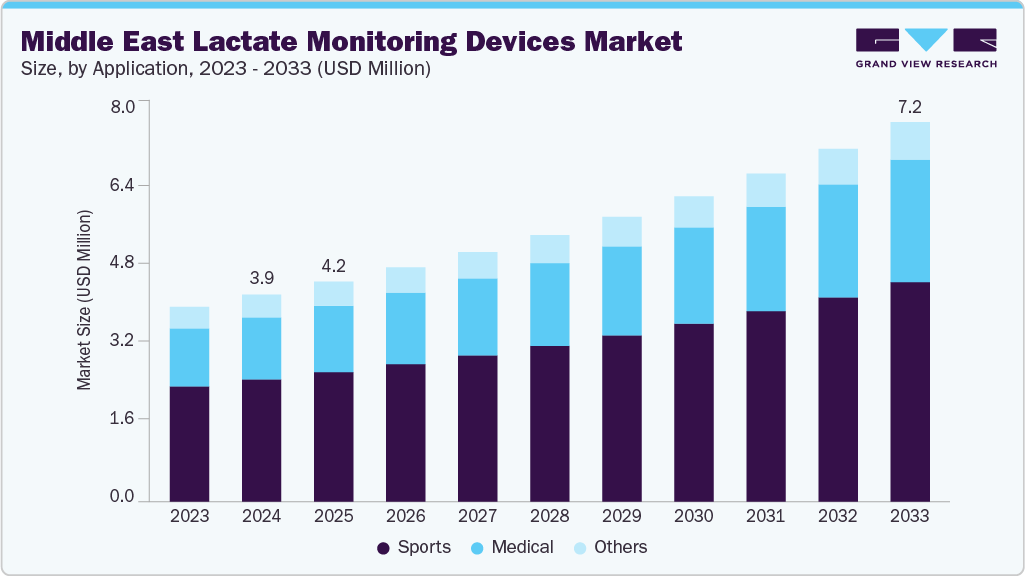
Moreover, expanding sports performance programs and rising critical care demands propel market growth further. Saudi Arabia’s investment in athletic excellence through Vision 2030 has led to increased adoption of lactate analyzers by professional sports teams, fitness centers, and academic institutions focused on exercise physiology. This momentum aligns with broader health goals, where performance tracking and metabolic assessments are becoming core to sports science.
Furthermore, rising cases of sepsis, trauma, and cardiac complications have elevated the use of lactate testing in emergency departments and ICUs. Hospitals are integrating handheld and point-of-care lactate monitors to support rapid triage and treatment decisions. For instance, in January 2025, a multicentre study in Qatar reported an early-onset GBS sepsis incidence of 0.58 per 1,000 live births and a late-onset rate of 0.33 per 1,000. Based on 123,878 births, 113 cases were confirmed, with a 7% mortality rate and 11% of survivors facing severe neurodisability.
Moreover, in September 2023, the Qatar National Sepsis Program commemorated World Sepsis Day with a national symposium and hospital-wide education initiatives to raise awareness among healthcare professionals and the public. The campaign emphasized early recognition and intervention, particularly through implementing the Sepsis Six Care Bundle, which includes lactate measurement as a core component.
The market also benefits from a gradual uptake of innovative biosensors and wireless technologies that simplify lactate tracking across diverse settings. As local distributors partner with global manufacturers and regulatory clarity improves, the Middle East countries are expected to play a significant role in advancing the regional adoption of next-gen lactate monitoring solutions.
Market Concentration & Characteristics
The chart below illustrates the relationship between industry concentration, industry characteristics, and industry participants. The x-axis represents the level of industry concentration, ranging from low to high. The y-axis represents various industry characteristics, including industry competition, level of partnerships & collaboration activities, degree of innovation, impact of regulations, and regional expansion. The lactate monitoring devices industry is characterized by a high degree of innovation. In recent years, the market has witnessed a significant degree of innovation. Technological advancements, research, and the development of new products drive this innovation. Companies are constantly striving to introduce novel products and delivery methods to meet consumers' evolving needs and preferences.
The Middle East lactate monitoring devices industry experiences a high degree of innovation driven by technological advancements. In April 2025, a study published in ACS Sensors unveiled a highly specific microwave biosensor for noninvasive lactate monitoring during exercise. The sensor uses a complementary split-ring resonator with lactate oxidase immobilized on microbeads, achieving strong selectivity and sensitivity in sweat.
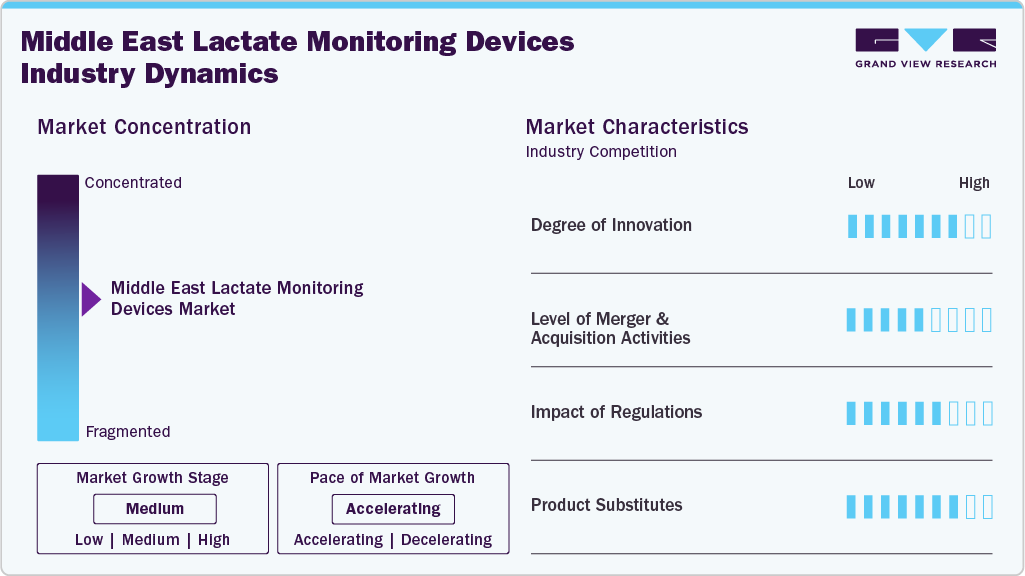
The industry is experiencing a moderate level of merger and acquisition activities undertaken by several key players. This is due to the desire to gain a competitive advantage, enhance technological capabilities, and consolidate in a rapidly growing market.
Regulations play a crucial role in shaping the Middle East market. In Saudi Arabia, the Saudi Food and Drug Authority (SFDA) regulates lactate monitoring devices under the Medical Devices Law and its Implementing Regulation.
Global manufacturers enter the market through streamlined import pathways and regional distributor networks. While regulatory alignment under the GCC is still evolving, the current system allows timely market entry for CE-marked and FDA-cleared devices.
Product Insights
Based on product, the battery-operated lactate meters segment accounted for the largest market share of 82.70% in 2024. The growth is attributed to its ease of portability and use in various settings, including sports fields, clinics, and hospitals. In the Middle East, healthcare infrastructure varies significantly, with highly advanced hospitals in urban centers and more resource-constrained facilities in rural or remote areas. The convenience and mobility offered by battery-operated devices are increasingly valued in this diverse landscape. In addition, the demand for decentralized healthcare and the growing adoption of point-of-care testing (POCT) across the region have further cemented the position of battery-operated devices.
The chargeable lactate meters segment is expected to grow at the fastest CAGR during the forecast period. There is a need for portable and efficient point-of-care testing systems that can provide quick and accurate lactate measurements directly at the patient’s bedside. These devices offer fast turnaround times, require minimal blood samples, and are user-friendly, making lactate testing practical and affordable in various healthcare settings such as emergency departments, intensive care units, and medical units.
Application Insights
Based on application, the sports segment accounted for the largest market share of 58.97% in 2024, due to growing awareness and adoption of lactate testing as a critical component of athletic performance monitoring and training optimization. Countries like the UAE, Saudi Arabia, and Qatar increasingly invest in elite sports development, sports medicine infrastructure, and national athletic performance programs. These efforts have significantly increased the demand for advanced monitoring technologies, including portable lactate meters to assess endurance thresholds and recovery dynamics.
Medical is expected to grow at the fastest CAGR over the forecast period due to the rising burden of critical illnesses, increasing ICU admissions, and greater clinical awareness about the diagnostic value of lactate levels in acute care. Lactate monitoring is crucial in evaluating tissue hypoperfusion, sepsis, trauma, and cardiac arrest, all of which are growing public health challenges in the region.
End Use Insights
Based on end use, the sports institute segment accounted for the largest market share of 45.74% in 2024. Sports institutes and training centers extensively use lactate monitoring devices to assess athletes' anaerobic thresholds, improve training regimens, and prevent overtraining by closely tracking blood lactate levels during exercise. This data allows coaches and sports scientists to make evidence-based decisions that enhance endurance, speed recovery, and maximize overall athletic performance. The segment's dominance is further fueled by growing participation in competitive and recreational sports across Middle Eastern countries such as Saudi Arabia, UAE, and Qatar, supported by institutional investments in sports science research and facilities.
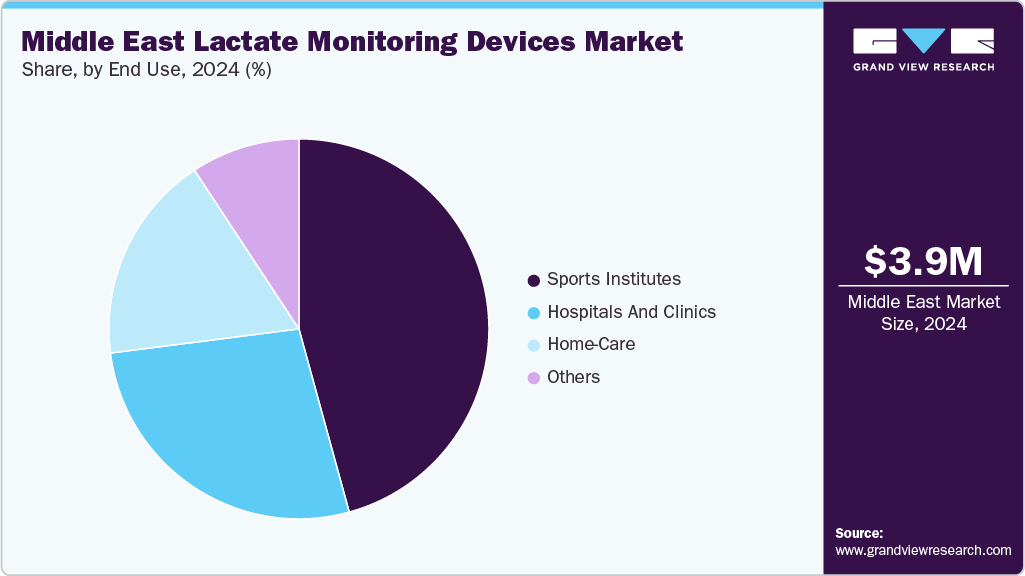
Homecare is expected to grow at the fastest CAGR during the forecast period. The increasing prevalence of chronic diseases such as diabetes and cardiovascular conditions demands continuous, real-time monitoring of physiological parameters, including lactate levels. These are vital for managing complications and improving outcomes in non-hospital settings. Home care lactate monitoring devices empower patients to self-manage their conditions conveniently, reducing the need for frequent hospital visits and enabling timely interventions.
Country Insights
The UAE lactate monitoring devices market is expected to grow rapidly, driven by increasing focus on elite fitness and high-performance athletics. In addition, rising cases of sepsis propel market growth further. For instance, in January 2024, Khaleej Times reported that UAE doctors raised alarms about sepsis, describing it as a silent killer responsible for 11 million deaths annually-nearly 20% of global mortality. Moreover, digital health initiatives in the UAE support trials and adoption of next-generation lactate sensors, including wearable and app-integrated solutions. Global manufacturers enter the market through streamlined import pathways and regional distributor networks.
Qatar Lactate Monitoring Devices Market Trends
The market for lactate monitoring devices in Qatar is driven by rising health awareness and investment, and the country’s strategic focus on digital health innovation. Qatar's high rates of chronic lifestyle-related conditions such as diabetes and obesity have prompted greater emphasis on metabolic health monitoring, creating a receptive environment for lactate sensors in both clinical and wellness applications. The country’s ambitions to position itself as a regional sports and medical tourism hub, supported by facilities such as Aspetar, have led to growing demand for performance analytics tools, including real-time lactate measurement.
Key Middle East Lactate Monitoring Devices Company Insights
Key players operating in the market are undertaking various initiatives to strengthen their market presence and increase the reach of their products and services. Strategies such as new product launches and partnerships are key in propelling market growth.
Key Middle East Lactate Monitoring Devices Companies:
- Nova Biomedical
- ARKRAY, Inc.
- EKF Diagnostics
- TECOM Analytical Systems
- Sensa Core Medical
- VivaCheck Biotech
- ApexBio
- TaiDoc Technology Corporation
Recent Developments
-
In August 2024, EKF Diagnostics Holdings plc launched the new Biosen C-Line glucose and lactate analyzer, featuring an enhanced color touchscreen and advanced connectivity. This benchtop device delivers fast, precise glucose and lactate measurements with less than 3% CV and seamlessly integrates with hospital IT systems via EKF Link. The analyzer supports clinical and sports uses, aiding diabetes management and elite athlete training.
“We are excited to introduce our new and updated range of Biosen C-Line glucose and lactate analyzers, which address customer demand for advanced connectivity and an enhanced, user-friendly interface.”
-Gavin Jones, Chief Product Officer of EKF Diagnostics
-
In January 2024, VivaChek introduced its latest Lactate Analyzer, tailored for athletes and fitness professionals, enabling them to closely track lactate levels during training to maximize performance and tailor recovery protocols. The analyzer features highly accurate lactate measurements, real-time Bluetooth connectivity for seamless data transfer to mobile devices, and a user-friendly design that makes lactate monitoring easy to integrate into daily workout routines.
Middle East Lactate Monitoring Devices Market Report Scope
Report Attribute
Details
Market size value in 2025
USD 4.18 million
Revenue forecast in 2033
USD 7.21 million
Growth rate
CAGR of 7.06% from 2025 to 2033
Actual data
2021 - 2024
Forecast period
2025 - 2033
Quantitative units
Revenue in USD million/billion and CAGR from 2025 to 2033
Report coverage
Revenue forecast, company ranking, competitive landscape, growth factors, and trends
Segments covered
Product, application, end use, region
Regional scope
Middle East
Country scope
Saudi Arabia; UAE; Qatar; Kuwait; Oman
Key companies profiled
Nova Biomedical; ARKRAY, Inc.; EKF Diagnostics; TECOM Analytical Systems; Sensa Core Medical; VivaCheck Biotech; ApexBio; TaiDoc Technology Corporation
Customization scope
Free report customization (equivalent up to 8 analysts working days) with purchase. Addition or alteration to country, regional & segment scope.
Pricing and purchase options
Avail customized purchase options to meet your exact research needs. Explore purchase options
Middle East Lactate Monitoring Devices Market Report Segmentation
This report forecasts revenue growth at regional and country levels and provides an analysis of the latest industry trends in each of the sub-segments from 2021 - 2033. For this study, Grand View Research has segmented the Middle East lactate monitoring devices market report based on product, application, end use, and region:
-
Product Outlook (Revenue, USD Million, 2021 - 2033)
-
Chargeable Lactate Meters
-
Battery Operated Lactate Meters
-
-
Application Outlook (Revenue, USD Million, 2021 - 2033)
-
Sports
-
Medical
-
Others
-
-
End Use Outlook (Revenue, USD Million, 2021 - 2033)
-
Hospitals and Clinics
-
Sports Institutes
-
Home Care
-
Others
-
-
Regional Outlook (Revenue, USD Million, 2021 - 2033)
-
Middle East
-
Saudi Arabia
-
UAE
-
Kuwait
-
Qatar
-
Oman
-
-
Frequently Asked Questions About This Report
b. The Middle East lactate monitoring devices market size was estimated at USD 3.93 million in 2024 and is expected to reach USD 4.18 million in 2025
b. The Middle East lactate monitoring devices market is expected to grow at a compound annual growth rate of 7.06% from 2025 to 2033 to reach USD 7.21 million by 2033.
b. Based on application, the sports segment accounted for the largest market share of 58.97% in 2024, due to growing awareness and adoption of lactate testing as a critical component of athletic performance monitoring and training optimization.
b. Some prominent players in the Middle East lactate monitoring devices market are Nova Biomedical ARKRAY, Inc.; EKF Diagnostics; TECOM Analytical Systems; Sensa Core Medical; VivaCheck Biotech; ApexBio; TaiDoc Technology Corporation
b. The growth is attributed to the increasing awareness about the increasing awareness of the benefits of monitoring lactate in sports & healthcare, the rise in the need for point-care tests, and the growing adoption of remote patient monitoring & telemedicine.


Share this report with your colleague or friend.
Need a Tailored Report?
Customize this report to your needs — add regions, segments, or data points, with 20% free customization.


ISO 9001:2015 & 27001:2022 Certified
We are GDPR and CCPA compliant! Your transaction & personal information is safe and secure. For more details, please read our privacy policy.
Trusted market insights - try a free sample
See how our reports are structured and why industry leaders rely on Grand View Research. Get a free sample or ask us to tailor this report to your needs.













