
- Home
- »
- Electronic Devices
- »
-
Mirrorless Camera Market Size And Share Report, 2026-2035GVR Report cover

Mirrorless Camera Market (2026 - 2035)
Size, Share & Trends Analysis Report By Type (Interchangeable Lens, Fixed Lens), By Application (Professional Photography, Amateur & Enthusiast Photography, Vlogging & Content Creation), By Region, And Segment Forecasts
Market Size, 2025
$4.3BMarket Estimate, 2026
$4.6BMarket Forecast, 2035
$7.8BCAGR, 2026–2035
6.1%Mirrorless Camera Market Summary
The global mirrorless camera market size was valued at USD 4.3 billion in 2025 and is projected to grow from USD 4.6 billion in 2026 to USD 7.8 billion by 2035, at a CAGR of 6.1% from 2026 to 2035. Asia Pacific dominated the market, accounting for the largest revenue share in 2025. The market is witnessing increasing adoption driven by growing demand for high-quality digital imaging and rising popularity of professional photography and videography. Moreover, the expansion of vlogging and content creation, along with continued advancements in autofocus, image stabilization, sensor technology, and video recording capabilities, is also contributing to market growth.
Key Market Trends & Insights
- By type: The interchangeable lens segment held the largest market share in 2025.
- By application: The professional photography segment held the largest market share in 2025.
Regional Highlights
- Largest regional market: Asia Pacific (2025)
- Fastest-growing regional market: Asia Pacific (highest CAGR, 2026-2035)
Market Size & Forecast
- Market size in 2025: USD 4.3 Billion
- Estimated market size in 2026: USD 4.6 Billion
- Projected market size by 2035: USD 7.8 Billion
- CAGR (2026-2035): 6.1%
Prism AI by Grand View Research Free to tryAsk a question about the mirrorless camera marketTry asking✓Every figure cited from GVR research Prefer the report? Download free sample →The rising demand for advanced imaging tools, surging adoption of high-quality visual content in both professional and consumer applications, and ongoing technological advancements in camera equipment are among the key factors driving the market growth. Advantages of mirrorless digital cameras include smaller and lighter designs, removable lenses, LCD screens, electronic viewfinders, fast auto-focus, high-resolution images, and sophisticated video features.
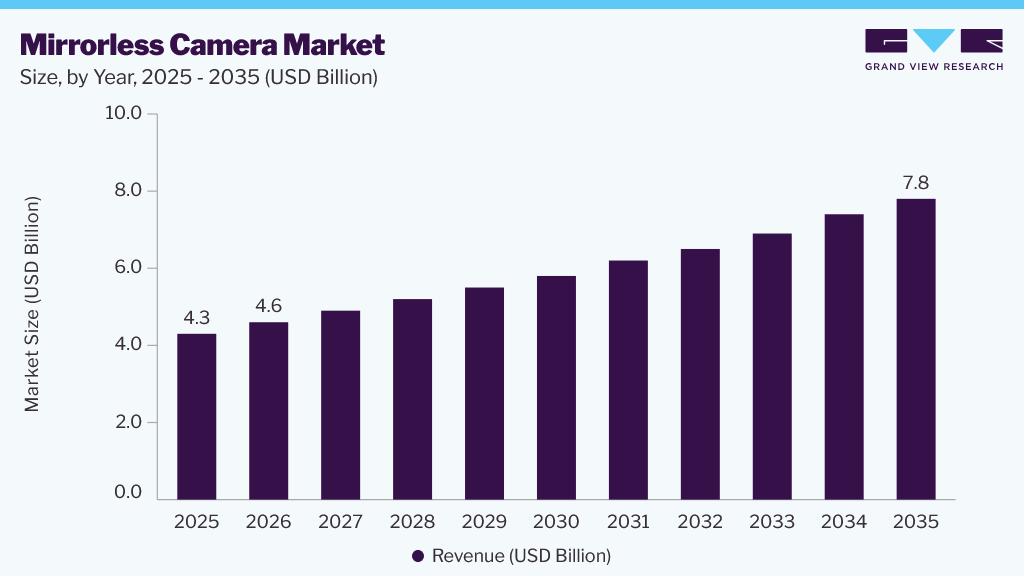 Source: Grand View Research, IR Documents, Primary Interviews, Paid DatabasesTo learn more about this report,
 Download Free Sample Report
The expanding use of cameras among professional photographers, hobbyists, vloggers, movie makers, and social media influencers is also contributing to market growth.
Moreover, manufacturers are emphasizing features such as AI-enabled subject detection, improved in-camera image stabilization, fast continuous shooting, advanced connectivity options, and integrated video tools in new mirrorless camera models. The expanding digital content creation and professional content demand are also likely to drive market growth.Analyst Perspective
The market continues to evolve, with manufacturers increasingly combining professional image quality with compact form factors and advanced computational features. While interchangeable-lens systems remain dominant, offering photographers and videographers greater control across a wider range of shooting scenarios, innovations in autofocus, EVFs (electronic viewfinders), in-body image stabilization, sensor performance, and video recording continue to drive consumer adoption of mirrorless cameras. The creator economy is expected to fuel demand for versatile cameras that perform well for both stills and video, expanding the user base beyond traditional professionals. With the continued growth of the consumer electronics markets, rising incomes, growing interest in photography and videography, and the expanding digital creator community, the region is expected to remain an important contributor to market growth.
Type Insights
The interchangeable-lens segment dominated the mirrorless camera market, accounting for the largest revenue share in 2025. Interchangeable-lens mirrorless cameras offer greater versatility by supporting a wide range of focal lengths and specialized lenses with varying specifications, enabling users to tailor their equipment to specific shooting requirements. This flexibility, combined with advanced autofocus, high-resolution sensors, and sophisticated video capabilities, makes interchangeable-lens models particularly well suited to professional photography, sports and wildlife, film and motion picture production, and advanced enthusiast applications. For instance, in April 2025, Nikon released the Z5II full-frame mirrorless camera, equipped with the Nikon Z mount, EXPEED 7 processing, deep-learning-based subject detection, and high-speed autofocus, demonstrating continued manufacturer investment in interchangeable-lens mirrorless systems.
The fixed-lens mirrorless cameras segment is projected to record growth over the forecast period. This category appeals to users seeking a compact, portable, and easy-to-use imaging system with an integrated lens, eliminating the need to purchase and carry multiple lenses. Demand for this category is further supported by the growing preference for lightweight cameras among travelers, enthusiasts, and content creators. As a result, fixed-lens mirrorless cameras are expected to register a higher growth rate than interchangeable-lens systems over the forecast period.
Application Insights
The professional photography segment dominated the mirrorless camera market in 2025. Professional adoption of mirrorless cameras is increasing across sports, wildlife, photojournalism, commercial, and studio applications, driven by high-resolution sensors, fast autofocus, high-speed continuous shooting, advanced image stabilization, and increasingly capable video features. For instance, in July 2024, Canon launched the EOS R1 and EOS R5 Mark II full-frame mirrorless cameras. The EOS R1 was specifically designed for professional photographers in fields including photojournalism, sports, and wildlife, while the EOS R5 Mark II was positioned for sports and wildlife photographers, journalists, video producers, and visual creators.
The vlogging and content creation segment is anticipated to witness the fastest CAGR during the forecast period. As YouTube, social media, livestreaming, and short-form video continue to grow in popularity, demand is increasing for cameras that combine high-quality still imaging with advanced video capabilities, autofocus, stabilization, and connectivity. This versatility makes mirrorless cameras well suited to hybrid content creation, enabling users to transition seamlessly between still photography and video. For instance, in November 2025, Canon launched the EOS R6 Mark III, positioning the full-frame mirrorless camera for advanced photographers, videographers, content creators, and hybrid enthusiasts, including users producing social media content.
Regional Insights
Asia Pacific mirrorless camera market held the largest share in 2025, owing to its vast consumer electronics and imaging-equipment production base, high concentration of top camera manufacturers, increasing disposable income in the populace, and an increase in the adoption of the art of photography and video content creation by the masses. For instance, in September 2025, Nikon announced a new silver version of its Z f full-frame mirrorless camera in Japan, adding three new Premium Exterior color options and a Film Grain feature for photographs and videos. Nikon stated that the Z f had been extremely popular since its launch and that the new version was introduced in response to user demand.
The mirrorless camera market in Asia Pacific is projected to record strong growth over the forecast period, as emerging and established camera manufacturers deliver ever-sophisticated products and consumers regularly pursue photography, videography, travel-documentation, and social-media activities. Japan, China, and South Korea remain key markets due to their mature imaging industries. At the same time, India and a few other Asian economies are expected to provide new opportunities with a notable surge in spending on electronics and content-creation tools. Asia Pacific might also benefit from further advances of AI-enabled autofocus, high-resolution sensors, video functions, and compact mirrorless bodies.
North America Mirrorless Camera Market Trends
North America represented a significant share of the mirrorless camera market in 2025, due to high consumer buying power, developed professional and commercial photographer/videographer/creator industries, well-developed content creation ecosystem as well as large installed base of mature high-end imaging equipment and demand for advanced equipment. The market is supported by professional photographers/videographers/creators, media companies and enthusiasts seeking high-end interchangeable-lens systems.
The North American mirrorless camera market is expected to experience steady growth during the forecast period as professional and enthusiast users replace their equipment with newer models that feature quicker autofocus, better in-body image stabilization, higher resolution sensors, and more sophisticated video functionality. The persistent growth of creator-focused photography and video production is also anticipated to contribute to the overall market growth in the region. For instance, in May 2025, Canon's EOS R1 full-frame mirrorless camera received the Best of the Best distinction at the Red Dot Design Award: Product Design 2025, with Canon highlighting its professional-oriented photographic performance and deep-learning-enabled subject tracking capabilities.
Key Mirrorless Camera Market Company Insights
Key players in the mirrorless camera market are focused on developing and broadening a series of both broad spectrum cameras with extra interchangeable-lens and a specialized, more united set of different cameras, including the high-end models with AF and subject-recognition improvements or with longer movie ratios or IS, sensors and hybrid photo-video research and advances. Product innovation remains a key strategy for companies seeking to strengthen their competitive position in the market.
Key Mirrorless Camera Companies
The following key companies have been profiled for this study on the mirrorless camera market:
-
Canon Inc.
-
Sony Corporation
-
Nikon Corporation
-
FUJIFILM Holdings Corporation
-
Panasonic Holdings Corporation
-
OM Digital Solutions Corporation (OM SYSTEM)
-
Leica Camera AG
-
Sigma Corporation
-
Hasselblad
-
DJI
Recent Developments
-
In June 2025, FUJIFILM launched the FUJIFILM X-E5, a compact mirrorless digital camera featuring a 40.2-megapixel X-Trans CMOS 5 HR sensor, X-Processor 5, and a five-axis in-body image stabilization system offering up to 7.0 stops of stabilization at the center. The company positioned the X-E5 as a lightweight, compact X Series model designed to enhance portability and everyday photography.
-
In May 2025, Panasonic announced the LUMIX S1II and S1IIE full-frame mirrorless cameras, expanding its LUMIX S Series. The S1II features a newly developed 24.1-megapixel partially stacked CMOS sensor, a next-generation Venus Engine, 4K 120p and 5.8K 60p recording, and Dynamic Range Boost technology delivering up to 15 stops of dynamic range in V-Log at specified frame rates. The cameras were scheduled for release in June 2025.
Mirrorless Camera Market Report Scope
Report Attribute
Details
Market size in 2025
USD 4.3 billion
Estimated market size in 2026
USD 4.6 billion
Projected market size by 2035
USD 7.8 billion
Growth rate
CAGR of 6.1% from 2026 to 2035
Base year for estimation
2025
Actual data
2021 – 2024
Forecast period
2026 – 2035
Quantitative units
Revenue in USD billion, and CAGR from 2026 to 2035
Report coverage
Revenue forecast, company ranking, competitive landscape, growth factors, and trends
Segments covered
Type, application, region
Regional Scope
North America; Europe; Asia Pacific; Latin America; Middle East & Africa
Country Scope
U.S.; Canada; Mexico; UK; Germany; France; China; Japan; India; Australia; South Korea; Brazil; Argentina; South Africa; Saudi Arabia; UAE.
Key companies profiled
Canon Inc.; Sony Corporation; Nikon Corporation; FUJIFILM Holdings Corporation; Panasonic Holdings Corporation; OM Digital Solutions Corporation (OM SYSTEM); Leica Camera AG; Sigma Corporation; Hasselblad; DJI
Customization scope
Free report customization (equivalent to 8 analyst working days) with purchase. Addition or alteration to country, regional & segment scope.
Pricing and purchase options
Avail of customized purchase options to meet your exact research needs. Explore purchase options
Global Mirrorless Camera Market Report Segmentation
This report forecasts revenue growth at the global, regional, and country levels and provides an analysis of the latest industry trends and opportunities across each sub-segment from 2021 to 2035. For this study, Grand View Research has segmented the global mirrorless camera market report based on type, application, and region:
-
Type Outlook (Revenue, USD Billion, 2021 - 2035)
-
Interchangeable Lens
-
Fixed Lens
-
-
Application Outlook (Revenue, USD Billion, 2021 - 2035)
-
Professional Photography
-
Amateur & Enthusiast Photography
-
Vlogging & Content Creation
-
-
Regional Outlook (Revenue, USD Billion, 2021 - 2035)
-
North America
-
U.S.
-
Canada
-
Mexico
-
-
Europe
-
UK
-
Germany
-
France
-
-
Asia Pacific
-
China
-
Japan
-
India
-
Australia
-
South Korea
-
-
Latin America
-
Brazil
-
Argentina
-
-
Middle East and Africa (MEA)
-
South Africa
-
Saudi Arabia
-
UAE
-
-
Frequently Asked Questions About This Report
The global mirrorless camera market size was valued at USD 4.3 billion in 2025 and is estimated at USD 4.6 billion for 2026.
The global mirrorless camera market is expected to grow at a CAGR of 6.1% from 2026 to 2035, reaching USD 7.8 billion.
The interchangeable lens segment accounted for the largest revenue share in 2025.
Asia Pacific dominated with the largest revenue share in 2025.
Key players in the market include Canon Inc., Sony Corporation, Nikon Corporation, FUJIFILM Holdings Corporation, Panasonic Holdings Corporation, OM Digital Solutions Corporation (OM SYSTEM), Leica Camera AG, Sigma Corporation, Hasselblad, and DJI.
About the Author(s)
Electronic Devices Research Team
Semiconductors & Electronics · Electronic DevicesThis report was authored by the electronic devices research team at Grand View Research - comprising two research analysts, one senior research analyst, and one industry expert - with specialized expertise in the electronic devices segment of the semiconductors & electronics industry. All findings are based on proprietary semiconductors & electronics databases, executive interviews, and regulatory analysis, subject to internal peer review prior to publication.
Last Updated:
Speak to Analyst

Customize this report to your needs - add regions, segments, or data points, with 20% free customization.
Or view our licence options:


ISO 9001:2015 & 27001:2022 Certified
We are GDPR and CCPA compliant! Your transaction & personal information is safe and secure. For more details, please read our privacy policy.


