
- Home
- »
- Distribution & Utilities
- »
-
Mobile Substation Market Size & Share Report, 2026-2033GVR Report cover

Mobile Substation Market (2026 - 2033)
Size, Share & Trends Analysis Report By Type (Power Transformer, Distribution Transformer), By Application (Industrial, Infrastructure, Utilities), By Region, And Segment Forecasts
Market Size, 2025
$1.2BMarket Estimate, 2026
$1.3BMarket Forecast, 2033
$1.8BCAGR, 2026–2033
4.7%Mobile Substation Market Summary
The global mobile substation market size was valued at USD 1.2 billion in 2025 and is projected to grow from USD 1.3 billion in 2026 to USD 1.8 billion by 2033, at a CAGR of 4.7% from 2026 to 2033. Asia Pacific dominated the market, accounting for a revenue share of 35.6% in 2025. The market is driven by the increasing demand for reliable and flexible power solutions in emergency situations, grid expansion, and temporary power supply needs.
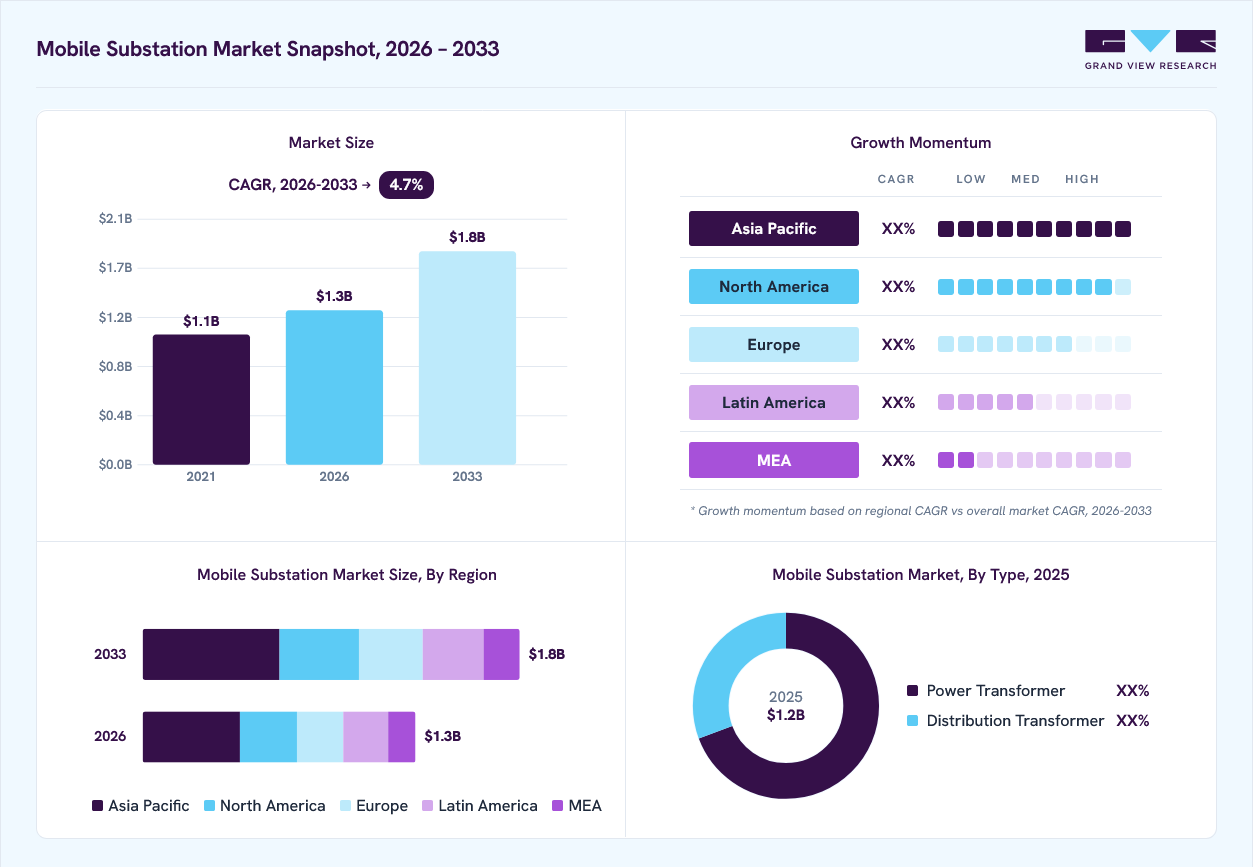 Source: Grand View Research, IR Documents, Primary Interviews, Paid DatabasesTo learn more about this report,
 Download Free Sample Report
 Key Market Trends & Insights
- By type: Power transformer segment dominated the market, with a revenue share of 69.2% in 2025.
- By application: Industrial segment held the largest market share of 51.2% in 2025.
Regional Highlights
- Largest regional market: Asia Pacific (35.6% revenue share, 2025)
- By country: China held the largest market share in 2025.
Market Size & Forecast
- Market size in 2025: USD 1.2 Billion
- Estimated market size in 2026: USD 1.3 Billion
- Projected market size by 2033: USD 1.8 Billion
- CAGR (2026-2033): 4.7%
Three ways to get this report
Buy it, customize it, or ask a question.Ask an Analyst
A direct answer, usually in 1 working day
- AccessReport author, directly
- Reply timeWithin 1 working day
- No sales callDirect answer only
- FormatEmail reply
- CostFree, no cost
Get the Full Report
What the study covers
- FormatsPDF · Excel · Dashboard
- Timeline2026–2033 annual, 2025 base
- Coverage20+ countries, 5 regions
- Companies10+ key players profiled
Customize the Report
20% free customization
- IncludeCountries, segments, points
- TailorTo your product definition
- ExtendDeeper competitor detail
- OrA fully bespoke study
- Turnaround5–10 working days
Growing investments in renewable energy integration, rapid urbanization, and industrialization are further boosting demand, particularly in regions with weak grid infrastructure or high disaster risks. Utilities and industries are adopting mobile substations for quick deployment and minimal downtime during maintenance, outages, or natural disasters. Additionally, advancements in modular and compact designs, along with government initiatives for rural electrification and smart grid deployment, are accelerating market growth globally.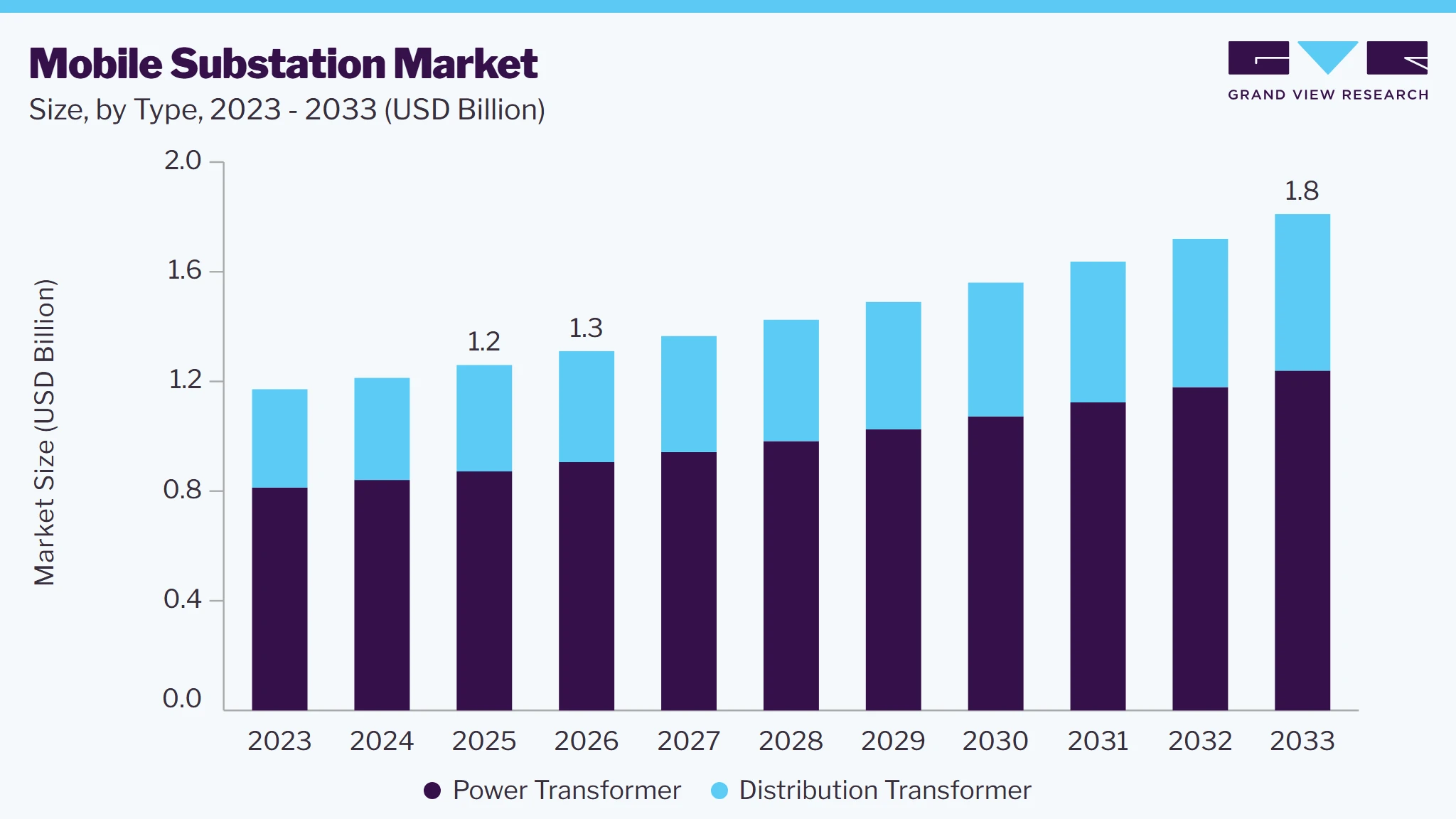 To learn more about this report, Download Free Sample Report
 Market Dynamics
The mobile substation market is primarily driven by the growing demand for reliable, flexible, and rapidly deployable power infrastructure across utility, industrial, mining, oil & gas, and renewable energy sectors. Mobile substations are increasingly used for emergency power restoration, planned maintenance, temporary grid connections, and transmission and distribution network upgrades. Rising electricity demand, ongoing grid modernization initiatives, and increasing investments in power infrastructure development are supporting the adoption of mobile substations globally. Furthermore, the growing focus on minimizing outage durations and improving grid reliability is accelerating market growth across both developed and emerging economies.
The increasing investment in grid modernization and transmission and distribution infrastructure remains a major driver for the mobile substation market. Utilities worldwide are upgrading aging power networks to improve reliability, accommodate rising electricity consumption, and integrate renewable energy sources into the grid. Mobile substations provide a cost-effective and rapidly deployable solution for maintaining an uninterrupted power supply during maintenance, equipment replacement, and network expansion projects. As governments continue to invest in strengthening electricity infrastructure, demand for temporary and flexible substation solutions is expected to increase significantly.
Additionally, the growing need for grid reliability and emergency power restoration is further supporting market growth. The rising frequency of extreme weather events, natural disasters, and unexpected equipment failures has increased the importance of mobile substations in utility contingency planning. These units enable utilities to rapidly restore power, reduce outage durations, and maintain service continuity during emergencies.
Despite strong growth potential, the high initial investment required for mobile substations remains a key restraint for market expansion. The deployment of mobile substations entails substantial costs for transformers, switchgear, protection systems, transportation equipment, and customization. Additionally, compliance with stringent electrical safety standards, transportation regulations, and grid interconnection requirements can increase project complexity and operational expenses, particularly for smaller utilities and industrial operators.
The increasing integration of renewable energy sources and growing focus on grid resilience present significant opportunities for the mobile substation market. Mobile substations are increasingly being deployed to support temporary grid connections, renewable energy project commissioning, capacity expansion activities, and emergency backup requirements. As utilities continue investing in resilient, flexible, and adaptive power infrastructure to accommodate changing energy demands and climate-related challenges, demand for mobile substations is expected to grow substantially over the forecast period..
Analyst Perspective
The mobile substation market is experiencing steady growth, driven by grid modernization initiatives, expanding transmission and distribution infrastructure, and increasing demand for rapid, reliable power restoration solutions. Rising renewable energy integration, aging grid assets, and greater focus on grid resilience are accelerating adoption across utility and industrial applications. Despite challenges such as high capital costs and complex regulatory requirements, advancements in modular designs, digital monitoring, and smart grid integration are enhancing deployment efficiency and operational reliability. Companies that strengthen technological capabilities and expand their presence in high-growth infrastructure markets are expected to gain a competitive advantage.
Type Insights
Based on type, the power transformer segment led the market with the largest revenue share of 69.2% in 2025. The power transformer segment in the mobile substation market is driven by the increasing need for rapid and flexible power restoration in case of grid failures, natural disasters, and emergency maintenance. Growing investments in renewable energy integration require mobile substations equipped with power transformers to provide temporary grid support for solar and wind farms.
Additionally, the expansion of industrial and infrastructure projects, particularly in remote and off-grid locations, increases demand for mobile substations with high-capacity power transformers. Technological advancements in compact, high-efficiency transformers, along with the adoption of smart grid solutions, enhance performance and reliability. Moreover, rising government initiatives to improve grid resilience and energy security, especially in emerging economies, further accelerate market growth for power transformers in mobile substations.
Application Insights
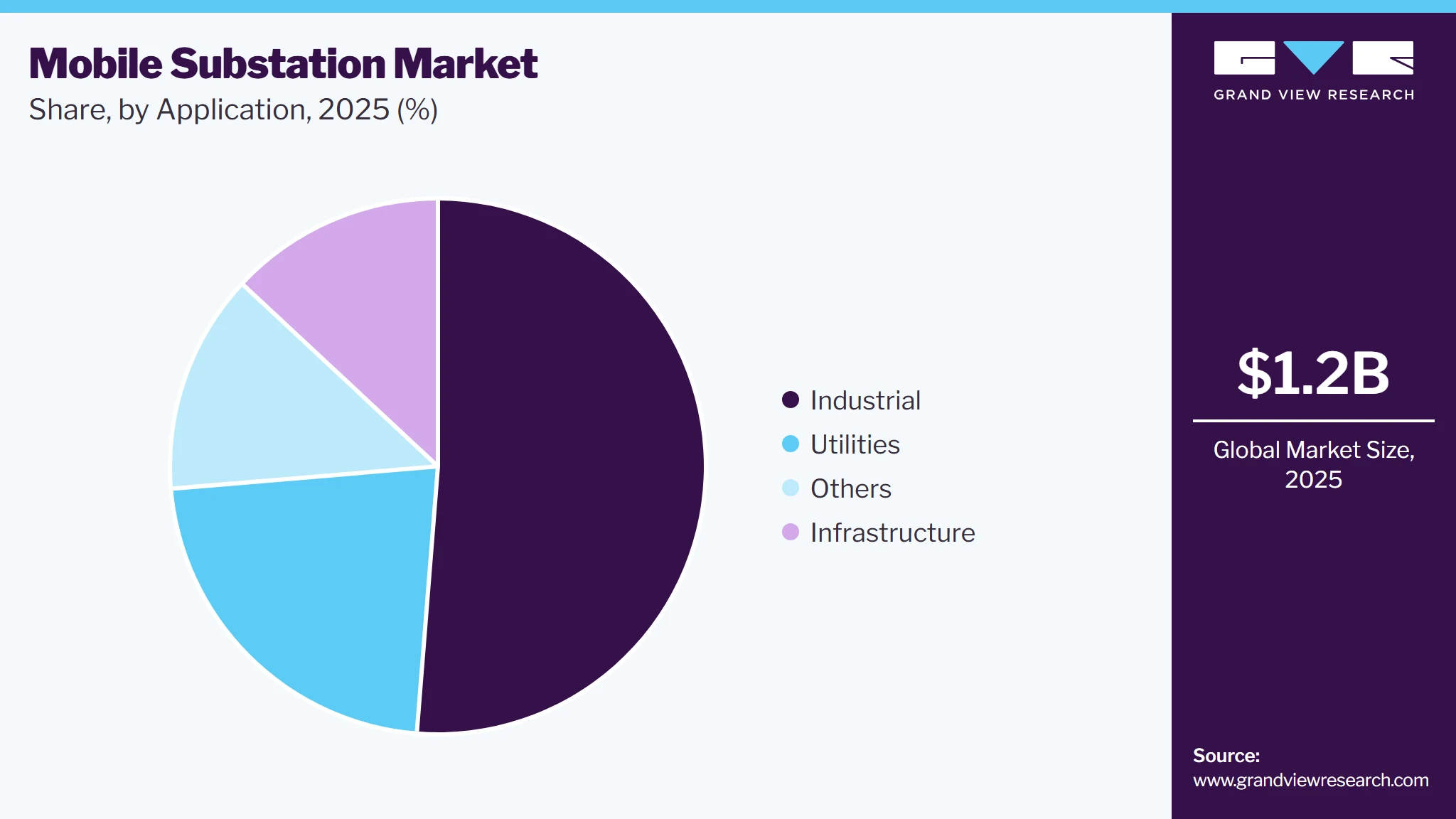
Based on applications, the industrial segment led the market with the largest revenue share of 51.3% in 2025. The industrial sector drives the mobile substation market due to its need for uninterrupted power supply in energy-intensive industries such as oil & gas, mining, manufacturing, and construction. These sectors often operate in remote locations where permanent substations are not feasible, making mobile substations a cost-effective and rapid deployment solution.
 To learn more about this report, Download Free Sample Report
 The infrastructure segment is driven by rapid urbanization, industrialization, and large-scale infrastructure development projects, particularly in emerging economies. Expanding smart cities, metro rail networks, airports, and highway electrification require mobile substations for temporary or backup power solutions.Additionally, the increasing electrification of remote construction sites and mining operations necessitates mobile substations for efficient power supply. The push for disaster preparedness and emergency power solutions in critical infrastructure, such as hospitals, data centers, and defense installations, further strengthens market growth.
Regional Insights
Mobile Substation market in North America is driven by the increasing need for grid resilience and emergency power solutions, particularly in response to extreme weather events such as hurricanes, wildfires, and winter storms that frequently disrupt power supply. Rising investments in grid modernization and renewable energy integration are further fueling demand, as utilities seek flexible and rapid deployment solutions for temporary power distribution.
U.S. Mobile Substation Market Trends
The U.S. mobile substation market is experiencing notable growth, driven by several key factors. Frequent power outages caused by natural disasters have heightened the demand for mobile substations, which provide temporary power solutions during such events. Additionally, aging grid infrastructures necessitate costly upgrades, making mobile substations a viable alternative to ensure a continuous power supply. Technological advancements, particularly in digital control systems and high-efficiency transformers, have enhanced the performance and reliability of mobile substations, increasing their appeal to utility companies and industrial users. Furthermore, the integration of renewable energy sources into the power grid has created a need for flexible and reliable power distribution solutions, further propelling the adoption of mobile substations
Asia Pacific Mobile Substation Market Trends
Asia Pacific dominated the mobile substation market with the largest revenue share of 35.6% in 2025 and is driven by rapid urbanization, industrialization, and increasing electricity demand, particularly in countries like China, India, and Southeast Asian nations. Government initiatives for rural electrification and smart grid development are accelerating the adoption of mobile substations, especially in regions with weak grid infrastructure.
 To learn more about this report, Download Free Sample Report
 China Mobile Substation Market Trends
The mobile substation market in the China held the largest share in the Asia Pacific region in 2025. China’s mobile substation market is being driven by the continuous expansion and modernization of the country’s transmission and distribution network, rising investments in grid resilience, and growing demand for rapid power restoration solutions during planned maintenance, natural disasters, and emergency outages. Strong government support for power infrastructure development, large-scale integration of renewable energy projects, and ongoing deployment of ultra-high-voltage transmission networks are further accelerating market growth. The presence of leading domestic power equipment manufacturers, coupled with increasing investments in smart grid technologies and electrification initiatives, is strengthening market development. In addition, the growing construction of industrial facilities, urban infrastructure, rail networks, and renewable energy plants, which require temporary and flexible power supply solutions, is creating new opportunities for the mobile substation market in China.
Europe Mobile Substation Market Trends
The European mobile substation market is driven by increasing investments in grid modernization and renewable energy integration, as countries transition toward sustainable energy sources like wind and solar. The aging power infrastructure across several European nations necessitates temporary and flexible power solutions, boosting demand for mobile substations.
Central & South America Mobile Substation Market Trends
The mobile substation market in Central & South America is driven by increasing investments in grid modernization and electrification projects, particularly in remote and underserved areas. Frequent natural disasters such as earthquakes, hurricanes, and floods create a strong demand for mobile substations as emergency power solutions. The region's growing renewable energy sector, especially in Brazil, Chile, and Argentina, is boosting the need for mobile substations to support temporary grid connections for solar and wind farms.
Middle East & Africa Mobile Substation Market Trends
The mobile substation market in the Middle East & Africa (MEA) is driven by the region's increasing investments in power infrastructure to support economic growth, urbanization, and industrialization. The rising demand for emergency and temporary power solutions, especially in conflict-prone and disaster-affected areas, boosts adoption. The rapid expansion of the oil & gas sector, mining operations, and large-scale construction projects further drives demand for mobile substations to ensure uninterrupted power supply.
Key Mobile Substation Company Insights
Some of the key players operating in the market include ABB Ltd., Aktif Elektroteknik A.S., Delta Star Inc., Eaton Corporation plc, EFACEC Power Solutions SGPS S.A., EKOSinerji, Elgin Power Solutions, and among others. These companies are driving innovation, expanding production capacities, and forming strategic partnerships to strengthen their market positions.
Key Mobile Substation Companies:
The following key companies have been profiled for this study on the mobile substation market.
-
ABB Ltd.
-
Aktif Elektroteknik A.S.
-
Delta Star Inc.
-
Eaton Corporation plc
-
EFACEC Power Solutions SGPS S.A.
-
EKOSinerji
-
Elgin Power Solutions
Competitive Benchmarking
Category
Operating Strategies
Competitive Edge
Weakness
Established Players (e.g., ABB Ltd., Siemens Energy AG, General Electric Company (GE Vernova), Eaton Corporation plc, Meidensha Corporation)
- Focus on large-scale manufacturing and deployment of mobile substations, mobile transformers, switchgear, and grid infrastructure solutions supported by extensive global service networks.
- Emphasize technological innovation, grid modernization solutions, digital monitoring systems, turnkey project execution, and long-term partnerships with utilities, industrial customers, and infrastructure developers.
- Benefit from strong brand recognition, extensive engineering expertise, diversified product portfolios, and established customer relationships across global power markets.
- Large-scale operations support advanced R&D capabilities, comprehensive after-sales services, global project execution, and reliable supply chain management.
- Face high capital expenditure requirements associated with manufacturing facilities, engineering resources, and regulatory compliance.
- Profitability may be impacted by fluctuations in raw material costs, transformer lead times, supply chain disruptions, and changing utility investment cycles.
Emerging & Specialized Players (e.g., Delta Star Inc., EFACEC Power Solutions SGPS S.A., Aktif Elektroteknik A.S., Elgin Power Solutions, Powell Industries Inc.)
- Focus on specialized mobile substation solutions, customized power systems, rapid deployment capabilities, and application-specific offerings for utilities, industrial facilities, infrastructure projects, and emergency power applications.
- Emphasize engineering flexibility, customer-specific configurations, regional market expansion, and niche expertise in mobile and transportable power infrastructure.
- Benefit from operational agility, specialized technical capabilities, faster project customization, and the ability to address unique customer requirements across targeted end-use sectors.
- Flexible business models support quicker response times, tailored solutions, and strong relationships within regional and niche markets.
- Limited geographic presence and production scale compared to larger multinational competitors.
- Expansion often requires significant investments in manufacturing capacity, service infrastructure, working capital, and international distribution networks to compete effectively in large-scale utility projects.
Recent Developments
-
In July 2024, WEG launched its new digital mobile substation in the Brazilian market. The solution enables real-time monitoring, control, and automation of operationsin both preventive and emergency situations.
Mobile Substation Market Report Scope
Report Attribute
Details
Market definition
The global Mobile Substation Market refers to the revenue generated from the sales of mobile substations, including trailer-mounted, skid-mounted, and containerized substations, used for temporary power supply, emergency power restoration, grid maintenance, and transmission and distribution applications across utility and industrial sectors.
Market size in 2025
USD 1.2 billion
Estimated market size in 2026
USD 1.3 billion
Projected market size by 2033
USD 1.8 billion
Growth rate
CAGR of 4.7% from 2026 to 2033
Base year for estimation
2025
Historical data
2021 - 2024
Forecast period
2026 - 2033
Quantitative units
Revenue in USD million/billion and CAGR from 2026 to 2033
Report coverage
Revenue forecast, company ranking, competitive landscape, growth factors, and trends
Segments covered
Type, application, region
Regional scope
North America; Europe; Asia Pacific; Latin America; Middle East & Africa
Country scope
U.S, Canada, Mexico, Germany, UK, Spain, France, Italy, India, China, Japan, South Korea, Brazil, Argentina, Saudi Arabia, UAE, South Africa
Key companies profiled
ABB Ltd., Siemens Energy AG, General Electric Company (GE Vernova), Delta Star Inc., EFACEC Power Solutions SGPS S.A., Aktif Elektroteknik A.S., Meidensha Corporation, Eaton Corporation plc, Elgin Power Solutions, Powell Industries Inc.
Customization scope
Free report customization (equivalent up to 8 analysts' working days) with purchase. Addition or alteration to country, regional & segment scope.
Pricing and purchase options
Avail customized purchase options to meet your exact research needs. Explore purchase options
Global Mobile Substation Market Report Segmentation
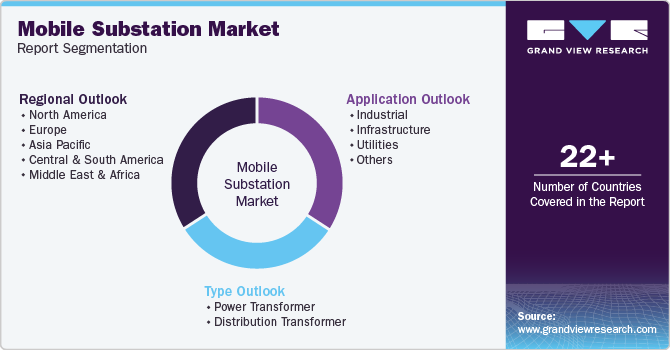
This report forecasts revenue growth at global, regional, and country levels and provides an analysis of the latest industry trends in each of the sub-segments from 2021 to 2033. For this study, Grand View Research has segmented the global mobile substation market report on the basis of type, application, and region:
 To learn more about this report, Download Free Sample Report
 -
Type Outlook (Revenue, USD Million, 2021 - 2033)
-
Power Transformer
-
Distribution Transformer
-
-
Application Outlook (Revenue, USD Million, 2021 - 2033)
-
Industrial
-
Infrastructure
-
Utilities
-
Others
-
-
Regional Outlook (Revenue, USD Million, 2021 - 2033)
-
North America
-
U.S.
-
Canada
-
Mexico
-
-
Europe
-
Germany
-
UK
-
France
-
-
Asia Pacific
-
China
-
India
-
Japan
-
South Korea
-
-
Central & South America
-
Brazil
-
-
Middle East & Africa
-
Saudi Arabia
-
UAE
-
-
Research Methodology
The mobile substation market figures in this report are based on a proven research process that combines executive interviews with secondary research from proprietary databases, company filings, and recognized regulatory and institutional sources. Market size is built through value-chain sizing - reconciling supply-side and demand-side estimates - and triangulated with bottom-up and top-down approaches. Every estimate passes multiple levels of expert validation before publication, with each mobile substation segment quantified using the revenue-capture definitions in the table below.
Segment Definition
Type
Revenue Capture Definition
Power Transformer
Power transformer mobile substations are primarily used in transmission networks, utility grid maintenance, emergency power restoration, grid expansion projects, and renewable energy integration. Market revenue is attributed to the manufacturing and sale of mobile power transformers, switchgear, protection and control systems, trailer-mounted platforms, engineering services, installation, commissioning, transportation, and related support services.
Distribution Transformer
Distribution transformer mobile substations are deployed for temporary power distribution, industrial operations, construction projects, planned maintenance activities, and localized outage management. Revenue is generated through equipment sales, system integration, deployment services, maintenance contracts, rental solutions, and associated power distribution support activities.
Application
Revenue Capture Definition
Industrial
Mobile substations are utilized across manufacturing facilities, mining operations, oil & gas sites, processing plants, and other industrial environments to ensure an uninterrupted power supply during maintenance, equipment replacement, and temporary power requirements. Revenue capture includes equipment procurement, installation, commissioning, operation, and maintenance services, rental offerings, and related engineering support activities.
Infrastructure
The infrastructure segment deploys mobile substations for transportation networks, airports, railways, construction sites, commercial developments, and public utility projects requiring temporary or backup power solutions. Revenue is derived from equipment sales, deployment services, installation, maintenance activities, and temporary power infrastructure support.
Utilities
Utilities represent the largest application segment, using mobile substations for emergency power restoration, grid modernization, transmission and distribution upgrades, load management, and disaster recovery operations. Revenue is generated through the sale of substation equipment, engineering services, commissioning, maintenance contracts, and long-term grid support solutions.
Others
This category includes applications for renewable energy projects, defense facilities, data centers, commercial establishments, and special-event power requirements. Associated revenues are linked to mobile substation sales, temporary deployment services, emergency response operations, technical support, and specialized power continuity solutions.
Estimation Model
Layer Name
Key Question
Description
Power Infrastructure Demand Base Layer
What forms the demand base?
Identify global demand for mobile substations across utilities, industrial facilities, infrastructure projects, renewable energy installations, and emergency power applications. Assess investments in transmission and distribution networks, grid modernization programs, electrification initiatives, and power reliability requirements to establish the addressable market opportunity.
Mobile Substation Manufacturing & Supply Layer
Where are mobile substations produced and supplied?
Estimate the production capacity of mobile substations, including power transformer-based and distribution transformer-based units, across key regions. Analyze transformer manufacturing capabilities, switchgear production, engineering expertise, transportation infrastructure, and supply chain networks to assess market accessibility, equipment availability, and supply dynamics.
Application Adoption Layer
How extensively are mobile substations utilized?
Analyze the deployment of mobile substations across utilities, industrial operations, infrastructure projects, and other end-use sectors. Evaluate factors such as grid reliability requirements, emergency response preparedness, maintenance schedules, temporary power needs, renewable energy integration, and disaster recovery activities that influence adoption levels and deployment frequency.
Revenue Layer
How is market revenue generated?
Expenditures on mobile substations, including transformers, switchgear, protection and control systems, engineering services, installation, commissioning, transportation, rental solutions, and maintenance contracts, quantify market revenue. Equipment pricing, deployment volumes, utility capital expenditure, industrial power infrastructure investments, and grid modernization spending drive the overall market value.
Delivered Customizations
This report has been delivered with the following In-depth customizations
Client Request
Customization Delivered
Value Adds
Mobile Substation Competitive Landscape Assessment
Detailed competitive landscape analysis covering manufacturers and suppliers of mobile substations, mobile power transformers, distribution transformer-based substations, switchgear systems, and related grid infrastructure solutions. The study profiled key market participants based on geographic presence, organizational structure, product portfolio, manufacturing capabilities, service networks, customer base, strategic initiatives, and investments in grid modernization, digital technologies, and power infrastructure expansion.
Enabled evaluation of competitive positioning, engineering capabilities, deployment expertise, service strengths, customer engagement strategies, and market participation across the mobile substation value chain.
Application & Technology Assessment
Evaluation of global mobile substation demand across utilities, industrial facilities, infrastructure projects, renewable energy installations, and other end-use applications. Included assessment of mobile substation types, transformer technologies, digital monitoring systems, protection and control solutions, deployment models, adoption patterns, regulatory requirements, and regional power infrastructure development trends across major markets.
Highlighted application trends, technology adoption patterns, and regional demand opportunities. Supported strategic planning, product portfolio optimization, market entry evaluation, and investment prioritization decisions.
Opportunity Assessment
Identification of high-growth opportunities associated with grid modernization programs, renewable energy integration, transmission and distribution network expansion, and increasing investments in grid resilience and emergency power restoration capabilities. Assessed emerging opportunities arising from aging infrastructure replacement, electrification initiatives, smart grid deployment, and growing demand for rapidly deployable power solutions across utility and industrial sectors.
Enabled prioritization of high-value growth opportunities and emerging application segments. Supported long-term business planning, product development strategies, capacity expansion initiatives, and investment decisions aligned with evolving power infrastructure requirements.
Frequently Asked Questions About This Report
Based on applications, industrial accounted for largest revenue share of 51.2% in 2025.
Asia Pacific dominated the market with revenue share of 35.6% in 2025.
The key drivers of the global mobile substation market are increasing investment in grid modernization, transmission and distribution infrastructure expansion, and the growing need for reliable, rapidly deployable power solutions.
Some of the key players operating in the mobile substation market include ABB Ltd., Siemens Energy AG, General Electric Company (GE Vernova), Delta Star Inc., EFACEC Power Solutions SGPS S.A., Aktif Elektroteknik A.S., Meidensha Corporation, Eaton Corporation plc, Elgin Power Solutions, and Powell Industries Inc.
The mobile substation market size was estimated at USD 1.2 billion in 2025 and is expected to reach USD 1.3 billion in 2026.
The mobile substation market is expected to grow at a compound annual growth rate of 4.7% from 2026 to 2033 to reach USD 1.8 billion by 2033.
Based on type, power transformers accounted for largest revenue share of 69.2% in 2025, while distribution transformers are anticipated to register the fastest CAGR over the forecast period.
About the Author(s)
Distribution & Utilities Research Team
Energy & Power · Distribution & UtilitiesThis report was authored by the distribution & utilities research team at Grand View Research - comprising two research analysts, one senior research analyst, and one industry expert - with specialized expertise in the distribution & utilities segment of the energy & power industry. All findings are based on proprietary energy & power databases, executive interviews, and regulatory analysis, subject to internal peer review prior to publication.
Last Updated:
Speak to Analyst

Customize this report to your needs - add regions, segments, or data points, with 20% free customization.
Or view our licence options:


ISO 9001:2015 & 27001:2022 Certified
We are GDPR and CCPA compliant! Your transaction & personal information is safe and secure. For more details, please read our privacy policy.


