
- Home
- »
- Distribution & Utilities
- »
-
Modular Substation Market Size And Share Report, 2033GVR Report cover

Modular Substation Market (2026 - 2033)
Size, Share & Trends Analysis Report By Voltage, By Insulation (Air Insulated, Gas Insulated), By Application (Power Utilities, Industrial), By Region, And Segment Forecasts
Market Size, 2025
$24.8MMarket Estimate, 2026
$27.5MMarket Forecast, 2033
$51.3MCAGR, 2026–2033
9.3%Modular Substation Market Summary
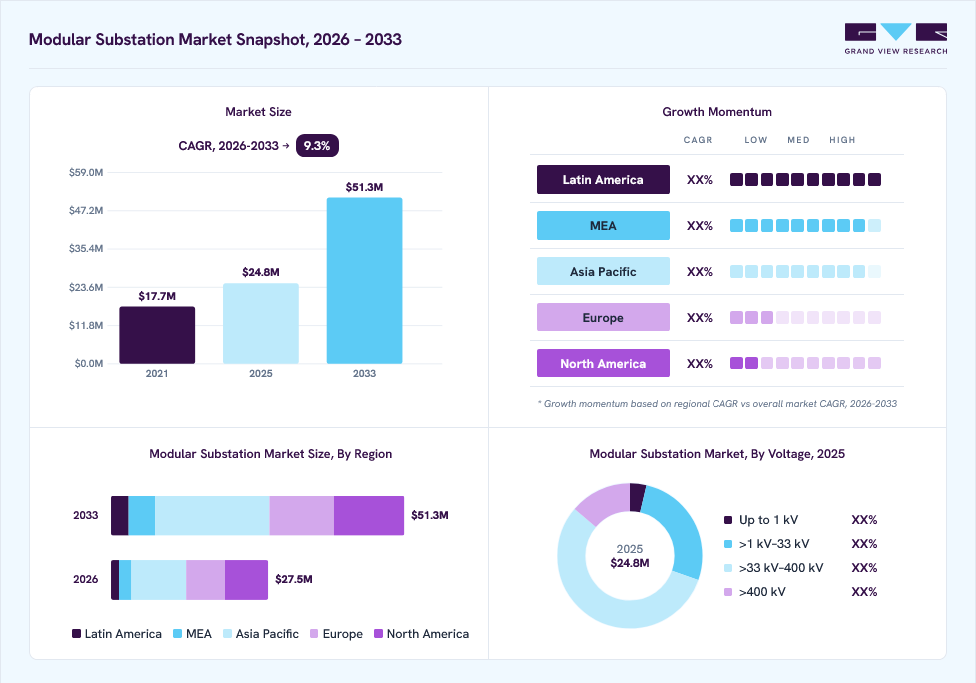
The global modular substation market size was valued at USD 24.8 million in 2025 and is projected to grow from USD 27.5 million in 2026 to USD 51.3 million by 2033, at a CAGR of 9.3% from 2026 to 2033. Asia Pacific dominated the market, accounting for the largest revenue share of 34.0% in 2025. The growing need for rapid grid expansion, renewable energy integration, and reliable power distribution is driving demand for modular substations that enable faster deployment, flexible capacity expansion, and reduced installation requirements.
 Source: Grand View Research, IR Documents, Primary Interviews, Paid DatabasesTo learn more about this report,
 Download Free Sample Report
 Key Market Trends & Insights
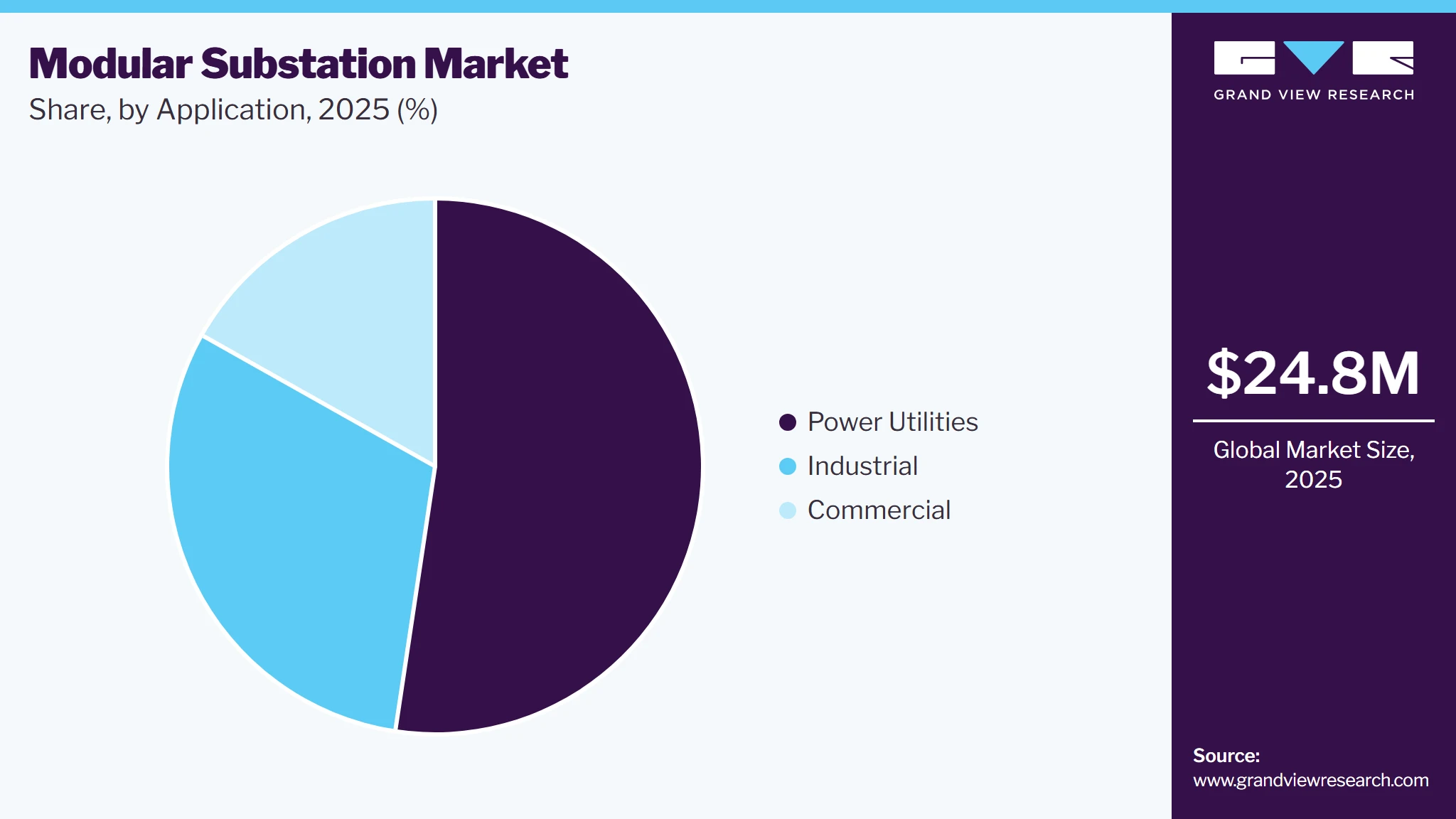
- By application: The power utilities segment held the largest revenue share of 52.4% in 2025.
- By voltage: The 33 kV-400 kV segment held the largest revenue share of 55.7% in 2025.
- By insulation: The gas-insulated segment held the largest revenue share of 57.2% in 2025.
Regional Highlights
- Largest regional market: Asia Pacific (34.0% revenue share, 2025)
- Fastest-growing regional market: Latin America (highest CAGR, 2026-2033)
- By country: China held the largest market share in 2025.
Market Size & Forecast
- Market size in 2025: USD 24.8 Million
- Estimated market size in 2026: USD 27.5 Million
- Projected market size by 2033: USD 51.3 Million
- CAGR (2026-2033): 9.3%
Three ways to get this report
Buy it, customize it, or ask a question.Ask an Analyst
A direct answer, usually in 1 working day
- AccessReport author, directly
- Reply timeWithin 1 working day
- No sales callDirect answer only
- FormatEmail reply
- CostFree, no cost
Get the Full Report
What the study covers
- FormatsPDF · Excel · Dashboard
- Timeline2026–2033 annual, 2025 base
- Coverage20+ countries, 5 regions
- Companies10+ key players profiled
Customize the Report
20% free customization
- IncludeCountries, segments, points
- TailorTo your product definition
- ExtendDeeper competitor detail
- OrA fully bespoke study
- Turnaround5–10 working days
Increasing investments in grid modernization, electrification, and resilient power infrastructure are further accelerating market adoption.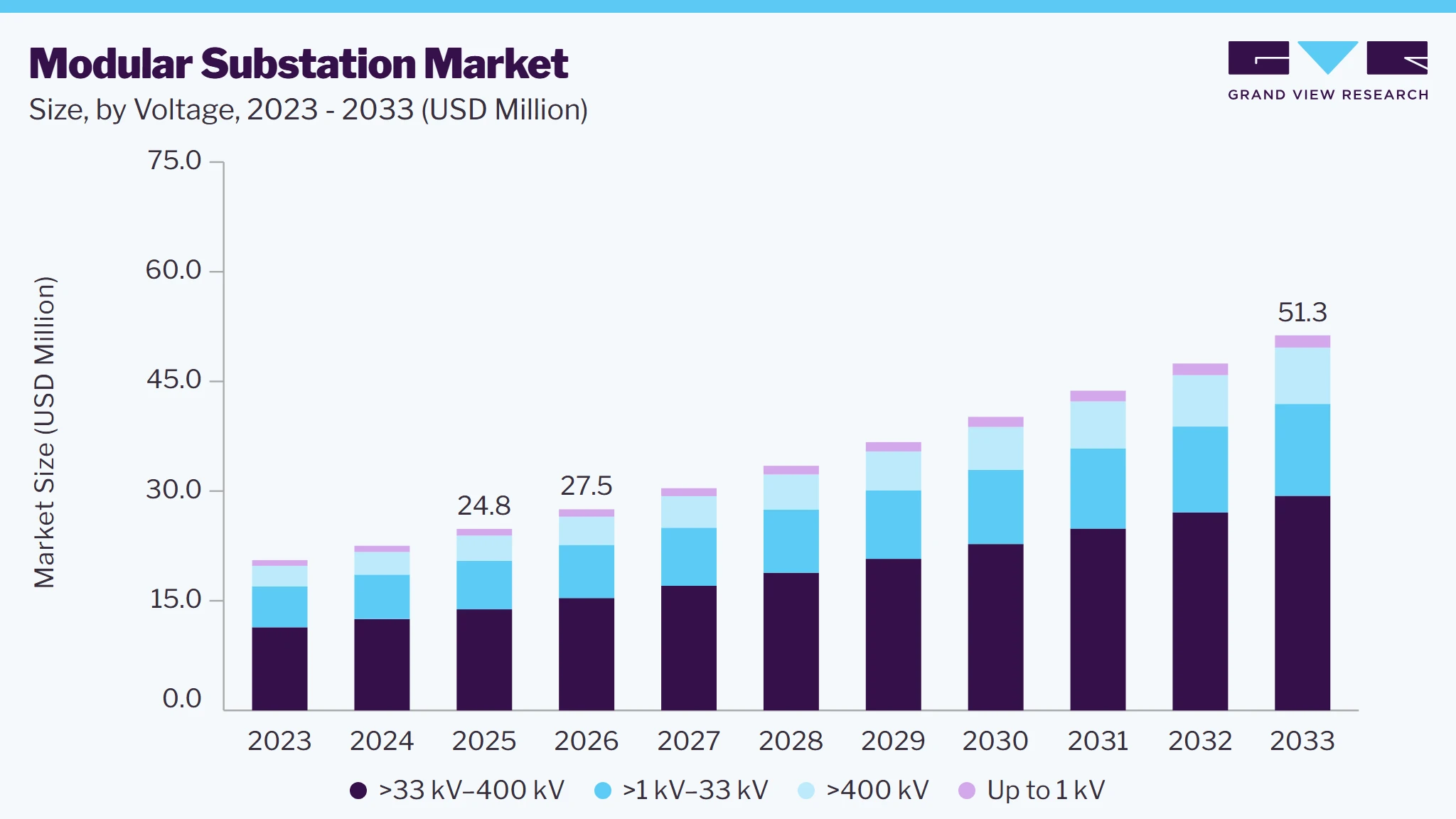 To learn more about this report, Download Free Sample Report
 Market Dynamics
The market for modular substation is driven by rising electricity demand, renewable energy integration, and increasing investments in grid modernization. Utilities and industrial users are adopting modular substations to enable faster deployment, flexible capacity expansion, and reduced construction requirements compared with conventional substations. Growing electrification across data centers, manufacturing, transportation, and commercial infrastructure is creating additional demand for reliable power distribution. The need to replace aging grid infrastructure and improve grid resilience is supporting adoption. However, high upfront equipment costs, transportation requirements, and technical integration challenges can constrain market growth.
The increasing deployment of utility-scale solar and wind projects is driving demand for modular substations that can provide fast, flexible, and space-efficient grid connections. Unlike conventional substations, modular solutions can be factory-assembled and tested before delivery, reducing on-site construction, installation time, and civil works. This makes them particularly suitable for rapidly expanding renewable projects, remote locations, and grid-constrained areas where additional transmission and distribution capacity is required.
A recent example is SSEN Transmission’s 2026 rollout of standardized modular substations, under which the company placed its first orders with Hitachi Energy and GE Vernova. SSEN plans to order 15 modular 132 kV/33 kV substations by the end of 2026, representing more than 1 GW of renewable generation capacity. Much of the assembly, wiring, and testing will be completed off-site before installation, demonstrating how modular substations are being adopted to accelerate renewable-energy connections and grid expansion.
The modular substation industry is constrained by high upfront costs associated with specialized equipment, customized engineering, prefabrication, transportation, and installation, which can make modular solutions less attractive than conventional substations in cost-sensitive projects. Additional customization for voltage levels, environmental conditions, and grid compatibility can further increase project costs, limiting adoption among smaller utilities and industrial users with constrained capital budgets.
The rapid expansion of AI-driven data centers, industrial electrification, and other high-density power loads is creating an emerging opportunity for modular substation providers to offer rapidly deployable, scalable, and dedicated power infrastructure. Modular substations can help developers address grid connection delays, capacity constraints, and limited space while supporting phased expansion of large power-intensive facilities. India’s data center capacity, for example, is expanding rapidly, with significant new capacity under construction and in advanced development, creating opportunities for modular power infrastructure near major demand centers.
Analyst Perspective
The modular substation industry is transitioning from a niche solution for remote and temporary power applications toward a strategic grid-infrastructure solution, supported by accelerating grid modernization, renewable-energy interconnection, and growth in electricity-intensive loads. The key trend is the shift toward standardized, prefabricated, and digitally enabled substations, allowing utilities and industrial users to shorten project timelines, reduce on-site construction, and scale capacity more flexibly. This trend is particularly significant as utilities face aging infrastructure and increasing pressure to connect new generation and loads faster.
Voltage Insights
The 33 kV-400 kV segment held the largest revenue share of 55.7% in 2025, driven by increasing investments in high-voltage transmission infrastructure, renewable-energy evacuation, and grid expansion. These voltage levels are widely deployed for transmitting electricity over long distances and connecting large-scale renewable generation to major load centers, supporting demand for modular substations that enable faster and more flexible deployment. India’s ongoing transmission expansion, including projects involving 400 kV substations for renewable-energy evacuation, further demonstrates this demand.
The 400 kV segment is expected to register the fastest CAGR of 10.4% over the forecast period, driven by increasing investments in ultra-high-voltage transmission networks, long-distance renewable power evacuation, and interregional grid expansion. The need to transmit large volumes of electricity efficiently from remote renewable-energy zones to major load centers is encouraging deployment of higher-voltage substations and associated infrastructure. In 2026, India approved transmission investments involving 765 kV substations and high-capacity corridors, highlighting the accelerating deployment of high-voltage infrastructure to support renewable integration and rising electricity demand.
Insulation Insights
The gas-insulated segment held the largest revenue share of 57.2% in 2025, owing to the compact footprint, high reliability, reduced maintenance requirements, and suitability for space-constrained and harsh environments offered by gas-insulated technology. Its modular and enclosed design also enables faster installation and efficient integration within prefabricated substations, making it particularly attractive for urban areas, renewable energy projects, industrial facilities, and other applications where land availability is limited.
The air-insulated segment is anticipated to register the second-fastest CAGR of 8.5% during the forecast period. The market is driven by its lower upfront cost, simpler installation and maintenance, scalability, and suitability for utility and industrial applications where sufficient land is available. The technology remains widely adopted for grid expansion and substation upgrades, particularly in emerging markets where cost-effective power infrastructure is a priority. Growing investments in transmission and distribution networks across developing economies are further supporting demand for air-insulated modular substations.
Application Insights
The power utilities segment held the largest share of 52.4% in 2025, driven by increasing investments in grid expansion, renewable-energy integration, aging infrastructure replacement, and the need for reliable and rapidly deployable transmission and distribution capacity. Utilities are increasingly adopting modular substations to accelerate grid upgrades, reduce on-site construction requirements, and support the integration of growing renewable generation capacity. India, for instance, plans to expand its transmission network to 6.48 lakh circuit km and transformation capacity to 2,345 GVA by 2032, highlighting the scale of utility-led infrastructure investment.
 To learn more about this report, Download Free Sample Report
 The industrial segment is expected to register the fastest CAGR of 10.4% during the forecast period, supported by rapid industrial electrification, expansion of energy-intensive facilities, and increasing demand for reliable and rapidly deployable power infrastructure. Modular substations are increasingly being used in mining, oil and gas, manufacturing, data centers, and other industrial facilities because they offer shorter installation timelines, compact footprints, and flexible capacity expansion.
Regional Insights
Asia Pacific Modular Substation Market Trends
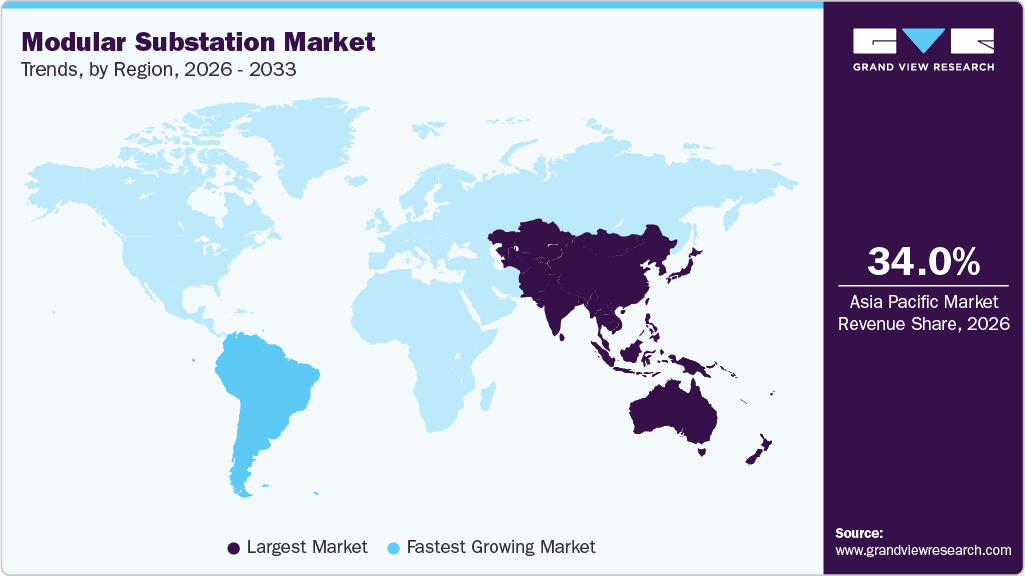
The Asia Pacific modular substation industry dominated the global market with a revenue share of 34.0% in 2025. This is supported by rapid urbanization, industrialization, rising electricity consumption, renewable-energy expansion, and large-scale grid development. Countries across the region are investing in transmission and distribution infrastructure to connect new generation capacity with rapidly growing load centers, while modular substations provide advantages in deployment speed and space efficiency. China and India are particularly important markets because of their large renewable-energy pipelines and extensive grid-expansion programs. The region's strong investment momentum is expected to sustain demand for prefabricated, compact, and digitally enabled substation solutions.
 To learn more about this report, Download Free Sample Report
 The China modular substation industry is being propelled by large-scale renewable-energy deployment, ultra-high-voltage transmission expansion, industrial electrification, and modernization of the national power grid. China invested more than USD 625 billion in clean energy in 2024, while grid investment is also accelerating to address the mismatch between renewable generation and electricity demand centers. In 2026, State Grid announced plans to invest up to USD 595 billion in fixed assets during 2026-2030, including expanded transmission capacity and ultra-high-voltage corridors, creating substantial opportunities for modular and prefabricated substation equipment.
Latin America Modular Substation Market Trends
Latin America modular substation industry is expected to register the fastest growth, with a CAGR of 11.9% from 2026 to 2033. The region is benefiting from rising renewable energy investments, grid interconnection requirements, electrification, and the need to strengthen grid reliability. Abundant solar, wind, and hydropower resources are driving new generation projects and demand for substations to connect and transmit power. Clean-energy investment reached approximately USD 70 billion in 2025, while transmission infrastructure is also expanding across the region. These developments are creating opportunities for modular substations due to their rapid deployment, compact design, and installation flexibility.
Europe Modular Substation Market Trends
The Europe modular substation industry is being driven by grid modernization, renewable-energy integration, electrification, and the replacement of aging electricity infrastructure. The region is increasingly adopting prefabricated and modular solutions to accelerate grid expansion while addressing land constraints and lengthy construction timelines. The European Commission estimates that €584 billion in investment is required in European electricity grids, with 40% of distribution grids already more than 40 years old. In 2026, the EU also advanced a grids package focused on modernizing infrastructure, accelerating permitting, and strengthening cross-border interconnections, supporting demand for flexible and rapidly deployable substation solutions.
North America Modular Substation Market Trends
The North America modular substation industry is supported by rising electricity demand, grid congestion, renewable-energy deployment, and significant investment in transmission and distribution infrastructure. Utilities and large electricity consumers are increasingly seeking modular solutions to shorten project timelines and address capacity constraints. The rapid expansion of AI and data centers is creating an additional source of demand for compact, scalable power infrastructure, although grid connection delays are becoming a major challenge. The U.S. data-center buildout is consequently increasing pressure on utilities to expand and reinforce local grid infrastructure.
U.S. Modular Substation Market Trends
The U.S. modular substation industry is driven by aging grid infrastructure, rapid growth in electricity-intensive data centers, renewable-energy interconnections, and the need to improve grid resilience. AI-related data-center development is particularly important because large facilities require substantial amounts of reliable power and are increasingly encountering grid-capacity constraints. This is encouraging utilities and developers to consider faster-to-deploy substation configurations alongside conventional grid expansion. In 2026, the U.S. data-center investment pipeline continued to expand significantly, with large facilities increasingly requiring dedicated and high-capacity electricity infrastructure.
Middle East & Africa Modular Substation Market Trends
The Middle East & Africa modular substation industry is supported by rising electricity demand, renewable-energy deployment, grid expansion, and industrial development. Large-scale solar projects and infrastructure investments in the Middle East are increasing demand for reliable and rapidly deployable substations. African countries are expanding decentralized renewable power and upgrading aging electricity networks, creating opportunities for modular solutions. In 2026, Egypt and the EU announced a USD 804 million financing package for electricity-grid modernization and renewable integration. Africa’s private clean-energy investment reached nearly USD 40 billion in 2024, supporting further demand for modular grid infrastructure.
Key Modular Substation Company Insights
Some of the key players operating in the global modular substation industry include GE Vernova and Siemens, among others.
-
GE Vernova is a major technology provider in the modular substation industry, offering prefabricated and modular substation solutions, high-voltage equipment, gas-insulated switchgear, transformers, protection systems, and grid automation technologies. The company supports utilities, renewable-energy developers, and industrial customers with integrated solutions designed to accelerate substation deployment and improve grid reliability. Its capabilities across transmission and distribution equipment, digital grid technologies, and turnkey project execution enable the development of compact and rapidly deployable substations. GE Vernova’s broad global presence and extensive power-grid portfolio position it as a key participant in the market.
-
Siemens is a prominent technology provider in the market, offering prefabricated substations, E-House solutions, medium- and high-voltage switchgear, transformers, protection and control systems, and substation automation technologies. Its modular solutions are designed to reduce on-site construction requirements, accelerate installation, and provide flexible power infrastructure for utility, renewable-energy, industrial, and commercial applications. Siemens combines electrification, automation, and digitalization capabilities to deliver integrated substation solutions that improve operational reliability and simplify project deployment. Its extensive global presence and broad electrical infrastructure portfolio position the company as a key participant in the market.
Key Modular Substation Companies:
The following key companies have been profiled for this study on the modular substation market:
-
ABB
-
Siemens
-
Schneider Electric
-
Eaton
-
GE Vernova
-
Hitachi Energy
-
TGOOD
-
CG Power
-
LS Electric
-
Larsen & Toubro
Competitive Benchmarking
Category
Operating Strategies
Competitive Edge
Weakness
Established Players (ABB, Siemens, Schneider Electric, Eaton, GE Vernova, Hitachi Energy, TGOOD, Larsen & Toubro)
- Leverage extensive global operations, established utility relationships, and broad electrical-equipment portfolios to provide integrated modular substation solutions across transmission, distribution, renewable energy, and industrial applications.
- Invest in advanced digital platforms, automation, remote monitoring, and intelligent control technologies to improve substation reliability, operational efficiency, and real-time asset management.
- Expand strategic partnerships with utilities, EPC contractors, renewable energy developers, and industrial customers to secure large-scale modular substation projects and strengthen market penetration.
- Benefit from strong global brands, long-standing relationships with utilities and grid operators, and extensive experience in high-voltage and medium-voltage power infrastructure.
- Offer broad technology portfolios spanning transformers, switchgear, protection and control systems, automation, digital solutions, and substation components, enabling integrated project delivery.
- Maintain strong financial and R&D capabilities that support continuous investment in modularization, digitalization, automation, and next-generation grid technologies.
- Face relatively complex organizational structures and longer decision-making processes that can reduce flexibility when responding to smaller or highly customized modular substation projects.
- Operate with higher overheads, extensive compliance requirements, and sophisticated engineering processes that can increase project costs compared with more specialized regional competitors.
- Depend on large-scale utility and infrastructure projects, exposing businesses to lengthy procurement cycles, regulatory approvals, and fluctuations in capital expenditure.
Emerging Players (CG Power, LS Electric)
- Focus on cost-competitive, standardized, and rapidly deployable modular substation solutions to address demand from utilities, renewable energy projects, industrial facilities, and expanding distribution networks.
- Strengthen regional manufacturing capabilities and localized supply chains to reduce production costs, shorten delivery times, and respond more effectively to domestic infrastructure requirements.
- Expand modular and prefabricated product portfolios, including containerized substations, compact switchgear, transformers, and integrated protection and control systems.
- Benefit from competitive pricing and comparatively leaner operating structures, enabling them to target cost-sensitive customers and infrastructure projects.
- Demonstrate greater flexibility in product customization and project execution, allowing solutions to be adapted to specific regional grid requirements and customer applications.
- Capitalize on growing demand for compact, prefabricated, and factory-tested substations that enable faster installation and reduced on-site construction requirements.
- Have comparatively smaller global footprints and less extensive international service networks, limiting their ability to compete for highly complex multinational substation projects.
- Possess lower brand recognition and shorter track records in some international markets, which can create challenges when competing against established global suppliers.
- Have comparatively lower R&D and financial resources, potentially limiting the pace of investment in advanced digitalization, automation, and next-generation grid technologies.
Recent Developments
- In May 2025, State Grid Zhejiang Electric Power completed China’s first fully modular 500 kV substation in Zhejiang, using a prefabricated construction approach in which more than 80% of the substation components, including the steel control room and firewalls, were manufactured off-site and assembled at the project location. The substation was completed in approximately 14 months, demonstrating how modular construction can reduce on-site work, accelerate project execution, and improve standardization for high-voltage grid infrastructure. The project also highlights the growing adoption of modular substation designs for strengthening grid resilience and supporting faster expansion of transmission infrastructure.
Modular Substation Market Report Scope
Report Attribute
Details
Market Definition
The market represents the sales revenue generated from modular, prefabricated, containerized, and skid-mounted substation systems, segmented by voltage, insulation, and application, and excludes installation, commissioning, maintenance, and other services.
Market size in 2025
USD 24.8 million
Estimated market size in 2026
USD 27.5 million
Projected market size by 2033
USD 51.3 million
Growth rate
CAGR of 9.3% from 2026 to 2033
Base year for estimation
2025
Historical data
2021 - 2024
Forecast period
2026 - 2033
Quantitative Units
Revenue in USD million and CAGR from 2026 to 2033
Report coverage
Revenue & volume forecast, competitive landscape, growth factors, and trends
Segments covered
Voltage, insulation, application, region
Regional scope
North America; Europe; Asia Pacific; Latin America; Middle East & Africa
Country scope
U.S.; Canada; Mexico; Germany; UK; France; Italy; Spain; China; India; Japan; South Korea; Australia; Brazil; Argentina; UAE; Saudi Arabia; South Africa
Key companies profiled
ABB; Siemens; Schneider Electric; Eaton; GE Vernova; Hitachi Energy; TGOOD; CG Power; LS Electric; Larsen & Toubro
Customization scope
Free report customization (equivalent up to 8 analysts working days) with purchase. Addition or alteration to country, regional & segment scope.
Pricing and purchase options
Avail customized purchase options to meet your exact research needs. Explore purchase options
Global Modular Substation Market Report Segmentation
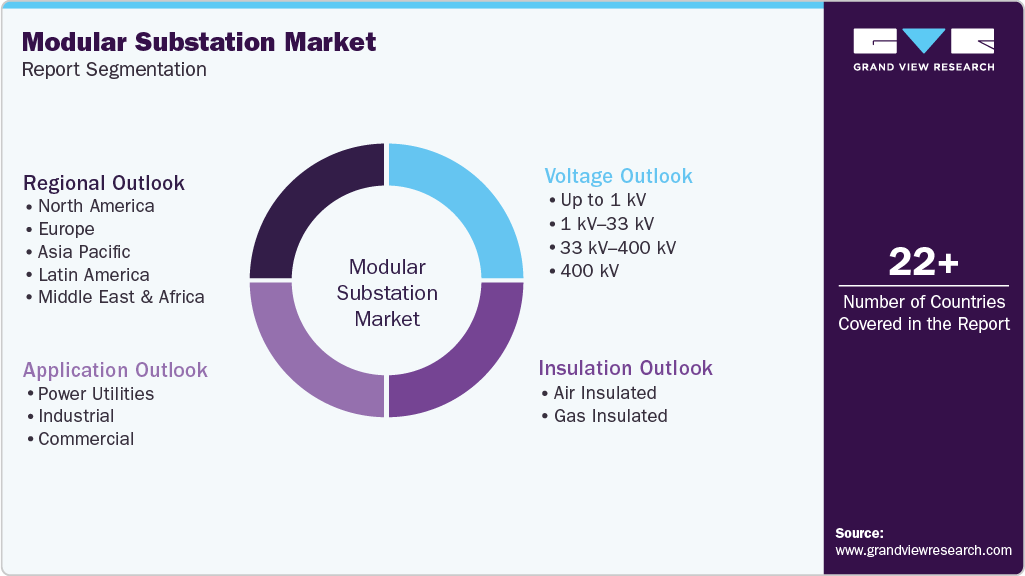
This report forecasts revenue & volume growth at global, regional, and country levels and provides an analysis of the latest industry trends in each of the sub-segments from 2021 to 2033. For this study, Grand View Research has segmented the global modular substation market report based on voltage, insulation, application, and region.
 To learn more about this report, Download Free Sample Report
 -
Voltage Outlook (Volume, MW; Revenue, USD Million, 2021 - 2033)
-
Up to 1 kV
-
1 kV-33 kV
-
33 kV-400 kV
-
400 kV
-
-
Insulation Outlook (Volume, MW; Revenue, USD Million, 2021 - 2033)
-
Air Insulated
-
Gas Insulated
-
-
Application Outlook (Volume, MW; Revenue, USD Million, 2021 - 2033)
-
Power Utilities
-
Industrial
-
Commercial
-
-
Regional Outlook (Volume, MW; Revenue, USD Million, 2021 - 2033)
-
North America
-
U.S.
-
Canada
-
Mexico
-
-
Europe
-
Germany
-
UK
-
France
-
Italy
-
Spain
-
-
Asia Pacific
-
China
-
India
-
Japan
-
South Korea
-
Australia
-
-
Latin America
-
Brazil
-
Argentina
-
-
Middle East & Africa
-
Saudi Arabia
-
UAE
-
South Africa
-
-
Research Methodology
The modular substation market figures in this report are based on a proven research process that combines executive interviews with secondary research from proprietary databases, company filings, and recognized regulatory and institutional sources. Market size is built through value-chain sizing-reconciling supply-side and demand-side estimates-and triangulated with bottom-up and top-down approaches. Every estimate passes multiple levels of expert validation before publication, with each modular substation segment quantified using the revenue-capture definitions in the table below.
Segment Definition
Segment - Voltage
Revenue capture definition
Up to 1 kV
Revenue from modular substations rated up to 1 kV, serving low-voltage distribution and power supply applications.
1 kV-33 kV
Revenue from modular substations designed for medium-voltage distribution and localized power supply networks.
33 kV-400 kV
Revenue from modular substations operating at high-voltage levels for transmission, grid interconnection, renewable energy, and large industrial applications.
400 kV
Revenue from modular substations rated at 400 kV and above, primarily used in high-capacity transmission and major grid interconnection infrastructure.
Segment - Insulation
Revenue capture definition
Air Insulated
Revenue from modular substations using air as the primary insulation medium for electrical equipment and components.
Gas Insulated
Revenue from modular substations using insulating gas within enclosed equipment to provide electrical insulation and enable compact installations.
Segment - Application
Revenue capture definition
Power Utilities
Revenue from modular substations sold to power generation, transmission, and distribution utilities for grid infrastructure applications.
Industrial
Revenue from modular substations deployed at industrial facilities requiring dedicated, reliable, and scalable power infrastructure.
Commercial
Revenue from modular substations supplied to commercial facilities and infrastructure such as buildings, campuses, airports, and data centers.
Estimation Model
Layer Name
Key Question
Description
Voltage Layer
Which voltage ranges contribute to modular substation market revenue?
Assess revenue across up to 1 kV, 1 kV-33 kV, 33 kV-400 kV, and 400 kV based on grid expansion, power demand, and transmission and distribution requirements.
Insulation Layer
Which insulations drive modular substation deployment?
Evaluate adoption of air-insulated and gas-insulated modular substations based on space requirements, voltage levels, reliability, and installation conditions.
Application Layer
Which applications generate demand for modular substations?
Assess demand across power utilities, industrial, and commercial applications based on electrification, grid expansion, renewable integration, and reliable power supply requirements.
Revenue Layer
How is market revenue generated?
Market revenue is measured through the sales of modular substation systems across voltage, insulation, and application segments, excluding installation and other services.
Delivered Customizations
This report has been delivered with the following In-depth customizations
Client Request
Customization Delivered
Value Adds
Competitive Benchmarking
Market analysis was performed across up to 1 kV, 1 kV-33 kV, 33 kV-400 kV, and 400 kV modular substations by evaluating deployment levels, grid requirements, project complexity, and demand for compact and rapidly deployable infrastructure.
Enabled identification of the most attractive voltage segments based on market demand, technological maturity, grid expansion requirements, and growth potential.
Application-Level Opportunity Assessment
A detailed assessment was conducted across power utilities, industrial, and commercial applications by evaluating electricity demand, grid expansion, renewable energy integration, space constraints, and reliability requirements.
Identified the highest-potential application segments and customer groups, supporting market-entry strategies, sales prioritization, and resource allocation.
Regional Opportunity Assessment
Country-level analysis was conducted to assess modular substation adoption based on grid modernization initiatives, renewable energy deployment, transmission and distribution investments, industrial electrification, and infrastructure development across key regions.
Identified high-growth countries with strong modular substation adoption potential, increasing grid investments, supportive policies, and favorable infrastructure opportunities.
Frequently Asked Questions About This Report
The modular substation market size was estimated at USD 24.8 million in 2025 and is expected to reach USD 27.5 million in 2026.
The modular substation market is expected to grow at a CAGR of 9.3% from 2026 to 2033 to reach USD 51.3 million by 2033.
The modular substation market is driven by rising grid modernization investments, increasing renewable energy integration, growing electricity demand, and the need for rapid, cost-effective, and flexible power infrastructure deployment.
The Asia Pacific region dominated the modular substation market with a revenue share of 34.0% in 2025.
Latin America is anticipated to register the fastest CAGR of 11.9% over the forecast period.
Based on application, the power utilities segment accounted for the largest revenue share of 52.4% in 2025.
The key players operating in the modular substation market are ABB, Siemens, Schneider Electric, Eaton, GE Vernova, Hitachi Energy, TGOOD, CG Power, LS Electric, Larsen & Toubro, and others.
The 33 kV-400 kV segment held the largest revenue share of 55.7% in 2025.
Based on insulation, the gas-insulated segment accounted for the largest revenue share of 57.2% in 2025.
About the Author(s)
Distribution & Utilities Research Team
Energy & Power · Distribution & UtilitiesThis report was authored by the distribution & utilities research team at Grand View Research - comprising two research analysts, one senior research analyst, and one industry expert - with specialized expertise in the distribution & utilities segment of the energy & power industry. All findings are based on proprietary energy & power databases, executive interviews, and regulatory analysis, subject to internal peer review prior to publication.
Last Updated:
Speak to Analyst

Customize this report to your needs - add regions, segments, or data points, with 20% free customization.
Or view our licence options:


ISO 9001:2015 & 27001:2022 Certified
We are GDPR and CCPA compliant! Your transaction & personal information is safe and secure. For more details, please read our privacy policy.


