
- Home
- »
- Advanced Interior Materials
- »
-
Multi-Tool Systems Market Size And Share Report, 2033GVR Report cover

Multi-Tool Systems Market (2026 - 2033)
Size, Share & Trends Analysis Report By End Use (Industrial, Residential, Commercial), By Product (Corded Multi-Tools, Cordless Multi-Tools, Manual Multi-Tools), By Region, And Segment Forecasts
Market Size, 2025
$1.9BMarket Estimate, 2026
$2.0BMarket Forecast, 2033
$2.6BCAGR, 2026–2033
3.6%Multi-Tool Systems Market Summary
The global multi-tool systems market size was valued at USD 1.9 billion in 2025 and is projected to grow from USD 2.0 billion in 2026 to USD 2.6 billion by 2033, at a CAGR of 3.6% from 2026 to 2033. Asia Pacific dominated the market, accounting for a revenue share of 33.5% in 2025. These systems offer users the convenience of performing multiple functions with a single device, reducing the need for multiple standalone tools.
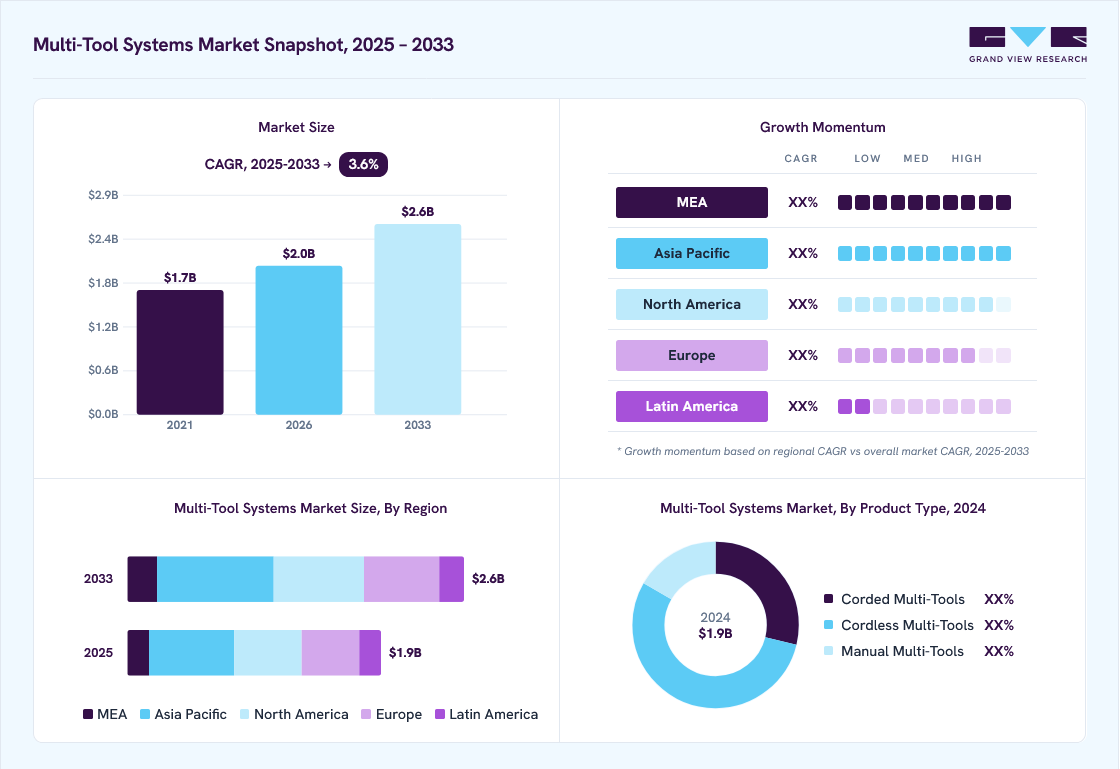 Source: Grand View Research, IR Documents, Primary Interviews, Paid DatabasesTo learn more about this report,
 Download Free Sample Report
Key Market Trends & Insights
- By product: Cordless multi-tools segment led the market with the largest revenue share of 54.7% in 2025.
- By end use: Industrial segment led the market with the largest revenue share of 46.6% in 2025
Regional Highlights
- Largest regional market: Asia Pacific (33.5% revenue share, 2025)
- By country: China held the largest market share in 2025.
Market Size & Forecast
- Market size in 2025: USD 1.9 Billion
- Estimated market size in 2026: USD 2.0 Billion
- Projected market size by 2033: USD 2.6 Billion
- CAGR (2026-2033): 3.6%
Prism AI by Grand View Research Free to tryAsk a question about the Multi-Tool systems marketTry asking✓Every figure cited from GVR research Prefer the report? Download free sample →
These systems offer users the convenience of performing multiple functions with a single device, reducing the need for multiple standalone tools. Growing emphasis on efficiency and space-saving solutions in professional and household applications is further boosting their adoption. In addition, advancements in material science and ergonomic designs are enhancing tool durability and user comfort, supporting market expansion. Technological innovations and the integration of smart features are significantly driving the growth of the market. Modern tools are increasingly being equipped with digital sensors, torque control, and battery management systems to enhance precision and usability.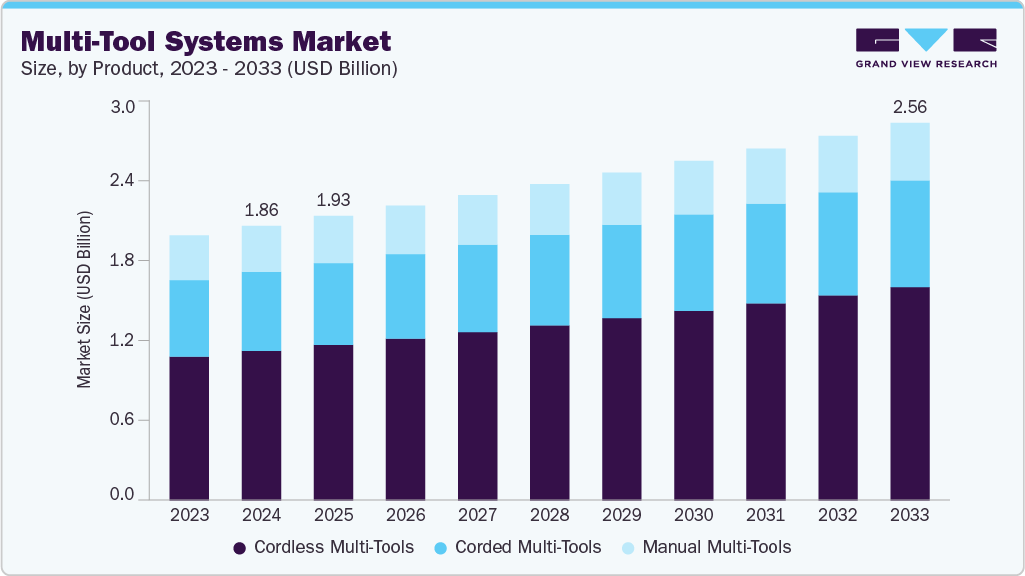 To learn more about this report, Download Free Sample Report
The rise of cordless and battery-operated variants, supported by advancements in lithium-ion technology, has improved portability and performance. Furthermore, the growing trend of automation and IoT-enabled maintenance systems in industrial operations is increasing the utility of multi-tools in technical applications.
The expanding DIY culture and home improvement activities are major factors stimulating the demand for multi-tool systems globally. Consumers are seeking cost-effective, user-friendly, and multifunctional tools for small repairs, crafts, and maintenance work. The accessibility of these tools through online retail channels and their marketing through tutorials and influencer-led campaigns have further widened their consumer base. In addition, the growing preference for sustainable and repair-oriented lifestyles is promoting the use of durable, long-lasting multi-tool systems.
Market Dynamics
The multi-tool systems market is driven by increasing demand for versatile tools that combine multiple functions into a single compact unit, helping professionals and DIY users improve productivity while reducing equipment costs. Expanding construction, renovation, automotive repair, industrial maintenance, and home improvement activities continue to strengthen product adoption across residential, commercial, and industrial applications. Ongoing advancements in lithium-ion battery technology, brushless motors, ergonomic designs, and quick-change accessory systems are enhancing tool performance, portability, and user convenience, encouraging the replacement of conventional single-purpose tools. Growing e-commerce penetration and wider availability of multifunctional tool kits are further improving market accessibility.
The market is gaining traction as professionals and DIY users increasingly prefer multi-tool systems that perform multiple applications, such as cutting, sanding, scraping, grinding, and polishing, using a single device. This versatility reduces the need for multiple standalone tools, lowers equipment costs, saves storage space, and improves work efficiency across construction, woodworking, automotive repair, and maintenance activities. Increasing investments in infrastructure development and residential remodeling projects are further supporting product demand.
Premium cordless multi-tool systems equipped with brushless motors, high-capacity batteries, and advanced accessory mechanisms often carry higher upfront costs than conventional single-purpose tools. The additional expense of compatible accessories and replacement batteries can discourage adoption among price-sensitive consumers and small contractors, particularly in developing markets. Differences in accessory compatibility across brands can also increase ownership costs and limit purchasing flexibility. Frequent technological upgrades may encourage replacement but can make older accessories obsolete, creating concerns for long-term users.
Manufacturers have significant opportunities to expand their product portfolios through cordless multi-tool platforms featuring longer battery life, faster charging, improved ergonomics, and smart connectivity for tool diagnostics and performance monitoring. Increasing demand for lightweight, portable, and connected power tools across professional and residential applications is creating new growth avenues for market participants. Growth in online retail channels enables manufacturers to reach a broader customer base while offering customized tool kits for different applications.
Market Concentration & Characteristics
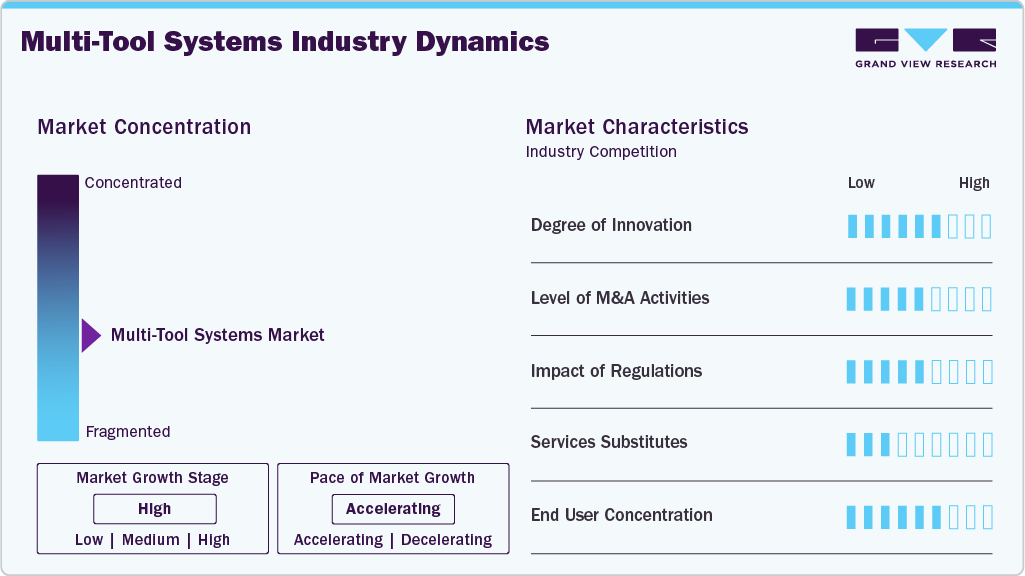
The global multi-tool systems industry exhibits a moderate-to-high degree of innovation, with manufacturers continuously developing advanced, ergonomic, and smart multifunctional tools to enhance performance and user convenience. Technological progress, particularly in battery efficiency, material strength, and compact design, has intensified competition among leading players. The market also reflects a moderate level of mergers and acquisitions, as companies aim to expand their product portfolios and strengthen distribution networks. Strategic collaborations with technology firms and component manufacturers are becoming increasingly common, fostering innovation and accelerating product development cycles.
 To learn more about this report, Download Free Sample Report
Regulatory frameworks related to product safety, quality standards, and environmental compliance have a considerable impact on market operations. Manufacturers are required to adhere to international standards such as ISO and CE certifications, influencing design and material choices. While the threat of service substitutes remains moderate, the availability of specialized single-function tools continues to pose competitive pressure in specific applications. End-user concentration varies across segments, with industrial users, construction professionals, and DIY consumers representing the major demand groups. The growing emphasis on sustainability and energy-efficient tools is further shaping purchasing decisions, driving the market toward high-quality, compliant, and multifunctional solutions.
Analyst Perspective
The multi-tool systems market is growing steadily as professionals and consumers increasingly seek compact, versatile, and durable tools that can perform multiple functions without compromising performance. Demand is expanding across construction, industrial maintenance, automotive repair, military & defense, emergency services, and outdoor recreation, where portability and operational efficiency are critical. Manufacturers are focusing on product innovation through lightweight materials, ergonomic designs, corrosion-resistant finishes, and interchangeable tool components to enhance functionality and user comfort. In addition, the growing popularity of DIY activities, e-commerce distribution channels, and premium multifunctional tools is broadening the consumer base. As industries continue to prioritize productivity and tool consolidation, manufacturers offering high-quality, application-specific, and technologically advanced multi-tool systems are expected to benefit from sustained long-term market growth.
Product Insights
Based on product, the cordless multi-tools segment led the market with the largest revenue share of 54.7% in 2025, driven by the increasing demand for portability, flexibility, and convenience in both professional and DIY applications. With advancements in lithium-ion battery technology, cordless multi-tools now offer extended runtime, faster charging, and consistent power output. These tools allow users to operate freely without being restricted by power cords, making them ideal for use in remote or hard-to-reach areas. Their growing adoption across construction, maintenance, and repair projects highlights a shift toward mobility-focused solutions.
The corded multi-tools segment is expected to grow significantly at a CAGR of 3.4% over the forecast period, driven by the need for uninterrupted power supply and high torque output during intensive applications. These tools are preferred in industrial and professional settings where continuous operation and precision are essential. Corded variants eliminate concerns related to battery life, ensuring consistent performance in cutting, sanding, and grinding tasks. Their durability and affordability also make them a practical choice for heavy-duty operations.
End Use Insights
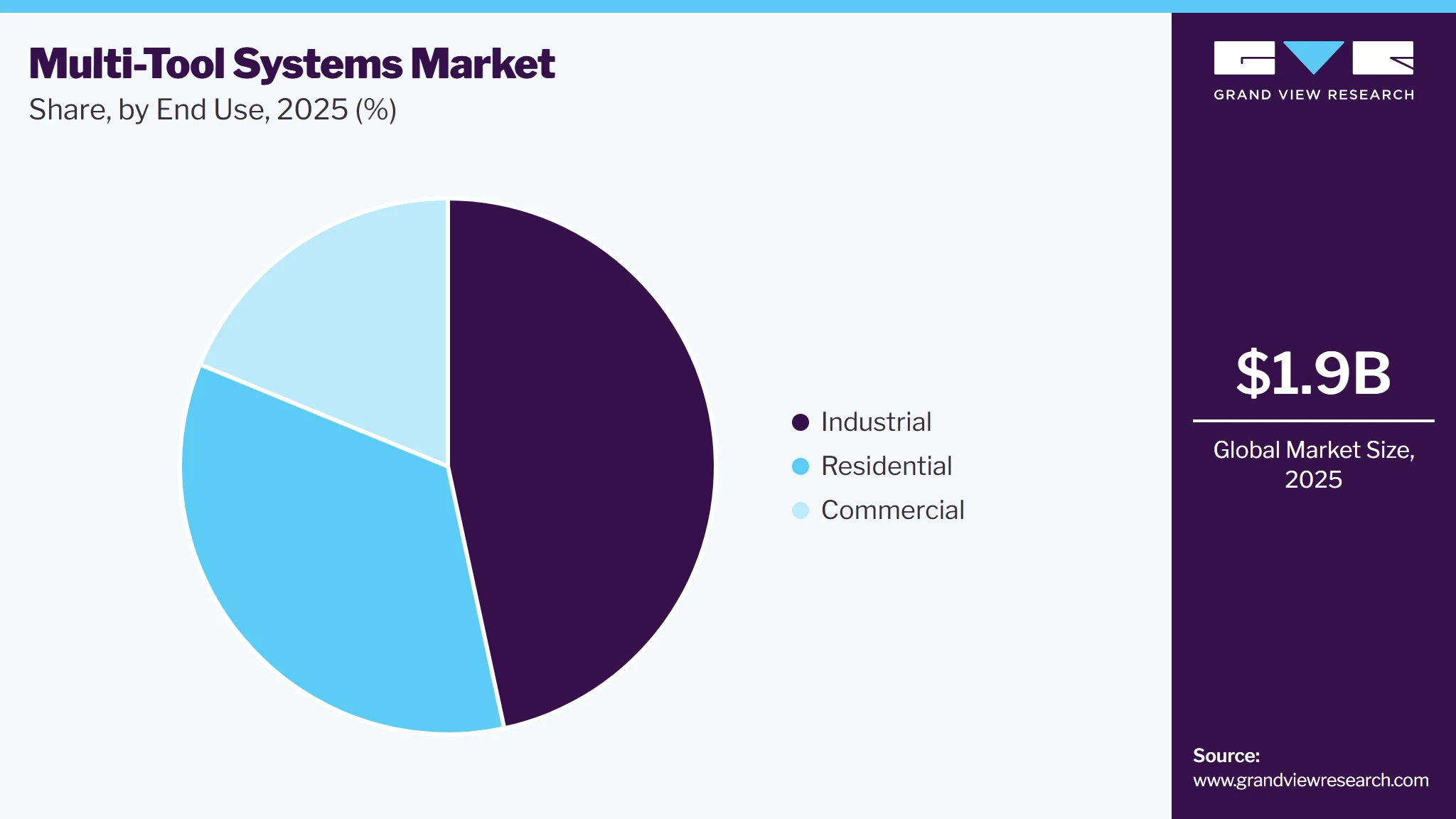
Based on end use, the industrial segment led the market with the largest revenue share of 46.6% in 2025, driven by the growing adoption of versatile tools in manufacturing, automotive, and construction industries. Multi-tools help reduce equipment clutter by combining multiple functions-such as cutting, drilling, and polishing-into one device, improving operational efficiency. Industrial users prioritize tools that offer precision, durability, and compatibility with multiple attachments.
 To learn more about this report, Download Free Sample Report
The residential segment is expected to grow at the fastest CAGR of 4.1% over the forecast period, driven by the rising trend of DIY home improvement and repair activities worldwide. Homeowners increasingly prefer multi-tools for their versatility, affordability, and ease of use in household projects such as furniture repair, flooring, and decor. The availability of compact, user-friendly designs with interchangeable accessories enhances their appeal among consumers. Growing e-commerce penetration has made these tools more accessible, further accelerating demand.
Regional Insights
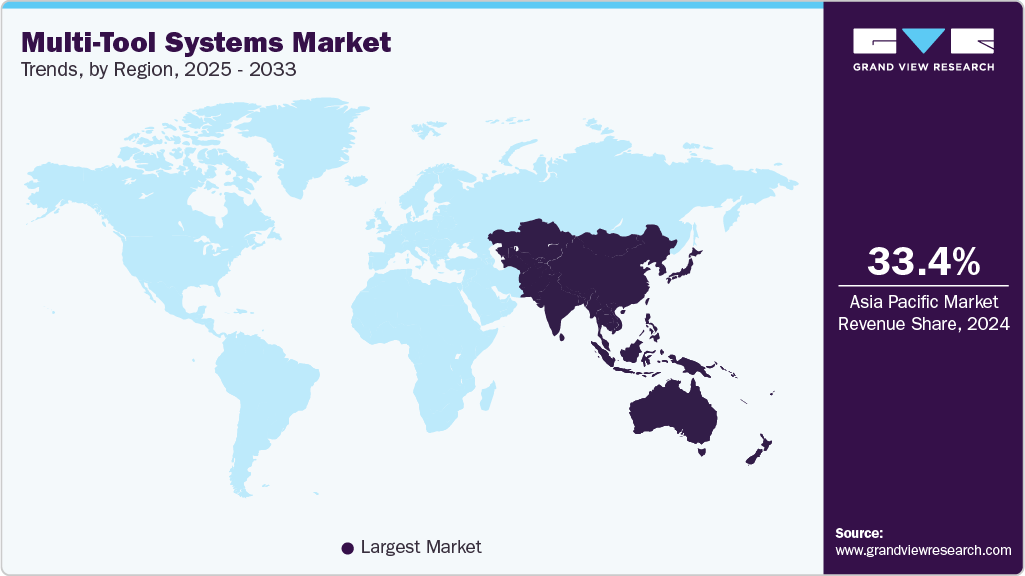
Asia Pacific dominated the multi-tool systems market with the largest revenue share of 33.5% in 2025, witnessing substantial growth driven by rapid industrialization, urban development, and expanding manufacturing activities. Increasing construction and infrastructure projects in emerging economies such as India and Indonesia are propelling demand for efficient and durable tools. The region’s growing middle-class population and rising disposable income are fueling the DIY and household repair segments. Local manufacturers are also entering the market with cost-effective and innovative products, enhancing competition. In addition, foreign investments and technological collaborations are accelerating market modernization and regional capacity expansion.
 To learn more about this report, Download Free Sample Report
China Multi-Tool Systems Market Trends
The multi-tool systems market in China held the largest share in the Asia Pacific region in 2025. China’s multi-tool systems industry is driven by large-scale industrial production, rapid urbanization, and strong domestic manufacturing capabilities. The nation’s focus on upgrading its construction and automotive sectors continues to stimulate tool demand. Local players are increasingly producing affordable yet high-performance tools, catering to both domestic and export markets. The integration of advanced materials and automation technologies is improving product efficiency and reliability. Moreover, the government’s initiatives to promote innovation and industrial modernization are fostering the development of smart, energy-efficient multi-tool systems.
North America Multi-Tool Systems Market Trends
The North America multi-tool systems industry is driven by the strong presence of established tool manufacturers and the region’s high adoption of advanced power tools. Growing demand from sectors such as construction, defense, and automotive repair continues to support market growth. The increasing trend of DIY home improvement activities is also a major factor fueling sales. In addition, technological innovations such as cordless and smart-enabled tools are appealing to professional and personal users alike. Supportive consumer spending patterns and a preference for durable, ergonomic, and multifunctional products further enhance regional demand.
U.S. Multi-Tool Systems Market Trends
The multi-tool systems industry in the United States benefits from robust industrial infrastructure and a thriving home improvement culture. The growing popularity of renovation and remodeling projects has significantly increased tool consumption across residential sectors. High labor costs encourage the use of efficient, multi-functional tools that save time and effort. Furthermore, American manufacturers are investing heavily in R&D to integrate smart technologies and improve energy efficiency. The growing e-commerce network and retail partnerships are also expanding product accessibility across both professional and consumer segments.
Europe Multi-Tool Systems Market Trends
The Europe multi-tool systems industry is characterized by strong technological innovation and a high demand for precision-engineered tools. Increasing investments in infrastructure renovation, coupled with strict regulatory standards for safety and sustainability, are driving market development. European consumers also display a preference for compact, eco-friendly, and energy-efficient tools. Moreover, the rise of home DIY activities and professional maintenance services supports sustained product demand. The presence of leading tool brands and ongoing R&D in cordless and digital tool technologies further strengthens the region’s market position.
Germany multi-tool systems industry stands out as a key contributor to the European market due to its advanced engineering and industrial expertise. The country’s strong automotive, mechanical, and construction sectors are major consumers of multifunctional tools. German manufacturers emphasize precision, durability, and ergonomic design, giving them a competitive edge globally. Increasing automation in industrial processes is creating new opportunities for high-tech, modular tool systems. In addition, growing environmental awareness and energy efficiency regulations are prompting the development of sustainable, high-performance multi-tools.
Latin America Multi-Tool Systems Market Trends
The Latin America multi-tool systems industry is growing steadily due to expanding construction and industrial maintenance sectors. Countries such as Brazil and Mexico are investing heavily in infrastructure development, driving tool demand. Rising urbanization and increasing consumer interest in DIY repair activities are also contributing to market expansion. However, price sensitivity remains a key factor influencing purchasing decisions, favoring affordable, versatile products. Moreover, the growing presence of international tool brands through partnerships and regional distribution networks is improving product availability and adoption.
Middle East & Africa Multi-Tool Systems Market Trends
The Middle East & Africa multi-tool systems industry is driven by rapid infrastructure growth, urban development projects, and increasing industrial activities. The construction boom in Gulf countries and the expansion of energy and mining sectors are key contributors to demand. In addition, government initiatives promoting manufacturing diversification are supporting local tool production and imports. The region’s rising middle-class population and growing retail availability of compact, user-friendly tools are also aiding adoption. As economies continue to modernize, the demand for efficient, multi-purpose tools across commercial and household applications is expected to rise significantly.
Key Multi-Tool Systems Company Insights
Some of the key players operating in the market include Leatherman Tool Group, Inc. and Victorinox AG.
-
Leatherman Tool Group, Inc. is renowned for pioneering compact multi-tools designed for outdoor, professional, and everyday use. The company’s portfolio includes versatile models such as the Wave+, Charge+, and Signal, which integrate pliers, knives, screwdrivers, and wire cutters in one durable design.
-
Victorinox AG is globally recognized for its iconic Swiss Army knives and precision-engineered multi-tools. The company offers a wide range of multifunctional tools tailored for outdoor, military, and household use. Its products, such as the SwissTool Spirit and SwissTool X, emphasize compact design, superior craftsmanship, and reliability, maintaining the brand’s reputation for quality and longevity.
Stanley Black & Decker, Inc. and Bosch Power Tools GmbH are some of the emerging market participants in the market.
-
Stanley Black & Decker, Inc. is a leading American manufacturer of industrial tools and household hardware. The company offers a comprehensive range of multi-tools under the Stanley and DeWalt brands, catering to both professionals and DIY consumers.
-
Bosch Power Tools GmbH, a division of the Robert Bosch Group based in Germany, produces high-performance power and hand tools. The company’s multi-tool systems, such as the Bosch Professional Oscillating Multi-Tool Series, are widely used in cutting, sanding, and polishing applications.
Key Multi-Tool Systems Companies:
The following key companies have been profiled for this study on the multi-tool systems market.
- Leatherman Tool Group, Inc.
- Victorinox AG
- Stanley Black & Decker, Inc.
- Bosch Power Tools GmbH
- Gerber Gear (Fiskars Group)
- SOG Specialty Knives & Tools, LLC
- Makita Corporation
- DeWalt Industrial Tool Company
- Snap-on Incorporated
Competitive Benchmarking
Category
Operating Strategies
Competitive Edge
Weakness
Established Players (e.g., Stanley Black & Decker, Inc.; Bosch Power Tools GmbH; Makita Corporation; Milwaukee Tool; Festool GmbH; Fein (C. & E. Fein GmbH))
Expand cordless multi-tool platforms with advanced battery systems, brushless motors, and interchangeable accessories.
Strengthen market presence through product innovation, global distribution, strategic partnerships, and investments in manufacturing capabilities.
Strong global brand recognition, extensive product portfolios, and well-established distribution networks.
Advanced engineering capabilities, integrated battery ecosystems, and comprehensive after-sales support enhance customer retention.
High R&D and manufacturing costs increase operational expenditure.
Exposure to raw material price fluctuations, supply chain disruptions, and intense competition from global and regional manufacturers.
Emerging & Regional Players (e.g., Leatherman Tool Group, Inc.; Victorinox AG; Gerber Gear (Fiskars Group); SOG Specialty Knives & Tools, LLC)
Focus on premium manual multi-tools with durable materials, compact designs, and multifunctional features for professional, outdoor, and EDC applications.
Enhance customer loyalty through continuous product innovation, direct-to-consumer sales, and strong brand positioning.
Strong reputation for product quality, durability, and specialized multi-tool designs.
Loyal customer base and differentiated products support premium pricing and brand value.
Limited presence in powered multi-tool systems compared to diversified competitors.
Smaller product portfolios and premium pricing can restrict growth in price-sensitive and large-scale industrial markets.
Global Multi-Tool Systems Market Report Scope
Report Attribute
Details
Market size in 2025
USD 1.9 billion
Estimated market size in 2026
USD 2.0 billion
Projected market size by 2033
USD 2.6 billion
Growth rate
CAGR of 3.6% from 2026 to 2033
Base year for estimation
2025
Historical data
2021 - 2024
Forecast period
2026 - 2033
Quantitative units
Revenue in USD billion and CAGR from 2026 to 2033
Report coverage
Revenue forecast, company ranking, competitive landscape, growth factors, and trends
Segments covered
Product, end use, region
Regional scope
North America; Europe; Asia Pacific; Latin America; Middle East & Africa
Country scope
U.S.; Canada; Mexico; UK; Germany; France; Italy; Spain; China; India; Japan
Key companies profiled
Leatherman Tool Group, Inc.; Victorinox AG; Stanley Black & Decker, Inc.; Bosch Power Tools GmbH; Makita Corporation; Milwaukee Tool; Festool GmbH; Fein (C. & E. Fein GmbH); Gerber Gear (Fiskars Group); SOG Specialty Knives & Tools, LLC
Customization scope
Free report customization (equivalent up to 8 analysts' working days) with purchase. Addition or alteration to country, regional & segment scope.
Pricing and purchase options
Avail customized purchase options to meet your exact research needs. Explore purchase options
Global Multi-Tool Systems Market Report Segmentation
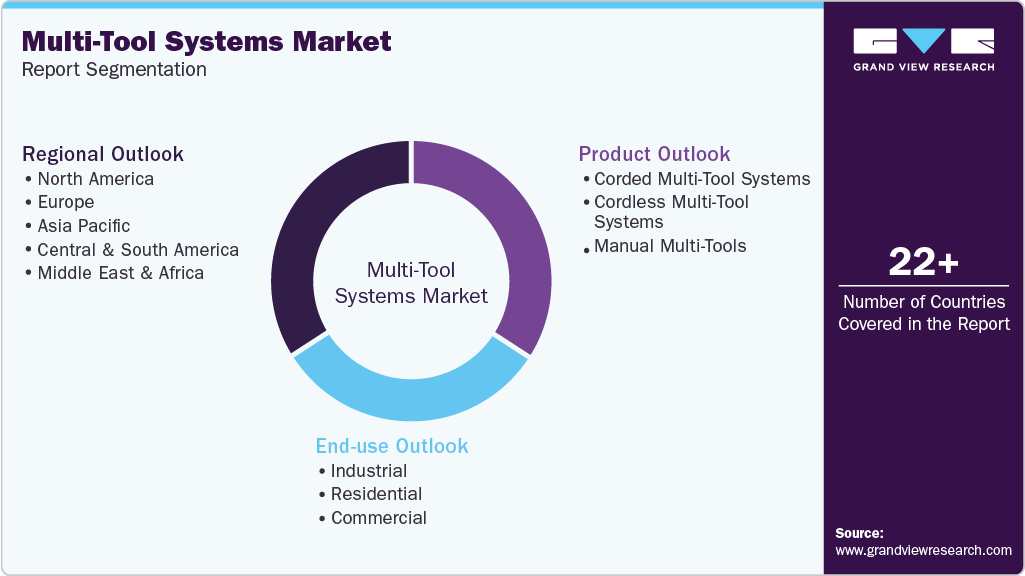
This report forecasts revenue growth at global, regional, and country levels and provides an analysis of the latest industry trends in each of the sub-segments from 2021 to 2033. For this study, Grand View Research has segmented the global multi-tool systems market report based on product, end use, and region:
 To learn more about this report, Download Free Sample Report
-
End Use Outlook (Revenue, USD Million, 2021 - 2033)
-
Industrial
-
Residential
-
Commercial
-
-
Product Outlook (Revenue, USD Million, 2021 - 2033)
-
Corded Multi-Tool Systems
-
Cordless Multi-Tool Systems
-
Manual Multi-Tools
-
-
Regional Outlook (Revenue, USD Million, 2021 - 2033)
-
North America
-
U.S.
-
Canada
-
Mexico
-
-
Europe
-
Germany
-
UK
-
France
-
Italy
-
Spain
-
-
Asia Pacific
-
China
-
Japan
-
India
-
-
Central & South America
-
Middle East & Africa
-
Research Methodology
The multi-Tool systems market figures in this report are based on a proven research process that combines executive interviews with secondary research from proprietary databases, company filings, and recognized regulatory and institutional sources. Market size is built through value-chain sizing - reconciling supply-side and demand-side estimates - and triangulated with bottom-up and top-down approaches. Every estimate passes multiple levels of expert validation before publication, with each multi-Tool systems segment quantified using the revenue-capture definitions in the table below.
Segment Definition
Segment - Product Type
Revenue Capture Definition
Corded Multi-Tool Systems
The segment refers to electrically powered multi-tool systems that operate through a direct AC power supply and are designed for cutting, sanding, grinding, scraping, polishing, and other precision applications. The segment captures revenue generated from the sale of corded multi-tool systems across all end-use industries.
Cordless Multi-Tool Systems
The segment refers to battery-powered multi-tool systems that provide portability and flexibility for construction, maintenance, repair, and renovation applications. The segment captures revenue generated from the sale of cordless multi-tool systems across all end-use industries.
Manual Multi-Tools
The segment refers to non-powered handheld multi-tools that integrate multiple functions, such as pliers, knives, screwdrivers, wire cutters, scissors, and files, into a single compact device. The segment captures revenue generated from the sale of manual multi-tools across all end-use industries.
Segment - End Use
Revenue Capture Definition
Industrial
The segment captures revenue generated from the sale of multi-tool systems supplied for manufacturing, maintenance, repair and operations (MRO), automotive, aerospace, energy, utilities, metal fabrication, and other industrial applications.
Residential
The segment captures revenue generated from the sale of multi-tool systems supplied for home improvement, DIY projects, furniture assembly, renovation, gardening, and household maintenance applications.
Commercial
The segment captures revenue generated from the sale of multi-tool systems supplied for commercial construction, facility management, electrical and plumbing services, hospitality, retail, institutional buildings, and other commercial maintenance applications.
Estimation Model
Layer Name
Key Question
Description
End-use Demand Layer
Where are multi-tool systems required?
Analyze demand across construction, automotive, military & defense, outdoor & recreational activities, emergency response, industrial maintenance, electrical work, and DIY applications.
Industrial & Consumer Spending Layer
Where is new product demand being created?
Evaluate investments in construction projects, industrial maintenance, defense procurement, outdoor recreation, and home improvement activities. Assess replacement demand, expansion of professional toolkits, retail sales trends, and increasing adoption among professionals and consumers that drive procurement of new multi-tool systems.
Product Adoption Layer
Which multi-tool system products are being deployed?
Segment demand by product type and end-use industry. Apply adoption rates based on portability, durability, tool versatility, ergonomics, and application-specific requirements. Assess the increasing adoption of lightweight, corrosion-resistant, and multifunctional tools featuring interchangeable components and enhanced locking mechanisms.
Revenue Generation Layer
How much market revenue is generated?
Estimate annual unit sales of multi-tool systems by product type, application, distribution channel, end-use industry, and region. Quantify revenues generated exclusively from the sale of new multi-tool systems supplied through OEMs, distributors, specialty retailers, e-commerce platforms, and industrial suppliers.
Delivered Customizations
This report has been delivered with the following In-depth customizations
Client Request
Customization Delivered
Value Adds
Competitive Benchmarking
A comprehensive competitive benchmarking assessment was conducted by evaluating leading multi-tool system manufacturers based on product portfolio, manufacturing capabilities, technological innovation, distribution network, brand positioning, pricing strategies, and strategic developments within the multi-tool systems market.
The benchmarking enabled stakeholders to compare competitive positioning, identify product differentiation opportunities, evaluate strategic initiatives, and support informed business expansion and product development decisions.
Regional Segmentation
A detailed regional assessment was conducted across major markets, analyzing demand trends, construction and industrial activity, manufacturing presence, distribution channels, regulatory environment, and adoption of multi-tool systems. The analysis also evaluated the contribution of major countries to regional market performance.
The regional assessment helped stakeholders identify high-growth markets, optimize regional expansion strategies, strengthen distribution planning, and align product offerings with regional industry requirements and customer demand.
Opportunity Assessment
A detailed opportunity assessment was conducted by evaluating advancements in cordless multi-tool systems, lithium-ion battery technologies, interchangeable accessory ecosystems, ergonomic product designs, and expanding demand from construction, industrial maintenance, automotive repair, woodworking, and DIY applications.
The assessment enabled stakeholders to prioritize investment opportunities, strengthen product portfolios, align innovation with evolving end-user requirements, and capitalize on increasing demand for portable, multifunctional, and high-performance multi-tool systems.
Frequently Asked Questions About This Report
The cordless multi-tools segment led the market with the largest revenue share of 54.7% in 2025.
The industrial segment accounted for the largest revenue share of 46.6% in 2025.
The key factors driving the multi-tool systems market include rising demand for versatile and compact tools across industrial and residential applications, advancements in cordless technology, increasing DIY trends, and the growing need for efficiency and multifunctionality in repair, construction, and maintenance activities.
Asia Pacific dominated the multi-tool systems market with the largest revenue share of 33.5% in 2025.
The global multi-tool systems market size was estimated at USD 1.9 billion in 2025 and is expected to be USD 2.0 billion in 2026.
The global multi-tool systems market, in terms of revenue, is expected to grow at a compound annual growth rate of 3.6% from 2026 to 2033 to reach USD 2.6 billion by 2033.
Some of key players in the multi-tool systems market are Leatherman Tool Group, Inc., Victorinox AG, Stanley Black & Decker, Inc., Bosch Power Tools GmbH, Gerber Gear (Fiskars Group), SOG Specialty Knives & Tools, LLC, Makita Corporation, DeWalt Industrial Tool Company, and Snap-on Incorporated
About the Author(s)
Advanced Interior Materials Research Team
Advanced Materials · Advanced Interior MaterialsThis report was authored by the advanced interior materials research team at Grand View Research - comprising two research analysts, one senior research analyst, and one industry expert - with specialized expertise in the advanced interior materials segment of the advanced materials industry. All findings are based on proprietary advanced materials databases, executive interviews, and regulatory analysis, subject to internal peer review prior to publication.
Last Updated:
Speak to Analyst

Customize this report to your needs - add regions, segments, or data points, with 20% free customization.
Or view our licence options:


ISO 9001:2015 & 27001:2022 Certified
We are GDPR and CCPA compliant! Your transaction & personal information is safe and secure. For more details, please read our privacy policy.


