
- Home
- »
- Biotechnology
- »
-
Mutation Detection Kits In Genome Editing Market Size Report, 2028GVR Report cover
![Mutation Detection Kits In Genome Editing Market Size, Share & Trends Report]()
Mutation Detection Kits In Genome Editing Market (2021 - 2028) Size, Share & Trends Analysis Report By Technology (CRISPR/Cas9, TALENs/MegaTALs, ZFN, Meganucleases), By End-use, By Region, And Segment Forecasts
Report Overview
The global mutation detection kits in genome editing market size was valued at USD 126.9 million in 2020 and is expected to expand at a compound annual growth rate (CAGR) of 17.3% from 2021 to 2028. Widespread usage of genome editing techniques, coupled with the increasing investment flow in the development of mutation detection kits to accelerate the adoption of genome editing methodologies, has majorly driven the growth of the market. The discovery of polymorphisms and unknown mutations in genome sequences is a significant aspect of widespread research and clinical areas, including pharmacogenetics, disease treatment, and reverse genetics study in model organisms. This has driven the adoption of mutation detection kits in genome manipulation space, in turn, propelling the market growth throughout the forecast period.
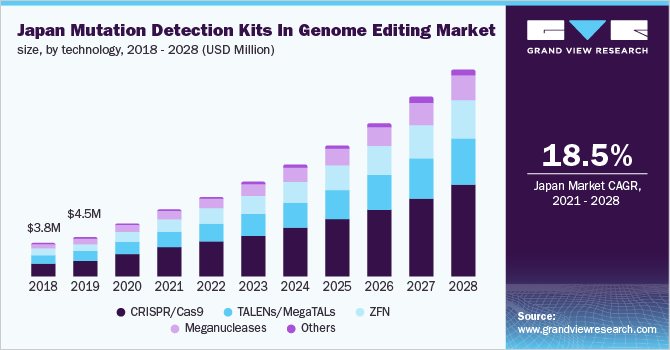
The introduction of several novel methods for mutation detection in DNA is anticipated to boost the number of players using gene manipulation technologies. For instance, in January 2021, a study was published in Nanoscale Journal, which demonstrated the new mutation detection method CRISPR–EXPAR that deploys Exponential Amplification Reaction (EXPAR) induced by CRISPR-Cas9.
CRISPR is a rapidly evolving gene editing methodology and a substantial number of CRISPR-Cas derived reagents facilitate a wide range of applications for gene editing. Given its availability and popularity, CRISPR technology dominates the genome editing space and is expected to improve incrementally in the foreseeable future. Several Cas-type enzymes have been discovered or engineered with different protospacer adjacent motifs.
The ongoing COVID-19 pandemic has created lucrative opportunities for operating players. Molecular biological solutions that comprise gene modification approaches, such as CRISPR-Cas12/13-based DETECTR, SHERLOCK, PAC-MAN & CARVER, ASO, ribozymes, antisense peptide nucleic acids, and RNAi silencing therapies, produced using cutting-edge scientific advancements as compared to conventional diagnostic methods or treatment, is anticipated to be vital in managing COVID-19 outbreaks.
Technology By Application Insights
CRISPR/Cas9 technology dominated the market in 2020 with a share of over 40.0%. The emergence of this technology has revolutionized the field of medical diagnostics and research on genetic testing. An increase in the adoption of gene therapy, coupled with the presence of a large number of therapies in clinical trials, is expected to drive the segment. The continuous development of new tools based on CRISPR technology would supplement the market growth.
For instance, in April 2021, researchers at UC Berkeley, Keck Graduate Institute (KGI), and Vilnius University developed a new handheld device powered with CRISPR technology. The researchers combined CRISPR with graphene electronic transistors in this new device to detect specific gene mutations in a very small timeframe. This device, named CRISPR-Chip, can diagnose genetic diseases in less time and can also be used for the evaluation of the accuracy of genome-editing technologies.
Limitations associated with the CRISPR technique have resulted in increased applications of TALEN technology in some genomic regions that are hard to edit. A study was published in January 2021, which stated that for compact DNA studies, TALEN was found to be a more suitable tool. Such studies are expected to increase the adoption of this technology in research settings in the coming years.
End-use Insights
Academic and government research institutes dominated the market with a revenue share of over 50.0% in 2020 owing to the ongoing clinical trials, a rise in the preference of personalized medicine, and R&D activities in clinical diagnostics. Moreover, the outbreak of COVID-19 has served as a catalyst for market expansion.
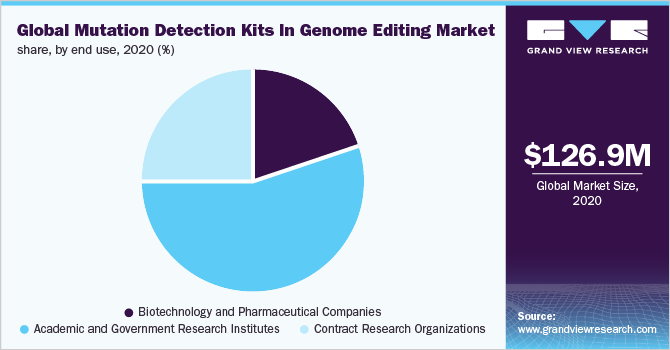
Several research institutes across the globe are actively involved in conducting studies to evaluate the use of various genome editing technologies in mutation detection. For instance, scientists at the Chinese Academy of Science successfully conducted a study in which they performed an experiment to correct disease-causing mutations in cataract mouse models with the use of CRISPR/Cas9 technology.
The increasing involvement of biotechnology and pharmaceutical companies is also anticipated to significantly contribute to market growth. With the increasing demand, several key operating players in the market have started the development and manufacturing of advanced mutation detection kits. For instance, in January 2021, baseclick introduced Click Tech Single Strain Mutation Mapping Kit for Sars-Co-V2.
Regional Insights
North America dominated the market and accounted for a revenue share of over 35.0% in 2020. This growth in the region can be attributed to the presence of a substantial number of market players, high R&D investments, and continuous technological developments by key players.
In addition, the supportive regulatory framework is anticipated to increase the use of mutation detection kits in the region. For instance, in April 2021, Health Canada declared that gene-editing technology used in crops is safe for human consumption and the environment. This is anticipated to increase the adoption of gene-edited crops by Canadian farmers, in turn, increasing research on transgene plants.
Asia Pacific is likely to witness the fastest growth over the forecast period. China was the first country that has successfully transferred genetically modified cells into human cells, to treat lung cancer and boost immunity. Continuous efforts taken by leading players in this market have also boosted the regional market growth.
Key Companies & Market Share Insights
Genome-editing technologies have already accelerated new developments across multiple diverse industries. The advent of CRISPR, which offers ease of use and improved efficacy as a precise genome editing tool, has led to the entry of several CRISPR-based companies.
The number of end-users engaged in genome-editing technologies in their research programs continues to increase. Several end users have overlapping and distinct target indications across various clinical stages. This indicates potential future competition among companies offering various products, including kits and other consumables, to carry out genome editing. Some prominent players in the global mutation detection kits in the genome editing market include:
-
Thermo Fisher Scientific
-
Takara Bio Inc.
-
Integrated DNA Technologies, Inc.
-
Lucigen
-
Promega Corporation
-
GenScript
-
Synthego
-
New England Biolabs
-
Applied Biological Materials, Inc. (abm)
-
Bio-Rad Laboratories
-
AddGene
-
Biovision Inc.
Mutation Detection Kits In Genome Editing Market Report Scope
Report Attribute
Details
Market size value in 2021
USD 158.6 million
Revenue forecast in 2028
USD 455.1 million
Growth rate
CAGR of 17.3% from 2021 to 2028
Base year for estimation
2020
Historical data
2017 - 2019
Forecast period
2021 - 2028
Quantitative units
Revenue in USD thousand/million and CAGR from 2021 to 2028
Report coverage
Revenue forecast, company ranking, competitive landscape, growth factors, and trends
Segments covered
Technology by application, end-use, region
Regional scope
North America; Europe; Asia Pacific; Latin America; Middle East & Africa
Country scope
U.S.; Canada; Germany; U.K.; France; Italy; Spain; Japan; China; India; South Korea; Brazil; Mexico; South Africa; Saudi Arabia
Key companies profiled
Thermo Fisher Scientific; Takara Bio Inc.; Integrated DNA Technologies, Inc.; Lucigen; Promega Corporation; GenScript; Synthego; New England Biolabs; Applied Biological Materials, Inc. (abm); Bio-Rad Laboratories; AddGene; Biovision Inc.
Customization scope
Free report customization (equivalent up to 8 analyst’s working days) with purchase. Addition or alteration to country, regional & segment scope.
Pricing and purchase options
Avail customized purchase options to meet your exact research needs. Explore purchase options
Segments Covered in the ReportThis report forecasts revenue growth at the global, regional, and country levels and provides an analysis of the latest industry trends and opportunities in each of the sub-segments from 2017 to 2028. For the purpose of this report, Grand View Research has segmented the global mutation detection kits in genome editing market report on the basis of technology by application, end use, and region:
-
Technology by Application Outlook (Revenue, USD Thousand, 2017 - 2028)
-
CRISPR/Cas9
-
Genetically Modified Organisms (GMO) Analysis
-
Disease Genotyping
-
Typing of Transgenic Plants
-
Therapy Development
-
Epigenetic Editing
-
-
ZFN
-
Genetically Modified Organisms (GMO) Analysis
-
Disease Genotyping
-
Typing of Transgenic Plants
-
Therapy Development
-
Epigenetic Editing
-
-
TALENs/MegaTALs
-
Genetically Modified Organisms (GMO) Analysis
-
Disease Genotyping
-
Typing Of Transgenic Plants
-
Therapy Development
-
Epigenetic Editing
-
-
Meganucleases
-
Genetically Modified Organisms (GMO) Analysis
-
Disease Genotyping
-
Typing of Transgenic Plants
-
Therapy Development
-
Epigenetic Editing
-
-
Others
-
-
End-use Outlook (Revenue, USD Thousand, 2017 - 2028)
-
Biotechnology and Pharmaceutical Companies
-
Academic and Government Research Institutes
-
Contract Research Organizations
-
-
Regional Outlook (Revenue, USD Thousand, 2017 - 2028)
-
North America
-
U.S.
-
Canada
-
-
Europe
-
Germany
-
U.K.
-
France
-
Spain
-
Italy
-
-
Asia Pacific
-
Japan
-
China
-
India
-
South Korea
-
-
Latin America
-
Brazil
-
Mexico
-
-
Middle East & Africa
-
South Africa
-
Saudi Arabia
-
-
Frequently Asked Questions About This Report
The global mutation detection kits in genome editing market size was estimated at USD 126.9 million in 2020 and is expected to reach USD 158.6 million in 2021.
The global mutation detection kits in genome editing market are expected to grow at a compound annual growth rate of 17.3% from 2021 to 2028 to reach USD 455.1 million by 2028.
Academic & research institutes dominated the market in 2020, owing to ongoing clinical trials, a rise in preference for personalized medicine, and R&D activities in clinical diagnostics. Moreover, the outbreak of COVID-19 has served as a catalyst for mutation detection kits in genome editing market expansion.
Some key players operating in the mutation detection kits in genome editing market include Thermo Fisher Scientific, Takara Bio Inc., Integrated DNA Technologies, Inc., Lucigen, Promega Corporation, GenScript, Synthego, and New England Biolabs.
Key factors that are driving the mutation detection kits in genome editing market growth include technological advancements in gene-editing technologies, increasing demand for synthetic genes and genetically modified organisms, and the growing adoption of personalized medicine.
About the Author(s)
Biotechnology Research Team
Healthcare · BiotechnologyThis report was authored by the biotechnology research team at Grand View Research - comprising two research analysts, one senior research analyst, and one industry expert - with specialized expertise in the biotechnology segment of the healthcare industry. All findings are based on proprietary healthcare databases, executive interviews, and regulatory analysis, subject to internal peer review prior to publication.
Last Updated:
Speak to Analyst -


Customize this report to your needs — add regions, segments, or data points, with 20% free customization.
Or view our licence options:


ISO 9001:2015 & 27001:2022 Certified
We are GDPR and CCPA compliant! Your transaction & personal information is safe and secure. For more details, please read our privacy policy.


