
- Home
- »
- Medical Devices
- »
-
Neonatal Mechanical Ventilators Market Size Report, 2033GVR Report cover
![Neonatal Mechanical Ventilators Market (2026 - 2033)Report]()
Neonatal Mechanical Ventilators Market (2026 - 2033)
Size, Share & Trends Analysis Report By Component (Devices, Consumables & Accessories), By Ventilation Mode (Invasive Ventilation, Non-Invasive Ventilation), By End Use, By Region, And Segment Forecasts
Market Size, 2025
$542.1MMarket Estimate, 2026
$564.3MMarket Forecast, 2033
$923.4MCAGR, 2026–2033
7.3%Neonatal Mechanical Ventilators Market Summary
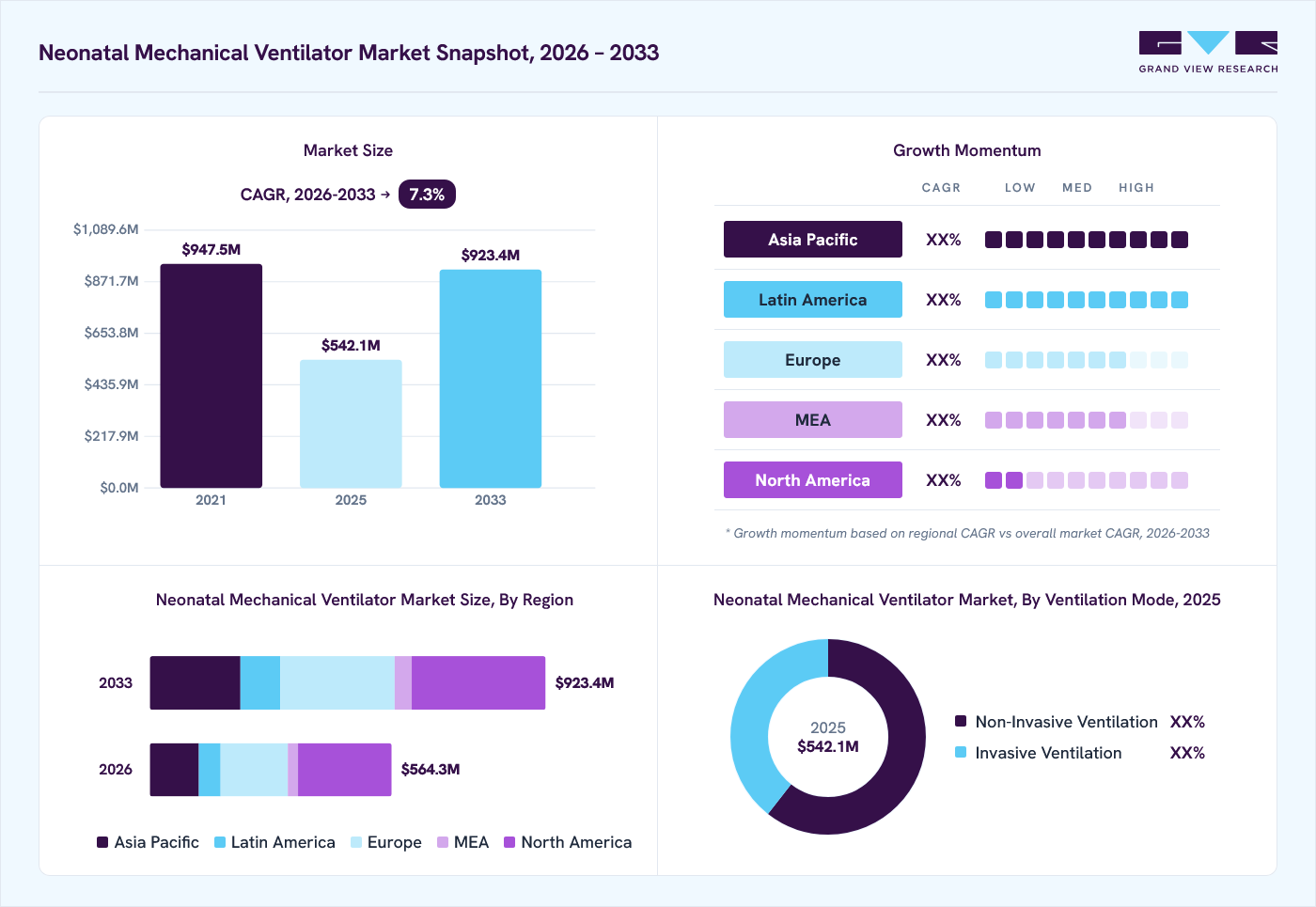
The global neonatal mechanical ventilators market size was valued at USD 542.1 million in 2025 and is projected to grow from USD 564.3 million in 2026 to USD 923.4 million by 2033, at a CAGR of 7.3% from 2026 to 2033. North America dominated the market, accounting for the largest revenue share of 39.5% in 2025. This growth is attributed to the rising prevalence of preterm births and neonatal respiratory distress, the increasing adoption of lung-protective neonatal ventilation, the growing need for neonatal transport and critical-care ventilation, and the expansion of advanced neonatal respiratory support in NICUs.
Key Market Trends & Insights
- By component: Devices held the largest market share of 93.6% in 2025
- By ventilation mode: Non-Invasive ventilation held the largest market share of 60.5% in 2025
- By application: Respiratory distress syndrome held the largest revenue share of 34.7% in 2025
- By end use: Hospitals held the largest revenue share of 66.0% in 2025
Regional Highlights
- Largest regional market: North America (39.5% revenue share, 2025)
- Fastest-growing regional market: Asia Pacific (fastest CAGR, 2026-2033)
- By country: The U.S. led the market in 2025
Market Size & Forecast
- Market Size in 2025: USD 542.1 Million
- Estimated Market Size in 2026: USD 564.3 Million
- Projected Market Size by 2033: USD 923.4 Million
- CAGR (2026-2033): 7.3%

Market Dynamics
The neonatal mechanical ventilators market is driven by the increasing investments in neonatal healthcare infrastructure, rising incidence of preterm births and neonatal respiratory disorders, and increasing adoption of non-invasive respiratory support. Advances in volume-targeted, high-frequency, and non-invasive ventilation, along with increasing use of connected and automated monitoring technologies, are supporting the adoption of advanced neonatal mechanical ventilators.
The rising prevalence of preterm births and neonatal respiratory distress is the significant driver for the market.Preterm birth remains a major source of demand for neonatal respiratory support because immature lungs increase the risk of respiratory complications, particularly among infants born at very early gestational ages. According to the CDC’s National Center for Health Statistics, approximately 3.6 million births were recorded in the U.S. in 2025, while the preterm birth rate is 10.4% in the U.S.
Moreover, respiratory distress is a major complication of prematurity and an important indication for neonatal respiratory support. According to the CDC’s National Center for Health Statistics, respiratory distress of newborn (P22) was the eighth leading cause of infant death in the U.S. in 2024, accounting for 453 deaths and a mortality rate of 12.5 deaths per 100,000 live births. The ongoing burden of neonatal respiratory distress is expected to drive demand for neonatal mechanical ventilators and other respiratory support devices in NICUs.
Neonatal mechanical ventilation requires specialized ventilators, breathing circuits, patient interfaces, humidification systems, monitoring equipment, and other consumables. The need for neonatal-specific equipment and recurring accessories increases the overall cost of establishing and maintaining NICU ventilation capabilities.
Effective neonatal ventilation also requires trained neonatologists, respiratory therapists, nurses, and other specialized staff to operate equipment and manage delicate patients. Limited availability of specialized equipment and trained personnel, particularly in resource-constrained healthcare settings, can restrict the adoption of neonatal mechanical ventilators.
The expansion of volume-targeted and advanced ventilation is a significant opportunity in the neonatal mechanical ventilators market, as there is a need to minimize ventilator-induced lung injury and provide precise, individualized respiratory support to premature infants. These technologies help clinicians maintain targeted tidal volumes despite changes in lung compliance, supporting safer and more controlled ventilation. For instance, in June 2025, Getinge expanded its Servo-c ventilator with a neonatal option designed to support premature infants weighing as little as 500 grams. The expanded system provides personalized respiratory treatment across patient categories and includes invasive leakage compensation, supporting more precise ventilation in fragile neonates.
Market Concentration & Characteristics
The degree of innovation in the neonatal mechanical ventilators market is high, driven by the integration of advanced monitoring, adaptive ventilation, and technologies that enable more personalized respiratory support. Companies are upgrading ventilators to provide clinicians with real-time physiological information and improve the precision of ventilation management. For instance, in July 2026, Nihon Kohden announced three new advanced capabilities for its NKV-550 Series Ventilator System, including non-invasive respiratory muscle pressure (Pmus) monitoring and Adjustable AdaptiveSync. The upgrades enable real-time respiratory-effort monitoring and adaptive, synchronized ventilation for individualized care.
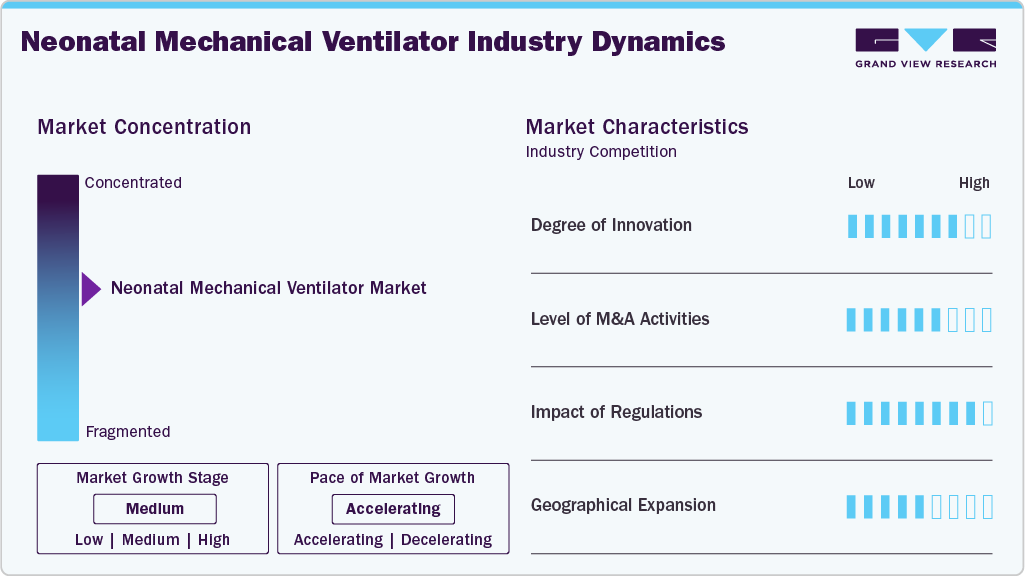
The level of partnerships and collaboration activities in the neonatal mechanical ventilators market is moderate to high, with manufacturers working with healthcare institutions, clinical experts, academic organizations, and training providers to strengthen neonatal-care capabilities. For instance, in July 2026, Getinge supported a Neonatal Critical Care Nursing Training Initiative in India in collaboration with KEDMAN SkillEd India Foundation, Amrita Vishwa Vidyapeetham, Amrita Hospital, and Business Sweden. The program aims to train 1,500 nurses through specialist-led clinical discussions, simulation-based training, and hands-on education, with modules developed by neonatologists at Amrita Hospital.
"We are proud to support this initiative as part of our Corporate Social Responsibility program, which reflects our broader commitment to helping save lives and strengthening healthcare systems. Strengthening neonatal care capabilities is a priority for India, and initiatives like this play a vital role in equipping nurses with the critical skills required to improve newborn survival outcomes."
- Aruna Nayak, Managing Director, Getinge India.
The impact of regulations is significant in the neonatal mechanical ventilators market, as ventilators are life-support medical devices subject to stringent requirements for safety, performance, clinical evaluation, quality systems, and cybersecurity. In the U.S., manufacturers must comply with FDA requirements, including applicable 510(k) premarket review and recognized ventilator safety standards. In Europe, the EU Medical Device Regulation (MDR) requires manufacturers to meet safety and performance requirements before placing medical devices on the market.The regional expansion of the neonatal mechanical ventilators industry is significant, as key players are strengthening their presence in high-potential markets through acquisitions, local distribution networks, regulatory approvals, and expansion of manufacturing capabilities. These strategies enable companies to improve market access and address regional requirements for neonatal respiratory-care products.
Analyst Perspective
The neonatal mechanical ventilators market is driven by the rising burden of preterm births and neonatal respiratory disorders, increasing NICU capacity, and growing demand for advanced respiratory-support technologies. Adoption is shifting toward volume-targeted, high-frequency, non-invasive, and transport ventilation systems that provide more precise and individualized support for vulnerable neonates.
Key players such as Drägerwerk, Getinge, Hamilton Medical, GE HealthCare, Medtronic, Fisher & Paykel Healthcare, Nihon Kohden, Mindray, and Inspiration Healthcare are strengthening their portfolios through advanced ventilation modes, specialized neonatal platforms, product enhancements, and regional expansion. Competition is expected to remain high as established manufacturers leverage broad distribution and clinical expertise, while emerging players compete through specialized neonatal products, innovation, and competitive pricing.
Component Insights
The devices segment dominated the neonatal mechanical ventilators industry, accounting for 93.6% of revenue in 2025, driven by the essential role of ventilators in providing controlled respiratory support to premature and critically ill newborns. Demand is supported by rising NICU admissions, the replacement of aging equipment, and the adoption of advanced systems that offer invasive and non-invasive ventilation, volume-targeted ventilation, and high-frequency ventilation. For instance, in December 2025, Vapotherm and Flight Medical announced a partnership to bring the VentO2ux ventilator to U.S. hospitals, expanding access to advanced mechanical ventilation technology in critical-care settings. This highlights innovation and expansion of mechanical ventilation device portfolios, supporting the broader devices segment.
The consumables & accessories segment is expected to grow at the fastest CAGR during the forecast period from 2026 to 2033. This growth is driven by the recurring need for breathing circuits, masks, tubes, humidification systems, filters, and other components used with neonatal ventilators. Increasing NICU utilization, the need for infection control, and the regular replacement of disposable components are supporting segment growth. The rising adoption of non-invasive ventilation and advanced respiratory support systems is further increasing demand for compatible consumables and accessories.
Ventilation Mode Insights
The non-invasive ventilation segment dominated the neonatal mechanical ventilators market, accounting for the largest revenue share of 60.5% in 2025, driven by increasing use of nCPAP and NIPPV as first-line respiratory support for premature infants. The ability to reduce intubation, airway trauma, and ventilator-associated lung injury supports wider adoption of non-invasive ventilation in NICUs. Growing preference for less invasive respiratory support in infants with respiratory distress and apnea of prematurity is further strengthening demand. Technological improvements in masks, interfaces, synchronization, and pressure control are also supporting segment adoption.
The invasive ventilation segment is expected to grow steadily over the forecast period. This is driven by the need for controlled respiratory support in extremely preterm and critically ill newborns with severe respiratory conditions. The growing adoption of volume-targeted and lung-protective ventilation is driving demand for advanced invasive ventilators that provide precise pressure and tidal-volume control. The increasing use of synchronized and high-frequency ventilation is further expanding the capabilities of invasive neonatal respiratory support. Continued NICU investment and the need to manage complex respiratory cases are expected to support segment growth.
Application Insights
The respiratory distress syndrome (RDS) segment dominated the neonatal mechanical ventilators industry, accounting for the largest revenue share of 34.7% in 2025, driven by the high incidence of RDS among premature and low-birth-weight infants. The need for timely respiratory support, including invasive and non-invasive ventilation, continues to drive the use of neonatal mechanical ventilators in NICUs. RDS is particularly common among preterm infants, with risk increasing substantially as gestational age decreases.
The persistent pulmonary hypertension of the newborn (PPHN) segment is expected to grow at the fastest CGAR of 10.2% over the forecast period from 2026 to 2033. This growth is driven by increasing clinical focus on early diagnosis and advanced respiratory management of affected newborns. The growing adoption of specialized ventilation strategies and improved monitoring technologies is driving demand for advanced neonatal mechanical ventilators for the management of PPHN. According to a 2025 study published in Global Health Research and Policy, PPHN has an estimated incidence of 1.8 cases per 1,000 live births, increasing to 5.4 cases per 1,000 among late-preterm infants.
End Use Insights
The hospitals segment accounted for the largest revenue share of 66.0% in 2025. This dominance is driven by the high concentration of NICUs and the availability of specialized neonatal care teams and respiratory support infrastructure. Hospitals manage a large proportion of premature and critically ill newborns, driving demand for advanced neonatal ventilators. The increasing use of advanced ventilation strategies and continued investment in NICU infrastructure are further supporting ventilator adoption in hospital settings.
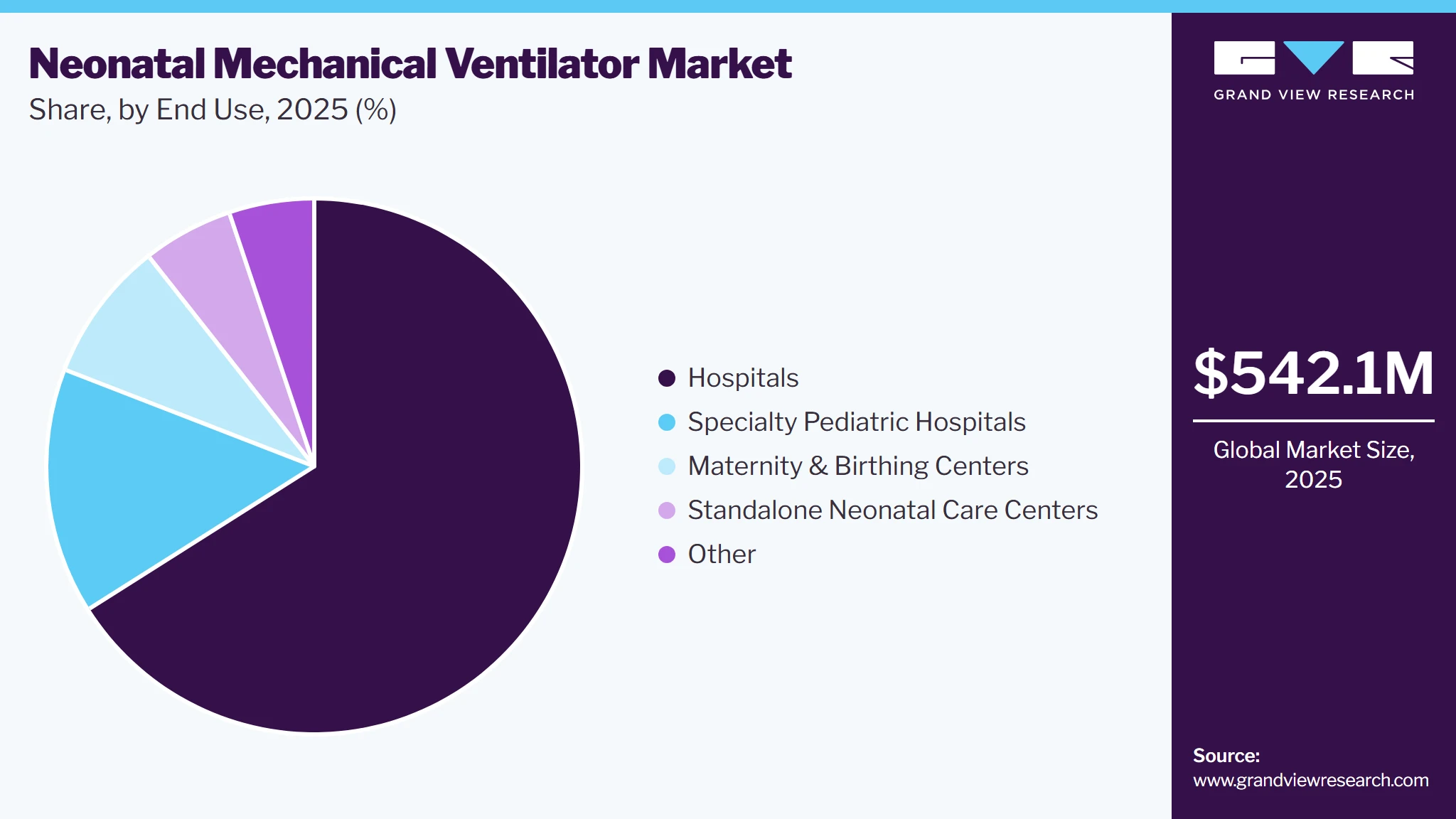
The specialty pediatric hospitals segment is expected to grow at the fastest CAGR during the forecast period, driven by rising demand for specialized neonatal and pediatric critical care services. These facilities are increasingly investing in advanced ventilators with non-invasive, volume-targeted, and high-frequency ventilation capabilities to provide individualized respiratory support for high-risk newborns. For instance, in December 2025, St. Charles Health System became the first NICU in Oregon to use neurally adjusted ventilatory assist (NAVA), supporting more responsive ventilation for newborns requiring respiratory support. This reflects the growing adoption of advanced ventilation technologies in specialized neonatal care settings.
Regional Insights
North America dominated the neonatal mechanical ventilators market in 2025 with the largest revenue share of 39.5%. This dominance of North America is driven by advanced NICU infrastructure, established neonatal care systems, and strong adoption of specialized respiratory support technologies. The region has a high demand for invasive and non-invasive ventilation, volume-targeted ventilation, and high-frequency ventilation for premature and critically ill newborns.

The presence of leading manufacturers such as Dräger, Getinge, GE HealthCare, Medtronic, Hamilton Medical, and Nihon Kohden strengthens product availability and technological adoption. Increasing focus on lung-protective and individualized ventilation is encouraging the adoption of advanced neonatal ventilators. Continued investment in NICU modernization and replacement of aging equipment is expected to further support market growth.
U.S. Neonatal Mechanical Ventilators Market Trends
The U.S. neonatal mechanical ventilators industry dominated North America in 2025, supported by advanced NICU infrastructure, high demand for specialized respiratory care, and strong adoption of technologically advanced ventilators. The presence of major manufacturers and established hospital networks further supports market growth. For instance, in October 2024, Nihon Kohden America announced the availability of the NKV-440 Ventilator System in the U.S. The system combines invasive ventilation, non-invasive ventilation, and high-flow oxygen therapy in a single compact device, providing flexible respiratory support while reducing equipment and training requirements.
Europe Neonatal Mechanical Ventilators Market Trends
Europe held a significant share of the global neonatal mechanical ventilators industry in 2025, driven by well-developed neonatal intensive care infrastructure, established respiratory care practices, and strong adoption of advanced ventilation technologies. The clinical focus on lung-protective respiratory support is encouraging the use of volume-targeted, synchronized, non-invasive, and high-frequency ventilation. European clinical guidance recommends lung-protective ventilation approaches for preterm infants, supporting demand for advanced neonatal mechanical ventilators.
The UK neonatal mechanical ventilators market is supported by well-established neonatal critical-care infrastructure and high demand for specialized respiratory support. According to NHS England 2024, around 60,000-70,000 babies are admitted to neonatal units annually in England, creating a substantial need for neonatal respiratory-care equipment. The adoption of advanced ventilation is further supported by NHS guidance recommending volume-targeted ventilation with synchronized ventilation for preterm babies requiring invasive ventilation, strengthening demand for advanced neonatal ventilators.
The neonatal mechanical ventilators market in Germany is driven by strong hospital and neonatal intensive care infrastructure and established medical device manufacturing capabilities. The country is also home to major respiratory-care manufacturers, including Dräger, supporting access to advanced neonatal ventilation technologies. The availability of specialized perinatal centers and well-established neonatal care pathways supports the adoption of advanced ventilation systems for premature and critically ill newborns. Continued investment in modern NICU equipment is expected to sustain demand for neonatal mechanical ventilators.
Asia Pacific Neonatal Mechanical Ventilators Market Trends
The Asia Pacific neonatal mechanical ventilators industry is expected to grow at the fastest CAGR of 9.2% from 2026 to 2033. Market growth is driven by high demand for neonatal care, expanding NICU capacity, and increasing healthcare investment. In 2024, China recorded 9.54 million births, according to the National Bureau of Statistics of China, while India accounted for a large share of births in the region. The expansion of specialized neonatal care infrastructure and the increasing adoption of advanced respiratory support technologies are expected to support demand for neonatal mechanical ventilators through 2033.
The neonatal mechanical ventilators market in Japan is driven by the advanced NICU infrastructure, established perinatal care networks, and high adoption of specialized neonatal technologies. According to Japan’s Ministry of Health, Labour and Welfare (MHLW), the country had 46.2 NICU beds per 10,000 births in FY2023, exceeding the national target of 25-30 beds per 10,000 births. This well-established neonatal care infrastructure and continued investment in advanced respiratory support technologies are expected to sustain demand for neonatal mechanical ventilators.
The China neonatal mechanical ventilators market is expected to grow significantly due to its large population, substantial neonatal care needs, and continued expansion of healthcare infrastructure. Government investment in improving maternal and child healthcare and strengthening neonatal intensive care capacity is driving demand for advanced neonatal respiratory equipment.
The presence of domestic manufacturers such as Mindray, together with international companies, is also strengthening local availability of neonatal-capable ventilation systems. The increasing adoption of advanced NICU equipment and the development of domestic medical-device capabilities are expected to support market expansion.
Latin America Neonatal Mechanical Ventilators Market Trends
The neonatal mechanical ventilators industry in Latin America is supported by increasing investments in NICU infrastructure, rising preterm births, and growing demand for specialized neonatal respiratory care. Brazil and Argentina are key markets as healthcare systems expand neonatal intensive care services and access to respiratory support equipment. This creates opportunities for manufacturers to expand through cost-effective products, local distribution partnerships, and technical-support networks.
Middle East & Africa Neonatal Mechanical Ventilators Market Trends
The neonatal mechanical ventilators industry in Middle East & Africa is driven by increasing investments in NICU infrastructure, rising preterm births, and growing demand for specialized neonatal respiratory care. For instance, Saudi Arabia is expanding neonatal intensive care capacity, thereby increasing demand for advanced neonatal ventilators. This creates opportunities for manufacturers to expand through hospital partnerships, distributors, and localized support.
Key Neonatal Mechanical Ventilators Company Insights
Key players in the neonatal mechanical ventilators market are strengthening their positions through advanced ventilation technologies, product launches, portfolio expansion, and geographic expansion. Established companies such as Dräger, Getinge, Hamilton Medical, GE HealthCare, and Medtronic leverage strong product portfolios and global distribution networks, while emerging players focus on specialized neonatal and transport ventilation solutions.
Key Neonatal Mechanical Ventilators Companies
The following key companies have been profiled for this study of the neonatal mechanical ventilators market.
-
Drägerwerk AG & Co. KGaA
-
Getinge AB
-
Hamilton Medical AG
-
GE HealthCare Technologies Inc.
-
ICU Medical, Inc.
-
Fisher & Paykel Healthcare Limited
-
Shenzhen Mindray Bio-Medical Electronics Co., Ltd.
-
Koninklijke Philips N.V.
-
Nihon Kohden Corporation
-
Inspiration Healthcare Group plc
-
Air Liquide Medical Systems
-
Atom Medical Corporation
-
Fritz Stephan GmbH
Exit Strategies of Key Market Player
Medtronic
-
In October 2022, Medtronic announced plans to separate its Patient Monitoring and Respiratory Interventions (PMRI) businesses into a new independent company. The planned separation included the ventilator business as part of PMRI.
-
Later, in February 2024, Medtronic announced its decision to exit the ventilator product line and retain the remaining Patient Monitoring and Respiratory Interventions (PMRI) businesses within a new Acute Care and Monitoring (ACM) operating unit. Medtronic cited the ventilator business becoming increasingly unprofitable and a shift in market preference toward lower-acuity ventilators as key factors behind the decision.
-
Medtronic Strategy
-
Phased exit: Stopped accepting new ventilator orders while continuing existing contracts and customer support.
- Resource reallocation: Shifted financial and operational resources toward higher-growth opportunities within its Acute Care and Monitoring (ACM) business.
-
Koninklijke Philips N.V.
-
In January 2024, Philips Respironics announced the discontinuation of sales of 19 sleep and respiratory products in the U.S., including several ventilators such as the Trilogy EVO and EV300, as well as EverFlo, SimplyGo, and SimplyGo Mini oxygen products. Philips stated that the portfolio changes were intended to streamline its offerings in response to changing market dynamics. According to a survey poll conducted by HME News in February 2024, approximately 70% of respondents expected Philips' withdrawal from a significant portion of the U.S. respiratory market to have a substantial impact on the industry.
-
While the discontinuation of respiratory products by Philips Respironics signifies significant development in the oxygen concentrator market, it also presents opportunities for other market players to innovate and expand their presence.
Competitive Benchmarking
Category
Operating Strategies
Competitive Edge
Weakness
Established Players (Drägerwerk AG & Co. KGaA; Getinge AB; Hamilton Medical AG; GE HealthCare Technologies Inc.)
- Expand advanced neonatal ventilation portfolios, integrate volume-targeted, synchronized, and high-frequency ventilation, strengthen NICU partnerships, and expand global distribution.
- Strong clinical reputation, broad respiratory-care portfolios, advanced ventilation technologies, established hospital relationships, global distribution, and strong R&D capabilities.
- High product and maintenance costs, complex regulatory requirements, dependence on specialized clinical expertise, and competition from lower-cost manufacturers.
Emerging Players (Inspiration Healthcare Group plc; Fritz Stephan GmbH; Atom Medical Corporation; Nihon Kohden Corporation)
- Develop specialized neonatal and transport ventilators, strengthen regional distribution, expand into emerging markets, and introduce advanced monitoring, synchronization, and lung-protective ventilation capabilities.
- Strong neonatal specialization, focused product portfolios, flexible innovation, established expertise in selected regional markets, and competitive solutions.
- Smaller global distribution networks, lower brand recognition compared with multinational players, limited R&D resources, and dependence on regulatory approvals for international expansion.
Recent Developments
-
In December 2025, Vapotherm and Flight Medical announced a strategic partnership to bring the newly cleared VentO2ux ventilator to U.S. hospitals. The compact system combines advanced ventilation and monitoring capabilities with portability, expanding access to mechanical ventilation in high-acuity hospital settings.
-
In June 2025, Getinge announced the expansion of its Servo-c ventilator platform with a dedicated neonatal ventilation option, enabling support for premature and newborn patients. The enhancement extends the ventilator’s usability to a broader patient population, providing advanced respiratory support across neonatal to adult care settings.
“Hospitals are under increasing pressure to deliver high-quality care for diverse patient needs while managing costs. Servo-c now supports this by enabling personalized respiratory treatment across all patient categories from premature newborns to full grown adults with full flexibility in targeted markets. This is part of our commitment to make life-saving technology accessible for more people,”
- Cecilia Sjöstedt, Vice President Critical Care at Getinge.
Neonatal Mechanical Ventilators Market Report Scope
Report Attribute
Details
Market size in 2025
USD 542.1 million
Estimated market size in 2026
USD 564.3 million
Projected market size by 2033
USD 923.4 million
Growth rate
CAGR of 7.3% from 2026 to 2033
Actual data
2021 - 2025
Forecast period
2026 - 2033
Quantitative units
Market value in USD million and CAGR from 2026 to 2033
Report coverage
Revenue forecast, company ranking, competitive landscape, growth factors, and trends
Segments covered
Component, ventilation mode, application, end use, and region
Regional scope
North America, Europe, Asia Pacific, Latin America, MEA
Country scope
U.S.; Canada; Mexico; Germany; UK; France; Italy; Spain; Norway; Denmark; Sweden; China; Japan; India; South Korea; Australia; Thailand; Brazil; Argentina; Saudi Arabia; South Africa; UAE; Kuwait
Key companies profiled
Drägerwerk AG & Co. KGaA; Getinge AB; Hamilton Medical AG; GE HealthCare Technologies Inc.; Medtronic plc; ICU Medical, Inc.; Vyaire Medical, Inc.; Fisher & Paykel Healthcare Limited; Shenzhen Mindray Bio-Medical Electronics Co., Ltd.; Koninklijke Philips N.V.; Nihon Kohden Corporation; Inspiration Healthcare Group plc; Air Liquide Medical Systems; Atom Medical Corporation; Fritz Stephan GmbH
Customization scope
Free report customization (equivalent up to 8 analysts working days) with purchase. Addition or alteration to country, regional & segment scope.
Pricing and purchase options
Avail customized purchase options to meet your exact research needs. Explore purchase options
Global Neonatal Mechanical Ventilators Market Report Segmentation
This report forecasts revenue growth at the global, regional, and country levels and provides an analysis of the latest industry trends in each of the sub-segments from 2021 to 2033. For this study, Grand View Research has segmented the global neonatal mechanical ventilatorsmarket report based on component, ventilation mode, application, end use, and region:
-
Component Outlook (Revenue, USD Million, 2021 - 2033)
-
Devices
-
Conventional Neonatal Ventilators
-
High-Frequency Ventilators
-
Transport Neonatal Ventilators
-
-
Consumables & Accessories
-
-
Ventilation Mode Outlook (Revenue, USD Million, 2021 - 2033)
-
Invasive Ventilation
-
Pressure-Controlled Ventilation
-
Volume-Controlled / Volume-Targeted Ventilation
-
Pressure-Regulated Volume Control (PRVC)
-
Other
-
-
Non-Invasive Ventilation
-
Nasal Continuous Positive Airway Pressure (nCPAP)
-
Nasal Intermittent Positive Pressure Ventilation (NIPPV)
-
Non-Invasive Bi-Level Positive Airway Pressure
-
-
-
Application Outlook (Revenue, USD Million, 2021 - 2033)
-
Respiratory Distress Syndrome
-
Apnea of Prematurity
-
Meconium Aspiration Syndrome
-
Persistent Pulmonary Hypertension of the Newborn
-
Neonatal Pneumonia
-
Bronchopulmonary Dysplasia
-
Other Applications
-
-
End Use Outlook (Revenue, USD Million, 2021 - 2033)
-
Hospitals
-
Specialty Pediatric Hospitals
-
Maternity & Birthing Centers
-
Standalone Neonatal Care Centers
-
Other
-
-
Regional Outlook (Revenue, USD Million, 2021 - 2033)
-
North America
-
U.S.
-
Canada
-
Mexico
-
-
Europe
-
UK
-
Germany
-
France
-
Italy
-
Spain
-
Denmark
-
Sweden
-
Norway
-
-
Asia Pacific
-
China
-
Japan
-
India
-
South Korea
-
Australia
-
Thailand
-
-
Latin America
-
Brazil
-
Argentina
-
-
Middle East and Africa (MEA)
-
South Africa
-
Saudi Arabia
-
UAE
-
Kuwait
-
-
Research Methodology
The neonatal mechanical ventilators market figures in this report are based on a proven research process that combines executive interviews with secondary research from proprietary databases, company filings, and recognized regulatory and institutional sources. Market size is built through value-chain sizing-reconciling supply-side and demand-side estimates-and triangulated with bottom-up and top-down approaches. Every estimate passes multiple levels of expert validation before publication, with each neonatal mechanical ventilators segment quantified using the revenue-capture definitions in the table below.
Segment Definition
Segment - Component
Revenue Capture Definition
Devices
Revenue generated from the sale of neonatal mechanical ventilators used to provide invasive or non-invasive respiratory support to newborns, including conventional, high-frequency, and transport neonatal ventilators.
Consumables & Accessories
Revenue generated from the sale of consumable and replaceable accessories used with neonatal mechanical ventilators, including breathing circuits, nasal prongs and masks, endotracheal tubes, filters, humidification chambers, tubing, and flow and pressure sensors.
Segment - Ventilation Mode
Revenue Capture Definition
Invasive Ventilation
Revenue generated from neonatal mechanical ventilators that deliver respiratory support through an invasive airway, such as an endotracheal tube, using pressure-controlled, volume-targeted, synchronized, and other invasive ventilation modes.
Non-Invasive Ventilation
Revenue generated from neonatal respiratory-support systems that deliver ventilation without an endotracheal tube, including nCPAP, NIPPV, and non-invasive bi-level positive airway pressure.
Segment - Application
Revenue Capture Definition
Respiratory Distress Syndrome
Revenue generated from neonatal mechanical ventilation products used to provide respiratory support to newborns diagnosed with respiratory distress syndrome, particularly premature infants with immature lungs.
Apnea of Prematurity
Revenue generated from neonatal mechanical ventilation products used to provide respiratory support to premature infants experiencing recurrent pauses in breathing associated with immature respiratory control.
Meconium Aspiration Syndrome
Revenue generated from neonatal mechanical ventilation products used to provide respiratory support to newborns with respiratory compromise caused by aspiration of meconium into the lungs.
Persistent Pulmonary Hypertension of the Newborn
Revenue generated from neonatal mechanical ventilation products used to support newborns with persistent pulmonary hypertension and associated respiratory failure or impaired oxygenation.
Neonatal Pneumonia
Revenue generated from neonatal mechanical ventilation products used to provide respiratory support to newborns with pneumonia-related respiratory distress or respiratory failure.
Bronchopulmonary Dysplasia
Revenue generated from neonatal mechanical ventilation products used to provide respiratory support to premature infants with chronic lung disease or bronchopulmonary dysplasia.
Other Applications
Revenue generated from neonatal mechanical ventilation products used for other respiratory conditions requiring ventilatory support, including congenital respiratory disorders and other neonatal respiratory complications not classified above.
Segment - End Use
Revenue Capture Definition
Hospitals
Revenue generated from neonatal mechanical ventilator sales to general hospitals providing inpatient neonatal and intensive care services.
Specialty Pediatric Hospitals
Revenue generated from neonatal mechanical ventilator sales to specialized hospitals focused on pediatric and neonatal medical and surgical care.
Maternity & Birthing Centers
Revenue generated from neonatal mechanical ventilator sales to maternity hospitals and birthing centers providing immediate respiratory support to newborns following delivery.
Standalone Neonatal Care Centers
Revenue generated from neonatal mechanical ventilator sales to dedicated neonatal care facilities specializing in intensive and specialized care for newborns.
Other
Revenue generated from neonatal mechanical ventilator sales to other healthcare facilities, including specialty clinics, academic medical centers, research institutions, and other facilities providing neonatal respiratory care.
Delivered Customizations
This report has been delivered with the following In-depth customizations
Client Request
Customization Delivered
Value Adds
Pricing Benchmarks and ASP Analysis
Analysis of average selling prices (ASP), pricing benchmarks, and pricing variations for neonatal mechanical ventilators across devices and ventilation modes
Supports competitor price benchmarking, product positioning, pricing strategy development, and identification of revenue opportunities across customer segments.
Competitive Positioning & Market Share Analysis
Company Market share analysis product portfolio benchmarking, ventilation technology comparison, recent product developments, strategic initiatives, partnerships, and mergers & acquisitions.
Enables benchmarking of established and emerging players, identification of competitive gaps, and development of market expansion and partnership strategies.
Regional Opportunity Analysis
Assessment of regional opportunities based on preterm birth rates, neonatal respiratory disease burden, NICU infrastructure, healthcare expenditure, medical-device adoption, reimbursement environment, and investment trends across key countries and regions.
Helps identify high-growth markets, prioritize geographic expansion, optimize resource allocation, and identify opportunities in emerging neonatal healthcare markets.
Frequently Asked Questions About This Report
The global neonatal mechanical ventilators market size was estimated at USD 542.1 million in 2025 and is expected to reach USD 564.3 million in 2026
The global neonatal mechanical ventilators market is expected to grow at a compound annual growth rate of 7.3% from 2026 to 2033 to reach USD 923.4 million by 2033.
The non-Invasive ventilation segment held the largest market share of 60.5% in 2025.
North America dominated the market and accounted for a 39.5% share in 2025.
Key factors that are driving the market growth include the rising prevalence of preterm births and neonatal respiratory distress, increasing adoption of lung-protective neonatal ventilation, growing need for neonatal transport and critical-care ventilation, and expansion of advanced neonatal respiratory support in NICUs.
Some key players operating in the neonatal mechanical ventilators market include Drägerwerk AG & Co. KGaA, Getinge AB, Hamilton Medical AG, GE HealthCare Technologies Inc.,Medtronic plc, ICU Medical, Inc., Vyaire Medical, Inc., Fisher & Paykel Healthcare Limited, Shenzhen Mindray Bio-Medical Electronics Co., Ltd., Koninklijke Philips N.V., Nihon Kohden Corporation, Inspiration Healthcare Group plc, Air Liquide Medical Systems, Atom Medical Corporation, Fritz Stephan GmbH.
Asia Pacific is anticipated to register the fastest growth rate of 9.2%.
The respiratory distress syndrome segment dominated the market with a revenue share of 34.7% in 2025.
The devices segment held the largest market share of 93.6% in 2025.
About the Author(s)
Medical Devices Research Team
Healthcare · Medical DevicesThis report was authored by the medical devices research team at Grand View Research - comprising two research analysts, one senior research analyst, and one industry expert - with specialized expertise in the medical devices segment of the healthcare industry. All findings are based on proprietary healthcare databases, executive interviews, and regulatory analysis, subject to internal peer review prior to publication.
Last Updated:
Speak to Analyst


Customize this report to your needs — add regions, segments, or data points, with 20% free customization.
Or view our licence options:


ISO 9001:2015 & 27001:2022 Certified
We are GDPR and CCPA compliant! Your transaction & personal information is safe and secure. For more details, please read our privacy policy.


