
- Home
- »
- Medical Devices
- »
-
Neonatal Ventilators Market Size & Share Report, 2026-2035GVR Report cover
![Neonatal Ventilators Market (2026 - 2035)Report]()
Neonatal Ventilators Market (2026 - 2035)
Size, Share & Trends Analysis Report By Product (Invasive Ventilation, Non-Invasive Ventilation), By Mobility (Intensive-Care Ventilators, Portable/Transport Ventilators), By End Use, By Region, And Segment Forecasts
Market Size, 2025
$511.0MMarket Estimate, 2026
$544.2MMarket Forecast, 2035
$959.2MCAGR, 2026–2035
6.5%Neonatal Ventilators Market Summary
The global neonatal ventilators market size was valued at USD 511.0 million in 2025 and is projected to grow from USD 544.2 million in 2026 to USD 959.2 million by 2035, at a CAGR of 6.5% from 2026 to 2035. North America dominated the market, accounting for a revenue share of 43.0% in 2025. The market is driven by the increasing incidence of premature births, rising neonatal intensive care unit (NICU) admissions, and ongoing advancements in neonatal respiratory care.
Key Market Trends & Insights
- By product: The invasive ventilation segment held the largest market share of approximately 60.0% in 2025.
- By mobility: The intensive-care ventilators segment held the largest market share of approximately 61.0% in 2025.
- By end use: The hospitals segment held the largest market share of approximately 73.0% in 2025.
Regional Highlights
- Largest regional market: North America (43.0% revenue share, 2025)
- Fastest-growing regional market: Asia Pacific (highest CAGR, 2026-2035)
Market Size & Forecast
- Market size in 2025: USD 511.0 Million
- Estimated market size in 2026: USD 544.2 Million
- Projected market size by 2035: USD 959.2 Million
- CAGR (2026-2035): 6.5%
Neonatal ventilators are specialized respiratory support systems designed to assist premature and critically ill newborns experiencing respiratory distress syndrome (RDS), apnea, congenital pulmonary disorders, and other serious breathing complications. These systems provide precise respiratory support through invasive and non-invasive ventilation techniques while incorporating features designed to minimize the risk of ventilator-induced lung injury in infants with underdeveloped lungs. Healthcare providers are increasingly adopting ventilators equipped with synchronized ventilation, volume-targeted modes, high-frequency ventilation, and integrated patient-monitoring capabilities to improve clinical outcomes and support lung-protective ventilation.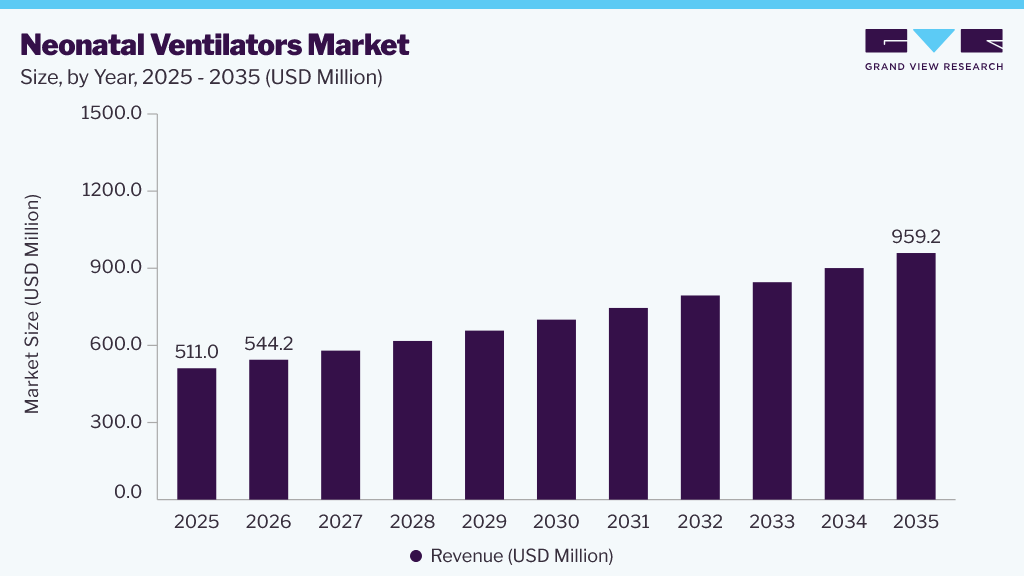
Demand for neonatal ventilators is increasing as hospitals and healthcare systems are investing in modern NICUs and strengthening maternal and child healthcare infrastructure. Rising healthcare expenditure, improved access to specialized neonatal care, and government initiatives aimed at reducing neonatal mortality are supporting equipment procurement across developed and emerging economies. Manufacturers are investing in developing compact and transportable ventilators with advanced monitoring capabilities to support safe respiratory care during intra- and inter-hospital transfers. The integration of advanced ventilation algorithms, touchscreen interfaces, and connectivity features is further improving workflow efficiency and enabling clinicians to provide more individualized respiratory support.
The market outlook remains positive, supported by technological innovation and the increasing emphasis on evidence-based neonatal care. Growing adoption of non-invasive ventilation strategies, expansion of neonatal care services in emerging markets, and rising investment in pediatric healthcare infrastructure are expected to support market growth. Continued product development focused on lung-protective ventilation, automated respiratory monitoring, and improved portability is expected to strengthen product adoption. As healthcare providers increasingly prioritize early intervention, patient safety, and improved outcomes for premature infants, demand for advanced neonatal ventilators is expected to remain strong throughout the forecast period.
Analyst Perspective
The neonatal ventilators market is expected to experience continued growth, supported by advancements in neonatal respiratory care, increasing investments in NICU infrastructure, and the growing emphasis on lung-protective and personalized ventilation strategies. Healthcare providers are increasingly upgrading their respiratory support systems to improve monitoring, ventilation precision, and patient safety, particularly in the care of premature and critically ill newborns. Manufacturers are differentiating their products through advanced ventilation modes, integrated patient monitoring, automated ventilation controls, connectivity, and compact, portable designs. The growing adoption of non-invasive ventilation and technologies that enable precise control of respiratory support is also creating opportunities for product innovation.
Product Insights
The invasive ventilation segment accounted for the largest market share, at approximately 60.0% in 2025, owing to its critical role in treating premature and critically ill infants experiencing respiratory distress syndrome (RDS), pulmonary hypertension, meconium aspiration syndrome, and congenital respiratory disorders. Invasive ventilators are widely used in NICUs to provide controlled oxygenation, airway pressure management, and advanced mechanical ventilation for infants with severe respiratory compromise. Continuous advancements in synchronized, volume-targeted, and lung-protective ventilation strategies are helping clinicians optimize respiratory support and reduce the risk of ventilator-induced lung injury.
The non-invasive ventilation (NIV) segment is expected to register the fastest growth during the forecast period, driven by the increasing preference for respiratory support approaches that can reduce airway trauma and minimize complications associated with endotracheal intubation. Non-invasive methods such as nasal continuous positive airway pressure (nCPAP) and non-invasive positive pressure ventilation (NIPPV) are increasingly used as primary or early respiratory support for premature infants with mild to moderate respiratory distress. Growing clinical evidence supporting the use of non-invasive respiratory support, including its potential to reduce the need for invasive mechanical ventilation and improve respiratory outcomes in appropriate patient populations, is contributing to the adoption of NIV in NICUs. For instance, in January 2024, Getinge introduced Servo-air Lite, a ventilator designed to provide non-invasive respiratory support and high-flow therapy, expanding its offering for neonatal and other patient populations requiring non-invasive ventilation.
Mobility Insights
The intensive-care ventilators segment accounted for the largest market share, at approximately 61.0% in 2025, driven by their widespread use in NICUs for continuous respiratory support of critically ill newborns. These systems offer multiple ventilation modes, advanced patient-monitoring capabilities, high-frequency ventilation options, and precise control of tidal volume and airway pressure. Hospitals continue to invest in technologically advanced intensive-care ventilators to improve the management of complex respiratory conditions and support better outcomes among extremely premature infants. Rising healthcare expenditure, expansion of NICU infrastructure, and the replacement of aging equipment are further supporting demand for intensive-care neonatal ventilators across developed and emerging healthcare markets.
The portable/transport ventilators segment is projected to register the fastest growth during the forecast period, driven by the increasing need for continuous respiratory support during the transportation of neonates from delivery rooms to ambulances and specialized NICUs. Modern transport ventilators are designed with compact form factors, battery-powered operation, portability, and advanced monitoring capabilities to maintain stable respiratory support during patient transfers. The regionalization of neonatal care and expansion of specialized neonatal transport systems is further increasing the need for portable and transport ventilators.
End Use Insights
The hospitals segment accounted for the largest market share, at approximately 73.0% in 2025, driven by the concentration of neonatal intensive care units (NICUs), specialized respiratory care professionals, and advanced neonatal care facilities. Most premature and critically ill infants requiring invasive or non-invasive ventilation are treated in tertiary and specialized hospitals equipped with advanced respiratory support and patient-monitoring systems. Government spending on maternal and neonatal healthcare, expansion of NICU capacity, and rising rates of preterm births is supporting the procurement of neonatal ventilators. Hospitals also represent the primary setting for the adoption of advanced ventilation technologies, as healthcare providers continue to invest in systems that improve respiratory monitoring, ventilation management, and patient outcomes. Manufacturers are also collaborating with healthcare technology companies to develop advanced solutions for neonatal and acute care. For instance, in 2026, NXP and GE HealthCare collaborated on edge AI solutions for acute care, including concepts related to anesthesiology and neonatal care showcased at CES 2026.
The ambulatory surgical centers segment is anticipated to register the fastest growth during the forecast period, primarily driven by the increasing availability of specialized pediatric procedures requiring short-term respiratory support and postoperative monitoring. However, neonatal critical care remains predominantly hospital-based, particularly for premature and critically ill infants requiring intensive respiratory support. Some selected ASCs may adopt advanced anesthesia systems, patient-monitoring technologies, and compact respiratory support equipment to support pediatric procedures. Rising demand for minimally invasive pediatric procedures, improvements in healthcare accessibility, and advancements in portable respiratory support technologies may contribute to the adoption of such equipment in outpatient settings. Continued investment in specialized outpatient surgical infrastructure is expected to create additional opportunities for respiratory equipment manufacturers during the forecast period.
Regional Insights
The North America neonatal ventilators market accounted for the largest market share of approximately 43.0% in 2025. The growth is supported by well-developed healthcare infrastructure, a high concentration of neonatal intensive care units (NICUs), substantial healthcare expenditure, and widespread adoption of advanced respiratory care equipment. The U.S. and Canada have infrastructure for several Level III and Level IV NICUs equipped with advanced invasive and non-invasive neonatal ventilators and patient-monitoring systems. Favorable reimbursement policies, continued investment in neonatal healthcare services, and the presence of leading medical device manufacturers are among the key factors supporting regional market growth. In addition, high survival rates among preterm infants and ongoing technological advancements in neonatal ventilation equipment are contributing to demand for advanced respiratory support systems.

Asia Pacific Neonatal Ventilators Market Trends
The neonatal ventilators market in the Asia Pacific is projected to register the fastest growth during the forecast period, driven by the high incidence of preterm births, increasing investment in NICU infrastructure, and government initiatives supporting maternal and child healthcare. Countries including China, India, Japan, South Korea, and Australia are investing in the expansion and modernization of neonatal care facilities. The development of healthcare infrastructure, rising healthcare expenditure, increasing access to specialized neonatal care, and growing awareness of the importance of early intervention for neonatal respiratory conditions are expected to support the adoption of neonatal ventilators across the region. In addition, improvements in healthcare accessibility and the expansion of specialized neonatal services are expected to create further growth opportunities for market participants.
Key Neonatal Ventilators Company Insights
The global neonatal ventilators market is characterized by the presence of established medical device manufacturers focused on technological innovation, neonatal-specific ventilation modes, and integrated patient monitoring. Leading companies are investing in advanced lung-protective ventilation technologies, portable respiratory support systems, and digital connectivity while expanding strategic collaborations and regulatory approvals to strengthen their presence across neonatal intensive care units (NICUs) and pediatric healthcare facilities worldwide.
Key Neonatal Ventilators Companies
The following key companies have been profiled for this study on the neonatal ventilators market:
-
Drägerwerk AG & Co. KGaA
-
GE HealthCare
-
Getinge AB
-
Medtronic plc
-
Hamilton Medical AG
-
Vyaire Medical, Inc.
-
Fisher & Paykel Healthcare Corporation Limited
-
Nihon Kohden Corporation
-
Air Liquide Medical Systems
-
Phoenix Medical Systems Pvt. Ltd.
Recent Developments
-
In November 2025, Fisher & Paykel Healthcare launched Nova Nasal Mask in the U.S. F&P Nova Nasal’s SwingFitTM headgear allows users to simply anchor the cushion on the nose, swing the headgear around their head, and secure with one click
-
In February 2024, Drägerwerk AG & Co. KGaA launched Babyroo TN300, an advanced neonatal open care warmer integrating thermal regulation and respiratory support workflows for delivery rooms and NICUs.
Neonatal Ventilators Market Report Scope
Report Attribute
Details
Market size in 2025
USD 511.0 million
Estimated market size in 2026
USD 544.2 million
Projected market size by 2035
USD 959.2 million
Growth rate
CAGR of 6.5% from 2026 to 2035
Base year for estimation
2025
Historical data
2021 – 2024
Forecast period
2026 – 2035
Quantitative units
Revenue in USD million and CAGR from 2026 to 2035
Report coverage
Revenue forecast, company ranking, competitive landscape, growth factors, and trends
Segments covered
Product, mobility, end use, region
Regional Scope
North America; Europe; Asia Pacific; Latin America; Middle East & Africa
Country Scope
U.S.; Canada; Mexico; UK; Germany; France; Italy; Spain; China; Japan; India; Australia; South Korea; Brazil; Argentina; South Africa; Saudi Arabia; UAE.
Key companies profiled
Drägerwerk AG & Co. KGaA; GE HealthCare; Getinge AB; Medtronic plc; Hamilton Medical AG; Vyaire Medical; Inc.; Fisher & Paykel Healthcare Corporation Limited; Nihon Kohden Corporation; Air Liquide Medical Systems; Phoenix Medical Systems Pvt. Ltd.
Customization scope
Free report customization (equivalent to 8 analyst working days) with purchase. Addition or alteration to country, regional & segment scope.
Pricing and purchase options
Avail of customized purchase options to meet your exact research needs. Explore purchase options
Global Neonatal Ventilators Market Report Segmentation
This report forecasts revenue growth at the global, regional, and country levels and provides an analysis of the latest industry trends and opportunities across each sub-segment from 2021 to 2035. For this study, Grand View Research has segmented the global neonatal ventilators market report based on product, mobility, end use, and region:
-
Product Outlook (Revenue, USD Million, 2021–2035)
-
Invasive Ventilation
-
Non-Invasive Ventilation
-
-
Mobility Outlook (Revenue, USD Million, 2021–2035)
-
Intensive-Care Ventilators
-
Portable/Transport Ventilators
-
Others
-
-
End Use Outlook (Revenue, USD Million, 2021–2035)
-
Hospitals
-
Ambulatory Surgical Centers (ASCs)
-
Others
-
-
Regional Outlook (Revenue, USD Million, 2021 - 2035)
-
North America
-
U.S.
-
Canada
-
Mexico
-
-
Europe
-
UK
-
Germany
-
France
-
Italy
-
Spain
-
-
Asia Pacific
-
China
-
Japan
-
India
-
Australia
-
South Korea
-
-
Central & South America
-
Brazil
-
Argentina
-
-
Middle East and Africa (MEA)
-
South Africa
-
Saudi Arabia
-
UAE
-
-
Frequently Asked Questions About This Report
The global neonatal ventilators market size was valued at USD 511.0 million in 2025 and is estimated at USD 544.2 million for 2026.
The global neonatal ventilators market is expected to grow at a CAGR of 6.5% from 2026 to 2035, reaching USD 959.2 million by 2035.
North America dominated with an approximately 43.0% revenue share in 2025.
The invasive ventilation segment accounted for the largest revenue share of approximately 60.0% in 2025.
Key players in the market include Drägerwerk AG & Co. KGaA, GE HealthCare, Getinge AB, Medtronic plc, Hamilton Medical AG, Vyaire Medical, Inc., Fisher & Paykel Healthcare Corporation Limited, Nihon Kohden Corporation, Air Liquide Medical Systems, Phoenix Medical Systems Pvt. Ltd., and others.
About the Author(s)
Medical Devices Research Team
Healthcare · Medical DevicesThis report was authored by the medical devices research team at Grand View Research - comprising two research analysts, one senior research analyst, and one industry expert - with specialized expertise in the medical devices segment of the healthcare industry. All findings are based on proprietary healthcare databases, executive interviews, and regulatory analysis, subject to internal peer review prior to publication.
Last Updated:
Speak to Analyst


Customize this report to your needs — add regions, segments, or data points, with 20% free customization.
Or view our licence options:


ISO 9001:2015 & 27001:2022 Certified
We are GDPR and CCPA compliant! Your transaction & personal information is safe and secure. For more details, please read our privacy policy.


